How are we going to repair Indian culture?

So much has been said, so much written, emoted, protested, pronounced and declaimed that you wonder if you should even venture to add anything to the maelstrom surrounding the young woman so brutally violated in Delhi who has now succumbed to her fearsome injuries. Yet not to mark her death with a post would be to disregard her life, to avert my gaze from this youngster who paid so dearly for having been out with her male friend in Delhi on December 16.

Image from Bangalore NH7 Weekender

On that same evening I was in Bangalore, with Achal and Rita, enjoying the stupendous NH7 Weekender music festival. Somewhere in a field near the Yelehanka Airforce Base this superbly organized event featured seven stages or music stations facing different directions each one with a roster of acts simultaneously pumping out a particular genre of music: rock, soul, folk, punk, electronica and of course the Pepsi Dub Station with Reggae-inspired music. In fact i had organized this outing so i could hear the Reggae Rajahs live at the Pepsi Dub Station.

Weekender2

We watched Indian Reggae fans skanking and vybsing to the Reggae Rajahs who put on a great performance. We had barely arrived in time to catch them and missed all the earlier acts but it was wicked to be in Bangalore listening to live Reggae and so much else. The whole event had a mela-like atmosphere, thousands of youngsters, i mean probably 20 thousand young men and women, many of them out with each other and enjoying themselves. There was food, drink, other stuff to buy and the music crashing all around us, what an awesome moment, especially catching just before we left, the amazing Indian Ocean, one of the oldest pop bands in India.

Achal vouchsafed that the experience had restored his faith in Bangalore which in recent years with the explosion of tech industries had become unrecognizable from the gentle, civilized city it used to be. But seeing all these young men and women out having clean, good fun said something for the kind of space still available for non-religious, communal, Western-inflected, almost cosmopolitan recreation. Mind you you had to well-heeled, the tickets weren’t cheap but it wasn’t by any means exclusively an upper-class, English-speaking crowd.

In the aftermath of what took place in Delhi that same night, originating in a part of Delhi i know so well–Munirka–having studied at JNU (Jawaharlal Nehru University), i was haunted by the thought of what a hostile space that city i love so much represented for a young man and woman who had only aspired to see The Life of Pi that evening. Early reports suggested that the rapists had taunted the young woman for being out alone with a man at 10 pm, as if to say she was now fair game for rape. They then had their way with her, expressing on her body and that of her companion, but particularly hers, all the repressed desire and rage engendered by a society that refuses to acknowledge the sexuality of its young, that keeps it pent up beyond all reasonable limits, allowing no space for young women and men to be with each other and enjoy their youth.

Who were these men? How old were they? I bet they didn’t have girlfriends or wives yet…where was their sexual energy supposed to be spent? This isn’t to justify their bestiality…personally i think they should be castrated as an example…but these are questions we need to ask and find answers for.

Ironically the long term cure for the rape culture so cozily nourished by draconian Indian kinship and marriage practices is the very thing this unnamed young woman and her friend were doing that evening. The practice of young men and women going out together before marriage has to be encouraged, cultivated and normalized before there’ll be any reduction in rapes. Look within India at cultures that have space for mating rituals before marriage and see what the correlation with rape is.

Gujarat may feature very high on the rape radar because of the systematic, premeditated rape that accompanied religious and ethnic riots there but if you look at regular, everyday rape statistics there i wonder what it would show. Because Gujaratis are generally very permissive towards their young and have space in their culture for widespread pre-marital mixing. Their garbas and other communal dances are designed i think to engage the sexual energy of young Gujaratis legitimately, within the culture, respecting cultural codes. As long back as the 60s and 70s the prevalence of courting couples had changed the name of Law Gardens in Ahmedabad to Love Gardens.

Look at Bangalore and the NH7 weekender event i described earlier and the vibrant pub culture long associated with this city. In recent years religious fundamentalists have decreed that pubs and other places be closed earlier and earlier, that spaces where the young could dance be shut down, all in the name of some sinister vernacular morality that ultimately begets, actually propagates, widespread rape, much of which takes place within families, with underage children, with the helpless and the most vulnerable in our societies. I haven’t even touched on the dread subject of Dalits all over India and the routine violation and terrorism they face at the hands of ‘moral’, ‘upright’, ‘chaste’ Hindus.

So rage against the government all you want, the problem is really with Indian culture, broadly speaking, despite the preponderance of female gods. Goddesses notwithstanding, as constituted now its a culture that incubates rapists, then trains them and arms them. How are we going to repair that?

nirbhaya_grey1
Nirbhaya image via Deepak’s Lore

Petrine Archer, 1956-2012: Scythed too soon

A note on the passing of Petrine Archer-Straw, British-Jamaican art historian.

petrine

The Caribbean is in mourning at the sudden passing of one its small group of art historians, Dr. Petrine Archer-Straw. Not many of us knew that she suffered from sickle cell disease which literally allowed the grim reaper to scythe her yesterday, on the eve of her 56th birthday. I didn’t know her closely, but we both wrote about art and sometimes found ourselves in the same forum, as in 2002 at the Documenta11 platform on Créolité and Creolization in St Lucia. Our views on art and culture often diverged but i will miss her meticulously kept blog which chronicled most art events worth recording in Jamaica. Her entries were brief, to the point and allowed you to get a quick sense of whatever it was she was documenting.

Interestingly in a recent posting she found herself confronted by the freewheeling  visual prodigy Peter Dean Rickards, who challenged her description of his recent excursion into the English art scene as a ‘claim’ on his part ‘to‘ fame. After a brief back and forth she was forced to alter the preposition ‘to’ to ‘about‘ which more accurately described his engagement with Banksy, and with LA Lewis whose tongue-in-cheek exhibition ‘Almost Famous’ was incorporated into the Nottingham show. Thus her final sentence read:

Rickard’s deliberate destruction of Banksy’s work and his ‘outing’ of the internationally enigmatic artist Banksy has solved a mystery, while also making an ironic statement about Rickard’s own claims about fame. View more works in the show.

One of her most recent projects was a collaboration with Claudia Hucke from the Edna Manley College of art in which they revisited  Jamaica’s first exhibition to tour Europe after gaining independence in 1962, Face of Jamaica, providing rich context and information about it:


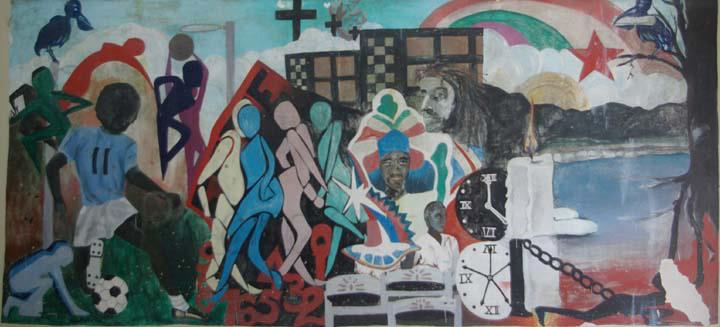
Petrine was also responsible for creating a mural at the University of the West Indies’ Taylor Hall, a student dormitory. See image below courtesy Trevor McCain:

petrinetaylorhall

For more about Petrine or Pet as she was known to her close friends read this moving eulogy put out by the Art History Department at the Edna Manley College of the Visual and Performing Arts:

The Art History Department and the School of Visual Arts regret the passing of Dr Petrine Archer-Straw. Dr Archer-Straw passed away in the early morning of 5 December 2012 at UWI Hospital as a result of a sickle cell crisis.

Dr Archer-Straw was the first official Head of the Art History Department here at the College serving as a Consultant from 2002 till 2004. She was responsible for creating the Department, recruited three of the five current staff members and created a long term vision plan for a possible Art History/Visual Culture major.

Dr Archer-Straw has a strong publication and curatorial record including her monograph Negrophilia, the book Jamaican Art, which she co-authored with Kim Robinson, and her exhibitions New World Imagery, Back to Black and Photos and Phantasms. Most recently she co-curated with our member of Department, Dr Claudia Hucke, the online exhibition About Face: Revisiting Jamaica’s First Exhibition in Europe. At the National Gallery of Jamaica she was also directing a major project that would critically engage the visual culture of Rastafari, entitled Rasta! Dr Archer-Straw early on embraced the digital world, excitedly using technology in the classroom and creating and utilising internet resources for Caribbean art. Her blog PetrineArcher.com is especially noteworthy for its entries on Jamaican artists. Dr Archer-Straw has taught at Cornell University in the United States and worked in the Bahamas, helping to create a roadmap for the structure of the National Art Gallery of the Bahamas.

Dr Archer-Straw was a gracious mentor and close friend to us all in the Department. She was a constant source of encouragement and guidance for our work. As a scholar she emphasised the importance of being focused, disciplined, and principled, but noted we should never lose the joy in our work. There was a formality to her demeanour emphasised by her English-Jamaican accent and her graceful poise from years of yoga. But she also knew how to laugh giddily with a girlish charm. Dr Archer-Straw was a model for us, never shying away from starting anew. She took up yoga training in her early forties and became a popular instructor; recently, she also became an art appraiser. Perhaps, because she suffered from sickle cell she emphasised a balanced life and found ways, whether through yoga, gardening or dancing to control her illness rather than having it control her.

 We will miss her dearly.

Resonance…by Jasmine Girvan


Resonance by Jasmine Girvan…, a set on Flickr.

Every year close to Christmas jeweler Jasmine Girvan has a show in Jamaica…This year the show was strong on sculpture as you can see from the photos. These photos were taken at the HiQo Gallery last night during the opening or vernissage of Resonance…one of the highlights of the show was an obvious commentary on some of the political pussyfooting at the 2011 Commission of Enquiry into the Government’s handling of the extradition request for former West Kingston strongman Christopher ‘Dudus’ Coke.

Exhibition runs til 13th December, Tues- Sat. 10 am – 3pm. Do go and check it out.

‘At this school we slap kids’…

An aside on corporal punishment in Jamaican schools with a quote from Professor Orlando Patterson on the terrors of Jamaican childhood as he experienced it.

I find myself bemused by the latest subject of public discussion in Jamaica–whether corporal punishment is a suitable form of discipline for children or not.  Alas it seems that if a poll were taken there would be overwhelming affirmation for this cruel practice despite there being instances of severe abuse, including a young boy who lost his eyesight after being struck with a teacher’s belt.

The subject hit the airwaves after a parent objected to her nine year old daughter being hit for not performing well enough at a popular Jamaican school. The following report in the Sunday Observer tells it all:

At this school we slap kids

THE administration of Kensington Primary School in St Catherine is coming under fire from the parents of a nine-year-old girl who are taking issue with the school’s use of corporal punishment in its administration of discipline.

However, the leadership of the school, which is arguably the best-performing primary institution in Jamaica, is hitting back, insisting that it has done nothing wrong, as the flogging of students plays a key rule in ensuring that they focus and display the behaviours that are conducive to learning.

What I find disturbing is the number of people i know, talk show hosts, Facebook friends and others, who defend the use of corporal punishment. One friend asked:

Shouldn’t we define corporal punishment  I believe there is a qualitative difference between a slap/hit in your palm as opposed to caning on the backside. When my children consistently do something that is wrong, I slap them with a short belt, not to hurt them, but to remind them that that particular behaviour is not what is expected of them. Over the years it seems to have worked. What is the alternative to correcting bad behaviour away from this physical reminder?

I think what I’m dumbfounded by is the fact that normal, responsible, well-educated adults genuinely don’t seem to know that there are other ways to discipline or teach children right from wrong. Another argument that keeps being repeated is:  WE were all brought up on the strap, the switch and the whip and look how well we’ve turned out.

No bredren, you haven’t turned out well, you’ve grown up into someone who thinks that its absolutely fine to beat a child into submission! You’ve taught that child the lesson that violence is the solution to ignorant behaviour not explanation or reasoning or education but application of pain. No wonder Jamaica is such a violent place. Colin Channer even wrote a story once called How to Beat Your Child the Right and Proper Way.

In fact the whole sorry state of affairs reminded me of an email  I recieved from Orlando Patterson some years ago. He was responding to an interview I had done with Rex Nettleford in Caribbean Beat in which Rex had rhapsodized over his idyllic rural childhood in Western Jamaica. Orlando’s memories of growing up in the Jamaican countryside were altogether darker. I hope he won’t mind if I quote the relevant paragraphs here…

It was interesting to read a bit about Rex’s childhood although it is heavily filtered by him. I grew up in rural Jamaica too– May Pen mainly, (then a small village) and Lionel Town (a couple of horrible years; I can still recall the stench of the hospital which suffocated the entire town) and spent holidays in St. Elizabeth. Rural life at that time had its brutal side: hunger, beatings from parents and grandparents who firmly believed in not sparing the rod and spoiling the child; sexual abuse of young girls (and, possibly young boys, although I was spared that), overcrowding and just mindless boredom. Rex and myself were among the very, very lucky ones who escaped through education. What I recall are the farm kids who never turned up to school on Fridays, then never on Thursdays and Fridays, then by age 10 or 11 never at all. The teachers were nearly all pretty sadistic, all of them armed with heavy leather straps, some with forked ends. I just don’t see how one can romanticize most of that.  It was serious alright, seriously oppressive. Sure there were the good moments– the moist light of the early mornings; the evenings before sleep when the older kids told stories; the rainy days when the teachers briefly rediscovered their humanity and treated us like the children we were; the occasional country fair ( in my case, the early days of the Denbigh Agricultural Show). But they were few and far between, and even the public rituals and fairs had a scary element for a young kid: the Jan Cunu and Horsehead  mummeries were genuinely terrifying; the Hussay festival which the Indians in Vere enacted  annually scared me near to death as I gasped at grown men  flagellating themselves and seeming as if they were about to chop each other to pieces; the crop-over market dances which always had at least one fight or worse. For nearly all but the fortunate few, life for a kid growing up in rural Jamaica (it was a lot better in Kingston, then) during the thirties, forties and fifties, was raw, unhealthy, painful, often hellish, and for far too many, brief.

Sorry if this depresses you. I am still reeling from the shock of  New Orleans and the horrible ineptitude of the federal and local governments here.  In a better mood I might perhaps remember rural Jamaica in terms more like Rex’s, but I doubt it.

One good thing is that beatings are no longer administered in most schools in Jamaica after determined efforts by the Ministry of Education to discourage it. The outcry in the media concerning Kensington Primary’s use and defence of corporal punishment is also encouraging.  Hopefully the number of children living in terror of physical violence will continue to decrease.

How Bal Thackeray got his English surname…

Isn’t it odd that the man who changed Bombay’s name to Mumbai has such a seemingly Anglicized surname? Bal Thackeray. How did that happen?

Isn’t it odd that the recently deceased and hyper-mourned Hindu leader Bal Thackeray had such an Anglicized last name? After all he famously led a campaign to change the city of Bombay’s name to Mumbai, arguing that the original Marathi name of the city had been Anglicized by the British. But so in fact was his last name Thackeray an Anglicism. Apparently his father Keshav Thackeray was such an admirer of British writer William Makepeace Thackeray that he changed his Marathi last name ‘Thakre’ to ‘Thackeray’. Logically then Bal Thackeray should also have changed his last name back to Thakre…I wonder if there was ever any discussion about this in the nineties when cities in India started reverting to their regional language names as a direct result of Bal Thackeray’s sustained campaign against British influence in India. The two excerpts below give you slightly more information on all this.

From Wikipedia:

When did Bombay become Mumbai?

Officially, in 1995. That year, the right-wing Hindu nationalist party Shiv Sena won elections in the state of Maharashtra and presided over a coalition that took control of the state assembly. After the election, the party announced that the port city had been renamed after the Hindu goddess Mumbadevi, the city’s patron deity. Federal agencies, local businesses, and newspapers were ordered to adopt the change.

Shiv Sena’s leadership pushed for the name change for many years prior to 1995. They argued that “Bombay” was a corrupted English version of “Mumbai” and an unwanted legacy of British colonial rule. Shiv Sena leader Bal Thackeray once installed a marble plaque with the name on the Gateway of India, a famous sandstone arch. The national government objected to the renaming, though, fearing that Bombay would lose its identity internationally.

The push to rename Bombay was part of a larger movement to strengthen Marathi identity in the Maharashtra region. The Shiv Sena party also declared their intentions to do away with the term “Bollywood,” a conflation of “Bombay” and “Hollywood” that refers to Mumbai’s film industry. That name, though, has stuck around.

And when did Bal Thackeray’s name change from Thakre to Thackeray? According to Wikipedia it was Bal Thackeray’s father Keshav who Anglicized the family name:

Keshav Thackeray was born on 17th September, 1885 in Panvel. In his autobiography, Keshav Thackeray writes that one of his ancestors was a kiladar of the Dhodap fort during the Maratha empire. His great-grandfather Krishnaji Madhav(“Appasaheb”) resided in Pali, Raigad, while his grandfather Ramchandra “Bhikoba” Dhodapkar settled in Panvel. Keshav’s father Sitaram adopted the lastname “Panvelkar” as per the tradition, but decided to give his son the surname “Thakre”, which was apparently their traditional family name before their ancestors moved to Dhodap. An admirer of the India-born British writer William Makepeace Thackeray, Keshav later anglicized the spelling of his surname to “Thackeray”.

Astro, the Morning Star, shines his light on us in Kingston…

A note on Astro Saulter’s exhibition at Studio 174


Astro, the Morning Star…, a set on Flickr.

Thoroughly enjoyed the opening of Astro’s show at Studio 174 last night…Born with cerebral palsy into the talented Saulter family (brother Storm Saulter is the acclaimed director of the film Better Mus Come and responsible for injecting new life into the filmmaking circuits in Jamaica and the Caribbean), Astro is a poster boy for the cause of creative development and nurturing for everyone no matter the physical challenges they’re saddled with. The artworks he’s produced using a computer and his head to direct digital tools are at once graphically sophisticated and chromatically intense, products of a refreshingly unjaded, ingenuous eye. Spotted at the opening in addition to many other notables was evening star Chris Blackwell; Blackwell Rum lubricated the occasion and the inimitable Nomadzz graced it with their rhymes, chants, curses and drums…

Check out the exhibition which will be up till January 19, Wednesday to Saturday 10:30am-4pm. Studio 174 is at the intersection of Harbour Street and West Street in downtown Kingston, an atmospheric space worth visiting in its own right. For more details and information on Astro’s ‘process’–how he actually makes his art–visit Kate Chappell’s blog here.

Mothers, Sons and Amru Sani…

Two excellent articles on Mothers and Sons in India and an intriguing Indo-Jamaican singer who’s been erased from our memories.

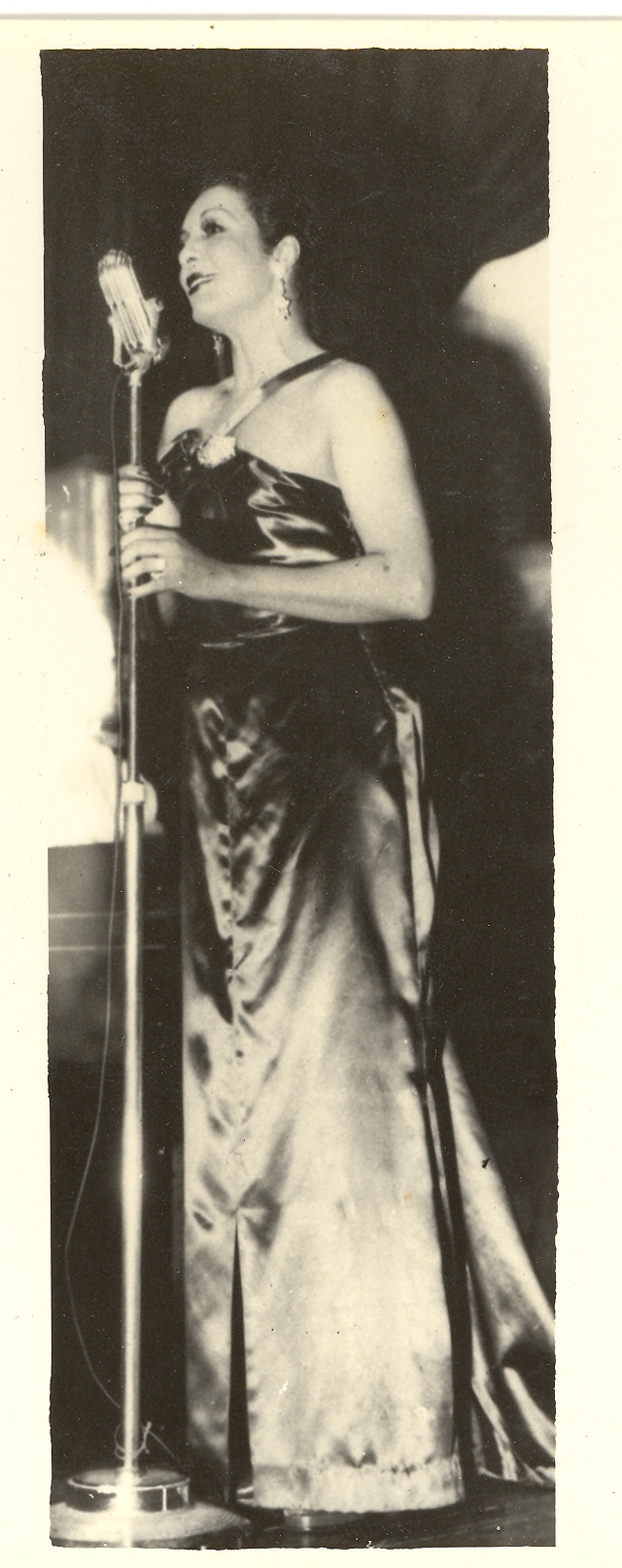
So in lieu of an actual post here are two of the most compelling articles I read today. I’m grateful to my old friend Tejaswini Niranjana for the first one about Amru Sani, an Indo-Jamaican singer who broke through the sugarcane curtain to the metropolitan circuit in the 50s. Absolutely fascinating…would love to know more about her.

Second, a totally revealing article about Indian mothers and their sons, by a young, would-be Bollywood star, rehearsing for an audition as an Indian mother figure. The thing is you could probably substitute Jamaican for Indian and find that the piece pretty much describes the love affair many tough Jamaican men have with their mamas…

So here enjoy. trust me, these are two gems…

Evidently, Sani didn’t do much to clear up the confusion. In various interviews, she claimed to have been born in Panama, to have grown up in India, to have been educated in Europe, and to have served as an airplane mechanic in England during World War II because she was too young to become a female pilot.

Amru Sani in Bombay

Perhaps the most credible explanation of Sani’s origins come from the Gleaner, published in Kingston, Jamaica. In 1943, the paper noted that Sani “was going to England shortly” to join the Women’s Auxiliary Air Force. The article listed her as “the only daughter of Mr. and Mrs. M. P. Sani of 10, Lundford Road, St. Andrew”, Jamaica. That would mean that Sani was probably the descendent of Indians shipped off to the West Indies to work as indentured labourers on the sugarcane plantations.

Those humble beginnings didn’t stop her forging a very respectable career for herself. In addition to her music, stage performances in New York, Paris and Rome, she appeared in at least three films: a spaghetti Western called Maracatumba . . . ma non è una rumba (Italy, 1949), The Naked Maja (1958), and John Huston’s The Bible: In the Beginning (1966).  She also made several appearances on the Ed Sullivan television show, including in the episode in which Elvis Presley made his debut.

For more visit Tajmahal Foxtrot….
And now, read all about the inexplicable bond between some mothers and their sons:

A few days ago, a male friend shared with me the tremendous unease he felt at the news of his mother’s impending breast reduction surgery. “It’s not that she wants her breasts smaller or firmer that bothers me—it’s the thought of the surgeon’s hands all over them!” he exclaimed. His mother, also very close to me, had discussed the same matter with me earlier: “I really want to wear pretty bras like you girls can. I want to be able to wear dresses and blouses rather than always loose kurtas. But I haven’t told my son yet. I don’t know why, but I just feel so shy to tell him.”

I am trying to establish myself as an actress in Mumbai, so it was charming to hear a story about breast reduction rather than breast enlargement. But more importantly, I happened to have an upcoming audition for the role of a young woman who, resenting her husband because of his relationship with his mother, redirects all her affection towards her son. While this premise is hardly original, being neither married nor a mother myself, I realised I would have lots to gain in terms of characterisation by paying close attention to the mothers and sons around me.

For the rest of the article go here.

So that’s it for now! back soon-

On the future of America’s children or whether Obama will have a different approach this time around | Greenpeace International

On the future of America’s children or whether Obama will have a different approach this time around | Greenpeace International.

Barack Obama: Certified Worl’ Boss

Images of Obama after historic second term win…

The US Presidential race is over. And Obama has prevailed. What a relief.  The race was so close Zina Saunders who was asked to design a cover image for the New York Observer had to come up with three cover images to cover every eventuality:

On Sunday afternoon, Ed Johnson at the NY Observer wrote with a cover assignment that thrilled and terrified me at the same time. The thrill? Painting the election cover! The terror? They needed to have 3 variations to cover all possible election outcomes (Obama wins, it’s a tie when they go to press, and Obama…gulp…loses). So, yeah, the prospect of Romney winning struck terror in my heart. And it was an awful feeling painting a sad Obama face for the Romney Wins variation. Awful, awful.

Read Zina’s blogpost for the full 100….

Meanwhile below are some other images i acquired from Facebook. They say it all I think…

And my favourite tweet of the evening was the following just before Obama finally made an appearance to give his speech:

Rob Hyndman@rhh

I want Obama to come out in a huge Afro wig. To the soundtrack of Shaft.

And favourite Facebook update:

Colorado, yes we CANNABIS!


By Charis Tsevis, via Michael Thompson
Random images circulating on Facebook

Literate mobs: UWI’s 2006 Brush with Gay Lynching

In which i resurrect my 2006 Herald column written on the occasion of the near lynching of a suspected gay man by a mob of 2000 UWI students…

In this post I reproduce my column in the Sunday Herald, April 2006, Keeping Men Safe at UWI, written  following an unprecedented attack on a man said to have made a pass at a male student on the University of the West Indies (UWI) campus. In that incident a mob of 2000 students descended on the unfortunate man and the security guards concerned actually protected him till the police arrived. But first here is an excerpt from the Gleaner’s editorial on the subject Barbarous bloodlust at UWI, published on April 6, 2006.

What happened was not a reasoned protest against what they consider deviant homosexual behaviour, but rather so violent an overreaction that the police in riot gear had difficulty controlling the mob. Shots had to be fired in the air while some students reportedly hurled missiles at the police. It seems clear that if there had not been strong and timely intervention by the police, the alleged homosexual would probably have been beaten to death.

 And below is the column i wrote in response to the attempted lynching. 

Keeping Men Safe at UWI

So now UWI has joined the exclusive club of tertiary-level institutions in Jamaica turning out bigots and murderers. Depressing, but somehow predictable, isn’t it? First there was NorthernCaribbeanUniversity where a few years ago five students suspected of being homosexual were severely beaten up after which to add insult to injury the university’s rescue vehicles refused to take the students to hospital. Then a year or two ago UTECH students cornered an alleged car thief on campus and killed him in the most barbaric manner suggesting that the expensive education spent on them had left little or no mark.

Now comes the crowning touch, the finale. Students at the crème de la crème of universities in Jamaica, the University of the West Indies, practically murdered a man who wandered onto campus and allegedly made an ‘advance’ towards a male student in one of the bathrooms on campus. It’s entirely possible that the alleged homosexual wasn’t quite right in the head judging by the fact that he had been escorted off campus earlier in the day for loitering on the premises. He came back and peeped at someone using one of the male bathrooms. Instead of politely declining the man’s advances and notifying security the student raised an alarm that summoned forth a mob described as being 2000-strong that proceeded to chase, beat and stab the man who narrowly escaped with his life after the police, with great difficulty, intervened.

What is perhaps even more alarming is the fact that senior lecturers at UWI seem bent on making spurious arguments which sound dangerously as if they are justifying the action of the students. “Imagine that the alleged pervert had entered the female bathroom and it was your daughter, sister, girlfriend or wife” equivocated one pun-derous (stet) academic who writes a column in the Sunday Gleaner.

Needless to say if every man on campus, student or otherwise, who made advances towards a woman, were similarly lynched men would soon become an endangered species. Perhaps male students should take lessons from us females in how to fend off unwanted advances without panicking that their manly virtue is about to be ravished. Isn’t it interesting, said a female colleague, that the slightest homosexual advance on a man is interpreted as a grievous assault almost amounting to rape? Suppose women were encouraged to do the same every time a lecherous male leered at them?

“I’ve always been told that if you’re robbed in downtown Kingston, its better to shout ‘B-man, B-man!’  rather than ‘Thief! Thief!’ quipped a Trini friend when he heard the news. According to him it’s a well-known fact that Jamaicans will barely take notice if they come across a thief or a murderer but confront them with a gay man and they react as if faced with a weapon of mass destruction or the devil himself.

It’s excellent that the University has come out and condemned the near-lynching in no uncertain terms. It must go further however by undertaking educational campaigns to rectify the prevalent mindset among both students and academics. What is absolutely astonishing is that in spite of such outrageous behaviour senior academics are still claiming that Jamaicans are ‘homo-antipathetic’ rather than homophobic. One shudders to think of the kind of research such scholars are producing given that their grasp of reality is so questionable.

It also does the university no good when it issues stern warnings to its students indicating zero tolerance of such violations of human rights when its own senior academics are to be found in the leading newspaper making weak puns about ‘homocide’ and ‘backlash’ in an attempt to underplay the seriousness of the situation. Noteworthy also is the tendency of such academics to be critical of ‘mob behaviour’ rather than the rabid homophobia which fuels such a mentality. Likewise it raises questions about the Gleaner’s own position on the matter that it carries such columns while at the same time thundering against the behaviour of the students in its editorials. All of this is sending mixed signals to young people who it could be argued seem to know no better though they’ve had the benefit of university education. But can they really be blamed when those who teach them prefer to purvey prejudice rather than knowledge?

This is why I thought the campaign by prominent gay rights organizations in the UK and the US against Jamaican DJs and their homophobic lyrics was fundamentally misguided. Most DJs, almost 99% of them have not had the benefit of the kind of education UWI students have had. How and why should anyone expect them to see the light when highly educated students and lecturers do not? Homophobia must be attacked in the places it really spouts from, the numerous fundamentalist churches that spew hatred and ignorance and in institutions of learning, higher or otherwise.

If at all anything was gained by the campaign to educate DJs against expressing homophobic sentiments it has surely been undone by the example of UWI students who not only engaged in flagrant gay-bashing but also vociferously defended their criminal behaviour on national television afterwards. Shame, shame, shame.