The WordPress.com stats helper monkeys prepared a 2011 annual report for this blog.
Here’s an excerpt:
The Louvre Museum has 8.5 million visitors per year. This blog was viewed about 110,000 times in 2011. If it were an exhibit at the Louvre Museum, it would take about 5 days for that many people to see it.
A summary of what i think went wrong with the JLP’s 2011 campaign to get a second term and the conditions under which Portia Simpson-Miller returned to political power in Jamaica despite her embrace of gay rights.
The Jamaica Observer made this really useful interactive map available, with all sorts of information on constituencies at your fingertips if you hovered over itLas May, Daily Gleaner, December 30, 2011
The December 29, 2011 general election was the fifth election in which I’ve voted, all in Jamaica, and this one was the most deeply satisfying. Not just because the candidate I voted for won, but because she won so decisively. It was also almost like a normal day, with no skirmishes or violence to mar it (well actually that’s not really normal in Jamdown, is it? But you know what i mean) At 6.42 pm yesterday when I tweeted, “I think Portia’s going to whip dem, this is going to be a rout…” I was in a minority of one who called it correctly long before the results made it plain there was going to be a landslide. Everyone thought it was too close to call, though my friends at Nationwide, like many others, had given it by a hair’s whisker to the JLP.
As Election Day came closer and closer I began to feel in my gut that there was going to be an upset. Unlike the highly touted pollsters with their ‘scientifically tested’ samples (99% of which turned out to be wrong) I was going by my own experience, by what i was hearing from close friends, associates and radio and what I was picking up on the ground so to speak.
Up to a month before the election I also thought that the JLP had it locked with their master-stroke of appointing a new leader, Andrew Holness, whose relative youth (age: 39) in a party dominated by oligarchs, signaled the beginning of something fresh and long overdue.
Lady wears both party colours so as not to be victimized by either?
Then unexpectedly one or two friends whose opinions i value highly, and who are both more Labour-leaning than PNP-types both said they thought the JLP would lose. The reasons they gave–the bleak economic landscape foremost among them–made sense. Still I didn’t really believe they were right and in the meantime the ruling party’s catchy election jingle Vote for Labour had bored itself into the nation’s skull, including mine. EVERYONE was humming it, I didn’t see how the JLP could lose, particularly as the PNP seemed to be mum on the whole judging by the lack of memorable jingles, TV ads or statements.
The much hyped debate did a lot to boost Sista P’s votability quotient. Widely portrayed by the JLP as being incapable of stringing a sensible sentence together the Leader of the Opposition came across as relaxed, friendly and totally in control in contrast to former Prime Minister Holness who looked like a rabbit caught in the horsehairs. He seemed visibly nervous whereas Portia came across as gracious and comfortable in her skin. These things speak louder than words, something the JLP seems to have forgotten even though they have the example of former Prime Minister Bruce Golding to hand. Golding was articulate to the point of eloquence, as sharp as they come and extremely knowledgeable. Did all this make him a better leader? Really? Then why are we even discussing why the man who prematurely succeeded him lost the election to win his own mandate yesterday?
So incredibly considering the negative publicity she received in advance of the debate, Portia took the debate. Another major blunder the JLP made was the scurrilous attack ad in which Portia was depicted as a raving lunatic. They aired it so often it began to be annoying and I started to feel resentful because it seemed like a cheap shot to me, using the most questionable editing tactics, freely re-arranging quotes, speeding up speech, distorting sound and generally altering and doctoring existing audio and video to suit their own purposes. To make matters worse the message they seemed keen to transmit was that Portia was loud, emotive, out of control and therefore not capable of being a good leader. It’s the kind of scornful, contemptuous portrayal women have suffered at the hands of men for centuries; poor people have suffered at the hands of the smug middle and upper classes; those who are not quick on the draw face from those who are considered bright; Muslims face from the West, etc etc.
Consequently anyone who has ever been the butt of such demonizing tactics would have and probably did, identify with Portia. I know I certainly did and I share very little with Portia in broad terms; imagine then how the hundreds and thousands of people who view her as someone who has risen from their own ranks, who feels she represents them, felt.
And that was the big miscalculation on the part of the JLP’s G2K. To make matters worse the Party lobbing such belittling take-downs is widely perceived as representing the ‘Mulatto’ and light-skinned segments of the population. Coming from them, or from anyone for that matter, the attack ads took on a racist dimension.
The JLP also miscalculated how their attack on the PNP’s Jamaica Emergency Employment Programme (JEEP) would be viewed. In their haste to scoff at JEEP as being ” nothing more than another crash programme” that would burden taxpayers’ pockets the Labourites forgot that while this approach might appeal to the middle class minority, to the far larger group of unemployed, underemployed and unemployable, JEEP would be a boon. Most of them don’t pay taxes so what do they care about that?
So in general the JLP was seen as trying to win the election through slander and mudslinging; they had very few ads promo-ing their worldview, their plans for new and inspired governance, or their creative approach to the problems plaguing the country.
The 2011 Elections in Jamaica were notable for the comraderie displayed by supporters of both sides
The utter contempt and disdain displayed by the government concerning the Tivoli incursion in which 73 civilians lost their lives was another nail in the JLP’s coffin, coming on the heels of the JDIP scandal. Security Minister Dwight Nelson’s blasé denials and prevarications when questioned by the media about a ‘spy’ plane (see my previousposts on this), fortified by a truly callous campaign mounted by the de facto JLP organ, the Jamaica Observer, dismissing the role of the US DEA Lockheed P-3 Orion in the invasion of Tivoli was more than any citizen could stomach. Former PM Holness’s belated attempt to set the story straight by contradicting his own security minister was the final straw: here was a party whose ministers didn’t hesitate to lie when it suited them, for whom the deaths of 73 civilians mattered so little they would try and shrug it off as Nelson had done.
But the most laughable, most despicable strategy employed by both the Labour Party and the Jamaica Observer was (as @BalanceMan said on Twitter) to treat the election of 2011 as if it was a referendum on gay rights. Again they completely misread the mindset of so-called ordinary Jamaicans (who are anything but ordinary). They assumed that this was a life-and-death issue which would be a liability for the PNP following Portia’s gallant statement that her government would review the existing buggery laws and that she was not averse to having a gay minister in her cabinet. The Observer tried its best, with numerous cartoons and articles on the subject to turn the population against the PNP by playing on the well-known local hostility to homosexuality.
Instead it backfired on them. Out of 63 parliamentary seats the JLP won 22 and the PNP 41! As Trindadian writer/editor Nicholas Laughlin observed on Facebook after the results had become known:
To summarise: in Jamaica, widely considered the most homophobic country in the Caribbean, the ruling party runs a gay-bashing general election campaign and loses by what can only be called a landslide.
On a side note you couldn’t help laugh at the following wisecrack referring to the PNP’s promise to remove general consumption tax from our energy bills. RT @rushknot: Electricity tax gone! *turns on AC*
And that is where I’m going to leave this for now; let’s hope that these are not just empty campaign promises because the outcome of the 2011 elections in Jamaica, in which popular sentiments on gay rights played such a prominent role, must give all of us plenty of cud to chew on. It certainly demands a rethinking of the global view of Jamaica as ‘the most homophobic place on earth’. Let’s see if the PNP having gained such a huge nod from the electorate will now put its mouth where its money is and REALLY strike a blow for equal rights for all.
If political ads can be doctored why not what journalists write in the paper? In which i doctor a leading columnist’s words to mean the opposite of what he would like to say to show how unethical the Don’t draw mi tongue video ad attacking Portia Miller is.
One week to go before elections in Jamaica. Christmas which is this coming Sunday has been almost completely sidelined. Santa? Who’s that?
Much to the disappointment of her detractors Portia Simpson-Miller, the Leader of the Opposition, failed to fall flat on her face during the much hyped final debate on December 20. In fact she came off looking rather good overall, despite an inadequate answer or two, completely outshining the competition when she boldly said that she would have no qualms about having Gays in her cabinet, if they were qualified for the job. Andrew Holness, the current Prime Minister, stuck to the party line and refused to acquiesce to reason, deferring to public sentiment that he says he is loath to cross.
Portia on the other hand was not afraid to buck popular sentiment, opting for what is right, displaying courage and leadership in the process, two qualities sorely needed in these trying times. The truth is that Jamaican attitudes towards the vexed question of homosexuality are slowly but surely changing. For an excellent post on the subject read Ross Shiel’s Reactions to THAT gay question.
Clovis, Jamaica Observer, December 23, 2011
But they may not have changed enough yet and the backlash from the anti-gay brigade in Jamaica is a real threat (curiously the charge is often lead by the media itself as evident in the Observer cartoon above). The Gleaner’s Dec 23 editorial sums up the situation well:
Mrs Simpson Miller’s courage in taking this stance, and its timing, ought not to be minimised, or overlooked. She did it in the middle of an election campaign in a largely homophobic Jamaica, with her party in a tight race with the governing Jamaica Labour Party.
The easier option, as Mr Holness took, would be to waffle about respecting Jamaican sentiment. That would ensure, at least, that fundamentalist Christians would not be trotting out scriptures to illustrate God’s abhorrence of homosexuality. She now runs the risk of alienating anti-gay voters.
Winning will certainly be an uphill battle for her, especially in the face of defamatory videos circulated by the Labour Party’s G2K, in which they cobble together a number of clips, some of them out of context and doctored to fit, depicting her as a raging virago. One of them, now banned from the two major TV stations, plays on a quote from her campaign in the 2007 national elections in which she said ‘Don’t draw mi tongue’; no one now recalls what this was said in response to and its impossible to tell from the cunningly doctored video. Of course ‘don’t draw mi tongue’ in itself is a harmless Jamaicanism broadly meaning ‘Let me hold my peace, don’t make me get too candid.’ This was widely used against Portia in 2007 and has now been resurrected, interspersed with images of the candidate in full demotic mode, with clips from various speeches and interviews collaged together to give the impression of someone violating all the norms of respectability and decorum so beloved by the Jamaican bourgeoisie.
The Jamaica Observer, to the surprise of many considering their blatantly pro-government stance, actually came out with an editorial chastising the JLP for the ad on grounds of ‘civility’ and ‘decency’. But these are highly subjective measures, what is decent to me may be indecent to you. What about the legality of broadcasting a doctored video in which clips are neatly arranged out of sequence, with crucial segments missing to give a certain impression? is it accurate and ethical to splice disparate bits of video and audio together like this? Is this not a violation of Regulation 30 (f) of the Jamaican Broadcasting Commission which rules that broadcast content should not “contain any false or misleading information”?
Ace Observer columnist Mark Wignall sees nothing wrong with the G2K ad. According to him:
One very important question is, who is the author of these ads? Other questions are, are the ads fictional and hence, defamatory? As I saw it, no, and hence the ads have been authored by the subject of the ads and not by fancy technological cut and paste in an engineering studio.
Really Mark?
So then you won’t object if I draw your tongue by doing something similar with your columns, would you now?
Folks read the following, every single word in it was written by Mark Wignall, and therefore using his own logic, is authored by him:
Andrew Holness is the…worst nightmare
Half-way through its first five-year term of government since it was defeated in February 1989, troubled by its inability to attach the word “spectacular” to any part of its performance during that time, and buffeted by political storm winds associated with the Dudus extradition request, the general view at street level suggests major survival problems for this administration beyond 2012.
An examination of the 17 Cabinet members will easily present us with eliminations simply because leadership material is largely absent. On our “first-scratch” list would be: Cabinet Secretary Douglas Saunders, Grand-daddy Mike Henry the transport minister, a remarkably fit Pearnel Charles at 74 years old, Deputy PM Dr Ken Baugh whose heart is not in it, and Karl Samuda who needs a good rest now. Housing Minister Dr Horace Chang has much in his educational, organisational, political and professional past to be proud of, but in this the age of the pirates he would never make it. Sports Minister Babsy Grange has never indicated that she had more in her than what she now has.
Security Minister Senator Dwight Nelson was, like Golding, a child prodigy, but it is not my belief that he was cut out for the potential pitfalls of representational politics. He earned himself the moniker, ‘I can’t recall’, during one phase of him being grilled by seeking solace in replying ‘I can’t recall’ to a series of questions. As a Jamaican watching him that day, I felt ashamed for the state of my country, and while I recognise that there will always be sensitive matters underpinning national security, I expected a lot more from him than ‘I can’t recall’. Dwight Nelson should pack his bags and go!
Read more:
Health Minister Ruddy Spencer reminds me of the late Hugh Shearer, a man who found real happiness after the west engineered his ouster as JLP leader in 1974 and replaced him with the fiery Seaga.
Heading our shortlist is the youngest Cabinet member: 38-year-old Andrew Holness, the education minister (a Seaga find) whose ministry operates in a poor country that will never be able to allow him to operate at his full competency level. He has what some would call a “caring” personality but he also will find it difficult to sail the seas with political pirates. He needs at least seven more years to toughen his hide. Andrew Holness is the…worst nightmare
The reality is, the little man and woman at street level are very much worse off than they were in 2007, the year the JLP took power…enough hopelessness and economic uncertainty exist among our people to scare the JLP government silly as it views its electoral prospects in 2012.
Is the PNP’s Progressive Agenda the answer? It is an exciting document that takes the PNP into almost scripting what I see as the ultimate mission statement. Does the JLP government have any mission statement guiding it or is it still playing “ketchy shubby”?
I don’t know Mark, you tell me, and don’t seh is mi draw your tongue…
Advisory: Content in this post has carefully been doctored to produce a particular message not unlike the production of the G2K video featuring the Leader of the Opposition. If you don’t have a sense of humour or are lacking in intelligence you may want to forget that you read it by undergoing appropriate memory erasing procedures or consuming amnesiacs.
The deaths of 73 civilians matter so little that the government of Jamaica can’t be bothered to ask for surveillance footage from the US DEA P 3 Orion which should show what took place on May 24, 2010 in Tivoli Gardens
To my astonishment the Jamaica Observer carried an editorial on Sunday titled “There was a spy plane over Tivoli, so what?” This was astonishing to me because in my last post I had commented saying that the Minister of Security’s reaction to questions about the spy plane he said he knew nothing about seemed to be a nonchalant shrug. “In fact he acted as if it really wasn’t his business or ours (!) An unidentified flying object in our airspace? Pshaw! So he didn’t know about it, so what?“
Now here was one of the nation’s leading newspapers shamelessly saying exactly the same thing. Not only that: highlighted on the Letters page was an inane one titled “What’s the big deal about the surveillance plane?”
“Dear Editor,
Ok, so it has been confirmed that a US plane provided surveillance assistance during the 2010 Tivoli Gardens operations. I don’t understand the controversy and what’s the big deal if they were invited to assist to strengthen the army’s tactics and strategy?”
The big deal dear thick-skulled letter writer and Observer editors is that 73 people were killed under unexplained circumstances during that Tivoli Gardens operation. This spy plane has video footage of what happened on the ground during that operation which ought to be central to any investigation into the massacre of 73 civilians by government forces only one of whom was killed in the battle for Tivoli.
So no one is faulting the government for asking or accepting assistance from the US government. As the Sunday Gleaner’s editorial eloquently said:
“…the decline in crime in Jamaica, in particular homicides, since Coke’s departure and the degrading of his network suggest that America’s insistence on his extradition, and whatever help they may have given to effect it – the memorandum included – were the best aid package by a foreign government to Jamaica in recent times.”
The question is why then Minister of Information Daryl Vaz denied this so vigorously immediately after the Tivoli incursion and why Minister of Security Dwight Nelson continued to do so until a few days ago.
And the really burning question is why the government shows so little interest in acquiring the video footage shot by the P-3 Orion. Are we to assume that the residents of Tivoli matter as little to this Prime Minister as they did to the previous one?
If this is a strategy by the Jamaica Observer to come to the rescue of its favourite political party it should think again because in its haste to diminish the import of the spy plane what it seems to be saying is that the massacre of 73 civilians in Tivoli in May 2010 was insignificant. Big deal! So what?
An article in the New Yorker about the massacre of 73 civilians in the Tivoli invasion of May 24, 2010 sets off a firestorm of denial from the Jamaican government
“Old dinosaur gone and young dinosaur a come.” Caller to Breakfast Club re JDIP scandal and JLP….LOLOL! I had posted on Twitter.
I thought this was quite the funniest comment I’d heard about the runnings when i heard it a few days ago but now I’m forced to wonder if there isn’t some truth to it. The Jamaica Labour Party gave itself a real boost when it decided to select young Andrew Holness to replace the controversy-plagued former Prime Minister Bruce Golding when he stepped down from office some weeks ago.
Holness further boosted his ratings when he asked for, and received, Transport Minister Mike Henry’s resignation in the wake of allegations of corruption in that ministry. But almost as soon as he had staunched that open sore, another boil erupted in the body politic with Security Minister Dwight Nelson’s pointless denials to the media that the government had authorized a US DEA Lockheed P-3 Orion plane to provide surveillance support during the May 24th, 2010 offensive by the Jamaican armed forces against Tivoli Gardens. TG was the highly fortified garrison community in which Christopher ‘Dudus’ Coke, wanted by the US for drugs and arms running was thought to be hiding at the time.
Most people in Kingston saw the plane flying around over the harbour that day and wondered about it especially after then Minister of Information Daryl Vaz categorically denied in a May 25, 2010 press conference that the Jamaican government had received any assistance from external governments. The confusion increased earlier this week when a lengthy article in the American magazine The New Yorker affirmed that the US had indeed provided Jamaica with aerial surveillance during the military operation.
According to the article:
A year and a half later, the Jamaican government has refused to make public what it knows about how the men and women of Tivoli Gardens died. So has the government of the United States despite clear evidence that the US surveillance plane flying above Tivoli on May 24th was taking live video of Tivoli, that intelligence from the video feed was passed through US Law enforcement enforcement officers to Jamaican forces on the ground and that the Department of Homeland Security has a copy of this video. The video could corroborate, or refute, allegations that members of the Jamaican security forces massacred dozens of innocents, and could help identify the alleged killers.
Questioned about this on Nationwide radio two days ago Minister Dwight Nelson refused to acknowledge that there had been any assistance, asserting that he knew nothing about the alleged ‘spy plane’. Nor it seemed was he curious enough to find out, all these months later now that the question has come up, what a foreign aircraft was doing in local airspace. In fact he acted as if it really wasn’t his business or ours (!) An unidentified flying object in our airspace? Pshaw! So he didn’t know about it, so what? Fail!
Nelson simply, stubbornly, kept denying that there had been assistance from any other government –forcing the young Prime Minister to call a press conference by the end of the day admitting that there had indeed been assistance from the US government although he tried to make a great deal of the fact that the US had not been part of the planning of the operation. Head of the JDF Antony Anderson also made a point of this.
This however was not what the public had asked about. What everyone wanted to know was the origin of the so-called spy plane and the reason it was in the air above Tivoli Gardens on the day of the military incursion into that community.
Its also interesting that all of this has now come to light because of investigations and expos´s by foreign journalists. So it seems that we are on the whole in need of quite a lot of foreign assistance one way another for in addition to the New Yorker article titled A Massacre in Jamaica which highlights the fact that despite 73 civilians being killed in the military incursion (in contrast only one security personnel went down) no one has been held accountable and no satisfactory answers seem to be forthcoming, there was also a Wired article on the subject titled U.S. Spy Plane Shot Secret Video of Jamaican ‘Massacre’.
In fairness local journalists such as Lloyd D’Aguilar and others have also been demanding similar answers but none had been forthcoming till now.
The following is an excerpt from the Wired.com article:
Somewhere in the bureaucratic bowels of the Department of Homeland Security is a videotape shot above the Tivoli Gardens neighborhood of Kingston, Jamaica on May 24, 2010. It could reveal whether the Jamaican security forces, acting on behalf of U.S. prosecutors, killed 73 members of a notorious crime syndicate or innocent civilians caught in house-to-house fighting. That is, if anyone in a position of power actually wants that question answered.
Over 500 Jamaican soldiers rushed into the teeming Tivoli Gardens neighborhood that day for what became known as Operation Garden Parish, a mission to capture the local mafia don, Christopher “Dudus” Coke. The mission was the result of heavy U.S. pressure: Coke had been indicted in U.S. federal court for running an international marijuana and cocaine ring. It would become one of the bloodiest days in recent Jamaican history.
What happened on May 24, 2010 garnered international headlines. But what no one knew until now was that circling overhead was a P-3 Orion spy plane, operated by the Department of Homeland Security. A lengthy investigation by journalist Mattathias Schwartz (a Danger Room friend) reveals that the Orion took footage of the hours-long battle. It has never been publicly revealed.
In which I meet Doc Cornish, shadow Minister of Justice of the Accompong Maroons, literally, by accident in the parking lot of Devon House.
Devon House by Varun Baker
Something surreal happened last night. Rather than go into any lengthy explanations I’ll let the following series of tweets, messages and status updates fill you in on the circumstances:
off to have dinner with Belinda Edmondson author of Caribbean Middlebrow…still haven’t decided on restaurant
On my way to pick Belinda up, i glanced at my phone during a red light break and saw:
Ok if diana paton and gad heumann tag along? They asked where i was eating?
Shortly I was tweeting from The Terrace at Devon House, formerly known as Norma’s on the Terrace. Norma no longer being on the scene (the famous chef died rather suddenly in 2010) the restaurant has been renamed by dropping Norma’s name (a new take on name-dropping?).
At The Terrace, Devon House w Belinda Edmondson, Faith Smith, Gad Heumann, Diana Paton. Magnificently lit tree
‘In courtyard’ I would have added if I had any character(s) left. And Shani Roper. By now you must know about Twitter’s infamous 140 characters, including spaces?
The tweet included a photo–not the best one–of said tree (see below).
Devon House Christmas Tree
The courtyard at Devon House is a splendid sight. The enormous tree in the centre is all decked out in lights for the season, done by someone with a light, magical touch. When you step into that space you feel transported–to happier, more cheerful times, to the festive, to thoughts of celebration and contentment–
There was only one jarring note; a mass produced nativity scene, reminding us that we live in a world largely made in China, out of cheap plastic, in garish colours.
Conversation was lively at our table as it was bound to be with several top ranking scholarly authors around it who happened to be in town for an editorial meeting. The book is to be about Victorian Jamaica, edited by Wayne Modeste, formerly of the Institute of Jamaica, and Tim Barringer, one of the Yale art historians who curated the massive Isaac Mendes Belisario show a few years back. That show produced one of the most sumptuous catalogues of its art the region has yet seen.
Belinda, who’s recovering from an illness, suddenly started to feel ill, and decided to leave before the food even arrived. I left with her to take her back to the Terra Nova where the authors were all staying, and return. In the parking lot people were coming and going, we got into my car and started pulling out when two ladies in a large forerunner type vehicle to our left started hissing and carrying on saying “Stop! Stop!”
What the hell–? I saw no reason to be detained by them so tried to start off again. This time one of them actually came and pounded on poor Belinda’s window shouting, “You can’t go!”
“But I’m feeling sick!” protested Belinda weakly while i leaned over to give the woman a piece of my mind.
“Jesus Christ, these women don’t understand?!” the younger woman shouted throwing her arms up in the air. “Look how long we been waiting for you to come out and now you don’t even want to listen! Lady, we bounced your car by accident, see the damage here!” she said dramatically pointing at the bonnet of the car which i now noticed was slightly bent out of shape.
Meanwhile the older woman came up and said “We’re really sorry, see my card here, just call me.”
This was all very confusing. Red wine had been imbibed after all. I was being pulled down to earth very suddenly and wasn’t sure how to respond. Surely i should be enraged and express some hostility towards these ladies but i couldn’t muster any. They were just so contrite and had been waiting for nearly an hour for me to come out. I shuddered to think what would have happened had Belinda not taken sick because i would only have emerged another couple of hours later.
“Jesus, mi feel faint. Mi was was scared so till…mi seh the driver going to so vex, he will beat mi up.” gasped the younger woman leaning against the bonnet of her vehicle for support. In retrospect i realize she must have been the driver though at the time i didn’t even have the sense to ask who was driving, much less take any photos which i decided some time ago I must do in the event of an accident.
I did have the sense to take down the young woman’s name, number and the license plate number of the vehicle, though i can’t for the life of me tell you what brand of car it was. I looked at the card the other woman had given me. ACCOMPONG it said. Maroon Traditional Medicine. VIH. Doc Cornish. Nature Pathic Practitioner. It gave a Stony Hill Address.
“You’re a Maroon?” I asked stupidly, feeling vaguely honoured at having been bounced by someone with such a legendary heritage. “Yes,” she answered proudly, “I’m the shadow Minister of Justice of the Accompong Maroons.”
Again I have no memory of the name she gave me. Vivian Cornish? I also forgot to ask for her documents or to get details of her insurance company but I just called the driver who assured me that the security guards last night had got all the details from them after examining the requisite documents. I’ll drive by there later today and talk to them.
As i said, somewhat surreal. This morning I wondered if I had dreamt it, but my car bonnet is still a little bent out of shape so i guess not. Somehow I can’t help thinking there’s something fateful about this collision. Its not often that people are honest enough to stay and face up to the consequences of their action. The lady must be a formidable Minister of Justice. Will keep you posted.
In which Tunku Varadarajan, whom i follow on Twitter and who’s editor of Newsweek International, is in Kingston for 2.5 days and contacts me by DM on Twitter to say he’d like to see Sabina Park….So being one of the top ten cricket ignoramuses of the planet I tweet for help. Cuz if it were up to me I would just do a drive by viewing, …”And on the left @tunkuv is Sabina Park…” Fortunately I decided to try a ting on Twitter asking “Who know anything bout Sabina Park? Is it open, have to take someone there whose fervent wish is to see it but know little abt access etc” and lo and behold @roderickJa responded saying “yes it is! Head to Kingston Cricket Club; ask for Jabba. Tell him I sent you/guests. He will give a tour, and the smalls up to u.”
So said so done. The photos speak for themselves…Let’s bring back the Lawrence Rowe Players Pavilion though!!!!
PS: For those who don’t know Lawrence Rowe, also known locally as Yagga Rowe, was one of the most brilliant batsmen Jamaica has produced. The photos of newspaper clippings above attest to his explosive talent. Earlier this year in recognition of this the Players Pavilion at Sabina Park was named in his honour which aroused a spontaneous outcry from members of the public still outraged at Rowe’s having led a cricket eleven to play in South Africa during the Apartheid era as part of the so-called Rebel tours. Rowe was reviled for breaking the ban on engaging with a racist South Africa and accused of greed because the players who went were handsomely paid. Completely overlooked was the fact that Rowe came from a very poor background, and that by then his eyesight was compromised by ” teryginum, a disease involving vision-blurring growths: they had almost completely covered his right eye and were on the way to obscuring vision in the left.” Also overlooked is the fact that the thrashing of the Australian team in South Africa by the black West Indian eleven led by Rowe was an enormous psychological boost for black South Africans. The campaign of disapproval against Rowe’s actions has persisted to this day resulting in the revocation of the decision to name a pavilion after Rowe. In the photos above you can see the attempt to erase his name from Sabina Park.
The President of the Pharmaceutical Society of Jamaica, Valerie Germaine, is seemingly muzzled after voicing criticism of the government.
One of my closest friends is a pharmacist so i usually prick up my ears when matters pharmaceutical are in the news. My friend who taught at UTech in the 90s used to tell her students that they HAD to pay attention in her class because unlike Literature or Sociology students any mistake they made was likely to kill somebody.
Well pay attention to this. The President of the Pharmaceutical Society of Jamaica, Valerie Germaine, has been sent on half pay leave (from her government job) by the Public Services Commission. Coincidentally this happened days after Germaine appeared on a local TV programme called Morning Time in which she spoke frankly of the acute shortage of qualified pharmacists in the system. In fact, said she, the government was filling the vacancies with technicians who are not properly qualified to be issuing prescriptions to the public which they are at present doing.
Interviewed on Nationwide by Emily Crooks and Naomi Francis this morning Mrs. Germaine said that after her TV appearance she was called into a meeting with health ministry officials, including the Minister of Health, and given a ‘serious scolding’. The half pay leave followed soon after. A health ministry official who was also interviewed on Nationwide denied that any punitive action had been taken against Mrs Germaine for fulfilling her role as President of the Pharmaceutical Association. The Association however says the government is trying to muzzle them. The matter is being investigated said the Health Ministry official who was unable to respond to Crooks and Francis when they asked about the specific offence being investigated. What are the charges, they persistedin asking, without recieving any satisfactory answer.
What emerged from the radio interviews i heard was a contrast being made between private sector pharmacies which adhered to international best practices and the public sector which was in violation of them. The Jamaica Pharmacists’ Association was originally established with fifteen members and in 1944 the name was changed to the Pharmaceutical Society of Jamaica (PSJ) according to the association’s website. Interestingly the website is hosted by the Private Sector Association of Jamaica.
We await further developments with bated breath. Hopefully people’s lives are not at risk in the meantime.
Writing and writers in India, Jeet Thayil and his debut novel Narcopolis, David Davidar and his novel Ithaca, literary agent David Godwin.
It’s been almost a month since I returned from India and tried to wriggle back into my life here. I no longer feel the irresistible urge to blog every two weeks or so, and have been reading instead. One thing I did do on this trip was indulge my reading eye with fiction, something i haven’t had much time for in recent years. But this time i found myself at Blossoms in Bangalore two days after i arrived, buying a clutch of books, the most memorable of which was Mafia Queens of Mumbai: Stories of Women from the Ganglands by S. Hussain Zaidi. An easy read the book detailed the lives of several tough women, many of whom were forced by circumstance to wander from the straight and narrow into lives of illicit pleasure and pain.
David Godwin in conversation with David Davidar
In Delhi I found myself at the launch of David Davidar’s Ithaca, a novel set in the ecosystem of mainstream literary publishing. Staying at the India International Centre I had discovered that none other than the well-known agent David Godwin was in residence there too, having come to Delhi to hold a public ‘conversation’ with Damodar at the British Council where Ithaca was to be launched. Curiousity made me attend the function, after all publishing is very much part of my world and i had followed Davidar’s ignominious return to India after losing his job as CEO of Penguin Canada on charges of sexual harrassment in 2010. I also wanted to see/hear Godwin in action. Besides the British Council building is a lovely spot (why don’t we have the benefit of a British Council in Jamaica/the Caribbean i wonder?), i had fond memories of my first visit there a few years ago for the launch of Ruchir Joshi’s Last Jet Engine Laugh. Now there‘s a novel one could rave about.
After some hard negotiations with my cab driver to allow me an hour and a half instead of the hour he was prepared to wait I went into the venue to find that the auditorium was full and overflow guests like myself were being directed to the courtyard where a screen had been set up and the conversation between Godwin and Davidar was just starting. It was actually very pleasant to be following the convo in the open air and you certainly had a better view of the stage and the participants. Can’t remember much of what was said, certainly not well enough to reproduce it here. Davidar did say that the novel only featured his recent tribulations tangentially.
I bought a copy of Ithaca and left, looking forward to the experience of reading a novel set in the publishing industry, but although a couple of people at the launch had said that they found the book hard to put down I on the contrary had the opposite experience. It was eminently put-downable. The central characters failed to grab my attention or sympathy and the story line plodded on with grim determination, building momentum only towards the very end. Davidar should definitely stick to publishing, a writer he is not.
The real-life story of a manuscript that evoked an instant rave and contract from Faber’s editor at the 2010 Frankfurt Book Fair, Jeet Thayil’s first novel Narcopolis, makes for far more compelling reading. David Godwin is also Thayil’s agent; interestingly Narcopolis was rejected by several Indian publishers though it created waves at Frankfurt, no doubt because it doesn’t follow the tried and true pattern of Indian writing in English, a formula Indian publishers instantly recognize and rush to acquire rights to. On the contrary as the Faber editor said:
Narcopolis has more in common with Burroughs, Irvine Welsh or Lawrence Durrell than it does Rushdie or Amitav Ghosh; it is literally (pun intended) a shot-in-the-arm for the Anglo-Indian novel, and come publication in early 2012 I hope you will agree. It is a spectacularly addictive opium-driven dream of a novel which, through a cast of pimps, pushers, poets, gangsters and eunuchs, illustrates the past thirty years in Bombay, in virtuoso style.
The first sentence of the novel runs to three pages and begins compellingly enough:
Bombay, which obliterated its own history by changing its name and surgically altering its face, is the hero or heroin of this story, and since I’m the one who’s telling it and you don’t know who I am, let me say that we’ll get to the who of it but not right now, because now there’s time enough not to hurry, to light the lamp and open the window to the moon and take a moment to dream of a great and broken city, because when the day starts its business I’ll have to stop, these are night-time tales that vanish in sunlight, like vampire dust – wait now, light me up so we do this right, yes, hold me steady to the lamp, hold it, hold, good, a slow pull to start with, to draw the smoke low into the lungs, yes, oh my, and another for the nostrils, and a little something sweet for the mouth, and now we can begin at the beginning with the first time at Rashid’s when I stitched the blue smoke from pipe to blood to eye to I and out into the blue world – and now we’re getting to the who of it and I can tell you that I, the I you’re imagining at this moment, a thinking someone who’s writing these words, who’s arranging time in a logical chronological sequence, someone with an overall plan, an engineer-god in the machine, well, that isn’t the I who’s telling this story, that’s the I who’s being told, thinking of my first pipe at Rashid’s, trawling my head for images, a face, a bit of music, or the sound of someone’s voice, trying to remember what it was like, the past, recall it as I would the landscape and light of a foreign country, because that’s what it is, not fiction or dead history but a place you lived in once and cannot return to, which is why I’m trying to remember how it was that I got into trouble in New York and they sent me back to Bombay to get straight, how I found Rashid’s, and how, one afternoon, I took a taxi through roads mined with garbage, with human and animal debris, and the poor, everywhere the poor and the deranged stumbled in their rags or stood and stared, and I saw nothing out of the ordinary in their bare feet and air of abandonment, I smoked a pipe and I was sick all day …
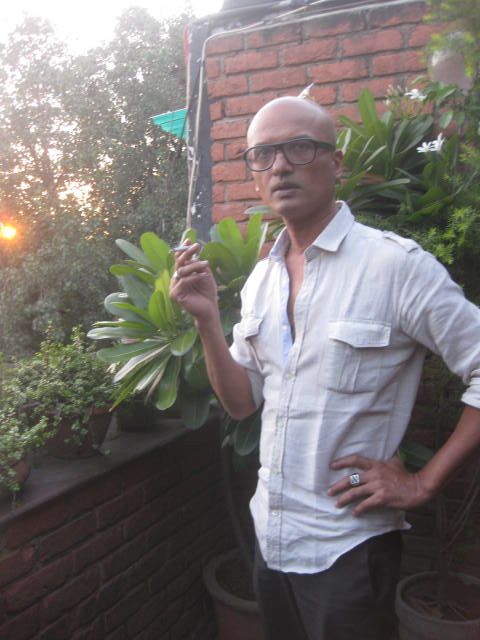
Jeet Thayil, Terrace at Oz, Khan Market
Jeet Thayil, better known as a poet and musician, and the editor of Bloodaxe Book of Contemporary Indian Poets, was married to Shakti Bhatt, herself a major player in Indian publishing before her untimely death in 2007. One of the highlights of my Delhi visit was finally meeting Jeet (we have friends in common as well as a common caste background–Syrian Christian) and spending a couple of hours with him in Khan Market at a rather cool bar/restaurant called Oz. I had wanted to interview him for my radio show, The Silo, but the ambiance made it impossible though i wasn’t about to complain; to my delight soon after we arrived they started playing Marley and other Jamaican music for the entire time it took us to drink two glasses of red wine, which surprised Jeet who said he couldn’t tell when last he had heard Reggae there. He also told me of three bands in Delhi affecting Jamaican accents and a Reggae concert in Shillong every year on Marley’s birthday.
Jeet was introduced to poetry by his uncle, Dr. A.T. Markose, a distinguished law teacher with an unusual obsession, his house in Kochi was stuffed with books by and on Baudelaire.
Narcopolis is due to hit the bookstores in early 2012, maybe earlier in India. I can’t wait to get my copy.








 Active Voice