A selection of tweets i favourited in the 24 hours leading up 11.2.11 Egypt’s day of reckoning….
Data visualization of Egypt's Tweets:
So the Egyptians got their Friday of Departure after all–congratulations to them! This is a heady moment for all of us, Egyptian or not–
What a rollercoaster of a few days! 11.2.11 has proved to be unforgettable for all Egyptians except one: ex-President Hosni Mobarak who probably wants to erase all memories of Jan 25 and its ineluctable aftermath.
I found Pioneer editor Kanchan Gupta’s analysis of the tumultuous events in the Middle East to be comprehensive and useful (though i don’t share his fear of a Muslim alliance):
…As Egypt burst into celebrations, a bitter realisation began to sink in: If the US could abandon Mubarak, it could also say goodbye to others without allowing friendships of the past to weigh too heavily on its conscience.
Ironically, it is this perceived callous indifference of the US towards a beleaguered Mubarak in his last days in office that has left many flummoxed in Arabia. Egypt under the Mubarak dispensation, backed by the Army, was the best bet for peace in the region, especially in regard to Israel. It was also the best defence against the rise of radical Islamism whose practitioners see themselves as the alternative to incumbent Arab regimes. With Mubarak gone, the Muslim Brotherhood is preparing to make a dramatic appearance either through collaboration or alone in Egyptian politics; through Hamas, an offshoot of the Muslim Brotherhood, Islamists have seized power in Gaza; in Lebanon, the Hizbullah, which has toppled the Hariri Government and put into place a regime controlled by Islamists, increasingly and frighteningly calls the shots; in Tunisia, dormant Islamism has come alive after the long-exiled leader of the till recently outlawed Islamist party Ennahdha, Rachid Ghanouchi, made a triumphant return home; in Jordan, the Friday street protests are being led by Islamists sustained by the Ikhwan’s ideology; in Yemen, Islamists are waiting for the palace to fall under their assault; in Qatar, Bahrain and Kuwait, a deep undercurrent of radical Islamism is waiting to burst forth.
A gleeful Ayatollah Ali Khamenei has described the Egyptian uprising as the unleashing of an “Islamic wave”. His protégé and Iran’s President Mahmoud Ahmadinejad has described the Egyptian uprising and the collapse of the Mubarak regime exactly 32 years to the day of the fall of Shah Mohammed Reza Pahlavi on February 11, 1979, as the “emergence of a new Middle East that will doom Israel and break free of American interference”.
On the subject of social media’s role in the recent ‘revolutions’ I found Global Voices Online co-founder Ethan Zuckerman’s comments thought-provoking:
– While there’s been extensive debate about whether social media helped organize or promote the protests in Egypt, I think the interesting story to watch will be whether social media can help Egypt in the transition to democracy. Power now rests with a council of military leaders, and there have been suggestions that this group could be complemented by a council of civilian “wise men”, giving a seat at the table to figures like Mohamed El-Baradei.
In lieu of having anything compelling to say myself I’ve decided to put up tweets I ‘favourited’ it in the last 24 hours or so (Twitter’s ‘favourite’ feature is a phenomenal tool which i use with abandon). Some of them reference Egyptian events and some don’t, but for what they’re worth here they are…with the most recent ones from this morning leading…
Why Gladwell is wrong about the recent revolts in the Middle East from Iran to Egypt.
Protesters take part in an anti-Mubarak protest at Tahrir square in Cairo February 1, 2011. At least one million Egyptians took to the streets on Tuesday in scenes never before seen in the Arab nation's modern history, roaring in unison for President Hosni Mubarak and his new government to quit. REUTERS/Suhaib Salem58. Protesters hold a banner during a demonstration in Cairo January 30, 2011. Egyptian opposition leader Mohamed ElBaradei told thousands of protesters in central Cairo on Sunday that an uprising against Hosni Mubarak's rule cannot go back. REUTERS/Asmaa Waguih
I’d bet my bottom dollar that somewhere in Tahrir Square today they’re blasting Bob Marley’s revolutionary lyrics while chanting down Babylon. We’re going to chase those crazy baldheads out of town–Get up, stand up, stand up for your rights–Rebel Music–Burnin’ and lootin’–almost every one of his songs yields a line of sheer rebellion and his music is all-pervasive. As @kristainchicago said on Twitter today: Universal truth: no matter what country you’re in, there’s a bar somewhere playing No Woman, No Cry.
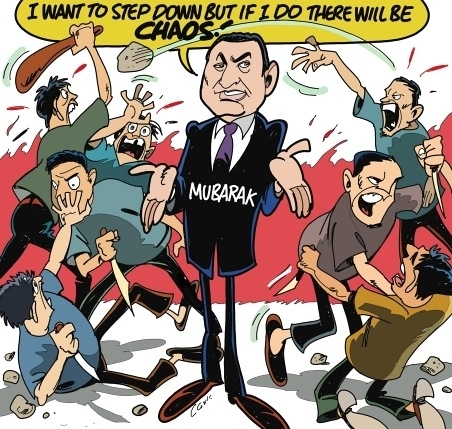
Clovis, Sunday Observer, February 6, 2011
Malcolm Gladwell has been shooting off his mouth insistently about whether or not social media played a role in the latest set of insurrections in the Middle East. His thesis is that revolutions took place before Facebook and Twitter from which he concludes that the recent uprisings had nothing to do with social media and even if they did, this is ultimately fundamentally unimportant compared to the reasons for the respective revolts.
People protested and brought down governments before Facebook was invented. They did it before the Internet came along. Barely anyone in East Germany in the nineteen-eighties had a phone—and they ended up with hundreds of thousands of people in central Leipzig and brought down a regime that we all thought would last another hundred years—and in the French Revolution the crowd in the streets spoke to one another with that strange, today largely unknown instrument known as the human voice. People with a grievance will always find ways to communicate with each other. How they choose to do it is less interesting, in the end, than why they were driven to do it in the first place.
A respondent to Gladwell, AliaThabit, succinctly pointed out the flaws in his thesis:
I just got back from Egypt last night. If the internet were of no consequence, the govt would not have shut it down–along w/ the mobile network in Cairo, and FB and the SMS network over the whole country, which is how most people there communicate–everyone has a mobile, and sms are free (calls are not). I spent most of the first week of the revolution in Aswan with a hotel full of Cairo students who were on holiday–we (and the whole town) were all glued to the television, and they were also glued to their phones. Information raced around the country. The French may not have had Twitter, but they would have used it if they had. There are twenty million people in Cairo alone. How many lived in Paris?
There is a crucial point that the prolific Gladwell (whose mother is Jamaican) is missing. The celebrated revolutions of yesteryear all had heroic leaders around whom sustained acts of dissent, rebellion and revolt were mobilized. What is noteworthy about the recent wave of popular uprisings everywhere from Iran to Tunisia to Egypt is that they have been ‘leaderless revolutions’. This marked change in modus operandi between traditional revolution and its contemporary counterpart is worth studying; the reasons for the shift are attributed to the speed with which information is collected and disseminated by groups of people using the new social networks. The era of the charismatic leader may be over.
I’m indebted to Nicholas Mirzoeff and his new blog For the Right to Look for these insights:
Whether or not the revolutions will have been fully successful–and no-one has really defined that success–there is a palpable and electric sense of change, not just in North Africa but globally. The events have revealed that there is already a network for change and how it has worked. One tweet widely circulating from Egypt outlined the method: “Facebook used to set the date, Twitter used to share logistics, YouTube to show the world, all to connect people.” The dispersed co-ordination shows that the network has learned from Iran that social networking can also be used by the police to track down activists. Mubarak tried to cut off all Internet access, hoping that this would quell the street actions. Facebook went first, followed by Twitter, then all connections. It was a revolution watched on social networks, but acted in the streets.
…The result has been the now-characteristic “leaderless” revolutions, as the Western media have depicted them, as if expecting new Castros and Lenins to materialize. Unable to comprehend networked change, those working in hierarchical companies are already writing banal opinion pieces predicting the collapse of the revolutions for lack of the very kind of leadership that provoked the uprisings. Should the revolutions fail, it will be following the combination of local state violence and globalized governmental and corporate hostility. Israel and Saudi Arabia found an unusual point of agreement in opposing the Egyptian revolution, while stock markets plunged on January 29 as it became clear that the revolution was not going to be crushed. Oil prices hit $100 a barrel on January 31, the usual profiteering from democracy. Israel has begun leading a movement to support Mubarak for fear of the unknown.
Tunisia exploded first, and a domino effect spills over multiple countries. Yemen, Algeria, Jordan. And now Egypt, cradle of humanity, that threatens to remove the Mubarak cancer by the force of the protesters…
…I wonder: why not Cuba? As I watch TV, listen to the demands of the volatile Egyptians. Listen, for example: “We got tired of lies, misery. For decades we endured the dictator Mubarak who has ruined this country.” We hear Egyptian scholars say:” I am a lawyer and live like a beggar. I earn $60 a month, and my rent alone is $75.” And we can not avoid the immediate association with our island.
I’ve heard all the arguments of the Egyptians. And I do not think there is one, I repeat — not one — which does not apply to my country. The same hunger and hopelessness, the same distaste for an inept government; the very low wages that don’t stretch even to survive, the underground corruption; the warning, just look at the living standards of the ruling class; and now, ironically, Cuba is also added to the list of countries with high unemployment.
And then there arises, inevitably, the pointed question: Why not Cuba?
If I had to respond I would start by pointing out a subtle reality: The control of information in my tranquilized country is, aberrantly, more fierce than in countries such as those that have just exploded. For those who don’t believe information has such an important role, I suggest they ask themselves: Why has the opening act of every classic dictatorship in History been to seize the methods of communication?
So this is what Gladwell glibly elides–how messages of revolution are transmitted is crucial–this is why as Licea observes dictators and powerbrokers have always tried to control the media, whether these were the drums of the enslaved signaling revolt on Caribbean plantations or more contemporary forms of broadcasting which now include Twitter and Facebook. Sorry Malcolm you can’t just blink this one away…
Dog Paw and Leah Tavares-Finson are expecting a baby this February. Leah is the offspring of wealth and privilege in Jamaica while Dog Paw is a notorious gang leader. A lengthy interview with Leah is included.
Leah Tavares-Finson Photo: Peter Dean Rickards
When the police finally found Dog Paw in a house at Elletson Flats, he had written, in full anticipation of being killed, a letter addressed to his Mother, his girlfriends, his children and his yet unborn child. That child, due in February, will be born ‘famous’ because her/his other parent will be Leah Tavares-Finson, the daughter of Senator Tom Tavares-Finson and Cindy Breakspeare, the former Miss World who was one of Bob Marley’s most favoured consorts. Bob Marley was the father of Leah’s step half brother (thanks for correction J!), Damian Marley. When her mother Cindy became pregnant for Marley it caused no end of scandal in staid 1970s Jamaica and abroad. A London newspaper carried photos of Cindy and the dreadlocked Bob under the headline “Beauty and the Beast.” In a strange twist her daughter’s pregnancy for an ‘outlaw’ is causing a similar scandal. I found the extraordinary conversation below on an online Dancehall Reggae forum. One marvels at the confidence with which jahblem offers his misinformation in this exchange generated by the fact that Leah T-F is pregnant for Dog Paw:
MissMention
nuh Cindy Breakspeare dawta dat? and damian marley sister? look like she tek affa har madda, ghetto bwaay shi love…
jahblem
no…they dont have kids together (tavares and cindy)…i would assume its tavares dawta before he hooked up wid cindy…i could be wrong…but when cindy got married to him they were both old and grey and had kids already from previous marriages.
LOL! Old and gray! Cindy married Tom when Damian was a toddler (she was probably in her early 30s), and went on to have Leah and Christian with Tavares-Finson.
Jamaica Observer, Clovis
Leah is a fascinating character. She may be following in the tradition of her father’s family (which has roots in the so-called garrison community of Tivoli Gardens) by going into politics. Will she herald a new kind of representational politics since she has personally breached not only the uptown/downtown divide but also the legit/illegit one by literally commingling with a Don? After all, Dons are also political representatives, only they are illegitimate ones, informal leaders whose constituencies straddle the world of organized crime and garrison politics. At any rate this young lady is one to watch, in my opinion.
Read more about Leah in the interview below which first appeared in the Style Observer. Her interlocutor was photographer/writer Peter Dean Rickards, of Afflicted Yard fame. The ‘Presi’ referred to in the early part of the interview is Christopher ‘Dudus’ Coke, reputed to be Leah’s godfather. Her father Tom Tavares-Finson was Dudus’s lawyer. Dudus has since been extradited to the United States on gun and drug-running charges. The “early morning ‘situation’ at a house in Kintyre” referred to is when she was taken into custody from Dog Paw’s house some months ago. Happy reading!
Leah Tavares-Finson is the daughter of Senator Tom Tavares-Finson and a former Miss World, Cindy Breakspeare. Her brother Damian Marley is pretty famous too, having copped a few Grammy Awards; so why has she been raising eyebrows recently? For starters, there was the brief MYSPACE message requesting that “Presi” be left alone, followed by an earlymorning ‘situation’ at a house in Kintyre. Leah is adamant, however, that she’s no “wild child”.
SO: Why did you post the message on MYSPACE to leave “Presi” alone?
For those of us who can accept reality, “Presi” is somewhat of a hero and a legend. He has been able to do for West Kingston what so many politicians can only dream of accomplishing. I’m not in a position to debate the means he used to accomplish what he has accomplished, but when all is said and done, he managed to pull off quite a job.
I think I fully understood at the time when I first posted “leave Presi alone” the grave and disastrous repercussions that the nation would face. We have lost more than 80 lives and even if they were not all innocent, I do not accept the term “casualties of war” as a reasonable excuse. I think our country should be deeply saddened by this absolutely unnecessary loss of mainly innocent lives. I know my heart is certainly broken; so you see, in the end it is not really about “Presi” but about the people of West Kingston. They now have to piece their lives back together, overcoming pain, loss and memories of brutality. They must do so without the indisputably strong leadership that they’ve had for so long. I only hope that our political system can provide them with the social programmes, the support and the guidance they need to replace what has been destroyed. REALITY!
SO: Tell us about Leah. Her likes, dislikes, what makes her smile and what makes her sad.
LTF: I’m not a very exciting or excited person despite what people may think. You know there is this idea out there that I am some wild card, but that’s not really true… I love being home. I’m very laidback. I love food, eating out and cooking. Yes, I can cook; my mother taught me well.
I love mango sorbet!
My little sister, Capri, makes me smile. She is quite something; so much smarter than I was at her age. I’m just so amazed when I watch her.
What makes me sad? Seeing a country with so much potential being exploited and abused. The lack of education amongst our people and the lack of opportunities on a whole are depressing.
Sometimes when I feel like I can’t do anything to help my own country (because every aspect of our society is so corrupt), I am sad.
SO: Who (artiste) does Leah listen to?
LTF: Gaza! Vybz Kartel is my artiste. I love my brother’s music, but I suppose where that is concerned most would say I’m biased. Alicia Keys, John Mayer, Aidonia, Busy Signal and Black Ryno. I don’t care who doesn’t talk to whom, respect is due once the talent exists.
SO: Who impresses Leah?
LTF: My brother Damian does. I think he is brilliant. I admire his focus and when I listen to his music I often think: ‘Wow, how did he come up with that?’ He is great.
I think anyone with a very business-savvy head and that drive to fight for what they want in life, regardless of what other people may think and say, impresses me.
SO: And Leah’s take on love?
LTF: Love is good. How could it not be?
As human beings our existence would be doomed if we didn’t have love for one another. We need people with bigger hearts. Love has no boundaries and no colour, and it should be unconditional.
SO: Who does Leah love?
LTF: My family, although it does not 100 per cent include my immediate family; it is not limited to and doesn’t only mean people who have the same ancestral background as I do. I love the people who have loved me unconditionally and have been a constant source of support and strength. They know themselves. The one I smile and laugh with and share my “dramas” with.
SO: What’s the last book Leah has read?
LTF: A schoolbook entitled Words that Ring Through Time. It’s an amazing collection of speeches by various historical figures.
SO: Leah on her mum Cindy Breakspeare and on her dad Senator Tom Tavares-Finson…
My parents are the two most amazing people I know. They are so different from each other but so similar at the same time. It’s pretty fascinating. Despite what anyone has to say, they’ve done a tremendous job raising Damian, Christian and myself, and nobody could ever dispute that. Both Damian and Christian are so wellmannered, so bright, so focused. They are just two well-rounded individuals. And I think they are a reflection of the kind of people my parents are.
My mother is a fighter, strong with a back as broad as the continent of Africa. I admire her ability to improvise and manoeuvre through any situation. My dad has a great sense of humour and he is affectionate and adores his kids. He is a great lawyer and is really what a politician should be all about. Both of them have taught me so much. Things that I am confident in the long run will prove to be my greatest assets and characteristics.
SO: Is Leah the voice of Jamaica’s uptown ‘white and restless’?
LTF: Absolutely not!
The correct definition of restless is to be worried and uneasy, and although that does define a part of my personality I don’t at all think it defines all uptown ‘whites’. I am the voice of people who care and people who want to help, and whether that means white, black, orange, uptown, downtown, or round town, it nuh matter. The quicker we put this uptown/downtown division behind us is the better off we will all be as a nation.
SO: Leah rocks… what’s Leah’s style?
LTF: Does she? I don’t think I rock at all! Anybody who knows me well knows that I am not a fashionista. I wear what is comfortable and practical for my lifestyle, and anything other than that you would have to ask my mother about because she is the one who dresses me when I look half decent.
SO: What’s next for Leah?
LTF: Finishing up school. I’m getting a degree in Political Science, after that…I really haven’t decided. My family business here in Jamaica, DC Tavares & Finson Realty Ltd is one of my options. It’s currently run by my uncle William whom I admire a lot and would love to work with! Maybe politics… we will see.
Most wanted fugitive from justice in Jamaica, gang leader Dog Paw, and his family were the inspiration for Diana McCaulay’s 2010 novel Dog-Heart.
The cliche that truth is stranger than fiction is true. It turns out that one of the main characters in Diana McCaulay’s 2010 novel Dog-Heart was inspired by none other than Christopher ‘Dog Paw’ Linton, who was taken into custody by the security forces on January 24th after topping the most wanted list of the police for several months. Day before yesterday Jamaica Defence helicopters hovered in the air for hours during the operation that netted Linton. After the first hour their incessant buzzing receded to the background like a dull but persistent headache. The University of the West Indies, where i’m based is right next door to Elletson Flats where Dog Paw was eventually found and arrested. We are squarely in the middle of the Dog Paw Gang’s turf which covered Kintyre, Papine, August Town and its environs.
I knew that the novel which i got to read in manuscript form way back in 2006 had been inspired by several street youth that McCaulay, an environmental activist, had tried to rehabilitate in the 1990s. She had written about that experience in her Gleaner columns, detailing her despair when the young boys she had tried to send to school eventually reverted to the streets. There are several co-incidences: the names Dog-Heart and Dog Paw for instance; also one of the illegal operations Dog Paw has been accused of is sand-mining. In the novel sand-mining is what sustains the young boys.
AP: How were you able to get into the head of an impoverished street youth? I know you had tried in the nineties, when you wrote a Gleaner column, to help one or two such youth? Is this novel inspired by those attempts? And did you have any success with the boys you tried to rescue from the street?
DM: In a sense, Dog-heart was inspired by my relationship with a family of boys and their mother in the 1990s, my attempts to help, but the events and people in Dog-heart are entirely fictional – nothing in Dog-heart really happened and the people are quite different from that family. But during that period I did observe many aspects of their lives and realized how difficult their circumstances were. It was humbling – people of my class tend to dismiss people like Dexter and his mother, Arleen, as, I don’t know, wasters, wut’less, stupid. But what I saw was something different – I saw people, children, trying their best to survive situations that I was sure would have defeated me. So I started thinking about it, imagining what it would really be like. Dog-Heart also had its genesis in a writer’s workshop at Good Hope, back in 2003 – we were asked to write a short piece from the point of view of someone of a different age, class, race, background and sex – and I wrote what became chapter two of Dog-Heart. I sent it as a short story called Car Park Boy to Caribbean Writer, they published it, and I decided the seeds of a novel were in there. So I kept working on it.
As for the boys I did try to help, that’s a fairly sad story, one I am not sure I am ready to talk about, because it is their story to tell too. I often wonder about what THEY thought at the time. I lost track of the family when I went to study in Seattle in 2000 – but when I came back to Jamaica in 2002, I learned from one of the boys’ teachers that the eldest boy had been killed by the police in a prison riot. And funnily enough, recently a friend encountered the youngest boy – who is now a man – and we are to get together – hasn’t happened yet.
Yesterday, I learnt that the elusive Dog Paw was one of the boys Diana had tried to rescue. I assumed that he was the model for Dexter, the protagonist of Dog-Heart, but i was wrong. His older brother Jeffrey, since brutally murdered, was the inspiration for Dexter. It is Marlon, Dexter’s younger brother in the novel who was modeled off Christopher Linton. Marlon is a lovely young boy, brimming with hope and wonder and trust, not unlike the child who became Dog Paw and who was eight years old when Diana entered his family’s life. Please read on for my interview with Diana today about the Dog Paw she knew and Dog-Heart, her novel.
DM: Hi Annie, I will try and answer your questions, but I want to tell you a few things before I start. First, obviously I have known Christopher Linton was one of Jamaica’s most wanted men since just after Dog-Heart came out in March 2010. I have never talked publicly about it, though, for various reasons — mostly respect for his privacy and that of his family, and not wanting to use a tragic story for opportunistic book publicity. So when people have asked me about this– Jamaica is a small place, after all — I have answered truthfully, I really didn’t want to lie about it, but have also asked them not to discuss it in public. I’ve decided to talk about it now because I have seen such horrible comments about Christopher on websites, Facebook, and heard them in conversation – things like, the police shoulda kill him, him is worse than a dawg and the like. I’ve decided to speak because I knew this young man, Christopher Linton –- Damien was his pet name -– from he was about eight until he was nearly fifteen or so and he was a sweet, very intelligent little boy with great potential and he was failed in every way by our society.
We need to stop pretending that such men are merely irredeemably evil and are simply to be exterminated. We need to understand what made the boy Christopher Linton become the man he is. I want to state clearly that I am appalled by the crimes he is accused of, and if he is guilty and convicted, he should be incarcerated. I want to say that like most Jamaicans, I am deeply concerned about the levels of crime in our society, I am as afraid as the next person especially as I get older, and I do not want to face a young man with a gun who is prepared to take my life without thought, but also, I want to challenge us as a people to examine the reasons for, the genesis of a young man like Christopher, one of our own sons, now effectively facing the fact that his life is over at 24, even as he and others must deal with his probable or certain role in ending the lives of some of his fellow Jamaicans. It is all an unspeakable tragedy.
AP: You’ve said that the protagonist in your first novel Dog-Heart was loosely modelled on Christopher ‘Dog Paw ‘Linton whom you had tried to rescue from the streets in the 90s when he was an adolescent. When did you find out that the young boy you knew had become a wanted gang leader and was none other than the Dog Paw the police have been searching for since last May?
DM: No, Dexter – the protagonist in Dog-Heart – was not modelled on Christopher Linton. What I have said is that I was involved in the education of four boys from the August Town area, beginning in the early 1990s and ending in roughly 2002. One of them – the second oldest – was Christopher Linton. His elder brother, Jeffrey Jones, was beaten to death while in prison during a prison riot in roughly 2002 or 3. None of the characters in Dog-Heart are the real people – I guess the best way I can put it is that the actual experience of becoming involved with these four boys started me thinking about the whole situation I was witnessing, experiencing, living through and I sat down to write a novel inspired by these real events. But the people in Dog-Heart, the events that occur in the book, I sat at my computer and made them up. As soon as Christopher’s name was mentioned in the newspapers, I knew who he was – I can’t remember how long ago that was, but probably more than a year.
AP: You’ve emphasized that “the events and people in Dog-heart are entirely fictional – nothing in Dog-heart really happened and the people are quite different from that family” but are there any similarities between them? For instance Dexter, the central character in your novel who grows into the gangster Matrix is portrayed as someone who is loving, sensitive and bright but who ultimately cannot overcome the internecine circumstances of the life he was born into. People have commented on the fact that Dog Paw comes across as well-educated and well-spoken. Did he actually graduate from school? What school did you send him to?
DM: When I say that the entire system failed Christopher, one example of that is the education system. When I met him when he was about eight, he was completely illiterate – and he was in school – but he could not recognize or spell simple three letter words. After just under four years in a good prep school – St. Hugh’s – he passed his G-SAT for Jamaica College. So yes, he graduated from St. Hugh’s. As I said before, he was a very bright boy, I am sure he is an intelligent man. He floundered at Jamaica College – he was in a very small remedial class at St. Hugh’s and at JC, he was suddenly in a class of 40-plus. Within a year or so, he was asked to leave as he had not met the minimum academic standard. The school also reported he wasn’t attending regularly, wasn’t doing his assignments. We got him into another secondary school, but within less than a year, his grades were so bad that the sponsors I had found were unwilling to continue to fund his education. I should say that initially myself and my then boyfriend funded the education of the four boys, but when I left my private sector job to work at an environmental NGO, I had to find other help and for many years, the education of the boys was paid for by overseas Jamaicans and local business people. So think about it, at just over fourteen or maybe fifteen, Christopher was out of school, with no prospects, no programme to learn a trade or anything – and then, his brother was killed – beaten to death – while in police custody. I imagine the rage and pain he must have been in – his entire family must have been in – and I am sure this event had something to do with the path his life then took.
AP: Linton has claimed in an Observer interview that he knows nothing of the charges the police want to lay against him. Do you think he’s being framed? He is very young—only 24—to be such a dangerous gang leader. Have you talked to him at all since your novel came out? Do you know if he’s read it? Have you been in touch with the rest of his family?
DM: I have no idea if he’s being framed or if he committed the crimes he is accused of. He IS very young. I haven’t talked to him, no. When I went to Seattle in 2000 I lost track of him and his family. When I came back, I learned of Jeffrey’s death, contacted Jamaicans for Justice, who had spoken to his mother, saw one of the teachers at St. Hugh’s who had been very involved with all four boys, and she told me that Christopher was no longer living at home and was in a gang. It was then that I started to think about the whole experience, question my own opinions, my own prescriptions that education is the answer, and eventually those thoughts became Dog-Heart.
AP: Linton has made an impression in interviews of someone who is very intelligent, articulate and educated. Did you see hints of this in him when you first met and is that what made you want to try and help him out of the ghetto?
DM: I didn’t meet Christopher first. It was really his brother, Jeffrey, who impressed me, and it was he we set out to help. To this day, I couldn’t tell you why he touched me in the way he did, compared to the many other children I have encountered in similar circumstances. I met Christopher and his brothers subsequently – and we then realized that we could not single out one child in the family for help, but had to make sure they all got the same assistance. I can only say again that Christopher was a sweet little boy with great potential who I remember and think about with fondness and I find the situation now unbearably sad, both for him and if he is guilty, for those he hurt or killed.
AP: I hope that finally Dog-Heart will get the attention it deserves. It is in effect the first document that seriously explores the conditions that influence the formation of characters such as Dog Paw; actually another novel that also does this is For Nothing at All by Garfield Ellis but of course it does so differently. You have tried so hard to change the environment that we all inhabit, in more ways than one, not merely as an environmental activist but by drawing attention to the systemic handicaps children such as Dexter suffer, are you at all frustrated by the lack of real change? What do you think it will take to produce an environment in which children are not exposed to such callousness and cruelty?
DM: Well, I’m not talking about this because of Dog-Heart. I’m talking about this, because I want to say, look, I knew this man when he was a child, this man who is easy to hate, easy to demonize, but he did not come out of the womb like that, that he was a child who never had enough, ever, not one day of his life. Yes, I’m very frustrated by the lack of real change in Jamaica, by the weakness and lack of integrity in our leadership, by the lack of thought we Jamaicans ourselves bring to these problems, by the level of national discourse, by the way as Mutty has always said, we trivialize our politics, it’s all a big party to us. I don’t know what it will take to bring about real change – where this particular issue is concerned, I have no expertise, I’m just a witness, a storyteller.
AP: The title of your novel doesn’t necessarily refer to the protagonist Dexter, or does it? I got the impression it more fit his friend ‘Lasco’ who seemed irredeemably ‘bad’. So were you referring to a metaphorical ‘Dog-heart’, a system that turns young children into dog-hearted killers? as an aside i wonder why or how the term ‘dog-heart’ came into being, are dogs really like that?
DM: Dog-Heart doesn’t refer to any particular person in the novel. It’s a reference to dog-heartedness, that quality that we Jamaicans talk about, recognize and react to with such revulsion. So yes, the title is more of a metaphorical frame for the subject of the novel. I don’t actually believe in dog-heartedness. I have no idea how the term came about – a linguist would have to investigate – and I think the heart of a dog is generally a big warm kind heart – unless, just like people, the dog is mistreated.
Watching Buju Banton in Kingston on Lime Mobile TV
Hi Everyone, this is a guest post by Marcia Forbes, formerly known as the Iron Lady of Jamaican Media and Author of Music, Media & Adolescent Sexuality in Jamaica (2010) She’s also conducting a research project called Youths Online (in progress).
Content Drives Demand
I heard it first on radio via talk show host, Ragashati, Mr. King of Mixup!! Good for LIME I thought, who better than Raga to make this announcement. After all, King Raga has afternoon radio locked into sorting, swiping and similar sexual stimulations. LIME was therefore guaranteed a large audience for the announcement that its trade-in offer of your old cell phone, from whichever provider, for one of its new mobile TV phones was sold out by Friday afternoon, January 14th. This came after only a couple days of the offer being publicized and from all reports was a great surprise for LIME—hence the fact that they ran out of instruments so soon, leaving many would-be mobile TV watchers very disappointed.
Two events drove the rush to acquire LIME’s mobile TV. Both of them relate to the well-established and accepted concept that content is KING! Rebel Salute, in its 18th year and positively branded as a show which features conscious artistes but staged in far-away St. Elizabeth, was scheduled for Saturday, January 15th. The highly-anticipated ‘Before the Dawn’ live concert from Florida, featuring embattled Buju Banton and several of his supporters, was for Sunday, January 16th. I intended to see both. So did many other Jamaicans in Jamaica. None of us knew/know if this would have been our last opportunity to see and hear Buju perform.
Getting the Signal
Having been favoured with a mobile TV phone at the launch, there was no scramble for me. Phase 3, the company I co-own, covered Rebel Salute so I already had that locked. What caused me some concern was the Buju concert. Although having previously ensured that the mobile TV phone did work at our Half Way Tree office, I could get no signal from home. The LIME customer service via twitter (@LIME_Help) tried everything to get me going. Their map for mobile coverage suggested that I was within the coverage radius but no luck. I was not accepting that this occasion, historic on so many counts, was going to miss me. So, off to the office a small group of us headed to watch Buju live via this 3 x 2 phone screen.
Three grown adults watched while the 4th listened to six hours of concert live from Miami, Florida via a tiny mobile TV phone. It was quite an experience and one I’m happy I did not miss. With amplification of the speaker phone we all heard quite clearly. The picture was also amazingly clear. Battery drain was addressed by plug in for on-going charge. Buju performed for a solid two hours from 10pm to 12 midnight with the signal cut as he exited stage in the company of his lawyer, David Marcus, who he had invited on.
I posted a total of over 70 tweets, encouraged along by several of my over 1,000 followers who only knew what was happening via my tweets. One tweep, a radio talk show host in Atlanta, enquired if I was in Miami at the concert. I explained that I was in Jamaica and tweeting based on what I saw via LIME’s mobile TV. My years as General Manager at TVJ with Simon Crosskill doing live commentary over sports feeds from overseas had taught me that, properly done, no one had to know you were not there live on location. The thank you tweet from David Marcus, in appreciation of my positive comments about Buju’s performance, was totally unexpected but yet again proved the power of twitter.
Empowerment v/s Entertainment
As I immerse myself in data-collection regarding how Jamaicans in the 14 to 30 age range are using their mobile phones and the internet, my eyes are riveted on this phenomenon of mobile TV via the cell. At first I conceived a faceoff between Digicel’s 4G versus LIME’s mobile TV. Empowerment versus Entertainment I thought. Quickly I realized the folly of this dichotomy. Entertainment is empowering for many Jamaicans. Truth be told, much of our economy thrives off entertainment-related projects and programmes. Flow’s recent announcement of its partnership with HBO to cover Jamaica Jazz & Blues highlighted the tourism spin-offs of this entertainment-based project.
LIME’s mobile TV via the cell phone offers tremendous opportunities for local content creators, production companies, rental houses and related small businesses such as talent scouts, make-up, etc. What is clear though is that the content must be worth the inconvenience of the small screen. Speaking of Rebel Salute via this tiny screen one tweep emphasized how much he wanted to see the concert and how happy he was to have it despite screen size. Motivation for viewing is important and content with strong appeal will pull people. Coming back to Ragashanti, the man and his tambourine posse are hilarious. Using entertainment to empower, he’s the King of Afternoon Radio who really belongs in Prime Time, 9pm and onward when he could be allowed full reign.
The Jaipur Literary Festival, Junot Diaz, and Calabash International Literary Festival…and what such festivals bring to the people in those countries.
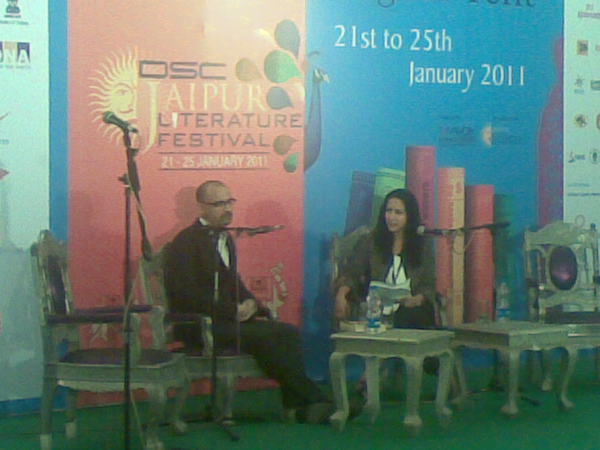
Junot Diaz in Jaipur being interviewed by Sonia Faleiro. Photo courtesy of Tehelkadotcom
Well, Junot Diaz stole the show on the first day of the Jaipur Literary Festival in an interview with Sonia Faleiro, one of my tweeple (@soniafaleiro) and author of Beautiful Thing: Inside the Secret World of Bombay’s Dance Bars. A flurry of tweets this morning by @tehelkadotcom, one of the best all round news cum arts magazines in India conveyed the excitement of the moment.
But before we go there–for those who want to know more about the JLF, taking place this weekend, chk this tweet:
The atmosphere is informal and the debates are conducted in a polite and generally consensual manner, often featuring the father of the festival — the British historian and expert on India, William Dalrymple.
But Dalrymple, a ubiquitous presence on the Indian literary scene who co-founded the modern Jaipur event in 2006, has been sucked into a damaging row after coming under attack in the Indian news magazine Open.
In an excoriating piece published on January 1, political editor Hartosh Singh Bal questioned why a white middle-aged Scottish man had established himself as a “pompous arbiter of literary merit in India.”
If Dalrymple is the father of the festival its mother is co-founder Namita Gokhale, whose daughter Meru, is married to Patrick French, VS Naipaul’s biographer. I met Meru and Patrick at the 2008 staging of Calabash where Patrick read from his The World Is What It Is: The Authorized Biography of VS Naipaul. Two years later he’s just published a new book India: A Portrait.
Let’s return to Junot Diaz, who as i said earlier has been wowing crowds in India just as he did here in Jamaica when he first read at Calabash, in 2002. Back then the Gleaner carried an article titled “ New ‘Latino’ author for Calabash festival”:
“Historic” is how Dominican Republic writer, Junot Diaz, views the upcoming 2002 Calabash International Literary Festival, scheduled to open at Jake’s Village in Treasure Beach, St. Elizabeth, on May 24.”It’s so rare to get African and Caribbean writers coming together outside of the United States of America,” he told The Sunday Gleaner in a telephone interview. “Usually, such festivals and gatherings are held within U.S. borders, so I find it rather historic, and am actually looking forward to participating.”
Mr. Diaz will be one of 31 writers in the fields of literature, theatre and music, scheduled to take part in the three-day festival. And, while it will be his first experience in such an event, he’s no stranger to Jamaica.
“I visited once before, and was impressed with the people and the country,” he said.
Mr. Diaz gained fame and acclaim with his first publication a collection of short stories, titled Drowning, which draws on his own emigration experiences from the Dominican Republic to the U.S.
In most of the 10 stories which make up the book, the narrator is a young adolescent who recounts his island childhood to current life in New Jersey.
“The inspiration for the stories came from my own observations and remembrances of my family and growing up, ” Mr. Diaz pointed out. “So portrayed are the struggles for survival, the poverty, cruelty and violence, all within a ‘macho’ context and presented in a humorous fashion.”
The 33-year-old fiction writer is rather candid about his transformation from struggling writer to overnight success: “I was lucky to be liked by one per cent of the reading audience in the U.S., which in itself constitutes about one per cent of the entire population.”
Drowning was published in 1996, and at the Calabash Festival, Mr. Diaz expects to do readings from the collection. But he’s also working on a second publication his first full-length novel.
“It will probably take me a long time to complete,” he warns his fans, “for I work very slowly and need to get my plot together.”
He’s promising no “happy ending”, for a main character “who will be the ‘opposite’ of that in Drowning“.
The Gleaner got the title of Diaz’s book wrong three times, it’s Drown not Drowning. And the character whom he promised would be the opposite of the one in Drown was Oscar Wao, the protagonist of Diaz’s masterful first novel The Brief Wondrous Life of Oscar Wao which was published in 2007. In 2009 Diaz again graced Calabash with his presence, along with Edwidge Danticat.
Today at the Jaipur Literary Festival Junot Diaz talked to an enraptured crowd about how ‘oppressive regimes destroy national character’ and ‘Silence becomes institutionalised in oppressive regimes.’ He was probably referring to the Dominican Republic where he was born. “There’s enormous silence, holes punched thru us, in people of my generation, from my country” he said.
So not only does Junot Diaz write like a dream, he is hot and funny. No, not gay either. #JLF
Also: Diaz insisted New Yorker stop italicizing Spanish words in his stories. They never italicised any foreign language word again#JLF
And: Diaz on removing the n word from a new edn of Huckelberry Finn- Just coz you use a word dsnt mean you endorse wht it stands for. #JLF
Diaz also said: “You assume as artist that what you create will one day in future encounter someone who needs it.”
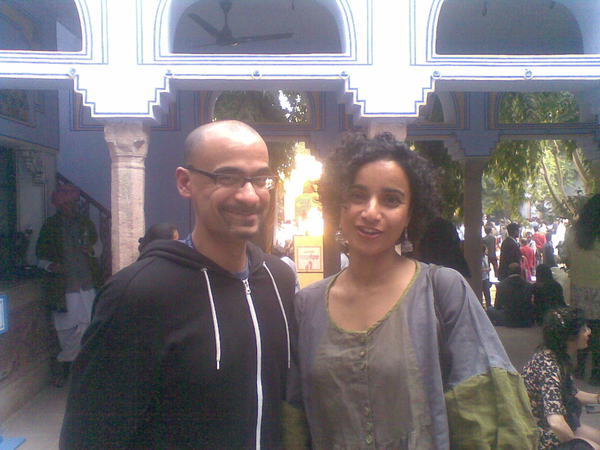
Junot Diaz with Indian author Mridula Koshy #jlf
That Diaz was responsible for changing the venerable New Yorker’s editorial policy regarding foreign words and how they are represented is awesome. We were blessed to hear him twice at different points in his comet-like trajectory. As you can see Calabash belonged to the same family as the Jaipur Literary Festival, both part of a network of such confabs around the world bringing the work of great writers to audiences in distant places. Neither is immune to criticism but to not admit their immense contribution to the societies in which they’re staged is to wilfully succumb to myopia. Long live Calabash and the JLF!
Calabash International Literary Festival Comes to an End
Wole Soyinka being interviewed by Paul Holdengräber at Calabash International Literary Festival
Well, the news of the moment is that Jamaica’s beloved Calabash International Literary Festival is no more. At a press conference this evening Calabash Programme Director, Kwame Dawes, announced the demise of the festival saying that Calabash, in its ‘present incarnation’ had come to an end and would not be held this year.
The plan is to regroup and return in a new avatar in 2012, Dawes said. 2012 is also the fiftieth anniversary of Jamaica’s independence and the new event will focus on celebrating fifty years of literary production in Jamaica.
Colin Channer, the leonine writer who has been the motive force behind the festival, is also no longer part of the core group. No reasons were given for his departure, with Dawes merely remarking that Channer’s decision was ‘mysterious’. Channer had been the artistic director of Calabash since its inception.
A valued Twitter source sent a message offering Channer’s perspective: Just talk to Channer, Man seh 10 year as the head is enough& anything longer would be a sign that something is wrong that it can’t grow beyond him
Colin Channer (l) posing with the Commonwealth Writers’ Prize (First Book) finalists in 2007. Photo: Georgia Popplewell
The constant challenge of raising funding each year and drawing on personal resources has also taken its toll of the three principals behind the festival.
This is a brief post to give you the breaking news…a more detailed post will follow in the next few days. See my posts on earlier Calabashes below:
The problem of skin bleaching in Jamaica is discussed and linked to the problem of language, and the privileging of English over Creole.
Khani LTD Edition # 1_21inx21in_ mixed mediaonpaper_2008 by Ebony G. Patterson
All of a sudden the problem of skin bleaching is in the spotlight and we have top DJ Vybz Kartel to thank for it. As I mentioned in an earlier post my favourite Christmas present was a pack of his infamous ‘cake soap’ I received, complete with personal autograph. VK as we’ll call him for short, has recently attracted attention with his complexion suddenly appearing several shades lighter than it used to be, the better he says, to show off his numerous tattoos. The melanin reduction is attributed to the said cake soap which is normally used to whiten clothes in the wash.
It just goes to show you how influential popular music is; young Ebony Patterson has been highlighting the skin bleaching problem here for years with her series of innovative artworks but hardly anyone outside the artworld paid much attention. Then along comes VK, the Darth Vader of Jamaican music (except that he doesn’t want to be dark any longer), with his cake soap and no one can talk of anything else.
Jamaica’s voluble moral majority has rushed to condemn VK claiming that he is encouraging impressionable youngsters to imitate him. What has upset many is that the DJ is unrepentant and even playful about lightening his skin colour, refusing to take the matter seriously and countering that it’s no different from white people wanting to tan themselves. Numerous musicians have rushed forth with anti-bleaching, love-my black-skin-songs but in a way all these knee-jerk responses are just as superficial as the act of bleaching itself, which only changes what is visible without attacking the underlying structural problems that make people bleach in the first place. Historian Elsa Goveia put her finger on it several decades ago when she said the structuring principle of Caribbean societies is “the belief that the blacker you are the more inferior you are and the whiter you are the more superior you are.”
Until this reality changes people are going to think that the best way to advance in such societies is to lighten your skin colour. People can fulminate all they want and express litres of outrage, it will make no difference.
To me bleaching your skin is fundamentally no different from deciding that Creole /Patwa , if that is your mother tongue, is so lowly and contemptible linguistically that it is not worthy of being spoken or allowed in schools. Edouard Glissant described how in Martinique it was common to see “In beautiful rounded white letters on a clean blackboard at the reopening of school: it is forbidden to speak Creole in class or on the playground.” And Jamaica is no different.
The logic is the same: English/French/Spanish is the language of universal currency so our children must only learn English and must actively be discouraged from speaking Jamaican or Patwa, the versatile, volatile language of the streets here that for many is their native tongue. Similarly skin bleachers reason that since white/light skin is almost universally valued higher than darker skin tones, they must use any means necessary to acquire it.
I find this kind of logic depressing. It’s as if to say that if your mother happens to be a poor, barely literate ghetto-dweller you must abandon her and cleave to the English missionary with her glowing white skin and impeccable English. Surely it’s not an either/ or game. Most people would agree that this was outrageous yet many of the same people would find nothing wrong with denigrating Patwa and banning it from official spaces as if it’s impossible to know and love Jamaican and also become fluent in English! The worst part is that for many children for whom Patwa is the only language available literacy becomes inaccessible because you have to know English to study any subject at school. In fact the way some people react to the idea that Patwa ought to be recognized as a language and used as a medium of instruction in schools you’d think that to promote or accept Creole is to diss English!
And if you think that’s bad read Carolyn Cooper’s blogpost where she describes the absurd system of ‘justice’ in Jamaica which is dispensed in impeccable English to Patwa-speakers regardless of whether they understand the language or not!
One morning, as I waited for my case to be heard, I listened in amazement as the judge explained in quite sophisticated English how she was proposing to handle a dispute about unpaid rent.
The defendant was told that the case was going to be sent to a mediator who would discuss exactly how much rent the defendant would have to pay. The distressed defendant kept on insisting in Jamaican that she didn’t owe as much rent as the landlord claimed. The judge continued speaking in English, simply repeating her proposal. This back-and-forth went on for a good few minutes.
At the risk of being deemed in contempt of court, I jumped up and asked the judge if she would allow me to translate her comments for the defendant. She agreed. As soon as the woman understood the proposal, she accepted it. What angered me was the smug question the judge then asked: “Is that what I should have said?” To which I disdainfully replied, “Yes, Your Honour.”
To come back to skin bleaching I had to laugh when I heard someone curling their lip in disdain at Kartel because this person happens to be someone with straightened hair and a very white affect, who never speaks Patwa or genuflects to the African origins proclaimed by her skin colour. What else is that but bleaching? And not just bleaching the superficial skin you were born with but the very culture that is also part of your heritage.
It’s pointless to get our knickers in a knot over Kartel’s latest antics. As a tweeter I know said “People are going to have to be mature enough to think for themselves. If the likes of Kartel can lead them astray then they already lost.”
I think Vybz Kartel is the very embodiment of the contradictions that bedevil Jamaican society and we should be grateful to him for foregrounding this disfiguring practice. But we need to go beyond that and deal with the fundamental problem that causes people to bleach their skins to begin with: the social value placed on lighter skin colour. Until that is addressed the bleaching agent industry will continue to flourish here and everywhere else that puts a premium on ‘fair’ skin (In the country of my birth pale skin is so prized that someone of my complexion could never play a starring role in Bollywood) .
It’s not a moment too soon for The International Conference on Language Rights and Policy in the Creole-Speaking Caribbean taking place in Kingston tomorrow and day after. Below is a disturbing video on a family of skin bleachers in downtown Kingston.
The stats helper monkeys at WordPress.com mulled over how this blog did in 2010, and here’s a high level summary of its overall blog health:
The Blog-Health-o-Meter™ reads Wow.
Crunchy numbers
The average container ship can carry about 4,500 containers. This blog was viewed about 15,000 times in 2010. If each view were a shipping container, your blog would have filled about 3 fully loaded ships.
In 2010, there were 64 new posts, growing the total archive of this blog to 144 posts. There were 149 pictures uploaded, taking up a total of 40mb. That’s about 3 pictures per week.
Rape charges against Julian Assange, the founder of Wikileaks are irrelevant to the ground-breaking nature of this whistle-blowing phenomenon.
Be it resolved that in 2011 I shall do shorter posts more often; failing that i shall post at least once a week on a matter of global/regional/local/site-specific interest without being parochial or provincial.
I think the single most important thing to have happened globally last year was Wikileaks.
On the matter of Julian Assange’s culpability as a rape-accused I respectfully maintain that it has nothing to do with the sensational success of Wikileaks as a groundbreaking phenomenon. Assange may or may not be a rapist, but that is a parallel matter that does not impinge on the systematic publishing of leaked documents or whistleblowing and their effects. If we were to discover that Albert Einstein was really a Jekyll and Hyde personality and a mass murderer by night would it have affected the theory of relativity one way or the other? Not at all. E = mc2 would still be E = mc2. Scientific discourse would still have been completely reformatted by the new knowledge Einstein contributed to it.
Similarly Wikileaks remains the revolutionary intervention it is and may prove to be just the shove needed to push us out of the undemocratic rut we’re all stuck in. No one can take that away from Assange, not now, not ever. Sorry Powers that Be, but that’s just the way the wiki leaks…US Press advocate Jay Rosen calls Wikileaks the first stateless news organization, and berates the American media for its reticence on the subject in a post titled From Judith Miller to Julian Assange. According to him:
It takes “the world’s first stateless news organization” http://jr.ly/5jnk to show our news organizations how statist they really are.
And in an excellent article titled “Why EL PAÍS chose to publish the leaks” editor Javier Moreno presents a lucid account of why Wikileaks is rocking the foundations of what Peter Tosh called the global ‘shitstem’:
The incompetence of Western governments, and their inability to deal with the economic crisis, climate change, corruption, or the illegal war in Iraq and other countries has been eloquently exposed in recent years. Now, thanks to WikiLeaks, we also know that our leaders are all too aware of their shameful fallibility, and that it is only thanks to the inertia of the machinery of power that they have been able to fulfill their democratic responsibility and answer to the electorate.
The powerful machinery of state is designed to suppress the flow of truth and to keep secrets secret. We have seen in recent weeks how that machine has been put into action to try to limit the damage caused by the WikiLeaks revelations.
Given the damage they have suffered at the hands of WikiLeaks, it is not hard to see why the United States and other Western governments have been unable to resist the temptation of focusing attention on Julian Assange. He seems an easy enough target, and so they have sought to question his motivation and the way that WikiLeaks works. They have also sought to question why five major news organizations with prestigious international reputations agreed to collaborate with Assange and his organization. These are reasonable questions, and they have all been answered satisfactorily over the last four weeks, despite the pressure put on us by government, and worse still, by many of our colleagues in the media.
If nothing else Wikileaks has generated a priceless stream of cartoons some of which can be seen in the video below.







 Active Voice