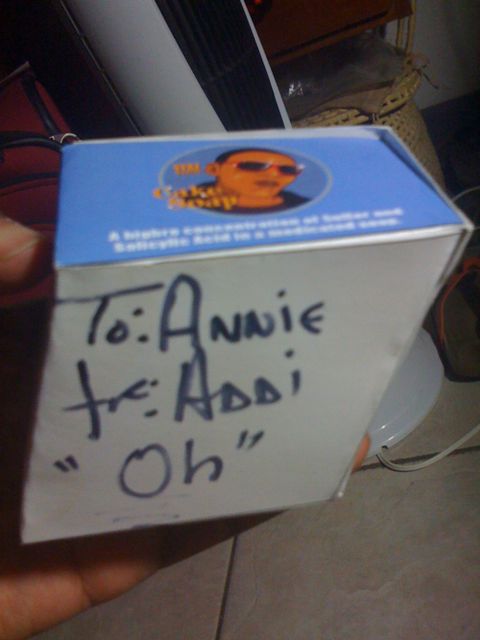
Below: Favourite gift, ‘cake soap’ inscribed from Addi to me–yes, the Kartel himself–it was my present from Anthony Miller, host of Entertainment Report (ER). See video below for the cake soap song, it’s all about bleaching…
Infamous cake soap celebrated by Vybz Kartel in song and videoand it's an autographed cake soap! From Addi to moi--
Below: The enchanting Christmas Treat protest which took place across from the US Embassy in Liguanea, Kingston on Wednesday. Children and adults waved placards and danced and sang demanding their annual Christmas treat, always held at that location by a Dr. Cole. We want Christmas treat! We want Christmas treat!
This year the Police High Command denied permission for the treat to be held on the grounds that it posed a security threat to the Embassy facing it. US Embassy officials on the other hand stoutly denied that they had requested any such thing. We may have to await further Wikileaks cable dumps to ascertain if this is true but in the meantime it was announced on the news this evening that the Police had relented and reconsidered their decision after meeting with relevant Embassy officials.
Christmas treat protestChristmas treat protest 2
Finally do enjoy the video below of a Trinidadian Indian Parang song. Parang is a form of Trini xmas music which is heavily influenced by its Hispanic heritage. Now add the Indian heritage to that and you get the following deadly musical cocktail. Right below that is Vybz Kartel’s Cake Soap. Merry Christmas everyone!
Anna Ardin, political secretary of the Swedish Christian SocialDemocrats, one of the rape claimants against Assange
We are now irrevocably in the era of information activism thanks to info evangelist Julian Assange, who has been variously described as an information saint, a digital fugitive and a rapist. Accused by Anna Ardin, political secretary of the Swedish Christian SocialDemocrats of riding her ‘bareback’ as they say here in Jamdown–after the condom being used broke–he now faces charges of rape in a Swedish court. The founder of Wikileaks foiled by a leaky condom. There’s a kind of poetic justice to it; the question however is what will the quality of Swedish justice prove to be?
Julian Assange, founder of Wikileaks has spoken to the BBC about fighting extradition to Sweden over sexual assault allegations. He believes he won’t be treated fairly. Should he go back? http://bbc.in/hHeZlR asked BBC World Have Your Say today.
Would the Nobel Peace Prize laureate, Liu Xiaobo, get a fair trial in China? Is the Pope Catholic? Do bears shit in the woods? Is ganja grown in Jamaica? Of course he wouldn’t be treated fairly.
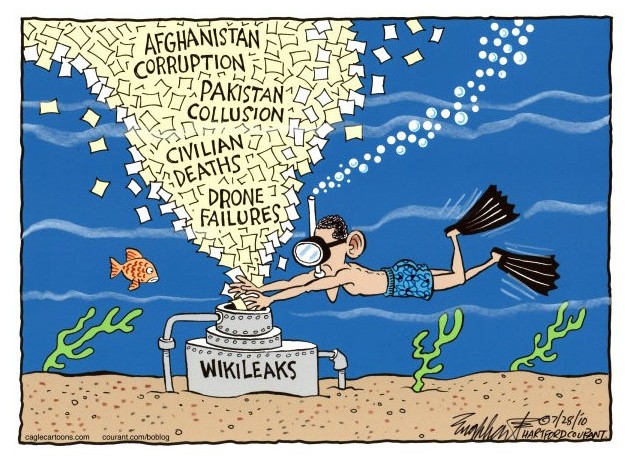
As long as Assange and Wikileaks were exposing secrets about non-Western countries like Kenya and Korea Julian was a hero. The conservative UK Economist magazine even gave him the 2008 Economist Index on Censorship Award. But by the time it was time for Time magazine to decide its Man of the Year award a couple of weeks ago things had changed considerably. By this time Wikileaks had released top secret and embarrassing classified documents about the US Wars in Iraq and Afghanistan, showing the wanton killing of civilians and a disregard for human rights as blatant as the supposed abuses that provoked those wars in the first place. The United States’ cover as a crusader for universal human rights, democracy and transparency was forever blown.
Bob Englehart, copyright 2010 Cagle Cartoons
Consequently although Time magazine readers voted overwhelmingly for Assange as Man of the Year, its editors opted to award the title to Facebook founder Mark Zuckerberg. According to a December 15 article in thinq.co.uk:
Facebook founder Mark Zuckerberg has been named Time magazine’s Person of the Year, blatantly disregarding the wishes of the magazine’s readership, who voted in their droves to put WikiLeaks founder Julian Assange in the top spot. The award is doled out annually to the person regarded by the magazine as the “most important” figure of the preceding 12 months. Readers are asked to vote for their favourite among a long list of nominations, but the final decision is left to the editors.
When the poll closed yesterday, Assange – who is currently in police custody in the UK – topped the chart with a whopping 382,024 votes, nearly a third of all those counted. Über-nerd Zuckerberg, by contrast, appeared to garner little support within the ranks of his 500 million ‘friends’ on Facebook, only just scraping into the top ten with a measly 18,353.
The 26-year-old CEO was beaten on the leader board by public figures including Steve Jobs and Barack Obama. Even Lady Gaga shimmied past him in her rubber pants to take number three spot.
We can only assume the editors must have employed the so-called ‘Florida method’, first witnessed in the 2000 US presidential election, in their final decision.
What’s funniest about the WikiLeaks bashing is that up until the middle of this year, Assange was being toasted all around. Two of the many awards his organisation has won are the 2008 Economist magazine New Media Award and a 2009 Amnesty International’s UK Media Award. The latter was for its publication of a report titled Kenya: The Cry of Blood – Extra Judicial Killings and Disappearances in 2008, which led to a regime change in the country.
Then, in April this year, WikiLeaks posted a video of Iraqi civilians and journalists being killed by US forces, followed by the Afghan War Diary in July and the Iraq War Logs in October – both showing up the US in dismal light. Since then, many bouquets have turned into brickbats.
The consequences for Wikileaks have been dire. As Economic and Political Weekly noted in their article The Brave New World of Wikileaks:
The manner in which the leading “democracies” of Europe and North America have responded to these revelations has been acutely revelatory about these regimes themselves. Despite there being not a single criminal case against Wikileaks it has had its website shut down, its payment gateways with Paypal have been closed, Visa and Mastercard have refused to transfer funds, its bank accounts have been frozen (including the one meant for its Julian Assange’s legal defence) and, worst of all, elected representatives have called for the murder of Assange. And there is no certainty that he will not meet an untimely end as various people have, whenever they have crossed Uncle Sam’s path.
Much has been said and written to decry Assange’s claims of being a journalist. He certainly is not a journalist in the traditional sense of the word, but his Wikileaks intervention has definitely altered the prevailing paradigms of journalism forever. Accusations of data dumping and lack of analysis of the data dumped miss the point completely. In Invisible Leaks Aaron Bady aka zunguzungu, a California-based blogger who has attracted a lot of attention recently, explains the significance of the ‘scientific journalism’ that Assange is proposing. Pointing out that it isn’t only Wikileaks that is leaking documents he examines a story in the UK Independent based on a leak showing that government “Ministers believe most graduates will spend their whole working lives making monthly payments to cover their loans and interest – without ever being able to settle their debts.” Yet the government went ahead and raised university fees regardless provoking the massive student riots and the near lynching of Prince Charles and Camilla we saw in early December. As zunguzungu points out:
…the entire story is nothing but a leaked document, and yet who leaked it? You barely even notice that there even was a leaker. And you don’t notice that The Independent’s role here has not been to propagate and disseminate the leaked document, but in fact, to obscure it. They read it and decided which parts were worth emphasizing, and then they excluded those which were not (the author of the report, for example, or other budgetary details). Such details might be much more damning. Yet standard journalistic procedure here is to excise such details, making an editorial choice (and taking the interpretive license) to tell you what the document says. Which is where Wikileaks’ “scientific journalism” comes in, the idea that all leaked documents should be fully released, so that conclusions can be independently checkable (not just checked by The Independent). Which is, of course, Assange’s real sin, and the reason he could be tried for espionage for publishing classified material, while the NY Times and Guardian never will be: he deigned to let us read the news ourselves.
Zunguzungu’s blog itself is an extraordinary one that shows the volatile and fast-shifting nature of the current media environment. According to Alexis Madrigal, a senior editor at The Atlantic:
When historians look back at WikiLeaks and how the world’s pundits tried to make sense of what was happening, they’ll see a familiar list of sources: Foreign Policy’s Evgeny Morozov, The Guardian’s John Noughton, The New York Times’ David Carr, several people from the Berkman Center for the Internet and Society, and various long-time digital leaders like Geert Lovink and Larry Sanger.
But among that list you’d also find Aaron Bady and his blog zunguzungu.wordpress.com. His probing analysis of Julian Assange’s personal philosophy and possible motivations became an oft-cited piece of the global conversation about what WikiLeaks might mean. Before Bady’s November 29 post, Julian Assange and the Computer Conspiracy; “To destroy this invisible government”, only a few hundred people a day found their way Bady’s blog. In the days afterward, tens of thousands of people swarmed to the site — and Bady ended up linked by some of the most influential media outlets on the planet.
This article explores how that happened because it shows that in today’s media landscape, an act of journalism can spread quickly to the very highest levels of the culture and news industry, no matter where it comes from.
Interestingly it was via the tweets of one of the tweeple i follow, ethnomusicologist @wayneandwax {the twitter handle of Wayne Marshall–not the Jamaican DJ–though Wayne has actually written about Jamaican music extensively (wayneandwax.com), even publishing an article in a special Reggae Studies issue of the journal I edit, Social and Economic Studies} that zunguzungu’s fascinating blogposts on Assange came to wider attention.
I end with a couple of tweets from my timeline: At what point does information become knowledge? asked @dmccaulay. When data is organized it becomes information. When it finds a potential application, it is knowledge, responded @damienwking.
Nuff said. For more info on Wikileaks, Assange and the history of the organization watch the videos below. The first one ends abruptly before the end, but the second one has the final clip:
A brief account with photos and video of Icons under Water, Greenpeace’s symbolic action in Cancun, COP16 and Kumi Naidoo…
Mobilizing the Icons
So I’ve been in Cancun, Mexico since Dec. 5 assisting my old friend Kumi Naidoo with his hectic schedule at the COP16 climate summit negotiations as head of Greenpeace International and Chair of The Global Campaign for Climate Action. I haven’t been to any of the formal meetingsmyself, by all accounts extremely long-winded, boring gatherings, but am very much part of the behind the scenes action, particularly where Greenpeace and Kumi are concerned.
Yesterday morning for instance I accompanied a group of Greenpeace activists as they executed one of their trademark performances designed to highlight the perils of so-called global warming. The concept was simple, efffective and relatively inexpensive, involving cutouts and submerged activists holding them up. The media turned up in force and today the Washington Post and other international and Mexican media featured images of the drowning icons. I was thrilled to be present at the execution of what was literally an iconoclastic event.
Labeled Icons Under Water the performance hoped to send a message to Ministers meeting at the UN Cancun climate talks that “the rising tide of climate impacts will affect each and every one of us – rich and poor.”
“Greenpeace is here today to illustrate that climate change does not discriminate, “ said Kumi Naidoo, Greenpeace International Executive Director. “We are all in this boat together, the storm is coming – we need to steer in the same direction.
“The rising tide of climate impacts, be they economic, environmental or humanitarian will affect everyone – rich and poor. Here in Cancun, Ministers must choose to steer it towards a bright and safe future. The rising tide of climate impacts, be they economic, environmental or humanitarian will affect everyone – rich and poor.”
You can read a Greenpeace activist’s account of it all here.
Kumi Naidoo talking to mediaMission Accomplished: Greenpeace Icons Under Water team
A few days before Icons Greenpeace activists had carried out another breathtaking, imaginative performance titled Real People can’t live under water. Visual culture fiend that I am these creative, visually arresting interventions fill me with admiration.
Real People can't live under water
For Kumi however, hardcore activist that he is, such activities are peripheral to the real substance of the climate talks; they may catch the world’s attention he says, but ultimately it’s the actual, painstaking give and take between governments, big business interests and advocates and NGOs representing the interests of ordinary people that will matter in terms of reducing wear and tear on the planet. I think Greenpeace’s manipulation of the visual to grab media attention does play an important role in conveying the urgency of the situation we face and is part and parcel of winning the hearts and minds of people in the struggle for what has become known as ‘climate justice’.
I’ve blogged about Kumi before he joined Greenpeace; see my posts about his hunger strike for Zimbabwe here and here. The CNN video below gives you a more comprehensive account of his career and a better sense of his personality. He’s been to Jamaica several times since i first met him in Trinidad and Tobago at a 1995 conference on Indians in the diaspora. There aren’t too many international organizations headed by persons from the South. The Mexican Greenpeace contingent for instance take pride in the fact that Kumi is from South Africa and not from the so-called developed world. It’s going to be interesting to see if and how he manages to leave his imprint on this forty-year old NGO. By coincidence the next United Nations Climate Change Conference, COP 17, is going to be held in Durban, the city of his birth.
In the videos below you can see Icons Under Water as it was orchestrated yesterday morning. Do forgive the occasional inexpert handshaking…
A tongue in cheek piece ‘connecting the dots’ between the arrival of the US Ambassador to Jamaica and a bizarre sequence of events.
Jamaica Observer: Jamaica's Ambassador to the United States, Her Excellency Audrey Marks (left) presents US Ambassador Designate to Jamaica, Pamela Bridgewater, with a book of Jamaican poems entitled 'Soul Dance' by Jamaican author Jean Lowrie-Chin, when she paid a courtesy call on Ambassador Marks at the Embassy of Jamaica on Tuesday, August 24
From time to time I like to undertake what i call ‘Dot connection exercises’. For instance I couldn’t help but notice the sequence of events that preceded and followed the sensational charges recently levied against JLP Deputy Leader James Robertson. Can we read a pattern here?
Someone spraypaints PNP graffiti all over the JLP stronghold of Tivoli Gardens.
Clovis, Jamaica Observer, November 10
According to a Gleaner article “Member of Parliament for West Kingston, Prime Minister Bruce Golding, is demanding answers from the police about who spray-painted pro-People’s National Party (PNP) graffiti on several premises in the communities of Denham Town and Tivoli Gardens Tuesday morning.”
In the days that followed speculation was rife as to who could have marked up the fortress of Tivoli in this manner; was it the residents themselves? was it the Police under whose watch the outrage had occurred?
“The one thing that I will dismiss is that the graffiti that was painted here was done by duppies from over the May Pen Cemetery,” Mr. Golding was reported by the Gleaner as saying.
Nov 14
The Sunday Herald publishes allegations that Deputy Leader of the JLP, Senator James Robertson, took out a contract on the life of Ian Johnson, a loyal activist for the Labour Party. Everyone immediately starts casting aspersions on Johnson’s mental health. Why? A crazy person can’t be targeted for murder? Remember the saying Just because you’re paranoid doesn’t mean they’re not out to get you. Just saying… For reasons unknown, Clovis the Observer cartoonist has not yet produced a cartoon depicting this situation.
Nov 16
Montego Bay Mayor Noel Donaldson writes to Prime Minister Golding saying he has recieved death threats from within the Jamaica Labour Party (JLP). He believes that Horace Chang interests are menacing him for supporting rival Christopher Tufton in the party’s leadership race.
Olint boss former foreign exchange trader David Smith was flown from a Turks and Caicos prison to to the US to face 24 charges against him. Pleads not guilty.
On the same day the JFJ (Jamaicans for Justice) calls on govt to correct 100 human rights abuses.
Nov. 19
It is announced that Jamaica has passed the next IMF test though a rocky road is predicted for the future. The last time Jamaica passed an IMF test was in May just before the Tivoli invasion and right after Bruce Golding announced his willingness to hand over Dudus to US federal authorities.
Las May, Sunday Gleaner, November 21, 2010
Also on November 19 there was an unexpected lightning visit by the President of Colombia. Newspapers report that:
President of the Republic of Colombia, Juan Manuel Santos Calderón, hopes the strategies his country used to fight the drug cartel in his country will be of benefit to Jamaica’s crime problem.
Prime Minister Bruce Golding (left) converses with President of Colombia Juan Manuel Santos Calderón shortly after the laying of a wreath at the statue of South American liberator Simón Bolívar at National Heroes Circle yesterday. - Rudolph Brown/Photographer
What next? And do you, like me, detect the hand of the Americans behind all this? Could this be our Manifest Destiny? Is the US just cleaning up its backyard?
Brief coverage of the funeral service for Gregory Isaacs, the Cool Ruler…
Photos: Annie Paul
This week was a brutal one. It started on Monday with the memorial service for Professor Barry Chevannes, whose sudden passing earlier this month took Jamaica by surprise. It ended today with the funeral service for the late Gregory Isaacs, the beloved Jamaican singer whose death a few weeks ago caused his name to trend on Twitter (worldwide) for an entire day. Considering how big Gregory was abroad it was surprising to see how small the crowd that came to send him off in Kingston was. The service was no less a treat for those who took the trouble to attend, myself included.
The star-packed programme ran smoothly and swiftly, with singer after singer performing to a rapturous audience in a rousing prelude to the actual service itself. The National Indoor Sports Centre was by no means filled to capacity but Gregory’s fans and friends sang and danced to his memory in a touching and heartfelt tribute to the cool ruler. It was a mature crowd, very few young folk around; I don’t recall seeing any of the big names in Dancehall there and no LA Lewis wasn’t in attendance…
Gospel singer, Barbara Jones
Ken Boothe, The Tamlins, Shaggy, Freddy McGregor, Judy Mowatt, George Nooks, A. J. Brown, Etana, Ernie Smith and the Nexus Choir were among those who performed while Tommy Cowan emceed the service. An enthusiastic bunch of women commandeered the video light by dancing and singing in the aisles when Nooks and Shaggy performed (see videos below).
Shaggy
Gregory was born in Fletcher’s Land, Kingston.His father was a Garveyite. His aunt, Mrs. Myrtle Shepherd, talked of how Gregory’s mother would dress him in sailor suits as a toddler. Numerous anecdotes were told of Gregory’s wit and good humour. Fond stories were related such as “Gregory used to say Neva bruk a man foot coz u might have to pass him on yr way back so just sprain ‘im ankle…” On another occasion when his room was invaded by enthusiastic fans in an African country where he had performed, he took refuge in someone else’s room after hiding the large sum of money he had earned under the ice machine at the hotel. According to him it was better that it got slightly wet than stolen.
Mikie Bennett once told me that Gregory was a very unassuming man, not given to delusions of grandeur despite his celebrity. When he performed at shows in Jamaica he would arrive early and ask to be allowed to perform soon so that people wouldn’t have to stay till the wee hours of the morning just to hear him. This is why i missed hearing him, when i arrived fashionably late at a Heineken Startime where he was performing, thus blowing my one chance of seeing Gregory Isaacs perform live.
Red roses, flags and Trilby hats were some of the memorabilia on sale outside the venue. On my way out i stopped to buy a Trilby and ended up taking the photo below of a fellow customer who couldn’t decide if he should take a white one or not. The picture convinced him to part with his money much to the vendor’s delight.
I leave you with some YouTube videos of the footage i took of the utterly heartwarming dancing and singing at the Cool Ruler’s funeral today. Have a look. Already in less than two days one of them has been viewed 634 times and the other one 723. We underestimate the interest of the Jamaican diaspora in what is happening back home. The following comments were left on the videos:
missmarjelGive thanks for posting this. It’s really important for those of us that could not be there in person. blessed.
and
MegaSoundkillaDo u have the clip when he Beried under the ground
Unfortunately i don’t have any footage of the burial not having gone to Dovecot for the interment. Incidentally quite a few people are angry that Gregory Isaacs was not given a hero’s funeral at Heroes’ Park and are circulating a petition to remedy this. On the matter of the low attendance at the service a music producer friend thought it might have been due to its being the third event in his honour in the space of a week. Last Thursday there was a huge free concert in his honour which was extremely well attended. I’m glad i went to the funeral service though. There’s nothing to beat the spirits and vibes at a Jamaican funeral anyway, but when its someone popular like Gregory or Bogle, it’s always extraordinary.
I apologize in advance for the abrupt way the videos end. was worried about batteries. Till soon.
Aung Suu Kyi’s release, the Gaza situation, and Jamaican dancehall
Free at last! As i write this the world is celebrating the release of Aung San Suu Kyi, held captive for 15 years by the ruthless military government of Myanmar/Burma. What a moment! There aren’t too many women–or men– like Suu Kyi, willing to sacrifice their freedom of movement in the name of moral principle, something completely lacking in politics today. Suu Kyi is an alumnus of my Alma Mater in Delhi, the venerable Lady Sri Ram College, whose initials, LSR, were said to be synonymous with Love, Sex and Romance for male students at Delhi University. Clearly besides being a source of girlfriend material, LSR has also produced stellar leaders with the moral fibre of the redoubtable Aung San Suu Kyi. I think of her as the Orchid of Steel.
Closer to home and the mundane, my daily trod was enlivened yesterday by a Skype interview with an Israeli journalist, Nirit Ben-Ari, who contacted me last week with the following request:
I will be honored and thankful if you interview with me for the article I am writing for Haaretz newspaper on dancehall culture in Jamaica. I am mainly interested in your interpretation of the term “Gaza” and its possible implication of awareness of global politics. Do you think that the choice of the name “Gaza” represents a political awareness and identification with the underdog? I am also interested in your view on the global “gaze” on dancehall culture and the dangers of misinterpreting and misunderstanding dancehall culture outside of Jamaica. What do you think about the dissemination of dancehall images globally?
In response i sent her the paper i had given at the Reggae Studies Conference earlier this year: Eyeless in Gaza (and Gully): ‘Mi deh pon di borderline’; essentially i was trying to document and comment on the effects of the feud between two of Jamaica’s top DJs, Vybz Kartel (Gaza) and Mavado (Gully) that resulted in the words ‘Gaza’ and ‘Gully’ being spraypainted or otherwise inscribed on surfaces all over Kingston, but also in places like Trinidad, Barbados as well as Brooklyn, London and the generalized Jamaican diaspora. I excerpt a relevant bit from my paper below:
Etymology of ‘Gaza’ in the Jamaican context
It is commonplace in Jamaica for impoverished urban areas to be informally named after locations known globally as war zones. Thus there are locales named ‘Angola’, ‘Tel Aviv’, ‘Vietnam’ and of course ‘Gaza’. In a widely publicized interview between Cliff Hughes, a prominent local journalist, and Vybz Kartel on TV Jamaica’s Impact which aired on November 12, 2009, Hughes asked Kartel why he had chosen the name Gaza for his area, and what the frequently uttered phrase ‘Gaza mi seh’ meant. Kartel who often refers to himself in the third person responded:
“’Gaza mi seh’ means ‘Fight for what you believe in against all odds, against all adversity.’ When I left the Alliance Vybz Kartel came under so much pressure, I said to Black Rhino and others we need to form a group. But we need a perfect name. The first war was just happening in Gaza, Israel was bombarding them but the people were fighting back regardless, and Vybz Kartel said to Laing (Isaiah Laing, prominent promoter associated with the annual Sting show), we’re going to use that name coz it means to me–dem people deh serious and dem nah back down.”
Indeed. Just like Aung San Suu Kyi. She nah back down needa. Interestingly, Kartel steered clear of the reason he felt obliged to look for a suitable name for the Portmore community associated with him, in the first place. The backstory is an interesting one umbilically connected to the complicated discourse around masculinity and sexuality in Jamaica. Yet the details of why the community of Borderline in Portmore came to be rechristened ‘Gaza’ is one the media had never considered noteworthy enough to mention let alone dwell on.
But back to yesterday, I can’t tell you how cool it was to be sitting in my living room in Kingston talking directly to Nirit in Tel Aviv, complete with images of ourselves and the rooms we were in. Viva Skype!
Nirit explained that she had wanted to read Carolyn Cooper and Donna Hope’s books on dancehall culture but they weren’t available in Tel Aviv and she had ordered them on Amazon but hadn’t recieved them yet. In the meantime someone referred her to my blog which is why she asked me to help her with the background on the use of the word ‘Gaza’ in dancehall culture. Interestingly Nirit works for an NGO named Gisha “an Israeli not-for-profit organization, founded in 2005, whose goal is to protect the freedom of movement of Palestinians, especially Gaza residents.”
How do you get from Gaza to Ramallah? Play "Safe Passage"
Like Aung San Suu Kyi the Palestinians have had their freedom of movement severely curtailed by the state of Israel. As the Gisha website explains:
Since the 1967 occupation of the West Bank and Gaza Strip, Israel’s military has developed a complex system of rules and sanctions to control the movement of the 3.4 million Palestinians who live there. The restrictions violate the fundamental right of Palestinians to freedom of movement. As a result, additional basic rights are violated, including the right to life, the right to access medical care, the right to education, the right to livelihood, the right to family unity and the right to freedom of religion.
Gisha, whose name means both “access” and “approach,” uses legal assistance and public advocacy to protect the rights of Palestinian residents. Because freedom of movement is a precondition for exercising other basic rights, Gisha’s work has a multiplier effect in helping residents of the occupied territories access education, jobs, family members and medical care.
Funnily Nirit told me that a Palestinian friend of hers got a chance to spend two months in Jamaica and was exulting at the thought of getting away from it all to a tropical island far from the rigours of life in Gaza, only to arrive in Kingston and find the word ‘Gaza’ graffiti-ed all over the city. You can read the first person account of Lisa Hanania’s visit to Kingston here.
Vybz Kartel was certainly aware of and sympathetic to the Palestinian cause but sympathetic is actually too weak a word to describe the admiration he expressed for the people of Gaza in that interview with Cliff Hughes: “…dem people deh serious and dem nah back down” and “’Gaza mi seh’ means ‘Fight for what you believe in against all odds, against all adversity.’” On the other hand i’m not sure how widespread Kartel’s view of the Palestinians is. Could one say that most of Dancehall’s ‘core constituents’ (to use Ragashanti’s apt term) are sympathetic to those ‘trapped in Gaza’? I don’t know.
What i do know is that Jamaican dancehall’s focus on Gaza has had an interesting ripple effect. When i tweeted a few days ago about being contacted by an Israeli journalist about the name Gaza in the Jamaican context one of my tweeple, Sweden-based @johannakey said “I’ve done a story on the same subject. There’s a Swedish song about it here.” The song Real Gaza mi seh! is so addictive i can’t get it out of my head. It’s a beautiful song, in which connections are made between Gaza, the curtailment of Palestinian civil liberties and universal oppression, using the vehicle of dancehall and the refrain “If you kill one of us, you kill all of us…the whole world is Gaza mi seh”. Listen to it below:
Eyes of the world pon the Gaza mi seh…
Well dem say Gully, dem say Gaza dem say Congo and Kinshasa Everywhere i turn i see pure passa passa I remember Kid Frost used to talk about La Raza It’s all tribal war people can’t take it no longer
Hopefully one day the residents of Gaza will–like Aung San Suu Kyi–regain their freedom. Till then Gaza mi seh!
Writer Arundhati Roy’s home is attacked by a mob protesting her position on Kashmir.
Speaking her mind Arundhati Roy’s views on the Kashmir issue have invited brickbats from all possible quarters (Tehelka). PHOTO: GETTY IMAGES
The democratic tradition in India is only skin deep. It’s as superficial as the skins or membranes we buy to put on expensive cellphones and other gadgets. You realize this whenever a public figure criticizes the government, or generally adopts an unpopular position. How dare they? A virtual fatwa is issued against the offending party by irate citizens with not even the slightest pretence that they might have the right to express their views, whatever these may be. So after weeks of outrage expressed on Twitter about the writer Arundhati Roy’s stance on Kashmir (that it should be allowed to secede) today the inevitable happened. A horde of protestors accompanied by TV cameras lynched the writer’s home, vandalizing property and shouting slogans at her and her family.
As fellow writer Salil Tripathi tweeted: Everytime Arundhati Roy writes or speaks, she incites people and there’s unrest, demonstrations, and threats of violence: erm, against her.
If only people would get their knickers in as much of a knot over serious things like the corruption that was highlighted during the Commonwealth Games or the scandal over the Chief Minister of Maharashtra allotting several posh apartments in a fancy building to himself and family members. To make matters worse the building “originally meant to be a six-storey structure to house Kargil war heroes and widows … was later converted into a 31-storey tower, apparently in violation of environmental laws,” and divided up among top politicians and army personnel in Mumbai.
How on earth is it that in the face of such crimes people can find the time to lynch a writer merely for expressing her views? And even if some people were foolish enough to do this how come members of the media accompanied the unruly protestors to the location and stood by doing nothing while the writer’s house was attacked? Is this the Indian version of ’embedded media’? Below is the statement issued by Arundhati Roy on the mob attack this morning.
A mob of about a hundred people arrived at my house at 11 this morning (Sunday October 31st 2010.) They broke through the gate and vandalized property. They shouted slogans against me for my views on Kashmir, and threatened to teach me a lesson. The OB Vans of NDTV, Times Now and News 24 were already in place ostensibly to cover the event live. TV reports say that the mob consisted largely of members of the BJP’s Mahila Morcha (Women’s wing). After they left, the police advised us to let them know if in future we saw any OB vans hanging around the neighborhood because they said that was an indication that a mob was on its way. In June this year, after a false report in the papers by Press Trust of India (PTI) two men on motorcycles tried to stone the windows of my home. They too were accompanied by TV cameramen.
What is the nature of the agreement between these sections of the media and mobs and criminals in search of spectacle? Does the media which positions itself at the ‘scene’ in advance have a guarantee that the attacks and demonstrations will be non-violent? What happens if there is criminal trespass (as there was today) or even something worse? Does the media then become accessory to the crime? This question is important, given that some TV channels and newspapers are in the process of brazenly inciting mob anger against me. In the race for sensationalism the line between reporting news and manufacturing news is becoming blurred. So what if a few people have to be sacrificed at the altar of TRP ratings? The Government has indicated that it does not intend to go ahead with the charges of sedition against me and the other speakers at a recent seminar on Azadi for Kashmir. So the task of punishing me for my views seems to have been taken on by right wing storm troopers. The Bajrang Dal and the RSS have openly announced that they are going to “fix” me with all the means at their disposal including filing cases against me all over the country. The whole country has seen what they are capable of doing, the extent to which they are capable of going. So, while the Government is showing a degree of maturity, are sections of the media and the infrastructure of democracy being rented out to those who believe in mob justice? I can understand that the BJP’s Mahila Morcha is using me to distract attention the from the senior RSS activist Indresh Kumar who has recently been named in the CBI charge-sheet for the bomb blast in Ajmer Sharif in which several people were killed and many injured. But why are sections of the mainstream media doing the same? Is a writer with unpopular views more dangerous than a suspect in a bomb blast? Or is it a question of ideological alignment?
One of the best responses to the entire situation came from Vir Sanghvi. In a cunningly argued article in the Hindu Times he asks a crucial question and then provides the answer:
Is the damage to India so great that it justifies curtailing free speech?
Obviously, it isn’t. No violence followed her statements and nor did she incite it. Moreover, there will still be an India with Kashmir as an integral part of it long after Roy herself is forgotten.
So, let’s just cool down. We have a perfect right to dislike Roy. We are entirely justified in being angered by her statements. But the moment we compromise on the principles that make us a liberal society —especially when her remarks pose no real threat to us at all — we start playing her game.
Gregory Isaacs. Legendary Jamaican singer dies. a memorial.
Gregory Isaacs, from the Gleaner archives
Gregory was drifting across the stage, in an orange three-piece suit, his skinny back swayed like a sea-horse, his voice a rippling whinny.
–Colin Channer, Waiting in Vain
It’s for lines like this that I rate Colin Channer; with 25 cannily chosen words he curates a transcendental image of the inimitable Gregory Isaacs, the much beloved Jamaican singer who surrendered to the big C in London today. Popular well beyond the shores of this small island the words Gregory and Isaacs have been trending worldwide on Twitter today. To understand what a feat this is, know that during the peak of Buju Banton’s recent troubles in New York, he trended for half a day in the New York region only. With Gregory every ten minutes 112 new tweets are pouring in from all over the world. Not all of them are in English (see sample below) showing that the Cool Ruler’s reach transcended geographic and linguistic boundaries in a virtual enactment of his song The Border. It’s hard to choose any one GI song as No. 1 but for me this one comes close.
If i could reach the border Then I would step across So please take me to the border No matter what’s the cost Cause I’m leaving here I’m leaving out of Babylon…
This place could never be my home… we waan we waan go home… where the milk and honey flow That’s where we want to go… we waan we waan go home… Africa we want to go…
So please take me to the border and i will pay the cost coz i’m leaving here…
The metaphor of Babylon has multiple meanings in Jamaica but the most potent is that of the biblical Babylon, the proverbial den of iniquity, reeking of corruption and venality…a place we know well…guarded by the world’s most brutal soldiers, themselves known as Babylon. The Jamaican Police.
When i moved to Jamaica in 1988 Gregory’s Rumours ruled the airwaves and the balmy, steamy nights just before Hurricane Gilbert. The dramatic opening chords and riddim bars hint at that heady mixture of menace and romance that typifies the Jamaican landscape. Another favourite…I still think of it as Rumours of War…which is what i thought i was hearing but it was actually Rumours a gwaan…
A pure rumours a gwaan, (rumours a gwaan)
Please mr. officer, leggo me hand You don’t know me and you don’t understan’ You see me flashin’ a criss rental So you claim that me a criminal
Rumours dem spreadin’…
Then who couldn’t love the perfectly fork-tongued Night Nurse, on the one hand a straightforward song of playful passion that so many couples can relate to, on the other a veiled paean to Gregory’s one time muse–the other big C–
Tell her it’s a case of emergency There’s a patient by the name of Gregory
Night nurse Only you alone can quench this Jah thirst My night nurse, oh gosh Oh the pain it’s getting worse
I don’t wanna see no doc I need attendence from my nurse around the clock ‘Cause there’s no prescription for me She’s the one, the only remedy
There have been 553 new tweets since i started writing this an hour ago. (PS: One is not making exaggerated claims for number of tweets as any indicator of real quality mind you, for alas, today, the day after i posted this, Gregory has been replaced by Paul the Octopus as a top trender. Apparently poor Paul was found dead in the water this morning. “Anyway Paul always had four feet in the grave…” quipped @Sidin. No doubt because his mortality had intimated itself to him !)
Olu OguibeDeclaring 24 hours of nothing but The Cool Ruler
Annie PaulTimes like this you realize not just the breadth but the depth of Jamaican music...
Olu Oguibe Still remember and cherish my first Gregory Isaacs cassette tape: Gregory Isaacs Live at the Brixton Academy, 1984. Wasn’t till I moved to Britain 5 years later that I realized Brixton Academy isn’t a real academy, but a night club, lol!
I was once even wooed with Gregory’s words by someone who thought he was the paradigmatic expression of Jamaican male angst (‘Though she isn’t in my top ten, still she is on my chart…”). Gregory forever holds a place in my heart on that count.
Here’s a selection of tweets on Gregory from local tweeters. i challenge you to guess which singer @bigblackbarry is referring to:
bigblackbarry [to] @oblessaHe isnt in the category I was referring to but your dad would prolly be the biggest trender currently god forbid if he died.
In which i explore a brand, new ‘in’ phrase in Jamaica. What do i mean by this?…
What do I mean by this?
Have just realized that there’s a new ‘in’ phrase in Jamaica and it’s spreading from commentator to commentator with the speed of hemorrhagic dengue fever. What do i mean by this? Yes, precisely, that is the phrase I’m talking about. What do i mean by this? That it is this phrase i have now heard used for the third time in the space of one week here in Kingston, Jamaica. And before it spreads much further I’d like to trace its origins. Can anyone tell me where it comes from? Please tell me who first used this phrase and why it’s taking Jamaica by storm. Was it a preacher? a ‘motivational speaker’? some first world politician like Obama? Why do I say this? (a variant of the said ‘in’ phrase…) .
First Angella Bourke of the People’s National Party used it on Impact last Thursday. She repeated it twice if i remember rightly. On Friday I heard someone else using it on radio, can’t remember who. Could it have been Emily Crooks? Naomi Francis? Cliff Hughes? Definitely not Raga. And those are the voices i regularly listen to on a weekday. Was it Carol Narcisse? Oh wait maybe it was someone at the Book Industry Association of Jamaica’s seminar on digital publishing in the Caribbean. I simply can’t remember but i did hear it again. And then just now, catching up with last Sunday’s dead tree media (the newspapers) i see that Clyde McKenzie has also caught the virus. In his article On the Success of Jamaican Music in last Sunday’s Observer he says:”In fact, ironically, the success of Jamaican music might well be working against Jamaican artistes. What do I mean by this? Well, on his return from etc etc….”
Seet deh? What do i mean by this?
Just that i want to know who originally popularized this phrase. Why do i say this? Because i can. Nuff said.
Wikileaks founder Julian Assange leaves a news conference on the internet release of secret documents about the Iraq War in London October 23, 2010. Reuters.
Could a nice, normal guy have started and run Wikileaks? asked @jeffjarvis today, sarcastically replying ‘No‘ to his own question.
It seems entirely predictable to me that anyone daring to expose damning military secrets pertaining to the United States’s disastrous wars in Iraq and Afghanistan would be subjected to severe ‘demonization’ as a first step toward damaging his credibility. After posting 77,000 classified Pentagon documents on the Afghan conflict on his website three months ago, Assange has now posted 391,832 secret documents on the Iraqi war. His critics say that he has endangered the lives of many secret intelligence sources (compare their numbers to the number of lives lost in both wars and let’s see if there’s still a serious complaint here) and are withdrawing support from him. We are told that he’s imperious, erratic and delusional, none of these are crimes mind you, and that he may have also molested two women in Sweden. Assange maintains that the sex was consensual.
Since posting the incriminating documents poor Assange has been forced to move from country to country looking for a safe haven without much luck. According to the New York Times article which provoked the above tweet:
Underlying Mr. Assange’s anxieties is deep uncertainty about what the United States and its allies may do next. Pentagon and Justice department officials have said they are weighing his actions under the 1917 Espionage Act. They have demanded that Mr. Assange “return” all government documents in his possession, undertake not to publish any new ones and not “solicit” further American materials.
Mr. Assange has responded by going on the run, but has found no refuge. Amid the Afghan documents controversy, he flew to Sweden, seeking a residence permit and protection under that country’s broad press freedoms. His initial welcome was euphoric.
“They called me the James Bond of journalism,” he recalled wryly. “It got me a lot of fans, and some of them ended up causing me a bit of trouble.”
Within days, his liaisons with two Swedish women led to an arrest warrant on charges of rape and molestation. Karin Rosander, a spokesperson for the prosecutor, said last week that the police were continuing to investigate.
In late September, he left Stockholm for Berlin. A bag he checked on the almost empty flight disappeared, with three encrypted laptops. It has not resurfaced; Mr. Assange suspects it was intercepted.
Things are so desperate that Assange jokes that he’s beginning to look at going to prison as the safest option open to him:
“When it comes to the point where you occasionally look forward to being in prison on the basis that you might be able to spend a day reading a book, the realization dawns that perhaps the situation has become a little more stressful than you would like,” he said over the London lunch.
I wonder whether our kindly hotelier Butch Stewart might be persuaded to offer Mr. Assange an extended vacation at Hedonism 1, 2 or 3, along with the Chilean miners to whom he so thoughtfully extended such an invitation. Or perhaps a shack on Wicky Wacky Beach could be made availabe? We could rename it Wikileaki Beach and take cruiseship passengers there for years to come. But then again would we have the balls to stand up to Uncle Sam? I think not. Methinks Julian had better start brushing up his Spanish as the Bolivarian Republic of Venezuela and the feisty Hugo Chavez may be his best bet. He better take up he money, like Matilda, and run Venezuela…
















 Active Voice