Excerpted from my new blog on EPW’s website…this inaugural post shares memories of Stuart Hall along with some photos.
Stuart Hall at INiva (Institute of International Visual Art) with Annie Paul and artist Steve Ouditt from Trinidad and Tobago, 2000
This post was written for the Indian magazine EPW (Economic and Political Weekly), it’s website to be specific, where I’ve been invited to blog. They asked if I would share some of my personal memories and photographs of Stuart Hall in the wake of his passing on Feb 10. The post follows.
RIP Stuart Hall, doyen of cultural theory (1932-2014). “The cultural dimension is not a secondary, but a constitutive dimension of society.”
I found Ranjit Hoskote’s tweet quoted above, worth retailing, because it encapsulates Hall’s vastly influential work most admirably and serves as a suitable introduction to the Jamaican-born thinker the world has been mourning since Feb. 10, 2014.
I first heard about Stuart Hall from Tejaswini Niranjana, an Indian scholar who visited Jamaica for three months in 1994. She was a Homi Bhabha Fellow (named after the Physicist not the theorist of hybridity) and had come to the University of the West Indies to familiarize herself with Caribbean culture. Teju was interested in and fascinated by the Indian diaspora in the Caribbean but equally by Jamaican popular culture which is predominantly Afro-Caribbean.
I credit Teju with awakening my now abiding interest in Caribbean, and in particular Jamaican, popular culture by introducing me to the relatively new field then, of Cultural Studies. Having studied English Honours at Lady Shri Ram College and Sociology at Jawaharlal Nehru University in the 70s followed by Journalism at the University of Kansas, and even a foray into visual art, I had found myself rudderless. Neither English Literature nor Sociology really enthused me; it wasn’t until that fortuitous encounter with Cultural Studies that I began to feel an interest in matters intellectual again.
Having wandered through several different ‘disciplines’ as I had, I was excited to find new ways of thinking and writing that synthesized my different areas of knowledge. Of course this was something that JNU’s multi-disciplinary approach to scholarship had also prepared me for. In 1995 I started writing a weekly column in a Jamaican newspaper while working at the University of the West Indies in scholarly publishing.
I named my column ‘Hyphen’ to signal my lifelong feeling of ‘in-betweenity’, of being formed between cultures in an India that was rapidly modernizing, producing tectonic cultural shifts not always easy to navigate. Born and brought up a Syrian Christian, albeit by liberal parents, I always felt envious of my Hindu friends, especially the numerous rituals and festivals they could lay claim to. There was also a sense of feeling illegitimate, especially since I grew up in Ahmedabad, not Kerala, where I wouldn’t have been as out of place.
There is something profoundly destabilizing about watching your mother carefully crow-proof fishbones and other scraps of our non-vegetarian meals in secure little packets before consigning them to the garbage can in case rapacious birds outed us in front of our finicky vegetarian Gujarati neighbours, forcing us to leave the community in disgrace. There is also a deep discomfort in feeling disconnected from the vernacular culture around you because your father thought English was the only language you needed to know. Not being allowed to go to Hindi movies like all my friends did produced yet more alienation; by the time I reached my teens I felt like a classic misfit, like someone looking at the world through an impervious bubble.
It wasn’t till I came to Jamaica in 1988, after sojourns in the United States and Brazil that I started to feel at home, leading me to settle down here. Here was a vibrant, vernacular culture I could be part of. Jamaica is also the most welcoming society I’ve ever come across.
Part 2 of my 2007 article on Cindy Breakspeare written for Riddim magazine…
Beauty pageants and contests have always been of enormous importance in Jamaica, a vexed and competitive arena that was biased in favour of light-skinned or white girls who defined the ideal of beauty in Black Jamaica. With her green eyes and fair skin Cindy was the embodiment of the “hallowed sororities” of light/white beauty queens produced by the Anglophone Caribbean and thus the ideal candidate to represent Jamaica at Miss World. Unfortunately for her the Manley government in an acknowledgment of the black power movement sweeping through the Caribbean had banned beauty pageants and the Miss Jamaica contest in particular as politically incorrect.
Cindy’s obstacle-filled path to the Miss World competition is a tale in itself. Suffice it to say that after winning the coveted title Cindy spent a hectic year fulfilling her Miss World duties with gusto and returned to Jamaica a celebrity in her own right. About the contest she says that, “It ended up being my ticket and my passport to seeing the world, I always refer to it as my Dale Carnegie course. It really was a job for a year. To me there was nothing else…its not as though I was studying medicine or law or anything else like that and left it to take time out to do this pageant. For me it was an opportunity so I made up my mind to capitalize on it as much as I could.”
Nevertheless she was glad at the end of the year to be able to resume her blossoming relationship with Bob Marley which had continued during her reign; in fact the London press had made a mini-scandal of their affair billing it as a romance between Beauty and the Beast. It may be hard to imagine today but in those days it was not difficult to demonize Marley with his locks and Rasta livity. In fact Marley was similarly typecast by the middle and upper classes in Jamaica to whom Rastafari was anathema.
Nevertheless Cindy was committed to her relationship with Bob. Now that she had experienced the dizzying heights of being judged the most beautiful woman in the world she was keen to settle down and create a life for herself. Realizing during her coronation year that she was pregnant with Bob’s child Breakspeare decided that it was time to start the family she herself had never had. Marley and she had a surprising amount in common, “We definitely were both passionate about the idea of being healthy and keeping fit”. Cindy’s vegetarianism– the only flesh she would eat was fish–had attracted a lot of attention during the contest. In those days such fussiness about diet was not as common as it is today.
The decision to return to Jamaica wasn’t difficult although Cindy turned down several international modeling opportunities to do so. “I think by then I had had my fill and I wasn’t maybe so hungry for travel, I wasn’t so hungry for the idea of stardom coz it was really intense. Within 24 hours you go from being a small island girl that no one has ever heard of anywhere to being on the front of every newspaper that you pick up in London and they’re in your personal life and of course my relationship with Bob was much talked about because it was considered very outrageous and that put me through a lot of anxiety…”
She had always loved to draw and paint and back in Jamaica Cindy was approached by Donna Coore, the wife of Third World musician Cat Coore, to start a business called Ital Craft making jewellery from shells and other natural objects. Ital Craft went on to become immensely successful; at its height the hand-made jewellery found its way into stores like Bloomingdales, onto the runways of Paris and in sixteen locations in the Caribbean.
Cindy disputes the claim that Marley had funded the start up with huge sums of money.
“It’s like Ital Craft –- that the start up money for that was some hundreds and thousands of dollars. Rubbish! We started Ital Craft with J$2500, Donna Coore and I. That was the shell capital that we started the company with, it seemed like a lot of money at the time but certainly nowhere near what has been written I think it was in the Don Taylor book.”
About Bob’s involvement in the business Cindy said:
“Not so much that I would ask but that he would think it was a wonderful idea because he was very supportive of any creative endeavour, any initiative and he just thought it was wonderful and he would come up there late at night when he was finished with studio work and whatever and pull up a stool and say ‘I’m a tradesman you know, what you need me to do for you now?’ and in fact one of our big driftwood tables – I had dug up a tree root from out of the sand out at Hellshire Beach — he leveled it and we put a glass on it. He loved to be involved in any little thing like that. And himself and another little youth from Hope Road leveled the top of that table for us and we put the glass on it. But he just loved the creative energy because he was so steeped in the creative process himself, he loved to see it in other people and since he was in a position to encourage it he would go to London and he gave a girflfriend of mine 500 pounds and said Now go and buy anything you can make jewellery with—beads, cords, bindings anything—I didn’t ask him, he just came back and presented me with this enormous duffel bag full of things and said ‘see a few little things here to make some things?’ Well girl, it was like xmas had come two hundred times over. Wonderful. He was very inspirational that way and when he went to Australia he bought a lot of shells for us and had them shipped. And he bought us like our first drill press to make tiny holes for the jewellery because we were using a dentist’s drill up until then.
“So he was very very encouraging and very inspirational. He always wanted to buy me a fancy car and I kept saying I need a van, I really need a van to transport stuff around, get out to the beach and take up things like these big pieces of driftwood. I always was the kind of person who went for practicality and functionability over just what we call profile nowadays—yeah, a two-seater sports car is great, it can go really fast but can it do anything else? you know that’s always been my way of looking at things. So every now and then I’d keep saying I need a van so finally one day he just drove up the hill in this big blue Ford Transit van, walked inside and said ok see the key here? I said what?! And he said well didn’t you say you need a van, well there’s the van. I had no idea and it didn’t have to be a birthday present or a xmas present if it was just something that you expressed you needed in order to make another part of your life function that much better well ok well I can get you a van. And that’s how he was.”
Excerpts from my 2007 article for Riddim magazine on Cindy Breakspeare…
Photo: Source unknown
Ever since Cindy Breakspeare gave the annual Bob Marley lecture last week interest in her story has heightened. I had interviewed her in 2007 for Riddim magazine. The article appeared in German in Riddim and it just occurred to me that I could publish segments of the English original here on Active Voice. Enjoy!
When asked in a radio interview about her origins Cindy Breakspeare once said “I’m as Jamaican as ackee and saltfish”. The comparison to the national dish was particularly apt as the codfish used in it is often imported from Newfoundland, Canada. Ackee of course is a strange fruit considered inedible in many places because of the potent alkaloid toxins it contains. Jamaicans however eat it with gusto. Apt too because Cindy is the product of a Canadian mother and a Jamaican father; coupled with her white skin her bi-cultural heritage is what often subjects her to questions about her eligibility to be considered Jamaican.
I started thinking about this article after listening to numerous radio interviews with Cindy Breakspeare over the last five or six years. Who was this extraordinary woman? I was struck by her voice and the down-to-earth sincerity it radiated, her healthy sense of humour, her refusal at a certain level to wield the celebrity that is her entitlement or even to take it too seriously. This was in stark contrast to the social columns of Jamaica’s newspapers–filled with the affected poses of individuals whose lives are completely banal and vapid, their only claim to fame being their disproportionate control of the resources of this small postcolonial nation.
Cindy on the other hand had not only been the favoured consort of the first (and to date the only) global musical superstar from the third world—Bob Marley—shortly after meeting him she had become a celebrity in her own right by winning the Miss World competition in 1976. In those days this was an even rarer achievement for an unknown from a small developing country than it is today. As for Cindy’s Marley connection, many of us would have given our eyeteeth just to have heard Bob Marley in concert live, let alone to have enjoyed an intimate relationship with this extraordinary musician whose fame and influence have grown exponentially since his untimely death almost thirty years ago.
Cindy actually bore Marley a son, Damian, or Junior Gong as his father called him, who has turned out to be an outstanding singer and songwriter in his own right. Damian, more than any of his half brothers and sisters, has seemed the reincarnation of his father–the champion of poor people’s rights, the shamanic performer chanting down Babylon. Some Jamaicans, however, criticize Damian Marley as an example of an “uptown browning,” suggesting that he lacks street cred, something essential to good Reggae.
The success of Damian’s 2005 hit ‘Welcome to Jamrock’ silenced most critics. In any case this sort of criticism rarely originated in the streets where people appreciated the younger Marley shining a spotlight on their plight. The question is where did he get this social conscience from? From where did he get his unflinching penchant for reality and plain speaking?
Without a doubt this was partly a legacy of his legendary father who had died when Damian was only 2 years old. But having the same legendary father had not led the other Marley siblings to produce music of this caliber. What if some of Damian Marley’s outspoken lyricism actually came from his famous mother, the beautiful Cindy Breakspeare?
Judging by the interviews I had heard with Cindy I began to suspect that far from being a pampered member of any VIP club the young Marley had actually benefited from a double dose of radicalism: Not only was he his father’s son he also had a mother who had flouted the values of Jamaican society, turning her back on the wealth and privilege that could have been hers and embracing a countercultural lifestyle that was far from glamorous then no matter its currency today.
Who was Cindy Breakspeare exactly? Born in the fifties to a Canadian mother and Jamaican father Cindy was brought up in Jamaica and went to school at Immaculate Conception, a local convent school, as a boarder. Having to be a boarder at such an early age while difficult and challenging taught Cindy independence and self-sufficiency.
I went to Immaculate at the age of 7. I think when you’re separated from your family at that age you have to make a lot of decisions for yourself at a very early age–so you learn to trust your instincts, your own instincts, at a very early age; you develop your own value system, your own sense of what’s right and wrong for you. You tend to move away from being a sheep and doing what every one else wants because you don’t have that safe cocoon; you have to follow your own feelings a lot more. Yes, this feels right for me and no that doesn’t and yes I like this and no, I don’t like that and maybe because there is no family constantly directing and supervising and saying no, you can’t do this and no you can’t do that you just tend to wend your own path and after a while you just kinda don’t know any other way to be–you just dance to the beat of your own drum.
While going to a convent school gave her the foundation of a good middle class upbringing her own family life was fractured and unstable so that when she finished school she was on her own, fending for herself and looking for any opportunity that might come her way. At 19 Cindy had been out of school for a while and done many different jobs. There was no money for further studies; her parents were separated, her father now in Canada and she had to get out there and hustle for a living. “I worked at a furniture store for a while, I worked at a jewellery store, I ran a nightclub, I worked at the front desk of what was then the Sheraton, now the Hilton, so I did many different things and eventually found myself at this restaurant …Café D’Attic.”
Café d’Attic was Jamaica’s first health food restaurant specializing in “fruit platters and salad plates and very healthy sandwiches…It was very health-oriented and attracted those who were looking for something other than your greasy spoon, your fast food”. It was during this period that Cindy met Bob whose own preoccupation with healthy food and ital living brought him to the restaurant. This was also what brought Mickey Haughton-James, the owner of a fitness club called Spartan there, a momentous connection that ultimately led to Cindy becoming Miss World in 1976. “So Mickey came and began talking to me about leaving there and coming to be involved in Spartan. He had not opened it yet but he was looking for someone he felt embodied health and beauty. “I was looking for opportunity, always, always looking for opportunity. Whatever looked like the next good step to take, take, let’s roll with it. So I went to Spartan.”
A few photos of Stuart Hall along with a 2004 interview done in Jamaica
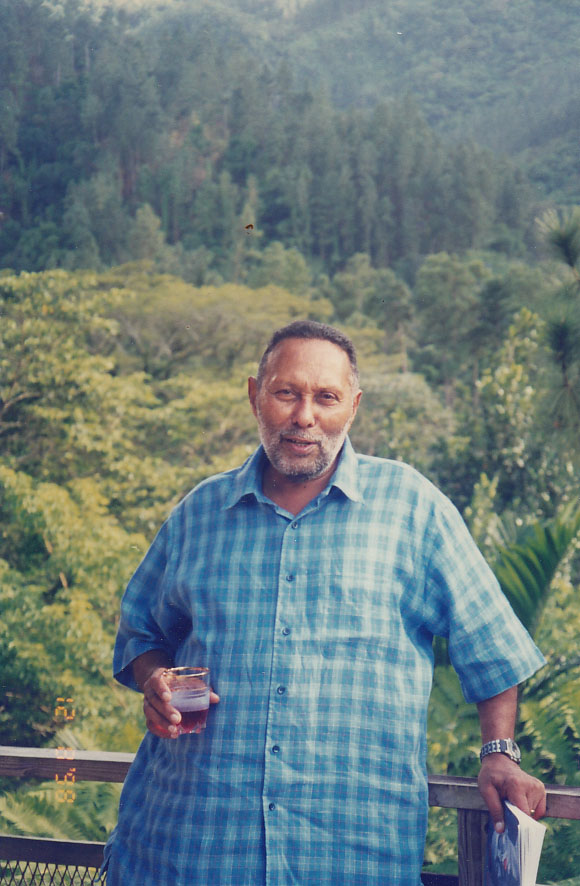
Stuart Hall, North Coast, Jamaica
When I saw Stuart at his home in London on December 14, 2013, I knew he wouldn’t last much longer. He had been ill for years and his health had deteriorated considerably since the previous year when we celebrated his 80th birthday at Rivington Place, the art centre born of his inspiration and hard work. All the same his departure comes as a blow. It’s too early for me to come to terms with this loss, for Stuart has been a close friend and mentor since 1996 when he came to the University of the West Indies to speak at the Rex Nettleford Conference.
For what it’s worth I publish a few photos taken over the years along with a substantive interview I did with Stuart in 2004. Stuart Hall was such an extraordinary thinker that his work ranged over a broad field of interests including visual art which was the one thing we truly bonded over. It was a preoccupation that didn’t get much coverage in other interviews which tend to focus more on his activism, his Marxism, and his political interventions. Here’s a link also to the post I wrote on the John Akomfrah film about him, a must see, which I hope will be shown on Jamaican TV soon.
Stuart when I first met him in 1996.David Scott (editor, Small Axe) and Stuart Hall, 1996Stuart Hall outside Rivington Place, under construction.1998
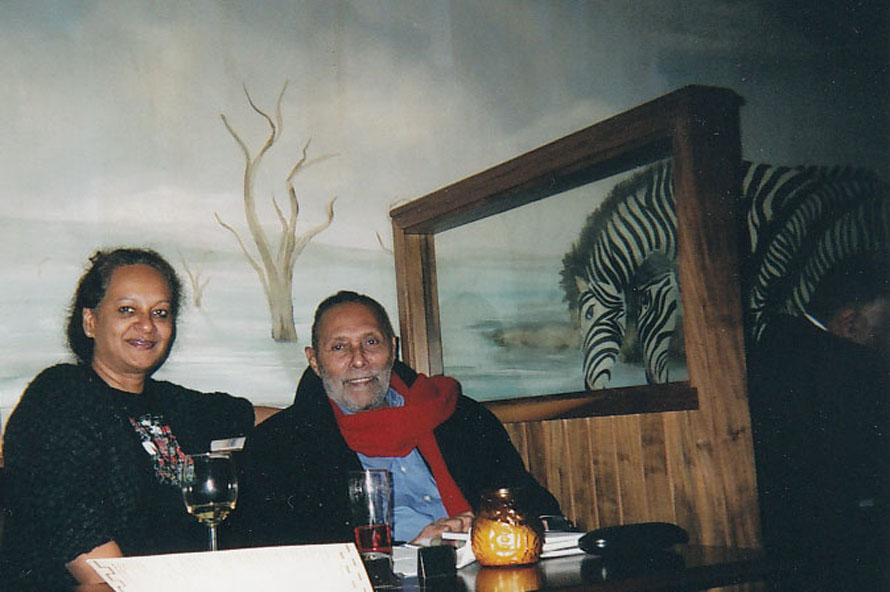
Stuart Hall at Aggrey Brown’s home, Golden Spring, Jamaica, 1998Stuart Hall at Good Hope Estate, Trelawny, Jamaica, 2004Stuart Hall (R) and Catherine Hall reading a copy of The Caribbean Review of Books at Hellshire Beach, Jamaica; June 2004with Stuart Hall at a bar on Edgeware Road, London, 2008. Photo by Dilia Montes-RichardsonPhoto by Dilia Montes-Richardson
and one of my treasures–a letter Stuart wrote to the Librarian at Birmingham U so that I could gain access to their inner sanctum:
Following the Vybz Kartel murder trial live and on Twitter.
So I finally made it to the Vybz Kartel Murder Trial this week. Jamaican DJ Kartel and his four co-accused are charged with the murder of Clive Williams aka Lizard, an associate who apparently borrowed two guns from the DJ and was subsequently unable to return them. It is alleged that in retaliation he was murdered by the DJ and his accomplices. In an unprecedented move Kartel and company have been held without bail for two and a half years, while rumours have swirled that the Police had incontrovertible evidence of Lizard’s murder at the hands of Kartel and his friends (despite the fact that to this day Lizard’s body has not been found). The evidence was said to be in the form of text messages, voice messages and videos found on cell phones belonging to the DJ that were taken into custody by the Police when he was arrested on 29 September 2011. There was also a series of text messages sent by Lizard Williams to his girlfriend saying that he feared for his life and begging her to inform the police.
Although some people, like my friend Peter Dean Rickards, remain skeptical of such evidence (“If someone preppin’ to murder me the last thing I’m going to be doing is sending txt messages…maybe I’m different,” he tweeted and “1) we’re talking about Jamaica here 2) no matter where it is, if you are looking at someone getting ready to kill you…do you send txt messages or do something a little more urgent?”) quite a few people have made up their minds that the entertainer is guilty of the crimes he’s accused of. So much for the accused being considered innocent until proven guilty.
Even though a couple of journalists, Emily Crooks for example, have been expertly tweeting the proceedings each day I wanted to observe the trial live and direct for myself. I particularly wanted to see Kartel’s defence lawyer Tom Tavares-Finson in action but as luck would have it I picked a day when he had just finished cross examining a key witness and wasn’t scheduled to be on. Not only that, it turned out to be the very day when the proceedings were so dull and plodding that Kartel himself fell asleep after lunch (see Emily’s tweets below).
Nevertheless I thoroughly enjoyed being in court on Wednesday to witness Pierre Rodgers (co-accused Sean Storm’s attorney) systematically pick apart Detective Sergeant Patrick Linton’s testimony. Linton is the former head of the Cybercrimes Unit who downloaded and presented the evidence collected from Kartel’s phones. While waiting for a legal friend to arrive to take me into Courtroom 2 where the Kartel trial was scheduled, I bucked up Supreme Court Judge Bryan Sykes who assured me that I needed no such escort, having a right as a member of the public to attend the trial. That may be true in theory, but in reality entry wasn’t easy.
Had I not been escorted by a legal heavyweight the four heavy set plainclothes policemen outside the courtroom who interrogated us while barring entry would have intimidated me enough to make me leave. Having finally breached the hallowed theatre of justice I was surprised at how small the courtroom was, and intimate; i found myself seated about six feet away from Kartel and within spitting distance of the jury. The DJ wore a shocking pink shirt and orange tie and held a matching orange handkerchief that he occasionally squeezed or twisted in his hands.
I don’t know if there were any other members of the public there, the seats were mostly taken up by plain clothes policeman nattily dressed in suits with different coloured ties and lawyers in their John Crow like robes. Not all the lawyers present were involved with the case, many of them were attending court cases of their own and slipped in and out when time permitted. Legatus Maximus, whose live tweets from the trial i had followed the day before turned out to be one such lawyer.
For those interested in getting a taste of this case and the courtroom action I’ve assembled below a series of tweets from the account of the person tweeting on behalf of Vybz Kartel under the twitter handle @Iamthekartel, followed by some of @Emilynationwide and Legatus Maximus’s tweets capturing some of the action. The main strategy of the Defence this week has been to shake the credibility of Det Sergeant Linton by suggesting that the evidence under his custody was tampered with and unreliable. For a verbatim transcript of the chilling voice notes presented as evidence by the police and much more see Emily Crooks’s blog thecrooksofthematter.
I arrived back in Jamaica from my two week visit to Amsterdam and London on the night of December 16 jetlagged and drained. I was in the air during the most important penultimate airing of the American reality show The Voice that evening and had missed the excitement of following the fortunes of Jamaican singer Tessanne Chin as she navigated a steady path to victory. As soon as we landed I tuned in to Twitter to see what i could glean about the evening’s performances. This collection of tweets is largely from that evening when instead of falling into bed after the ravages of intercontinental travel I stayed up till 1 am hooked to Twitter and the live commentary available there on Tessanne’s relentless ascent up the iTunes charts. Thanks to top journo Emily Crooks for her live tweeting and sometimes hilarious commentary (calling for a sign language interpreter from South Africa to interpret Cristina Aguilera’s body language after another stunning performance by Jamaica’s songbird eg).
Read the rest of this post on Storify–linked below:
A look at some reasons 13 Jamaicans were denied access to Trinidad and Tobago.
Diana Thorburn Chen: An apology is not necessary. What is necessary is for Jamaicans to have an honest conversation among ourselves about why we are turned back so often from our neighbours’ doors. But that would require us doing some soul-searching and talking honestly about how our actions bring on these reactions. Highly unlikely, so we will keep up the facade of indignation over and over again as until we face the truth nothing will change.
VERITAS also thought that Jamaicans needed to open their eyes and look within…
We are hypocrites too. When CARICOM member Haiti was struck by that devastating earthquake recently, and many Haitians turned up at our borders, desperate for admittance and “free movement”, we demanded the government send them back. Many of us were angry any money was even spent to accommodate them for the period they were here. Is it that free movement only applies when we want it?
What really troubles me about all this is the nagging feeling that most of us are angry because of our false sense of pride. We have always been a proud and, as one of my colleagues pointed out, reactive people. Trinidad’s exercise of its sovereign authority hurt that pride and so we are now reacting. If we are honest with ourselves, we have always harboured the unhealthy sentiment that Jamaica is the best of the Caribbean, a capital of sorts, and therefore we have behaved accordingly entitled. That is the source of our pride. Many of us are incredulous because we deem Trinidad a “spec in the sea” and “two likkle fi even be a country”, an “insignificant” country should never seek to disrespect Jamaica, right? We took the same stance on Mugabe’s comments on Jamaica. Meanwhile, the United States rejects us in droves every single day and we sit pretty smiling at that, with little more than a peep. In our quest to satisfy our wounded pride, we have gone as far as accusing Trinidad of “badminding” Jamaica for our achievements. I admit myself baffled at that argument, because we have such precious little to ‘badmind’. We are on auto pilot, veering on the edge of a political, economic and social abyss, who would ‘badmind’ that? Pride aside, how about we accept the fact that statistics are not in our favour? Most countries have instituted visa requirements against us because we do not have a good track record for international conduct and behaviour. We have to accept that; the bad mek it worse for the good. It is unfortunate, but true. Let us put our pride aside and accept the realities.
Then there were those who still thought Jamaicans had been wronged:
Michael Andrew David Edwards Whatever the reasons, the treatment as described is unacceptable; they wouldn’t accept it from us
And others who imagined the worst case scenario:
Nicholas Laughlin: I find myself thinking it’s a good thing Trinidad and Jamaica don’t share a land border.
Oh Nicholas, the very thought makes me shudder. But honestly i do have to ask: how can a population that has no qualms about turning away neighbouring Haitians when they arrive on Jamaican shores in dire need be so self-righteous when 13 of theirs are shown the door?
Jamaicans are considerably incensed over Trinidad and Tobago’s refusal to grant 13 of their compatriots permission to land in that country. The subject has dominated the talk shows as well as social media ever since the day the 13 were sent back. This isn’t the first time this has happened, in fact news reports said that over the last three years at least 1000 Jamaicans have been sent back from the twin island republic. An Observer article provides details of what is promising to blow up into a diplomatic row:
On Tuesday, 13 Jamaicans, including an 11-year-old girl and a man who is married to a Trinidadian woman, were denied entry upon arrival at the Piarco International Airport in Port of Spain and were sent back to Jamaica the following morning.
Immigration officials at the airport seized the Jamaicans’ passports and ordered them to sit on a hard bench all night before shipping them out of the country, despite the fact that the Caricom Single Market and Economy (CSME) allows for free travel between countries by Caribbean Community nationals.
The move by the Trinidadians is also a direct breach of the Revised Treaty of Chaguaramas and defies a recent ruling by the Caribbean Court of Justice (CCJ), which handed down a judgement in favour of Jamaican Shanique Myrie who had sued the Barbados Government.
Myrie was refused entry into Barbados on March 14, 2011, was detained, subjected to a dehumanising cavity search, and deported to Jamaica the following day.
Reactions from social media and local newspapers give some idea of the outrage this has caused:
From Facebook:
Mariel Brown
The fact that 13 Jamaicans from one flight were deported needs to be addressed by the tt government before we end up with a xenophobic backlash from Jamaica.
Diana Thorburn Chen
There are already FB fliers circulating calling for a boycott of all T&T goods & services.
Zarna Herrera
Xenophobic backlash in full force already
Signs of the xenophobic backlash are fully in evidence. The following is from the Observer article quoted above:
Jamaican George Lopez said Jamaicans can use their purchasing power to hit the Trinidadians where it hurts most.
“The only thing that works is the economic embargo. Don’t buy their goods, don’t give their children jobs. The Government won’t do it, so the people must,” said Lopez.
“I am going to remove my money from any financial institution that has ties to the eastern Caribbean. I have long boycotted them, my family and friends also, from the 1970s. They are racist,” he charged.
Lopez said Trinidadians’ hatred for Jamaicans go way back to the 1960s when the Alexander Bustamante-led Government voted against a Caribbean Federation.
“There is a retention of hatred. It is the small island mentality. Jamaica is a continental mentality. I won’t go there (Trinidad),” he said.
Meanwhile on Twitter my good friend Grindacologist was gnashing his teeth and muttering under his breath about any Trinidadian musicans coming here:
@Grindacologist
wait till kes the band try come round ere again…a worries…
all di one machels montanas…
goin mek dem sleep pon di tarmac…
when a jamaican gets killed in trinidad dem all try deport the corpse…
Stay tuned to this spot for further updates on this contentious issue.
A meditation on Afro-futurism and Jamaica’s contribution to it…
The first time I heard of Afrofuturism it was from Camille Turner (@Afrofuturist) who was helping Honor Ford-Smith with her Rest in Peace murals project. She introduced me to her short film, The Final Frontier, according to her “an ongoing performance that chronicles the voyage of African Astronauts, descendants of the Dogon people of West Africa who have returned to earth after 10,000 years to save the planet.” Check it out.
There’s quite a tradition of Afrofuturism in Jamaica. The inimitable Lee ‘Scratch’ Perry is possibly the coolest alien the world ever hatched and he’s from here. check out his video below. It’s unclear if this is a spontaneous ad for Guiness but among other things the goblin of dub raises a toast or two to Dublin.
And then, improbably enough, there’s Bunny Wailer. He who hated flying in airplanes, navigates cyberspace on his flying carpet in grand style.
Bunny Wailer as Cyber Ras flying through space
I should mention that the occasion for all this reflection on Afrofuturism is the current exhibition at the Studio Museum in Harlem: The Shadows Took Shape which i sincerely hope I’ll get a chance to see.
The Shadows Took Shape is a dynamic interdisciplinary exhibition exploring contemporary art through the lens of Afrofuturist aesthetics. Coined in 1994 by writer Mark Dery in his essay “Black to the Future,” the term “Afrofuturism” refers to a creative and intellectual genre that emerged as a strategy to explore science fiction, fantasy, magical realism and pan-Africanism. With roots in the avant-garde musical stylings of sonic innovator Sun Ra (born Herman Poole Blount, 1914–1993), Afrofuturism has been used by artists, writers and theorists as a way to prophesize the future, redefine the present and reconceptualize the past. The Shadows Took Shape will be one of the few major museum exhibitions to explore the ways in which this form of creative expression has been adopted internationally and highlight the range of work made over the past twenty-five years.
The exhibition draws its title from an obscure Sun Ra poem and a posthumously released series of recordings. Providing an apt metaphor for the long shadow cast by Sun Ra and others, the exhibition will feature more than sixty works of art, including ten new commissions, charting the evolution of Afrofuturist tendencies by an international selection of established and emerging practitioners. These works span not only personal themes of identity and self-determination in the African-American community, but also persistent concerns of techno-culture, geographies, utopias and dystopias, as well as universal preoccupations with time and space.
Last night there was a Shadows Took Shape Panel Discussion with Naima J. Keith, Zoe Whitley, Alondra Nelson and Paul D. Miller (aka DJ Spooky, That Subliminal Kid) that was live tweeted making it possible for me to follow the proceedings from here. Check out the tweets below to get a sense of the event.
Studio Museum Harlem @studiomuseum live tweeted most of the following:
“How would you define Afrofuturism? Conversations about race and technology.” -Alondra Nelson
“Afrofuturism wasn’t originally about an academic lockdown. It was a collage of hip hop, sound, and tapestry.” -DJ Spooky
“People were bored. In the 90s the art world barely knew how to use a computer.” – @djspooky
“Whether you’re a dada-ist or a futurist you’re interested in new portals.” – @djspooky
“I loved Octavia Butler’s book, Kindred, so much that I wanted anyone I dated to read it first…” @alondra jokes.
“I took my name from “Nova Express” by William S. Burroughs.“ – @djspooky
.@djspooky highlights the influence of dancehall music in the Carribean on the course of electronic music.
“I loved anything that had an alien!” – @alondra
“People have a selective memory when it comes to slavery. There was no future.” – @djspooky
“Well, what isn’t futuristic about being black in America?” -Greg Tate
“The idea that the robots will uprise and take over goes back to slavery.” @djspooky
Thanks to @DukeU we can all access some of @alondra’s #Afrofuturist texts through Dec 21st. Visit: bit.ly/afrofuturism
“What’s wrong if it’s only afro? It isn’t about excluding other people. It was about carving out a space.” –
Panelist @djspooky offers a healthy critique on the exhibition recommending that there be more music.
Alondra Nelson @alondra
In the green room @studiomuseum with @djspooky @naimajoy and Zoe Whitley #afrofuturism… instagram.com/p/hAAdIQSZS2/
DJ Spooky performance and talk at Roktowa in Kingston, Jamaica, December 2012.
For those who may not know, DJ Spooky’s mother is Jamaican. He did a residency in Kingston at Roktowa earlier this year where he talked at length about his mom, his work, his music. Can’t reproduce that now but here’s an excerpt from an interview where he makes the Jamaican connection more than once:
DJ SPOOKY: Everything I do is all about the mix; social, political, economic, it’s a deconstruction of all the crap the 20th century has left behind. I really think that mix culture is that deep. It reflects so much of what is best in humanity, what makes people relate to their fellow human being. I guess you could say I’m a musical idealist.
RIOTSOUND.COM: When you were young your mother owned an international fabric business and you were able to travel a lot; how did that affect your outlook on music and Hip-Hop in particular?
DJ SPOOKY: My mom’s store was called Toast and Strawberries; I used to spend afternoons there after school. I’d play soccer with my high school’s team and then ride a bike to my mom’s store and do chores and whatnot. Then I would take a break and listen to records. I never really got into TV that much; I just liked to listen to records a lot. That made the transition into DJing [easy]. I started producing tracks when I got to college as a way of passing the time.
My dad passed away when I was 2 years old and I checked out his records as a way of getting to know him. My mom wanted us to travel a lot so we wouldn’t get caught up in this whole American trip of race; black, white, whatever. We had German exchange students and Nigerian exchange students [and others] stay at our house, so I was always open to people from different cultures. That’s what Hip-Hop is about to me.
RIOTSOUND.COM: You got a new double mix CD out that features a variety of tracks from the legendary Jamaican label Trojan Records. How did you go about picking out the music for “In Fine Style: 50,000 Volts of Trojan Records”?
DJ SPOOKY: As far as I’m concerned, Jamaica has been part of Hip-Hop from jump. Everything from MC battles to DJ battles to sound systems, Kingston had it all. America was caught up in disco fever when Kool Herc showed up and switched the soundtrack. I pay respect to Herc and I pay respect to how dancehall helped shape what we know as Hip-Hop.
On the compilation I went through a lot of my records and found different versions of classic tracks; stuff like Desmond Dekker’s “007 Shanty Town” that Special Ed sampled or Lee Scratch Perry’s “Disco Devil” out take from Max Romeo’s “Iron Shirt” which Kanye West sampled. 50,000 Volts of Trojan Records looks at the intersection of Hip-Hop, sampling, and different production techniques. I just want people to connect the dots.
RIOTSOUND.COM: In your view, what are some of the most important values of Jamaican sound system culture that contributed to Hip-Hop and to the growth and evolution of music in general?
DJ SPOOKY Let’s put it this way, the sound system situation is a kind of musical democracy. Some people get to vote with their styles and others get to vote with how they respond or don’t respond to the different performers. There’s so many ways that I think this kind of way of presenting shows flipped all the usual performance issues of the day. At the height of the Beatles era people were just going to shows to see the band. The Jamaicans flipped that and made people go to shows to hear records. What could be weirder? I think you have to realize that today, most of the groups you hear, you hear because you checked out their record first, and then went to see them. That’s another gift from Jamaica.
Yet another gift from Jamaica is Small Axe editor David Scott’s interview with Orlando Patterson. This small excerpt, discussing Patterson’s “Toward a Future That Has No Past,” is directly connected to the subject of Afrofuturism though the term is never once used. Check it out:
DS:
How interesting! But I don’t want to let you off the hook so easily with that, because I remember reading An Absence of Ruins as a student at university in the late 1970s and feeling that I could identify with Alexander Blackman—with the sense that even as he is playing himself (as the Trinidadians might say), he is watching cynically a society play at being a “society.” And that perception, I think, is incredibly acute, and as relevant today as it was in 1967.
OP:
It was partly that, but I think Alexander Blackman was an archetype not just of Caribbean blacks but also of blacks generally. I was thinking of the black experience; I was thinking of blacks within the context of Western civilization. How is it possible to survive, to build a meaningful tradition, within the context of a very dominant Western culture? I was thinking of the whole question of what had been achieved, and whether it was possible or not to accept the nationalist answer “Back-to-Africa”; I began to see the dilemma of where you go from this very catastrophic past—especially if you’re not into Negritude, or Eddie Brathwaite’s interpretation. So that novel was more of a broader novel about the black condition than just the West Indian one.
DS:
It’s interesting that you put it that way, because in that very brief passage that I just read—”A being deprived of essence, a willing slave of every chance event”—one notices its deliberately paradoxical character. The passage notes the power structure, that he’s not merely devoid of essence but deprived of essence. He’s both a willing being and an enslaved being. He’s caught in a web of paradoxes.
OP:
And that, of course, is a very powerful philosophical trope, which is behind that Sartrean dictum that “existence precedes essence.” You may be deprived of essence but you still have an existence. It’s like a pure existential state, which I was trying to argue and which may well be the basis of a viable way of survival. I have an essay, which I wrote not long after I came here, “Toward a Future That Has No Past,” published in an odd sort of journal, Public Interest, in 1972 (it was the most radical thing that Public Interest ever published).56 The argument there was that precisely not having a past may be a liberating condition. We’re the people of the future. That was the theme. I linked up the West Indian experience with the black experience all over. So I was thinking in broader terms, even though I was using Jamaica, obviously as the site for the novel. “Blackman,” as the name [End Page 169] indicates, is about black people and the black condition. So I found working through existentialism very valuable then, in that you didn’t need an essence, you didn’t need a tradition, you didn’t need the bourgeois sort of anchorage—that, indeed, in the world in which we live, it may well be that you have the possibility of starting from scratch and creating a world for yourself.
DS:
So Alexander Blackman is an attempt, then, to create that kind of figure.
OP:
Yes. And by the way, I saw jazz as very much a part of that, as the most successful model. I seem to recall having an argument with Brathwaite about that. Because where he was seeing it in terms of continuities I was seeing that the spontaneity of jazz was only made possible because you weren’t trapped in tradition.
DS:
But it’s interesting because the challenge, I suppose, is to create a fictional figure that is both essenceless and simultaneously creative. And Alexander Blackman turns out himself not to be a creative character. He wanders around London lost and adrift at the end.
OP:
Right, that is the end, but it’s also the beginning. And it’s sort of simply saying, let’s forget about the past; forget about any essence; just start in this moment to create. And there may be advantages to that. That last paragraph of the novel was deliberately written in a more poetic way to almost suggest a sort of spontaneous kind of [John] Coltrane expression. So it was not creating something out of nothing but creating something out of chaos.
DS:
It’s not as if there was no past. All of your work is preoccupied with slave past. There is a past, but there is no continuity.
OP:
Right, but there’s the knowledge and weight of the past. There is, in fact, a kind of continuity, the continuity of problems and chaos—a continuity of discontinuity.
David Scott. “The Paradox of Freedom: An Interview with Orlando Patterson.”Small Axe 17.1 (2013): 96-242. Project MUSE. Web. 22 Nov. 2013. <http://muse.jhu.edu/>.
And finally check out Gemsigns, a novel by Stephanie Saulter (yes one of film director Storm’s sisters):
Humanity stands on the brink. Again. Surviving the Syndrome meant genetically modifying almost every person on the planet. But norms and gems are different. Gems may have the superpowers that once made them valuable commodities, but they also have more than their fair share of the disabled, the violent and the psychotic. After a century of servitude, freedom has come at last for the gems, and not everyone’s happy about it. The gemtechs want to turn them back into property. The godgangs want them dead. The norm majority is scared and suspicious, and doesn’t know what it wants.
I’m sure I’ve only scraped the surface of this fascinating subject. If you have anything to add please do so…I respond to all my commenters…Over the next few days i’ll probably add to and refine this post, so do check back!
PS: December 22, 2013. Paul Gilroy recently tweeted the link to this “1992 documentary titled simply Black Sci-Fi, which was directed by a Terrence Francis, for the BBC in the UK.
and of course you must have heard of the new Kenyan sci fi series Usoni, set in 2062, about European refugees fleeing to Africa?
“Included in the film, which focuses on black science fiction in literature, film and television, are interviews with black sci-fi notables like authors Octavia Butler, Samuel R. Delaney, and Steven Barnes, as well as actress Nichelle Nichols, and others.”
Noting with alarm another tragic and completely avoidable police killing in Jamaica.
I was just getting ready to write a rare pro-Police post, after listening to Police Commissioner Owen Ellington on one of the morning programmes; he was describing in detail the gang structures the police are trying to dismantle and what a Sisyphean task they face. Listening to the calm, rational voice of Commissioner Ellington I actually wondered if sometimes we aren’t unfair to the Police when we protest so vigorously against their unnecessarily life-threatening tactics. Then I listened to the 5 pm news on Nationwide Radio and found myself seething with rage at yet another wanton, vicious police killing.
Two 16-year old cousins in Hanover were riding a motorbike when police ordered them to halt. Afraid because they weren’t licensed to ride the bike the boys took off with the police in hot pursuit. Having blocked them successfully after a chase the police are alleged to have beaten them to a pulp. How dare they disobey the Police? This would teach them to do such a thing again. Well if there’s one thing the Police seem to excel at, its the application of violence to hapless youths (not the apprehension of real criminals judging by the 5% conviction rate for murders and the rising number of kidnappings, robberies and murders we hear about daily). So soundly were the boys beaten that one of them succumbed to his injuries yesterday and the other remains critically injured.
Tell me how this is acceptable Commissioner Ellington? How can you expect the rest of us to sit idly and watch this brazen brutality continue? If the police involved in this boy’s death are allowed to go unpunished aren’t you sending a message to other cops with no respect for human rights, especially the rights of the poor, that they have a license to behave like this? how many other youngsters will meet their deaths at the hands of uncontrollable policemen? Why are none of them ever found guilty and punished?
I’ve met so many really good police men and women over the years. Especially officers, some of whom are or were students at the University. I’ve always been amazed at how civil and considerate most of them seem. But where are they now? Why aren’t they speaking up when these atrocities happen? Why aren’t they stopping them? How much longer will this wanton bloodletting be allowed to go on? If you, the good police, don’t put your collective foot down you surely will be considered to be aiding and abetting in some of the most inhumane policing tactics in the region. Please. Say something. Do Something. Stop the killing.











 Active Voice