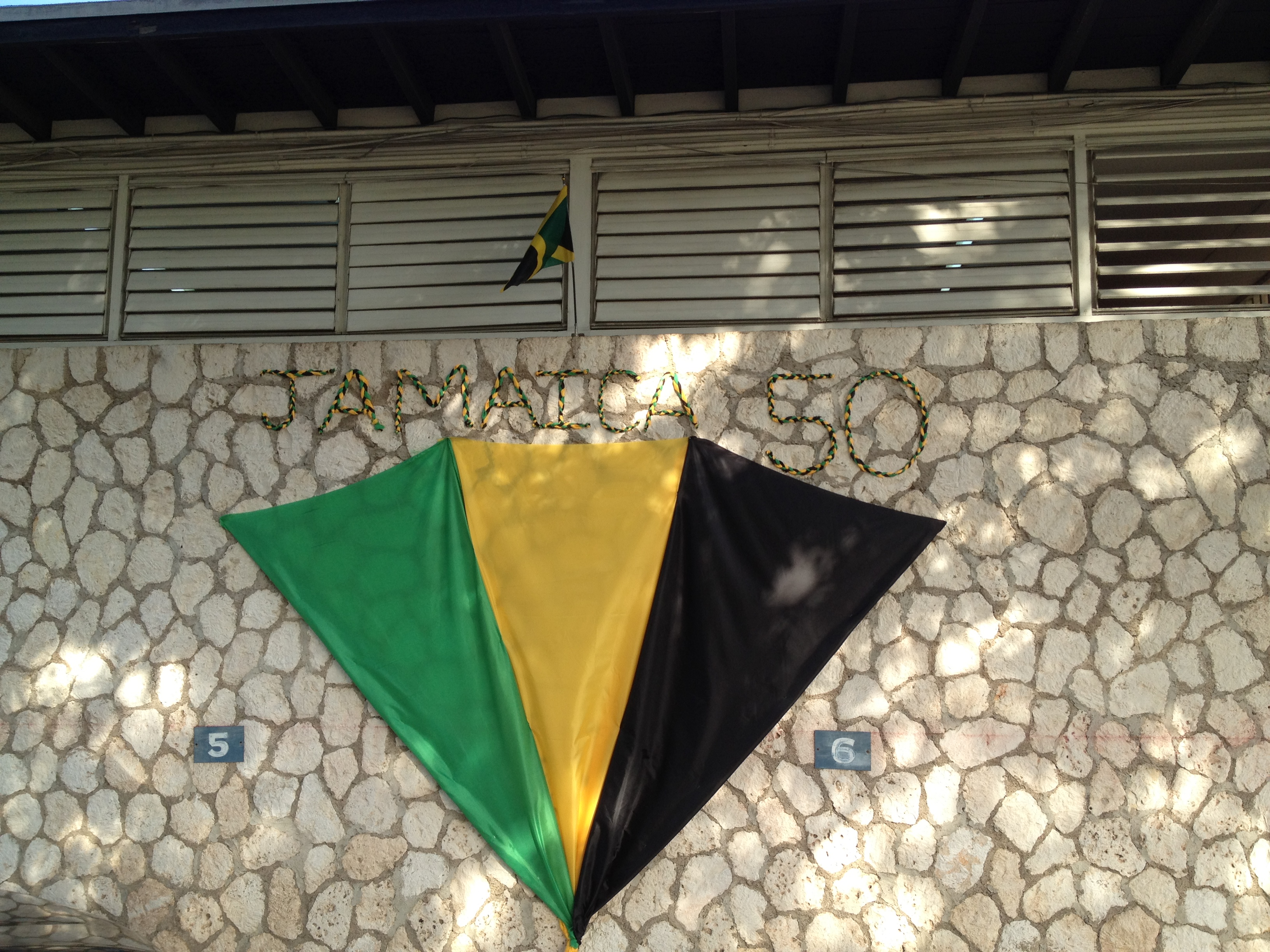
Independence day decorations opposite the US Embassy in Liguanea, Kingston on Emancipation Day, Aug 1, 2012
Although Kingstonians were running around like chickens with their heads cut off yesterday preparing for the Emancipation Day holiday today a number of supermarkets and small stores were actually open for part of the day. The Indian stores for instance at the Marketplace and Northside Plaza. I was happy because I hadn’t been able to do a proper shopping last week but it did set me remembering an article I published three years ago in the British journal Slavery and Abolition called ‘Do You Remember the Days of Slav’ry?’ Connecting the Present with the Past in Contemporary Jamaica.
Supermarkets in Jamaica are mainly owned by Chinese families. The Indians and Chinese came here as indentured labourers, and emancipation from slavery clearly doesn’t have the same resonance for them as for the rest of the population. In my article i discuss at length the historical ambivalence to this holiday in Jamaica, the celebration of which was officially banned in 1962 when Jamaica became independent and only reinstated in August 2002 on the fortieth anniversary of independence by then prime minister, P.J. Patterson.
Wish i knew who took this amazing image of Jamaica’s Emancipation Monument, they deserve credit. Found this on Facebook today. Sculpted by Laura Facey, Redemption Song was created to stand at the entrance to Emancipation Park in Kingston.
Why not make a pdf of the article available today I thought, considering that its Emancipation Day today and Jamaica is on the verge of celebrating its fiftieth anniversary of independence. The following abstract will explain why it may be of interest:
In early 2006, the parish councilors of St Elizabeth, Jamaica, decided not to support plans for celebration of the abolition of the slave trade citing the position taken by National Hero Sir Alexander Bustamante, founding father of the Jamaica Labour Party, that ‘we should celebrate our achievements (but) we should not look back at our shame’. This article looks at this instance and others like it of ambivalence towards the memory of slavery and how it ought to be treated today. Main sources for the article are discussions in the public sphere, radio, newspaper and television debates on the subject, and interviews with key principals such as the chairwoman of the Committee for the Commemoration of the Abolition of the Slave Trade as well as dissenting voices such as the St Elizabeth councilors during the period 2006–2007 in the run-up to commemorative activities.
In the published abstract we didn’t catch two errors…’abolition of the slave trade’ instead of ‘abolition of slavery’, which I’ve taken the opportunity to correct in the abstract above. Hope my article is of interest. Happy Emancipation Day!
The security guard at the Sir Arthur Lewis Institute of Social and Economic Studies (SALISES), singlehandedly created this festive decoration on the front of the SALISES building
P.S. The entire island has erupted into effusions of black. gold and green, the colours of the Jamaican flag. As @DamienWKing, head of the Economics Department at the University of the West Indies rightlynoted on Twitter: Proliferation of black, green & gold around the country is NOT frivolous. Builds social capital & sense of unity. Important for development.
A further look at my Newsweek profile of Usain Bolt and some of the discussion around what I said in it.
A friend based in Indonesia sent a photo of this double-spread from the AsiaPacific edition of Newsweek where my profile of Bolt occupied 6 pages incl photos….
i was overjoyed when I got the invitation to write a profile of Usain Bolt for Newsweek International. It came in mid-June and I had till July 9th to deliver 2000 words. I sighed with relief for it was a deadline i could work with. Then came the hard part–realizing that i couldn’t get access to Usain because as his publicist, Carole Beckford said, he was in training and absolutely no interviews were allowed at this stage. It slowly began to dawn on me that while Newsweek might need Bolt, Bolt definitely didn’t need Newsweek. That they wanted to put him on the cover made not one iota of difference.
The Japanese edition of Newsweek with my article in it did have UB on the cover…
Dispirited I almost gave up on the story. It seemed unfair. Here was my big break at last and I couldn’t deliver because of lack of access to the subject. Lord knows Carole Beckford must be absolutely sick of me because i wouldn’t take no for an answer though my persistence wasn’t getting me anywhere. While waiting to get through with live access I had started working on a rough draft; at some point it suddenly occurred to me that I already had a fully developed piece written just by talking to people who knew him and immersing myself in all the audio, video and texual material available about Usain Bolt, including his fascinating autobiography 9.58. Written with help from professional writers, the book is a must-read and I warn Ian Randle Publishers that they should be ready to do a huge new print run by mid-August for if UB comes good, millions of people are going to want a copy.
As background, I wanted to foreground Jamaican culture and the place of sports, athletics in particular, in all of this. As I see it Jamaica’s aspirations as a former plantation society to erase the scars of slavery by exemplary, world-beating performance are embodied by Bolt and enacted in its extraordinary track and field history. Remember this is Newsweek, not Sociology Today, warned Editor Tunku Varadarajan, half jokingly, adding that lots of personal colour was what was needed.
There is a certain array of ‘facts’ about Usain that are in wide circulation already and I didn’t intend to reproduce them. To my mind what would make my article different was providing salient features of the context he comes from. The language wars in Jamaica are something I’ve focused on quite a bit, even featuring Usain Bolt himself in an August 23, 2008 post-Beijing post called To the World from Jamaica! Patwa Power Bolts the Stables…from which i quote below:
The Ministry of Transport hastened to announce that it was going to upgrade the roadways in all the communities whose athletes had produced Olympic gold. Why? Not so much to elevate these depressed communities as to give them an instant facelift so that when the international media arrived their impoverishment would be less apparent and less of a blight on the brand name of Jamaica! The politics of sports in Jamaica! Or just the politics of politics…
On a more amusing note page two of the Observer, the social page, suddenly underwent a population transfusion, the beige and white socialites who normally monopolize it abruptly displaced by the almost uniformly dark-skinned athletes. Sigh! If only Jamaica’s business and social elite were one hundredth as nimble and competitive as the country’s athletes! If only they too were worldbeaters!
Personally I think that the phenomenal performance of Jamaican athletes is also due to the cultural self-confidence they feel; a confidence expressed by Usain Bolt in Beijing’s Bird’s Nest stadium when he spontaneously broke into the Nuh Linga and the Gully Creeper, the latest dance moves innovative Jamaican dancehall music has produced (actually Usain’s trademark gesture of pulling back an imaginary bow and arrow like Orion is now the latest dancehall move here).
This is not a confidence manufactured by the abjectly self-conscious, respectability-seeking, hymn-singing English-speaking middle classes but one bred out of the flamboyant, boisterous, in-your-face Patwa-speaking population. In the forty years since Jamaica’s independence it is the latter who have proved both through their athletic and musical prowess that they are ready to take on the world. The Beijing Olympics have shown that the world is more than ready for them (minus the prissy IOC head Jacques Rogge who sounds for all the world as if he had been formed in the bowels of Upper St. Andrew). To the World Ja!
In providing a lightning sketch of Usain Bolt I had to carefully select the facts I thought would bring him to life and animate him for an international audience. Language would be one of them for Bolt had spoken eloquently about it himself.
In 9.58 Bolt writes:
When I moved to Kingston and started running professionally I had to take special English lessons so that in interviews people would know what I was saying…I can adapt now, according to who I’m speaking to, but with friends and family we always use patois. Some native Jamaicans cannot speak proper English at all, they talk patois all the time–and its raw patois. When I’m talking to my mom a normal English-speaking person could probably pick up some words, but raw patois is impossible–you would have no chance (pp 183-4).
Here was something that none of the previous interviews with Bolt I read or heard had focused on, something my own interest in Jamaica’s language politics had primed me for. Accordingly this is what i wrote in the text I sent to Newsweek:
Another interesting thing about Usain Bolt is that he only learnt ‘proper English’ after he began winning gold medals and was groomed to interface with international audiences. Till then like many Jamaicans his first language was Jamaican patois, a fast-paced amalgam of several different tongues including African languages, English and Spanish, virtually incomprehensible to English-speakers. While the world thinks of Jamaica as an Anglophone country not many realize that a sizeable proportion of the population is fluent only in its versatile oral vernacular. Today, Bolt’s rival and partner, Yohan Blake, finds himself in the same predicament, his English halting and hard to understand. No doubt the nation’s elocution teachers are rushing to rectify the situation weeks before the London Olympics where Blake stands a good chance of becoming the new sprint sensation.
Cartoon titled ‘Edited for Clarity’ by Mike Luckovich of the Atlanta Journal-Constitution. I’m grateful to Melody Winnig for bringing this to my attention.
Translated into Newsweek speak that became:
Bolt is still growing into his role as an international star. He didn’t even know standard English until he began winning gold medals. Until then he spoke only the Jamaican patois, a dizzying amalgam of English, Spanish, and African languages. Blake currently finds himself in the same predicament, his English halting and hard for outsiders to understand. Jamaica’s elocution teachers will need to work as fast as they can to prepare him for the spotlights in London.
Clearly some of what I said was lost in translation. I could have exercised more control over the editorial process but time didn’t permit. In particular I wish I’d changed back the last line in the paragraph above to my original. But c’est la vie, you live and you learn. There was so much else i thought important and would have loved to include–such as the role of dancehall music in motivating Usain Bolt, Yohan Blake and so many of the Jamaican athletes to higher heights–but there was no space for such detail. I remain grateful to Newsweek, to my readers and my critics for all the lessons learnt in the process of producing this profile. Glad I had the opportunity to write about such a legendary athlete for a forum like Newsweek/The Daily Beast. Oh and in Japan mine was the cover story, see above for a shot of it…glad to get a copy courtesy Fuji TV…thanks Kumiko!
PS: September 25, 2013. I just came across an article by Matthew Teller about his experience of writing for CNN and the gross editorial changes made to his text which eventually caused him to ask them to remove his byline from the piece. It’s very relevant to many of the issues I’ve raised in this post and well worth a read:
In which i respond to criticism of my Usain Bolt article which appeared in Newsweek, July 16. Part of the problem may have been caused by the inevitable editing process which condenses and removes context in some cases, throwing statements into starker relief than was intended.
Street artist James Cochran, also known as Jimmy C, works on his spray painted picture of Jamaican sprinter Usain Bolt in Sclater Street car park in east LondonPicture: REUTERS/Paul HackettOlympic security. Soldiers doing a Usain Bolt impression waiting to enter the Olympic Park on Sunday 15/07/2012 Pic by Frances Leader
On the rare occasion when i’ve had to teach a writing class, usually to students at the Sir Arthur Lewis Institute of Social and Economic Studies at the University of the West Indies, there are three publications i use as exemplars of the best writing available in English today. They are Time, Newsweek and the Economist. These three global newsmagazines, employ some of the best writers in the world today evident in the tightly constructed, yet fluid articles they feature, some no more than half a page in length, or a few hundred words, but words so expertly chosen and so economically strung together that (like the ant which carries loads several times its size on its tiny back) the quantity of information they convey belies their slender word counts.
Or so i thought. When i relayed this opinion at a dinner party once, someone, and I wish i could remember who this was, suggested that I was wrong. It’s not good writers these newsmagazines have, she or he said, it’s excellent editors. Hmmmm i thought to myself at the time, not entirely convinced. Now in the wake of writing an article on Usain Bolt for the current issue of Newsweek I know exactly what they meant; they were right.
When i got back the first edit of my article from Sam Seibert, an editor at Newsweek, i was mortified but also somewhat pleased. It was a drastic edit, with some rewriting and additions to my text in places (was my writing as poor as that?), but on the whole i couldn’t deny that it had improved my submission considerably. In fact there were some lessons about writing that Sam’s expert editing and rewriting reminded me of and i can’t thank him enough for this. The transition from one paragraph to another for instance; how to link thoughts and words so that the narrative flows along at a clip bearing the reader along.
Of course some of the changes inevitably shift the emphasis, sometimes even altering the meaning that was originally intended. I was given the opportunity to correct his rewrite more than once but the turnaround time was short and in retrospect i see a few things now which i should have rephrased. They’ve come to my attention because of the number of negative reactions, even objections to some of the things i say in the article. For example Dionne Jackson-Miller, one of the top journalists here whose shows I regularly tune into on radio and tv, posted on Facebook saying: Several comments gave me pause Annie Paullike this one…” In a land where hardly anything else works, an exemplary tradition of track-and-field instruction and competition has flourished for almost 100 years. ” Gonna have to think about that – are we really as underdeveloped as that suggests?
I could see her point, it was a harsh statement. Had i really said that? i went back to the text I had sent Newsweek and found something slightly different: “In a country where hardly anything works as it should an exemplary tradition of track and field instruction and administration has existed for almost 100 years.”
In fact it’s worth quoting the entire section this line was taken from, in which in an attempt to explain the Bolt phenomenon i try to sketch out the roots of the athletic culture that has developed in Jamaica.
Biological and dietary considerations aside the truth is that to ‘get’ Usain you have to get Jamaica, a country and culture riven by contradictions and inconsistency. To call Jamaica a ‘sprint factory’ is misleading; far from churning out cookie-cutter champions Jamaica is a crucible in which unique, world-class runners are formed, bursting onto the world stage at regular intervals and conquering it against all odds. They’ve been doing this since the 1948 Olympics when Jamaican runners, Arthur Wint and Herbert McKenley, won gold and silver in the 400m. In a country where hardly anything works as it should an exemplary tradition of track and field instruction and administration has existed for almost 100 years.
A nation of fervent Christians and bible thumpers, Jamaica has a deeply entrenched network of churches which may have been very receptive to nineteenth century British ideas about ‘muscular Christianity’. This may explain why running became so popular; anyone, anywhere could do it you didn’t neeed deep pockets or an expensive infrastructure to become a runner. By the middle of the twentieth century the sport was flourishing in Jamaica. According to Patrick Robinson, author of Jamaican Athletics: “There is no entity or area of endeavour in Jamaica, whether in the public or private sector, that is as well organized and, applying international standards, has been as consistently successful as track and field athletics.”
Whereas earlier generations of promising athletes with Olympic ambitions had to go abroad to be trained on track scholarships, Jamaica now has its own world-class coaches, trainers and managers. Stephen Francis of MVP Track Club and Glen Mills of Racers Track Club are two whose homegrown battalion of runners in the last two Olympics stupefied the world. Glen Mills is not only Usain Bolt’s coach, he is also the man behind young Yohan Blake, Bolt’s most dangerous opponent in the upcoming Olympic 100 and 200m races.
Blessed with exceptional natural talent in running Usain Bolt benefited from the systems already in place to identify potential athletes and train them. His passion as a child was cricket and he played on his school team from an early age. Fortunately his father and others noticed the speed with which he ran down the pitch and sent him to the William Knibb Memorial High School, a school with a strong track and field programme that gave sports scholarships and has produced a number of the country’s top athletes including the multiple-gold medal winning Veronica Campbell Brown.
Much of this landed on the cutting floor during Newsweek’s editorial process and what was left was this:
Running is a sport that seems practically ideal for a country like Jamaica. You don’t need deep pockets or fancy equipment to become a great runner. In a land where hardly anything else works, an exemplary tradition of track-and-field instruction and competition has flourished for almost 100 years. The island first seized the world’s attention back in 1948 when Jamaican runners Arthur Wint and Herbert McKenley won the gold and silver in the 400m in London.
Nevertheless, the sport that first captured the boy’s heart was not running, but cricket. He played on his school team from an early age, and it was on the pitch that his extraordinary speed first caught the attention of the town’s grown-ups. He became a prize recruit for William Knibb Memorial High School, which featured both a strong track-and-field program and sports scholarships. Knibb has produced many of Jamaica’s top athletes.
Sam Seibert’s editing of my article was so drastic that i actually asked if he’d be sharing the byline with me, but that’s not the convention in most major print media. It was interesting to come across an article called How the Byline Beast was Born, the very day after i got back the first edit of my article. I realized that there was no need for me to be crestfallen, that the process i had just undergone was pretty standard. In Byline Beast Jack Shafer was writing about the recent fuss about Journatic a content farm that provides local news stories to news media all over the United States. It’s a fascinating article i highly recommend, the following is only a small quote of immediate relevance to the editorial process i describe above:
In even the most professional of newsrooms, editors frequently do sufficient work on a piece – reporting and re-reporting sections, composing long passages without the assistance of the bylined writer, redefining the story’s parameters – that they deserve a byline or at least a co-byline. Yet magazine, newspaper and wire editors rarely receive this credit for their extraordinary interventions.
Although I highlight the radical edit of my article in this post I don’t blame it entirely for people’s reactions to what I’ve said in this article. When I call Jamaica a country where hardly anything functions as it should I’m referring to the major structures of governance that serve the needs of most citizens here so poorly that they’ve created their own informal structures and processes. While middle-class Jamaicans may well find things to be proud of–the system does work on their behalf after all–large numbers of poorer Jamaicans may disagree, for there is a sharp divergence in the way they are treated by the Police, the Justice system, the education system and government processes in general. Even the media in Jamaica treats you differently based on whether you come from uptown or downtown.
Incidentally the text i sent Newsweek was titled Usain Bolt: A Latter-day Hermes? but news media here and elsewhere rarely use headlines provided by writers, they have special people on board just to write headlines.
There were other things i said in my article which upset readers here and in the diaspora. I’ll discuss those in subsequent posts. In the meantime enjoy this Dorian Scott video of Usain Bolt, Yohan Blake and others building a vibe on the racetrack in Birmingham while they prepare for the Olympics. Scott is representing Jamaica in shotput at the upcoming Olympics. You may need a Facebook account to view the video but it’s well worth it.
PS: The photos at the top of this post are from the UK Telegraph.
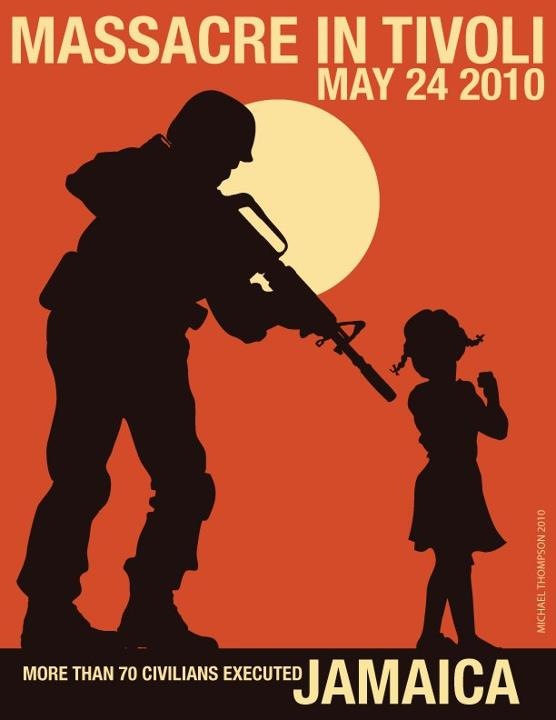
Keeping Tivoli Gardens in the picture…memento mori by Michael Thomspon
Tivoli. What of Tivoli. What of the Tivoli 73. Let’s not forget…
All posters above are by graphic designer Michael Thompson. He’s produced a stream of unforgettable images to sear the unspeakable nature of this act of war into our memories. I will let him speak for himself. The folliowing is a quote from him that accompanied the series above on Facebook:
Immediately after the information began to leak out of the Tivoli Gardens community of the executions by the Jamaican Security forces during the military operations there on May, 24, 2010 I began making posters to express my feelings about the brutality and massacre that the citizens spoke about. Two years after the incident there is still no official report published or any one held responsible for the massacre. The Government and the security forces are silent on the matter. The local media has since forgotten about the incident. Last December an article in the The New Yorker magazine written by Mattathais Schwartz uncovered the tragic stories of killings. A MUST READ for anyone who missed the story. The story is not going away and more people who believe in Justice need to speak out and demand Justice for the people of Tivoli.
A short note on the ruling in the Keith Clarke case which found 3 soldiers guilty of killing him along with two artworks depicting Clarke and the scene of his killing.
Poster of Keith Clarke by Michael ThompsonArtistic rendition of Keith Clarke’s murder by Hubert Neal Jr. June 2010
FINALLY there is some resolution of one of the horrific killings of citizens at the hands of agents of the state. The wanton murder of Keith Clarke, an accountant whose home in the hills of Kingston was mistakenly believed by the security forces to be harbouring the fugitive Christopher Dudus Coke in May 2010, shook Jamaica. Now two years later the Director of Public Prosecutions (DPP) Paula Llewellyn has ruled that three members of the Jamaica Defence Force are to be charged with the murder of businessman Keith Clarke. For details read this Gleaner article.
In my blogpost of May 27, 2010 I noted details of the attack on the Clarke home:
Well, the Gideon (local slang for Armageddon) continues. Last night it seemed as if things in Kingston had simmered down but this morning i checked into Twitter to hear that the armed forces were lobbing grenades and perhaps bombs at a house in E. Kirkland Heights, a very upscale neighbourhood in Red Hills, Kingston. “The template of violence in jamaica has changed ova d las week. Its now an insurgency with all the relevant weaponry” tweeted one of the people i follow. “I wanna see the police deny this one. Grenades an bombs are the new weapon of choice for the state now.”
While the DPP’s ruling may bring closure to the members of Keith Clarke’s family none is forthcoming for the Tivoli 73, the 73 (some say more) civilians killed during the military incursion into West Kingston on May 23-24, 2010. According to a news interview i heard with Terrence Williams, Commissioner of INDECOM, the body authorized to look into police misconduct, none is likely to be forthcoming either because unlike the Clarke home which was treated as a crime scene and immediately scoured for all evidence available, the environs of Tivoli Gardens were not designated a crime scene (because some claim, the civilian casualties were treated as war crimes), making it impossible two years later to identify the culprits in that massacre.
Of course as Mattathias Schwarz has indicated in his New Yorker article titled A Massacre in Jamaica the US government should be able to help by supplying video footage shot from the air on the day of the massacre by its US DEA Lockheed P-3 Orion plane.
But who knows when that will happen? It seems people in Tivoli Gardens may have to just hug up their losses and move on as far as the government is concerned. For an interesting interview with Mattathias Schwarz on the matter see here.
And in the meantime the DPP’s ruling raises more questions. Concerned citizens are asking how holding three low-ranking soldiers accountable for such a hgihly orchestrated military operation can be considered a credible outcome in this prolonged court case. The Daily Gleaner’s July 19 editorial, excerpted below, says it best:
Justice, in this case, is not only about holding to account the three soldiers who have been accused of firing the shots that killed Mr Clarke in his home more than two years ago. It includes, also, placing the spotlight on the Jamaica Defence Force (JDF), so that it can view itself, hopefully with dispassion, and conclude whether it operates in a manner worthy of the public’s trust.
Mr Clarke, it is recalled, was not the victim of random circumstance. His death happened during what was supposed to have been an organised military operation.
…What is not clear is the command and control procedures that governed that operation and the rules of engagement to which the junior soldiers were subject.
The point is that Mr Clarke’s killing happened at a period of heightened tension in Jamaica. Coke was on the run and, in the face of the challenge from his gunmen and supporters, a state of emergency was in force in several parts of the island.
Against that background, we would be surprised if the search for Coke in Kirkland Heights would have been entrusted only to two JDF lance corporals and a private, without the previous knowledge of a significantly more senior commanding officer.
Should we be right, the obvious question that we expect would have been the subject of an internal review by the JDF, as well as part of INDECOM’s investigation, is what role did the commanding officer play in the sequence of events and whether he carried out his duty appropriately. In other words, are there matters for which he should be held accountable?
We believe that these are appropriate questions for which the public deserves answers, lest the cynics claim that juniors have been made fodder after an incompetent execution of an operation.
A link to my article on Usain Bolt in Newsweek International this week…
Presenting my article on Usain Bolt which appears in Newsweek International this week…
Jamaica’s Usain Bolt: Is He Still the World’s Fastest Runner?
Jul 16, 2012 1:00 AM EDT
Will lightning strike again in London? Or have the years of fast living finally caught up with the speediest man alive? A close look at the Jamaican record breaker.
The Twitter messages seemed calculated to drive Jamaica frantic. “Driving the black speed today,” Usain Bolt informed his followers as he posted an Instagram image of his chosen vehicle for the day, a 2009 Nissan GT-R. “Nothing but speed for the fastest,” he added. Still, the world-record sprinter could scarcely ignore the fact that the last thing they want is for him to risk yet another smashup in the final days before the 2012 London Games. “I will take it easy lol,” he promised.
Sometimes I don’t write about the things that are closest to me…the preceding post is by Emma Caroline Lewis and is about a work project that i’m very involved in…spread the word and come out and attend! you’ve been give plenty of notice…also check the 5050 Project blogspot.
Jamaica’s fiftieth anniversary (Jamaica 50) celebration has not been a smooth, gentle glide to the August 6 finish line. In fact, it has been fraught with political niggling, confusing press statements and slick marketing jargon, (with the local media trying to make sense of it all) and apparently rising levels of frustration and irritation on the part of the Jamaican populace. Amidst the confusion, it seems we are all searching for meaning. Surely, we cry, Jamaica 50 is not just about signature songs and parties and Jamaica 50 sunglasses, cute as they may be. Recriminations have been heaped on the head of an overburdened Culture Minister who is valiantly seeking to create something coherent. According to a Gleanerarticle this week, the youth of Jamaica – those who will take over for the next half-century – believe that “the true essence of Jamaica 50 is lost on the masses.”…
An account of the Men’s and Women’s 100m finals at Jamaica’s Olympic national trials where world records were broken and the winning times were faster than those in the American trials.
Finish of Jamaican Olympic trials men’s 100m semifinal, the winning blur is Asafa Powell…
So i was at the stadium yesterday for that thrilling 100m men’s race which saw Asafa Powell, Usain Bolt and Yohan ‘the Beast’ Blake vying with each other for first place. Asafa had won his semifinal and Bolt his. In the final Powell lead the way coming out of the starting blocks fast unlike Bolt who lumbered a bit in the beginning. All eyes were on them when the Beast running in lane 7, seemed to appear out of nowhere, gaining on the others by leaps and bounds and slicing into the finish line a head ahead of Bolt who had by then overtaken Powell. I mean it doesn’t get much better than this.
Earlier we had enjoyed Shelly Ann Fraser’s seemingly easy, thrilling run to victory over a star-studded cast of runners including Veronica Campbell-Brown, Kerron Stuart and others. All in all it was a great evening bedevilled in the early stages by a malfunctioning starter’s gun. How can a gun not work in Jamaica asked a man within earshot, looking puzzled.
There was some gloom earlier in the day when news broke that Asafa Powell had injured himself and might miss the semis and final. Exasperated Jamaicans cussed him left, right and centre citing mental weakness, psychological problems, general all round fecklessness etc trying to understand why this runner so beloved of everyone here seems so prone to injury and misfortune. This time there was also anger at the prospect of being robbed of the chance to see the great Jamaican running triumvirate compete against each other in the same race.
People were thrilled therefore to see Powell on the field when the time came for the semis and he got a huge roar of applause when his name was called. He then proceeded to run better than anyone has seen him run in recent years delighting his fans, though some felt he should have maintained his early lead to the end.
What I didn’t realize till this morning was that Powell had torn his groin during the quarter final heats on Thursday evening and been flown to Miami for medical attention. When he ran yesterday he had only been back from Miami four hours before the semi-finals and knowing how disappointed the public would be if he didn’t run had insisted on taking part. I hope he didn’t aggravate his injury by doing so, but as someone said on Twitter, “The man have heart and guts.”
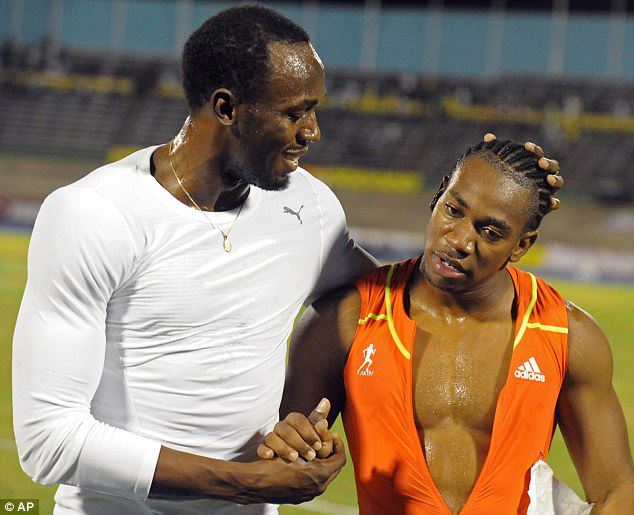
i couldn’t identify the author of this image so it remains unattributed though the AP suggests it might be an Associated Press photograph.
Now everyone waits breathlessly for the 200m finals tomorrow night when Bolt and Blake meet again. I think Bolt should prevail because the 200m gives him more time to recover from his slow starts and he’ll certainly want to teach young Blake a thing or two after being pipped by him in the 1000m.
Incidentally the winning times in both men’s and women’s 100m races were faster than those in the American trials the week before. So once again Jamaica has a monopoly on the fastest men and women in the world.
I hope to be there but it all depends on ticket availability. It’s quite clear that something highly irregular is going on with ticket sales for the National Senior Championships to give it its proper title. I went to the ticket office on Thursday morning to get grandstand tickets for Friday and was told they only had bleachers available. All around the ticket office were scalpers offering grandstand tickets at three or four times the official price. Even on the way to the stadium the street was full of young men flogging tickets. Yet i heard from a friend this morning that she was able to obtain grandstand tickets from the Stadium ticket office at 12.30 pm on Friday! But there’s a coda. In response to my incredulous “you got grandstand tickets at the stadium office?!” she replied:
“Believe it – what’s more interesting is that I had a white American with me and SHE got the tickest although they told me they had none – scandalous if you ask me”
What are we celebrating this year again? 50 years of WHAT? smh…when will we ever live up to the standards set by our heroic athletes? Will it take another 50 years to get there? Talk about slow starts…
The Jamaican 50 song fiasco and the role of social media in holding the relevant authorities accountable…
Las May, The Daily Gleaner, June 20, 2012
Once upon a time the Jamaican Government commissioned senior producer and songwriter Mikie Bennett to write a song to celebrate the nation’s 50th year of independence which will occur on August 6 this year. The song, Find the flag in your heart and wave it, was duly written and produced with as many Jamaican celebrity voices as Mikie could get into his studio. If the country had to pay for the song it would have run into millions so Bennett and all those involved decided to donate the song to the nation.
In October 2011 the song was officially launched as the theme song of the Jamaica 50 celebrations slated for 2012. On December 29, 2011 after general elections, there was a change of government: the new PNP government it seemed had no intention of continuing with the schedule of events put together by the Jamaica 50 planning committee and Mikie Bennett’s song was one of the casualties.
Clovis, Jamaica Observer, June 21, 2012
Journalist and blogger Dionne Jackson Miller, covered this flipflop on her blog:
So even our music has fallen victim to that agent of change – the election. Some months ago, I was perplexed to see people calling for Eric Donaldson’s “Land of my Birth” to be made the official Jamaica 50 song. What the hell?I thought. We already HAVE a Jamaica 50 song! Remember? The song, “Find the Flag” was produced by the respected veteran Mikey Bennett and officially presented to the country.
Let me reiterate that. The song was officially and publicly presented to the country last October. If you don’t believe me, or never heard about it, read this story by Mel Cooke in the Jamaica Gleaner. http://jamaica-gleaner.com/gleaner/20111204/ent/ent7.html
A Reporter’s Guide to Jamaica 50 sent out by the Culture Ministry in December stated that:
“The Jamaica 50 song ‘Fly (sic) the Flag in Your Heart’, written by Michael Bennett, captures Jamaica’s journey of challenges and triumphs.”
So I posted to that effect, saying that we have a Jamaica 50 song.
Except… silly me. There was an election. For months we heard nothing of Find the Flag – the official Jamaica 50 song – until another story in the Observer told us the song had been shelved.
On June 15, 2012, the current government suddenly released a new song, On a Mission, announcing at its launch that THIS was now the official Jamaica 50 song. Starring prominent singer Shaggy and others the song’s driving technobeat whipped up a wave of resentment on Twitter with many expressing disapproval and disappointment that such an ‘un-Jamaican’, Europop sounding song could represent Jamaica in its 50th year of independence.
Initially Robert Bryan, director of the Jamaica 50 committee and young Lisa Hanna, Minister of Culture airily dismissed these concerns, claiming that they had not designated On a Mission the official Jamaica 50 song and that there was therefore no controversy involved.
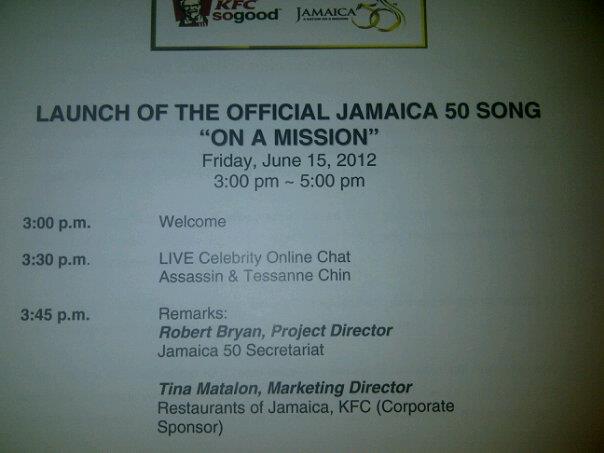
Since there was considerable evidence to the contrary what with the public launch in a prominent venue that had just taken place (see photograph below) and the official CD of the song that was distributed. the chorus of disapproval kept growing until it could no longer be ignored.
Closeup of invite to the launch of second Jamaica 50 song posted on Facebook
Suddenly yesterday a penitent Robert Bryan appeared on radio claiming in a shaken voice that he and the Minister had been ‘blindsided’ by Shaggy’s company and producer Sharon Bourke who had without any authorization launched ‘Mission’ as the official song etc etc. As one tweeter wryly noted:
Robert Bryan jus threw Shaggy, Sharon Burke and Solid Agency under the bus on Nationwide Radio! #JA50!
For details I refer you once again to Dionne Jackson Miller’s blogpost Lessons from the Jamaica 50 Song Fiasco where she details the latest series of missteps by the political authorities.
Again on Facebook and Twitter arguments and criticism raged about the controversy, proving more than anything else that in its 50th year of independence Jamaican politics has not reached the critical level of maturity required at this stage. Instead of admitting at the outset that they had handled the whole affair poorly and apologizing to the nation Robert Bryan and Minister Hanna tried to brazen it out with the usual political chicanery which assumes the people they act on behalf of are dunces. They are now left with egg on their faces and Minister Hanna has suffered a damning blow to her credibility she could easily have avoided.
I reproduce below a Facebook conversation on the subject with names carefully concealed to avoid any unpleasant repercussions for the individuals concerned. It would behoove the political class to remember that you are being judged, and judged harshly by sane and intelligent people. Its the twenty first century and you can no longer rely on a docile, feckless media to avert their eyes from your shenanigans. Please find the flags in your hearts and wave them, the national flag, not the party ones.
Finally, thank god for social media.
BB: the Secretariat says, it does not intend to, nor did it choose, select or designate an official or national Jamaica 50 song. Why was the event called “launch of the official Jamaica 50 Song?
GS: Repeat after me: “Pathologically Mendacious”. Thank you.
DK: bareface liars…..smh
FS: A lie dem lie, danny Buchanan must be turning in his grave to his his prophesy now taking root in his party
VS: If we count the lies told in the flag fiasco and in this “launch” of the song for Jamaica 50, pathologically mendacious is too generous. However note, the lies have been flowing in patriotic issues…..signs of the times!!!
AV: thanks for the reminder GS!
MW: This is politics at its best. If you listen the song carefully it mentions Lisa Hanna and HPSM in glowing terms. It must be a PNP party song.
PR: I’m putting it to you that you’re Pathologically Mendacious…lol
For more on this sorry affair please watch the news item here:
An episode in the battle between Jamaican telecommunications companies, Lime and Digicel
Customers purchase LIME handsets at the phone company’s Half Way Tree Road headquarters yesterday. (Photo: Bryan Cummings in Jamaica Observer)
This is a rare moment for Jamaican consumers. We might actually be sitting pretty while our two telecommunications giants slug it out. Lime, formerly Cable and Wireless, has just taken the fight to Irish-owned but thoroughly creolized Digicel, by slashing its mobile telephony rates by up to 80%. From J$8/min rates have now fallen to J$1.99 and even though Lime only has a small percentage of the mobile market everyone is rejoicing at the prospect of Goliath Digicel’s comeback for the company can hardly allow itself to be felled, or even significantly wounded, by David and his slingshot.
Meanwhile Digicel stores were full of empty space…
Mind you the actual share of the mobile market claimed by Lime is contested by Digicel which claims Lime is underreporting its subscriber base to gain public sympathy. Still this move has precipitated a rush on Lime by eager customers who want to cash in on the pricefall. Meanwhile i congratulate myself on having invested in a Lime handset months ago.
Digicel’s climb to behemoth status has been an interesting one with the company astutely participating in Jamaica’s rambunctious popular culture by creating popular TV reality shows and sponsoring live music events among other things. But this it seems can only take you so far, mobile customers have consistently complained about the unreasonably high rates of making calls from Digicel to other Digicel clients (intranet) as well as inter-network rates. Looks like Goliath may have to bow this time…
















 Active Voice