The Barbados Tourism Authority vs The Jamaica Tourist Board. A comparison of two advertising strategies….
The above ad featuring the ‘Minnesotan Jamaican’ of VW ad fame was produced by the Jamaica Tourist Board (JTB).
And this one featuring Rihanna was produced by Barbados’s tourism entity–the Barbados Tourism Authority.
Do you see a difference in strategy, production values, script and use of each island’s natural assets? Why does the Jamaican ad seem lame, insipid and bereft of imagination? why is the Barbadian ad on the contrary so perfect that it could be a global model on how to sell yourselves? And contrastingly how and why does the JTB ad sell the country short?
After 50 years of Independence is this the best our creative class can do? or is JTB hiring friends and relatives and not the pros that we need and have?
Discuss.
PS: This post came out of a discussion on Twitter and is indebted to @Gordonswaby, Erin MacLeod @touchofallright for drawing my attention to the Rihanna ad and @drewonline.
After Dan Rather’s in-depth coverage of the Lotto Scam in Jamaica might it be a good time to ask why local media doesn’t produce similarly aggressive, investigative reporting?
News outlets in Jamaica this week were inundated with coverage of and responses to the US media’s unprecedented focus on the Lotto Scam, a locally generated con game, whose victims are elderly Americans. Former 60 Minutes stalwart Dan Rather visited Jamaica some weeks ago so his in-depth exposé of the scam, Just Hang Up, which aired on March 12, complete with heart-rending interviews with some of the victims didn’t come as a surprise. The documentary was timed to air in tandem with evidence presented to the US Senate’s Committee on Ageing yesterday. At least two other major US channels also aired stories on the scam.
The US Embassy in Jamaica obligingly posted links on Facebook with the following note:
As you are aware, there has been a great deal of U.S. media attention focused on advanced-fee fraud (also known as “lotto scams”) recently. Below are the links to the Dan Rather, CBS and NBC stories.
I haven’t yet seen the entire documentary featuring Rather (its available free on iTunes though only in the US not in Jamaica) but the excerpts shown on TV here have been riveting. The American TV team even lured a scammer, tracked down by his IP address, to a meeting in Montego Bay, showing him live and direct for all to see. Naturally the impact has been sensational especially because this well-crafted documentary was shown on prime time TV in the United States. It suddenly came home to Jamaicans that ‘Brand Jamaica’, as local technocrats and the media in general have taken to calling it, was going to take a battering.
Relying on tourism and American visitors as much as Jamaica does this could be potentially devastating.
What does it mean that serious crimes like the Lotto Scam and the Tivoli genocide (the 2010 killing of 73 plus citizens by the State in its pursuit of fugitive don, Christopher Coke) are exposed by foreign not local media I asked on Twitter yesterday. For although the media here has carried any number of stories on the Lotto Scam, many of them bizarrely claiming that most of the scammers are gay, we’ve never been given a true idea of the scale of the problem, affecting enough Americans for their political representatives to start raising the alarm about it.
Several media folk I follow on Twitter reacted negatively to my question, interpreting it as a slight or a claim that there had been no local media attention to the scam. It s true that there have been many stories about the Lotto scam here. To my mind however there’s a qualitative difference in the way the story was investigated and reported on American TV and the way it’s been carried in the local media which mainly focused on the scam when police action brought it to the forefront. Piqued by public criticism Simon Crosskill played some of CVM’s previously aired coverage of the Lotto Scam last night. It did cover much of the same ground as Rather’s documentary but the audio was poor and too many of the people interviewed had their faces obscured and voices disguised, thus robbing it of the impact it could have had.
Are there some stories local media consider too dangerous to touch? or don’t have the resources to I wondered puzzling over this variance in the quality of media coverage. In the case of the 2010 Tivoli carnage also there had been nothing in local media to approach the in-depth investigative article by American journalist Mattathias Schwartz whose exposé provided evidence that the US had given Jamaica military assistance in the May 2010 incursion into Tivoli despite the Jamaican government’s claims to the contrary. In both cases it was the American media that brought these stories to international attention, and sustained interest in them, not local media.
Let it be noted that Jamaican media are perfectly capable of executing well-researched, hard-hitting, in-depth stories when they’re ready to. In 2004 Cliff Hughes’s TV programme Impact won an Emmy in the United States for its documentary on sniper Lee Boyd Malvo called ‘The Potter and the Clay’. It was so good it not only attracted the attention of the US media, it won one of the most coveted journalism awards there. Other journalists such as Earl Moxam, Simon Crosskill, Dionne Jackson-Miller and Emily Crooks are as good as or better than their American peers.
Is it that there’s a lack of political will from the big media houses to provide the best journalists with the required resources and time to follow up the really important stories? Or are there more sinister reasons why Jamaica doesn’t have aggressive, exposé-driven investigative news outlets such as 60 Minutes and ABC’s 20/20?
The closest thing Jamaica has had in recent times to similar hard-hitting TV newsmagazines, was Doubletake, produced by Anthony Miller and CARIMAC lecturer Yvette Rowe for TVJ in 2000-2001. Despite winning awards the programme was phased out after only 8 or 9 episodes because it was considered too hard hitting and perhaps too close to the truth for comfort. It was felt that the broadcasters’ relentless focus on corruption and calling out politicans and others without fear or fanfare was ‘mashing too many corns’. This was the perception of the hosts of the programme; the station apparently discontinued it for lack of sponsorship although it was extremely popular and well-received by the public. Why a popular, well-made documentary programme would have difficulty finding sponsors is anybody’s guess. But it reinforces the point I’m making about the lack of will on the part of those with the means to enable and sustain high quality, hard-hitting journalism.
Among other subjects Doubletake covered, were the death and funeral of Grants Pen area leader Andrew Phang in Death of a Don, colour and race issues in The Browning Syndrome, the politics of the 100 Lane Massacre and other such matters. Whatever was the issue of the day was grist for their mill and with a miller like Anthony, no holds were barred. We desperately need a show like Doubletake again.
A look at the Shanique Myrie case and how class and taste impinge on it.
Shanique Myrie, circa the time of deportation from Barbados
There’s a landmark case being heard in Kingston, Jamaica, at the first sitting of the Caribbean Court of Justice (CCJ ) here. In March 2011, Jamaican Shanique Myrie landed in Barbados to visit a friend there (by her own account). Instead of the usual sedate Barbadian welcome Myrie was treated to a cavity search, kept in a dark room and deported the next morning to Jamaica although nothing illegal was found on her person or in her possession.
After this unceremonious return to the country of her birth Myrie charged that in the process of the cavity search she had been finger-raped by the immigration officials concerned. Her lawyers took the case to court claiming that her rights as a CARICOM citizen were abused, and that she was discriminated against because she is Jamaican. The CCJ argued that Myrie does indeed have a case against Barbados and the trial began yesterday morning at the Jamaica Conference Centre in downtown Kingston.
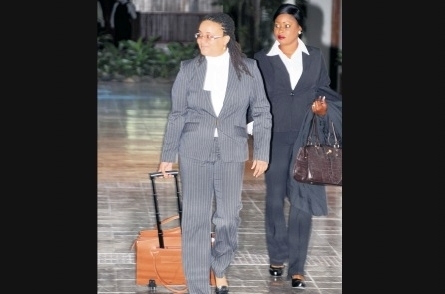
Photo of Myrie (r) from the Jamaica Observer
When one of my favourite Jamaican journalists who was present in court yesteday tweeted the link to her post on the proceedings of the first day I clicked on it rather eagerly but was repelled by her opening sentence:
A beautiful fair skinned pony tailed, black suit, white inside blouse wearing young woman in a medium heeled closed up black shoes, Shanique Myrie is called into conference room 2 at the Jamaica Conference Centre, in a fight for her rights as guaranteed under the Revised Treaty of Chaguaramas which establishes the Caribbean Court of Justice, CCJ.
In the first place, the Grammar Nazi in me was offended by the overladen, clumsy, grammatically dubious lead-in to the report. How on earth could “white inside blouse wearing young woman” be considered acceptable English by anyone but particularly a journalist? Was there a moratorium on fullstops, commas and hyphens? How could a black suit ever be described as beautiful, fair-skinned and pony-tailed?!
Second, why was it important to know what the claimant was wearing? would a male petitioner’s clothing have been described in such tiresome detail? Later in the same post the journalist went on to note:
Wearing a diamond shaped gold looking clip on earring, Miss Myrie recites her full name as Shanique Samantha Myrie who though unemployed now works in food and beverage in better times.
I was dumbfounded and took to Twitter challenging this gendered depiction of events. Why not focus on the substance of what was unfolding in court and leave sartorial detail to be captured by TV cameras ? The journalist responded saying “I believe it is important to paint a full pic for all.” She appeared puzzled by my objections.
I was even more puzzled by the reaction of another tweep, @diva_simmo, who argued that “in the court room image is everything. Even Vybz Kartel choose jacket and tie over – straight jeans and fitted.” Her next tweet said “as a listener I found the information very useful especially the ‘medium heel shoe’. Image matters.”
Curiouser and curiouser. Pray how did it help to know that the claimant wore a medium heel shoe I tweeted back.
Because “if she wore 6″red wedge with mini green dress and blue wig it would indicate the direction her legal team is taking” responded @diva_simmo, “…her attire in court says legal team is portraying self respecting, mature professional.”
The penny dropped.
This landmark case is not only about nationality, it’s also about ‘class’, the ungainly elephant in the room no one wants to explicitly mention. It is important to portray Myrie as ‘decent’ ‘respectable’ and ‘sober’ because the image of Jamaicans in the region is overwhelmingly influenced by the higglers, DJs and hustlers who often represent the face of Jamaica, visiting, even migrating to other countries, where they are not always welcome.
Why? because these enterprising but capitally-challenged individuals (ie owning little capital, whether financial or social) often violate all the dearly held norms of ‘decency’ ‘respectability’ and ‘good taste’ with their choice of garments, raw speech and boisterous behaviour. They regularly transgress the zealously guarded borders of civility and decorum as much as the borders of nation states which under the new Chaguaramas Treaty they now have a right to breach.
Perhaps this was why Myrie was given the finger when she arrived in prim and proper Barbados, regionally glossed as ‘Little England’. Not just because she was Jamaican but because she was perceived to be a particular kind of Jamaican. So @Emilynationwide was right to emphasize the outfit and demeanour of Ms Myrie. It may be extremely germane in the instant case.
PS: The overall point I’m making in this post is not to dis the journalist concerned or claim that there was no substance to her post. Far from it. When i said let’s focus on substance rather than style or appearance it hadn’t yet occurred to me that in this case style IS the substance or a substantial part of what’s at stake. I realized belatedly based on something @diva_simmo said that the reason for the focus on Myrie’s dress was because class prejudice is a real danger here and Myrie’s appearance is material evidence that may well influence the jurists involved, so much so that her legal counsel went to great pains to counter this by dressing her ‘classily’. So Emily was right to focus on how this was achieved. Being somewhat resistant if not immune to the strictures of fashion this wasn’t obvious or self-evident to me. My point is simply that if class is an issue let’s explicitly state it and discuss it because that’s the substance of what we’re getting at by extensively describing Myrie’s carefully assembled clothing. Profound apologies for any distress I caused Emily Crooks.




 Active Voice