MPs should be banned from speaking in English in Parliament, Samajwadi Party supremo Mulayam Singh Yadav has said.
“There should be a ban on English address in Parliament. Countries which use their mother tongue are more developed. It’s the need of the hour to promote Hindi,” Yadav said in a function here last night.
…
“The leaders of the country have double character as far as Hindi is concerned. They ask for vote in Hindi but give address in Parliament in English. This should be stopped,” he said, clarifying that he was not against English language per se.
Excellent point I thought recalling that it was only a few months ago that the opposite scenario played itself out in Jamaica:
was the astonishing headline in the Jamaica Gleaner.
President of the Senate Stanley Redwood had interrupted Justice Minister Mark Golding as he used patois (also called Jamaican, and Patwa, the unofficial mother tongue of the land) to thank bondholders and workers. As the article reported:
This morning, Justice Minister Mark Golding, who was in his element was stopped in his track as he thanked bondholders and workers for their role in ensuring that Jamaica fulfills prior actions requirement for an agreement with the International Monetary Fund.
“Respec’ due to those patriotic Jamaicans,” Golding said when Senate President Reverend Stanley Redwood broke his strides.
“Sorry to break your flow but the language used in the Senate must be standard English,” Redwood told Golding.
The minister had no choice but to relent, and instead of saying respec’ due, resorted to respect is due.
What a farce! Especially since the esteemed Mr. Redwood migrated to greener pastures within a few weeks of making his startling intervention. To be noted is what the Indian politico said: “Countries which use their mother tongue are more developed.” I firmly believe that half of Jamaica’s problems stem from its linguistic identity crisis, insisting its mother tongue is English when a huge proportion of the population can only speak Patois. As if that weren’t bad enough the mother tongue of the majority is not recognized as an official language in its own country. Meanwhile the airwaves are full of English-speakers gnashing their teeth over the ‘growth and development’ that eludes the country. smh. They don’t seem to realize that there’s a causal relationship at work here. Jamaica needs to be declared the bilingual state it is asap.
Jamaican singer Tanya Stephens sings the praises of her Tata Nano car.
Photo: The GleanerPhoto: The Gleaner
India’s Tata Nano has a great brand ambassador in Tanya Stephens, one of Jamaica’s finest songwriters and singers, who is the proud owner of a silver Nano she calls the Bubble. In general Jamaicans go in for large, flashy SUVs and cars but Tanya didn’t see the point of parking expensive auto real estate for weeks when she tours. She also wanted something that wouldn’t guzzle gas, that was easy to park and a pleasure to drive. The Tata Nano has provided all three. “I LOVE the gas consumption (or lack thereof),” she said joking that the auto dealers were probably not amused considering they were trying to sell her a Land Rover. “Them so darn expensive and not getting me any more ‘there’! LOL” laughed the irrepressible Tanya.
“I’ve always loved small cars. I fell in love with them seeing them in Europe. Dem park so easy and drive so easy. It’s much more convenient than the type of car I usually go for, and I don’t really have any small kids anymore, and I have no crowd, and I have an allergy to high gas prices,” she joked.
…
Stephens has been acting as an ambassador of sorts for the Nano, as she offers test drives to close friends.
“The number of people who test drive my car, Tata need fi pay me. All of my friends. First of all, dem laugh. Dem say dem can’t picture you in this. Me in a small vehicle, it doesn’t detract anything because mi personality much bigger than any vehicle mi go inna anyway, so mi no need fi compensate because I lack nothing,” she said.
Tanya Stephens is set to release the album Guilty on December 20. The first release party is set for December 5 at Pier One in Montego Bay. The December 6 staging will be at White Bones Restaurant in St Andrew.
One eagerly awaits the appearance of Tanya’s beloved Bubble in one of her songs.
A brief meditation on how language facilitates rape on the first anniversary of the inhumane Delhi gang rape.
Nirbhaya image via Deepak’s Lore
There are many reasons I chose the phrase Active Voice for the title of my blog. One of them is simply grammatical. I deplore the tendency to resort to the passive voice and all that it implies. The passive voice dwells on the action not on the actor. You come across it a lot in bad academic writing. “A form was developed and disseminated to collect epidemiological data, including data on health services utilization and costs….Subsequent visits were made to collect the data” etc etc.
But there are far more serious abuses of the passive voice, especially as described in the article quoted below; written in the wake of the horrific Delhi gang rape almost exactly one year ago (December 16) Tilotamma Shrinivasa notes how the passive voice can be employed as a blame-shifting device in relation to sex crimes. It’s worth thinking about.
Before we begin, a quick grammar lesson is due. Google for ‘passive voice’ and the very first hit defines it like this:
Passive voice is used when the focus is on the action. It is not important or not known, however, who or what is performing the action.
And adds this:
“Sometimes a statement in passive is more polite than active voice, as the following example shows:
Example: A mistake was made. In this case, I focus on the fact that a mistake was made, but I do not blame anyone (e.g. You have made a mistake.).”
So, saying “Draupadi stole Bheema’s apple” blames Draupadi for stealing, while saying “Bheema’s apple was stolen by Draupadi” focuses on the fact that the apple was stolen. Now if you drop Draupadi from the second sentence, “Bheema’s apple was stolen” conveys the idea that this terrible thing happened to Bheema but doesn’t blame anyone! Or if I use an even worse and a grammatically dodgy form of passive voice: “Bheema had his apple stolen” squarely dumps the responsibility of what happened on Bheema’s head!
Now that you are equipped with the power of grammar, here is a snapshot of Google results for the recent assaults in Gurgaon and Manipal:
Let’s not even start with the ‘allegedly’ business! Anyway, here is another general snapshot of recent articles:
Featuring Super Smiley…the giant stress ball advertising Jamaica in NYC…
WIN! Jamaica Tourist Board’s giant stress ball in NYC. Did you see it by any chance? I’d say JTB should use Draftfcb Agency more often. They clearly know what creativity means and how to apply it.
Apparently Gyptian was on location too…read about all about it in this Adweek story (thanks to @Gordonswaby for drawing my attention to it with his tweet).
A few tweets and quotes on the occasion of Sachin Tendulkar’s retirement from test cricket.
Photo: India Today
The day dawned with the beginning of Sachin Tendulkar’s final test match in Bombay’s Wankhade Stadium. I present a selection of tweets and quotes from articles as a small tribute to the little giant. Incredible that as the photo below shows his mother was watching her son play in a stadium for the first time. Apparently Tendulkar insisted that his entire family be present for his final test match.
Hindustan Times @htTweets
Mother watches the elegant straight drive for the first time on field. Cant believe this is his last match! #SRT200
Photo: Hindustan Times
Ellen Barry @EllenBarryNYT
Twitter now featuring selfies of Indian desk workers who wish to show that they are watching cricket on their computer monitors.
India Today @IndiaToday
Now only humans will play cricket, say fans with banners #salaamsachin
Chris Gayle @henrygayle
Was absolutely a pleasure being apart of history Sachin Tendulkar 200 Test Match. #legends #Lara… instagram.com/p/gxMsp-IeYo/
Nigel Britto @NigelBritto
If you have to rob a bank, murder someone, orchestrate a scam, do it today. No one will bother. Everyone’s watching Sachin. #ThankYouSachin
EnthaHotmess @enthahotness
Bat all you want maccha. Bat for four days straight. Nobody will declare.
Sachin with wife, Anjali
One article I read consisted of an interview with Tendulkar’s British mother-in-law:
Annabel never has quite been able to comprehend it since Tendulkar swept into their lives in 1990 when Anjali, then a paediatrician at a Mumbai hospital, came to pick her up her mum at the airport and, while waiting, met the teenage Tendulkar, who was returning with the Indian team from his breakthrough tour of England, where he had scored the unbeaten Test-saving maiden century at Manchester which captured a nation’s imagination. But not Anjali’s apparently.
“My husband thought it heaven on earth to have a Test cricketer around and I think he was recognised by everyone in India by then – except my daughter,” Annabel says with a laugh. “We’ve come a long way!”
In his farewell speech Sachin left no doubt about the importance of his marriage and Anjali:
in 1991, I met my wife Anjali. I know she was a doctor. When we decided to make it a family, she said, you continue with your cricket and I’ll take care of the family. Without that I think I couldn’t have played so much cricket. Thank you for all that you’ve done and it is the best partnership I’ve had in my life.
Tunku Varadarajan’s NYT article on Tendulkar is more substantial, suggesting that the cricketing god’s career mirrored the glory days of the Indian economy’s relentless rise in the 90s. He doesn’t hesitate to weigh in with a healthy dose of criticism:
When he first played for India — in 1989, at age 16, against the old enemy, Pakistan — the country was adrift economically. National morale hit a nadir in 1991, with India pawning gold reserves to stay afloat. Sachin’s blossoming coincided with the economic liberalization that followed, and his cricketing splendor tracked a healthy, sometimes rollicking, growth rate. In his success, he embodied a new Indian self-image. Other heroes have since emerged: younger, brasher, like the New India itself, but Sachin’s heroism reminds the country of a more vulnerable time, and he is loved the more for that.
…
At the same time, there is also, remarkably, an unsentimental view of Sachin, which is that he should have retired two years ago (or more), that he has stayed at the wicket much too long.
There is no Indian tradition of graceful retirement. The inherent human vanity of an authority reluctant to cede the public stage is reinforced by a culture of adulation, of shrieking, ululating crowds, of an uncritical elevation of heroes to godlike status by devotees who will not let go. In politics, in cinema, even in corporate business houses, old Indian men do not fade into the sunset. They hobble on and on. And when they die, they are “kept alive” by heirs who succeed them: sons, daughters, wives. Sport, by its very nature, is different: there is no elegant case for heirs on a cricket team, and the body imposes its own laws of retirement.
Yet Sachin and his fans have tried their best to defy those natural laws. After all, idolatry is an Indian art form. Some Indian gods have three heads, or 10 arms. Others have serpents coiled around their torsos, or rivers streaming from their heads. And one, Sachin, wields a sacred cricket bat, heavy, sweet, made of the finest willow.
I don’t know about you but I’d say the tradition of graceful retirement is completely missing in the Caribbean as well where our local giants linger on into their dotage, unwilling to ride off into the sunset when their time comes. In this context Shashi Tharoor’s BBC article on Sachin’s retirement made an interesting claim:
A weak, insecure nation needs sporting heroes, players larger than life on the cricketing field, who can transcend the limitations of their country and team.
Tendulkar was the diminutive colossus who showed his countrymen that an Indian, too, could be the world’s best. He was elevated to God in the country’s cricketing pantheon.
But the confident India of 2013, with a stronger economy that carries more weight in the world, an India wooed and courted by global leaders, doesn’t need a God to project its capabilities. Mere mortals are good enough to win when winning comes naturally.
Here is Sachin walking into Wankhede Stadium on the 2nd day of his final test match:
Being analog in a digital world….TV Jamaica’s acquisition of exclusive rights to The Voice…and how they had to change their tune.
A few weeks ago, when the current season of The Voice had just begun there was a bit of an uproar in Jamaica because one of the two local TV stations, TVJ, bought exclusive rights to it and then refused to show it live. They showed it two hours later when they figured they would snare the largest number of viewers. What made matters worse was that those who normally watch the show on cable as part of a bundle of American programming they have paid for suddenly found their access to NBC’s broadcast of The Voice denied simply because TVJ had bought exclusive rights to the show.
Infuriated viewers took to social media and complained enough that by the second week’s broadcast TVJ had agreed to carry the show live on one of its subsidiaries. The problem was that there was some kind of technical snafu that prevented The Voice being broadcast till an hour into the show.
People who had looked forward to watching Jamaican singer Tessanne Chin wow the judges for the second week running were upset and once again took their complaints to Twitter and Facebook. TVJ management later said it was shocked by the intensity of the reactions and the vitriol expressed by viewers. In retaliation TVJ executives tried to pit cable viewers against non-cable viewers by suggesting that somehow the former (privileged fatcats) wanted to deprive the latter (downtrodden masses with no options but local TV) of the pleasure of watching The Voice.
How they figured this is beyond me. The cable viewers didn’t object to TVJ broadcasting the Voice, what they objected to was being deprived of access to the cable channel they normally watch the show on. Similarly there was a strong suggestion that those who objected to TVJ’s buying the exclusive rights to The Voice and then not showing it live were somehow encouraging theft of intellectual Property.
I found myself in a radio discussion on RJR (Radio Jamaica) with Oliver McKintosh, President and CEO of Sportsmax, Chris Dehring of the West Indies Cricket Board and Gary Allen, Managing Director of the RJR Group that owns TVJ, where there was a tendency by the corporate representatives to lecture listeners about IP rights, about respecting rightsholders, about how this was no different from stealing physical property etc etc.
I was more than a little bewildered. Had anyone suggested that TVJ steal rights to The Voice? When?? Who?
Judging by Gary Allen’s statements on radio that evening, RJR’s motives for buying exclusive rights to The Voice were largely humanitarian. They had noticed that the participation of a local singer, Tessanne Chin, was exciting a bit of interest amongst Jamaicans and felt called upon to respond. As Allen elaborated:
When we recognized that this programme is one which is going to expose the talent of one of our artistes and that it is creating so much interest, our primary thing was, at that stage–not everybody has access to cable, we have a responsibility and a mission as broadcaster to try and bring content that is of interest to the widest possible audience. And therefore we were also very interested in exposing this beyond the cable audience. People who have cable very often forget that there are tens of thousands of people in Jamaica who do not have that access and to whom we should extend our services.
Aren’t Jamaicans lucky to have such a magnanimous TV station, one willing to spend millions of dollars buying exclusive rights just so their viewers can have access to Prime Time American TV programming without depending on cable? Conversely how quick TVJ’s top honchos were to throw us cable viewers under the bus! How little we matter to them. Tsk tsk tsk. Perhaps they’re not aware that the number of Jamaicans watching cable is as high as 70% according to some cable providers.
When it was President and CEO of Sportsmax Oliver MckIntosh’s turn to speak, he said he was a ‘bit disappointed’ with the reactions of those who had protested on social media and promptly went on to talk of piracy of content. Chris Dehring interrupted, objecting to the use of the term piracy because “it makes it sound almost romantic”, and insisted that it–whatever ‘it’ was– be called stealing.
“Just because there are a number of cars sitting on the wharf for 9, 10 months, you can’t just jump into a car and drive it off…If everyone’s allowed to steal which is essentially what is being proposed here…” he continued.
How analog they all sound I thought, futilely trying to point out that TVJ’s cardinal sin had been acquiring exclusive rights to a popular show and then not showing it live, particularly when it was the kind of reality show that demanded audience participation in the form of texting, voting and tweeting. It’s called interactivity and it has revolutionized the way content is presented, consumed and distributed globally. Those who want to profit from making content available, from providing access to it, cannot afford to overlook the huge transformation sweeping the creative industries.
I remembered all this as I listened to David Pakman (@Pakman), the keynote speaker at JSTOR’s Ithaka Sustainable Scholarship Conference in New York City recently. Pakman co-founded the Apple Music Group in 1995, co-founded MyPlay (pioneer of digital music locker), and was COO/CEO of eMusic for five years.
Pakman talked of the profound technological shifts that have taken place, the move from analog to digital for instance, and the tendency nowadays toward something he called ‘mass customization’. It had all started with the internet and its effects on the way music was consumed–in essence the fallout of ‘debundled’ content being made available. “The story of music is the story of unbundling,” said Pakman as he moved into explanatory mode.
The CD or music album was a bundle; you had no choice but to buy 10 songs bundled together for the one or two hits among them. “Then singles came along and ruined the bundle,” he said. The sale of albums had shrunk not because of piracy but because of debundling. Traditional incumbents try to bundle and the legacy costs of businesses are predicated on bundling.
Bundling is more expensive, it artificially raises overall costs. Information wants to be distributed friction free–and what flows best? Atomic units–which are more user-friendly.
The world is moving towards debundled content, journals too will be unbundled, with articles not papers, being the units of sale, Pakman said, making the link to the field of scholarly publishing that had brought together his audience of journal editors, librarians and publishers.
The Internet is a bi-directional medium–the user is also a producer, he explained, bringing up the interactivity I mentioned earlier. New aggregators are the social platforms not the publishers, and content discovery has shifted to social media where those with Twitter and Facebook clout have become the new ‘influencers’.
The latest American shows are fully aware of these new trends and have adapted to them, sensitive to the bi-directionality or interactivity mentioned earlier. The last episode of The Voice even incorporated Twitter into its voting process.
You can buy the exclusive rights to such shows but you can’t do that and treat them as if they’re the kind of traditional uni-directional, analog content that’s on its way out without raising the ire of your viewers. The sooner management of all the top media entities here realize this the better it’ll be for all concerned.
Sezi’s instructions to Tessanne Chin’s numerous supporters in Jamaica and Adam Stewart’s Instagram are a hint of the Voice mania that has overtaken the country. This evening NBC’s popular singing reality show introduces a first-of-its-kind Twitter vote using the hashtag #VoiceSave. This will allow tweeters to keep one contestant from joining the reject heap in an ‘instant save’ during a five-minute voting window toward the end of the results show.
I’ve been quite amused by the national frenzy to make sure Tessanne Chin, the popular Jamaican singer on this season’s Voice, is not eliminated due to a shortage of votes. Everyone from radio talk show hosts to scholars to teachers is busy devising methods to beat Jamaica’s inherent ‘economy of scale’ problem. How else could a small country with a population of 2.5 million, three at the most, compete in generating the required votes for their favourite singer?
You just have to admire the ingenuity called forth by everyone and their grandmother, check out these tweets to see what i mean:
@SadeSweetness: My co-worker in Trinidad just gave me remote control of her pc via #Lync to vote for @TessanE via @Skype
@mamachell Bitch! Lol RT @thtGrlDanielle: Every email in my contact list going vote fi tessanne whether u like it or not
@Dale_Gonsalves
Come on peeps, buy @Tessanne’s #thevoice songs on itunes, we need to get her numbers up. NO, downloading it illegally wont help. Ole Teef
@taraplayfair
Morning! We have until 11am.. Get up. Get voting. Or get friends/family in USA/CAN to vote for… instagram.com/p/gnXW0XBI2a/
@cucumberjuice Purchase during the voting period for the purchase to count for Tessanne’s votes. Voting period begins @ 9:55 PM.
@ingridriley And di las lick before me really gone to mi bed…Mek sure oonu vote, and tell your friends and family in the USA to vote for #tessanne
@ThisisPreki Right now Cuffe cant go outta road and do nuh wrongs cuz di whole world know him now and to how dem luv Tess dem wudda buss pon him
They will be referred to as Hijras in both English and Bangla
Hijras, who are neither male nor female, from now on will be considered as a separate gender in Bangladesh and will get priority for education and other rights.
The decision was made at a Monday cabinet meeting chaired by Prime Minister Sheikh Hasina.
Cabinet Secretary Musharraf Hossain Bhuiyan briefed the media after the meeting.
Journalists asked Musharraf whether the spelling of Hijra would be spelled with a “z or a j.”
“With a j. They will be referred as Hijras in both English and Bangla language. Any other translations in English is misleading,” the cabinet secretary said.
There are currently 10,000 Hijras living in the country he said, referring to a survey conducted by the Ministry of Social Welfare.
This has led the government to consider them as a separate gender alongside the existing male and female sexes, he said.
Hijras are already enlisted as voters in Bangladesh.
The move comes as the current government’s term draws to a close.
The Bangladeshi decision comes on the heels of the German government’s move to recognize the status of those of indeterminate gender. According to a Huffington Postarticle:
As of November, Germany will be the first country in Europe to offer a “third gender” distinction on its birth certificates.
A new German law stipulates that children who are born of indeterminate gender no longer have to be categorized as “male” or “female.” Instead, parents can choose to leave the space blank on their child’s birth certificate, according to German newspaper Süddeutsche Zeitung. Those individuals can eventually decide whether to identify as male, female or neither.
There is a large Hijra community in India as well. Not sure if they have legal rights but their existence is socially accepted and recognized though they are by and large treated as outcastes. Below is an excerpt from a first person account by one of them:
Then there’s Kamal. He was the only son of an Ulhasnagar businessman. But from childhood he was fond of cross-dressing; wearing a sari and make-up. The family dismissed this as a kid’s fancy. But one day Kamal told his family: “I will not be able to live as you want me to, as a male.” Saying this, he left home. His best friends were Shiba and Vinnie, and all three of them became my chelas. Kamal’s folks landed up at my place in Thane. They were comforted to learn that their only son was safe and sound, and that we lived together as a family. Today, Kamal’s folks have opened their doors to her. Sometimes she goes home on overnight visits. She’s not in the family business of course, but works instead in a dance bar. She hands over her earnings to her folks, believing it to be her duty, though her parents are well-off and do not need her money.
A colleague at UWI, Julian Cresser, alerted me to the following. I had no idea:
Androgen insensitivity syndrome (AIS), formerly known as testicular feminization, is an X-linked recessive condition resulting in a failure of normal masculinization of the external genitalia in chromosomally male individuals. This failure of virilization can be either complete androgen insensitivity syndrome (CAIS) or partial androgen insensitivity syndrome (PAIS), depending on the amount of residual receptor function.
Both individuals with partial androgen insensitivity syndrome and individuals with complete androgen insensitivity syndrome have 46,XY karyotypes. Individuals with complete androgen insensitivity syndrome have female external genitalia with normal labia, clitoris, and vaginal introitus.[1, 2, 3, 4] The phenotype of individuals with partial androgen insensitivity syndrome may range from mildly virilized female external genitalia (clitorimegaly without other external anomalies) to mildly undervirilized male external genitalia (hypospadias and/or diminished penile size). See the image below.
Penoscrotal hypospadias is shown. Note the associated ventral chordee and true urethral meatus located at the scrotal level.In either case, affected individuals have normal testes with normal production of testosterone and normal conversion to dihydrotestosterone (DHT), which differentiates this condition from 5-alpha reductase deficiency. Because the testes produce normal amounts of müllerian-inhibiting factor (MIF), also known as müllerian-inhibiting substance (MIS) or anti-müllerian hormone/factor (AMH/AMF), affected individuals do not have fallopian tubes, a uterus, or a proximal (upper) vagina.
For squeamish Jamaicans who insist that no such thing as ‘trans gender’ exists here try acquainting yourselves with the story of British socialite Lady Colin Campbell. Not only were her roots Jamaican she was born trans gendered much to the horror of her Jamaican father who reportedly advised her to take poison:
Lady Colin Campbell is one of our most flamboyant socialites. The 64-year-old is best known for her royal biographies, in particular her book, Diana in Private (“One of my closest friends was one of her closest friends”), which caused a sensation when it was published, with its revelations about Diana’s eating disorders, affair with James Hewitt and tales of marital strife, prior to Andrew Morton’s biography. She was dismissed as a fantasist, only to be later vindicated.
But royal scandals are as nothing in comparison with the roller coaster that has been Lady Colin’s own life. Born into Jamaica’s prominent Ziadie family, she gained her aristocratic title on marrying Colin Campbell, younger brother of the 12th Duke of Argyll in 1974. But when they broke up acrimoniously, she claims he sold the tabloids the – inaccurate – story that she had been born a boy.
Her outrage at his betrayal is undimmed with time. “I bitterly resent it, I resented it then, I resent it now and I will resent it until my dying day,” she says in her endearing half-Jamaican, half-upper-crust accent. “It was wildly inappropriate.”
Finally would love to know more about this. Grateful for any information, I don’t read the papers anymore and may have missed updates.
Corroborated: Crossdresser found dead in St. Catherine
03/11/2013 15:16:00
The body of 19-year-old Britney Ebanks o/c “Luke” was found on Thursday, October 31 in the community of Central Village, St. Catherine. The former winner of a “Miss World 2012” contest was reported missing on Sunday October 27, 2013 after failing to arrive at the home of friends that night. Residents stumbled upon the body on October 31 and summoned the police. The scene processed before the body was removed to the morgue.
Jamaican Police’s war against murals and memorials exemplified by the destruction of the Glenford ‘Early Bird’ Phipps murals at his brother, Zeke’s bar in Matthews Lane.
A policeman paints out the mural of Glenford ‘Early Bird’ Phipps which was on a building at the intersection of Beeston Street and Matthews Lane in west Kingston in February.-Norman Grindley/Chief Photographer, The GleanerThe mural of Glenford ‘Early Bird’ Phipps, seen being painted out above, photographed in 2004
In a bizarre twist on community policing lawmen in Jamaica have embraced iconoclasm–the erasure of painted memorials in this case–as a strategy. The photograph accompanying Honor Ford-Smith’s article in the Gleaner today (see above) pleading for the Police to be more sensitive to the social role images play in the communities that produce them is a case in point. What its caption doesn’t tell you is WHO Glenford ‘Early Bird’ Phipps was, or his relationship to Western Kingston and Matthews Lane in particular. It’s just another example of how Jamaican media occludes rather than reveals information.
“For some years now, the Jamaican police have been painting out murals in working-class communities in a symbolic battle with residents,” begins Honor’s article, a longer version of which she had sent me a week ago:
Judging by the public silence, many agree that destroying the murals will somehow help to obliterate donmanship. Perhaps this is understandable, given the fact that we’re all tired of living in fear and we’re tired of the global media marketing the idea that all Jamaicans are pathologically violent. It is hard then to ask what other meanings the police ‘clean-up operation’ might carry, or to suggest that we have much to learn from the murals themselves.
….
The destruction of the murals is an act of violent censorship of a popular street-art movement in Kingston in the guise of law enforcement. It is a violation of the right to freedom of expression that is guaranteed in the Jamaican Constitution. We may not like the murals. We don’t have to. That is not the point. Not liking them is not the same as denying the right of self-representation.
Just how much history is packed into murals and images produced by street artists can be seen by looking at the history of the very image the policeman is painting out in the Gleaner photograph above.
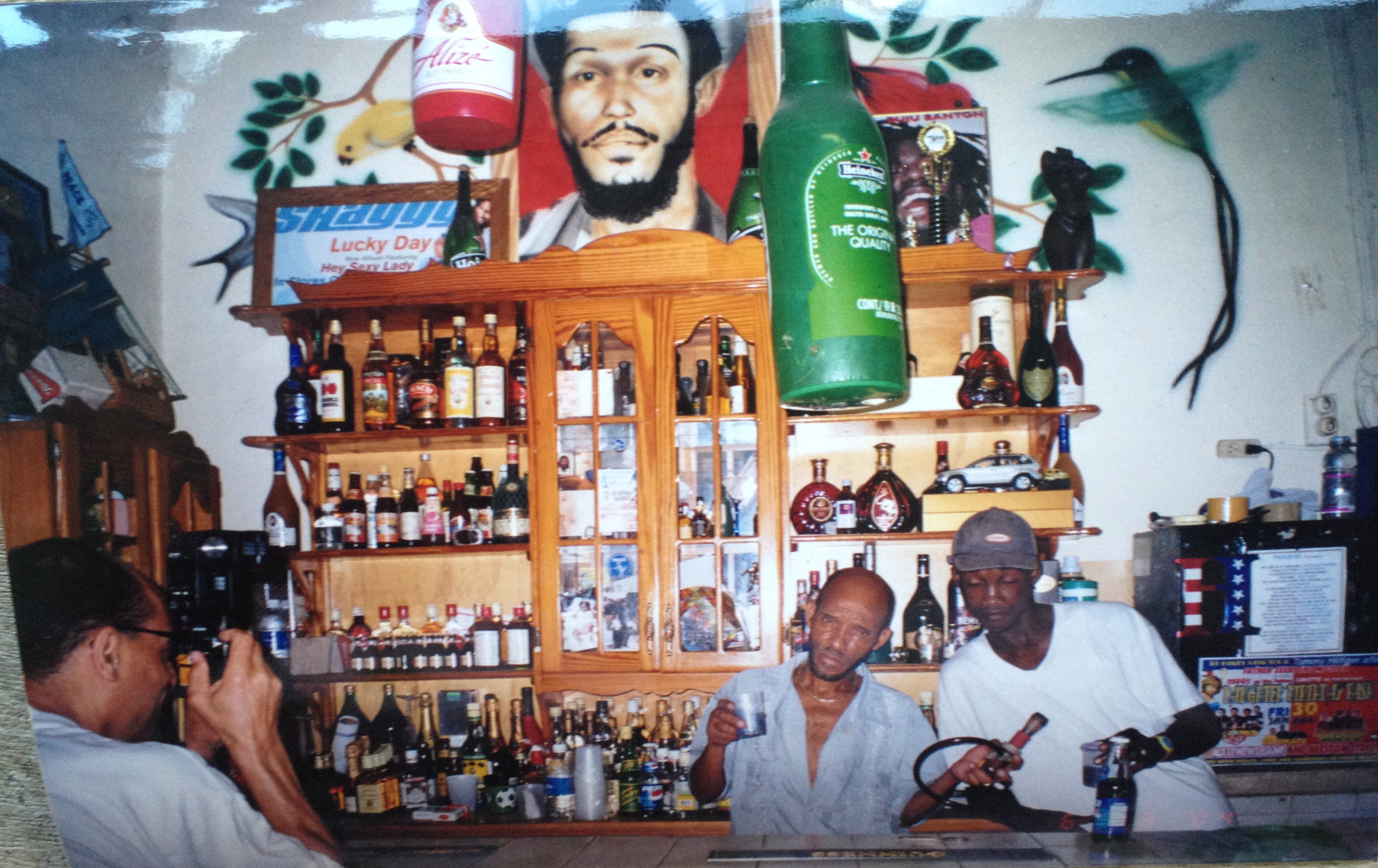
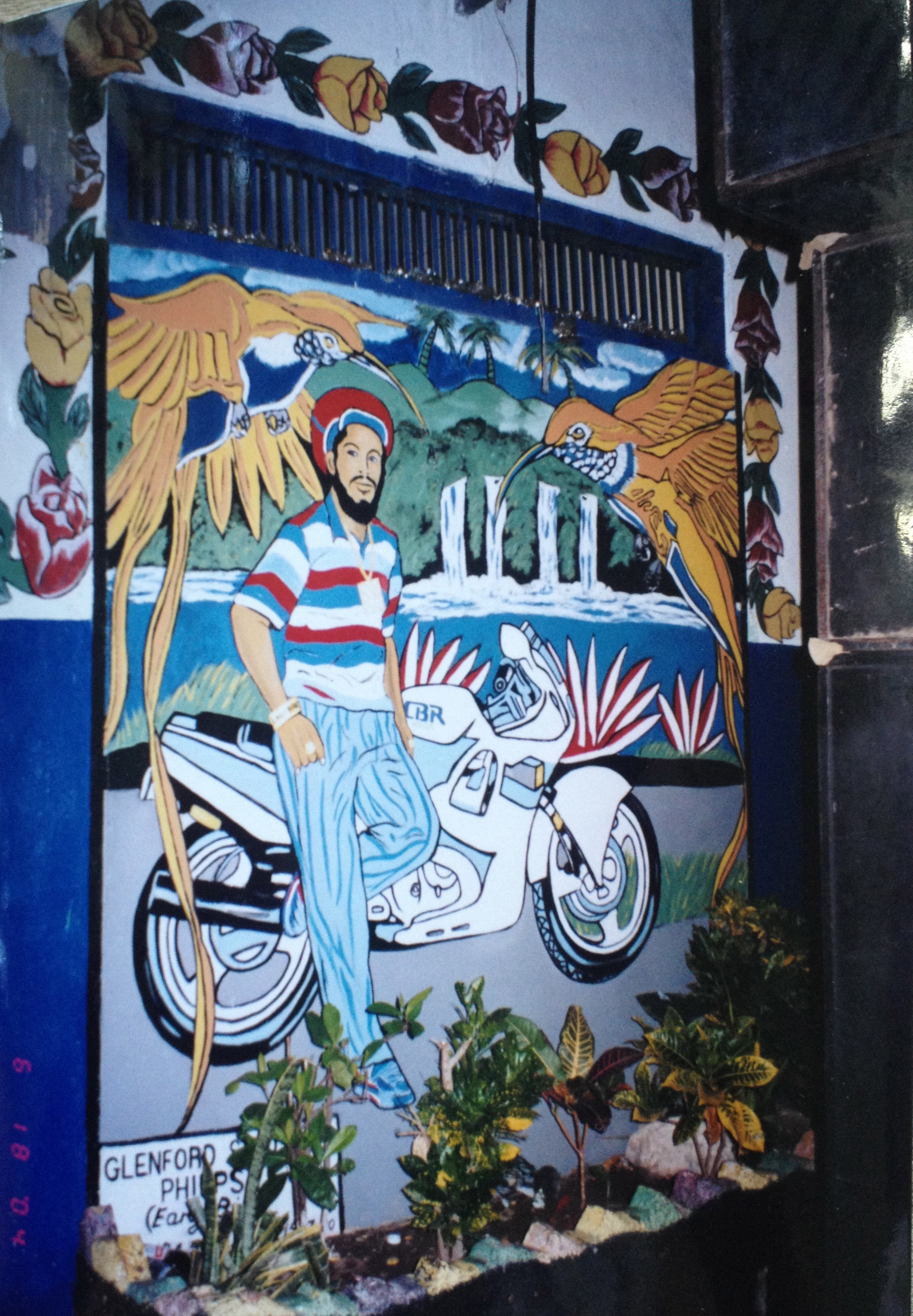
It happens to be a mural that I photographed a bit in 2004 during a close encounter with Zekes, the notorious Don of Matthews Lane, who brought Kingston to a standstill in 1997 when the police briefly arrested him. Glenford ‘Early Bird’ Phipps was Zekes’s beloved brother, brutally murdered in 1990 and memorialized by Zekes in an extensive series of murals on the walls outside and inside his bar (see below).
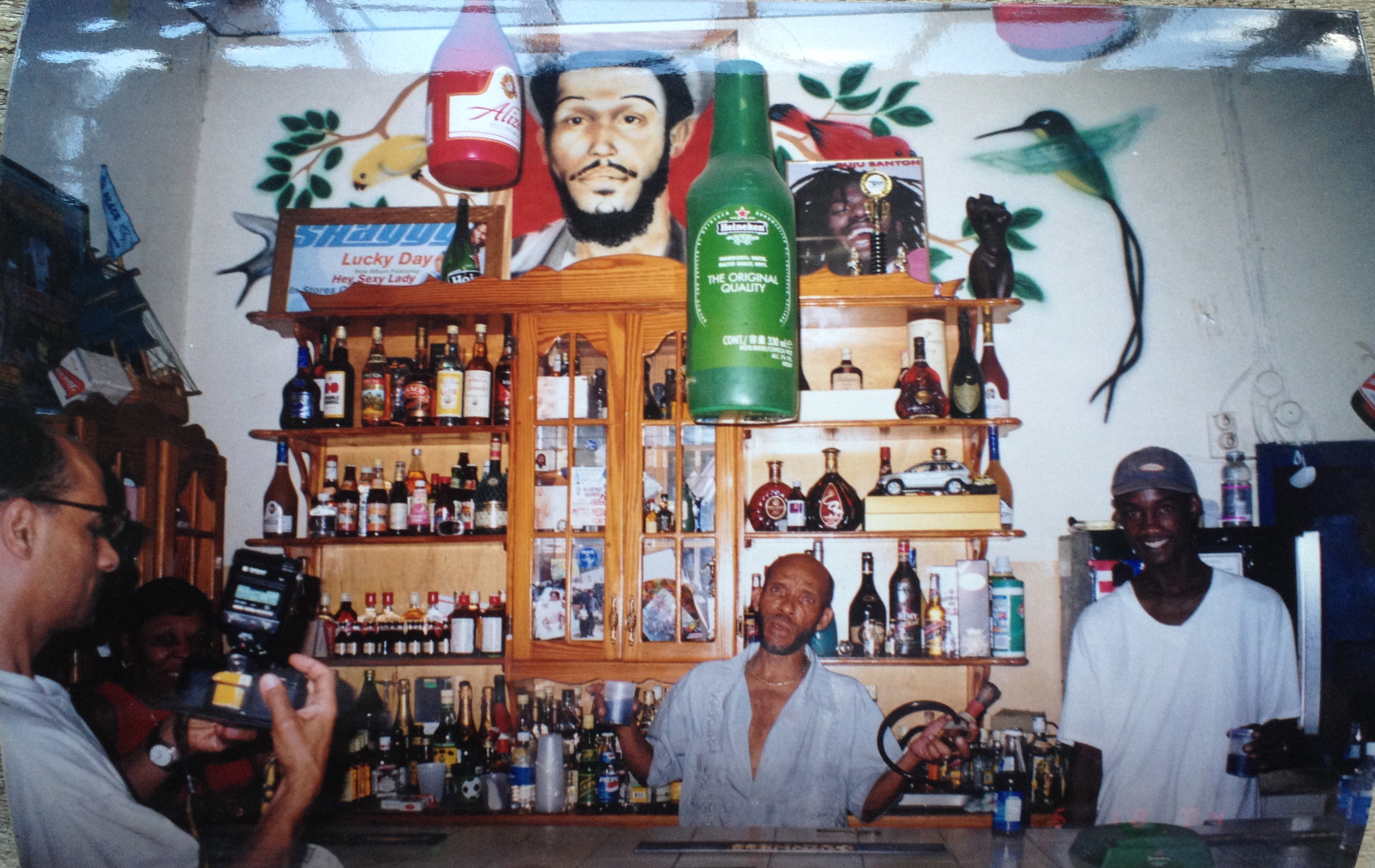
In this photo you can dimly see Zekes behind his bar. He actually tended the bar himself and poured me a portion of John Crow Batty, a powerful white rum the likes of which i’ve never encountered since.Inside the bar there were more images of Early Bird, flanked by humming birds. You can also get a better look at Zekes with one of his lieutenants. On the left behind his camera is Julian Henriques, film-maker and lecturer at Goldsmith College in London.Zekes was initially hostile, incensed at my taking photographs without his permission, though he soon became very friendly, even posing for photos and sending his lieutenant, who had previously ripped the film from my camera, to accompany me while i took photos outside.
But even better than this, Early Bird was memorialized by none other than the famous poet Kamau Brathwaite in his long poem Trenchtown Rock. I’ve taken the liberty of photographing and reproducing below relevant portions from that poem so that you get a better sense of who Glenford Phipps was (“was a young Dreadlocks, [later I was to learn that he was known as “Early Bird”/catching his first too early worm of death that early All Souls Morning] his beautiful long hair like curled around his body making snakes like dance“), his sensational slaying outside the very building Brathwaite lived in, in which Phipps had also been resident, and his importance to the community he came from, to whom those murals would have been of great significance.
This magnificent painting of Early Bird was on the outer wall of the bar.
Many will say the murals are merely ‘a glorification of criminals’ and should be defaced for fear of their ‘grave effects’ on ‘poor Jamaicans’ etc. I quote from a Facebook response to my posting of Honor’s article. Frankly I’m always amazed at how many Jamaicans talk as if everything is black or white, easily distinguishable, devoid of ambiguity or nuance. Many of Jamaica’s national heroes were on the most wanted list of the colonial government in power at the time. How does a profoundly corrupt state determine criminality? If/When so many police personnel behave like criminals and in effect ARE criminals how do they determine whom to punish? And should the public support them in this? These are hypothetical questions but ones worth pondering. One of the interesting things brought out in Honor’s article on censorship is the fact that also memorialized in many of these communities are the fallen policemen belonging to them:
Some of the murals can be read as covert statements against police impunity and against police methods. But this doesn’t mean communities are against the police per se. If this were true, police from inner-city communities would not be memorialised. But they are. They, too, are mourned and remembered. Nevertheless, it is well known that Jamaica has a high rate of police violence that undermines public confidence in law enforcement.
Do we really have a right to erase the social history of communities in the name of hard policing? Really? What next?
A brief look at the University of the West Indies forum on the proposed logistics hub at Goat Islands
I didn’t actually make it to UWI’s one day colloquium on the proposed Goat Islands logistics hub today but tried to keep track through those who were live tweeting it. Below is a selection of tweets from the event, unfortunately all the tweeters seem to be critics of the project. I’m no environmentalist myself but am sympathetic to arguments on behalf of preserving its integrity against rapacious ‘developers’. It’s unfortunate that such projects inevitably portray environmental activists as ‘anti-development’ or ‘anti-economic growth’. In fact what we need to do is look at the last 10 projects that environmentalists protested about and see whether the claims of economic developments, ‘job-creation’ etc actually stand up to scrutiny now that those projects have steamrolled ahead. Can the cruise ship terminal at Falmouth be called a success? For whom? Have the big Spanish hotels been good for the economy? or are local tourist interests hurting and unable to keep up with the cheap rates they offer? Is anyone doing the cost-benefit analyses needed?
What i found amusing was Nature being invoked by the developmentalists when someone said ‘Nature abhors a vacuum’ in arguing the urgency of pursuing the hub. Hopefully Nature’s potential wrath will also be taken into consideration when turning the proposed Iguana sanctuary into a logistics hub, so that it is done with the least amount of damage to the surrounding areas. One can hope, can’t one?
PS: Nov 10. Top journo Dionne Jackson-Miller’s takeaways from the forum under discussion at which she actually chaired a panel, give a fuller picture of the day’s discussons. Check her post out.
Diana McCaulay @dmccaulay
Beautiful Sat morning – heading to all day UWI session on the logistics hub billed as economy vs environment? Sigh
Damien King @DamienWKing
At UWI forum on the logistics hub. Still don’t know if hub will be a facilitator for the broader economy or an enclave that will burden it.
@DamienWKing when we hear special economic zone it means enclave of no taxes that everyone else will have to pay taxes for #LogisticsHub
@DamienWKing : we nd to know why ja has bn worst performing economy over past 40 yrs so we can know if #LogisticsHub will solve the problems
Diana McCaulay @dmccaulay
100% all male panel at the head table for opening session. Does UWI not have a Gender Studies Dept??
Diana McCaulay @dmccaulay
Am musing on what Easton and Conrad Douglas talk about over dinner..
Diana McCaulay @dmccaulay
World can’t wait for opening of Jamaica’s logistics hub – nature abhors a vacuum. Folks have options – will make other plans
Jherane @Jherane_
Wow. After showing the massive harbours that will be built they show pretty pictures of the local beaches we have…
Jherane @Jherane_
There’s only one female panellists today. Out of 24 panellists, only one female. Wow.
Diana McCaulay @dmccaulay
Usual story: Since we’re running late, Q&A will be shortened
Jherane @Jherane_
“[Jamaica] has a stable political and social culture” –> hysterical laughter from the audience.
Diana McCaulay @dmccaulay
Logistics hub task force has 12 sub committees – none on the environment
Jherane @Jherane_
Caribbean Coastal Area Management (C-CAM) lists storm surges, tsunamis, flooding, sea level rise amongst the climate change risk.











 Active Voice