Kei Miller Maps His Way to Zion…

A conversation with Forward Prize Winner Kei Miller of Jamaica

Kei Miller. Photo credit: Susumba.com

Kei Miller was born in Jamaica in 1978. Kei writes across a range of genres: novels, books of short stories, essays and poetry. His poetry has been shortlisted for awards such as the Jonathan Llewelyn Ryhs Prize, the Dylan Thomas Prize and the Scottish Book of the Year. His fiction has been shortlisted for the Phyllis Wheatley Prize, the Commonwealth Writers Prize for Best First book and has won the Una Marson Prize. His recent book of essays won the 2014 Bocas Prize for Caribbean Literature (non-fiction). In 2010, the Institute of Jamaica awarded him the Silver Musgrave medal for his contributions to Literature. Kei has an MA in Creative Writing from Manchester Metropolitan University and a PhD in English Literature from the University of Glasgow. In 2013 the Caribbean Rhodes Trust named him the Rex Nettleford Fellow in Cultural Studies. His 2014 collection, The Cartographer Tries to Map a Way to Zion, has just won the Forward Prize for Best Collection. (Adapted from note on Carcanet website–Carcanet Press being the main publisher of  Kei’s poetry)

Kei it was in Treasure Beach during the Calabash Literary Festival in June this year that you found out you had been shortlisted for Britain’s top poetry award, the Forward Prize, right? I remember your telling me about the controversy aroused by Chief Judge Jeremy Paxman’s draconian pronouncements on the state of contemporary poetry (“with bloggers ranting and poets unfriending each other on facebook “ as you said on Facebook) and his virtually calling for an inquisition of poets. At the time you were pleased just to be on the shortlist but now it turns out you’re the sole survivor–the champion–of that figurative Inquisition. Do you feel as if the moon just fell into your lap? Describe what winning the Forward Prize feels like and means to you please…

Well, it was while we were in Treasure Beach that the news became public. I had known a little bit before, and yes, I was simply pleased to be shortlisted. I actually wasn’t looking forward to the award ceremony because before that there was simply the possibility I could win, and I thought after I’d go back to simply being the person who was shortlisted. I seem to get shortlisted for things but hardly ever win, so it has come as a huge surprise and as you put it, a little like the moon has landed in my lap. I knew I had written my best poetry collection to date, but I also knew there were other really good books out there, and I didn’t know if a collection so steeped in a Jamaican soundscape could be fully heard by British ears. So it all feels like an incredible validation that if we write well enough our voices can be heard.

I have to say I completely agree with Paxman about poets needing to connect with ‘ordinary people’ more. As a youngster I loved reading poetry but gradually became alienated by the gnomic, elliptical utterances I was increasingly being offered in its name. Your A Light Song of Light was the first book of poetry that made me realize I didn’t really dislike poetry as I had started thinking, that I could and did still appreciate really good poetry I could connect with. What was your reaction when Paxman said he thought poets had more or less made themselves irrelevant? I feel the same way about much contemporary art that I see today by the way–too tight-lipped if you know what I mean–oh, you don’t wish to communicate with me? Let me not be detained any further by you then is my response. I know you disagree about communication–strictly for ad agencies and PR folk you’ve said in the past but it IS something you do well. There’s a profound empathy in your poems that pulls you in and an effortless virtuousity that detains you, enraptured. So you’ve won it already and don’t have to worry about offending anyone, tell us what you really think of Paxman’s position on poetry.

Well I always kind of agreed with Paxman and I think many poets, not only today but as far back as Wordsworth, have been saying the same thing. There was an unfortunate backlash that seemed to me to say, how dare a non-poet talk about our world and our craft, which pretty much proved his point. I think each poem ought to consider very deeply its reader and what it is offering that reader. Too many poems, I think, seem to be more conscious about what they withhold rather than what they reveal. The thing about communication is probably just semantics, because I think we’re saying almost the same thing. I don’t like the word ‘communicate’ because it’s too wrapped up in the idea of a simple and reducible message, and I think what a poem transmits is a lot more than that, a lot more complex. But that the poem ought to be generous, that it ought to consider and give to its reader – these are things I’m fully on board with.

When did you first start writing and did you start with poetry? A lot of people think that you came out of the Wayne Brown writing workshops in Kingston but you didn’t did you? Was there a literary community that nurtured your interest in writing or was it something you just developed on your own?

I don’t know if it’s possible to develop on your own, but those communities were quite various. No, I didn’t attend Wayne Brown’s workshops regularly though I dropped into a couple of their end of year sessions. But the space that Wayne created in the Observer Arts supplement was one of the most important spaces in which I was allowed to develop as a writer. So Wayne was massively important – not as a tutor but as an editor who created space for writers. Mervyn Morris was much more important to my beginnings as a poet. I did his poetry workshop as an undergraduate student at UWI and at a time when I only saw myself as a prose writer. But there were online communities as well – place at Alsop Review called the Gazebo that had both the kindest and the most vicious critics I’ve ever encountered. It was nurturing and rigorous and I grew a lot there – my standards became much higher.
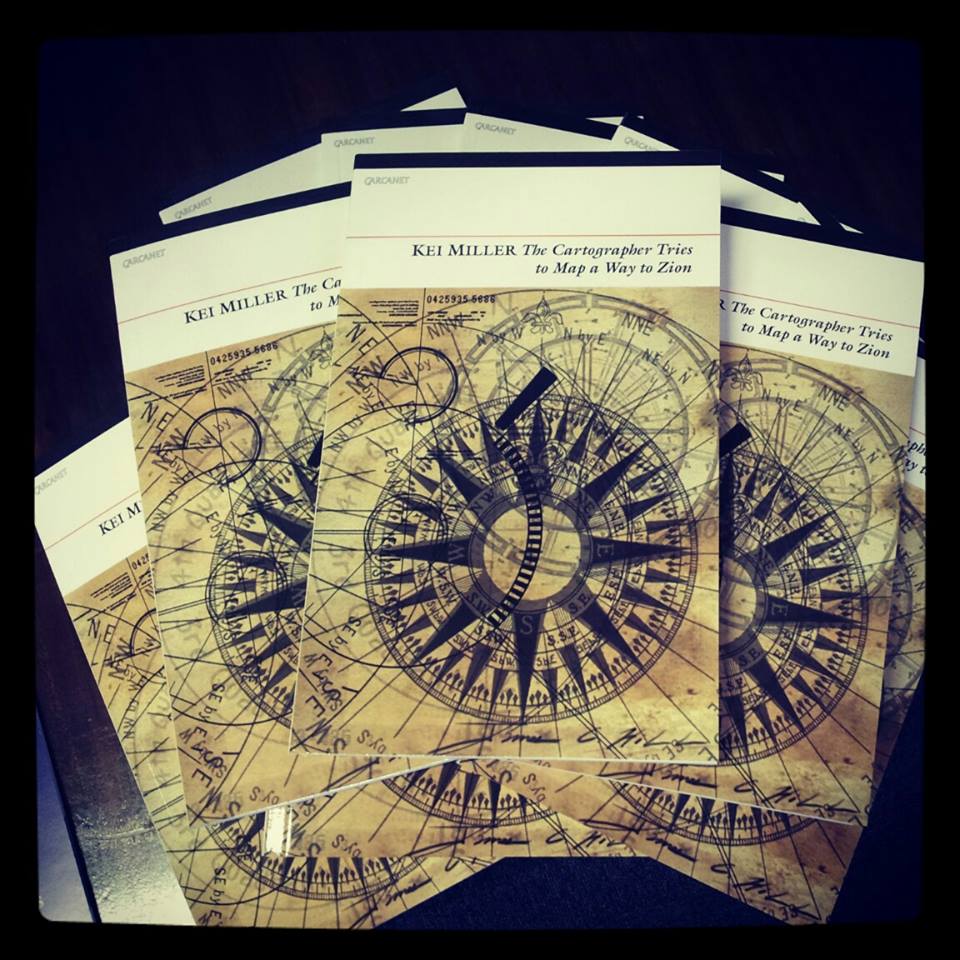
cartographer

One of the remarkable things about you is that you’re a multigenre writer, if that’s the right term. You’ve written novels, poetry and most recently a book of essays. I remember a conversation in which you said you thought you were increasingly finding non-fiction a more interesting medium than any other, am i remembering correctly? You also write about art, don’t you? Could you talk more about your forays into non-fiction? Did this develop out of your blog Under the Saltire Flag?

The blog is certainly a space where I try out a lot of my ideas and sometimes develop them, but I’m not sure where my interest in non-fiction came from or how it grew. I know that it’s a genre that seems incredibly full of possibilities – a place where I can use all my skills as a poet and a fiction writer at the same time. But also, where a good poem might impress you most deeply for its lyricism and a good story might impress you most by its narrative, a good essay always impresses me most for its intelligence. I leave a good essay thinking, what an incredible mind this writer has! And to be able to think that clearly, with that much sophistication, and to be able to allow others to think through things like that – it seems to me an especially high calling, something I always want to aspire to. But something about the sensibilities of these various genres keep on spilling over into each other. I think it used to be obvious in my fiction that I wrote poetry as well, and in this new collection of poems it’s probably quite obvious that I’ve been writing essays.

Did you follow the recent fuss about Shonda Rhimes, the woman behind a string of US TV success stories such as Scandal and Gray’s Anatomy, who was described as ‘an angry black woman’ by a New York Times writer despite the fact that she chooses not to view herself or race in such polarized terms? That whole controversy reminded me so much of your encounter with some postcolonial African academics who tried to interview you a few years ago but assumed you shared their sentiments and worldview. “I’m sorry I cannot be your angry black poet” was what you wished you had replied, apologizing for the fact that you were comfortable in your own black skin. Can you talk a little more about this refusal of an all too familiar role? It’s not unlike Jamaican poet Mervyn Morris’s refusal to be a cookie cutter ‘revolutionary’ or leftwing poet several decades ago.

I wonder if that’s natural, I mean – for an artist to resist the boxes we try to peg them in. It’s an occupational tick to live in fear of clichés, and also I live in fear of a kind of self-indulgent earnestness. Maybe that’s because, deep down, I think I’m susceptible to that sort of thing, so I have to resist it. But I’ve never felt like a particularly angry writer, which obviously doesn’t mean that there isn’t a lot that doesn’t concern me, and neither does it mean that I’m not a deeply political writer. But there are other tools I think we can use to explore and unpick the many things that are so wrong about the world we live in today – humour for instance. Humour is always there in anything I write and we discredit humour too easily as not having heft, as being trivial, but I don’t think it is at all.

Marlon James, Kei Miller, London Underground, October 2014. Photo: Morgan Everett

This is such an incredible moment for writing in Jamaica what with you winning the Forward Prize, and back in the US Marlon James meteoric streak across the literary firmament with his new novel A Brief History of 7 Killings. How does this make you feel?  How long have you known Marlon? When did you first become aware of each other? You seem to enjoy a friendly rivalry with him–I’m remembering your Facebook jousts about being invited to an event in Switzerland because Marlon the original invitee had dropped out and you joked that the organizers turned to you “to fill their quota of One youngish dreadlocked Jamaican writer”; then there’s your defence of ‘Maas Joe’, the rural caricature whom Marlon dismissed in his keynote address at the 2013 Edinburgh World Writers’ Conference. I agreed completely with Marlon by the way, what he was criticizing was the stock rural Caribbean character often found populating mediocre stories and not a particular individual who may happen to live in the country and ride a donkey. It was the hackneyed representation of such individuals he was deriding. It’s not just about cosmopolitanism versus local or ‘fi wi maas joe’ but about a romanticization of rural poverty over urban blight–a kind of simple-minded belief that the ‘folk’ are not to be found in urban ghettoes, only in verdant pastoral villages.

If what I have with Marlon is a rivalry, then I wish all rivalries would be like that. We obviously like each other. We’re friends. It’s true that not all my interaction or relationships with Caribbean writers in my generation feel as healthy. Some of them – the things people say – are downright petty and vindictive. But in that I have a Caribbean Granny’s approach: I leave them to god. But with Marlon, you know, I think it’s just exciting to be writing at the same time that he’s writing. Probably in both of us is this excitement that we want to do something in literature that hasn’t been done yet. I don’t know if you know this, but our backgrounds are scarily similar – we went to the same high school (not at the same time), then we went to UWI to study literature and were both influenced by similar books; we both went into advertising; we were both part of the same charismatic Christian circles which we eventually stepped away from. Perhaps the profound difference is that Marlon’s instinct is to transform the material he gets into a kind of darkness, and my instinct is to transform it into a kind of light.
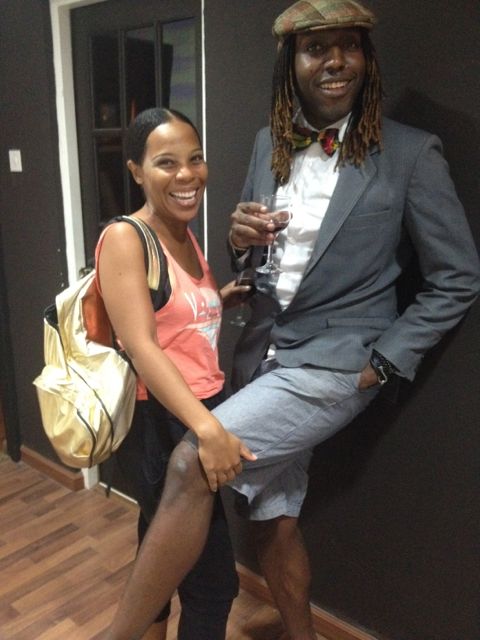
Kei Miller, Deborah Anzinger...
The ever mischievous Kei Miller with Deborah Anzinger of New Local Space (NLS) Photo: Annie Paul

You mentioned our Maas Joe argument, and maybe that’s something that I will continue to disagree with both you and Marlon about. I used to feel the way you do, but the more I think about it is the more I simply don’t know the books you’re talking about. I’m not saying people don’t probably write such books, but when has such a book ever been valorized or held up as great Caribbean Literature? I don’t know any such examples. It seems like a myth to me. Look – literature is something that is created twice. It’s created when the writer writes it, but more profoundly it’s created when the reader reads it, and perhaps we have to ask – how are Caribbean novels being taught? How are they being read? Because I suspect the folk romanticization you’re talking about happens then. I think of a writer like Olive Senior whose settings are as idyllic and rural as you can get – but in Summer Lightning, a little boy is raped by a man who visits the village; in Claude McKay’s books, goats are raped; in Erna Brodber characters migrate and return and have huge psychotic breakdowns, and in the novels of Orlando Patterson or Roger Mais, the folk are very much in the heart of urban blight where the most violent things happen to them. So where is this romantic treatment we love to criticize. When I actually think about Caribbean literature the folk presented are always wrestling with a violent and complicated modernity that is thrust on them. Even in the poetry of Louise Bennett (which is where my argument with Marlon began long before – he tends to dismiss her), if you don’t read the sometimes brutal critique that she levies against the folk, then you’re simply misreading her.

So to repeat the easy argument that the folk has been romanticised in Caribbean Literature seems simply wrong to me, and represents a kind of anxiety to appear sophisticated, savvy, and yes – cosmopolitan, but it reinscribes a terrible, terrible misreading of the literature. There’s a lot more I could say, but I’ll stop there.

Finally, you recently moved from Glasgow where you taught for several years to London. How are you finding the shift? What are your writing plans for the coming year or two?

Moving from Glasgow to London feels a little bit like moving back to the Caribbean. My first morning here I woke up to two voices arguing under the window and all manner of ‘clawt’ was traded in this verbal altercation. And those sounds for me are a kind of healing. I’m enjoying it so far. As you know, I’m always writing something, and there are several ideas (non-fiction and fiction) percolating in my head, and I’ll write them as they come, but I don’t want to say too much and jinx myself.

Pawns of the Pentecostalists? Global Homophobia on the rise

Are we all becoming pawns of a Pentecostalist anti-LGBT crusade being conducted worldwide?

AP Kenya Gay and Out
Binyavanga Wainana. Photo: Ben Curtis, AP

I finally got around to watching Kenyan writer Binyavanga Wainana’s Hard Talk interview with Stephen Sackur of the BBC  just a few days ago. The interview was instigated by Binyavanga’s hugely hyped ‘coming out’ a few weeks earlier. In response to the recent  wave of homophobic legislation in Nigeria and Uganda Wainana released a short story titled I Am a Homosexual, Mum. In the BBC interview Binyavanga was on form as usual and made a lot of sense but Sackur took me by surprise when he seemed to reject out of hand the Kenyan writer’s assertion that the Pentecostal movement with its fire and brimstone preachers were very much to blame for the recent escalation in homophobia on the African continent.

This sounded perfectly plausible to me, especially since I’ve heard local gay activists say the same thing in the context of Jamaica, that American Pentecostalist preachers come to the Caribbean and rave and rant against homosexuals with an incendiary intensity that simply wouldn’t be allowed in the United States with its hate speech laws. All of a sudden something I’ve been puzzled by for a long time–the mystery of why homophobia manifests itself so virulently both in the Caribbean (with Jamaica taking the cake for over the top intolerance) and on the African continent–seemed to have a simple explanation. The same set of American Pentecostalists have mounted concerted campaigns against what they call ‘the homosexual agenda’ in both locations, and I don’t know about African countries but you will have noticed if you’re from here that the use of the term ‘homosexual agenda’ has seen an exponential rise in the last 5 years. Just to test my hypothesis I decided to look at another recent site of anti-gay rhetoric and action–Russia. It was instructive. An American evangelist named Scott Lively had been at work there just as he had in Uganda, which he first visited in 2002. According to a Washington Post article:

Scott Lively is an obsessively anti-gay American evangelical minister. He is, according to National Journal, “perhaps the most extreme” of a network of U.S. evangelicals who, having failed in their crusade against all things gay at home, travel abroad to connect with anti-gay activists and arm them with arguments that, for example, homosexuals will seduce their children, corrupt all of society, and eventually take over the country. You don’t need to take my word for it; read Lively’s manifesto here. It’s a 2007 missive to Russians suggesting they “criminalize the public advocacy of homosexuality,” i.e., use state power to force gay people into the closet. This is something Russia actually did last year (rather indirectly, but quite effectively).

Meanwhile the Southern Poverty Law Centre details Lively’s pernicious activities in Uganda:

In early March 2009, he went to Uganda to deliver what would become known as his infamous talk at the Triangle Hotel in Kampala at an anti-LGBT conference organized by Family Life Network leader Stephen Langa. The conference, titled “Exposing the Truth behind Homosexuality and the Homosexual Agenda,” also included Don Schmierer, a board member of the ex-gay therapy group Exodus International, and Caleb Brundidge Jr., a self-professed ex-gay man with ties to the ex-gay therapy group Healing Touch. Thousands of Ugandans attended the conference, including law enforcement, religious leaders, and government officials. They were treated to a litany of anti-LGBT propaganda, including the false claims that being molested as a child causes homosexuality, that LGBT people are sexual predators trying to turn children gay by molesting them, and that gay rights activists want to replace marriage with a culture of sexual promiscuity. Lively met with Ugandan lawmakers during the conference, and in a blog post later he likened his campaign against LGBT people to a “nuclear bomb” against the “gay agenda” that had gone off in Uganda. A month later, the Ugandan parliament was considering legislation that included the death penalty for LGBT people in some instances and life imprisonment for others. According to Rev. Kapya Kaoma, an Episcopal priest from Zambia (now in Boston) who went to the conference under cover, Lively’s talking points were included in the bill’s preamble

According to Right Wing Watch:

While Lively lashes out at Republicans in the U.S. for helping “hand over the military to the Sodomites,” he praises anti-gay measures in India, Russia and Jamaica, and argues that the reason Ukraine’s president pulled out of an agreement with the European Union was “the Ukrainian disdain for the sexual perversion agenda of the EU.”
In Lively’s own words:
Those of us who still hold a Biblical worldview have been heartened by recent global events affirming normalcy. The Australian high court struck down “gay marriage” as unconstitutional, the Indian high court re-criminalized sodomy, and Russian President Putin declared his nation to be the new moral compass of the world for championing family values. Although Ukraine’s highly controversial decision to postpone (or cancel) a step into the fold of the European Union has been framed in economic terms, there is little doubt that the Ukrainian disdain for the sexual perversion agenda of the EU has played a major role. And in tiny Jamaica, a push to decriminalize sodomy (driven in large part by the U.S. State Department), has run into so much opposition that the pro-family Jamaicans just might win that battle.

To see Lively in action watch this UK Guardian video released today, How US evangelical missionaries wage war on gay people in Uganda. Although Lively himself doesn’t seem to have made a personal appearance in Jamaica as yet we have been treated to diatribes against the LGBT-community by one of his disciples, Peter LaBarbera, whose group Americans for Truth About Homosexuality (AFTAH) threw a banquet in honour of Lively in 2011. LaBarbera was in Jamaica as recently as December 2013 urging Jamaicans to resist changing the laws against buggery. 

LeRoy Clarke. Photo: Stefan Falke

Of course we can’t blame the Pentecostal purveyors of hate entirely for the intolerance towards the LGBT community. Their maniacal fervour and rhetoric falls on very fertile ground. Anti-gay sentiment is alive and well from the least literate to the most highly educated and accomplished of Caribbean citizens. Look for example at the startling outburst the other day by Trinidadian artist Leroi Clarke, that has stirred up quite a controversy in Port of Spain. A report in the Trinidad Guardian quoted the eminent painter:

In a phone interview yesterday, Clarke related homosexuality to the increase in crime, saying young men are usually indoctrinated into gangs with homosexuality and because of the violation of their manhood use the gun as a symbol of their masculinity. He added: “It is brought about by power bases that manipulate the principles that hold our heritage for their own advantage. “Something is happening with the gender paradigm today. We had guidelines where we looked at certain types of conduct as abominations. We took it from the scriptures.” The Bible, he added, was one of those and verses clearly refer to homosexuality, men with men and women with women, as “unnatural” and an abomination. “Today, the word abomination does not have the same tone. People indulge abominations, accede to them,” Clarke lamented. “At 73, I can say the world is no longer mine,” he said. Asked exactly what he meant by saying homosexuality was threatening the arts, Clarke said with the exception of the sailor and maybe the midnight robber, there were no longer any definitely male costumes in Carnival, not even in portrayals of the devil. “An effeminating power has taken over the costumes and even the rhythm of the music. Carnival is no longer male and female. “This is a very serious matter. We are dealing with a problem that is threatening our heritage.

LeRoy Clarke at work. Photo: Annie Paul

Rumour has it that what may have set Clarke off was the recent state gift to Carnival Masman Peter Minshall of the State property he has been occupying in Fede­ra­tion Park, Port of Spain. Minshall, a white Trinidadian is openly gay.

To return to Stephen Sackur’s interview with Binyavanga Wainana which must be watched to be believed, I admit to feeling as if the scales have dropped from my eyes. On the one hand you have Sackur browbeating Wainana for bringing up the very pertinent matter of the anti-gay campaign by Pentecostalist missionaries in African countries such as Uganda, claiming that the Kenyan writer was trying to blame African homophobia on ‘external influences’ such as this (He wasn’t); and on the other hand you have Sackur insisting later on in the interview that the West must be allowed to interfere in the internal matters of African societies in the name of championing ‘universal values’! Sackur needs to be administered a good dose of Stuart Hall 101 on the inherent problems of overlooking cultural factors in the name of a tenuous universalism which only seems to work unidirectionally–from the West to the rest of us.

If indeed you speak in the name of the West Mr. Sackur deliver up former UK PM Blair to the Hague for trial for the universally understood category of war crimes (as Wainana gently suggested).  I’d love to see an interview along those lines. And at the very least leash the rabid hatemongers within your midst and curb the export of hatred and homophobia from the West before we all become puppets of the Pentecostalists. After that you may or may not be allowed to preach ‘universal values’. External forces ought not to lead the way to change in societies from outside, they can provide assistance discreetly, at the behest of, and in line with, not in advance of those militating for change  from within and only after they put their own house in order. Nuff said.

A Stuart Hall-shaped hole in the universe…

A few photos of Stuart Hall along with a 2004 interview done in Jamaica

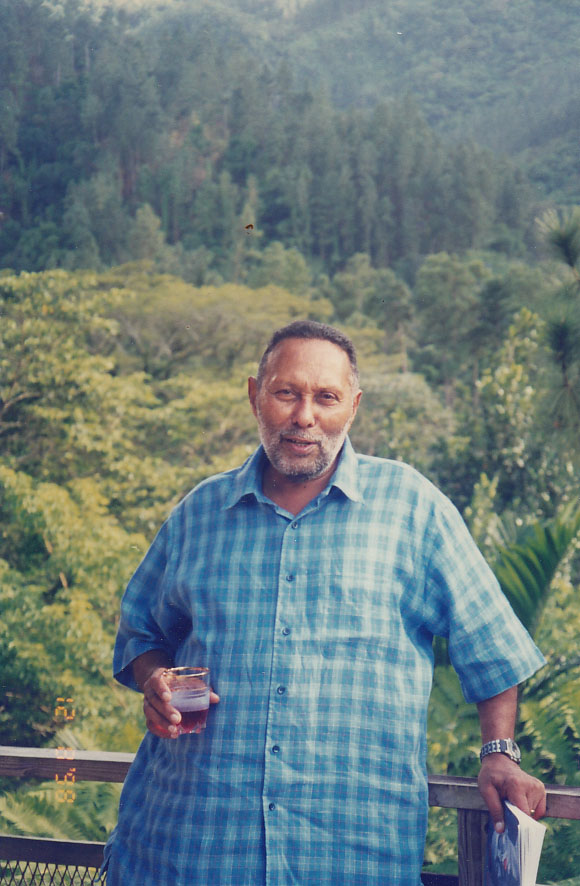
Stuart Hall, North Coast, Jamaica

When I saw Stuart at his home in London on December 14, 2013, I knew he wouldn’t last much longer. He had been ill for years and his health had deteriorated considerably since the previous year when we celebrated his 80th birthday at Rivington Place, the art centre born of his inspiration and hard work. All the same his departure comes as a blow. It’s too early for me to come to terms with this loss, for Stuart has been a close friend and mentor since 1996 when he came to the University of the West Indies to speak at the Rex Nettleford Conference.

For what it’s worth I publish a few photos taken over the years along with a substantive interview I did with Stuart in 2004. Stuart Hall was such an extraordinary thinker that his work ranged over a broad field of interests including visual art which was the one thing we truly bonded over. It was a preoccupation that didn’t get much coverage in other interviews which tend to focus more on his activism, his Marxism, and his political interventions. Here’s a link also to the post I wrote on the John Akomfrah film about him, a must see, which I hope will be shown on Jamaican TV soon.

Stuart when I first met him in 1996.
David Scott and Stuart Hall, 1996
David Scott (editor, Small Axe) and Stuart Hall, 1996
Stuart Hall outside Rivington Place, under construction.
stuartaggreyhse
1998

Stuart Hall at Aggrey Brown's home
Stuart Hall at Aggrey Brown’s home, Golden Spring, Jamaica, 1998
Stuart Hall at Good Hope Estate, Trelawny, Jamaica, 2004
Stuart Hall (R) reading a copy of The Caribbean Review of Books at at Hellshire Beach, Jamaica; June 2004.  Photo by Annie Paul.
Stuart Hall (R) and Catherine Hall reading a copy of The Caribbean Review of Books at Hellshire Beach, Jamaica; June 2004
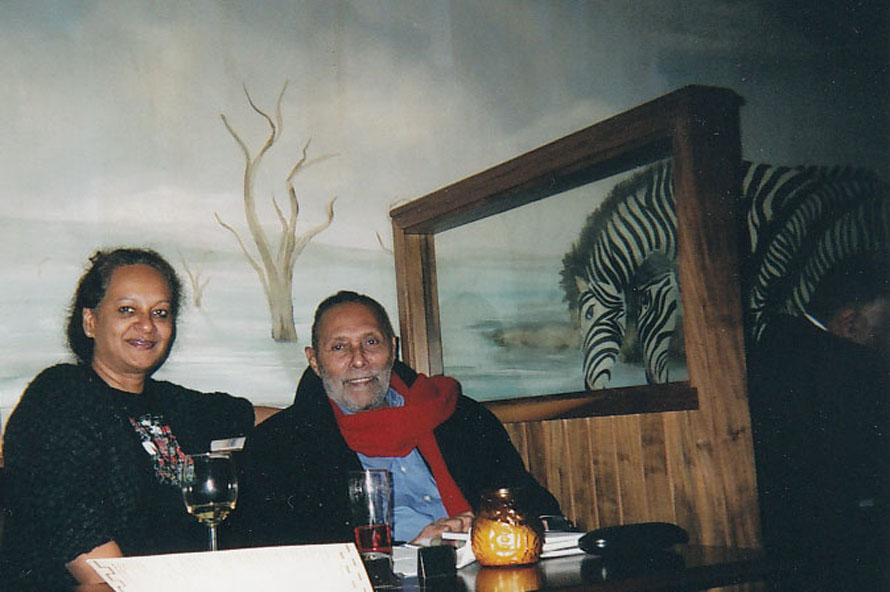
with Stuart Hall at a bar in Edgeware, London
with Stuart Hall at a bar on Edgeware Road, London, 2008. Photo by Dilia Montes-Richardson
stuetmoi2
Photo by Dilia Montes-Richardson

and one of my treasures–a letter Stuart wrote to the Librarian at Birmingham U so that I could gain access to their inner sanctum:

birminghamletter

Cross-Border Politics: Why TnT may have blanked 13 Jamaicans…

A look at some reasons 13 Jamaicans were denied access to Trinidad and Tobago.

deportees

Diana Thorburn Chen: An apology is not necessary. What is necessary is for Jamaicans to have an honest conversation among ourselves about why we are turned back so often from our neighbours’ doors. But that would require us doing some soul-searching and talking honestly about how our actions bring on these reactions. Highly unlikely, so we will keep up the facade of indignation over and over again as until we face the truth nothing will change.

VERITAS also thought that Jamaicans needed to open their eyes and look within…

We are hypocrites too. When CARICOM member Haiti was struck by that devastating earthquake recently, and many Haitians turned up at our borders, desperate for admittance and “free movement”, we demanded the government send them back. Many of us were angry any money was even spent to accommodate them for the period they were here. Is it that free movement only applies when we want it?

What really troubles me about all this is the nagging feeling that most of us are angry because of our false sense of pride. We have always been a proud and, as one of my colleagues pointed out, reactive people. Trinidad’s exercise of its sovereign authority hurt that pride and so we are now reacting. If we are honest with ourselves, we have always harboured the unhealthy sentiment that Jamaica is the best of the Caribbean, a capital of sorts, and therefore we have behaved accordingly entitled.  That is the source of our pride. Many of us are incredulous because we deem Trinidad a “spec in the sea” and “two likkle fi even be a country”, an “insignificant” country should never seek to disrespect Jamaica, right? We took the same stance on Mugabe’s comments on Jamaica. Meanwhile, the United States rejects us in droves every single day and we sit pretty smiling at that, with little more than a peep. In our quest to satisfy our wounded pride, we have gone as far as accusing Trinidad of “badminding” Jamaica for our achievements. I admit myself baffled at that argument, because we have such precious little to ‘badmind’. We are on auto pilot, veering on the edge of a political, economic and social abyss, who would ‘badmind’ that? Pride aside, how about we accept the fact that statistics are not in our favour? Most countries have instituted visa requirements against us because we do not have a good track record for international conduct and behaviour. We have to accept that; the bad mek it worse for the good. It is unfortunate, but true. Let us put our pride aside and accept the realities.

Click here for more.

Then there were those who still thought Jamaicans had been wronged:

Michael Andrew David Edwards Whatever the reasons, the treatment as described is unacceptable; they wouldn’t accept it from us

And others who imagined the worst case scenario:

Nicholas Laughlin: I find myself thinking it’s a good thing Trinidad and Jamaica don’t share a land border.

Oh Nicholas, the very thought makes me shudder. But honestly i do have to ask: how can a population that has no qualms about turning away neighbouring Haitians when they arrive on Jamaican shores in dire need be so self-righteous when 13 of theirs are shown the door?

13 Jamaicans denied entry to Trinidad and Tobago

Jamaicans are considerably incensed over Trinidad and Tobago’s refusal to grant 13 of their compatriots permission to land in that country. The subject has dominated the talk shows as well as social media ever since the day the 13 were sent back. This isn’t the first time this has happened, in fact news reports said that over the last three years at least 1000 Jamaicans have been sent back from the twin island republic. An Observer article provides details of what is promising to blow up into a diplomatic row:

On Tuesday, 13 Jamaicans, including an 11-year-old girl and a man who is married to a Trinidadian woman, were denied entry upon arrival at the Piarco International Airport in Port of Spain and were sent back to Jamaica the following morning.

Immigration officials at the airport seized the Jamaicans’ passports and ordered them to sit on a hard bench all night before shipping them out of the country, despite the fact that the Caricom Single Market and Economy (CSME) allows for free travel between countries by Caribbean Community nationals.

The move by the Trinidadians is also a direct breach of the Revised Treaty of Chaguaramas and defies a recent ruling by the Caribbean Court of Justice (CCJ), which handed down a judgement in favour of Jamaican Shanique Myrie who had sued the Barbados Government.

Myrie was refused entry into Barbados on March 14, 2011, was detained, subjected to a dehumanising cavity search, and deported to Jamaica the following day.

Reactions from social media and local newspapers give some idea of the outrage this has caused:

From Facebook:

Mariel Brown
The fact that 13 Jamaicans from one flight were deported needs to be addressed by the tt government before we end up with a xenophobic backlash from Jamaica.

Diana Thorburn Chen
There are already FB fliers circulating calling for a boycott of all T&T goods & services.

Zarna Herrera
Xenophobic backlash in full force already

Signs of the xenophobic backlash are fully in evidence. The following is from the Observer article quoted above:

Jamaican George Lopez said Jamaicans can use their purchasing power to hit the Trinidadians where it hurts most.

“The only thing that works is the economic embargo. Don’t buy their goods, don’t give their children jobs. The Government won’t do it, so the people must,” said Lopez.

“I am going to remove my money from any financial institution that has ties to the eastern Caribbean. I have long boycotted them, my family and friends also, from the 1970s. They are racist,” he charged.

Lopez said Trinidadians’ hatred for Jamaicans go way back to the 1960s when the Alexander Bustamante-led Government voted against a Caribbean Federation.

“There is a retention of hatred. It is the small island mentality. Jamaica is a continental mentality. I won’t go there (Trinidad),” he said.

Meanwhile on Twitter my good friend Grindacologist was gnashing his teeth and muttering under his breath about any Trinidadian musicans coming here:

@Grindacologist

wait till kes the band try come round ere again…a worries…

all di one machels montanas…

goin mek dem sleep pon di tarmac…

when a jamaican gets killed in trinidad dem all try deport the corpse…

Stay tuned to this spot for further updates on this contentious issue.

The Faculty of Social Sciences, UWI, Mona: 60 years of Praxis

A potted history of the University of the West Indies’ Faculty of Social Sciences at Mona, Jamaica

NB: The following article was written in 2008 for a commemorative insert in the Gleaner at the request of the then dean, Mark Figueroa. It is NOT an official document put out by the University of the West Indies. Today I received a request from a lecturer at UWI, St. Augustine, asking me where her students could source this article and i thought the best way to do this was to publish it here. It would also take care of today’s post for #NABLOPOMO which requires participants to post something each day for the month of November 🙂

The study and teaching of social sciences at the University of the West Indies, Mona, is an academic venture that started in 1948 with the establishment of the Institute of Social and Economic Research (ISER) at the then nascent UniversityCollege of the West Indies. The funding for this new institution was provided by a Colonial Development and Welfare grant provided by the British Government.

It would be another twelve years before a Faculty of Social Sciences was instituted at the University. The thinking was that researchers working at ISER on social and economic issues in the Caribbean would create a bank of relevant local research that academics could draw on in the teaching of Caribbean Economics, Political Science and Sociology.

As early as 1953 therefore, a quarterly, inter-disciplinary journal, Social and Economic Studies (SES), was established with a view to publishing and disseminating the fruits of the research conducted at ISER. The climate of intellectual ferment at the Institute was such that despite the lack of an approved budget the Director Dudley Huggins decided to go ahead with production of the journal using small grants from various sources including the Leverhulme Foundation in London and a contribution from the Colonial Secretary. The Institute also embarked on a publishing programme producing books, monographs and working papers. These were to become important texts in the teaching of Caribbean social science.

The Faculty of Social Sciences was formally established in June 1960. The Faculty initially had only two departments: Government and Economics. Later a one-year course in Public Administration was instituted for technical and administrative personnel in the British Caribbean. In October a two-year certificate course in Social Work was introduced and in 1961 the Department of Sociology was established. Early staff members were recruited from Britain and it was only by the mid-sixties that lecturers of West Indian or Caribbean extraction began to teach in the Faculty of Social Sciences.

This early cadre of West Indian lecturers set out with alacrity to analyze, research and teach various aspects of Caribbean reality. By so doing they aspired to contribute to the development of Caribbean society as well as make their mark in their respective fields. They ran headlong however into resistance and hostility from the British researchers who formed the core of the teaching departments who felt that there were no social and economic problems specific to the Caribbean and that the creation of a Caribbean-oriented Economics, Sociology or Political Science would lead to a dangerous parochialism.

The Economics Department was particularly active in the early years with lecturers representing a wide range of differing ideological perspectives. By the late 60s and early 1970s there was already a vibrant critique of the work of the Nobel-prize winning Arthur Lewis’s Theory of Economic Growth and the work of George Cumper, a stalwart of the department since 1949. The latter was a prolific contributor to Social and Economic Studies, the journal started by ISER.

These critiques came from a group of loosely allied thinkers known as the New World Group in the Faculty of Social Sciences. Their aim was to develop an “indigenous view of the region”. It was members of this group that produced the influential ‘PlantationSchool’ model of economic analysis which was rooted in a strong sense of pan-Caribbean nationalism. The group included thinkers such as Lloyd Best, Norman Girvan, George Beckford and Michael Witter. In recent times this paradigm has in turn been challenged by a younger cadre of economists such as Damien King, Dillon Alleyne and others.

Meanwhile the Sociology Department was animated by the work of social structuralists such as Lloyd Brathwaite and R.T. Smith. A younger generation was hot on their heels with M.G. Smith and his theory of plural societies leading the way. The latter was the principal author of The Rastafari movement in Kingston, Jamaica co-authored with Roy Augier and Rex Nettleford and published by ISER in 1960. This was the first academic study undertaken of this unique indigenous religious movement. Smith was in turn challenged in later years by Marxist sociologists such as Don Robotham and Derek Gordon and others who posited a ‘Creole Society’ in opposition to Smith’s Plural Society model. In more recent years sociologists such as Patricia Anderson, Hermione McKenzie and Ian Boxill have continued the tradition. By 2002 the Department was expanded and became the Department of Sociology, Psychology and Social Work.

The Department of Government in turn had its own ideological battles with the likes of Trevor Munroe, head of the Worker’s Party of Jamaica, in its ranks. In the seventies ISER published Munroe’s The Politics of Constitutional Decolonization: Jamaica, 1944–62. In general UWI political scientist concerned themselves with “an investigation of questions concerning power and state legitimacy, community and justice, and authority and civil order in contemporary Jamaica”. Louis Lindsay’s seminal works The Myth of Independence — Middle Class Politics and Non-Mobilization in Jamaica and The Myth of a Civilizing Mission: British Colonialism and the Politics of Symbolic Manipulation were published as working papers by ISER. Meanwhile Rupert Lewis engaged in ground breaking research on Marcus Garvey, producing important texts on the pan-African leader.

The eighties were dominated by the quixotic figure of the late Carl Stone (1940-1993), and his theory of “clientelism”. Stone was a public intellectual with his Gleaner columns and his surveys and polls. The theory of clientelism, it has been said, is to the political sociology of the Jamaican polity what M. G. Smith’s theory of pluralism is to the anthropological analysis of its society and culture. Stone offered “his social-political clientelism in direct criticism of Smith’s cultural pluralism as the theoretical handle able to supply the best understanding of modern life in Jamaica.” In his first book, Class, Race, and Political Behaviour in Urban Jamaica, published in Kingston in 1973, Stone made the case for building up an empirical tradition of political science in the Caribbean.

Younger members of the Department of Government such as Brian Meeks, by contrast, concerned himself with the re-historicization of radical politics (especially revolts, insurrections and revolutions) so as to make visible the “hidden transcripts” of those whose voices and actions have been marginalized or suppressed. Anthony Bogues, sought “to generate an understanding of the “symbolic orders” of a popular political tradition, and of the alternative conceptions of history, freedom and sovereignty that this tradition articulates and embeds in its practices”.

Meanwhile the Faculty continued to grow with the Department of Management Studies being officially established in 1971. In 1978 the Centre for Hotel and Tourism Management was established as a specialist department within the Faculty of Social Sciences, Mona although located in Nassau, the Bahamas.

In 1984 a major landmark of the Faculty came about with the establishment of  ISER’s Mona Documentation and Data Centre for the storage, retrieval and dissemination of documents and data.  This was followed in 1985 by the founding of The Consortium Graduate School in the Social Sciences. The introduction of an experimental multi-disciplinary MSc Social Sciences degree was approved to start from October 1985 for a minimum of two (2) years in the ConsortiumGraduateSchool.

In 1999 the Institute of Social and Economic Research (ISER) and the Consortium Graduate School of Social Sciences (CGS) were merged to create the Sir Arthur Lewis Institute of Social and Economic Studies (SALISES). Sixty years after its creation the Faculty of Social Sciences, UWI, Mona continues to retool and re-invent itself to cope with the demands of a region in constant change.

Fly Jamaica…

plane-staff-sm

I flew Fly Jamaica on my recent trip to New York. I chose it because the return flight from JFK is at noon rather than 6 am like American Airlines or Jet Blue. AA even forces you to negotiate Miami’s vast and boring airport, it has no direct flight from Kingston to New York.

I had no idea what to expect with Fly Jamaica as its fairly new and is a collaborative venture between Jamaican and Guyanese interests. In fact i was taken aback by the number of Indian-looking passengers on board till i remembered that the flight originated in Georgetown, Guyana.

By coincidence the lady sharing my row also looked Indian. We both assumed the other was Guyanese till we started talking; she turned out to be Indo-Jamaican while I’m from the subcontinent itself, though resident in Jamaica for 25 years now.

The plane seemed much larger than the ones that usually ply between the Caribbean and North America. It was a Boeing 757. No wonder Fly Jamaica can afford to allow Economy passengers two check in items instead of the measly one almost all airlines now allow you. What’s the point of travelling if you can’t bring back all kinds of goodies with you?

And perhaps because they’re new and want to make an impression Fly Jamaica also serves a hot meal in-flight. On the way there it was delicious ackee and saltfish and on the return leg I had curry chicken. Good quality too. The film showing wildlife in Guyana looked fascinating but i’d forgotten to get one of the free earphones so couldn’t hear the soundtrack. The images were truly compelling, i couldn’t believe the wide variety of creatures you can find in Guyana. I’ll definitely visit now that there’s a direct flight.

Curry chicken lunch on Fly Jamaica

Out of curiousity I looked up Fly Jamaica’s website to find out more about their background. I had heard that it was a former Air Jamaica pilot and a Guyanese pilot who started the airline. Here’s what the website says:

Fly Jamaica Airways began with a dream to create a truly regional airline, using local talent and with an emphasis on providing a truly local experience to its customers. A full-service, local airline that would bring the Diaspora, and the world, home to the Caribbean.
Fly Jamaica Airways is a partnership between Chief Executive Officer and Guyanese-born Captain Paul Ronald Reece, and Jamaican shareholders, including Chief Operating Officer, Captain Lloyd Tai and Manager of In-Flight Services, Christine Steele. The Company was incorporated in Kingston, Jamaica on September 7, 2011 and started with a Boeing 757 aircraft. We faced a rigorous start-up process, including meeting national and international requirements.
Through the stewardship of our experienced management and dedication of our amazing employees, we proved to aviation regulators that we have what it takes to be a world-class airline.
On August 24, 2012, Fly Jamaica Airways conducted its demonstration flight from Kingston, Jamaica to Georgetown, Guyana, as part of the Jamaica Civil Aviation Authority’s (JCAA) approval process.  On August 31, 2012 the JCAA issued our Air Operators Certificate (AOC). Fly Jamaica Airways has also satisfied rigorous requirements for the US Federal Aviation Administration (FAA), Department of Transportation (DOT), and Transportation and Security Administration (TSA), in order to operate as a commercial US-registered carrier. Now, we look forward to taking to the skies and sharing our passion for safe, reliable and enjoyable aviation with the world!

I generally don’t buy things just because they’re locally produced but if you give me local AND good you have my vote. The service on Fly Jamaica was warm, friendly and efficient. I would fly them again. And again.

The Rastafari Report: An Academic Betrayal?

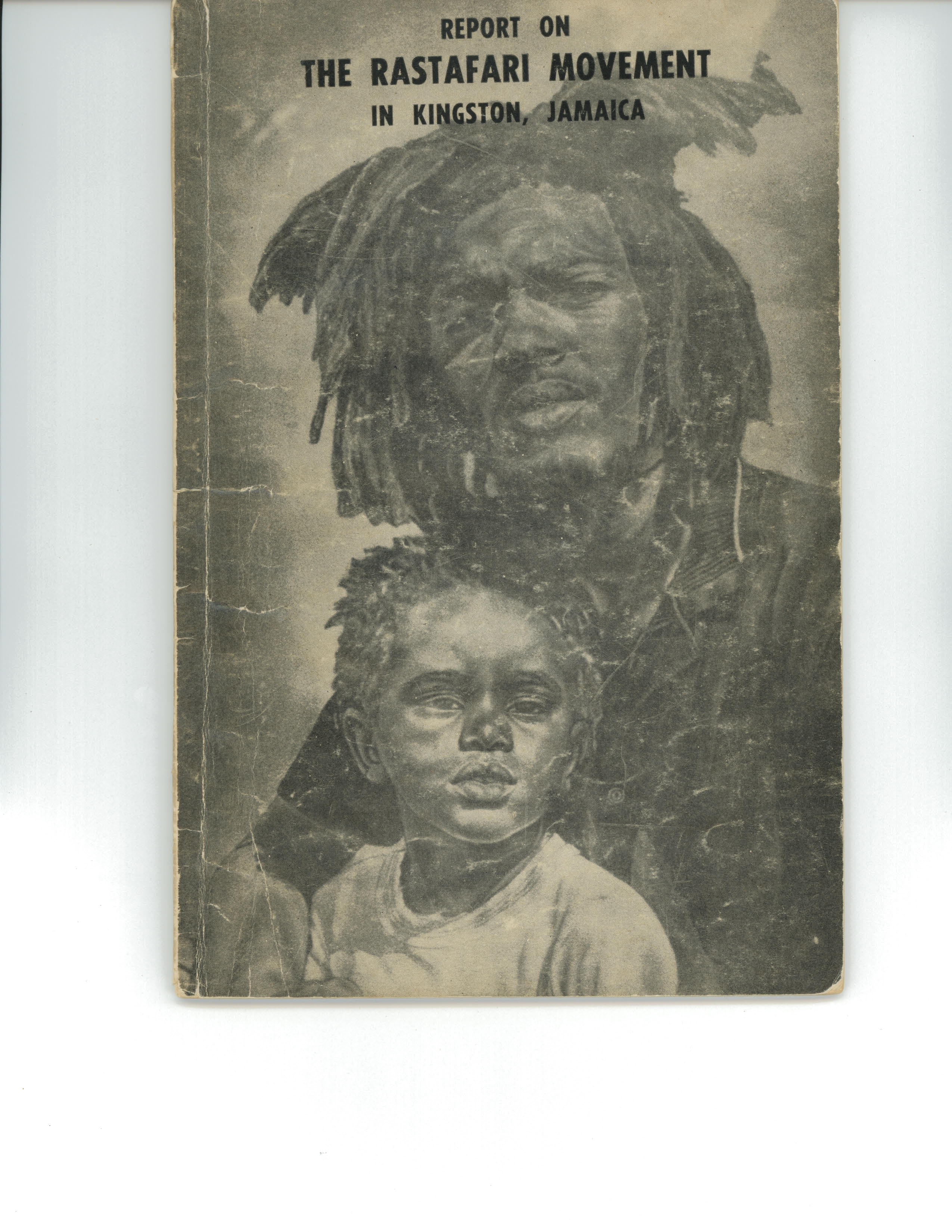
RRep1960

Ever since I heard Robert A. Hill’s lecture in April this year titled ‘The University Report on the Rastafari Movement in Kingston, Jamaica: The half that has never been told’ I’ve wanted to blog about it. I started a post soon after but it remained a draft all this time because I felt quite inadequate to the task of conveying the brunt of what Bobby, a friend of many years standing, was saying.

Robert A. Hill, Professor Emeritus, UCLA; Director, Marcus Garvey Papers Project

That talk, sponsored by the Sir Arthur Lewis Institute of Social and Economic Studies (SALISES), where I happen to work, began with Bobby announcing:

What I’m going to talk about this evening might be rephrased as the hidden history of the University Report on the Rastafari Movement. It is hidden because in my view the report was based on considerable deception.  This was not my view going into this research, I’ve spent 6 years probing, researching, trying to understand how this report came to be. It’s only in the last two months that I felt ready to go public with my findings and this evening is the first time an audience will hear the findings and I leave it to you to make your own interpretations.

After that dramatic opening Professor Hill handed out timeline worksheets, essentially Xerox copies of  calendar pages with cells displaying the months April–October 1960 along with pens for those who didn’t have their own. It was important  Hill said, to keep track of the dates he was  going to talk about, the chronology being  important, “so that we are all, not just figuratively on the same page, but literally on the same page.”

The impact, influence and staying power of the Rastafari Report, he pointed out, has far outweighed any of the other reports emanating from the University, most of which are collecting dust today. Hill remembered seeing the report for the first time as a 17-year old. “It was like a meteor had crashed into the whole world. Jamaica has never been the same since that August day when i first saw it. ”

JPEG 1968 REPRINT OF REPORT ras daniel hartman cover - Copy

Although first published in August 1960 when Rastafari was spelt as two words ‘Ras Tafari’ most people are familiar with the ‘edited, redacted’ version reprinted in 1968 with a Ras Daniel Heartman image on the cover. There were many reprints thereafter with different covers like the one below, reprinted in 1975. What the reprints all have in common is that they spell ‘Rastafari’ as one word, again something pointed out by Hill in the course of his lecture.

RRep1975

The Report was a triumph for the Rastafari movement, Hill claimed. “I’m going to say very carefully that the Report was a propaganda victory for the Rastafari Movement…but I’m not using propaganda in its sinister sense, I’m using it in its classic sense, namely the propagation of one’s beliefs.” Hill then went on to recount how the Report ‘armed the mission’ sent by the Jamaican government to Addis Ababa in 1966 to initiate conversations about the repatriation of Rastafari to Africa.

The first date Hill asked his audience to note on their worksheets was the date renowned Nobel Laureate Arthur Lewis took up his position as Principal of the University of the West Indies. April 16, 1960.

This was where I gave up, unable as i said before, to succinctly convey the gravamen of what Robert Hill was suggesting. Months later I decided to ask Bobby for an interview thinking that would be the best way to capture the sensational charges he was making against the University of the West Indies. He obliged. The interview started modestly but soon swelled to 40 pages. I agonized again over how best to present such a long document here. Finally I realized the simplest way to accomplish this was to publish it as a WordPress ‘page’.

To fully understand some of the points Bobby raises in the interview its important to remember how feared, reviled and despised Rastafarians once were. You can get a good sense of this by reading Roger Mais’s Brotherman, a novel written in the 50s or from Deborah Thomas and Junior Wedderburn’s film Bad Friday, about the Coral Gardens massacre in the 60s. Even VS Naipaul, writing of his visit to Jamaica in 1960, in The Middle Passage, talks about the fear caused by militant Niyabinghi groups pledging ‘death to the whites.’

We’ve certainly come a long way from those days especially when you consider sentiments expressed at the opening of the Rastafari exhibition at the Institute of Jamaica on July 21, 2013.  “Rastafari is deeply connected to Brand Jamaica” said Lisa Hanna, Minister of Culture.  And at the closing ceremony of the Kingston-leg of the Rastafari Studies Conference and General Assembly, held on the campus of the University of the West Indies (UWI), Mona, on August 15 Prime Minister Portia Simpson Miller said that Rastafari was “an important part of the image of brand Jamaica.”

Pariahs no more…the hidden history of the Rastafari and their relationship to the nation of Jamaica certainly is the perfect illustration of the biblical sentiment Bob Marley made so famous, “The stone that the builder refused, shall be the head cornerstone…

Well folks, it gives me great pleasure to present my interview with Professor Robert Hill, aptly titled Our Man in Mona. As Bobby said at the beginning of his SALISES lecture “I leave it to you to make your own interpretations.”  I find Bobby’s research and findings quite persuasive but I’m also willing to be persuaded by a counter-explanation of events that is as painstakingly researched and presented as his. In the meantime I thought it important to make this provocative hypothesis widely available to keep alive that spark of agonistic engagement so lacking in the public sphere today.

Trinidad Journalism in crisis?

What the hell has happened to press freedom in Trinidad and Tobago?

The news broke yesterday. Trinidad Guardian Editor-in-Chief Judy Raymond had reportedly walked off the job, followed by Sheila Rampersad and several other conscientious journalists in an atmosphere rife with allegations of political interference. Then today both the governemnt and the Guardian refuted the charge of political interference. As Patricia Worrell@bytesdog succinctly put it “This Guardian story have more twists and turns than Lady Chancellor or the road from Maracas.”

Raymond’s laconic Twitter account @HeyJudeTT doesn’t yield much at first glance. Her last three tweets are suitably cryptic but the Orwell quote is telling:

heyjudeTT
Judy Raymond@heyjudeTT
A luta continua
7 hours ago

heyjudeTT
Judy Raymond@heyjudeTT
“Journalism is printing what someone else doesn’t want printed. Everything else is public relations” – George Orwell
a day ago

heyjudeTT
Judy Raymond@heyjudeTT
fun times in the newsroom
3 days ago

Here’s another blog’s take on the situation:

Trinidad Guardian editor-in-chief Judy Raymond did not even realise she was holding a political seat!

Raymond was hired last year to help the Guardian bottom-line: Increase sales. However, Mr Live Wire understands she ran afoul of the company’s motto: Stay close to the Government.

Photo: Ansa McAll chairman Anthony Norman Sabga. Editorial policy is whatever he writes down on a sheet of paper.

Photo: Ansa McAll chairman Anthony Norman Sabga.
Editorial policy is whatever he writes down on a sheet of paper.

In a politically aware country, although not necessarily a politically intelligent one, Raymond’s Guardian won nationwide acclaim for a string of exclusives including the stunning Section 34 scandal.

It turns out that Government officials felt Raymond and her nosey crew should spend more time on hard-hitting stories like the intrusion of Keith Rowley’s back door at Balisier House or MP Donna Cox’s alleged slap across the face of a PNM rival, presumably during recess.

For more click here.

How will this situation be resolved? The region watches and waits with bated breath.