“All Muscle and Damage”: Dog-Heart by Diana McCaulay

Tomorrow, March 26, 2010, is the launch of Diana McCaulay’s first novel Dog-Heart. I wrote the review below four years ago when i first read the book in manuscript form. Yesterday i did a short interview with Diana about the process of writing this novel; My questions and her responses are presented below the review. The book will be launched at Bookophilia, 92 Hope Road, tomorrow evening at 6.30 pm.

My Review

Kingston, April 23, 2006

Dog-Heart peels back the zinc fence concealing the liminal world of the outcasts of postcolonial development; not just for a hasty peep but for a sustained look at what most of us would prefer to forget exists. Written by an “atypical middle-class Jamaican” attempting to live her life by the Emersonian principle of leaving the world a better place “whether by a garden patch, a happy child or a redeemed social condition” this is a book that could have easily descended into missionary melodrama and bathos.

Instead it is a tightly plotted, muscular narrative recounted mainly through the voice of its young male protagonist–Dex—one of the ubiquitous street kids of Kingston. McCaulay renders his patois-inflected voice vividly, deftly drawing the reader into the brutal shadows of the ghetto; you find yourself literally following Dex and his brother as they negotiate the peril-strewn path of their poverty-stricken existence.

The clumsy though determined intervention of the ‘uptown browning’ into their lives is described through Dex’s eyes. Miss Sahara disapproves of almost everything—“She don’t like it that we t’ief light from public service but she don’t say how we is to pay light bill.” Miss Sahara complains that they watch too much TV and that their mother spends too much money on unnecessary things such as a new dresser from Courts instead of buying books and clothes for the children. Dex despairingly observes that “She don’t understand about respect, how people inna ghetto disrespect you if you don’t have certain t’ings.”

Dexter has little faith in Miss Sahara’s mission to turn them into uptown children. “She think if we learn how to read and count, learn how to behave, get expose to opportunity—she always a talk about opportunity—make uptown friend, then we will be like uptown people.” His cautious teenaged eyes take in everything, processing and assessing with impeccable ghetto logic the hostile environment he faces.

One of the finest touches in this impressive debut novel is the friendship between Dex and Felix, the quadriplegic who is not only wheelchair-bound (“He look like him don’t have muscle”) but whose head needs the perpetual support of a tin can. After his initial revulsion Dex is drawn into a close relationship with the handicapped boy, making a point of protecting and looking out for him, something he himself has lacked all his life. The socially handicapped Dexter and the physically handicapped Felix thus manage to establish a useful though fleeting alliance.

Ever aware of his liminality Dexter inexorably morphs into the thuggish ‘Matrix’ whose overweening ambition is to join one of two warring neighbourhood gangs. Along the way we get to know Dex’s younger brother, the gentle Marlon, his baby sister Lissa and his friend, the dog-hearted Lasco innocuously named after a Jamaican brand of powdered milk. We even get to know and like Arleen, Dexter’s feckless mother, one of the less sympathetic characters in the book, who is forever beating and abusing her children.

Dog-Heart is an uncompromising story imaginatively told; it is a tale of the class imbalance of postcolonial societies, of how vast the gap is between those damned by the (Babylon) system and kept outside and those who reside comfortably inside. The expendability of life in the ghetto and the perpetual injustice meted out to its inhabitants by the state and so-called civil society lie at the heart of this tale of postcolonial darkness.

As Dexter sadly observes:

“This is what everybody inna ghetto know: If anybody want kill you, white man, big man, policeman, area don, gang member, schoolmate, politician, shotta anybody—they will just do it. Nobody can stop them and after, nobody will care. You can t’ink man who do murder will be arrest and put in jail and you, the person who is dead, will be in heaven a look down on them in jail with a whole heap a batty man, but that is not how it will go.”

Not even such limited justice as rejoicing after death in the travails of one’s murderer is available to ghetto people. “Batty man” is colloquial Jamaican for ‘homosexual’; terms such as these require glossing else the foreign reader new to Jamaican culture unnecessarily loses a whole layer of allusion and meaning that serve to add focal depth to the narrative.

Aside from that McCaulay’s sense of irony and humour delicately leavens this tale of what lies on the other side of tourist paradises such as Jamaica inviting the reader into territory you probably would have declined to enter on your own. The novella is expertly constructed, its constituent parts neatly dovetailing into one another.

McCaulay, who wrote a weekly column in the country’s leading newspaper for many years, showcases her formidable writing skills in this ambitious, heart-breaking work to excellent effect. Woven into the story are traumatic events—mob killings, kidnappings–from contemporary Jamaican life that convulsed the nation when they happened, registering as twenty-first century landmarks in the history of its world-renowned violence. For her Jamaican readers these signal additional dimensions of common belonging; the mirror McCaulay relentlessly holds up doesn’t let anyone off the hook, least of all those who read this book without flinching.

The Interview

Kingston, March 24, 2010

How long did it take you to write Dog-Heart Diana? And then after that how long till it was published? Did you ever feel like just giving up?

The first draft took two years to write. The submission process (sending in, rejection, rewrite, sending again) took five years up to the time I had a contract. Then another year and a half to publication. Eight and a half years in all. Yes, I felt like giving up many times. Had no faith in the work at all, at many, many points along the way. But people encouraged me – like Esther Figueroa, you, Kim Robinson, another friend in England, Celia, who has been reading my writing since we were teenagers, so somehow I kept going. I have quantities of never finished manuscripts on my computer, in boxes, in drawers and I was determined to see this one in print..

You had to revise the manuscript several times. What were the kinds of changes publishers asked for?

The eventual publisher, Peepal Tree Press, asked for very few changes – a few language issues, a few places that editor Jeremy Poynting felt did not ring true. He was right in every case. But earlier in the process, various agents and publishers who eventually passed on it had suggested changes…some I adopted, others no. For instance, the first draft of Dog-Heart had four voices – Dexter, Sahara (the two that now survive), but also Sahara’s son Carl, and Dexter’s mother Arleen. An agent who sent me five pages of comments on the early draft suggested these were too many voices, and that I tell the story from only two points of view – Dexter and Sahara. So that’s what I did. I have many chapters of Arleen’s story and Carl’s story in my computer… who knows what I will do with those one day. Some agents didn’t like the Jamaican, felt it was too limiting, but I wasn’t prepared to compromise on that.

How were you able to get into the head of an impoverished street youth? I know you had tried in the nineties, when you wrote a Gleaner column, to help one or two such youth? Is this novel inspired by those attempts? And did you have any success with the boys you tried to rescue from the street?

In a sense, Dog-heart was inspired by my relationship with a family of boys and their mother in the 1990s, my attempts to help, but the events and people in Dog-heart are entirely fictional – nothing in Dog-heart really happened and the people are quite different from that family. But during that period I did observe many aspects of their lives and realized how difficult their circumstances were. It was humbling – people of my class tend to dismiss people like Dexter and his mother, Arleen, as, I don’t know, wasters, wut’less, stupid. But what I saw was something different – I saw people, children, trying their best to survive situations that I was sure would have defeated me. So I started thinking about it, imagining what it would really be like. Dog-Heart also had its genesis in a writer’s workshop at Good Hope, back in 2003 – we were asked to write a short piece from the point of view of someone of a different age, class, race, background and sex – and I wrote what became chapter two of Dog-Heart. I sent it as a short story called Car Park Boy to Caribbean Writer, they published it, and I decided the seeds of a novel were in there. So I kept working on it.

As for the boys I did try to help, that’s a fairly sad story, one I am not sure I am ready to talk about, because it is their story to tell too. I often wonder about what THEY thought at the time. I lost track of the family when I went to study in Seattle in 2000 – but when I came back to Jamaica in 2002, I learned from one of the boys’ teachers that the eldest boy had been killed by the police in a prison riot. And funnily enough, recently a friend encountered the youngest boy – who is now a man – and we are to get together – hasn’t happened yet.

There’s a wonderfully taut scene where Dexter is bouncing a football while being taunted by his new schoolmates. How did you know how to do that? Did you play football yourself? The moment when he raises his eyes to look at the games teacher and the ball finally falls and rolls away was a masterful use of suspense I thought.

I did play football when I was young. My sisters tell me I was unbearably sweaty. But truthfully, I don’t really know where that scene came from, I remember the day I wrote it, and it just appeared in my head, in the very mysterious way such things happen from time to time.

Also how did you come up with the character of Felix the quadriplegic boy stuck in a wheelchair who has to rest his head on a tin-can for support? Felix is a fine foil for Dexter and the growing sympathy between them is very finely developed.

Well, I needed a way to show aspects of Dexter’s character – that he was able to overcome opinions he held (about the “slow” children, for example) and find sympathy and empathy with someone facing greater hurdles, and I thought a boy in a wheelchair might be a good way of doing that…

I particularly like the moments of collision between what I think of as ‘ghetto logic’ and ‘uptown logic’ in the way people’s lives are organized in the novel. So eg. Sarah’s presumptuous and haughty complaints about the way Dexter’s family ‘wastes’ money on a dresser, on TV or other luxuries they can’t ‘afford’ goes to the root of the class divide that governs our lives.

Yes, it was one of the novel’s many challenges – to write about the same events from two different points of view without becoming boring or redundant, and to try and really understand these different ways of looking at the world – Sahara’s point of view was easy for me to imagine, even to feel, of course – but Arleen and Dexter’s much harder. Writing Dog-Heart was really a search for compassion and empathy and understanding in my own heart.

Did you make any earth-shattering discoveries in the process of writing this novel?

Not sure about earth-shattering, Annie! I have many reflections about the process of writing a novel, about developing characters, about the pitfalls of writing a novel with a message – as some early feedback pointed out. I struggled greatly with language – I wanted to write in Jamaican when I was in Dexter’s voice, without making the novel inaccessible to a non Jamaican speaker. I am still not totally satisfied with how that came out. I learned something about what Anthony Winkler calls “trusting the darkness…” often I would go to bed with my characters stuck in some situation, with a feeling of hopelessness about the novel, and I would make sure they were in my mind when I fell asleep, and when I woke up the next morning – answers came to me. I learned to trust that. I learned the value of readers – people who support you – it’s a mistake to let too many people read your early work. Most of all, I learned that writing a novel is a marathon, not a sprint, but with determination, patience and a fair bit of pain, it can be done.


David Coleman Headley: The Ugly American?


For those interested in more information on the Indian situation vis-a-vis US terrorist David Coleman Headley two interesting articles from the Indian media are presented below:

A spy unsettles US-India ties
By M K Bhadrakumar

News that the United States Federal Bureau of Investigation (FBI) had reached a plea bargain with David Coleman Headley, who played a key role in the planning of the terrorist strike in Mumbai in November 2008 in which 166 people were killed, has caused an uproar in India.

The deal enables the US government to hold back from formally producing any evidence against Headley in a court of law that might have included details of his links with US intelligence or oblige any cross-examination of Headley by the prosecution.

Nor can the families of the 166 victims be represented by a lawyer to question Headley during his trial commencing in Chicago. Headley’s links with the US intelligence will now remain classified

information and the Pakistan nationals involved in the Mumbai attacks will get away scot-free. Furthermore, the FBI will not allow Headley’s extradition to India and will restrict access so that Indian agencies cannot interrogate him regarding his links with US and Pakistani intelligence.

In return for pleading guilty to the charges against him Headley will get lighter punishment than the death sentence that was probably most likely.

Headley’s arrest in Chicago last October initially seemed a breakthrough in throwing light on the operations and activities of Lashkar-e-Taiba (LeT), the Pakistan-based terrorist organization, in India. But instead the Obama administration’s frantic efforts to cover up the details of the case have been taken to their logical conclusion.

The plea bargain raises explosive questions. The LeT began planning the attack on Mumbai sometime around September 2006. According to the plea bargain, Headley paid five visits to India on reconnaissance missions between 2006 and the November 2008 strike, each time returning to the US via Pakistan where he met “with various co-conspirators, including but not limited to members of LeT”.


For more click here:

And for a more personal take on the matter by one of India’s top journalists, NDTV editor Barkha Dutt, see below. Barkha was the reporter who commented live outside the Taj in Bombay while it was under siege:

Chasing a Shadow

Barkha Dutt

Now that the light-eyed Pakistani American who waged war against India and plotted the ruin of Mumbai in meticulous detail has finally pleaded guilty — we are being told that all is not lost. After the cushy deal that David Headley has cut with the Americans, it’s brutally clear that India will never get hold of the man who criss-crossed our country like some Super-Bomber, surveying targets and picking new victims. But, apparently we are still meant to be pleased that Indian investigators may eventually be able to talk to the man in some shape or form. So what if a government who demanded extradition now has to quietly contend with a reduced sentence for Headley and one that India will have no say in.

Never mind the humiliation of our sleuths being turned back from the United States when they first arrived to question him. And forget the fact that India allowed the Federal Bureau of Investigation (FBI) to interrogate Ajmal Kasab for nine hours away from the formal constraints of court trials and the relentless gaze of the public eye. Since 26/11 claimed the lives of six Americans, the FBI felt it had an automatic entitlement to that meeting. But the murder of more than a hundred Indians in the same attack; one that left India naked and vulnerable forever, does not apparently give us the same rights in reverse. But no — we are being asked to forget all of that and be grateful for the fact that Headley may now testify in the trial via videoconference. As they sometimes say in Ronald McDonald’s land: “Gee Whiz.” What a joke.

There can be only two explanations for this astounding double standard: hypocrisy or secrecy. For several months now questions have been raised about Headley’s curious and untold past. His differently coloured eyes (one brown, one blue) may as well have been a metaphor for a life steeped in schizophrenia. We know now of his two wives and about his American socialite mom who ran a swinging bar and his Pakistani diplomat dad who encouraged a regimented orthodoxy. But Headley’s version of East- meets-West turned out to be his stint in Pakistan working as an undercover informant for the US Drug Enforcement Administration (DEA).

To continue reading click here:

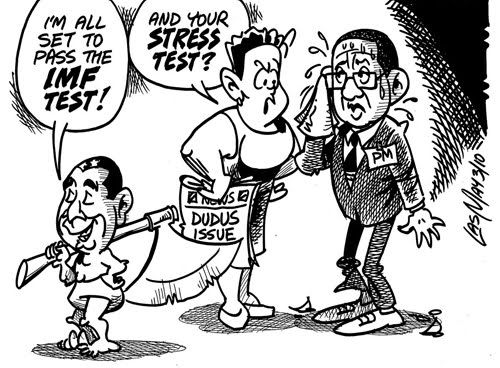
Headley you win, Dudus you lose…A Tale of Two Extraditions


Las May, The Gleaner, Mar 19, 2010

Remember what the donkey said?: the worl nuh level. Translation: There’s no level playing field. While the Jamaican government is catching hell from all sides for not surrendering to the US’s request to extradite Christopher ‘Dudus’ Coke on various charges, the most serious of which seems to be drug-running, India has practically given up on trying to extradite US citizen David Coleman Headley, who is accused of being the mastermind behind the 26/11 Mumbai attacks. Headley who has Pakistani roots is also accused of conspiring to target a Danish newspaper. He has pleaded guilty to all terror charges before a US court.

In spite of this the US refuses to extradite Headley to India. Neither will he recieve the death penalty. According to an India Today article:

49-year-old Headley, who faces six counts of conspiracy involving bombing public places in India, murdering and maiming persons in India and providing material support to foreign terrorist plots and LeT; and six counts of aiding and abetting the murder of US citizens in India, could have been sentenced to death if convicted.

But his plea agreement with federal prosecutors ruled out the death penalty and extradition to India, Pakistan and
Denmark, provided that he cooperates with the government’s terrorism investigations.

“Headley will cooperate in foreign investigation conducted in the US,” his lawyer John Theis told reporters after the hearing.

Headley, a Chicago resident who was arrested by the FBI’s joint terrorism task force on October 3 last year, told US District Judge Harry Leinenweber that he wanted to change his plea to guilty, in an apparent bid to get a lighter sentence than the maximum death penalty.

Son of a former Pakistani diplomat and a Philadelphia socialite, Headley, who was wearing an orange jumpsuit with hands and legs shackled, admitted guilty in all 12 counts during half an hour long hearing.

Meanwhile back home on the rock Police are worried that if Dudus is extradited the country’s 268 gangs will unite in protest and wage a war against ‘law and order.’

In its annual International Narcotics Control Strategy Report, the Barack Obama administration castigated Jamaica’s Golding administration for not handing strongman Coke to the US as requested. As the report noted:

The GOJ’s unusual handling of the August request for the extradition of a high-profile Jamaican crime lord with reported ties to the ruling JLP which currently holds a majority in Parliament, on alleged drug and firearms trafficking charges marked a dramatic change in GOJ’s previous cooperation on extradition, including a temporary suspension in the processing of all other pending requests and raises serious questions about the GOJ’s commitment to combating transnational crime.

For more on the Dudus extradition read this Stabroek News article and my earlier post on the subject.

For more on Headley read this New York Times article and watch the following videos. Interestingly Headley was also a heroin dealer under investigation by the DEA in the nineties.

Let us Prey! The flight of Calder Hart from Trinidad and Tobago


Cobo Town: Cat in Bag Productions’ 2010 mas presentation, designed by artists Ashraph and Shalini Seereeram. Let us prey!

I’m quite fascinated by the goings on in Trinidad and Tobago over the last couple of days. The Urban Development Corporation of Trinidad and Tobago Limited (UDeCOTT) boss Calder Hart has resigned and fled the country. Surely this is a 9.0 magnitude political earthquake for the Manning Government. I‘d like to see how the ruling party extricates itself from what appears to be damning evidence of guilt: the sudden, hasty departure of one of the major players accused of corruption. “AT LAST!” blared a headline on Newsday’s cover page, referring to Calder’s resignation. The lead article by Andre Bagoo titled “Hart resigns”started off like this:


ALMOST two years after allegations of corruption were first made against him, Calder Hart yesterday resigned as the Udecott executive chairman and as the chairman of four other state boards he had been appointed to under Prime Minister Patrick Manning’s administration.

His resignation came after Newsday last week published a series of documents which appeared to disclose clear links between his wife, Malaysian born Sherrine Hart, and a company the Udecott board awarded $820 million in contracts to. The documents, birth and marriage certificates tying Sherrine to two men who served as directors on Sunway Construction Caribbean Limited, emerged after being obtained by the Congress of the People in the course of a six-week investigation.

Hart’s resignation also came one day after High Court Judge Justice Mira Dean-Armorer shot down an attempt by lawyers acting on behalf of Udecott to stop the submission of the final report of the Uff Commission of Inquiry. The judge rejected Udecott’s arguments that the inquiry, which saw damning evidence of corruption and mismanagement emerge, was illegal.


Calder Hart was no ordinary Trinidadian. The following paragraphs were taken from his Witness Statement to the Commission of Enquiry Into the Construction Industry.

  1. My name is Calder Hart. I live at No. 6 De Lima Road, Cascade, Trinidad and Tobago. I was born in Sydney, Nova Scotia, Canada. I have lived in Trinidad and Tobago for the last 22 years and in 2004 I applied for and was granted citizenship of Trinidad & Tobago. To do so I was not required to renounce Canadian citizenship and as a consequence I am now a citizen of both Canada and Trinidad and Tobago.
  2. As can be seen from my curriculum vitae attached below (annexure 2) before I first came to Trinidad and Tobago in 1986, I had acquired considerable work experience in the areas of housing (both private and public), mortgage financing, land assembly and urban development and redevelopment at both federal and provincial levels.

The news of Hart’s resignation and abrupt departure from the country drew loud and raucous responses from the blogosphere.

“The flight of Cobo Hart: naturally my Carnival placard helped turn the tide!: http://bit.ly/cmUG6m Nicholas Laughlin announced on Twitter, the link leading to his blogpost excerpted below:

SUNDAY, MARCH 07, 2010

The flight of the cobo


My Carnival Monday placard from the band
Cobo Town, proudly carried through the streets of Port of Spain nearly three weeks ago. The face of Calder “Cobo” Hart — head of the powerful state construction agency Udecott, widely suspected of massive financial improprieties and thought by some to be Prime Minister Patrick Manning’s bagman, subject of investigation by the Uff commission of enquiry — replaced the national coat of arms in the middle of a giant $100 bill. Read the rest of Nicholas‘s blog here:

Now the interesting thing is that i had arrived in TnT on the 20th of February just in time to be taken to the victory party of the Cobo (‘corbeau’ the equivalent of our John Crows) Town band (fourth place in the small band category at Trini carnival). I was transported from the airport to artist Ashraph’s frame shop in one fell swoop, where the erstwhile Cobos were flinging wine and sundry spicy snacks down their beaks.

Cobo Town - Carnival Tuesday

artist Ashraph Ramsaran, leading the Cobo Town Band, seen above descending on Red House (House of Parliament)


One of them detached himself and introduced himself as Andre Bagoo, the author of the article quoted above and parliamentary reporter who was in the news only a few months ago. We had been following each other on Twitter and Facebook for some time but had never met in person. Bagoo is also author of the blog Pleasure (Art in all its forms) and had been banned from Parliament in TnT last November “for the rest of the session” on grounds of ‘contempt’. Coincidentally, as a Trinidad Express story said:

The article written by Bagoo arose out of a report stating that the Urban Development Corporation of Trinidad and Tobago, which had been referred to the Privileges Committee for alleged contempt arising out of a complaint made by Caroni East MP Dr Tim Gopeesingh, had planned to concede on the contempt charge and had decided to issue an apology.

A Cobo Town placard
Bagoo was not the only one so hastily dispatched. Former Trade Minister Diego Martin West MP Dr Keith Rowley was fired under mysterious circumstances. Rowley had called for Cabinet oversight of Udecott and accountability. And that’s not all. In the March 8th edition of Newsday Bagoo states: BEFORE CALDER Hart resigned as executive chairman in the wake of documents showing links between Hart and a company the Udecott board awarded $820 million in contracts, the Prime Minister Patrick Manning and Cabinet defended Hart and Udecott no less than forty-five times over the course of two years, all the while apparently taking no action to deal with allegations against Hart.


And they claimed Panday was corrupt! One of the funniest, most effective pieces of satire in the Caribbean Blogosphere is a blog calling itself The Secret Blog of Patrick “Patos” Manning”. The voice is ostensibly that of Manning:

Breakfast of losers

March 7th, 2010 · No Comments

Mealtime at a Commonwealth heads of government event is never pretty. You’d swear some of these characters have only recently learned to eat with knife and fork, and I’m not talking just about the South Asian and Sub-Saharan African delegates. For instance, it’s well known in Commonwealth heads circles that the person you never want sitting across the table from you isGordon Brown, who, in addition to having the table manners of a warahoon, insists of having a serving of haggis with every single meal. Experienced heads like me know that the thing to do is arrive at the dining room well ahead of time and choose the smallest table possible, which also limits your chances of having to sit near a type like Jacob Zuma.

But even an experienced head like me sometimes oversleeps. Thanks to a combination of jetlag, a not completely guilt-free conscience and a nightmare featuring a horrifying creature with the upper body of Calder Hart and the hindquarters of the Rev Apostle Juliana Peña, I didn’t manage to roll out of bed this morning until well after 8am BST. Hazel was already awake, talking on the phone in hushed tones. She said that she too had lost track of time and planned to skip breakfusses, which didn’t quite explain why she was already fully dressed, nor the general whiff of bacon and sausages about her person. I considered ordering room service, but in heads circles not showing up for a meal when you’re embroiled in a scandal is tantamount to an admission of guilt. Even Mugabe was still eating among us till the bitter end, much to everyone’s chagrin.

What i love about Trinidad is the freewheeling creativity to be found there as evidenced in the blog above and also in recent developments in Carnival. The riotous street festival which many feel has been hijacked by ‘bikini mas’ in recent years, is being reclaimed by a small band of politically and socially conscious revellers. A motley crew of artists, writers, fashionistas and techies this group has demonstrated what true creativity is, for two years running. Last year the band performed T’in Cow, Fat Cow, a commentary on the voicelessness of ordinary citizens. This year they performed as vultures, the birds of prey known as Cobos in Trinidad and John Crows in Jamaica.

Arriving back in Trinidad after my art appointment in Suriname i found myself riding in a taxi past the Labasse, the giant garbage dump across from Laventille. The sky was filled with circling cobos but what has truly stayed with me is the sight of 40 or 50 cobos sitting on the ground, striking birds of intense blackness, waiting their turn at the carrion. In the wake of the flight of Cobo Calder Hart and the unveiling of the depth of corruption in the governance procedures of the country, Cobo Town emerges as the stinging critical intervention it was meant to be. This is a kind of popular action that is definitely not happening in Jamaica.
In 2009 Ashraph and Shalini debuted an independent mas band of artists and ‘creatives’ called T’in Cow Fat Cow with the theme ‘The People Must be Herd”. The photos below show their strikingly simple, immensely creative costumes. Below the photos i’ve cut and pasted their manifesto which was clearly designed to extend itself to political protest from being a mere mas band.

One looks in vain for anything remotely similar in Jamaica both in terms of sheer conceptual creativity and as political mobilization. I eagerly await the next installment of Gab Hossein’s hard-hitting video blog called “If I Were Prime Minister…” in which she mercilessly lampoons and takes down the political directorate of TnT about the absurdities that pass for governance. What will she have to say about the Hart resignation and the latest shenanigans?. One waits with bated breath.
The People Must be Herd
Photo: Georgia Popplewell
On Thursday 16 April, as final preparations are being made for the staging of the 5th Summit of the Americas in Trinidad, a group of artists will do a performance installation on the streets of Trinidad and Tobago’s capital, Port of Spain.

The silent procession is part of a video installation being created by the band’s designers Ashraph Ramsaran and Shalini Seereeram.

T’in Cow Fat Cow debuted as an independent mas band in 2009, inspired by the song T’in Cow by 3 Canal.

The procession takes place on the streets of Port of Spain between 9 and 11 and started at that traditional seat of people’s democracy, Woodford Square.

The People Must be Herd manifesto

T’in Cow Fat Cow – The People must be Herd.

Dey belly full but we hungry
And right about now we angry
And de reason dat we angry
Is because we belly hungry

Tin Cow tin cow green grass dey over so
Fat cow de butcher callin yuh
Watch for yuh head ah warnin yuh
Otherwise in de pot yuh goin to go.

T’in Cow, 3 Canal

We represent the voiceless. The many thousands of Trinbagonians outside of the Red Zone. Whose tax dollars are being invested in a display that does not address their most urgent concerns.
New buildings, a repaved highway, painted lamp posts and hidden homeless do not mean that we are on the road to development.
In the midst of the Summit performance we ask, who is seeking the interests of the voiceless? Who is spending many many millions to address our concerns. Who is listening? Who will suffer the most in the face of a global economic meltdown?

The people of high risk communities must be heard.
The missing children must be heard.
The homeless people must be heard.
The women and children who live with abuse every day must be heard.
The people who will lose employment in the aftermath of the Summit must be heard.
The people of communities in danger of environmental destruction must be heard.
The physically challenged must be heard.

Caribbean Nationalisms: Trinidad and Jamaica

$2m flag in right hand upper quadrant

I’ve been in Trinidad the last couple of days where i’m contemplating the giant $2 million national flag fluttering in the breeze in Port-of-Spain, while hummingbirds fight each other for a suck at the red plastic feeder on the balcony of a friend’s apartment. Found out yesterday that Trinidad and Tobago is suffering from a prolonged drought as is the rest of the Eastern Caribbean. Jamaica has also been severely affected by the lack of rainfall recently but the discussions around this never ever referred to the fact that this was a regionwide phenomenon.

I was interviewed practically on arrival for an online forum called NBS or the No Behaviour Show by @SanMan_ish or Hassan, someone i previously knew only on Twitter. Hassan had just started NBS the week before and was wishing he had access to a Jamaican perspective on various issues including water shortages, when my tweet announcing my arrival in TnT appeared in his timeline. Before you knew it i was being interviewed on a variety of subjects starting with something Jamaican Minister of Culture, Olivia Babsy Grange, had said at the opening ceremony of the International Reggae Conference at UWI, Mona. Was Jamaica losing Reggae to European musicians as Ms. Grange had suggested, Hassan wanted to know. I said i preferred to view singers such as Gentleman and Matisyahu as ambassadors for Reggae, taking a Jamaican product to new brand audiences. To hear more of what i said click here…

The International Reggae Conference at the University of the West Indies, Mona, was a big success i thought. The first morning I chaired a panel on Collection, Storage and Dissemination of Jamaican music with three participants, Herbie Miller, the director of the Jamaican Music Museum and two Americans; Elliott Lieb, founder of the Trade Roots archive, dedicated to collecting Jamaican music and Brad Klein, a film-maker working on a documentary on Jamaican ska. In the audience, amongst others, was Stranjah Cole, ska maestro, who features in the film.

Stranjah Cole seated in front row

Herbie Miller made an eloquent case for a budget to stock his museum and do the kind of work the foreigners were doing gratis out of love for Jamaica’s music. How extraordinary i thought, that a case even needs to be made for something so obviously deserving of support. After all the Jamaican government had decided decades ago that Jamaican art was worthy of being collected, stored and disseminated, investing in a National Gallery for the purpose. And this despite the fact that Jamaican art is insignificant compared to Jamaican music which has virtually put the country on the map, creating Brand Jamaica and maintaining its profile to this day. Yet as Brad Klein pointed out many of the early recordings and films on Jamaican music have vanished without a trace. What a tragedy!
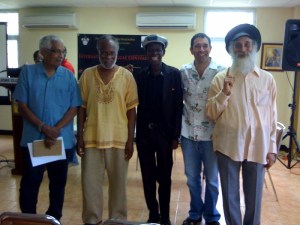
l to r: Chappie St Juste, Herbie Miller, Stranjah Cole, Brad Klein and Elliott Lieb
During the discussion that followed the presentations, cinematographer Chappie St. Juste who was in the audience, disclosed that the films were actually safely stored in vaults in England where they had been sent for processing and the task now was to repatriate them. But repatriate them to what? and where? and to what conditions? The music museum exists only in name. Perhaps instead of berating Europeans for ‘stealing’ our music we should be grateful to them for having stored our cultural products safely, something we ourselves have been careless about. Remember the scandal a few years ago when it was discovered that the Jamaica Broadcasting Corporation archives had been vandalized, and that early recordings of Louise Bennett and others had vanished?

INTERNATIONAL REGGAE CONFERENCE 2010: "Current and Future Trends in Popular Music"

So many people are asking for the programme that i thought i’d make this available. Keep in mind that this is an early draft, there may be changes.

INTERNATIONAL REGGAE CONFERENCE 2010, FEBRUARY 17-20, 2010
DAILY SCHEDULE OF ACTIVITIES

DAY 2 – THURSDAY, FEBRUARY 18, 2010
8.30AM-5.00PM
REGISTRATION

8.30-10.00
Session 1A – Multifunctional Room, Main Library
The Reggae Nation: Global Impact –
Chair: Sonjah Stanley-Niaah
1. Mercy Dioh, Promoting Reggae Music in Cameroon and Africa at Large
2. Jason Robinson, Dubbing the Reggae Nation: Transnationalism, Globalization and Interculturalism
3. Marvin D. Sterling, “Race Reggae and “The Search for Self’: Japan’s Literary Excursions into the Jamaican”
4. Colin Wright, “Rebel Music: Reggae, Rastafari and Resistance in a Globalised World”
5. Michela Montevecchi – In a Jamaican-Italian Style.Mutual Cultural Influences via Reggae and Rastafari

Session 1B – Special Needs Seminar Room
Collection, Preservation and Dissemination of Cultural Artifacts
Chair – Annie Paul
Brad Klein -filmmaker,
Elliott Leib – sound collector and preservationist
Herbie Miller, museum curator

Session 1C – HR Seminar Room
Economic Exploitation: Copyright, Marketing and Sponsorship –
Chair: Hume Johnson
1. Joan Elizabeth Webley, “Emancipating Ourselves From Mental Slavery: A Socio-legal Exploration of Existing Copyright Law Issues in Jamaica”
2. Sandra “Sajoya” Alcott, The Rastafari Reggae Revolution: Global Repositioning Towards Wealth Creation.
3. Daniel Neely, Never Grow Old: On the Contemporary Marketing of Jamaican Mento Music
4. Melville Cooke, ‘Falling Out: When the Sponsors Conducts Dancehall’
10.00-10.30
BREAK

10.30–12.00
Session 2A – Multifunctional Room, Main Library
Music and the Youth: Exploring Consumption and Influence

– Chair: Lloyd Waller
1. Donna Hope Marquis – Dancehall, Violence and Jamaican Youth: An Empirical Synopsis
2. Lisa Tomlinson – Reggae, Resistance and Youth Culture in Toronto
3. Fania Alemanno – Dancehall, Women and Sport: A Preliminary Overview

Session 2B – Special Needs Seminar Room
Media & the Culture of Reggae –
Chair: Franklyn St Juste
1. Klive Walker, Reggae Cinema: Past, Present and Future
2. Mike Alleyne, The Reggae Album Cover Art of Neville Garrick
3. Maureen Webster-Prince, “Putting Up Resistance: Reggae in Radio Serial Drama”

Session 2C – HR Seminar Room
Reggae / Rastafari Icons and Ambassadors

– Chair: Jahlani Niaah
1. Erna May Brodber, Social Consciousness and Marley.
2. Gloria Simms, The Reggae Artiste as Cultural Ambassador
3. Jahlani Niaah, Bob Marley Country

12.00-1.30
LUNCH

1.30-3.00
Session 3A – Multifunctional Room, Main Library
Sacred and Secular Iterations in Dancehall –
Chair: Michael Bucknor
1. Kenichi Ninomiya, Dancehall Gospel as Masculine Christianity
2. Winston C. Campbell, ‘Suppose a God Song Mi did a Sing’: A Case Study on Lyrical Typecasting in 21st Century Dancehall
3. Anna Kasafi Perkins, Love the long ding dong– Tanya Transgresses Christian Sensibilities?

Session 3B – Special Needs Seminar Room
Reggae Film, Media and Iconography in Brazil –
Chair: Patricia do Reis
1. Leonardo Vidigal, Brazilian documentaries about Jamaica
2. Laura Guimaraes Correa, Reggae Music in Brazilian Advertising
3. Carlos Bendito Rodrigues da Silva, The Iconography of reggae music in Brazilian Jamaica

Session 3C – HR Seminar Room
Reggae, Resistance and Social Consciousness – Chair: Mel Cooke
1. Iheanacho George Chidiebere, Diasporic Humanism and Resistance in Reggae
2. John D Marquez, Mexica Binghi I and Jahwaii: Reggae and Resistance in Latin(o) America and the Pacific Islands
3. Christian Akani, Diasporic Resistance and African Resistance: The Challenge of Reggae in the New World Order
4. Wayne D. Russell, Reggae’s Social and Political Contestation: Global Reggaefication and the Global Impact of Reggae

3.10-4.30
SPECIAL PLENARY
Neville Hall Lecture Theatre (N1)
Presenter: Professor Carolyn Cooper
“Reggae University:’ Rototom Sunsplash and the Politics of Globalising Jamaican Popular Culture”
Chair: Professor Claudette Williams

4.30-6.00
Session 4A – Multifunctional Room – Main Library
Diasporic Pedagogies –
Chair: Michael Barnett
1. Bobby Seals, Reggae and the Rastafari Movement (WORKING TITLE)
2. Leonie Wallace, Teaching Bob Marley in France
3. Renato Tomei, The Influence of Jamaican Reggae English on the Ethiopian English, With Special Focus on the Rastafarian Community in Shashamane

Session 4B – Special Needs Seminar Room
Imaging Culture: Films, Videos and Future Possibilities
Chair: Rachel Mosely Wood
Chris Browne
Paul Bucknor
Brian St. Juste

Session 4C – HR Seminar Room
Reggae Subcultures Transforming Society
Chair: Kim Marie Spence
1. Louis EA Moyston, Howell, the Early Rastafari: Development in Black Nationalism, Jamaican Nationalism and the Revolution in Music.
2. Christopher A. D. Charles, Anti-informer and Anti- snitch Subcultures: A Discursive Analysis
3. Christina Abram-Davis, “Role of the Cultural Pan Africanist in Transforming Society
6.00-7.00
BREAK
BREAK
BREAK

7.00
BOB MARLEY LECTURE – The Undercroft
Presenter Tekla Mekfet
RASTAFARI-REGGAE BOB MARLEY : AFRICA SCATTERED FOR RHYTHM OF ONENESS FOR THE WORLD

DAY 3 – FRIDAY, FEBRUARY 19, 2010
8.30AM-
5.00pm
REGISTRATION

8.30-10.00
Session 5A – Multifunctional Room, Main Library
SPECIAL PANEL
Participation/Contribution of Persons with Disabilities to Jamaican Music
Chair: Floyd Morris
Floyd Morris,
Grub Cooper,
Derrick Morgan
Cidney Thorpe

Session 5B – Special Needs Seminar Room
Dancehall Feuds, Factions and Fandom –
Chair: Anna Kasafi Perkins
1. Michael Barnett, Prince Buster vs Derrick Morgan: The Original Dancehall Clash
2. Annie Paul, Eyeless in Gaza and Gully: “Mi deh pon di borderline”
3. Sonjah Stanley Niaah, Gully vs. Gaza?: Feuds, Factions and Fuelling Fandom in Jamaican Dancehall Performance
4. Kim-Marie Spence, Clash! – Jamaican Artistes in a New Digital Music Market

Session 5C – HR Seminar Room
10.00-10.30
BREAK
BREAK
BREAK

10.30-12.00
Session 6A – Multifunctional Room, Main Library
SPECIAL PANEL
The Legal Framework for Jamaican Music
Chair – Clyde Williams
Peter Goldson
Andrea Scarlett Lozer
Simone Bowie
Sundiata Gibbs
MYERS FLETCHER AND GORDON

Session 6B – Special Needs Seminar Room
Sexual Politics in Dancehall ––
Chair – Shakira Maxwell
1. Keino Senior, Sexuality in Dancehall Music: A Philosophical Perspective
2. Agostinho M. N. Pinnock, ‘Rude- boy Don’t Apologise to No Batty Boy!’: Gay Politics; Trans-National Identities and the Jamaican State.
3. Brent Hagerman, Slacker than them: Yellowman and the Nadir of Jamaican Popular Music

Session 6C – HR Seminar Room
Genesis, Transformation and Innovation: Comparative Dimensions II –
Chair: Chuck Foster
1. Christopher Johnson, Caribbean Abstraction: Reggae Music, Jazz and Transcendent Performance
2. Camille Royes, The Riddim Method: Friend or Foe?
3. John C. Baker, Natural Audiotopias: Dub’s Construction of Sonic Space
4. Michael Barnett and Paul Barnett, Who Really Pioneered Reggae?
12.00-1.30
LUNCH
LUNCH
LUNCH

1.30-2.30
SPECIAL SESSION – Multifunctional Room, Main Library
Presenter: Hon Edward Seaga
“Jamaican Music Industry as a Site of Nationalistic Fervour”
Chair:

2.30-4.00
Session 7A – Multifunctional Room – Main Library
Genesis, Transformation and Innovation: Comparative Dimensions I –
Chair: Clinton Hutton –
1. Chuck Foster, Jamaican Musical Genres: Innovation and Transformation
2. Meaghan Sylvester – Identity and Soca Music in Trinidad and Tobago
3. Dennis Howard, Genre Bonding and Defiance in Kingston’s Creative Commune: Genre Development in Jamaica

Session 7B – Special Needs Seminar Room
Language, Lyrics, Listening and Literary Issues – Chair: Rohan Anthony Lewis
1. Nickesha Dawkins, Gender-based Vowels Used in Jamaican Dancehall Lyrics
2. Michael Kuelker, The Many Functions of the Bus in Jamaican Music
3. Wayne D. Russell, Paradigm Shifts in Content: Recasting Lyrics and Images in Reggae- (A Video Supported Presentation)
4. Winston Campbell – When Did Dancehall Cease to Exist? Thematic Engagement of Dancehall Lyrics of the 90s and 21st Century.
5. Lloyd Laing, “Inoculating the Dancehall Virus: An Introduction to Memetics”

Session 7C – HR Seminar Room
Screening/Cleaning: Image, Content and Management –
Chair: Christopher Charles
1. Jon Williams, Screening/ Cleaning the Lyrical Content of Our Music
2. Hume Johnson, Mending Jamaican Music’s Crisis of Image: What Role for Public Relations and Crisis Management?
3. Charles Campbell, European Penetration Requires New Strategies
4. Joshua Chamberlain, Control Dis: Jamaican sound system influence on media regulation

4.00-4.30
CONFERENCE BREAK FOR MOVEMENT TO AUGUST TOWN

4.30-6.30
SPECIAL CONFERENCE SESSION IN AUGUST TOWN – MUSIC IN THE COMMUNITY
Artistes, PMI, Principal, Community Leaders

6.30-8.00
BREAK

8.00-
Entertainment – Reggae/Dancehall Fashion Show and Reggae Concert – (VENUE TBC)

DAY 4 –SATURDAY, FEBRUARY 20, 2010
9.00-10.30
Session 8A – Assembly Hall
SPECIAL PANEL
Supportive Institutions: The Jamaican Situation – Chair: Clyde McKenzie
JIPO
JACAP
JAMCOPY
JAMMS

10.30-11.00
BREAK

11.00-12.30
Session 9A – Assembly Hall
SPECIAL PANEL
Music Associations and Federations –
Chair –
JARIA
JFM
JAVAA

12.30-2.00
LUNCH
Lunch Hour Entertainment – ASSEMBLY HALL
Skit from the Play Soundclash
LUNCH
LUNCH

2.00-3.30
Assembly Hall
SPECIAL SESSION – Jamaican Music in Europe: The Homphobia Debate
Chair: Donna Hope Marquis
Ellen Koehlings
Pete Lilly

3.30-5.00
Assembly Hall
FINAL PLENARY: David Katz
Chair: Professor Rupert Lewis

5.00-5.20
BREAK

5.20-6.00pm
CLOSING REMARKS – ASSEMBLY HALL

Feb 8, 2010

The King is dead! Long live the King! Rex Nettleford 1933-2010

Issa Scholar, later Rhodes Scholar, 1957

The following is excerpted from “To be Liberated from the Obscurity of Themselves: An Interview with Rex Nettleford” by David Scott which was published in Small Axe Number 20 in June 2006. A quote from David’s preface to the interview is used here to locate Nettleford for readers not from the region who may not know who he was. For me the extraordinary thing about T Rex, as i privately thought of him, was that he was both an intellectual and a dancer at once, ingeniously harnessing mind and body. I am extremely glad that i had the opportunity to see Rex dance his signature role of Kumina King at least once…

Born in Falmouth, Jamaica, on 3 February 1933, Rex Nettleford [was] vice chancellor emeritus

of the University of the West Indies. His achievements are too many to list and in any case too

well known to require listing. Recently, Oxford University, where he pursued postgraduate studies in politics as a Rhodes Scholar, awarded him both a Fellowship of Oriel College as well as an honorary Doctor of Civil Laws, and the Rhodes Trust established a Rex Nettleford Fellowship

in Cultural Studies to be awarded in perpetuity. He is the author of many books, including

Mirror Mirror: Identity, Race, and Protest in Jamaica (1970), Caribbean Cultural Identity (1978), Dance Jamaica: Cultural Definition and Artistic Discovery (1985), Inward Stretch, Outward Reach: A Voice from the Caribbean (1993), and (with Philip Sherlock) The University of the West Indies: A Caribbean Response to the Challenge of Change (1990); and editor of Manley and the New Jamaica (1971), Jamaica In Independence: Essays on the Early Years (1989), and Race, Discourse, and the Origin of the Americas (1995), as well as of Caribbean Quarterly, the University of the West Indies journal of cultural studies.


David Scott: I want to begin, Rex, with the early years. I imagine you have told this story more than once. But tell me where you were born, where you grew up, and also, tell me what your earliest memories of childhood are.

Rex Nettleford: Well, I was born in Falmouth, Trelawny, and I grew up there for a while with my mother Lebertha Palmer, who is still aliveall of ninety-seven years old! I am a typical member of the so-called 70 percent clan, that legendary 70 percent of the Jamaican population who were born to a mother who did not have the benefit of confetti. And therefore what they would now grandly call a single-parent household was for me matriarchal and matrilocalmatrilocal in the sense that my brother and my two sisters by my mother all grew up for a short while together; matriarchal in that she certainly ruled the roost, absolutely. No doubt at all about that. I remember that, from very young, traipsing about on my own, finding my way, for some strange reason, I just had an interest in reading. And she encouraged it. I remember that at about three years old she sent me to what they now call basic schoolbut we didn’t call it that in those days. It was just a little place which was in somebody’s yard. And we were taught the very basic three Rs. And she felt that I should go; maybe it was to keep me out of trouble, or to give her free time to go and do whatever she wanted to do, but she was very strong about protecting her children. I remember that very, very clearly; she was very, very loyal to us.

But obviously things got hard. With the advantage of hindsight, I can see this. She decided to migrate to Montego Bay. She took the youngest one of us with her. The boy was sent off to his father in Sherwood Content and I was sent to my grandmotherher motherin Bunker’s Hill, which is in the hinterland of Falmouth. This was typical. I didn’t feel that I was disadvantaged because of it; I guess I was too young to even think in those terms. But I went to Bunker’s Hill and had a very rural upbringing. And again, from early, not just with the advantage of hindsight now, but from very early I understood the importance, or the significance, of that particular exposure.

Sixth former at Cornwall College, Montego Bay, 1950

My grandmother, Florence Reid, got married to a gentleman who [in consequence] was my step-grandfather, and who in fact made me understand that I was an outsider when I got there [to Bunker’s Hill]. She protected me, really. She too was very strong on education. And I suppose because I chatted a lot, she said, “Well, this little boy is bright, you know. I better send him to school.” And the school was really a haven. I went to school, while my young uncles and aunts had to stop from school, particularly on Fridays as was the custom in rural Jamaica at the time. I gather it still holds today. School is kept for half a day to release the children to go and work in the fields. She never stopped me from going to school.

●●●

DS: …I want to get a sense of this involvement of yours in theatre in Montego Bay. So tell me about this vaudeville group.

RN: Well, the thing is I was very conscious of the need for me to be comfortable in my own skin in order to exist. But I couldn’t do it without relating to other people. So I found myself anywhere there was some kind of collective communal kind of work. And there is a storythe devil is in the detailsof Worm Chambers as he was called, who was illiterate, couldn’t read or write. He wanted a letter written. And he saw me, this little boy, thisbright boy from Cornwall College one morning on my way to school and asked me if I could write a letter for him. I used to write letters for lots of people, like a scribe. And it’s interesting, when I went to Africa I remembered those scribes on old imperial typewriters typing away. They were the scribes for people who wanted letters written. And this is very important in a way, because were back to my elementary school thing. We were taught to write letters of application for jobs, as well as telegrams. Remember in elementary school, once you finish sixth standard, youre going out to look for a job. So how you write a letter was very, very important. All of this we learnt in elementary school in those days.

Undergraduate in the first Carnival celebrations at the University College of the West Indies, Mona, 1955

And then of course English was taught marvelously, in the way that I think English ought to be taught, as another language for people like ourselves. Not as our language. And thats how I was taught, using that good old Nesfield Grammar text.

DS: You mean that the assumption of teachers was that you did not speak English?

RN: That English was not our first language. I dont even know if they assumed it, but in the Nesfield Grammar textbooks, thats how you were taught English. In grammar, you were taught the parsing, the different figures of speech, and all the rest of it, oh yes. So in fact I got a good grounding in that up to age nine, ten, eleven. I spoke a very heavy dialect to my peers and my family, and when speaking to people in authority I would speak something approaching standard English. And I would certainly write my compositions in standard English.

Director of Extramural Studies

DS: Let’s go back to your meeting with Worm Chambers.

RN: Ok, so I wrote the letter for him and when I brought it back his partner told me that he wasnt there, he was gone to practicewhich of course meant the rehearsal, leading up to the showsbecause they had an August Morning concert and a Christmas Morning concert. So I went to the theatre and there he was with his crew.

Myal

DS: Now you’re a boy of eleven.

RN: Eleven, twelve. They were doing the usual thing, because they were greatly influenced by the cinema. Buzz [Busby] Berkley and so on, that kind of musical. You could see [what they were up to]: Who threw the whiskey in the well? And they used sort of blackface, Al Jolson and all the rest of it. So they were doing this number and I asked could I show them something? And he [Worm] said yes, and that was the beginning. The rest is history. I did it every year from then until 1953.

Addressing National Savings

Committee, Savanna-la-Mar, 1973

DS: What did you show them?

RN: Movements to the music that they were singing. Because I had been doing things like that. And then I took over. And I appeared on one or two of the shows doing dialect poems, because I wrote several dialect poems.

●●●

DS: . . . One very central theme in Inward Stretch, Outward Reach, is the idea of what you call global learning, a form of education that will, as you say, ensure intellectual plasticity, flexibility, adaptability, an education for creativity, not narrow technical training is what youre after. But isn’t the latter precisely what your very beloved UWI had become mired in?

Rex Nettleford as vice chancellor,

University of the West Indies

RN: Yes, my beloved UWI, UCWI. Let me hasten to say that I’m the first to criticize it for becoming that or being on the verge of becoming that. We have to guard against just being a degree factory, [and become] a community where learning is treasured, where in fact free discourse is encouraged. And if we become a degree factory, which in fact we are being asked to become, we are in for trouble. This place should be preparing its graduates to cope with the texture and diversity of human existence. And I don’t think we have altogether succeeded, particularly in more recent years, with the increase in the student population, also with the massification of education, which Im not against, but we have to find the ways and means to cope with it.

DS: As usual, your criticism is very gentle. But I read Inward Stretch, Outward Reach as a sharp critique of the University of the West Indies, of the decline in the commitment to the creation of what you just referred to as spaces for the cultivation of . . .

RN: . . . the Kingdom of the Mind!

DS: Yes, indeed, the Kingdom of the Mind. And I wonder whether or to what extent Inward Stretch, Outward Reach was read as a critique of the university; but I wonder also whether people at the university appreciated the attempt in Inward Stretch to subvert the increasing orthodoxy of the idea that this should be a degree-awarding factory.

RN: No, I don’t think many did. And let me hasten to say, I will not fool myself into thinking that many of my colleagues even read my work, and that’s one of the things that I find in this university, we don’t read each other’s work. So probably that hasn’t occurred at all to lots of people.

But those who know me well enough would know that I am critical of many of the things that we do. But we have come a far way, because it could have been worse.

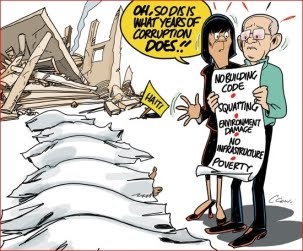
The Haitians are Coming! The Haitians are Coming!


Clovis, Sunday Observer, January 31, 2010


Ever since January 12 when the 7.0 earthquake hit Port-au-Prince Jamaicans have been bracing for an influx of Haitians seeking refuge from their inhospitable island. Finally on January 28, TVJamaica’s 7 pm newscast announced that the first ‘refugees’ had arrived on the North Coast–in Stewart Town, St. Mary, to be precise.


The camera switched to an impoverished looking individual with no front teeth who described how he and some other Stewart Townians had encountered a famished looking stranger riding a bike through their community. His clothes were wet and when questioned by the stalwarts of Stewart Town, he couldn’t provide an answer. In fact he looked at them mutely, dumbstruck as it were.


By this time the residents of Stewart Town were beginning to suspect that what they had in front of them was none other than a real live Haitian who had come to Jamaica looking for help. After days of wall-to-wall coverage of the quake on CNN and the BBC, the dire straits of those who survived the natural disaster was well known and the St. Mary residents were determined to be kind and hospitable to the putative refugee.


In mounting excitement they started gesticulating at the man asking if there had been an earthquake where he came from. According to a newspaper report:


Pearl Cameron, a resident who offered Anderson a bath, food, clothing and money said although he was hungry and weak he appeared to be in good health.


‘He wrote on a piece of paper and told us that it was five of them on the boat and that his family survived the earthquake,’ she told the Observer, adding that she had used sign language to communicate with Anderson.”


The newspaper account continued, saying “The residents, believing Anderson’s story, called the police who took him to the Port Maria Hospital where, with the help of a translator, they tried to question him.”


Meanwhile the nation was shown images of the unfortunate Haitian being tenderly ministered to by the Police; in Portland one Mavis Anderson gasped and jumped to her feet.


“Him a nuh Haitian, him a Jamaican. Mi nuh know weh him a do a Stewart Town. Him usually ride him bicycle to Port Maria, but mi nuh know weh him a do down there.” Mavis Anderson is reported to have told the Observer after retrieving her son from the hospital.


It transpired that the starving Haitian refugee was a famished Jamaican fisherman or as the Observer put it, “a Jamaican mute from Windsor Castle, Portland.”


At this point i find it necessary to issue the disclaimer that any similarity or resemblance to the plot of an Anthony Winkler story is purely incidental. The truth in Jamaica, is truly stranger than fiction…


While we’re on the subject of refugees it might interest you to know that no less than 13 heads of state from Haiti have taken refuge here with four actually passing away on this island. And all of this was between the years of 1843-1871! The first Haitian President to arrive was Jean-Pierre Boyer in 1843. In 1844 his properties in Haiti were confiscated by the new government in Haiti, headed by one Charles Riviere-Herard. And it wasn’t only Haitian Presidents who whiled away their exile in Kingston. As Matthew Smith, UWI historian and author of the book Red and Black in Haiti: Radicalism, Conflict, and Political Change, 1934-1957 noted:


“Boyer…was one among a handful of once powerful ex-Presidents who were lying low in Kingston. Among the others were: the colourful Mexican caudillo, Antonio Lopez de Santa Anna who, after the crushing defeat at Chapultepec in the final decisive battle of the Mexican-American War in 1848, fled to Guatemala and then to Kingston, where he would remain for two years; Jose Antonio Paez, the heroic leader of the llaneros who fought the royalists in 1819 in the South American revolution against Spain, and who was the first President of Venezuela; and General Juan Jorge Flores, former President of Ecuador who had been forced out of office…in 1843. How exciting it must have been walking around Kingston in 1848! To complicate things even further, Boyer’s successor and archrival, Riviere-Herard, the same man who had confiscated Boyer’s property, was overthrown in May 1844 and found himself living in Kingston at the same time…Later Guerrier, Riviere-Herard’s successor would also set sail for Kingston, though we don’t know much of what became of him.”*


*from “Emperors, Exiles and Intrigues: The Case of Nineteenth-century Haitian Heads of State in Jamaica” by Matthew Smith in Regional Footprints: The Travels and Travails of Early Caribbean Migrants


See? In Jamaica the truth rivals fiction anyday.


PS: This post was originally called “The Haitian Fugee” but after reading Gelede’s comment i had to rename it. The Haitians are Coming captures it all…nuff thanks Gelede.


So. fucking. thirsty. #Haiti

Clovis, Daily Observer, January 20, 2010

Clovis, Jamaica Observer, January 17, 2010
 

How can you be sitting there/telling me… that you care?

 –Bob Marley, Survival
 

In the first 24 hours after Haiti’s 7.0 earthquake on January 12, there were two tweeters who steadfastly transmitted information from ground zero. @RAMhaiti and @Carelpedre. The latter also posted some of the earliest images out of the devastated country on Facebook. @RAMhaiti, the twitter name for Richard Morse, a musician and owner of the handsome Hotel Oloffson was a fount of information, not just of death and entrapment, but also details such as the information that everyone slept outdoors after the earthquake. In fact you could distinguish between those who arrived afterwards and those who lived through the quake, by the fact that the former slept indoors, while the latter slept outdoors, in driveways, parks, squares; anywhere but inside a structure that could collapse and kill them while they slept.

 
@Dooneystudio memorably captured the effect of Morse’s messages: “Like a dark poem unfolding amidst the dread: Richard Morse tweeting during the earthquake in Haiti.” Her tweet links to the Guardian story How Haitian writer Richard Morse gave an hourly account of earthquake through Twitter.

Yesterday i found my day interrupted by the following tweet from @Carelpedre, billed as one of Haiti’s best and most popular radio & TV hosts:


@carelpedre: It’s sad! It’s Been 4 days now and we’re begging for some water on twitter!

 
This stark tweet reminded me of the gap between virtual reality and the REAL, constantly reminding us that no matter how empowered we feel by the new technologies there are too many people out there at the mercy of nature, without so much as the crudest tools at their disposal to withstand its ravages.
It reminded me of the darkly brilliant Tweeter who created the StarvingAfrican account. Her/his periodic tweets are sent out as if they come from a starving person, reminding you that they are still hungry.The account only has a handful of followers because who wants to be reminded that people are starving, right? I can’t help but link what’s happening in Haiti to StarvingAfrican. See below for StarvingAfrican’s recent tweets.

starvingafrican

hungry. still.
about 24 hours ago from web

fucking hungry
1:14 PM Jan 7th from web

hungry. really. hungry.
1:09 AM Dec 29th, 2009 from web

merry fucking christmas. still hungry.
4:36 AM Dec 27th, 2009 from web

hungry.
3:22 PM Dec 23rd, 2009 from web

surprise! still hungry.
1:57 PM Dec 23rd, 2009 from web

hungry
5:48 PM Dec 22nd, 2009 from web

could eat a horse.
5:32 PM Dec 22nd, 2009 from web

lunchtime. **crickets**
3:22 PM Dec 21st, 2009 from web

vultures are circling overhead. still hungry.
12:46 PM Dec 21st, 2009 from web

hungry.
1:57 AM Dec 21st, 2009 from web

time for dinner. **crickets**
12:26 AM Dec 20th, 2009 from web

fucking hungry.
12:23 AM Dec 20th, 2009 from web

hungry
6:13 PM Dec 19th, 2009 from web

so. fucking. hungry.
2:50 PM Dec 19th, 2009 from web

belly distending. vultures circling overhead. hungry.
2:36 PM Dec 18th, 2009 from web

starving to death.
2:33 PM Dec 18th, 2009 from web

hungry.
2:09 AM Dec 18th, 2009 from web

feed me.
5:14 PM Dec 8th, 2009 from web

So. fucking. hungry.
10:19 PM Dec 6th, 2009 from web