India Art Summit et al

loved this work at the India Art Summit but neglected to note artist’s name.
India Shining

Landing in Kingston after five weeks away reminded me vividly of why I love returning to the Rock so much. As I waited with my lootcases and laptop for the offspring to arrive, I noticed two individuals hovering nearby. One of them sidled over muttering something that sounded like “Mi like yu eyes y’know, wicked eyes yu ave.” I complimented him on his prowess with lyrics while trying to return a basilisk stare.

“Well, a lady like you must elicit lyrics y’know,” growled the other wolf (trust me he actually did use the word ‘elicit’), approaching and shooing the first lyricist away. Before I could contemplate my next move, Worm, a taximan I occasionally use, appeared out of nowhere: “You look like you need to make a call” he said, slipping his cellphone into my grateful hands. And in two twos the offspring who had inexplicably been lurking a few cars away (“I thought you’d still have credit!”) appeared and whisked me off after the lyrical ones had manhandled my baggage into the trunk. A few bills were distributed hither and thither and off I rode into the Kingston night, thrilled to be back.

Dalmatian by Ved Gupta

India was a trip and a half. The parents live in Bangalore and that was my base, a cool Southern city with a remarkable number of pubs, cafés and restaurants. From there I went to Kochi and Trivandrum, Kerala, for a week to visit extended family and friends. Then a week in Delhi to visit a cousin, more friends and the India Art Summit, an art fair and forum of discussions around the state of art in India.

Compared to art in Jamaica and the Anglophone Caribbean, Indian art is thriving, despite much hand-wringing and laments from sundry art interests who populated the rather expensively priced discussion fora. The pocket would only permit two sessions, consisting of four discussions or talks altogether. The standout speakers for me were Jitish Kallat, one of the most successful contemporary artists in India today and Geeta Kapur, the single-most respected voice on the Indian artscene speaking on Emerging Markets and Subversion, Perversity and Resistance respectively.

Two Gandhis by Balaji Ponna

A panel titled The Role of the Gallery—The View from the Street turned out to be a riveting one as well when the matter of pre-eminent Indian artist M.F. Husain’s absence from the Fair was raised, provoking an impassioned debate about the role of the state in relation to the politics of art-making and the corresponding role of galleries. 94-year old Husain is in voluntary exile in the UK after a group of Hindu extremists declared the equivalent of a Fatwa on him for portraying ‘Bharatmata’ or ‘Mother India’ in the nude. Previously the artist had also drawn the ire of religious extremists with his depictions of Indian Goddesses in their birthday suits. This was one thing, but was it also necessary for his work to be kept from display at the Fair was the question posed.

Jab we meet by Saptarshi Naskar

With a panel including Sharon Apparao of Apparao Galleries, the venue where the offending artwork by Husain had originally been exhibited, the ensuing discussion was pretty intense. The Galleries unanimously maintained that they would have been happy to exhibit Husain’s work but were prevented from doing so by the organizers who had forbidden the work to be shown for security reasons. “We acknowledge the iconic stature of Husain, but are unable to put all
the people and art work at risk,” Neha Kirpal, associate director of the India Art Summit said in an AFP interview.

When asked about this at the Forum Kirpal explained that the organizers had tried their best to enlist the support of the Government security forces in protecting the Fair against possible terrorist threats but that the police had shown complete indifference, only complaining that they had not received their VIP passes to the fair (!). Under the circumstances it seemed unwise to court almost certain disaster by exhibiting M.F.’s work.
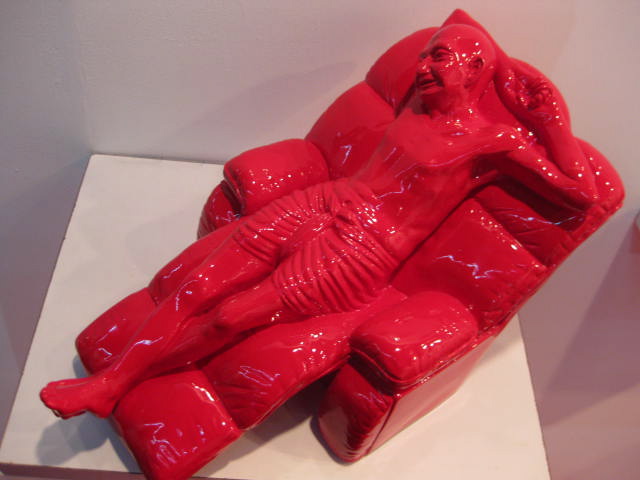
Reclining Gandhi by Debanjan Roy

At the Emerging Markets forum Sotheby’s deputy director, Maithili Parekh, lamented the lack of an ‘art ecosystem’ as she put it—that is, the network of artists, curators, critics, dealers and gallerists required to maintain a functioning and healthy artworld. Self-titled ‘artworld worker’ Jitish Kallat summed it up as “a lot of art being viewed and very little art being reviewed.” Hmmmm, over here you would have to say–very little art being viewed and even less reviewed. Saying that serious cultural stewardship was required Kallat went on to observe that India has an “art scenario completely orphaned by an absent state.” The sharp-tongued artist also described the current recession as “a kind of greed tax”.

At the session on ‘difference’, cultural, sexual and otherwise, the next day, Geeta Kapur chided the Fair organizers for billing the Summit as “400 crores worth of art on display” (a crore is an Indian unit of counting equivalent to ten million). Vigorously embodying the spirit of resistance Kapur invoked Guy Debord’s 1967 tract Society of the Spectacle to dismiss the art fair as “the epitome of the idea of the spectacle” or “money which one only looks at”. In response to an art writer who had celebrated her ability to critique art without being in possession of an abundance of erudition (‘swallowing an encyclopedia’) Kapur declaimed that she would have liked to “perform an encyclopedia that I have swallowed.” In the final analysis she urged that exhibition sites such as India Art Summit be kept open for innovation. A slideshow of some of the work on display at the fair, courtesy Livemint.com, may be viewed here.

Another redoubtable interlocutor on the discussion circuit was Shukla Samant but enough about the words that were exchanged at India Art Summit. The best part of the Fair was of course, the art. I was struck by the number of artists who focused on Mahatma Gandhi as a suitable subject and by the sense of humour that pervaded much of the work. Graças à Deus there were not too many tormented, tortured bodies as would have appeared in the Caribbean or that sense of leaden solemnity that pervades much visual work here.

A fortuitous meeting with Singapore artist Ketna Patel (we were both staying at the India International Centre) introduced me to Siddhartha Tagore, the editor of Art and Deal and the artists in his circle, among them Vibha Galhotra, whose brilliant work Construction, Deconstruction and Reconstruction, drew much attention at the Fair. Other highlights were meeting Abhay Sardesai, editor of Artindia, photographer Gauri Gill and on old friend George Jose, now with the Asia Society. Hanging out with George at the Devi Art Foundation reception is a memory I will cherish for a long time. The fortress gallery of Anupam Poddar, the most canny collector of contemporary art in India (sometimes called the Indian Saatchi) was opened to summit participants one evening complete with bar, dinner and disco. An amazing collection of art letters between four Sri Lankan artists* and artwork by a Bangladeshi artist** were testimony to Poddar’s subcontinental vision, ignoring national borders in favour of a regional purview. Hint hint, Caribbean collectors who still confine their collections within national borders.
Through an Anish Kapoor, darkly

Back in Bangalore I gave a talk at Gallery Ske called Kingston Logic vs. The History Brush about Jamaican music, art and culture. It went down really well. Gallery Ske is one of the most interesting galleries in Bangalore/India along with No. 1 Shanthi Road, where I spent a little time. I also commissioned a portrait of the offspring as a Hindu deity, by Afsar Pasha, a billboard and sign painter of renown in Bangalore—Varun, as God of the Sea and water, his namesake—hopefully I won’t be targeted by religious extremists, after all Pasha is a Muslim while I’m a Syrian Christian by birth.
Varun by Afsar Pasha

So much more to tell, but here finally is the first installment…from India…with love.

*”‘The One Year Drawing Project’ is an experimental drawing exchange that takes the form of an artists’ book, involving four of Sri Lanka’s most critically acclaimed artists- Muhanned Cader, Thamotharampillai Shanaathanan, Chandraguptha Thenuwara and Jagath Weerasinghe. It comprises 208 drawings created by the artists in response to each other’s works. From May 2005 to October 2007 these artists exchanged drawings via post between Jaffna in the north of the country and the suburbs of the capital Colombo.” (from Devi Art Foundation website)

**”Mahbabur Rahman, 40, is a painter and performance artist, a key figure in the Bangladeshi art scene. Setting his performances within larger installations, Mahbub often uses his own body as material. Some draw from literary references – a performance titled Transformations (2004) is an enactment of a story by Bangladeshi writer and poet Syed Shamsul Haq about an indigo farmer who was forced to plough his field with his own body.” (from Devi Art Foundation website)

The Last Don: KOTE 09 Part 2

Word on the street has it that the Jamaican Security Forces have created a “Don Squad” which is systematically eliminating “Dons” or Ghetto strongmen around the country. Popular belief is that although the eliminations are staged as shootouts between rival gangs it is the police who are behind the killings. If this is true it would seem to be a clever strategy and might very well give an added resonance to The Last Don, at least in name, by the Rickards Brothers.

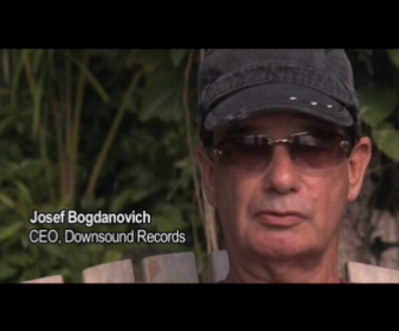
The Last Don was premiered to much acclaim at the recently concluded Kingston on the Edge in its Films on the Edge segment. The pilot for a putative TV series Last Don is an ironic, irreverent look at music promoter Josef Bogdanovich and the contortions he goes through in his attempt to corral and showcase Jamaican musical talent. I took the opportunity to quiz the prime mover behind the film, Peter Dean Rickards, about the process of making this comic documentary and his own history as a film-maker and photographer. Check out the priceless footage of Kingston Signals, the show that started it all, with Sean Paul before he hit the big time.

Q. So what are the origins of Last Don? How did the idea come to you? What are you trying to or interested in portraying?

The Last Don actually originated about 8 years ago when I began working at Downsound Records which was then in the basement of Globe Furniture on Constant Spring road. The boss was a guy named Josef Bogdanovich, an American from Los Angeles who had moved to Kingston a few years earlier to produce Jamaican music and concerts. Although the initial purpose of meeting Josef was to build him a website, I ended up working there for the next three years after we created Kingston Signals – the first live-to-broadband webcast of hardcore Jamaican soundsystems.

It was a great job and I quickly became addicted to the fast pace and unpredictability of the business; but what was far more interesting was the day-to-day hustle of running a music studio in Kingston and the personalities involved, particularly that of Bogdanovich who could be described as ‘constantly in first gear.’

Several years later when I began to think seriously about jumping into film, it occurred to me that the story of Downsound was something I really wanted to do because I had practically written the story in my head a thousand times; constantly explaining ‘episodes’ to people who would ask me what it was like to work in such a crazy environment with a person like Josef, who is often misunderstood by people who either don’t know him or are put off by his management style which goes something like : “Get it done or get the f*** outta here!”

Then, when you stop to consider that there are no guarantees in that line of work, and that each day can end in great success or terrible failure, the potential for a series or even a film becomes more obvious, especially when fused with the character of Bogdanovich himself, an unlikely underdog , a white guy in Kingston working in Jamaican music who does things his way, because, after all — he can.

As far as what we were trying to portray, it is simply a true-to-life observation of some unusual people in an unusual business, with Jamaica, and particularly Kingston as an interesting backdrop.

Q. What is your background in film/video? Is it true that this is your first attempt at film having experimented with music videos previously?

I have no formal training in film or video but just like my photographs I believe it’s all about a solid concept followed by framing and then ‘painting’ the story from the pieces. Although my cousin PJ (the other half of the Rickards Bros.) has been working as a video editor for over 10 years, I’m very new to video/film. After we got our first camera in late 2008, PJ came down from New York and we immediately got to work; creating two videos for Terry Lynn before jumping right into production of The Last Don. Also involved in the team is Jarmilla Jackson (another cousin) who writes, creates and participates in the meticulous editing process with me and PJ. The three of us are highly critical of our own work so hardly anything slips by without heavy scrutiny– but we like it that way.

Q. You’re clearly immersed in visual culture, who are your influences? (Weejee etc) is it true you have no photographic training? how did you learn to do what you do?

Weejee wasn’t much an influence you know. I only discovered him the other day but I can certainly relate to his ambulance chasing from the perspective that he had to sell his stuff. Photography is not an easy business to be in if you want to actually earn a living taking pictures of what interests you (unless you actually like taking wedding photos and talking about ISO settings). In my opinion, you have to have an angle and be doing something different from the other 50 million people who own a camera. I guess that’s why Weegee took pictures of murdered gangsters instead of that rusty boat down by the airport.

No I didn’t have any formal photographic training but let’s be serious here, how could you justify more than a week of ‘photographic training.’ You might as well go to school to learn how to put batteries in the thing and attach a lens. It’s just an instrument that anyone can operate. No school can’t teach you to be creative no matter how many years you study the work of others. Dentists need school, not photographers.

To be sure, I learned to make a decent photograph by simply shooting and looking at what I did, then adjusting to make it better. It can be fun but it also made me a lazy writer and so I’ve been drawn towards video and film because it combines the visuals that I enjoy doing with a return to storytelling.

My biggest influences are Stanley Kubrick, Woody Allen, Tarantino, Coppola (and many others but those stand out). I’m a huge fan of SCTV, The Office (UK) and anything Charles Schulz did.


Q. Ideally what would you like to be doing? What are the obstacles or constraints you face?

For once in a long time, I’m actually doing what I really want to be doing – making stories that can be shown on a big screen in front of many people…and watching as they react to the things they see and hear. It’s an incredible high to experience that, especially since I always dreamed of doing it. The goal is to constantly improve, both technically and creatively so that we can justify bigger budgets that will enable us to do bigger things.

As far as constraints are concerned, I suppose it’s the typical stuff: limited resources and the limited mindset of a rather stagnant television industry here. Considering the creative currency of Jamaicans, it’s sad that one has to look outward, not only for funding but for outlets to present your work without someone like Cordel Green telling you what is suitable for the eyes and ears of the adult population.

Thankfully, we have the Internet and Fed Ex to circumvent certain things.

Kingston on the Edge (KOTE) 09: UnCONVENTional Edges out Rest


Neila Ebanks

It was June 22, Day 4 of Kingston on the Edge and UWI’s Philip Sherlock Centre was full as the audience, mostly young folk, waited for Dance on the Edge to begin. I was with Deborah Thomas and Junior Wedderburn, the former a seasoned dancer (and author of Modern Blackness), the latter an accomplished drummer who performs with the Lion King on Broadway. As the lithe, young dancers pranced around on stage we joked and laughed to ourselves, commenting among other things on the full house and the meaning or meaninglessness of the various dances.

Then right after a performance that Junior dubbed Johncrow nyam Dove, the tempo changed and the quality of the offerings went sharply uphill. A video with the puzzling title The Edging of Sister Mitzie Margaret started playing, featuring the exciting young dance maven, Neila Ebanks. With a quirky, offbeat, almost Chaplinesque sense of timing and parody Ebanks completely reinscribed the idea of dance as it has been known in these parts as she fluttered, skanked and slid her way on film along UWI’s Ring Road toward the Sherlock Centre. Dressed in a nun’s habit the film opens with Neila in the character of Sister Mitzie Margaret, intently inserting earphones and plugging into an ipod. As the music begins Sister Mitzie responds by quaking, shaking and feeling her way along the ground as if afraid the road might suddenly be pulled from
beneath her.


As the camera follows Sister Mitzie’s comical progress towards the Sherlock Centre, it suddenly dawns on you that she is mugging her way up the path to the auditorium and as you see her hand reaching for the door you realize with a shiver of anticipation that the dancer is actually outside and about to enter. Loud applause broke out as the the film then morphed into a live performance by Ebanks and she entered the auditorium, slipsliding across the stage and out a door on the other side, the film taking over once again, showing her emerging from the exit as the credits started to roll. Brilliant. Just brilliant.

Other memorable performances were by a group of tough looking chicks who took on the Broadcasting Commission and the recent ban on ‘daggering’ and what it deemed ‘lewd’ dancing. They lay the ground for the high-energy, wickedly creative male dance troupe, Shady Squad, who captured the audience with their imaginatively choreographed dancehall moves and style. At one moment they even performed a version of Michael Jackson’s anti-gravity lean. Superb. The audience screamed with delight at their performance and a mere one and a half hours after it began the show ended on such a high note that as someone said on Facebook the next day it was a pity there was no after-party to capitalize on the incredible vibes.

For me KOTE’s evening of dance was the most memorable of the week-long self-styled urban art festival. This is KOTE’s third year and it keeps getting better and better. The thirty-something organizers managed to bring out filled-to-capacity audiences for all the events. I’m only sorry that I missed the opening night at Red Bones and the premiere of the film “Why Do Jamaicans Run so Fast?” a production that has been attracting a lot of attention. A clip of video i shot of my office co-workers watching the 100m men’s relay in Beijing is actually included in the film but more on that when I’ve seen it.

An effervescent fizz fills the air at successful cultural events and there was plenty of snap, crackle and pop at KOTE this year. Theatre on the Edge was pretty good but only one production stood out for me (I missed the first of the eight offerings). Everyone had ten minutes to present their work and Amba Chevannes as playwright made the most of hers. Using just one eccentric character talking directly to the audience, Miss Burton Gets A Promotion was quirky, natural and best of all contemporary. No ‘folk’ dressed in turbans and bandana trotting around shouting at the audience, thank God.

Its not that the rest of the eight ten-minute productions that evening weren’t good, the audience was certainly appreciative, judging by the loud applause that attended most of them. It’s just that i like to focus on the really outstanding performances, artworks, music—the ones its worth telling the rest of the world about. There was at least one of these in every field except visual art, which continues to trail behind the other arts in Jamaica (and the rest of the region for that matter), the works either too conventional or pedestrian or just plain bad. The best of a bad lot was The Core Insight at Olympia Art Centre, an atmospheric art space if ever there was one.


In Film on the Edge again one film dominated the rest, The Last Don, by the Rickards Brothers. A trailer for a proposed TV/video series the film depicts a typical day in the working life of music producer and promoter Josef Bogdanovich. Again the film is offbeat, quirky and brilliant along the lines of the innovative Brazilian documentary, Manda Bala (Send a Bullet). I plan to follow up soon with an interview with the conceptual force behind The Last Don, Peter Dean Rickards.

HABITUAL OFFENDER?

Meanwhile back to dancing on the edge: “Psychological, cathartic, layered. I rarely go for the easy or obvious” is what Neila Ebanks said about her work in an interview with Karin Wilson of Yardedge.

I asked Ebanks to tell me more about the birth of Sister Mitzie Margaret and how her KOTE project unfolded in real time. Who were her models or sources of inspiration? Was she trying to convey anything in particular? Why a nun? Interestingly The Edging… was conceived, planned and performed in a very short space of time with the dancer liasing with the film director, John DaCosta, at the Lit Fest Calabash in Treasure Beach a scant four weeks before Kingston on the Edge started.

Here’s what Neila told me:

My Sister Mitzie personality comes out of a love of classic goofiness —– think Carol Burnett, Dick Van Dyke, The Muppet Show, Mr. Bean —– and intelligent physical comedy. Her character has been inspired by my Catholic prep and high schooling and my wondering how much of themselves the sisters had to give up to serve (and sometimes not) as they did.

The piece is the second in what is to become a series of Sister Mitzie capers in which she tries to balance her whimsy with her duty as “bride of Christ” (said like the announcer for “Pigs in Space” from the Muppet Show ). The first in the series, UnCONVENTional, was actually premiered 10 years ago in my Improvisation examination @ the Edna Manley College School of Dance. The night before the exam I had a eureka moment when I thought of a striptease in reverse, and the most unlikely character to perform it. She wasn’t named at that time but she has been able to surprise and make an audience laugh everywhere she goes.

I often take my work back to the lab to tweak and twiddle and so in 2003, I revisted that first piece, called it A Life CONVENTtional and I created a 10 minute version of it which debuted @ the HIP Festival of Dance in London in. From that experiment I discovered that the effect was not as arresting when the piece was that long and so I returned to it’s original 3 minute format. The best thing about that trial, though, was that I got to really examine the character of Mitzie (@ that time still unnamed) and uncover her reasons for being and the layers behind her nuances.

Fast forward to KOTE and Mitzie’s edging… She wasn’t even supposed to appear! Lighting designer John DaCosta and I had a Calabash discussion about making a film for KOTE in which I (Neila) would be dancing off the edges of surfaces @ UWI until I reached into the theatre. I have always been interested in dance film, and John is making a foray into film-making and so we were both excited about the collaboration. We had further discussion about the concept with my right-hand man Michael Holgate but Mitzie only came into the picture the day before the shoot, after our rehearsal when we realised that the film needed another layer, the character needed history, a little complexity…. and rather than have us create a new character Mitzie raised her hand and said “Me please!” . We shot on the Saturday before Monday’s performance and as I improv’d John filmed while we tried to beat the inevitable sunset. The music was found (before we filmed) by my musicmate, Renee, who has the knack for finding just the right soundtrack for my life, but I didn’t listen to it more than once before filming, and not immediately either. In fact, as I danced I just made up my own music, because I couldn’t remember the melody. Editing was done in record time by Serchen Morris of Phase 3, and magically, even when he was asked to make things faster, the movement still fit the music perfectly. Sister Mitzie was obviously an idea whose time had come.

I don’t know if I was trying to do anything particular with Mitzie, except probably crack smiles and get to play with my audience and allow them to put the puzzle pieces together in a way which used technology and live dance differently. I mean, I know full well that in other contemporary dance circles the work might be described as too literal and simplistic, but as far as JA goes, not many persons are stepping into dance on film, and this is my starting point. It’s as I write this that I realise how interested I have always been in the illusions that film can help to create. The applause on entry to the theatre really surprised me, especially because I wasn’t sure how many people had seen the first installment (done most recently @ Jamaica Dance Umbrella in March 2009) and I was concerned that without that information the audience would not find it funny. Though the applause was great to hear and feel, I was most pleased with the engagement that I saw in the audience’s eyes when the house lights came on and Mitzie realised where she was. It’s a beautiful thing to realise you have been able to build that kind of connection with an audience in just a few minutes, without words.

PROVE YOU’RE HUMAN: The Post-Michael Jackson Post

The boy who danced and sang his way into countless hearts from all cultures anywhere is no more. Michael Jackson.

There’s a yawning MJ-shaped chasm in the universe at this post-Jacksonian moment. Michael’s death wrenched the spotlight away from Iran and refocused it on a lost boy who was led astray everytime he tried to find his way home. Now he never will. I think the pressure of having to prove he was human to a world that suddenly seemed to turn hostile and scornful proved too much for this extraordinary boy-man to bear.

PROVE YOU’RE HUMAN demand the spambot busters when you try to leave a comment on blogposts or Facebook discussions. You then have to correctly type two distorted-looking words into a box, an action that apparently will instantly expose a spambot (which pretend to be users but actually want to harvest your email and other useful info about you) incapable of deciphering the letters.

Could MJ possibly have realized just how many fans and well-wishers he has all over the world? Michael Jackson dies and nearly takes internet with him announced one headline referring to the volume of cybertraffic trying to verify his death on the afternoon of June 25th, resulting in an overload which nearly crashed the Net the day he died. The media, snarling and vicious only a few years ago has been obsessively adulating him in death.

looklikemoney09 crazy how this nigga #michaeljackson got respect when he died an aint have none when he was alive was how one tweep roughly and eloquently summed it up. A commenter (sharon p) on a blog called Can’t Stop Won’t Stop poignantly asked: “how will i remember him? as the person who bought the elephant man’s bones just so he could bury them. who will he remind me of? Zora Neale Hurston, who was also accused of child molestation in 1948 — an accusation that caused her to leave the “community” she had dedicated her life to.”

The accusations of child molestation made against MJ in 2005 and the resulting media frenzy must have left a malingering but fatal wound on his already bruised and battered psyche. We seem to overlook the fact that everything Michael did was a scream for help. MJ enacted on his body the aggression he faced from his father & by extension society, and he flaunted his wounds in our face– that etiolated Geisha mask and his mutilated nose were pleas for the unconditional love he always desired.

Yet the media demanded that Michael act ‘normal’ and policed his departures from the norm with a vengeance that verged on violence. Hyena-like they were expressing the deep violence that underlies the social contract, a violence that had also consumed his erstwhile friend Diana, Princess of Wales, a decade or so ago.

Well, the mainstream media has limited credibility for me now, particularly in the wake of the Iraq War which they triumphantly and confidently led us into. If i’m going to believe anyone on the Michael Jackson saga it will be his close friends and family (see Deepak Chopra in the Huffington Post) who all testify to his innate goodness and compassion and not some journalist riding a moral high horse and instructing me on what is normal and what isn’t. For a good article on the subject i recommend Andrew Sullivan’s Thinking about Michael.


Jackson’s profound influence on global popular culture can be measured in the numerous song-and-dance routines of Bollywood films. Indian choreographers have yet to recover from the Thriller effect, which informs a good three quarters of all Bollywood dance numbers. Jai ho MJ said AR Rahman in his tribute. In the Caribbean the Jackson Brothers came to both Jamaica and Trinidad and Tobago. Mark Lyndersay has written a memorable account in the Trinidad Guardian of his encounter with MJ on that 1978 visit. Here he describes accompanying MJ to Laventille:

The lanky young black man, his hair a massive puff that swayed in the evening breeze, walked along the road, waving, shaking hands and chatting with surprised people relaxing in their verandahs on a warm sunny Sunday afternoon. I photographed the entire encounter for what I was told were his scrapbooks, memoirs he gathered of his travels.

Another area Michael may have been surprised to know he impacted on was the Middle East. In an article called “He meant so much to Arabs” the author detailed the region’s love affair with the singer:

As most of his admirers in the Middle East got pirated or smuggled copies of his music in the 1980s and 1990s, I don’t think MJ knew just how much his music shaped a whole generation of Arabs, just how many fans he had here and just how devoted they remained throughout his ordeals.

We might not have heard of the Beatles or Elvis Presley, but we sure knew Michael Jackson

There was just something about him and his songs that rang true. When we were teenagers, we would often smuggle music by MJ into our school in Saudi Arabia and share it among us by putting the cassettes into generic plastic covers to hide the fact that we were listening to his music.

There were fears among the religious police about his “influence” on the young mind, particularly as songs such as Bad and Beat It were copied and sung, and even dubbed into Arabic, by the young and the rebellious.

We didn’t care about his personal life, it didn’t matter. What was important were the songs. We identified with the themes of loneliness and rejection in his lyrics.

After the first Gulf War, the young in countries such as Saudi Arabia, Iraq and Kuwait listened to his songs for strength and inspiration. I know I did – even if I didn’t understand all of the words back then.

In many ways – and despite reservations about Washington’s recent foreign policy – he was a symbol of America as a land of opportunity, especially for a generation of Arabs that had grown up in conflict.

People named their cars after him, not to mention their pets – my own white-and-black cat is called MJ.

The 1985 song We are the World, which MJ co-wrote, is a regular at school parties. Even his more recent albums strike a chord with his Middle Eastern fans, while a song like Scream, for example, is often played among young groupings who feel frustrated, pressurised, and suppressed by the establishment, whether it be official or cultural.

MJ performing live in Bucharest

As #Michaeljackson replaced #iranelection overnight as the top trending subject on Twitter a bitter Iranelection tweep reflected on the rapid shift in the public’s attention: amazing how quickly interests shift from the plight of an entire country and its people to the death of a washed up pedophile #iranelection”. I wondered if this person so contemptuously dismissing Jackson realized that, just as in Saudi Arabia and the rest of the Middle East, it was probably this ‘washed-up pedophile’ who was responsible for exposing Iranian youth to the seductive, permissive culture of the West and indirectly to the rebellious spirit we saw erupt in Tehran last week.

And for a great deconstruction of how news systems work the death of ‘famous persons’ have a look at this cartoon from the Stereotypist (a comic written and poorly drawn by john campbell. updated entirely without warning. e-mail wtfwjd ‘at’ gmail dot com)
below. In the meantime i prefer to think of Michael as a friend on Facebook visualized him:

Sonjah Stanley Niaah MJ: The moonwalker who dwelled on earth for a while and left a luminous musical legacy!

‘Bad Words’ at Calabash 09


Calabash Vibes: The Underage drinker Drew, The fossil Blinger, Marlon, the proprietor of the world’s coolest name, Johnny Temple, the never far from a camera Annabelle, and some writer named Junot Diaz. Photo: courtesy The Fossil Blinger.

WRITER & WIFE: Anthony Winkler and spouse, Cathy, at Calabash (i enjoyed a brief career as Winkler’s wife courtesy Tallawah Review. The error has now been corrected).

the-torment-of-saint-anthony-michelangelo

The Torment of Saint Anthony, reportedly by Michelangelo

Writers are not the most spectacular looking creatures (except for Terese Svoboda who apparently dazzled the Calabash crowd with her silver-sequined mini dress if not her poetry) so i thought i’d lead into my first brief on the literary festival with some unrelated but compelling images from the artworld.

Japanese artist Takashi Murakami poses on top of one of his art works. EFE/Ym Yik.

I’ll tell you up front. The main draws for me at Calabash 09 were Patrick French, Junot Diaz and Pico Iyer. Many of the other literary stars i’d already heard read or know personally. I’ve heard Stacey Ann Chin at least four or five times but was still eager to hear what she might say or read from her memoir. I heard her being interviewed on radio recently and she struck me as more mature and thoughtful than on previous occasions where her rage outran her rapport with the audience.


Stacey Ann Chin flanked by Mr. Seaga and Anthony Winkler.
captions courtesy Peter Dean Rickards


Chin didn’t disappoint. Her account of her first encounter with a sanitary pad under the gimlet
(if grim) gaze of her aunt played havoc with the Jamaican sensibilities present some of whom shook their heads in disbelief. Stacey Ann proceeded with the frank chronicling of her abused pumpum, followed by Mr. Seaga whose autobiographical account was severe and puritanical in contrast. One of my companions sardonically remarked that he seemed to be reading his resume. Anthony Winkler, who followed, restored the climate of lewdness and profanity that had been set in motion the first night by an ebullient Junot Diaz. Winkler regaled the audience with the story of ‘Greasy Legs’ a prostitute who initiated generations of Cornwall College students into the slippery secrets of her anatomy.

The session between Paul Holdenberger and Pico Iyer took the festival out of the gutter to spiritual heights as travel writer Pico (whose work i used to read in Time magazine) described the peripatetic trajectory of his existence. A citizen of the Global Commons if ever there was one, Iyer (pronounced the way many locals pronounce ‘Higher’ but with a Barbadian ‘I’) personifies the figure of the Nomad, combining contemporary radical chic (he once spent two weeks at LA International Airport as part of the research for his book Global Soul) with a yearning for the timeless, ageless monasticism of ancient Eastern cultures.

The next session of invited readers included Laura Fish from the University of Newcastle whose second novel Strange Music is about Elizabeth Barrett Browning. Fish’s father resides at the Greenwood Great House near Falmouth where the Barrett Brownings lived. Fish struck a clean, light note followed by Marlon James, whose compelling, dark novel The Book of the Night Women has just been published to much critical acclaim. His profanity-laden reading found disfavour with audience members who had brought their children with them. They attempted to intervene without success and were reminded by the organizers that Calabash is, after all, an adult event.

From the album:
“Wall Photos” by Marlon James
Because the kiddies deserve a good story too. I know, please keep your awwws to yourselves


Does shielding young ears from words like pussy, bombaclaat, pumpum and other such words ensure a more sensitive, ethical adult? Especially when they can see for themselves the hypocritical, unjust society we live in? And if we assume that all the outraged adults yesterday had been similarly shielded in their childhood why aren’t we living in a better organized, more just society?

Patrick French was the boomshot for me. He didn’t just read from his superb biography of Naipaul. His comments and reactions to place names in Jamaica, his thoughts on Caribbean and Trinidadian society, his observations on Derek Walcott’s dubbing Naipaul the Mongoose at Calabash O8 engagingly prefaced the reading. His performance was deft and sure-footed. It never fails to impress me that the best writers are careful to leave you wanting more (as did Edwidge Danticat and Junot Diaz on the first night) while the lesser ones have no qualms about abusing your patience. It’s like blogging–you do have the freedom to go and on but is that really the wisest strategy in engaging your readers?

Postscript: Incidentally it is NOT true that Stacy Ann Chin has instructed her publishers not to distribute her memoir in Jamaica. I asked her myself and she said that the UK rights have not yet been negotiated although the US rights have and since Jamaica falls under the former where book distribution rights are concerned we will have to wait for bookshops here to stock it. The book is also being vetted to ensure that Ja’s strict libel laws have not been violated. When are we going to revise these? I mean antiques have their place but not in law surely? In the meantime anyone wanting a copy of Stacy Ann’s book can easily order it from Amazon.

Who the Bill Fit, Let Him Wear It…

The brilliant imagician Richard Whyte strikes again. This time with a seven grand bill for the Seven Star General LA Lewis (For my friends in St Vincent and elsewhere LA is a Kingston urban legend who has willed himself to stardom despite negligible musical talent. He’s a self-taught marketing genius of no mean order).

Context: Release of J$5000 bill with Hugh Shearer’s admittedly handsome mug decorating it in the face of public demands for a note with Bob Marley’s face pon it. i myself had a status update (on Facebook) saying ‘why didn’t they put Bob on the 5000 bill?’ “Or Bolt, to remind us of how fast we will be spending each note …” quipped V in response while the Afflicted One retorted, ‘Because there’s no Elvis on the American money?” And the Observer of May 21 even editorialised on the subject asking Is Mr Hugh Shearer worth $5,000?


Wednesday, May 20 2009, The Daily Observer

But then Ziggy responded in an Observer article–Bob doesn’t ‘fit the bill’, says Ziggy, insisting that he wouldn’t want his Dad’s face on the ultimate symbol of Babylon–its currency–anyway. And that does make sense though one feels deprived by this…i mean imagine what it would be like to have five thousand dollar bills that people all over the world would kill for. it could be the new bauxite for Kali, Muhammad, Selassie and Christ’s sake. we could literally print our way out of the financial crisis with dollar bills that Marley fans would snap up at $5000 a pop! Man a Yaad, move with haste–Who the Bill Fit, Let Him Wear It…

And i have nuff brawta for you and you–the inimitable Prince Zimboo and the Stalker, Vlad–listen!

and Vlad

meanwhile i’m off to Treasure Beach tomorrow for a star-spangled Calabash. more anon!

‘Guns, Ganja and Games’ anyone?

Dear Annie Paul,

Anne Walmsley, Nick Gillard and Bill Schwarz all recommended that I contact you.

Faber & Faber have commissioned me to write a book (non-fiction) on Jamaica, which will be a hybrid of history and travel. I am interested in Small Axe, and wonder if we could meet? Do you perhaps have a contact telephone number?

I shall be arriving in Kingston this Monday 4 July for an initial period of two months to research my book.

My last book was a biography of the Italian writer Primo Levi (Picador USA, Vintage UK), but I have written extensively on Haiti, so I’m not entirely new to the West Indies. Indeed I visited Jamaica last October for the first time.

When you have a moment, please do get in touch.

With all good wishes,

Ian Thomson

I received this email from Ian Thomson in 2005. The hybrid book of history and travel he was arriving to research has just been published with the provocative title The Dead Yard: Tales of Modern Jamaica. Four years is a good turnaround for a book like this. Anyone who thinks that they can write a book today, publish it tomorrow and retire on the profits the day after that doesn’t understand the world of publishing. The journey from manuscript to print alone can last almost two years.

If that doesn’t deter the starry-eyed would be writers who publish their effusions in the Sunday papers then perhaps this will. One of the things that struck me about Thomson when I finally met him was his obsession with thrift and economy. He never took a taxi if he could get a bus or walk, and he rarely paid for meals or drinks with his informants. If he had made much money from his earlier books there was no sign of it. And if Faber had allocated him an expense account it was an extremely parsimonious one.


In a country such as Jamaica where walk-foot whites are a rarity Thomson stood out like a sore thumb. I saw quite a bit of him on that first visit he made to Kingston. He had a quirky sense of humour and an analytical eye and of course like all writers he came formatted with his own subjective prejudices and preconceptions. Apparently back in England he had close friends who were first-generation immigrants from Jamaica to the UK and his view of things Jamaican was necessarily coloured by what he had been told by them.

Photo: Peter Dean Rickards

So I’ve been waiting a long time for Ian’s book and my appetite has been further whetted by his punchy, devastating article in the UK Independent last week: “Sun, sand and savagery: Whatever happened to Jamaica, paradise island?” Illustrated with a provocative photograph by Peter Dean Rickards titled ‘Guns, Ganja and Games’ the article has predictably roused the ire of Jamaicans here and abroad (stirring up controversy to promote book sales is a well-known publishing gimmick) although some of what he says is indubitably true and warrants comment:

“Jamaica is now a quasi-American outpost in the Caribbean, yet its legal system is clogged with British Empire-era red tape. The island’s anti-sodomy laws, which carry a jail sentence of up to 10 years, derive from the English Act of 1861, and show to what a dismal extent Jamaica has absorbed values from its imperial masters. Similarly, the death penalty is still on the Jamaican statute books, though most capital punishments are overturned in London by the Privy Council, Jamaica’s Court of Final Appeal. Thus an ancient British institution comprised of mostly white Law Lords has become the unlikely defender of human rights in Jamaica. A majority of Jamaicans – not just conservative, pro-monarchy ones – see hanging as the only effective deterrent against criminality: murderers must face death. Yet the British Law Lords, through the grace of Queen Elizabeth II, use their power to prevent executions. Such paradoxes are part of the Jamaican confusion: Victorian standards that have long disappeared in Britain linger on in Jamaica – to Jamaica’s detriment.”

More on The Dead Yard after I’ve read it. I’ve asked someone arriving from the UK next week to procure me a copy as it may not be available locally for some time to come. Rumours have been swirling about the book being banned locally, censorship and other worse outcomes. As a friend from Trinidad wrote: BTW have you heard that Faber can’t get any bookseller in JA to stock The Dead Yard?

So being the upstanding member of the Book Industry Association of Jamaica that i am i went straight to the source for more information on these rumours. Suzzanne Lee of Novelty Trading Co. the primary importers and distributors of books and magazines in the island was quick to dispel the speculation:

Dear Annie,

To my knowledge, there is NO local ban on Ian Thompson’s “Dead Yard” or any other book in Jamaica for that matter. The Novelty Trading Company does not believe in censorship and has always stood for freedom of the press.

Novelty Trading was asked to invest in a few thousand copies of this book. Due to the significant financial exposure that would be required and given the vast number of persons mentioned and quoted, we requested permission from the publishers to check sources. The first two sources checked said the book had factual inaccuracies. We then forwarded the book to our Company Lawyer who read it and advised that “portions may be legally actionable”. Due to the above, Novelty declined the publisher’s offer to distribute this title. We made the decision that there are no profits worth more than the reputation of our company. This was purely a business decision.

I am not aware of how exactly Jamaica’s libel laws differ from those in the US and UK, but we have recently encountered another case of a memoir which we attempted to purchase and which the publisher refused to sell to Jamaica due to our libel laws.

I hope this email clarifies any rumours you have heard about “Dead Yard” and Novelty Trading.

All best,

Suzzanne

More as i said when i’ve read the book. Meanwhile all roads lead to Treasure Beach next week where the next instalment of Calabash Literary Festival will unfold with the usual stellar cast of writers including Robert Pinsky, Edwidge Danticat, Junot Diaz, Xu Xi, Pico Iyer, Melvin Van Peebles, Terese Svoboda and Patrick French. Calabash ho everyone!

Taxing Matters…


Clovis, Jamaica Observer, April 27, 2009

It took virtually twenty years but a Jamaican government has finally taken my father’s advice to tax petroleum. 1990 was the first time my Dad came to visit me here and he couldn’t believe how cheap gas/petrol was. Your government is subsidizing petrol? he would incredulously ask my friends who dropped by. They should be taxing it! In India we have just raised the petrol tax again. People drive too much, there’s no need to drive everywhere etc etc. (I should say that my Dad is generally full of good ideas that have earned him quite a reputation. He was recently in the news in India for having launched a ‘child-tracking system‘).

Needless to say my father gained instant unpopularity with my friends. i remember Victor Chang kissing his teeth as he left my house one evening. The fact that my Dad (Samuel Paul) was an economist who had been adviser to the current Indian Prime Minister Manmohan Singh when he was Finance Minister and a member of various five-year plan committees didn’t endear him to my friends any further. They were simply enraged by the idea that gas should be taxed.

I’ve come to the conclusion that there is some irrational link between the price of gas in Jamaica and public tolerance levels. Like the proverbial red rag that provokes the bull to charge, price increases in gas have repeatedly been the trigger for Jamaican rage: the only thing that is guaranteed to make public patience boil till it erupts into violent social disorder. People will willingly put up with torture, rape, murder and corruption but touch the price of gas and you’ve gone too far.

Las May, The Gleaner, April 24, 2009

You will therefore understand why the Jamaican government had to put its security forces on alert the night before Finance Minister Audley Shaw (Oddly Sure i call him in private) announced his tax package. The Prime Minister even made a TV appearance the evening before to address the nation. As someone put it on Twitter “He was on TV basically begging us not to set Jamaica on fire come tomorrow when the new taxes are announced.” After all that the country is still recovering from the fact that for the first time in decades the much feared gas tax has been imposed without social repercussions of any sort. Surely some credit is due to the Opposition for not opportunistically inciting violence as happened in April 1999. And congratulations to the ruling party for biting the bullet and belling the cat. The gas tax was long overdue. I am my father’s daughter after all (I do deplore the tax on ‘printed material’ and computers though).


Las May, The Gleaner, April 2, 2009

Anyhow! Those of us who Twitter and Facebook had a great time before, during and after Oddly Sure’s presentation. Below is a sample of the kinds of conversations to be had on social networking sites such as Facebook. It was initiated by a Facebook friend whose status update the night before Minister Shaw’s presentations said:Wonda if me fe work tomorrow or start black d road fram tonight?” On G-day this was her status update and the conversation it generated:

WC: MEMO TO ALL CONCERNED: Due to budget constraints I will have to surrender my internet so no more FB after 2:10pm, it was nice knowing you all, to the foreigners, pls send a likkle barrel now and then as I will be facing some harsh times, to those i owe – i plead ‘mentally unstable’ so pls write off those debts! to ma fellow roadblackers…..’keep it blacked’! over & out!

OW at 8:54am April 23
talk the tings Winnsome what a gwane a yard!!!!! dont tell me say a de Change what dem ask fa….. a tek place….lol

SB at 9:02am April 23 via Facebook Mobile
Smaddy caan beg di driva fi slow done… One stop driva one stop.DRIVA!!!!

WC at 9:12am April 23

Steve hon, how d bus fi slow dung when no driva no een deh!! a strait collision…stay deh…..say u prayas an ask fi forgiveness!!!

SB at 9:17am April 23 via Facebook Mobile
Memba Seaga wen seh di pnp economy was like a bus going dung mount rosser hill wid no driva. Dis yah one yah is like a hijack plane wid out pilat

OW at 9:19am April 23
Winnie me feel say U vote fi the change to talk up……..
WC at 9:21am April 23

rahtid!!! a true…..yes, but u know say Seaga did mix up an love war!! (lol) but me dear…dis even wos dan hijak plane….a doh even know what fi call e……u memba how Man a Yaad did say jus few weeks ago dat ‘the Jamaican economy not affected by the world crisis an how we criss’ an fram den me say da man d really tek we fi dunce an now him tunRead More him mout….but we did know an eediat Mike Henry a say we need d gas tax fi fix d badly neglected roads an even dat not going to be enuff!! u shld a see him face!! bwoy Steve….it no pretty

DM at 9:33am April 23 via Facebook Mobile
Lawks Winnie, mi very sarry fi hear bout di sudden heconomic downturn pon di rock but noh worry as di barrel is being packed as I tab. Just remind me of yu haddress and pray seh dem noh seajack di ship….have mercy dear Faadah and pilat we chu lifes tempestuous seas…. roger dat, 10 4, ova n hout!….an til wi meet ah farin again mi fren, walk good!!!

Piracy: the way the books are balanced?

Pirates are intercepted by HMS Cumberland

Image of Somali boats from , November 12, 2008

Recent events in the Gulf of Aden where Somali pirates have been boldly attacking passing ships are a reminder that piracy, like prostitution, is one of the oldest professions in the world. By the late twentieth century pirates on the high seas had become such a rarity that the word ‘piracy’ was hijacked to describe the activities of copyright violators. But by the end of the first decade of the twenty-first century pirates were back, using the latest technology to do the same thing the fabled pirates of yore did–hold down an’ tek weh—from ships that passed in the night.

To have the exploits of the Somali pirates unfold just when I happened to be reading the manuscript of a novel called Heart of a Pirate has been quite extraordinary. I was contacted by the author, Pamela Johnson, a few months ago; she wanted someone competent to read the ms and give their reactions and I had been recommended. I agreed to take a look at it but wouldn’t have time to read it it till mid-March to April, I told her.

Anne Bonny

Heart of a Pirate is a novel about Anne Bonny, the female pirate who once inhabited these shores. Her story has come down to us in song and legend rather than official history. As I wrote in the blurb I sent the author:

A rollicking adventure story starring women instead of men— Heart of a Pirate brings to life the legendary female pirates Anne Bonny and Mary Read and the times and places they inhabited. Set in the early eighteenth-century between Jamaica, Ireland, and the Southern United States Pirate plots the coordinates of the extraordinary life of a woman who unceremoniously spit the silver spoon she was born with out of her mouth, taking to the unpredictable and dangerous high seas rather than abide by the laws of patriarchy. Pirate society itself is presented as a more democratic alternative to the hierarchical social system that ruled Britain and its colonies; the political history of Ireland and plantation slavery are referenced and undergird this bracing tale of female bravery, gallantry and piracy. Heart of a Pirate is a story of the human desire for equality and freedom, social justice and piratical valour—a thought-provoking romp of a read particularly at a time when contemporary piracy is occupying international attention again.

An adept swordswoman, who knew how to use the superior strength of men against them, Bonny was a force to reckon with. Dressed in men’s clothes she took on soldiers and sailors alike, besting them and earning her place on many a pirate ship. Although to the manor born, Bonny abhorred slavery and inequality of any sort, chafing under the bit of her father’s authority. She started leaving her house under cover of night to keep the company of sailors and ‘women of the street’ “real people who lived on the edge of life, one day to the next.”

For she understood their poverty, the small wages, the persecution and social circumstances from which many of them ran—debtor’s prison in England, branding, thumbscrew and boot, whip and cane and cat o’ nine tails, long, arbitrary sentences for petty theft or for being on the losing side in some religious war. Almost all had been born on the wrong side of the blanket, bastards, orphaned or abandoned as children. The men, outlawed, turned to theft as the occasion rose, and protected each other better than any army or police. Together, sword in hand, they would take back from the world what had been taken from them. Piracy was the way the books were balanced.

The pirate’s code, also called the Articles of the Brethren or The Brotherhood of the Coast allowed pirates to vote for their captain who would remain captain till he was voted out. “Every man of us is a freeman and stands for his own self, but a man serves his best interest by standin’ with other free men. We don’t hold to colour or class or wealth. A man’s not born with his rank, but earns it.”

To Anne Bonny, the pirate’s code meant equality, something she had not encountered previously and now defended fiercely against the very pirates she lived with. At one point she turns on her husband demanding: “Have ye not just told me that the Code made all men equal? By what right do ye tell me how to speak…or what to think? I’m here precisely because I will have no one tell me what I can or cannot do.” At another moment she argues: “Do not try to tell me that because I am a woman, I must have a different set of rules, for God knows, I have earned my place as an equal. I am a crew member and entitled to all the privileges of any man here.”

While I was reading Heart of a Pirate the pirates of Somalia were rousing international consternation by capturing a US ship and holding its crew hostage. Though the mainstream media were quick to condemn the so-called pirates other voices disagreed. “You Are Being Lied to About Pirates” went one headline in the Huffington Post. Another account simply called Roman Piracy, was making the email rounds, linking slavery to the prevalence of piracy in Roman times:

The piracy threat which came to a head in the decade of the 60’s BC was in part due to Rome’s complacency about the issue. Rather than stamping out small pockets of pirates early on, they allowed piracy to flourish into a large force of marauders. A poor economy and oppressive social conditions also fed the pirate forces as men who were on the verge of bankruptcy discovered more profit as robbers and pillagers. Rome was unwilling to act conclusively toward the reduction of pirate forces because those forces, along with tax companies, provided slaves for the large luxury markets. The pirates did not attack Rome as an enemy, but treated all targets equally, as opportunities for profit. During the next century Roman senators did not find the political will to suppress the piracy, perhaps in part because it served their interests; pirates supplied tens of thousands of slaves for their Italian estates and disrupted the grain trade, thus raising prices for their produce in Rome.

I emailed Pamela Johnson remarking on the coincidence of her sympathetic portrayal of pirate society and the view that the Somalis were being unjustly demonized and might have good reason to be resorting to piracy in response to the severe social injustice they had suffered: Do you have a comment on the Somali activity? I asked.

Comments? Actually, a lot! replied Pamela.

When I first began to think of writing about this fascinating woman, and why she has been the subject of song and legend, why the story has stuck with us for so many years, I looked for the reasons why. Piracy, clearly, is not a good thing, so how could I justify the heroism of it, other than to look at the romance of Rafael Sabatini (Captain Blood) and Errol Flynn and Paul Henried movies (Paul Heinreid filmed a movie in the 50’s entitled The Spanish Main that features a pirate named Anne Bonny–my first hearing of the woman when I was in my teens).

I found that answer in the scholarly theories of Marcus Rediker of the University of Pittsburg who studies piracy and emerging capitalism in the 18th century. Not until then did I realize the extent of poverty, unemployment, and economic stress on a society facing massive population migrations.

The pirates of Somalia face the same situation as the pirates of ‘the Golden Age of Piracy’, in that they face poverty, lack of education, and hopelessness. Instead, these one-time simple fishermen, men of the sea, decided to take from others who, in their view, have more. The issues in our own times are the same, the pirate’s search for greater weaponry, navel tension in parts of the world, even religion.

The outcome for the men of Somalia, and indeed pirates anywhere, the Amazon region and the south China Sea, among others, is that they face overwhelming odds of retribution in superior armies, navies, and funding. When fifty-two of Bartholomew Roberts’ men were hanged along the African coast, the governments of nations were making a statement, commerce will succeed, capitalism is important, men who invest will have their due. Even Anne knows she will fight anyone who tries to take the product of her own land.

Today we like to think that we are above such barbarity as gibbeting men and leaving their bodies to rot. Yet commerce will not be disrupted. Investors will lose money if the situation is not contained. Ordinary seamen will face threat, torture, and even death to move their vessels from port to port. And searobbers will die if they test themselves against superior power.

We are still faced with questions of social justice and the hard issues of finding solutions to the hopelessness of poverty, overpopulation, and ignorance born of lack of education. Wherever we cannot give to all members of society a fair footing, we will see theft. It happens everyday in all countries, not just on the seas. One man who struggles to eat will look at another who has more than he needs, wonder, and come to certain conclusions. Poverty breeds chemical dependencies for self-medication and escape, whether it be the rum of the pirates of Anne’s time, or those drugs of today, adding another layer of complexity to the situation. It will take some very smart, very compassionate people to begin to unravel the factors that create poverty that continues generation to generation.

I like to think we in the United States are on the right path in electing a President who knows the poverty of communities, who has worked to better the lives of ordinary people, and who is compassionate. He understands the excess of corporate capitalism, and although we all have the right to comfort and the freedom of mobility, the earnings of our hard work and creativity, greed does abound in some areas of business. We will see.”

Heart of a Pirate is at press now and will be available for distribution at Calabash, Treasure Beach, May 23-25 this year.

Connecting the dots…when artists’ paths cross

Phantom 54: Michael ‘Flyn’ Eliott

It’s Shouter Baptist day here in Trinidad. Have been away from Ja since the 22nd, first in Barbados where i attended a work retreat and conference at UWI–but more on that later; since i was so close to TnT (Trinidad and Tobago) i decided to hop across for a few days to feed my ‘doubles’ fix and check in with close friends and collaborators whom i haven’t seen in a while.

Ataklan and his friend Rabbit picked me up at the airport and of course first stop: doubles vendor at Long Circular Mall. That evening i caught up with Christopher Cozier, an artist whom i’ve frequently collaborated with, over a bottle of wine. I’ve written about his artworks in the past and we work together closely on the art aspect of Small Axe and other projects. The last two years have found each of us so busy that this was the first time in a couple of years that i was able to show him the various visual works coming out of Jamaica recently that i find exciting.

One of these is an eloquent, trenchant commentary on the situation in Zimbabwe by young Jamaican artist, Michael ‘Flyn’ Eliott. Flyn who recently recieved a lot of flack from the powers-that-be of the Jamaican artscene, has proved with this painting that he is capable of the kind of imaginative leaps that his customary photorealism often left one craving for. Titled ‘The Trillionaire’ the painting depicts a self-absorbed and abstracted Mugabe sitting amidst the ruins and debris of a burnt out building. He is seated on a patch of red velvet, drinking wine and surrounded by piles of Zimbabwe dollars. On the left is a heap of bleached out skulls. The painting is testament to the power of an image to convey what a trillion words could not.

The Trillionaire: Michael ‘Flyn’ Eliott

What had motivated such a departure from his usual subject matter i asked young Flyn. Well, said he, he had been in Suriname recently, visiting fellow graduates of the Edna Manley College of Visual Arts there and had come across the ruined building. While photographing it, the image of Mugabe sitting in the ruined interior suddenly came to him. Normally he would have simply reproduced the interior, brick by brick, in loving detail, but this time something had clearly jostled his imagination. Whatever the reason, i thought the resulting painting was an exciting departure and leap forward for Eliott.

Chris found ‘The Trillionaire’ intriguing, particularly when i mentioned that it was inspired by Eliott’s recent Suriname trip. Hmmmm, said he, it seems to be dealing with the theme of genocide. The painting reminde him of the work of Surinamese artists such as Marcel Pinas. Pinas graduated from the Edna Manley School of Visual Art (located in Kingston, Jamaica) in 1999 at the top of his class. Cozier pulled up a Pinas image called ‘Wakaman’ from a recent exhibit of his to show me what he was getting at (As Usha Marhe informed me Wakaman is a Sranantongo (Surinamese lingua) word literally meaning ‘walking man’. It expresses somebody who has cut himself loose from everything and everybody, going here and going there, with no obligations). The work, part of an installation, clearly hinted at what might have nudged Eliott’s imagination and provoked the devastating image of Mugabe he subsequently produced. Pinas’s work often references the destruction of the N’dyuka culture in Suriname. The N’dyuka is the Maroon community Pinas was born into, whose way of life is gradually vanishing.

Wakaman: Marcel Pinas

How interesting, i thought to myself, listening to Chris Cozier and noting the pile of skulls in Pinas’s installation. This is why it’s important for collaborations to take place in every sphere–between critics and commentators, between artists, between thinkers– in different parts of the Caribbean and elsewhere. For cultural criticism is partly detective work and you can’t read all the clues sitting marooned on an island. Eliott’s recent work also demonstrates the invaluable element that traveling outside one’s culture and linking with other artists in other places can contribute to an artist’s practice. As elegiac and moving as some of Eliott’s work has been in the past–for he is also lamenting the passing of a way of life, just look at the painting he recently produced of the last steam engine used in Jamaica, Phantom 54 (top of this post)–there is no question that his Suriname visit has made this talented Jamaican painter grow in ways that could not have been foretold.