Hard Woman fe Dead

portia


Prince Buster died on September 8 this year, roughly two weeks ago. I remember feeling a deep  sense of loss all day long into the next few days that was exacerbated by the scant attention local media was giving the news. On the day of the latter-day superstar’s death radio and TV newscasts in Jamaica carried it way down in their line-up. None of them even had the sad news as a top three item as far as I recall.

I didn’t know Prince Buster personally. I know that he was a crucial pioneer of the success story that is Jamaican music and I love his music and his swaggering history. When @DahliaHarris said “The way international media is paying tribute to Prince Buster is amazing. We need to teach our youth about our Jamaican legends” I completely agreed. The news of Prince Buster’s death should have led newscasts in Jamaica on that sad day for this was the passing of a legend.

Think about it. Had a paltry politician from the top two rungs of Parliament died it would have led the news here but someone who helped to put Jamaica on the map through its music, someone who inspired so many people worldwide that when you google his death you get a list of tributes published in all the top global media—the New York Times, BBC, The Economist, The UK Guardian, Rolling Stone—no of course not…that’s secondary news in the country of his birth.

The Economist’s tribute described Prince Buster’s life as “a chronicle of the tropical tempest that is modern Jamaica” and ended by invoking his blockbuster Hard Man fe Dead:

“In his 1966 record “Hard Man Fe Dead”, Prince Buster sings the tale of a corpse who steadfastly refuses to die.  It’s an ode to the indomitable spirit of his countrymen—and a fitting tribute to his own legacy:

“Now the procession leads to the cemetery,
The man holler out—don’t you bury me!
You pick him up, you lick him down,
Him bounce right back, what a hard man fe dead.”

It’s at moments like this that you realise there is something seriously askew with the way Jamaican society operates. This lopsidedness also manifests itself in the inability of the country’s bourgeoisie to understand who Portia Simpson Miller is and what she represents to many people in this country. “I’m a hard woman fe dead,” she said when she emerged triumphant from the internal elections of the People’s National Party last weekend, having won 2,471 of 2,669 votes cast by delegates.

This after a mounting campaign in the media to discredit her in the weeks preceding the election, on the grounds that it was time for her to go, particularly as her health seems increasingly to be an issue. The negative campaign only seems to have spurred on the support this grassroots leader enjoys. In 2006 when Portia won the PNP’s leadership election for the first time, with the vast majority of PNP delegates voting for her, it was against the wishes of the majority of the party leadership at Cabinet level, and in Parliament.

Unfortunately for the top leadership they soon realised that none of them could muster similar support from the delegates and thus began a decade of an uneasy coalition between middle class and elite PNP leaders and Portia. Although some of them were involved in the campaign to hasten her departure they have now been told in no uncertain terms by the delegates that she will go, when she, and they, are ready. Without Portia the PNP may never win another election and that is the simple truth of it.

As a wit once observed in response to snarky sniping about Portia Simpson Miller’s lack of higher academic degrees, “Who say Portia don’t have PhD? Portia Have Delegates. seet deh? PhD.” An upper St Andrew friend was bitter about Portia’s re-election as party leader, grumbling that she needs to go as she couldn’t represent the country. Why not, I prodded. “No man, she can’t speak for me,” came back the answer, and implicit in that statement was all the prejudice and disregard too many of us feel towards the grassroots of this country.

The sober truth though, is that neither can Upper St Andrew (and its counterparts) speak for the grassroots any longer. That is why Portia still reigns…and why the passing of Prince Buster should have been front and centre of the news on September 8, 2016. No two ways about that.

(The above is my Gleaner column from September 21, 2016)

Much Law, No Order

We slavishly practice the letter of the law and studiously ignore its spirit, especially if financial blandishments are on offer. As a friend observed on Facebook recently, “I love how TVJ follows an ad for Black Stallion “Bedroom Tonic” with a public service announcement about how the program is rated PG. At 8:50 on a Sunday morning #dobetter”.

At Daggers Drawn: The Broadcasting Commission and Jamaican Popular Culture (updated)

Below is the unedited version of my Gleaner column of Aug. 10, 2016. It seems ever more relevant today now that news has broken that five senior members in Jamaica’s Opposition People’s National Party (PNP) have been fingered in a campaign funds misappropriation scandal. At the same time the police are belatedly continuing an  investigation into the alleged involvement of a senior Jamaican politician from the ruling party in a murder plot years after evidence was provided of wrongdoing.  Meanwhile the Police continues to harrass and arrest citizens for using profane language. The concept of obscenity takes on new meanings in such a context. See my column below:

It’s high time the law against using ‘indecent language’ in public is taken off the books. In a society which acknowledges widespread abuse of power by the Police, the state must remove any unnecessary pretext  lawmen might have for arresting citizens, especially when the so-called crime is absolutely no threat to public order. People should have the right to curse when they are upset, and if Police are breaking the law by cursing at them for no rhyme or reason, yes, citizens should have the right to curse back without being manhandled on the pretext of being arrested.

Had this inane law not been on the books Kay-Ann Lamont and her child would be alive today, the latter all of 4 years old. Her two older children would not have to be passed around from relative to relative like hot potatoes as was reported in the news a few days ago. According to a  newspaper account:

“The summer holiday is a bittersweet period for sisters Gillian Senior, 13, and nine year-old Sabreka Salmon, daughters of Kay-Ann Lamont…For the first time since last Christmas, the sisters played together two Thursdays ago, having become accustomed to a choppy routine after being separated to live with relatives following their mother’s death.”

Lamont’s crime? A policeman overheard her using an expletive after her wallet was stolen on Orange Street where she was shopping for back to school items for her children. In the tussle that followed his decision to arrest her he ended up shooting the 8-months pregnant woman in her head, killing both mother and child instantly. If that isn’t obscene, i’d like to know what is.

Meanwhile criminal charges have been pressed against the Gordon Town woman who greeted profanity from a policeman with profanity but “NO CHARGE FI DI POLICE WHEY DID A BATTA UP DI WOMAN FI NOTHING”. This despite the fact that the policeman involved was caught on video dragging the woman by her hair and generally manhandling her with the kind of gusto and  abandon one has become used to seeing from American police, prompting a #Blacklivesmatter movement in that country.

As an online commenter once said “the culture we have developed seems to be one where there is much law yet no order”. Yet we refuse to reconfigure the legal system inherited from our colonizers, keeping alive archaic laws that have long been consigned to oblivion in the countries where they were first devised. We slavishly practice the letter of the law and studiously ignore its spirit, especially if financial blandishments are on offer. As a friend observed on Facebook recently, “I love how TVJ follows an ad for Black Stallion “Bedroom Tonic” with a public service announcement about how the program is rated PG. At 8:50 on a Sunday morning  #dobetter”.

This is the same spirit in which the government pays lip service to the Paris Agreement it signed some years ago to stick to a Nationally Determined Contribution to greenhouse gas emissions. According to Wikipedia, Intended Nationally Determined Contributions (INDCs) is a term used under the United Nations Framework Convention on Climate Change (UNFCCC) for reductions in greenhouse gas emissions that all countries that signed the UNFCCC were asked to publish in the lead up to the 2015 United Nations Climate Change Conference held in Paris, France in December 2015. Jamaica did so in November 2015.

Along comes an investor with deep pockets, promising thousands of jobs, and the government is willing to abandon the Paris Agreement and sign on to a 1000MW coal-fired plant to be built by a Chinese company, Jiuquan Iron and Steel (JISCO). As Diana McCaulay, head of Jamaica Environment Trust (JET), often a lone voice in the wilderness, points out:

“A modern coal-fired plant emits 762 kilograms of CO2 per megawatt-hour of electricity generated, if there is no CO2 capture. This plant alone would emit roughly 6.7 million tons of CO2 per year, just over half of our 2025 target. Meeting our Intended Nationally Determined Contribution to greenhouse gas emissions under the Paris Agreement would become highly unlikely.”

A multitude of sins creep in under cover of blandishments of ‘development’ and ‘progress’. For the government ‘job creation’ translates to votes which must constantly be mustered no matter the cost. What could be more indecent than that? In an eloquent article published by Commonwealth Writers called ‘Giving up on the earth’ McCaulay details the price we are paying globally for reckless abuse of the environment in the name of progress:

“As I write, the world faces 14 straight months of global record breaking warm temperatures, described on many websites in the dispassionate language of science. Disease vectors like mosquitoes are spreading outside their previous latitudes and so are the diseases they carry. Wildfires rage earlier and longer. Land cracks in droughts and is washed away in floods. The largest living structure in the world, the Great Barrier Reef in Australia had its most serious bleaching event ever – roughly 22% of this wonder of the world is dead. All over the world, the people most vulnerable to extreme climate events are displaced, impoverished and die. You think there is a refugee crisis now? Wait until large areas of the globe are uninhabitable. And yet real reductions in greenhouse gases have not been achieved, despite decades of international meetings, agreements and stated good intentions.”

Its high time we paid attention to the spirit of the law and agreements we sign on to, instead of obeying them in letter only. And take that #$%^@ law against indecent language off the books! There is much to curse about.


Every Now Has its Before

In Jamaica it should be #Poorlivesmatter not #blacklivesmatter coz some black lives do matter here and the police doing the killing and maiming are just as black as their victims…

vveXIQjBQbPG_1WTm10uBIuLEPhgPwTiJ_YGohH81TI

The column below from a couple of weeks ago about the need for a #poorlivesmatter campaign in Jamaica has been getting some attention. #Blacklivesmatter as a rallying call has little traction in Jamaica where if you’re black but middle class or upper class you’re–for all intents and purposes–an honorary white. Social blackness is reserved for those who are black and poor, not just those who may be dark-skinned, regardless of class.

I thought as much when I saw Fabian Thomas’s ‘Black Bodies’ almost a year ago–a play that aimed to “tell the stories and honour the memories of four Jamaicans (Vanessa Kirkland, Jhaneel Goulbourne, Michael Gayle, and Mario Deane) killed by the police or while in police custody” while attempting to draw a somewhat facile connection with the US’s #blacklivesmatter campaign which was then just beginning to gain momentum.

And in a move to rival the truth in strangeness, a very bougie, uptown Kingston nightclub named Fiction invited patrons to come and show their support for #Blacklivesmatter by partying the night away. Fittingly they aroused the wrath of social media with tweeters like Matthew McNaughton @mamcnaughton saying “Never been more disgusted with Jamaica UPT Culture than when I saw this @FictionJamaica flier.” The flier is at the top of this post, my column is below:

Gleaner, July 13, 2016

The #BlackLivesMatter campaign has rightfully been hogging media attention worldwide with American Police being shown up as less respectful of human rights than you would expect from a nation that regularly monitors and penalizes other countries for their alleged violations of these universally agreed on rights. Superficially there appears to be a resemblance to the way Jamaican police behave except for a crucial difference.

Here it’s the intersection of class with race that arouses the savagery of the Police and seemingly gives them the right to detain, imprison and on far too many occasions murder a ‘suspect’ whereas in the US the detention and deaths in question seem to be largely racially focused. In 2009 for instance the very distinguished Harvard professor Henry Louis Gates was detained and imprisoned by police after forcing open the stuck door to his own house. A neighbour, misconstruing the scene, reported a robbery in progress, the police arrived, and despite the erudite Professor’s explanations he was carted off to jail.

This would never happen In Jamaica. Here you might be black and suspect until you display your rightful ownership of certain markers of privilege—and therefore legitimacy–of which the ability to speak English fluently is one. This is another stark example of how Patwa-speakers are discriminated against in their own country. Many parents tell their sons that when stopped by police they are to speak perfect English, and mention that they ‘come from somewhere’—that is, an uptown community rather than a downtown or inner city one. Almost instantaneously this frees them from suspicion.

There is no direct way to relate the #BlackLivesMatter campaign to police abuse in Jamaica without acknowledging or starting a local “#PoorLivesMatter campaign. Less than two weeks ago policemen shot a schoolgirl in the head when they wantonly fired bullets at a taxi downtown. Do you think this would have happened in Liguanea or Manor Park? And then to add insult to injury the initial response of the Police was that they had no evidence to suggest that the shooters in question were police officers. What could be more alarming than a possible scenario involving five men disguised as policemen firing their weapons at taxis? Well, actually, duh, a scenario involving five POLICEMEN firing at a taxi which is what in the end it turned out to be.

These are the same police the Attorney-General, in the wake of Lotto-scam generated crime ramping up in Montego Bay, wishes to endow with more leeway to abuse citizens by  insisting that “To successfully tackle the murder problem, some of the fundamental rights and freedoms which we have guaranteed to people may have to be abrogated, abridged or infringed.” In fact she forgot to mention that this has been the state of affairs for so-called downtown people forever; the outcry now is because the warning is addressed to English-speaking, uptown-dwelling, middle-class bodies.

I adapted the title of this column from Kei Miller’s novel The Last Warner Woman. “Every now have its before”, she warns, although few heed her. Police Commissioner Williams has rightly said that the problems in Montego Bay are not something harsher policing measures or a state of emergency can solve. They are systemic and need social intervention, for what gone bad a-morning, can’t come good a-evening. Imagine the scene in the United States if President Obama used the current crisis to give American police even more draconian powers than they already enjoy. Wrong move. Racism in the USA has a long and troubled history just as the virulent classism in Jamaica does. There’s no moving forward without addressing either.

We would do well to heed the words of social commentator Nadeen Althia Spence, who invoking the late great Jamaican writer Michelle Cliff, said:

If I could write this with fire I would set ablaze some ideas on this page. I would talk about the black boys in Montego Bay who no longer know the value of life. They don’t know because their black always needed to be qualified for it to become fully ‘smadditized’. It needed land, and money or an accent. When you grow up in communities that are built on captured land, what does it mean for the girls and boys who develop their personhood in a place where land and property and money helps to define your person.

Capture is a legitimate philosophy, because dem nuh own nutten. When Daddy Sharpe led his rebellion, when he set Kensington ablaze the white people in Montego Bay were angry, they punished, maimed and killed, and Daddy Sharpe gave his life in the middle of Sam Sharpe Square Downtown Montego Bay, right across from the Kerr Jarrett’s Town House.

How has Montego Bay changed? Who plans for the children of Sam Sharpe and his soldiers, the Christmas martyrs. Dem used to state of emergency, di blinking city was born in a state of emergency. What they are not used to is justice and equality and rights and development. Give them that Minister, give them justice and mek it stretch back to 1831 and remember Sam Sharpe. Start with the land…mek dem stop capture…because all lotto scam is another capture philosophy…

Rebooting the Past: The Flying Preacherman’s Story

Augustown

“Augustown’s elevation from village to inner-city community had to do with urban sprawl. As Jamaica settled itself into the 20th century, Kingston began to spread out from its harbour, rippling out into the dormitory parish of St. Andrew that surrounded it. The ebbless wave of the city frothed its way up towards Half Way Tree, then further up Hope Road towards Liguanea, Mona, Papine and inevitably, Augustown. To its own surprise, the village found that it was no longer five miles away from the city, but on its edge and then comfortably inside it. Kingston flooded in. Houses were connected to the water main of the NWC and to the electric grid of JPS. The residents of Augustown, new urbanites as they were, no longer tolerated the countrified designation of ‘village’. Instead they spoke of themselves as living in a Kingston community. But no sooner had the village graduated itself to ‘community’ than its middle-class neighbours made sure to distinguish themselves with the prefix ‘suburban’ and Augustown with the prefix, ‘inner-city’. Like dark magic, that phrase seemed to draw into Augustown a heaviness and a heat and a rot. Rusting zinc fences now line the streets, and ratchet knives and machine guns have appeared in the hands of young men. A scar is now on the face of the overlooking hillside.”

On the eve of the launch of Kei Miller’s new novel Augustown in the UK where it’s being published it seems appropriate to pause and consider his huge achievement. The sale of the American rights to Augustown in the USA shortly after Marlon James won the Man Booker Prize last year set off a bidding war that earned him a six-figure advance. In the wake of James’s phenomenally successful A Brief History of Seven Killings Jamaican authors are hot properties and Miller was the first beneficiary.

As you can tell from the passage quoted at the top, Miller’s prose is commandingly deft and lyrical, capable of capturing the massive shifts in Kingston’s social and physical topography in a few fluidly rendered sentences. The Augustown he describes is a fictional valley in Jamaica bearing a marked resemblance to August Town, situated just below the University of the West Indies, Mona.

In this novel, that revolves around the figure of Alexander Bedward—the flying Preacherman—Miller performs a gallant act of literary reclamation. Most of us know of Bedward as a figure of ridicule, a ‘lunatic’ who claimed he could fly. When he failed to do so he was carted off to an asylum, discrediting his Church and breaking the hearts of his followers. So we’ve been told and with our pragmatic, rational, utilitarian worldviews we shake our heads and move on.

But as historians such as Kamau Brathwaite, Veront Satchell and others have told us, there is far more to the story of Bedward. In fact his ministry was so successful, his charisma so compelling, that the Jamaica Native Free Baptist Church he founded became a mass movement, a subaltern anti-colonial awakening that demanded the immediate overthrow of the white overlords and the barriers of race, class and religion experienced under colonial rule. So alarmed were colonial governors by the Preacher’s popularity that they embarked on an active campaign to discredit him, one which has proven remarkably successful, judging by the decimation of the Bedwardite movement, Church and all, and the fact that today this extraordinary preacher is viewed as a faintly comic figure.

As anthropologist Gina Athena Ulysse has tried to do with Haiti (Why Haiti Needs New Narratives: A Post-Quake Chronicle), Miller has done with August Town and Bedward, retrieving their story from the dustbin of history and providing them with a new narrative. And the story he has supplied is one that is ingenious, intricately wrought, powerful and moving enough to recuperate Bedward from his ill-deserved ignominy once and for all. In doing so he also illuminates the power of belief, its sanctity, and the ‘autoclaps’ that is bound to follow when you violate and belittle a people’s belief.

With Augustown Miller breaches the gap he himself notes at one point in the novel between “the stories that were written and stories that were spoken—stories that smelt of snow and faraway places, and stories that had the smell of their own breaths.” In his book Silencing the Past acclaimed Haitian historian Michel-Rolph Trouillot discusses in detail how history is produced by the powerful, how certain historical facts are privileged while others are pushed into the shadows.

With this novel Miller has ruptured the silence shrouding a very important history, dragging out of the shadows the refusal of a people to submit quietly to persistent inequality and injustice, people who tried to use their faith and their belief to rise above the abjectness of their lives and fly away home to Zion.

Published in the Gleaner 6/7/16

Jamaica’s ‘Strange Love’ for Indian Drama

This was my latest column in the Jamaica Gleaner. Since a lot of people are complaining they cannot access it easily, i’m reposting it here.

I don’t know when I first started noticing it. Perhaps it was the time I went to clear some goods I’d shipped from India a couple of years ago at one of Kingston’s ports. After navigating the much improved process of recovering your possessions from the wharf you finally end up in a large waiting room with about fifty chairs and a TV mounted on the wall in its own personal grill.

It was lunchtime by then. Sitting in front of me occupying the front rows were 15 or so large, tough-looking men, the kind of individuals who lift up crates and literally manhandle them, along with a few wimpier looking folks there to claim their goods. All were glued to the TV screen on which a brilliantly coloured Indian soap-opera was playing. The men were watching the melodrama with the helpless concentration of snakes following a mongoose’s wily darts to and fro.

Some weeks later the Smith sisters came to visit me. When I mentioned serving some Indian sweets up jumped Sister No. 1 accompanying me to the kitchen saying she wanted to see if they were the kind of sweets Khushi makes. Khushi? A who dat I asked upon which Sister Smith informed me that Khushi was the star of Strange Love, one of two Indian soap operas CVM TV had started showing in their lunchtime slot, Monday to Friday from 1 to 1:30 and 1:30 to 2:00.

“Whenever Khushi’s upset she retreats to the kitchen and starts making sweets,” declared Sister Smith as if she was talking about a bosom buddy.

Really? Indian soaps are melodramas of the sickly sweet variety, how on earth had they taken Jamaica by storm I wondered. Sister Smith assured me that they were such fun that not only she but her parents—the goodly Reverend Smith and her Mom—as well as her brother, a financial analyst in New Kingston, were all hooked to Strange Love. In fact at her brother’s workplace, office workers threw ‘Khushi parties’ after work and spent Saturdays binge-watching the serial while at home the goodly Reverend could be seen shouting at the Indian couple to just DO IT. Just kiss the girl no man, her father would yell in exasperation as Khushi’s admirer spent days and weeks gazing into her eyes, while the background music intensified in volume and sentimentality.

Strange Love or Iss Pyaar Ko Kya Naam Doon as it’s called in Hindi, premiered in India in 2011. Comprising 398 half hour episodes the drama is the love story of an arrogant business tycoon,  Arnav Singh Raizada and his middle-class secretary Khushi Kumari Gupta. Played by actors Barun Sobti and Sanaya Irani the series has propelled both to fame and stardom not only in India but around the world where the show is dubbed into the native language of the region it is shown in. After a few years when Barun left to pursue a career in Bollywood, the show’s fans went berserk demanding his return.

Ok fine. But what is the attraction such shows hold for Jamaicans? I mean a recording artiste named Tiana has even come out with a single named ‘Khushi’ that has reportedly been blowing up local radio.

“What fascinates us is the slowness of the story, the way the lovers look at each other.  The music that comes up when they think of each other. Strange Love focuses on…feelings, how people view each other, how they love each other from their hearts, not their gonads,” vouchsafed a blogger named Lady Fingers.

Meanwhile according to Jodian Downs “These dramas are different, as the characters still maintain their pure innocence and for the viewers, this is extremely addicting. Imagine yourself watching the full 20 episodes of one show just to see the main characters at least get a small peck on the cheek from their love interest.”

Also, continues Downs “the level of loyalty portrayed by each female actress for their male superior is rather humorous and astonishing for the modern female.” Aha! perhaps this explains why Jamaican men are so fascinated by Strange Love. The docile Indian female is no doubt irresistibly attractive to them considering the independence of most Jamaican women?

Interestingly unlike Jamaica where Indian soap operas are appreciated as a step back to a time when love was innocent, in places like Afghanistan where they are also popular they are considered too liberal and therefore threatening to Afghan culture. According to a recent article “Afghan video editors must blur all objectionable content in the scenes, such as too much bare skin, Hindu ways of worship, alcohol and anything that could offend religious sentiments.”

In Jamaica on the other hand Indian dramas have generated much goodwill and love of Indian culture. Long may it last!

A Culture of Anti-intellectualism?

Well, it would appear that I’ve abandoned blogging and wandered back into the arms of traditional media. At least for the time being. It’s a month now since i started writing a weekly column at the Daily Gleaner, Jamaica’s premier newspaper, and in consequence Active Voice has become inactive. It’s an interesting zig-zag, from column writing to blogging to column writing once again. In a blog you address the big wide world, in a column you tend to address local issues for a local audience.

The movement is not unlike a lens zooming in or zooming out, manually of course, there is no autofocus available, only telephoto or wide angle and all the calibrations in between. As you zoom in small things get larger and more legible; as you zoom out the enlarged shrinks, allowing you to see the big picture and where you fit into it. Occasionally the view becomes panoramic, collapsing horizons and walls, a grand sweep from left to right.

cnn-missionaries-dead

In my second column I took on a group of what I termed ‘cultural nationalists’ who seemed more interested in protecting Jamaica’s image than in changing the dangerously lopsided society we live in, one designed for the middle class and the wealthy, to the detriment of those who have not/naught. A CNN anchor had described Jamaica as a ‘remarkably violent place’ after two North American missionaries were murdered here. Up rose the cultural nationalists claiming that the anchor was  exaggerating wildly and there are only ‘pockets’ of violence here.

This seemed rather disingenuous to me when murder and violent acts dominate the news headlines here daily so that the nation seems equipped with an abnormally large number of violent ‘pockets’, if one must use such imagery. Yes, areas where uptown people live don’t suffer the same intensity of violence as poorer neighbourhoods, but surely to deny that the country has become remarkably violent is like thumbing your nose at those for whom this is a daily reality. Are they likely to disagree with the American anchor’s description of Jamaica?

These are people  who live, as UWI scholar Norval Edwards pointed out in the 90s, in a permanent state of emergency. The rest of us tolerate this, some even demanding this routine abrogation of citizens’ rights. Not surprisingly when the violence then spills across the boundaries and news of it escapes into the international news circuits some of us start squealing about bias and exaggeration when actually what is being reported is the truth.

But of course the truth is dispensable. We prefer to think of ourselves as highly cultured, civilized, law-abiding, English-speaking citizens who do not curse or act violent. This is the image we want to project, let no foreign anchor tell you otherwise. The level of denial and self-delusion is all-pervasive. I spoke to a couple of individuals who don’t live in middle class enclaves and they too insisted that Jamaica could not be called a violent society. A banal nationalism trumps all.

What seems curious to me is that at the same time the cultural nationalists are busy pushing back at portrayals of Jamaica as a violent country by outsiders they have no problem with internal declarations that there is a ‘culture of violence’ here, sometimes even uncritically reproducing this canard themselves. In doing this they seem unaware of the ethnic profiling they are participating in, one that is made amply clear by the following tweet:

Stereo Williams @stereowilliams
Black guys fire shots at rap shows and u hear “culture of violence.” White guys fire shots at theaters/schools/offices and it’s “isolated.

In my third column I tried to elaborate on this weird incongruity between local commentators’ denial of the existence of violence on the one hand and their comfort level in  denouncing the ‘culture of violence’ that allegedly exists here. Not all are guilty of this but far too many are and it makes you wonder what’s going on. The following is taken from my column The ‘Culture of Violence’ Thesis:

The ‘Culture of Violence’ Fallacy was the title of a book review by David Scott in 1997 in the second issue of the journal Small Axe. He was reviewing Lauri Gunst’s Born fi Dead and Geoff Small’s Ruthless: The Global Rise of the Yardies. Praising the books’ authors for being ‘thoughtful, perceptive and readerly’ while attempting to arrive at “theoretically informed understandings of the problem of organized violence in Jamaican society” Scott rued the reliance on ‘pop’ cultural psychology in their analysis. The books’ main weakness he said lay in their “unproblematic reproduction” of the view that there is in Jamaica something called a ‘culture of violence’.

Scott noted that while this view was a widely held one, much retailed by the press and others, he doubted its usefulness as a conceptual framework, fearing that it obscured problems rather than illuminating them. What Scott was objecting to–rightly in my opinion–was the proposition that Jamaicans have an inclination towards violence or a ‘constitutional aggressivity’ and that there is social acceptance towards violence in Jamaica. He also questioned the idea that violence was endemic to Jamaican culture or that the frequent episodes of violence here are due to ‘historically constituted behavioural patterns’.

In contrast to the way violence in Jamaica is portrayed countries like Sri Lanka, victim to decades of the most violent conflict and prolonged warfare, are rarely described as having a ‘culture of violence’, said Scott. He went on to clarify that his objection was not to culture being used as a conceptual tool in analysing violence but to the particularly narrow and limited concept of culture employed by analysts.

In her 2011 book Exceptional Violence: Embodied Citizenship in Transnational Jamaica anthropologist Deborah Thomas highlights the same problem pointing out that the notion of Jamaica having a ‘culture of violence’ is so widespread that commentators within the country freely use it without questioning its validity. She cited a National Security Strategy green paper of 2005 that used the phrase unproblematically claiming, “It is now conceded that Jamaica has spawned a culture of violence in its most negative form which is abhorrent to its values and stands in the way of every kind of social progress.”

The problem with viewing violence as a cultural trait is that it presents the issue as one of an innate brutality and savagery, whose roots are in Jamaican culture rather than generated by the system itself. Thus it distracts attention from the socio-economic inequality and the lack of opportunities for decent work and living conditions in the country, the everlasting structural adjustment that has marooned the impoverished out on a rickety limb; the systemic problems that contribute to violent solutions to social problems and need urgent attention. For the violence that envelops Jamaica is not a symptom of its culture but the fallout of the ‘Babylon’ system the country’s numerous singers and DJs have raised their voices against.

Though there were many who appreciated my use of cutting edge scholarship to make my argument on the subject of violence, there was a surprising pushback from the Gleaner. I was told that this particular column was considered “Too philosophical and not digestible by regular folk”.

A lot is claimed on behalf of ‘regular folk’ and it made me wonder whether the reason most public discussion here remains simplistic and one-dimensional is this insistence on dumbing down debate for the much maligned regular folk. I’m sure some folk object to exercising their minds even occasionally but there are many others who don’t. Which constituency is a columnist at the premier newspaper in the country to cater to? What is the role of an opinion columnist? To provide pap for the masses or to give them the benefit of some of the finest thinking on a subject of relevance to them?

Are we not guilty of fostering a culture of anti-intellectualism when we insist on insulating the public from complex ideas and arguments? Don’t Jamaicans deserve better? I don’t like running fast myself nor could  I if I tried, and I’m sure there are many more like me, but I’m so glad that Usain Bolt, Shelly Ann, Asafa and the others weren’t told they had to slow down and keep pace with us so as not to hurt our feelings.


Once there was Prince: Exit Passion’s Purple Ambassador

Prince remembered in Jamaica and other places…


Above: Prince’s influence on global music and cinema is to be noted. “A revolutionary story of guitars, motorcycles, cell phones – and the music of a new generation” is how director Christopher Kirkley describes his West African re-imagining of Purple Rain. Set in the Saharan city of Agadez in Niger, Akounak Tedalat Taha Tazoughai (Akounak for short) is a visually sumptuous and musically thrilling movie that works splendidly with or without the Purple Rain mythos. But riffing on Prince’s tale locates Purple Rain’s universal heartbeat.”

It was on Twitter that i first came across a report that Prince had died, hours before the official news carriers were disseminating the announcement. My mind immediately went to Marlon James, the Jamaican writer who won the Booker Prize last year, from whose status updates over the years i had grown to have a sense of this enigmatic musician and performer. He would be devastated by the news I thought. And sure enough his Facebook updates said it all:

I’m not believing this until I see his body myself. Fuck the world right now.

said Marlon first, followed by:

I’m sorry. I’m done with today.

Then:

Purple Rain was the first album I ever bought. I don’t want to talk about the music, so much as just the act of buying Purple Rain. Going to the record store at 14, already knowing about “Darlin Nicky” but buying it anyway. Working up the nerve to buy it. Looking around the record store, nervous, hoping nobody seeing me grab it. Then working up the nerve to play it, Since there was only one record player, in the living room and everybody was home. The mind-melt of hearing stuff I didn’t know humans could make. The scare of coming up to Darling Nikki and the thrill of watching it pass their ears without my parents picking up on the lyrics. Playing the album every day in December 1984, so much so that my father could sing the lyrics to When Doves Cry back to me. After Purple Rain, records became the thing I bought most, after comics. It wasn’t just that Purple Rain remains the most liberating experience I’ve ever had, it’s that by buying it myself, with my own money, I learned that I can play the biggest role in my own liberation. I could go find the world on my own. And I can blow my own damn mind all by my own damn self.

Marlon’s sentiments were echoed in a tweet that started bouncing around the internet for the rest of the day. By one @ElusiveJ it said: “Thinking about how we mourn artists we’ve never met…we don’t cry because we knew them. We cry because they helped us know ourselves.”
I remember reading similar responses to David Bowie when he died not so long ago. How through his protean persona he had helped people all over the world who felt like misfits or betweenies, not quite this and not quite that. Prince was also admired for the boundless virtuosity he embodied, the sheer bravura of his performances while all the time looking more like an antihero than popular portrayals of superheroes. Said editor and writer Faiza Sultan Khan on Facebook:

I hope to explain someday how the great sex symbol of my day and the stuff of a million fantasies was a five foot two inch satyr of a man in high heels, frilly shirts and eyeliner. Not that there’s any need to explain it to anyone since you get it the moment you see or hear him.

Faiza went on to put her finger on the very thing that makes the Prince phenom so unusual. It’s popularly believed that the hoi polloi–the vulgar multitudes–have little discrimination or ‘taste’ often leading to disparaging comments about the ‘lowest common denominator’ determining the quality, or lack thereof, of things. How then had so many been able to tune into and appreciate someone as ahead of the times as Prince? The conversation below is from her Facebook page:

Faiza Sultan Khan: Pleasantly surprised to see that with the exception of about two people (whom I shall never speak to again obvs) everyone I can see on Facebook mourning Prince, the whole thing is glowing purple. I wonder how someone that experimental and avant garde managed such a gigantic following…maybe the world isn’t utterly hopeless after all
Rahma M Mian: Sadly it’s the FB algorithm showing you what you want to see. The world is still shit. Also </3.
Faiza Sultan Khan: Don’t you find it strange that someone who really challenged listeners also managed to sell 100 million albums?
Huma Imtiaz: I was in three different meetings where people kept finding out mid meeting and launching into wails of disbelief. Also, how are the Rolling Stones still alive and Prince is not?
Faiza Sultan Khan: I assume by ‘how’ you mean ‘why’


Taking it down a different but equally compelling road Natasha Thomas-Jackson blogged about “The Impossibility of Loving Prince While Hating Queerness

If you can’t fully embrace the humanity of the Princes walking around your community – the ones being bullied, disrespected, dehumanized, assaulted, and killed on a daily basis – I’m going to have a difficult time believing the sincerity of your outpouring of love and respect for the Purple One today. Prince had the inner fortitude, and perhaps external supports, to be his damn self and reach his potential….despite you. And though his ascension into super stardom -and the money, fame, and celebrity deification that come with – may have afforded him some protection from perspectives like yours, the truth remains many of you would have hated him if you actually knew him.

Want a litmus test? Please ask yourself how you’d feel about this picture if it were anyone other Prince. If it were your neighbor? Classmate? Friend? Son?

image
Photo Credit: Paisley Park/Warner Brothers


The tributes and spontaneous recounting of close encounters with the purple one made for interesting reading:

Talib Kweli Greene @TalibKweli
Once I djed a BET party for Debra Lee. I played some gangsta rap. Prince walked up & said “I ain’t get dressed up to come out & hear curses”

Closer to home @BigBlackBarry tweeted a series of lines about the time he found himself in a limo with Prince:

  • So a long time ago in a galaxy far far away a bunch of stuff was happening. All that stuff converged to have me end up in a limo with Prince. So Prince had a label deal through Warner. It was called Paisley Park. And they had a publishing side as well.
  • This was at a point when dancehall and reggae and jamaican talent were actually very attractive to international record labels. So I end up getting a job at one because of a hook up from my brotha from another motha @StretchArmy .
  •  So I’m spending money signing acts, getting a couple decent hits and becoming an all round jiggy mofo in the game.
  • So this beautiful chick who I had seen in clubs hits me up and says she has a gig running Paisley Park pub. And wants me to assist her…So that’s music, Prince access and a pretty woman. Sheeeet. Yu dun know mi an her start flex an buil
  •  Long and short is that in their attempts to sign Sly and Robbie publishing we all end up in a limo going to one of those pop up concerts
  • Prince used to just randomly show up at really small bars or lounges and have them lock it off and he would do a surprise acoustic set. Sometimes just to like 25 people in a tiny nyc bar. So I got to see him in one of those spaces. And then he ends up in the limo I came in. Cause he wanted to meet Sly/ Robbie. Cause as a musician he really appreciated that they were amongst the best drummer and bassist in world.
  • So the crowning moment for me is when that mofo Prince turns to me in the limo and says “I really dig your work.” At this point I start stuttering and shit. And say thank you. He says he really really dug the Grace Jones stuff….
  •  At this point I realize he thinks I am Sly. Shit, I say ” nah man, that’s the real big man over there! I jus hang out and do label stuff”
  • Mofo like him waan kick mi out the limo to rass…. lool
     I haven’t thought about that night in yeeeears. I forgot that shit really till earlier this week talking to @AliBJM bout music

Others, like Sarah Manley, whose babyfather, Saint, was probably Jamaica’s biggest Prince fan, bemoaned Prince’s passing as the ‘end of an age’ and agonized over why her children didn’t ‘get’ the dazzling superstar:

The records. That’s definitely part of it and part of why the kids can’t truly get it. The albums themselves. What it was to get a new record, put it on the turntable and sit back and study the cover, the sleeve, every single inch, read every line of every song, read every single word of the notes, find secrets lines to songs, jokes, and in Princes case realize he had written every single word and played every single instrument…. Me and my sister Natasha Manley went through this process again and again cos the one thing we always always got as gifts from our music loving dad, was music. For me, like for many many others Prince was the cornerstone of cool and the soundtrack of those halcyon days… 1984 85 86 87 88 89 90 My sister works in music I know in part because of those days, my daughter Raine Manley Robertson exists with certainty in part because her father Saint himself a brilliant musician and songwriter for whom Prince was the absolute hero, could cover Purple Rain like a rockstar. I tell my boys now who don’t really know Prince music because Prince refused to allow himself to be you tubed and they have come of age in the time as someone said yesterday of a passing acquaintance with music and not the total ownership of my teen years when we consumed albums like food, i tell them I want a turntable for my 50th, and I want back all our albums, and some kick ass speakers, so I can show them what music was… Ah sah… It’s… It’s the brave new world and I still get most of it I do, but with the passing of Prince… Truly truly it’s the end of an age…

I myself, having grown up in India in the 60s and 70s, missed the Prince phenom completely. For some reason his music wasn’t played much there, the preference being for the Beatles, Rolling Stones, Led Zeppelin, The Doors and other stalwarts of white pop music. Tuning into him now, belatedly, I find one of the most fascinating things about Prince was how politically savvy he seems to have been, not only guarding his own intellectual property like Cerberus, but also demanding more airtime and column space for women and Blacks. Black women in particular he had a lot of time for, and I end this post with the fascinating accounts of two such women whose lives he touched indelibly. The first, Erica Kennedy, was asked about her interview with Prince which came about because he insisted that he would only grant an i/v to a black woman:

The Revolution @axolROSE
Erica Kennedy broke into writing because Prince FORCED in style magazine to hire a Black woman to interview him pic.twitter.com/PrinceEricaKennedy

 According to writer Leone Ross, who also interviewed him in 1995 Prince was special and important for many reasons:

He only began to give regular interviews in the 90s when he began a protracted fight with Warner Bros to get back the rights to his music. This is when he began to try and point out to the world how artistes get screwed by the industry. he wrote ‘slave’ on his face. He was derided. But he was trying for the first time to use the press to express a message.

Her Facebook update read:

Before I met Prince in 1995, I liked to think we’d had a moment. I think it was the year before, at some wrap party. So long ago. There was a rumour he was in town, but after several hours skulking around the room, waiting, with other hopefuls, I gave up and left. As I walked out onto the pavement, cursing, I suddenly saw him dart out of a side door.
We both stopped: I am sure my mouth fell open.
He twinkled at me and then dived into a car.

On the day of our interview, I kept him waiting because his security wanted to frisk me and there was no woman to do it. When I walked through the door he grinned like a little boy and said ‘Yes, a black woman!’ No one can ever again tell me I am not black enough because PRINCE TOLD ME SO. He smelled sweeter than any man I have ever been close to: patchouli. He was burning far too much incense. He moved on the balls of his feet, like a dancer. We sat on a sofa. Our knees touched. The room was a ridiculous Arabian nights parody: draped material in pinks and purples. I did not want him to think I was crazy. I wanted to be professional. I was 26 years old and I could not fucking believe I was breathing the same air in the same room as Prince.

I earnestly thanked him for the music and tried to ask my first question. He interrupted: What’s your favourite song? I said: Old Friends For Sale. He laughed: ‘Now where did you get that?’ This was when you could only get it on bootleg. I said, ‘C’mon now, Prince,’ and he winced. I said: ‘What do you want me to call you?’ He said: ‘My friends don’t call me anything.’ I rolled my eyes. I rolled my fucking eyes at Prince. He laughed. He wouldn’t take his dark glasses off. As we sank into it, I complained. I told him I couldn’t see his pretty eyes, that I had been waiting on an island to see them, all my life. He shook his head, teasing me. So I looked straight at him through the fucking glasses for the rest of the interview, so he would have the impression I was looking into his eyes. He realised what I was doing; became amused, restless. Wagged his finger at me: ‘You’re clever’. Took the glasses off. Sighed at my delight: like a strip tease. Put them on again.

He wanted to know about Jamaica. I told him we were listening to him. I told him I once dated a man because he was a Prince fan.

Prince: ‘Did you sleep with him?’
Me: ‘Yes’.
Eyebrow. ‘Because of me?’
Me: ‘No, I loved him!’
Prince: ‘That’s the right answer.’

He was so funny. We laughed so much. At one point, he laughed so hard, he fell into my lap. In. My Lap. And I couldn’t even be aroused by this man who had aroused me for so many years, because I was so shocked. Hours passed. There were other journalists outside, waiting and cussing, and Prince kept sending his frantic publicist away with a flick of his finger. He kept switching and changing topics: trying to confuse me, trying to control it all. Such a control freak. He was so kind. I asked him if he’d ever fucked Kylie Minogue. Just like that. He said: ‘Somebody WROTE that shit.’ He told me that he spent every Sunday at Rosie Gaines’ house and ate fried chicken, but nobody was writing about THAT and why not? I knew he was telling me that because I was a big woman sitting in front of him; I also knew he said it because he meant it. He told me that his next video [Most Beautiful Girl In The World] would deliberately include women of all colours and shapes, and that Warner Bros NEVER let him do that.

He cussed the music industry. He played me Pussy Control and Gold. He suddenly slapped my thigh and said: ‘I know you!’ and then told me about our wrap party moment: completely without prompting: ‘Girl, your FACE!’
He talked about his relationship with food; everything in that description sounded like bulimia, to me. He looked, sad, shaken, thin, then. i touched the back of his hand. It was the moment of the interview: the most authentic. You learn that, as a journalist. When they forget the interview and talk like humans, then gather themselves and go off the record.

He was so political. He was so fucking BLACK. He reminded me of every black man I have ever loved: brothers, friends, lovers. The publicist came in: I had been granted 20 minutes and it was over three hours. We were gazing at each other: nothing sexual, I was just trying to hold him there by sheer force of WILL. And then I had a moment: jesus fucking Christ, I’m talking to PRINCE. And my gaze wavered. And he wavered. And the fucking publicist beseeched. And then it was done. We were standing up; he was hugging me, this amazing, bruised, astonishing person and and I believed everything, anything was possible.

But then he always made me feel that way. I could be light-skinned and black. I could be bisexual and fine. I could be mischievous. Men could wear eye-liner and heels. Women could talk about sex.

The first song of his I ever heard was ‘I Wanna Be Your Lover.’ He gave me permission to feel the heat between my legs, man. With NO shame. I realise now that I experience him as a breathing embodiment of my own sexuality. That was why it felt so profound and strange the first time I saw him. Part of me always felt like a big-brown-eyed, high-heeled, shimmying, whip-thin boy. His existence validated my androgyny.
After the interview, I reeled out. ‘He liked that,’ one of his people smiled at me. ‘He said if all interviews were like that, he’d do more.’

Later, I watched him onstage, front row. I was the only person in the room who could sing along to Pussy Control with him, because I was the only one who knew the lyrics. He laughed with me from the stage and touched my hand.

I have such wonderful friends: but the subset of us who were children of The Revolution hold a special place in my heart. People are sending me messages like Prince was my family. Saying they’re sorry for my loss. It’s not strange: everyone who knows me – and some who don’t – associated me with him. Which I find funny. See, I love Prince to my marrow, but I stopped being obsessed with him on a white-hot level years ago. Ever since I met him and accepted anything was possible. Which was his very best gift to me. A little girl from Jamaica, fulfilled her most unlikely dream.

As my mum said, the day I met him: ‘You can die happy, now.’
And I thought: ‘No, I’ve got things to do.’

That was 20 years ago, and I’ve been doing those things. I was on my way out to do a reading when I saw the news. I froze. I thought: he’d want me to go. I am sure the man forgot about me years ago. But he was a perfectionist, like me. An artist. Like me. Jesus Christ, Prince. I am like you.
So I went. And I did a fucking amazing reading.
I just can’t stop shivering.

I knew one day he’d die. And that I’d cry until I puked. Or something. I fervently wished it would never happen. I wanted to die before him. I did, I did, I did.

Prince is not dead. He is not dead. Too much Annie Christian, Do Me Baby, 7, Joy In Repetition, Starfish & Coffee, 1999, Darlin Nikki, For You, Pop Life, Raspberry Beret, Thieves In The Temple, Uptown, Little Red Corvette, When Doves Cry, Insatiable, If I Was Your Girlfriend, Greatest Romance Ever Sold, Partyman, Pope, Computer Blue, Right Back Here In Yo Arms, It’s About That Walk, One Kiss At A Time, Face Down, Batdance, Daddy Pop, Nothing Compares 2U, Adore, Pink Cashmere, Adore, Sign O’ The Times, Alphabet Street, Lady Cab Driver, International Lover, Gotta Broken Heart Again, Head, Gett Off, Pop Life, Kiss, Private Joy, Controversy, Race, Letitgo, I Wonder U, Under The Cherry Moon, Mountains, Paisley Park, Count The Days, Screams of Passion, Don’t Talk To Strangers, Strollin… If you set your mind free, baby, maybe you’ll understand.

The Kula Ring: Thyssen Bornemisza Art’s first convening of The Current debuts in Kingston, Jamaica

Detailed programme and information about TBA21’s first Current Convening in Kingston, Jamaica and profile of Ute Meta Bauer.

IMG_8786

TBA - gen invite logo  copy_Page_01

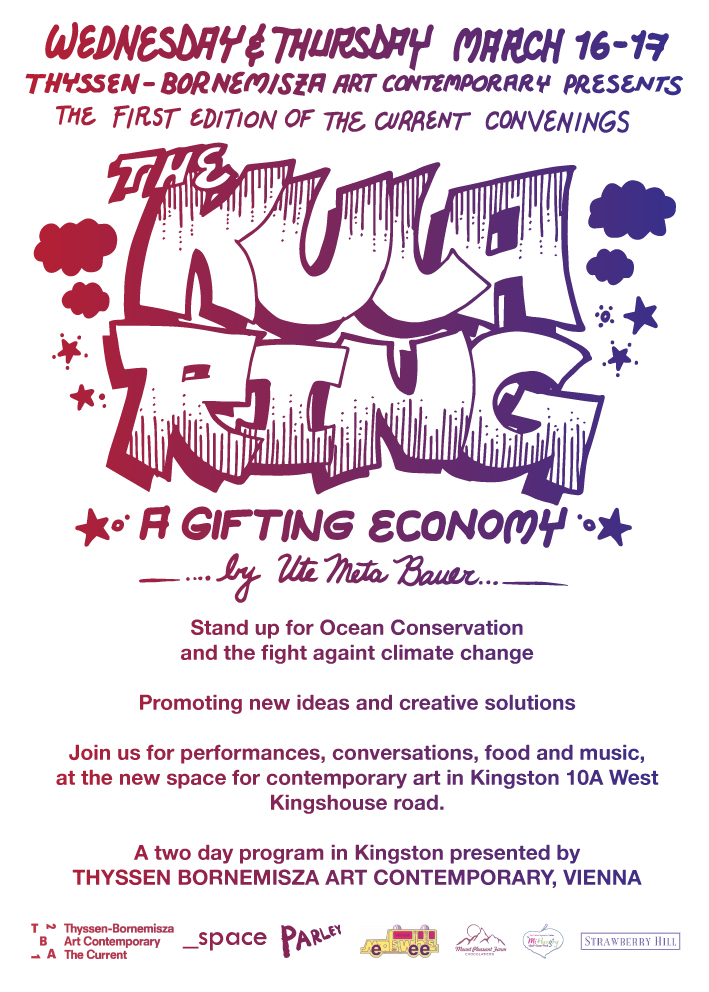
The week of March 13, 2016 is a momentous one for visual art and oceanographic research  in Kingston, Jamaica. March 16-17 will see the unfolding of the first convening of TBA21’s The Current, an ambitious cross-disciplinary venture marrying art and science in the service of ocean conservation.

The Current project and its ambit are described succinctly on TBA21’s website:

The ocean and its coastal communities provides a singular arena in which sociopolitical, economic, and environmental factors converge with the spirit of exploration. The Current seeks to redefine the culture of exploration, exchange of ideas and discovery in the 21st century.
Organized in three-year cycles, The Current is a multiphase fellowship program that gives artists, curators, scientists, marine biologists, anthropologists, and other cultural producers a platform to cultivate interdisciplinary thought and transfer of knowledge. Embracing the notion of the journey as a goal in itself, participants in The Current will join an annual expedition on the research vessel Dardanella. Avoiding the structures of conventional conferences, think tanks, and residencies, The Current reimagines knowledge production and the methods through which we present, understand, and exchange ideas.

The first voyage of this mission, headed by  distinguished curator, art educator and thinker Ute Meta Bauer (see my profile of Ute later in this post), having taken place already, Bauer and her team are in Kingston to share their experiences and ‘soundings’ with local audiences on March 16 and 17. After that, activities shift to Port Antonio where Francesca von Habsburg, patron of TBA21, is inaugurating her fish sanctuary at Alligator Head, the Thyssen estate where she spent many summers swimming and exploring the reefs. Her concern at experiencing the deterioration of the coast and reef in Portland between her happy childhood days and the present, instigated her to launch the far-reaching Current programme of research. It seems only appropriate therefore that the first Current convening should take place in Jamaica. The site of the convening is _Space Jamaica, Rachael Barrett’s equally ambitious Museum of Contemporary Art (10a West Kings House Road), a work in progress, but which people have a chance to acquaint themselves with this week. For a full programme of activities click here; for a schedule of the two days in Kingston see below:

TBA21 The Current Convening: The Kula Ring, a Gifting Economy at _space, 10A West Kings House Road, Kingston, Jamaica: March 16 – 17, 2016

Announcement of the East Portland Fish Sanctuary and Inauguration of the Alligator Head Foundation Headquarters and the East Portland Sanctuary Information Center in Turtle Cove, Portland: March 18 – 20, 2016

The inaugural Convening of the TBA21 The Current introduces and discusses what has been discovered on an expedition to the Pacific archipelagos with the research vessel Dardanella. Titled The Kula Ring, a Gifting Economy, the Convening in Kingston follows a ten-day journey to the remote littoral of Milne Bay Province in Papua New Guinea. The Convening engages various formats of translocal exchange in the spirit of the kula including visual and sonic presentations, newly developed performances, film screenings (of existing films as well as new footage), structured conversations with invited experts, educational workshops, and “Thematic Tables” between presentations that allow smaller groups of shared interests to convene in a more intimate discussion setting. The experience of forming a collective body and exchanging knowledge is key not only for the expedition itself but also for these gatherings. The Current’s organizers, expedition leader, and fellows will be joined by a diverse group of environmentalists, oceanographers, artists, scholars, and activists from Jamaica and abroad. The Convening at _space will connect what has been discovered and experienced in the Southern Pacific to issues that are shared with Jamaica and other Caribbean nations.

The first day of the Convening will focus on fieldtrips, workshops, performative events, and presentations of materials, introducing creative practices as knowledge production in its own right. On the second day, formats will shift towards lectures, performances, screenings, roundtables and “Thematic Tables” that invite the audience to become active participants. Narrator Amina Blackwood Meeks, custodian of the oral tradition and performer, will introduce participants and speakers as a protagonist / persona in this Convening, and there will be interventions by the Brooklyn Jumbies. The evening will close with a live exchange of artistic and sonic material that will take place in the format of a concert/performance.

03/16 Wednesday

2:00 PM Public Workshop: Flying Fish Kites meet Robotics TBA21
The Current Fellow Tue Greenfort, Artist, Denmark; Marvin G. Hall, Educator, TED Fellow and Founder of Halls of Learning, Jamaica/USA; Julia Moritz, Education Curator, Switzerland

This workshop seeks to experiment with the practical and visionary idea to research local fish species and make them fly – by way of the kite, bridging global and local traditions and technologies of kite building. It will be a collaborative process that offers a playful introduction to Engineering and Computer Science. In a following conversation, we will discuss how creative and playful learning can be a tool to share knowledge and inculcate environmental awareness.

4:00 PM Recycling and Revitalizing for Ocean Conservation
Presentation: Ocean Plastic
Cyrill Gutsch
, Founder of Parley for the Oceans, USA

Cyrill Gutsch is presenting the Parley A.I.R Strategy – a formula that can end ocean plastic pollution. Plastic is a design failure. Once produced, it never dies but keeps poisoning our planet. We can only end its crusade by inventing new materials. In the meantime we save marine wildlife by cleaning up coastal regions, dragging plastic debris out of the sea and cutting into the production of new, virgin plastic by making recycling material a mega trend and working on closed-loop systems.

5:00 PM Presentation and Conversations: Agents of Change, Part 1

Clouds, Orta Water and Antarctica Lucy Orta, Professor and UAL Chair of Art in the Environment, University of the Arts London and artist, France/UK

This presentation introduces three ongoing projects by Studio Orta – Clouds, Orta Water and Antartica – that intersect issues of water paucity and pollution, climate change and its effects on migration.

Interfaces

Oskar Mestavhat, physician, artist, environmentalist, Brazil

The artwork Interfaces marks a transitory moment in Oskar Metsavaht’s life. Conceived during an artistic residency at Inhotim, it allowed him for the very first time to combine his different perspectives – or interfaces – of being a physician, designer and artist, and to live up to their full potential. Interfaces I – man//art//nature thus carries this new awareness. In his talk, he proposes a reflection about this “imaginary layer” aiming at defying the boundaries between the human body and nature.

Conversation
Lucy Orta
and Oskar Mestavhat

This conversation will introduce creative engagement addressing urgent questions that touch on the changing condition of our environment.

7:00 PM Opening Ceremony

Francesca von Habsburg, TBA21, Chairperson and Founder, Jamaica/Austria; Rachael Barrett, _space, Founding Chair, Jamaica

Talking Materials with TBA21 The Current Fellows Laura Anderson Barbata, artist, Mexico/USA; Armin Linke, filmmaker, artist, and professor at HfG Karlsruhe, Germany and TBA21 The Current Expedition Leader Ute Meta Bauer, Founding Director, NTU Centre for Contemporary Art Singapore, Germany/Singapore

The Kula Ring – Collective Body and Knowledge Exchange Lorena Garcia Castro and Lena Rossbach, graduate students, HfG Karlsruhe, Germany

A presentation of 60 photographs that are part of a collective visual database accumulated by the TBA21 The Current Expedition Leader and Fellows during their ten-day expedition to Milne Bay Province in Papua New Guinea from September 30 – October 9, 2015.

Kula Exchanges
TBA21 The Current Fellow Newell Harry, artist, Australia

Through an examination of the tradition of the kula and its modes of exchange and circulation, Harry’s installation of selected materials that he collected during his visits to Pacific Islands questions the way materials and objects accrue economic and social value and significance in the Pacific, and against the wider sphere of global trade.

From the (Kula) Ring to the Belt (& Road)
TBA21 The Current Fellow Jegan Vincent de Paul, architect and artist, NTU PhD candidate, Canada/Singapore

The presented books are part of a collection of materials and ongoing research that Jegan Vincent de Paul has undertaken to examine (un)official perspectives on Chinese State-led infrastructure construction across the Indian Ocean littoral, attempting to reveal the political fallouts of the routes and its general social, cultural and economic effects in a society.

8:00 PM Performance: What-Lives-Beneath
TBA21 The Current Fellow Laura Anderson Barbata, artist, Mexico/USA; The Brooklyn Jumbies, Trinidad and Tobago/Barbados/USA; Chris Walker, choreographer, Jamaica/USA; Dancers from the National Dance Theatre Company of Jamaica; Ewan Simpson & NDTC Music, Jamaica; Amina Blackwood Meeks, custodian of the oral tradition and performer, Jamaica

What-Lives-Beneath is an original cross-disciplinary performance, combining dance, spoken word, stilt dancing, costuming and music. Based on first-hand experiences, research and ancient wisdom, it charts the physical and emotional relationship maintained with the ocean and the urgent need for collective transformation. The Moving Mas works created by Laura Anderson Barbata in collaboration with Chris Walker incorporate traditional handcrafts from Papua New Guinea collected during the expedition and other recycled materials.

9:00 PM Conversation: Agents of Change, Part II
TBA21 The Current Fellow Tue Greenfort, artist, Denmark; Cyrill Gutsch, Founder of Parley for the Oceans, USA; Francesca von Habsburg, TBA21, Chairperson and founder, Jamaica/Austria; Justine Henzell, producer and director, daughter of Perry Henzell, Jamaica;  Oskar Mestavhat, physician, artist, environmentalist, Brazil;  Lucy Orta, Professor and UAL Chair of Art in the Environment, University of the Arts London and artist, France/UK; Moderated by Markus Reymann, Director, TBA21 The Current, Germany/USA; This conversation discusses artistic and creative practices in support of environmental awareness.

10:00 PM Film Screening: The Harder They Come
Director Perry Henzell, 1972, 120 min, Jamaica

“Possibly the most influential of Jamaican films and one of the most important films from the Caribbean,” the film starring reggae singer Jimmy Cliff is famous for its reggae soundtrack that is said to have “brought reggae to the world.”

Q & A: Justine Henzell, producer and director, daughter of Perry Henzell, Jamaica


03/17 Thursday

Narrator Amina Blackwood Meeks, custodian of the oral tradition and performer, will guide throughout the day.

10:00 AM Lecture and Film Screening: The Current, an Energy field, an Ocean Phenomenon, and a Sense of Now, Markus Reymann, Director of TBA21 Academy and TBA21 The Current, Germany/USA

The Current is the exploratory soul of TBA21. Imagined and implemented by Francesca von Habsburg and Markus Reymann, it is a ground-breaking new program that takes artists and other cultural producers, architects, scientists, philosophers, and environmentalists into the South Pacific. Based on the research vessel Dardanella, The Current is the offspring of TBA21 Academy. In his talk, Markus Reymann addresses the results of the first two expeditions and proposes an outlook on how the art world and the cultural sector in alliance with science can creatively engage with today’s most pressing issues of climate change to conceive imaginative solutions.

11:00 AM Screening and Lecture Performance: Anthropocene Observatory Project
and Deep Time
TBA21 The Current Fellow Armin Linke, filmmaker, artist, and professor at HfG Karlsruhe, Germany

Excerpts from the Anthropocene Observatory Project, a collaboration by Armin Linke with John Palmesino and Ann-Sofi Rönnskog (Territorial Agency) and Anselm Franke (Haus der Kulturen der Welt, Berlin). The Anthropocene Observatory depicts the work of international agencies, organizations and scientific researchers in a series of short films, interviews and documentary materials.

Unpublished footage of a research project titled Deep Time by Armin Linke
discusses the thesis of the Anthropocene as the epoch defined by the actions of humans.

12:00 PM Presentations

The Ocean—Flywheel of Global Change
Patrick Heimbach
, oceanographer, Visiting Associate Professor, Department of Earth, Atmospheric and Planetary Sciences (EAPS), Massachusetts Institute of Technology (MIT) and Associate Professor, the University of Texas, Austin, USA

The animated visuals that were collected through various satellites underscores the global connectedness of the coupled climate system at large, and the far-reaching effect that regional changes can have. In the same way that polar ice sheet melt influences tropical communities living near the coast, changes to the tropical atmosphere-ocean circulation will impact polar climate. As we convene to witness changes to the local environment, we will do so against the backdrop of global changes.

Ring of Fire: Ecocide and Environmental Self-determination in West Papua
Nabil Ahmed
, researcher and lecturer, Sir John Cass Faculty of Art, Architecture and Design (The Cass), London Metropolitan University, UK

Investigating the intersection of contemporary eco-politics, art and architecture at multiple scales and in the making of new legal and political forums, this presentation explores an ongoing geopolitical investigation of ecocide and environmental self-determination in West Papua, a militarized territory on the northeaster eastern edge on the Ring of Fire.

1:30 PM Thematic Tables

The audience is invited to join the presenters in smaller, intimate groups for discussions. Topics include “Our ocean’s now – Our ocean’s future?”, “Agents of change – responsible philanthropy”, “Vernacular knowledge and material archives”, “Collective body and transcultural exchange”, “What is this – the epoch of the Anthropocene?” and “Undoing education / learning by doing”.

3:00 PM Conversation: The Kula Ring, a Gifting Economy
Annie Paul
, writer and critic, Head of Publication section, Sir Arthur Lewis Institute of Social and Economic Studies, University of the West Indies, Jamaica; TBA21 The Current Expedition Leader Ute Meta Bauer, Founding Director, NTU Centre for Contemporary Art Singapore, Germany/Singapore; TBA21 The Current Fellow Laura Anderson Barbata, artist, Mexico/USA. Moderated by Filipa Ramos, art writer and Editor-in-Chief, art-agenda, UK

This conversation will discuss if a collective experience of a very particular locale is translatable to another locale, and how can one create a field of resonance that serves as a feedback loop? What kind of knowledge is produced under such particular circumstances like an expedition and how can this knowledge be made productive and be exchanged within a wider group? What is required to establish a community of shared interests across cultures and local specificities?

4:00 PM From Ska to Rocksteady
A sonic presentation by Mika Vainio, experimental electronic musician, Finland/Norway

4:30 PM Sound Clash Part I: ‘Slackness’ Versus ‘Culture’ in the Dancehall
Carolyn Cooper, Professor of Literary and Cultural Studies, University of the West Indies, Jamaica

Jamaican dancehall culture celebrates the dance as a mode of theatrical self-disclosure in which the body speaks eloquently of its capacity to endure and transcend material deprivation.  Furthermore, the politics of the dancehall is decidedly gendered:  it is the body of the woman that is invested with absolute authority as men pay homage to the female principle.

5:00 PM Conversation: Spatializing Reggae – Sonic Exchanges

Carolyn Cooper, Cat Coore, Annie Paul, Mutabaruka and Mika Vainio, Moderated by Ute Meta Bauer

11:00 PM Sonic Exchanges Part II
Performances by Cat Coore and Mutabaruka, Kingston, Jamaica; Mika Vainio, experimental electronic musician, Finland/Norway

1:00 AM From Townhall to Dancehall: Visit to Music sites in Kingston

And here is my profile of Ute Meta Bauer, whom I have known since 2000 and last met in person in 2002 at Documenta11’s platform in St Lucia. Over the years we have kept in touch; it is a great pleasure to collaborate with her 14 years later on this convening. Please come out in your numbers, you won’t be disappointed.

UTE META BAUER: The Force behind the Scenes

UTE META BAUER is not a household name and likely never will be. Although the stage is a passion for her you will never see her on a red carpet in the glare of a zillion flashlights or hotfooting it from an army of fans; no paparazzi will ever hunt her through the tunnels of Paris or anywhere else.

Why should we be interested in her then you ask? Simple. Alongside the celebrity culture and money-driven economies we occupy in this neoliberal epoch, there are social economies at work, trying to imagine and realize more creative and equitable systems of co-existence. Can art have social functions beyond being storehouses of monetized value tailor-made for buying and selling? What role can/should artists play in the design of more humane, less number-driven societies? How can we institute the ability to explore, to experiment and to improvise, to work and think in unconventional ways? How can we engineer an automatically innovative, self-reinventing social system? Such questions have animated the work of Ute Meta Bauer over the arc of her career inciting her to operate at the frontiers of research into new thinking about art, art education and performance.

Thus subjects like cultural, social and media theory, gender, cultural and critical postcolonial studies, curatorial studies and methods of presentation, cultural policy, the study of transcultural and, popular-cultural issues have all been grist for Ute’s mill. Her unconventional but productive approach to knowledge and knowledge-building has attracted the attention of institutions at the forefront of education in art and technology and her curatorial practice has encompassed a wide range from contemporary art, film, video to sound installations.

After trying to shake things up at the Academy of Fine Arts in Vienna, Austria, as a Professor of Theory and Practice of Contemporary Art (1996-2006) Ute went to the Massachusetts Institute of Technology (MIT) where she was director of the Visual Arts Program for several years and Founding Director of the Program in Art, Culture and Technology (ACT). In both places Bauer tried to revolutionize the curricula, arguing for more interdisciplinarity, transdisciplinary research, and occasionally even an anti-disciplinary programme of studies.

“Why not regard students as competent partners capable of cooperating and being actively involved in the design of their learning environment?” she asks. In her own student days in Hamburg, Germany, Ute, along with other students, had formed a group devoted to extracting and moulding the kind of educational structures they wanted and needed from the programmes of study they were offered.

“We developed projects — exhibitions, events, performances — and made videos. We set our own context. We saw professors as resources, more as coaches, not people we waited on for instruction. When I became a professor at the Academy of Fine Arts Vienna in 1996, I was stunned by the antiquated notion of the Master Schools, and that the “professor as master” model was still in place. I was then the only female professor, since Erika Billeter, a predecessor, had left. The last female professor before her led the textiles class during World War II. To enter into a context is to understand its mechanisms and the inherent power relations it operates under. Changing structures requires changing politics, which has been critical to my approach.”

Inevitably Ute’s determination to change the politics of art and the structures within which it operates, has brought her into the ambit of art professionals such as the highly acclaimed Okwui Enwezor, another curator with similar ambitions. In 2002 she became part of Enwezor’s Documenta11 curatorial team, widely acknowledged to be the most paradigm-shifting of any Documenta in the weighty exhibition’s 60 year old history. Curating the 3rd Berlin Biennale for contemporary art in 2004 and several other ground-breaking exhibitions, since 2013 Bauer has been the Founding Director of the NTU Centre for Contemporary Art Singapore, a national research centre of the Nanyang Technological University (NTU). Her mandate is to merge various streams of programmes into a cross-disciplinary platform. Just a little after two years into the operation they are well on their way.


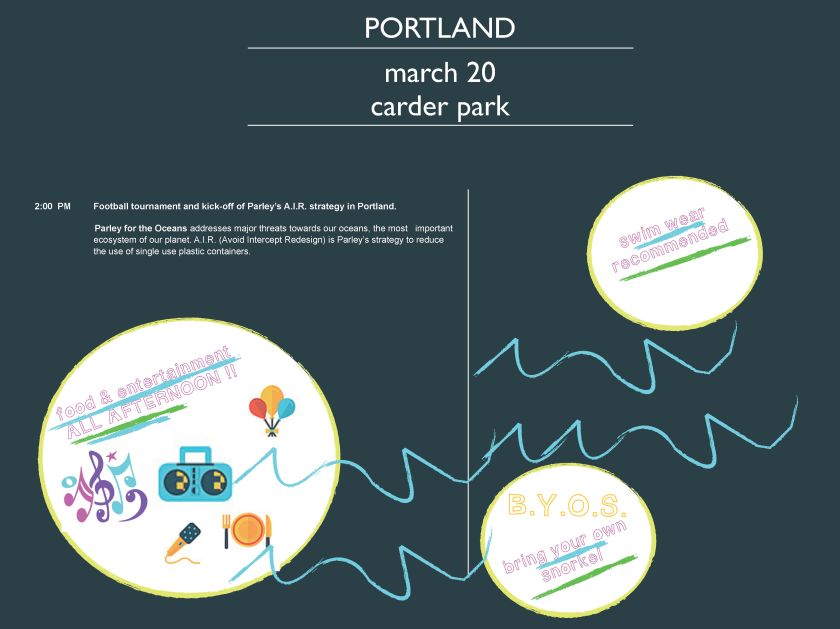
For the Portland section of the programme see below:

TBA - gen invite logo  copy_Page_08TBA - gen invite logo  copy_Page_06

TBA - gen invite logo  copy_Page_07


The programme also includes exciting performances and musical events:

TBA - gen invite logo  copy_Page_09

TBA - gen invite logo  copy_Page_10


Minshall’s Dying Swan: A Creole Requiem or what?

A facebook discussion of Minshall’s Dying Swan at Trinidad Carnival 2016 with beautiful photographs and videos.

20160128_kings_queens_659

It’s that time of year when our Trini friends are gearing up for their annual national catharsis — carnival. Each year we follow their goings on remotely, deluged with the latest road marches, Soca and Chutney Monarch competitions, exciting costumes and panyard play from Trinidad and Tobago.

This year a poignant image started to appear on Facebook of a long, spidery daddy longlegs in white, the most delicately grotesque ballerino you’ve ever seen, dancing unlike any traditional moko jumbie (stiltwalker) to the haunting strains of The Dying Swan.

Titled “Ras Nijinksky as Anna Pavlova in ‘The Dying Swan'” the performance heralded the return of Mas man Peter Minshall after a few years of self-imposed exile from Trinidad carnival. Jhawhan Thomas’s rendition of the swan was powerful and eloquent i thought especially with all the inversions and subversions trailing behind it. Europe, Africa, male, female, traditional mas vs beads and bikinis — so many collisions were choreographed into this creation it was thrilling.

Imagine how i felt then to read Monique Roffey’s rather deflating Facebook update, above a post of the original Dying Swan:

ok Trinis, why is a dying swan at all relevant to Caribbean society? Why all the fuss?

Anna Pavlova (1881-1931) in her signature ballet, The Dying Swan, choreographed by Mikhail Fokine in 1905.

What? was she nuts? Couldn’t she SEE how brilliant Minshall’s intervention was? It’s Creolité personified! Roffey’s question led to one of those spirited Facebook discussions one participates in from time to time that capture the heat and light of the moment. Apparently it wasn’t the only one. The St Lucian poet Vladimir Lucien expressed a view remarkably similar to Roffey’s that generated a whole other thread on his timeline.

idk what to make of da swan nuh, unless daz Minshall Ole Mas on d economy.

I’m always loathe to let such ephemeral conversations disappear into Cyberia. I have no access to Lucien’s but I reproduce a lightly edited version of the discussion on Roffey’s page here with her permission. Interspersed throughout this post are videos of Minshall’s Dying Swan, one by Makeda Thomas of Jhawhan in rehearsal along with a beautiful set of photographs by Maria Nunes.

ok Trinis, why is a dying swan at all relevant to Caribbean society? Why all the fuss?

Loretta Collins Klobah Nicholas Laughlin gave a cogent, well -written answer to that question on a FB discussion yesterday. It could have been a good editorial for the Guardian…

Monique Roffey didnt see it. Whose page?

Loretta Collins Klobah VL

Monique Roffey ha

Nicola Cross It’s absolutely stunning. The movement the fact it’s even in the “carnival” bacchanal.

Edward Bowen several layers to “the fuss” – firstly the unexpected return of Minsh, secondly, with the usual “difference” of content and presentation, often quite startling, thirdly the obvious androgyny, and fourthly, that collection and more of content = drama, abstracted, left field, story telling, theatre – our society allows him that stage, his mas, perhaps we need the stories, more stories. Thing is though, stories going on all the time, but our media not geared to diversification of their own lenses, so we do not see this creativity going on all year round, all over the country, in many divergent forms, so the Carnival stage is a brief opportunity for a kind of maximum impact scenario, or “play”, and Minsh is one of the Masters. So, we expect him to come with something to stop you in your tracks, we expect, want, need, that difference .

Nicola Cross I’m smelling people’s choice.

20160128_kings_queens_768

James Christopher Aboud Minshall is an adapter, and the fact that the stilts fail to capture the graceful movement of Pavlova is not the point, although I noticed that at once. He made a connection with something other than ourselves, which is what the mas is supposed to do, and, by that adaptation, made it ours. Pavlova in drag is the original thought here, shocking the ballet purists and entering our transgender debate. I only wish that there was more movement. The length of the stilts make movement precarious. He went for impact more than movement it seems.

Annie Paul maybe it’s his own swan song? Minshall’s that is? would love to read Nicholas Laughlin‘s comments…

Abigail Hadeed Well if this is not Minsh at his best, when last was such discourse come to the mas! Hallelujah… Annie check Vladimir Lucien page.. Nick responds to V and Christian Campbell

Annie Paul Alas Vladimir Lucien ‘unfriended’ me some time back so I can’t but i’ll just ask Nicholas

Annie Paul Should Caribbean societies only portray things that others deem ‘relevant’ to them? The very reaction this performance has received is a sign that its hit a chord with people? though clearly not with you Monique

Gaiven Klavon Clairmont I agree with a few of the comments above, in that it was very refreshing to see the swan, and the beauty of art is that it doesn’t have to be limited to one’s own regional influences. We can interpret aspects from around the world and mould it into our own culture. So I absolutely loved this.

Judy Raymond Did you see the others? I haven’t yet this year, but they are almost always a variation on a fancy Indian or a giant clamshell-shaped thing on wheels that the masquerader drags along around/behind him- or herself. Occasionally there are special effects with lights/darkness/music.

Minsh draws on traditions from all over the world–because they’re all ours too–just as he drew on the work of Alexander Calder to produce his human mobiles–and especially stands on the shoulders of mas giants to produce something that is new–a moko jumbie combined with European ballet. And yes, as Eddie says it’s real theatre, and it included androgyny in a reference to one of the issues that this society is only now beginning to address. He doesn’t overestimate the value of originality but no one else understands how to combine the basic mechanical principles and characters of the mas into a new work of art that says something about the world and especially our corner of it now.

Abigail Hadeed I though this was the whole premise and history of our carnival appropriating / mimicing – The aristocrat / plantocract … Negue Jadin …. the free coloured / emancipated slaves mimicing the aristrocat – Dame Lorraine etc??? not a speller not an interlectual, but i recognise when something is soulful and appreciate it for what it is… the bonus is we get to enjoy and celebrate Minsh and he brings dialogue to a very mediocre dead boring beads and feathers mas

Edward Bowen de man wukin’!

20160128_kings_queens_637

Nicholas Laughlin Since Annie asks, here’s the relevant bit of a (long but hardly exhaustive) note I dashed off last night in response to a similar “why all the fuss” question. Also interesting to read your various notes above.

Having seen the components of the costume coming together backstage at the Savannah last night, having felt some doubts, then having seen the actual performance, I find it’s stuck in my head and I’ve been thinking about it all day. I can’t escape the sense that The Dying Swan is Minshall’s meditation on the place — aesthetic, intellectual, emotional — he finds himself in at nearly the end of his career as an artist.

The ballet that inspired the maswork is about the inevitability of death (the title gives that away, right?). It’s a classic Minshall move to have taken this exemplary work of European “high” culture and translated it via two traditional Carnival characters, the moko jumbie and the Dame Lorraine. And through a minimalist but rigorously considered form, a deceptively simple performance by the masquerader, a touch of self-awareness and self-parody (it’s a burly dude in drag, after all), to have made something that his audience can plainly delight in, while feeling the little emotional quiver of recognition that this is an artist’s elegy for his art.

As for brilliance on its own terms, though The Dying Swan isn’t technically innovative (Minshall did a moko jumbie king and queen as far back as 1988, and it’s now standard in the repertoire), and certainly not epoch-defining like Man Crab, I think it achieves the simple but not-so-simple thing that Minshall’s works have long argued is the meaning of mas: to give the performer the means to express an energy, an emotion, an idea beyond what the body alone can do.

In this case, I’d say, it starts in the gorgeous elongation of the masquerader’s limbs and thus the bird-like delicacy of his steps. It’s also remarkable to me how the generally male energy of the moko jumbie is subverted here without sacrificing presence or scale. And I am obviously no Carnival judge, but the scoring system ought to reward those kings and queens that can move entirely through the muscles and energy of their masqueraders, i.e. with NO WHEELS. There are so many massive kings and queens built like small houses — all the masqueraders can do is drag them into position before the judges and try to wiggle. The costumes that can actually pick up and move — and there were several last night, including the moko jumbie queen and king from Touch D’ Sky, and a couple of joyful fancy sailors — give the audience a really basic, straightforward pleasure by communicating the masqueraders’ energy.

For the record, I also really enjoyed the king who was a giant pot of callaloo topped by a magnificent blue crab, all made from papier-mâché. Even if it was on wheels.

Abigail Hadeed Nick, thank you for this…

Elspeth Duncan It’s the only thing i’ve seen of 2016 Carnival and I don’t need to see any more to know that none of the cliche beads, feathers and clam-shapes (as Judy called them) can come close to this.

Edward Bowen “clam shapes”, being dragged, bead and fedder and sekwin!

Monique Roffey Gosh, I left that question open and went to yoga to find this thread. Thanks Nicholas Laughlin for your thoughts, as yes there is something of a swan song that may be very personal to Minshall. Many of you have touched on my reactions to it. 1) drag is in no way new or original to the mas, 2) the stilts weren’t too graceful. 3) I liked the ‘burly dude’ drag element but he wasn’t too graceful up there, and, while I love that any designer can reach beyond our shores for inspiration, I did wonder what de ass, why this, why the dying swan? I agree Edward Bowen he’s a theatrical master/genius, but like Nicholas Laughlin, this swan ain’t epoch defining, like Man Crab. It felt odd to me to see this swan and then for all the fuss. I didn’t NOT like it Annie Paul, more like, hmmm, if Minshal were to put out a dying elf, Jedi knight, imp or one of Snow Whites dying dwarfs, would we all applaud and say what genius he is?

20160128_kings_queens_904

Edward Bowen this cultural “field” we have here is a mishmash of 500 years of continuous imports, it’s as if we apologize or attack this premise, which is still the case – it is about appropriation of whatever influence comes into that field of relavances, which is not fixed to any specific iconography or lines of thought – deal with it, deny it, it is a matter of artistic choice and thankfully that is being taken

Gin Awai The answer is yes. Minsh does ballet and the crowds ooooo and aaaaa. Next year it’ll be Minsh does Broadway on stilts. Traditional costumes aka costumes with wheels are built that way for stability to survive the roads of not only this Carnival but the other Carnivals around the world – Caribana, NY etc.

Can’t see our dying Swan lasting one concrete Ariapita Ave block.

Gin Awai Also, this is how Kings of Carnival make money to support future costumes and build the Carnival Industry through the denizens of hands that went into creating said traditional “forgettable” costume. Minsh clearly doesn’t need the prize winning money to continue producing his “art”.

Nicholas Laughlin I’m gonna disagree with you on the question of roadability, having scrutinised the costume components backstage with a very enquiring eye. Whatever seems delicate about the Swan is an optical illusion–it’s very solidly engineered. The legs are as sturdy as any moko jumbie’s, and everything is relatively lightweight and carefully balanced. In fact, it’s a king better suited to the vicissitudes of the road than the house-size behemoths designed to go the length of the Savannah stage and not much further–getting those on the road requires teams of handlers and traffic-directors. Scale is always impressive, but so is agility, and it’s interesting how the audience in the stands responds so enthusiastically to smaller costumes that can actually move without back-breaking effort.

Gin Awai Definitely looking forward to seeing Jha-Whan on the road. I hope he has insurance.

Audiences respond to drama which you described beautifully – the performance is breathtaking drama come to life. Still don’t think it’s a good Carnival King.

The theatrics don’t translate without the Minshall story. Seems more apt for Cirque du Soleil than first place. Interested to see what more drama would be created in the finals.

I predict more glitter and a blackened bird.

Nicholas Laughlin Interestingly, there was also a black swan queen from another band–I didn’t catch the title of the costume, and I can’t make out whether it got to the finals. She had a skirt of waterlilies and a kind of arbour of leafy branches.

Colin Robinson Carnival kings and queens have long portrayed mythical, “classical” themes and ones from foreign folklore. Apart from a heaping dose of Minshall nostalgia, the sheer imagination of the white costume compared to the yawning colourfulness and reductive representation of all the others is what the fuss is about. And at least half the fascination is about a king of carnival looking like a queen. Carnival costumes have lost imaginativeness in their mechanics as well, growing to the width of the stage and the weight a muscular man can drag. So Minshall pushing the one real area in which there has been mechanical imagination—the mokojumbie—even further with a simple shoe is what the fuss is about. These are a third of the costumes in the finals this year, and their Caribbean relevance: Artemisia, Medusa, Yacahuna, the Aztec Menace, Gloriana (Elizabeth I), Quecha, Demonato, Howakan, Elfurdrakos. But maybe we should be getting excitedabout bois in Moruga, wood instead of drag LOL


Jenifer Smith The plain was grassy, wild and bare,
Wide, wild, and open to the air,
Which had built up everywhere
An under-roof of doleful gray.
With an inner voice the river ran,
Adown it floated a dying swan,
And loudly did lament.
It was the middle of the day.
Ever the weary wind went on,
And took the reed-tops as it went.
Some blue peaks in the distance rose,
And white against the cold-white sky,
Shone out their crowning snows.
One willow over the water wept,
And shook the wave as the wind did sigh;
Above in the wind was the swallow,
Chasing itself at its own wild will,
And far thro’ the marish green and still
The tangled water-courses slept,
Shot over with purple, and green, and yellow.
The wild swan’s death-hymn took the soul
Of that waste place with joy
Hidden in sorrow: at first to the ear
The warble was low, and full and clear;
And floating about the under-sky,
Prevailing in weakness, the coronach stole
Sometimes afar, and sometimes anear;
But anon her awful jubilant voice,
With a music strange and manifold,
Flow’d forth on a carol free and bold;
As when a mighty people rejoice
With shawms, and with cymbals, and harps of gold,
And the tumult of their acclaim is roll’d
Thro’ the open gates of the city afar,
To the shepherd who watcheth the evening star.
And the creeping mosses and clambering weeds,
And the willow-branches hoar and dank,
And the wavy swell of the soughing reeds,
And the wave-worn horns of the echoing bank,
And the silvery marish-flowers that throng
The desolate creeks and pools among,
Were flooded over with eddying song.

Monique Roffey Colin Robinson thanks for this reply, but it has only backed up my querie, as you say, this isn’t too new. A long history of classical heroes in the mas, also a long history of dragging up. Aesthetically, it didn’t do it for me.

Colin Robinson Gotcha. But for all the limitations cited, it’s a huge breath of fresh air in the staleness of that competition.

Jenifer Smith I haven’t seen it for real yet but surely the dying swan could also be a metaphor for our failing society? city? innocence? ….and not just about Minshall’s reflection on his own mortality

Monique Roffey yes, this I really agree with Jenifer Smith.

Judy Raymond Yes, it’s about more than Minsh

Monique Roffey might be worth stating I’m a big fan of Minsh. Just not so crazy about this.

Colin Robinson Had a WTFyoumean response to Monique’s question and posted, and only now reading and enjoying the more grounded comments. I’m no ballet connaisseur but, contrary to others, I thought Jhawhan‘s mokojumbie movements did quite gracefully conjure the ballerina’s is it called bourrée?

Judy Raymond A kind of crude “drag”/androgyny as we’re calling it on this thread (not right word/s in this context) goes back centuries in the mas and is reflected in this mas: we’re not meant to be deceived into thinking the character is being played by a woman. Hence “Ras Nijinsky” and the less than perfectly graceful, “feminine” movement.

But has there ever been a cross-dressed king or queen before?

And it’s perhaps especially significant now in an age of hypersexualised pretty mas when women especially have to have perfect bodies: genitals barely covered, not an ounce of fat, exaggerated nails/hair/makeup/spray tan/glitter/lashes way out there/stiletto boots on the road etc etc (men can get away with ripped bodies & six-packs).

20160128_kings_queens_538

Nicholas Laughlin Only belatedly it occurred to me that there might be a sly reference here too to the pisse-en-lit, another traditional “drag” mas in which men portray women to deliberately evoke disgust and disdain–and which may have a fresh relevance at a moment when gender and sexual identity and expression are being vigorously debated and (re)contested.

Sharon Maas There was something eerie, haunting about it, but the arm movements didn’t synch at all — very ungraceful. but maybe that was deliberate?

Martina Laird Towering and proud, beautiful and grotesque, tragic and comic. Sexuality explicit and concealed. An amazing drag statement of ownership made on the very mainstream stage of the Savannah. Such challenge being very much the spirit of Carnival. Not to mention the parody of Eurocentric high culture in Trinidadian context

Jason Jones It is a genius piece of performance art and politics. A LIVE BANKSY! Utter BRILLIANCE. How it only got 4th place is disgraceful considering the masqueraders bravura performance!

Gab Souldeya Hosein Minsh says it best…this is not a costume, this is a mas. It’s not European copy, it’s something never tried with moko jumbies before…that uses the natural point of the stilts to masquerade ballet shoes…it says to every European ballet which has never done this…you ent really imagine a dancer on her toes until you see her cross a carnival stage in the body of an African moko jumbie 20 feet tall. It as African as it is European…in a way only Carnival brings together. I loving it.

Nicola Cross HAHAHA!

Nicola Cross “repurposing” i like that.

20160128_kings_queens_638

Gab Souldeya Hosein Not only that, usually with moko jumbies, the legs are hidden under pants or considered ‘wooden sticks’ underneath the costume, here they were deliberately shaped into legs! It’s the legs and ballet shoes of a dancing moko jumbie not the waving arms ‘like’ a dancer that are de heights of this mas….pun intended!!

Nicola Cross u good gurrl!

PS: And for dessert the Mas man himself, discussing The Dying Swan:

PPS: And how do you know when something has hit its mark? When it gets this kind of reaction from others in the game while the public delights. The following is from The Trinidad Guardian two days after Dying Swan placed third in the Carnival Kings category:

Acclaimed mas designer Peter Minshall’s return to Carnival after an over decade long hiatus has been marred in controversy after several veteran mas designers criticised his Carnival king costume — The Dying Swan, Ras Nijinsky in Drag as Pavlova — on Tuesday night.

The costume placed third in the King of Carnival Competition at the Queen’s Park Savannah, Port-of-Spain, where it was a clear crowd favourite.

However, after the results were announced, several veteran mas designers criticised its minimalistic design, which was in clear contrast to the more grandiose portrayals which traditionally dominate the competition.

Marcus Eustace, the designer of the competition’s eventual winner Psychedelic Nightmares, worn by his brother Ted, described Minshall’s high placing as “ridiculous.”

“Put it this way, if you call that mas, how would it look if next year everybody play moko jumbie. That is not a mas. That is why the stands are empty.

“You have people building all kinds of expensive costumes and they coming tenth and 11th, and a moko jumbie come third,” Eustace said after the results were announced early Wednesday morning.

And carnival has barely started. Such fun!

The Chris Gayle Ambush, #Racesplaining and other Sticky Wickets

Some thoughts on the Chris Gayle-McLaughlin Affair, #Racesplaining, Sledging and sexual harrassment.


Mise-en-scène

By now most of us have seen the video clip of benighted cricketing superstar Chris Gayle–who happens to be Jamaican–flirting with Aussie journalist Mel McClaughlin as she attempts to interview him during a match down under.

Chris-Gayle-of-West-Indies-acknowledges-the-crowd-21

Former West Indies’ Test captain Gayle had just hit 41 runs from 15 deliveries during the Melbourne Renegades’ Big Bash League win over the Hobart Hurricanes.

The clip that’s gone viral (top of the post) is edited down to make it look as if Gayle had refused to answer the reporter’s question about his ‘smashing innings’, deflecting it by ‘lyric-sing’ her, saying HE had wanted to interview McLaughlin as well, for a chance to look into her beautiful eyes, oh and by the way how about a drink to celebrate after the match? When her cheeks turned red at the unexpected pass, Gayle compounded his faux pas by saying “Don’t blush baby”.

I thought from viewing the clip that Gayle had countered the reporter’s question with his flirtatious comments, refusing to stick to the subject of the game or even answer questions about it. But why did it start so abruptly I kept wondering. Why did her question seem truncated? Was it possible to view the interview (such as it is) in its entirety? Shouldn’t we examine what was said immediately before and after the edited clip before deciding Gayle’s behaviour is/was beyond the pale?

It didn’t take me long to find a clip with the entire interview on it (see video immediately above) and when you look at it you find that McLaughlin had already asked a couple of questions about the game, received appropriate answers from Gayle, and that it was towards the tail end of the brief q and a that Gayle slipped in his less than stellar advance to the reporter.

Somehow this casts a different light on the whole matter for me. Gayle’s comments were clearly inappropriate and deserve criticism but the kind of vituperative condemnation and hate that’s been directed at him and the amount of outrage the matter has generated seems like overkill. Retribution has been swift and vociferous and quite disproportionate to the gravamen of the offence.

Selective outrage?

Former Australian captain Ian Chappell seemed particularly incensed, calling for “a zero-tolerance message” to be sent immediately. Here’s what he told the Guardian:

“I wouldn’t have a problem if Cricket Australia said to the clubs, ‘he’s never to be contracted again in this country’,” Chappell said in Sydney, where he participated in an Optus SMB Cricket Legends event alongside Tom Moody.

“And I also wouldn’t have a problem if Cricket Australia said to the ICC, ‘what we’re doing should be worldwide’.”

Really? Well blow me down under! Is this the same skipper who, with his brother, presided over the blatant racism of Aussie cricket in the 70s with its notorious ‘sledging’ or what has been called “the dark art of verbal abuse in sport”? Where was his no tolerance policy then?


Actually mate? Your track record doesn’t warrant the high horse you’ve chosen to ride against Gayle. Read the following description of Aussie cricketing tactics and marvel at the absurdity of sleaze warriors such as Chappell and company turning into moral scolds on the subject of Chris Gayle’s lame pass at Mel McLaughlin.

Sledging has been widespread in cricket since the early 1960s when the Aussies first coined the term. In my view sledging is an entirely legitimate part of the game. When Sri Lankan skipper Arjuna Ranatunga called for a runner during a one-day international against Australia, wicketkeeper Ian Healey quipped: ‘You don’t get a runner for being an overweight, unfit, fat cunt.’ Sexual slurs about a player’s wife are favoured weapons in the sledger’s armoury. ‘How’s your wife and my kids?’ Rod Marsh famously asked Ian Botham.

If sport is ‘war minus the shooting’, as George Orwell once described it, then sledging is the sporting equivalent of ‘psy-ops’. The objective is to force your opponent to crack under pressure – ‘mental disintegration’ as former Aussie captain Steve Waugh’s memorably described it.

Of course sledging can be turned into a fine art as well:

Then there is this episode from English county cricket that is regularly cited as the best of all time. Greg Thomas had been bowling at West Indian batsman Viv Richards, who kept playing and missing. Said Thomas: “It’s red, it’s round, it weighs about five ounces and you are supposed to hit it.” Viv Richards promptly hit the next delivery back over Thomas’ head for six, saying: “You know what it looks like man, now go and fetch it!”

Malcolm Knox #racesplains situation to Gayle

But let’s leave sledging where it belongs for now. One of the most egregious critiques of Gayle’s behaviour appeared in the Sydney Morning Herald, lobbed by sports columnist Malcolm Knox. With the casual racism of the clueless, Knox, author of a novel titled Jamaica (!), attempts  to ‘racesplain’  the intricacies of intersectionality to Gayle in atrociously articulated Jamaican Patwa:

 I didn’t take offence when you were charming ole sparkly eyes, because me didn’t have the foggiest idea what was comin’ out you mouth. Is you even speaking English? Me rasta brethren too – me spend seven days and six nights on a Qantas Holiday at Negril one time – so me jive talk better than any white man, cha! But the Universe Boss go too fast even for the I. So no offence taken!

And your newspaper columns, too. They don’t make no sense. All that in-joke gibber between you and KP, all that fun about you being the best batsmen in the world, cha, me didn’t take no bombocloth offence to that neither. But see, I’m different from your average Australian. Me understand cultural differences. Unlike dem Australians wit their BS about PC, me know where you comin’ from, brethren. Me know you got a good lovin’ heart like all we Jamaican brethren. And Mel whatshername, she’ll come around, just you wait. Any woman be flattered to be asked out for a drink by you, boss. Just wait till she understand cultural differences. I’d go weak at the knees if you noticed my sparkly eyes, Chris. Some would call them penetrating.

Finally he lumbers to the point:

 Well, boss, if you’ve taken any offence, I’m sure I’m sorry, but can’t you take a joke? What? People like you have been used as free labour and second-class citizens and downtrodden just because of an accident of birth? And you don’t like being judged as a piece of meat, some kind of mere physical specimen? You don’t like me suggesting you is uneducated? You don’t like me pretending I understand where you comin’ from when I clearly have not the slightest idea?? Me thought me flattering you, Chris. Hey mon, me only jokin’ wit you.

I’m not sure what prompted  sometime back to plaintively tweet “Is “racesplaining” a thing? If it’s not, I think it should be.”  but yes it is baby, it definitely is, check out Malcolm Knox’s column if you don’t believe me.

I wish i could recommend Knox’s novel Jamaica (in which the country appears as backdrop to the antics of a group of white tourists) but with writing like this I might be opening myself up to a lawsuit:

He finger-combed his awning of orange hair–bloom of rust, the colour of heartbreak adolescence. Outside, the day was being dragged out of the dark, its rosy claws scratching the eastern blue;.

Let’s also leave Knox where he belongs. Peter Mattessi @pmattessi it was who got it right: Still can’t get over that Malcolm Knox piece. The written  equivalent of wearing blackface and dancing while singing Island In The Sun.

On the vexed subject of Chris Gayle and his amb(l)ush tactics I agree with Dale Hughes whose article Chris Gayle and our addiction to public shaming summed up the problem neatly:

We are living in the age of the social media lynch mob, where crime and punishment is dictated via the emotions of the masses. A cricketer makes a clumsy advance on a reporter and then we are subject to an entire week’s worth of analysis. The dirt file will be dug on Gayle’s past exploits, and no doubt other exaggerated claims of inappropriate comments and behaviour will be offered in a fine cornucopia of disgust to feed the insatiable appetites of the Twitter brigade.

The public reaction around these sorts of events is not healthy. It is, to quote from Gayle himself, blown out of proportion. Accepting that the comments were misplaced and apologising is not enough. He has to be dragged through the mud, fined, sanctioned, and sacked from contributing columns in the media. He is the modern day equivalent to the witch of Salem, forced to publicly repent his sins to satisfy the public’s thirst for blood.

Sexual harassment

The problem for us in the Caribbean is not Chris Gayle and his outlook per se. It’s the casual sexism of Caribbean masculinity in general that really needs taking in hand. The reaction back home has been mixed, with female journalists and other women condemning Gayle’s flirtatious comments on the grounds that it disregarded and disrespected norms of professionalism that should have protected McLaughlin from unsolicited male advances. There is merit in this view of the matter.

On the eve of the enactment of a sexual harrassment bill in Jamaica an alarmingly high number of men here, journalists, men on the street, university lecturers and others, have chosen to ignore this view completely and insist on discussing the matter as if men have the right to flirt with women they’re attracted to whenever the urge takes them. This is problematic.

These are the same men who–were the gender dynamics shuffled so that Gayle, favouring the first three letters in his name, was a gay sportsman propositioning a male reporter–would be so outraged as to want to lynch him, leave alone sue him for sexual harrassment. Yet they feel that a woman placed in such a position should simply take it in stride by bantering back becomingly. No harm done baby! That’s not sexual harrassment, that’s a man paying you a compliment. Just lie down and take it nuh?

The following quotes from Orville Higgins’ column in one of the Jamaican papers capture opinions typical of the masculinist views I’m talking about:

Now we are hearing perfectly learned people saying that this could be classified as sexual harassment. The Gleaner carried a front-page story in which Bert Samuels, a prominent lawyer, postulated that Gayle could be accused of such if the recently tabled sexual harassment bill is passed in its present form. Really?! If complimenting a woman’s eyes and inviting her out on a one-off occasion is considered deviant sexual behaviour, much less sexual harassment, I would have been guilty of sexual harassment in the past! Several times, in fact.

No man who is pursuing a woman knows what answer he may get when he invites her out for a date. If she says no and he persists, that’s a completely different argument. But how can a first-time compliment and an invitation to a drink be seen as harassment of any kind, never mind sexual? Why do we assume, automatically, that a drink invitation and a compliment is a prelude to sex? If the law is prepared to find a find a man guilty of sexually harassing a woman for complimenting her and inviting her out the first time he does it, the law is really an ass!

Since this issue has come up, many people are juxtaposing this case with tennis player Maria Sharapova openly flirting with a male reporter at the 2014 Australian Open. She was gushing about his self-esteem, telling him how she liked his form, clearly insinuating that she was admiring him. We didn’t hear anything untoward then.

This is a double standard. One rule for women; one rule for men. Gayle has been accused of being too carefree with his bat in the past. He will now know that he also has to be less impulsive with his mouth.”

Sportscaster and talk-show host Orville Higgins contrasts Gayle’s waylaying of a female reporter with Sharapova’s ‘open flirtation’ with a male reporter on an earlier occasion arguing that the lack of censure directed at Sharapova demonstrates a double standard. Is Higgins blind to the power relations involved in the two situations that mitigate against any such simple equivalence?

If individual columnists and commentators disappoint with their half-baked responses, the Jamaica Gleaner’s editorial on the subject was pithy, on point and worth closing with :

Gayle failed to appreciate that a cricket ground is part of a sport reporter’s work environment and that civil and professional courtesy and protocol should be adhered to in such circumstances. This chauvinism, and worse, is not unfamiliar in many workplaces in Jamaica, and can give rise to advances that are unwelcome and uncomfortable.

And that is why we endorse the move to enact legislation in Jamaica to protect both men and women from sexual harassment. Already, critics inside and outside Parliament are bristling at any attempt to stifle what they believe is a subcultural norm – and that a little sweet talk is harmless.

But any allowance for primitive catcalling may eventually spiral into a toxic and asphyxiating environment for workers who perceive that resistance could trigger victimisation, whether by co-workers or bosses, threatening the opportunity for promotion or leading to job separation. Jamaica should no longer tolerate a free-for-all feel-for-all.

Attempts to trivialise workplace-harassment concerns as alarmist should be deplored. After all, would the homophobes be as assertive of the right of gays to solicit their affections on the job?”

PS: I’m grateful to Ben Etherington for arousing my interest in doing this post on cricket, a subject i rarely address 🙂 He linked me to some of the material I used such as the video on racism in the 70s and the priceless Knox article.