My Gleaner column of February 8, 2017. Reactions to it ranged from amusing to predictable to baffling.
You are the head of a self-appointed coalition to foster a ‘healthy society’ in Jamaica. You are also a medical doctor. Or you are the head of an assembly of churches, a Reverend. No, not one of those going around molesting young girls. No, no not one of those. You are dedicated to the policing of gender boundaries in Jamaica. Men are men and women are women and there shall be nothing betwixt or between.
You are duty-bound to police the borders of Jamaica against interlopers and unwanted immigrants. Why, even Donald Trump is taking a leaf out of your book! Those who ignore or show lack of respect for gender boundaries are not welcome in Jamaica. It is your solemn duty to make this clear to every citizen. You have to be particularly vigilant against the Gay Agenda, a global conspiracy involving institutions at the highest levels—the UN, the World Bank, the EU—whose goal is to destroy the world (and inter alia the Jamaican family) by legalizing gay marriage.
If, God forbid, gay marriage is legalized in Jamaica it will be the beginning of the end. For all and sundry will take up with their own gender, setting up same sex households all over the country, and soon procreation will grind to a halt. There are no examples, as yet, of this happening in countries where gay marriage has been legalized but so what? Reality is not a shackle. Keep stressing the following point. How can we have a healthy society without children?
As for feminists. They too must be kept from invading Jamaica where we like to do things in old, time-honored ways. It is a pity that slavery was officially abolished two centuries ago. What is wrong with slavery? Nothing at all. Slaves are essential to healthy families. Women are meant to cook, clean, raise children and provide sex for heads of households at no pay. Also the sex part is non-negotiable, women must deliver when the subject is broached. Shop must remain open 24/7. Think Open Access is a new sumpn?
It’s just that slavery must be gender-based. This is why it’s so important to distinguish between the sexes. There can be no ambiguity about this. Men and women who break these rules must be enslaved by our cultural rules. Either they conform to these or they leave. It is for the benefit of the nation. Our good name is at stake.
Also, it is to be noted that rape is a crime that can only be inflicted on women for Jamaican law defines sexual intercourse under the Sexual Offences Act as “penetration of the vagina of one person by the penis of another person”. Rape occurs when there is sexual intercourse without the consent of the woman. That is, for rape to happen, there has to be penetration of a vagina. By a penis. If a man buggers a boy or man that is not rape; if a man thrusts his penis into your daughter’s mouth without her consent that is not rape either; nor is penetration of one’s orifices, vaginal or not, by the forced intrusion of an object, considered rape.
This actually means that homosexual men who bugger other men or boys get away with a lesser charge of grievous sexual assault, with much milder punishment compared to rape but so what? “Anal penetration is wrong in 2017 and anal penetration will still be wrong in the year 3000.” We can’t let ourselves be fooled by such tactics. Sometimes the truth is inconvenient…but let that not stand in your way. Redefinition of rape is a Trojan horse to bring in gay marriage. The Gay Agenda must be stopped at all costs. It’s the Al Quaeda of the god-fearing world, the ISIS of virtuous, law-abiding countries such as Jamaica.
What about all those women who keep turning up murdered, you ask? Like the one in the barrel in St Thomas? Ignore them man. More than likely they were asking for it. Its just the work of feminists. That is why we have to oust them too. There is too much sensationalizing of crimes against women, the media gives them too much space. “Men die everyday . Boys are molested and sexually assaulted in every community. But what? No one cries out, protests, chastises government or prays about it. Male lives matter too.”
Hat tip to the brilliant Nigerian satirist, Elnathan John.
Correction: This teach in was on Feb 17 which was last week. No wonder the Gleaner removed the information. Mea culpa…have made the necessary adjustments to tense.
It’s time to resurrect Active Voice. My column in the Gleaner today was pruned of most of the last 2 paragraphs which talk about the planned Teach-in at UWI this Friday concerning the review of the Sexual Offences Act (#SOAReview). Since this is a very important example of the kind of citizen participation I’m talking about, I thought it important to carry the unexpurgated version on my blog.
My first visit to the United States since Donald Trump became president of the country was uneventful. New York City was bustling with activity as usual, as was the conference I attended. The College Arts Association is the largest association of art professionals in the US–including artists, art historians, critics, curators, art writers and publishers. Their annual conference attracts 4000 attendees and each of 5 time slots a day might have up to 18 concurrent panels. The mammoth conference runs for four days.
Landing at John F Kennedy airport in the afternoon there were no lines at immigration. In fact everyone had to scan their passports at kiosks, then photograph and press their fingers on screens themselves before proceeding to an actual agent who engaged minimally to retake fingerprints and photographs. Kiosks are always unnerving, even for someone as technologically literate as I am so i wondered how others with less experience were faring.
Then I was off to my airbnb room in Hell’s Kitchen, Manhattan, by public transport, the air train to–where else–Jamaica, in Queens, and then the E train which took me within a block of my accommodation. Unlike hotels, airbnb accommodation in the city might often be in 3-or 4-storied buildings without elevators so packing lightly is a must. My room turned out to be very comfortable though i never fail to be amazed at how constrained for space many New Yorkers are. I had never seen such a tiny bathroom till then. My hosts were incredibly thoughtful and pleasant which more than made up for the cramped quarters.
On the up side i was in the middle of an avenue of good restaurants, a block away from Broadway with all its glitz and glitter and a healthy walk from the Hilton where the conference was. What are conferences and why do people go to them? Those who pooh pooh them disregard the exchange of knowledge, ideas and concepts that occur at such events. The world is not a mechanical place: beneath the technology, the geopolitics and the surface of the societies we inhabit, lie webs of ideas, theories, and hypotheses.
Knowledge is a communal enterprise, not the product of individuals sitting cocooned in their castles. The cross-fertilization that occurs simply by listening to new points of view on the same subject you might be researching is invaluable. The arc of the scholarly enterprise may be long but it bends towards insight. And insight is essential in these dark times.
An unusual addition to this conference was a wall of protest for people to display posters and slogans on behalf of their cause, whatever that might be. Quite a few of them addressed the Trump presidency. Jostling a sign for the Society of Contemporary Art Historians was one saying, “Trump is the symptom, capitalism is the disease.” “Germans against walls and white nationalism” announced another. “NOT MY PRESIDENT”. “This is not normal”. “Make American kind again.”
One of my favorites just said TRUST WOMEN. On the eve of possibly having a female police commissioner for the first time, and a few weeks before March 11 when the Tambourine Army plans to mobilize women onto Kingston’s streets to protest the unremitting violence they face this is a good slogan for all of us.
The Tambourine Army is asking people to wear purple on March 11 and join the protest. “Bring your friends, your family, your colleagues, your neighbours and let’s march in solidarity as one Jamaica against sexual abuse, against rape, against all forms of sexual violence against our women and girls.”
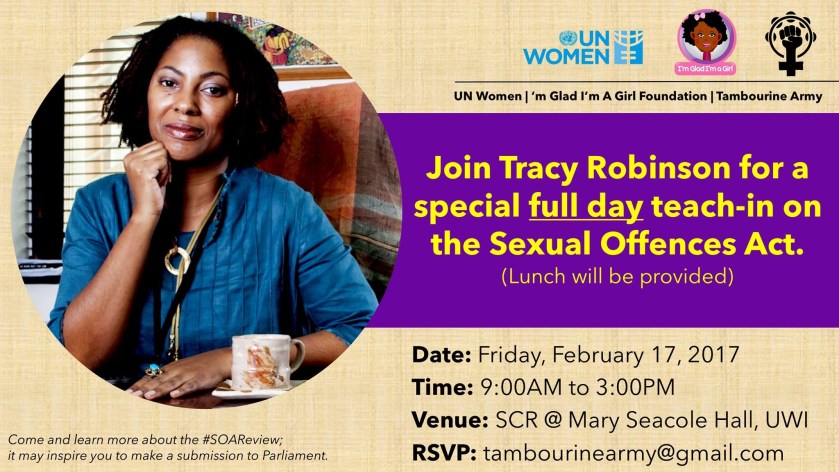
Also on Friday, February 17, the I’m Glad I’m A Girl Foundation partnered with UN Women and the Tambourine Army to host a full day teach-in on the Sexual Offences Act. A presentation on the Act and related Acts was made by Tracy Robinson (Senior Lecturer, Faculty of Law, UWI Mona) in the morning, and discussions with advocates about how folks can contribute to the current review of the Act followed in the afternoon.
Citizen participation is the name of the game, WE have to become the change we want to see. Purple is the colour of power, let’s put it on and take to the streets come. To all the men out there come show your support for us, with or without tambourines, on March 11 and we’ll reciprocate by joining the one for violence against men whenever you choose to organize it. Deal?
Fidel Castro with Jamaica’s Michael Manley in the 1970s
A mountain has died and words are inadequate to describe the loss, the Fidel-shaped hole in the universe we must live with now, but Jamaican songwriter and singer Tanya Stephens has written the most thoughtful, eloquent, hard-hitting tribute you can imagine and it deserves to be read far and wide–
Contributed In this September 6, 2005 photograph, Cuban President Fidel Castro (right) makes a comment to Venezuelan President Hugo Chavez (left), much to the amusement of Jamaican Prime Minister P.J. Patterson. The state heads, two now retired and one deceased, were enjoying a moment in between sessions while at the Second PetroCaribe Summit at the Ritz Carlton Hotel in Montego Bay, Jamaica.
I still remember the almighty roar that went up from the crowd outside the Holy Trinity Cathedral on North Street in Kingston when Fidel Castro alighted from his car and made his way into the Cathedral where the funeral service for Michael Manley was being held. It was 1997. I was in the street outside with the hoi polloi but i heard that even inside the Cathedral, full of VIPs, diplomats and other elites the entire congregation arose applauding when he walked in. Fidel was an inspiration as Tanya explains so eloquently…
He was good or bad depending on who you speak to. I fell in love with the romantic portrayal of the Cuban revolution in high school History class. I couldn’t express that at home. I later took more details into consideration and lost some of my love for the man while exercising empathy for the many refugees who fled the country to seek more favorable socioeconomic conditions elsewhere. Then I went to Cuba and my love was renewed. There’s no human on this planet who gets a perfect score from every other human. What I saw was an education system which works. Healthcare which works. National security which works. We stayed in a rooming house in a ‘ghetto’ in Havana although we could have easily afforded a room in the best hotel, but we wanted to be among the people. I went walking in this ‘ghetto’ after midnight, and the only interactions from locals we attracted were offers to (literally) break bread with us and invitations to come into homes and hang out with them. I dream of a Jamaica close to this.
I could also see that it was a synthetic kind of safety born of fear, but I would pick someone being afraid of the repercussions from committing a crime over everyone being afraid of criminals ANY day.
To all the people whose lives he touched negatively, I hope they and their descendants can somehow find the peace he is now incapable of giving them.
To all the people from all over the world who have benefited from the world leading education and health care industries he sculpted, I hope their gratitude will never wane and it will influence somehow their decisions when electing their own officials.
To all the other Caribbean Government heads, please take a page from his book. One of the good pages. Craft our education and health systems like you ACTUALLY have our interest somewhere in your corrupt hearts.
To those in the Jamaica tourist industry, Cuba has comparable and even better beaches, more points of interest, a more romantic tourism product. Get off your butt and start rebuilding your sector. The sky is not falling but your appeal and worth is!
To my 5th form history teacher Miss Blisseth (hope I spelled correctly) I thank you with all my heart for introducing me to the ONLY living Caribbean legend of my childhood. Shaping young minds is a tough job. We didn’t agree on everything, sometimes we even disagreed aggressively, but I’m grateful for every illusion you shattered and every new thought you introduced.
In Jamaica it should be #Poorlivesmatter not #blacklivesmatter coz some black lives do matter here and the police doing the killing and maiming are just as black as their victims…
The column below from a couple of weeks ago about the need for a #poorlivesmatter campaign in Jamaica has been getting some attention. #Blacklivesmatter as a rallying call has little traction in Jamaica where if you’re black but middle class or upper class you’re–for all intents and purposes–an honorary white. Social blackness is reserved for those who are black and poor, not just those who may be dark-skinned, regardless of class.
I thought as much when I saw Fabian Thomas’s ‘Black Bodies’ almost a year ago–a play that aimed to “tell the stories and honour the memories of four Jamaicans (Vanessa Kirkland, Jhaneel Goulbourne, Michael Gayle, and Mario Deane) killed by the police or while in police custody” while attempting to draw a somewhat facile connection with the US’s #blacklivesmatter campaign which was then just beginning to gain momentum.
And in a move to rival the truth in strangeness, a very bougie, uptown Kingston nightclub named Fiction invited patrons to come and show their support for #Blacklivesmatter by partying the night away. Fittingly they aroused the wrath of social media with tweeters like Matthew McNaughton @mamcnaughton saying “Never been more disgusted with Jamaica UPT Culture than when I saw this @FictionJamaica flier.” The flier is at the top of this post, my column is below:
Gleaner, July 13, 2016
The #BlackLivesMatter campaign has rightfully been hogging media attention worldwide with American Police being shown up as less respectful of human rights than you would expect from a nation that regularly monitors and penalizes other countries for their alleged violations of these universally agreed on rights. Superficially there appears to be a resemblance to the way Jamaican police behave except for a crucial difference.
Here it’s the intersection of class with race that arouses the savagery of the Police and seemingly gives them the right to detain, imprison and on far too many occasions murder a ‘suspect’ whereas in the US the detention and deaths in question seem to be largely racially focused. In 2009 for instance the very distinguished Harvard professor Henry Louis Gates was detained and imprisoned by police after forcing open the stuck door to his own house. A neighbour, misconstruing the scene, reported a robbery in progress, the police arrived, and despite the erudite Professor’s explanations he was carted off to jail.
This would never happen In Jamaica. Here you might be black and suspect until you display your rightful ownership of certain markers of privilege—and therefore legitimacy–of which the ability to speak English fluently is one. This is another stark example of how Patwa-speakers are discriminated against in their own country. Many parents tell their sons that when stopped by police they are to speak perfect English, and mention that they ‘come from somewhere’—that is, an uptown community rather than a downtown or inner city one. Almost instantaneously this frees them from suspicion.
There is no direct way to relate the #BlackLivesMatter campaign to police abuse in Jamaica without acknowledging or starting a local “#PoorLivesMatter campaign. Less than two weeks ago policemen shot a schoolgirl in the head when they wantonly fired bullets at a taxi downtown. Do you think this would have happened in Liguanea or Manor Park? And then to add insult to injury the initial response of the Police was that they had no evidence to suggest that the shooters in question were police officers. What could be more alarming than a possible scenario involving five men disguised as policemen firing their weapons at taxis? Well, actually, duh, a scenario involving five POLICEMEN firing at a taxi which is what in the end it turned out to be.
These are the same police the Attorney-General, in the wake of Lotto-scam generated crime ramping up in Montego Bay, wishes to endow with more leeway to abuse citizens by insisting that “To successfully tackle the murder problem, some of the fundamental rights and freedoms which we have guaranteed to people may have to be abrogated, abridged or infringed.” In fact she forgot to mention that this has been the state of affairs for so-called downtown people forever; the outcry now is because the warning is addressed to English-speaking, uptown-dwelling, middle-class bodies.
I adapted the title of this column from Kei Miller’s novel The Last Warner Woman. “Every now have its before”, she warns, although few heed her. Police Commissioner Williams has rightly said that the problems in Montego Bay are not something harsher policing measures or a state of emergency can solve. They are systemic and need social intervention, for what gone bad a-morning, can’t come good a-evening. Imagine the scene in the United States if President Obama used the current crisis to give American police even more draconian powers than they already enjoy. Wrong move. Racism in the USA has a long and troubled history just as the virulent classism in Jamaica does. There’s no moving forward without addressing either.
We would do well to heed the words of social commentator Nadeen Althia Spence, who invoking the late great Jamaican writer Michelle Cliff, said:
If I could write this with fire I would set ablaze some ideas on this page. I would talk about the black boys in Montego Bay who no longer know the value of life. They don’t know because their black always needed to be qualified for it to become fully ‘smadditized’. It needed land, and money or an accent. When you grow up in communities that are built on captured land, what does it mean for the girls and boys who develop their personhood in a place where land and property and money helps to define your person.
Capture is a legitimate philosophy, because dem nuh own nutten. When Daddy Sharpe led his rebellion, when he set Kensington ablaze the white people in Montego Bay were angry, they punished, maimed and killed, and Daddy Sharpe gave his life in the middle of Sam Sharpe Square Downtown Montego Bay, right across from the Kerr Jarrett’s Town House.
How has Montego Bay changed? Who plans for the children of Sam Sharpe and his soldiers, the Christmas martyrs. Dem used to state of emergency, di blinking city was born in a state of emergency. What they are not used to is justice and equality and rights and development. Give them that Minister, give them justice and mek it stretch back to 1831 and remember Sam Sharpe. Start with the land…mek dem stop capture…because all lotto scam is another capture philosophy…
This was my latest column in the Jamaica Gleaner. Since a lot of people are complaining they cannot access it easily, i’m reposting it here.
I don’t know when I first started noticing it. Perhaps it was the time I went to clear some goods I’d shipped from India a couple of years ago at one of Kingston’s ports. After navigating the much improved process of recovering your possessions from the wharf you finally end up in a large waiting room with about fifty chairs and a TV mounted on the wall in its own personal grill.
It was lunchtime by then. Sitting in front of me occupying the front rows were 15 or so large, tough-looking men, the kind of individuals who lift up crates and literally manhandle them, along with a few wimpier looking folks there to claim their goods. All were glued to the TV screen on which a brilliantly coloured Indian soap-opera was playing. The men were watching the melodrama with the helpless concentration of snakes following a mongoose’s wily darts to and fro.
Some weeks later the Smith sisters came to visit me. When I mentioned serving some Indian sweets up jumped Sister No. 1 accompanying me to the kitchen saying she wanted to see if they were the kind of sweets Khushi makes. Khushi? A who dat I asked upon which Sister Smith informed me that Khushi was the star of Strange Love, one of two Indian soap operas CVM TV had started showing in their lunchtime slot, Monday to Friday from 1 to 1:30 and 1:30 to 2:00.
“Whenever Khushi’s upset she retreats to the kitchen and starts making sweets,” declared Sister Smith as if she was talking about a bosom buddy.
Really? Indian soaps are melodramas of the sickly sweet variety, how on earth had they taken Jamaica by storm I wondered. Sister Smith assured me that they were such fun that not only she but her parents—the goodly Reverend Smith and her Mom—as well as her brother, a financial analyst in New Kingston, were all hooked to Strange Love. In fact at her brother’s workplace, office workers threw ‘Khushi parties’ after work and spent Saturdays binge-watching the serial while at home the goodly Reverend could be seen shouting at the Indian couple to just DO IT. Just kiss the girl no man, her father would yell in exasperation as Khushi’s admirer spent days and weeks gazing into her eyes, while the background music intensified in volume and sentimentality.
Strange Love or Iss Pyaar Ko Kya Naam Doon as it’s called in Hindi, premiered in India in 2011. Comprising 398 half hour episodes the drama is the love story of an arrogant business tycoon, Arnav Singh Raizada and his middle-class secretary Khushi Kumari Gupta. Played by actors Barun Sobti and Sanaya Irani the series has propelled both to fame and stardom not only in India but around the world where the show is dubbed into the native language of the region it is shown in. After a few years when Barun left to pursue a career in Bollywood, the show’s fans went berserk demanding his return.
Ok fine. But what is the attraction such shows hold for Jamaicans? I mean a recording artiste named Tiana has even come out with a single named ‘Khushi’ that has reportedly been blowing up local radio.
“What fascinates us is the slowness of the story, the way the lovers look at each other. The music that comes up when they think of each other. Strange Love focuses on…feelings, how people view each other, how they love each other from their hearts, not their gonads,” vouchsafed a blogger named Lady Fingers.
Meanwhile according to Jodian Downs “These dramas are different, as the characters still maintain their pure innocence and for the viewers, this is extremely addicting. Imagine yourself watching the full 20 episodes of one show just to see the main characters at least get a small peck on the cheek from their love interest.”
Also, continues Downs “the level of loyalty portrayed by each female actress for their male superior is rather humorous and astonishing for the modern female.” Aha! perhaps this explains why Jamaican men are so fascinated by Strange Love. The docile Indian female is no doubt irresistibly attractive to them considering the independence of most Jamaican women?
Interestingly unlike Jamaica where Indian soap operas are appreciated as a step back to a time when love was innocent, in places like Afghanistan where they are also popular they are considered too liberal and therefore threatening to Afghan culture. According to a recent article “Afghan video editors must blur all objectionable content in the scenes, such as too much bare skin, Hindu ways of worship, alcohol and anything that could offend religious sentiments.”
In Jamaica on the other hand Indian dramas have generated much goodwill and love of Indian culture. Long may it last!
Well, it would appear that I’ve abandoned blogging and wandered back into the arms of traditional media. At least for the time being. It’s a month now since i started writing a weekly column at the Daily Gleaner, Jamaica’s premier newspaper, and in consequence Active Voice has become inactive. It’s an interesting zig-zag, from column writing to blogging to column writing once again. In a blog you address the big wide world, in a column you tend to address local issues for a local audience.
The movement is not unlike a lens zooming in or zooming out, manually of course, there is no autofocus available, only telephoto or wide angle and all the calibrations in between. As you zoom in small things get larger and more legible; as you zoom out the enlarged shrinks, allowing you to see the big picture and where you fit into it. Occasionally the view becomes panoramic, collapsing horizons and walls, a grand sweep from left to right.
In my second column I took on a group of what I termed ‘cultural nationalists’ who seemed more interested in protecting Jamaica’s image than in changing the dangerously lopsided society we live in, one designed for the middle class and the wealthy, to the detriment of those who have not/naught. A CNN anchor had described Jamaica as a ‘remarkably violent place’ after two North American missionaries were murdered here. Up rose the cultural nationalists claiming that the anchor was exaggerating wildly and there are only ‘pockets’ of violence here.
This seemed rather disingenuous to me when murder and violent acts dominate the news headlines here daily so that the nation seems equipped with an abnormally large number of violent ‘pockets’, if one must use such imagery. Yes, areas where uptown people live don’t suffer the same intensity of violence as poorer neighbourhoods, but surely to deny that the country has become remarkably violent is like thumbing your nose at those for whom this is a daily reality. Are they likely to disagree with the American anchor’s description of Jamaica?
These are people who live, as UWI scholar Norval Edwards pointed out in the 90s, in a permanent state of emergency. The rest of us tolerate this, some even demanding this routine abrogation of citizens’ rights. Not surprisingly when the violence then spills across the boundaries and news of it escapes into the international news circuits some of us start squealing about bias and exaggeration when actually what is being reported is the truth.
But of course the truth is dispensable. We prefer to think of ourselves as highly cultured, civilized, law-abiding, English-speaking citizens who do not curse or act violent. This is the image we want to project, let no foreign anchor tell you otherwise. The level of denial and self-delusion is all-pervasive. I spoke to a couple of individuals who don’t live in middle class enclaves and they too insisted that Jamaica could not be called a violent society. A banal nationalism trumps all.
What seems curious to me is that at the same time the cultural nationalists are busy pushing back at portrayals of Jamaica as a violent country by outsiders they have no problem with internal declarations that there is a ‘culture of violence’ here, sometimes even uncritically reproducing this canard themselves. In doing this they seem unaware of the ethnic profiling they are participating in, one that is made amply clear by the following tweet:
Stereo Williams @stereowilliams
Black guys fire shots at rap shows and u hear “culture of violence.” White guys fire shots at theaters/schools/offices and it’s “isolated.
In my third column I tried to elaborate on this weird incongruity between local commentators’ denial of the existence of violence on the one hand and their comfort level in denouncing the ‘culture of violence’ that allegedly exists here. Not all are guilty of this but far too many are and it makes you wonder what’s going on. The following is taken from my column The ‘Culture of Violence’ Thesis:
The ‘Culture of Violence’ Fallacy was the title of a book review by David Scott in 1997 in the second issue of the journal Small Axe. He was reviewing Lauri Gunst’s Born fi Dead and Geoff Small’s Ruthless: The Global Rise of the Yardies. Praising the books’ authors for being ‘thoughtful, perceptive and readerly’ while attempting to arrive at “theoretically informed understandings of the problem of organized violence in Jamaican society” Scott rued the reliance on ‘pop’ cultural psychology in their analysis. The books’ main weakness he said lay in their “unproblematic reproduction” of the view that there is in Jamaica something called a ‘culture of violence’.
Scott noted that while this view was a widely held one, much retailed by the press and others, he doubted its usefulness as a conceptual framework, fearing that it obscured problems rather than illuminating them. What Scott was objecting to–rightly in my opinion–was the proposition that Jamaicans have an inclination towards violence or a ‘constitutional aggressivity’ and that there is social acceptance towards violence in Jamaica. He also questioned the idea that violence was endemic to Jamaican culture or that the frequent episodes of violence here are due to ‘historically constituted behavioural patterns’.
In contrast to the way violence in Jamaica is portrayed countries like Sri Lanka, victim to decades of the most violent conflict and prolonged warfare, are rarely described as having a ‘culture of violence’, said Scott. He went on to clarify that his objection was not to culture being used as a conceptual tool in analysing violence but to the particularly narrow and limited concept of culture employed by analysts.
In her 2011 book Exceptional Violence: Embodied Citizenship in Transnational Jamaica anthropologist Deborah Thomas highlights the same problem pointing out that the notion of Jamaica having a ‘culture of violence’ is so widespread that commentators within the country freely use it without questioning its validity. She cited a National Security Strategy green paper of 2005 that used the phrase unproblematically claiming, “It is now conceded that Jamaica has spawned a culture of violence in its most negative form which is abhorrent to its values and stands in the way of every kind of social progress.”
The problem with viewing violence as a cultural trait is that it presents the issue as one of an innate brutality and savagery, whose roots are in Jamaican culture rather than generated by the system itself. Thus it distracts attention from the socio-economic inequality and the lack of opportunities for decent work and living conditions in the country, the everlasting structural adjustment that has marooned the impoverished out on a rickety limb; the systemic problems that contribute to violent solutions to social problems and need urgent attention. For the violence that envelops Jamaica is not a symptom of its culture but the fallout of the ‘Babylon’ system the country’s numerous singers and DJs have raised their voices against.
Though there were many who appreciated my use of cutting edge scholarship to make my argument on the subject of violence, there was a surprising pushback from the Gleaner. I was told that this particular column was considered “Too philosophical and not digestible by regular folk”.
A lot is claimed on behalf of ‘regular folk’ and it made me wonder whether the reason most public discussion here remains simplistic and one-dimensional is this insistence on dumbing down debate for the much maligned regular folk. I’m sure some folk object to exercising their minds even occasionally but there are many others who don’t. Which constituency is a columnist at the premier newspaper in the country to cater to? What is the role of an opinion columnist? To provide pap for the masses or to give them the benefit of some of the finest thinking on a subject of relevance to them?
Are we not guilty of fostering a culture of anti-intellectualism when we insist on insulating the public from complex ideas and arguments? Don’t Jamaicans deserve better? I don’t like running fast myself nor could I if I tried, and I’m sure there are many more like me, but I’m so glad that Usain Bolt, Shelly Ann, Asafa and the others weren’t told they had to slow down and keep pace with us so as not to hurt our feelings.
A run down of exciting new developments in Jamaica’s literary and art worlds.
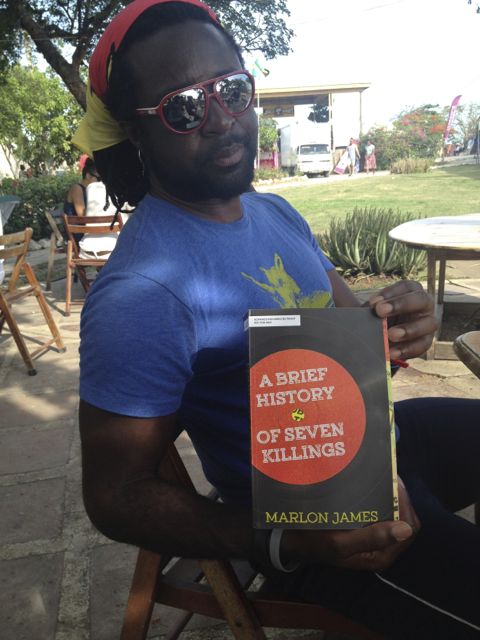
Marlon James at Calabash Literary Festival, June 2014
As a new year hurtles towards us, the worlds of writing and visual art in Jamaica are poised to come into their own once again what with stars like Marlon James and Ebony G. Patterson blazing their way to global attention in 2015. You might say a strong current is buoying Jamaica right now and those equipped to swim with it are bound to soar. Can aquatic creatures soar? are we mashing metaphors here? No doubt…but methinks the situation warrants it.
James’s Booker win with his novel A Brief History of Seven Killings has set off a maelstrom of praise and adulation but also concern from some Caribbean literary critics who maintain the work is needlessly violent. How to represent the internecine violence we live with in a seemly manner is a moot subject that will fuel many a literary conference to come; in the meantime Marlon James has adroitly dismantled the thatch ceiling that seems to veil the work of Caribbean writers from international visibility.
Kei Miller on right, Ebony Patterson and Leasho Johnson on left
Kei Miller, James’s counterpart in the literary world, known more for his Forward Prize-winning poetry than his prose has just signed a six-figure deal with Knopf for a fictional work. Indeed his manuscript Augustown was the subject of a bidding war between publishing giants Penguin, Random House and Knopf, all offering six-figure deals. Miller’s agent chose Knopf, whose editor also works with Toni Morrison.
This is what I call the Marlon James effect. Doors have been flung open! as Kevin Jones remarked on Facebook. The success of Brief History has made publishers sit up and take notice of a culturally rich region they had somehow managed to overlook all these years.
To give some perspective–not even the much lauded Booker winner Marlon James himself was offered six figures by his publisher, River Head–but that was before the stir that his ambitious novel subsequently created. The bidding on his next novel will likely hit seven figures. Move over 7-Star General LA Lewis!
It must be added that Kei Miller’s Augustown was an excellent manuscript, and any really good writing coming out of the Caribbean in the next year or two is likely to arouse the interest of all major publishers. “Roland need to send out something,” remarked Marlon James colloquially, referring to Roland Watson-Grant, a third Jamaican writer whose brilliant novels have yet to get the attention they deserve.
_Space Jamaica and The Current
Meanwhile over in visual art the thatch ceiling is about to be blown away by a very ambitious project called _Space Jamaica, the brainchild of Sotheby-trained Rachael Barrett, who has recently returned to Jamaica with visions of starting an international museum of contemporary art in Kingston and other points in the region.
Located at premises owned by the Henzell family and run as a cultural space for many years _Space Jamaica will hold two shows a year, one in December timed to take advantage of traffic to Art Basel Miami and the other in June to coincide with Kingston on the Edge, a small but exciting series of activities curated by young Jamaican ‘creatives’ and led by Enola Williams. June 2016 will see _Space Jamaica launching its inaugural exhibition with a solo show of works by Jean-Michel Basquiat, curated by Rachael Barrett. Titled I FEEL LIKE a CITIZEN, Barrett “will take a new approach to Basquiat’s oeuvre, examining his life, work and cultural legacy from the perspective of his Caribbean heritage.”
In early December Barrett held a preview of what’s in store for the museum with an ambitious programme of activities, some of which fell through, due to funding and other delays. The highlight was a lunch for diplomats and others held at the Old Railway Station in downtown Kingston. The station is in disuse since the trains stopped running more than a decade ago.
Artist Laura Facey at _Space Jamaica lunch, Railway Station, Kingston
This was followed by the welcome announcement on December 16 by mega-collector Francesca von Habsburg, founder of Thyssen–BornemiszaArtContemporary (TBA21) that TBA21 would be giving _Space Jamaica a significant US dollar contribution to be matched, she hoped, by local contributions.
Francesca von Habsburg announcing collaboration with _Space Jamaica at Red Bones, Kingston, Dec. 16, 2015
In addition TBA21’s ground-breaking (or perhaps ocean-breaking would be a better term) The Current International Research Programme will hold its first ever ‘Convening’ (an inter-disciplinary conference) at _Space Jamaica from March 16-20, 2016. The Current which was launched at COP 21 in Paris instead of Art Basel Miami reflects von Habsburg and her partner Markus Reymann’s shift from pure art (for want of a better expression) to art that engages with environmental problems. According to Reymann the Foundation is interested in knowledge production, not just art production.
Thus The Current, “a three-year exploratory fellowship program taking place in the Pacific, will offer artists, curators, scientists, marine biologists, anthropologists, and other cultural producers a platform to generate interdisciplinary thought and knowledge.”
The curator leading the inaugural voyage is Ute Meta Bauer, founding director of the recently opened Centre for Contemporary Art (CCA) in Singapore, who curated the US entry to the Venice Biennale this year; she was also part of the curatorial team of Documenta 11. It will be exciting to see what she comes up with for the Current Convening in March.
As von Habsburg says:
In spite of the unprecedented wealth of scientific information available, global environmental woes are still largely underestimated and poorly communicated. Art can be a powerful weapon if used well, by challenging us to reconsider the way we think, feel, and live instead of just conforming to the rules of the growing art market. After all, the next 10 years are going to be the most important in the next 10,000.
At the dinner in Kingston celebrating the successful unfurling of The Current von Habsburg announced TBA21’s support of _Space Jamaica and explained why she was shifting her attention “to the environment, to climate change, to preserving our oceans”:
They are my priority for a very special reason–mainly because of Jamaica–because i came here as a baby. I learnt to swim here, i learnt to snorkel here, i learnt to dive here. I taught my children–my beautiful daughter Eleonore who just came in today–i taught her to swim here and to snorkel here and to dive here. So I’ve been on these reefs for over 55 years and I’ve seen a colossal difference and I’ve seen what has been happening to the oceans, not just the oceans here, but to oceans all around the world. So for me Portland is a big accent on my attention, and as a result of that I created a foundation called the Alligator Head Foundation, which will be registered shortly, because it takes a while to get things registered in Jamaica as you know. The Foundation is to follow a very important establishment of a fish sanctuary which will be called the East Portland Fish Sanctuary. It is two hectares in size and it’ll be the biggest fish sanctuary in Jamaica. I’m meeting with the Minister tomorrow and I hope to be able to establish the sanctuary by the end of the year, if not the very beginning of next year. And these two things come together, I’ve started to talk about it to many artists and musicians that i know and there’s a whole movement of the creative industries that are backing me up on this programme so much to say about that in the future. But when I got together with Rachel this week to talk about her project _Space that she has here in Kingston–she’s been working with a great architect I’ve known for many years called David Adjaye but in particular this design was done by Vidal Dowding, an architect who I have a lot of time for and a lot of admiration–and I thought this idea of taking over a previous cultural space and reactivating it is something that’s really caught my attention. And the contemporary art scene in Jamaica could do with this incredible boost and I think probably the best way to address it is to actually do that in an independent space. I think the National Gallery of Jamaica is of course very much focused on moving into the contemporary art scene and I understand that, but I thought it was time for Rachael to get some real support so, today I’m announcing a gift to the _Space of US$150,000.
Architect Vidal Dowding explains concept of his plans for _Space Jamaica. Joseph Matalon, l; Rachael Barrett, c; Vidal Dowding, r.
These are exciting developments for the local art scene which has been far too insular for far too long. May local donors match Francesca von Habsburg’s generous injection of resources into local art and science in the way the University of the West Indies has collaborated with TBA21 on founding the Alligator Head Marine Laboratory, seconding Dr. Dane Buddo to oversea (a Freudian slip which i shall leave alone) it. May young Jamaicans finally get a chance to experience the best in art and science without having to leave these shores and may it galvanize the country into leaping forward this coming new year.
Some thoughts on Marlon James copping the Man Booker 2015…
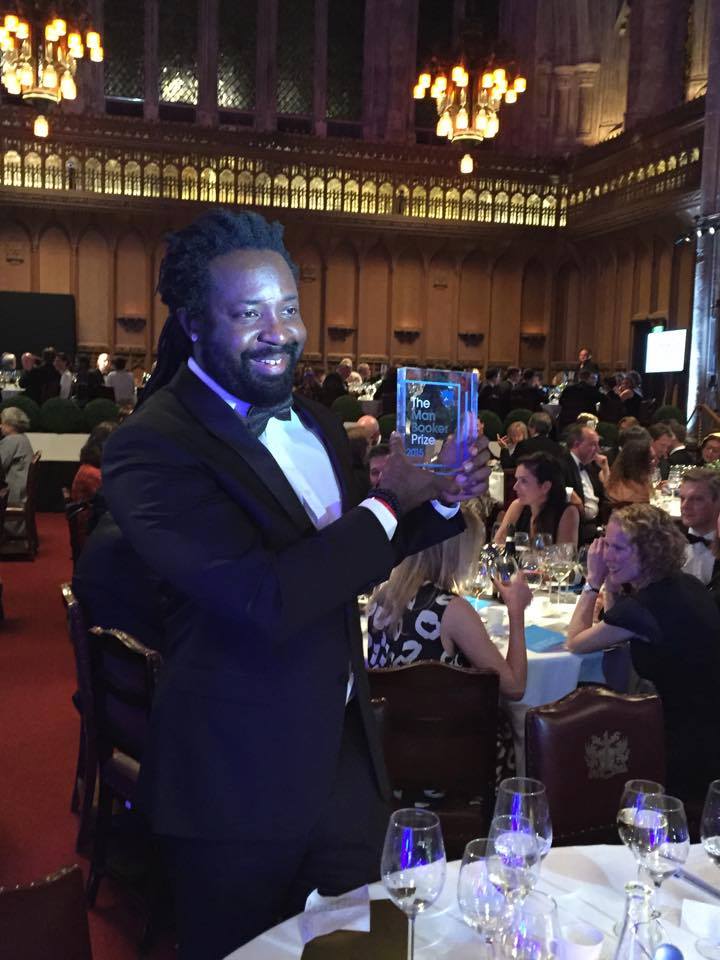
Holy shit! was Marlon James’s reaction on Facebook to winning the 2015 Man Booker prize in mid-October. With those two words he summed up the prevailing zeitgeist of his novels which fluidly run the gamut from the sacred to the profane. In Jamaica the literati exhaled in relief as the Man Booker judge laughingly produced A Brief History of Seven Killings saying “It’s MARLON JAMES!”
Most of Jamaica remained unaware but only till news time when all or most of the island’s radio stations and news websites carried the news. Nationwide radio actually led with the story and hte next day’s Gleaner had it on the front page. I felt it should have headlined every single newscast here but Justine Henzell, one of the founders of the Calabash Literary Festival, the gamechanger that gave James his springboard, pointed out that this was actually real progress, that 10 years ago the Booker victory might scarcely have been mentioned on the news in Jamaica let alone headlined it.
Justine is right of course. RJR radio’s Dionne Jackson-Miller held a 40 minute discussion on Marlon and the Booker and I was part of a shorter one on Nationwide News with noted columnist and academic Carolyn Cooper and Ingrid Riley, Marlon’s best friend. You can listen to the audio of the latter below.
I still found it bothersome that both TV stations buried James’s victory way down in their newscasts as if this wasn’t as incredible and joyous an achievement as any of Usain Bolt’s electrifying runs. On a TV newscast I watched on the evening of the literary coup, Marlon’s Booker was considered less important than a story about Mexican investors–Charisma–investing in the Jamaican hotel industry; a run-of-the-mill story about politics in Portland; a protest by the supporters of Member of Parliament Patrick Atkinson and a story about tertiary education and how it should be free according to the Leader of the Opposition Andrew Holness. Clearly the news in Jamaica is dominated by politics and business, two of the worst performing sectors in the country. Go figure, as the Americans say.
It is sad and telling that even once in a blue moon Jamaica’s two premier TV stations couldn’t bear to put the astonishing story of a local writer winning the most important literary prize in the English-speaking world front and centre. How often has a Caribbean person won the Booker? The only other writer to have done so is VS Naipaul. And we boast of being a cultural superpower? There needs to be a sea change in the way news is conceptualized and produced in Jamaica. Why is there so much focus on the inane trivia that politicians inflict on us? And hit or miss business ventures that never seem to improve financial conditions in the country?
From Facebook. happy to credit the author of this photo if I’m given the necessary information.
It is widely believed that the muted response to James’s win may also have to do with something as immaterial as his sexuality. Marlon James is the first prominent Jamaican to have openly ‘come out’ as gay and this may have put a spanner in the works for some people. The tweet below is typical of the prevailing sentiment of some:
Im A Big Deal @NigelBigMeech
The man all gay to mek it worse suck unnu mumma and stop tweet bout him pon me TL yere.
On the other hand Head of the University of the West Indies’s Economics Department Damien King tweeted that James’s Booker win was hardly something for homophobic Jamaica to celebrate:
Considering [that] our shameful intolerance drove Marlon James from Jamaica, his winning the Man Booker prize is hardly a proud moment for us.
James’s sexuality wasn’t the only thing that some Jamaicans found irksome. The fact of Marlon James’s location in the diaspora and what this implies is an irritant for many. The Jamaica Observer penned a somewhat querulous editorial praising James for winning the Booker while at the same time taking issue with the proposition his success has raised–that most good writers are forced to flee the rather limited literary provinces of the Caribbean if they want to fully develop their literary talent. Asking “Is exile really a necessity for Jamaican writers?” the editorial stated:
…being in exile abroad situates writers far from their subject matter, their home, their friends and creative compatriots of their own nationality and culture. Given the perceived advantages of exile and the downside of self-imposed exile, the question is: Are Jamaican writers choosing exile or are circumstances here forcing them into exile?
On Facebook Darryn Dinesh Boodin offered a cogent answer:
Writers have always traveled and worked from foreign countries Joyce lived in Italy..Conrad moved to England..Hemingway lived in Cuba. this romantic idea of ‘exile” seems kind of silly in an Internet world…when Marlon James learned he got nominated for the booker he posted it on Facebook…the internet is the new Paris in the 20’s…in his article for the times Marlon James wasn’t talking about leaving Jamaica to become a writer..he was taking abut leaving Jamaica in order to be happy..
It wouldn’t be the first time the vexed question of ‘offshore’ Caribbean writers has come up. In 2000 another writer from the Jamaican diaspora, Colin Channer, took issue with the idea that he was in ‘exile’, a word frequently used to describe Caribbean writers based in the UK and the US. According to Channer the physical distance of diaspora-based writers from the country they were writing about in no way vitiated their ability to represent it convincingly; moreover he charged, locally based writers had been negligent in plumbing native terrain for the untold stories that littered it. In a combative speech at CARIFESTA 2000, in St Kitts Channer addressed his literary ‘elders’ saying:
I understand why you would feel that our work would be enhanced if we were able to write while looking out the window on the landscape whose mud was used to make us… But elders I must remind you of something. I was there in Jamaica in the seventies…Where were all our novelists then, the big men, with the big names, and the big positions when the gunmen burned down the Eventide Home, and bun up the old lady them? Where were they when the army murdered some ghetto yute at the Green Bay firing range after enticing them with offers of guns?…where were they when dem shoot Bob Marley?
Uncannily, a whole 15 years before James’s Brief History Channer had identified Marley’s shooting as a story worth retailing but in the year 2000, at the turn of the century, Marlon James wasn’t yet on the horizon to prove Channer’s point, spectacularly illustrating that you didn’t have to reside at Ground Zero to evoke it or channel it. His ability to work Jamaica’s tortuous history and wring from it a story so vividly capturing the terror and permanent state of emergency many Jamaicans inhabit, once again highlights the issue Channer had raised, of what academics call ‘the politics of location.’ These are questions that also haunt two other young giants of Caribbean writing, the Dominican Republic’s Junot Diaz and Haiti’s Edwidge Danticat, both resident in and writing from locations in the United States.
Marlon James at Calabash Literary Festival, June 2014
Curiously, exile and location were also central to a Facebook spat generated by an article James published earlier this year in the New York Times magazine titled “From Jamaica to Minnesota to Myself” in which he described the stifling sense of illegitimacy he felt as a young gay man growing up and living in Jamaica. The subhead of the article, “I knew I had to leave my home country — whether in a coffin or on a plane,” provoked Trinidad-based gay activist Colin Robinson to comment on Facebook that he was exhausted and enraged by the ‘reductionism of the exile narrative.’ “I’m sorry, but we need other narratives of the queer Caribbean than die or leave,” he fulminated. “What about those who stayed and struggled?”
In a similar vein the Observer editorial interpreted James’s statement about needing to leave Jamaica as somehow reflecting a slight on locally-based writers. Jamaica’s homegrown writers are just as good the editorial seemed to imply. The kneejerk tendency to defend the ‘local’ or ‘fi wi’ writers and intellectuals in this manner is a misguided impulse and is precisely one of the reasons why serious writers are forced to migrate.
This tendency also fails to recognize the glaring similarity to Jamaica’s great athletic tradition which depended for many years on local athletes going abroad to train and prepare to compete at the global level. For a long time Jamaica did not have the infrastructure locally to produce the world-beaters you see today, which took time and resources and a lot of help from home and abroad to develop. The talent was there but it had to go elsewhere for its maximum potential to be extracted.
Marlon James, Kei Miller, London Underground, October 2014. Photo: Morgan Everett
Had the local powers-that-be grudgingly insisted that home-grown talent was just as good as those who left and shone on the global stage, instead of systematically putting in place the necessary coaching and training facilities required, there would not be a Shelly-Ann Pryce or an Usain Bolt today or there may have been, but they wouldn’t be home-grown. Just because there are one or two exceptions in the Caribbean, and Martin Carter of Guyana is an outstanding example of this, it doesn’t mean that a Marlon James could have just as well stayed in Jamaica and won the Booker. To argue that is to fail to recognize the difference in scale between the achievements of a Kei Miller or a Marlon James and the far more modest achievements of writers, artists and intellectuals whose ambitions were local or regional rather than global (and by this i mean writers who assume their audience is local or regional and therefore au fait with Caribbean culture and language whereas one with a more global orientation might cover exactly the same ground but in such a way that outsiders or newcomers are not excluded. And while doing this they’re aiming to compete with the world’s best, not merely the island’s best, or the region’s). As James himself said in a 2006 interview I did with him: “If you’re not competing against Norman Mailer, why bother?…I’m not one of these I-write-for-my-people-first-and-everybody-else-later thing.”
It is incredibly difficult to write a story that rings true at home while at the same time making itself eloquently understood to readers outside the culture. This has been James’s big achievement and one of the reasons he won the Man Booker. In the same interview we also discussed the question of language and how to be true to Jamaican Patwa without compromising meaning and interpretation. Keep in mind that this is from a 2006 interview recorded while James was writing his second novel, The Book of Night Women:
Maybe I should put it in the context of all the stuff we were talking [at the “Writing Life” conference] about dialect and Creole, and there’s a slight objection to standard-englishising the B-word — but in the book I’m writing now, a character says “bloodclaat,” which is a Jamaican bad word. And if I spelled it “bloodclaat,” non-Jamaicans would get a sense that this is an expletive, and Jamaicans would go, yeah, that’s the word. But I changed it to “bloodcloth,” and a friend who’s Irish read it and said, what’s up with all these expletives tied to menstruation? Why is a female bodily function a bad thing? So she nailed it, which she wouldn’t have gotten had I said, let me play — let me just go — let me spell phonetically and write “bloodclaat.”
The finest editorial on Marlon James’s Man Booker came from the Stabroek News in Guyana and reminds us that his win was not just a Jamaican achievement but a coup for the whole region. Titled Jamaica’s Booker the editorial said:
A Brief History of Seven Killings, James’ complex, humorous, uneven foray into politics in the Manley years, is entirely Jamaican, but its success ought to be celebrated throughout the Caribbean. James’ exuberance, his confident yielding to the temptations of what another James famously called the “loose, baggy monster” of a large novel, is suggestive of how far West Indian fiction has advanced in recent years, not least in its use of literary registers and devices that used to belong, almost exclusively, to writers serving large, foreign (predominantly American and European) audiences.
Speaking at the Bocas literary festival in 2012, James lamented the musty notion of a Jamaican or West Indian novel (villages, religion, stock characters) and said that younger writers, like himself, ought to tackle contemporary life and wrestle, unashamedly, with the region’s racial, sexual, and political questions. Then, having warmed up with two historical novels, he delivered.
This brings us back to the critique leveled by Channer that local writers seem unable or unwilling to plumb the hardcore realpolitik of the ground they write from in bold and innovative ways focusing instead on easier material and conventional forms unlikely to make an impact outside the local arena.
The question of why the writers or activists who ‘stayed and struggled’ aren’t leveraging their own stories, narratives embedded in local history and culture, to international attention remains a moot one ripe for analysis. They are certainly beginning to do so although it remains difficult to attract mainstream attention while based in the Caribbean. For Marlon it was reading Shame by Salman Rushdie during the years in Jamaica when he belonged to a charismatic church that made him realize that the present was something he could “write his way out of.” This son of parents who were both officers of the Jamaica Constabulary Force promptly set about doing so and the rest is history.
As in the case of Marlon James and his Brief History of Seven Killings there were writers and books in India before diaspora-based Rushdie wrote Midnight’s Children but their scope and ambition was slimmer and much too conventional to make any impact internationally. Midnight’s Children broke the mould of the kind of novel that was possible in and about the subcontinent and Indian writing was never the same post-Rushdie, his success and example opening the floodgates to decades of Indian dominance in English-language writing. This will likely be the case in the Caribbean as well. For this James’s vaulting ambition and example must be celebrated and imitated rather than grudgingly disparaged or undervalued.
Some thoughts on Cameron’s visit to Jamaica and the UK proposal to contribute towards building a new prison here.
The Gleaner, Oct 2, 2015, Las May
In a superb blogpost titled “Slavery’s ghost: Prison imperialism, Jamaica, and the UK” author Scott Long provides the context for the UK’s extraordinary offer to pay for a state-of-the-art prison to be located on Jamaican soil. He details the tortuous twists and turns of a global prison industrial complex founded, funded and fostered by countries such as the UK and the USA starting in Guantanamo Bay and reaching all the way to Somalia, Somaliland and the Seychelles. Utilizing elaborate ‘prisoner transfer agreements’ and the building of maximum security prisons in other countries that largely benefit the UK (or the exporting country in question) a global trade in prisoners is in swing and its routes and circuits are not far removed from those of the slave trade two centuries or so ago. As Long says:
The enslavement of the human being; his reduction to a rightsless cipher; her extermination once her economic use was exhausted — these are extreme cases, absolutely not typical of all incarceration. But they’re possibilities inextricably latent in the modern prison: because buried under the prison is the slave camp.
Although the links between Cameron’s offer of £25m towards the building of a prison and similar experiments in Somalia and elsewhere haven’t been discussed much in the Jamaican media Long suggests that the Jamaican government was well aware of the geopolitics of the deal and cannily acted in its own interests. In fact a 2013 article in the Observer chronicles a Senate debate between the Jamaican government and Opposition on the subject. To return to Long however:
WIth all this going on elsewhere in the world, Jamaica knew there was money in the prisoner-transfer business, and drove a hard bargain. The deal Cameron announced had been in the works since at least 2007; but it’s easy to imagine that, as Kingston saw other countries profiting, its own price went up. Britain paid to import chained humans to its territories for several centuries. There’s a certain justice that, as the whirligig of capital brings round its revenges, it must now pay to export them. Of course, for the humans in question, “justice” may not be the right word.
Long pinpoints the UK’s interest in the matter:
The UK’s reasoning is clear: if we have to spend that much on prisoners, which we don’t want to, let’s spend it on our own, not foreigners. “Deporting foreign criminals would free up prison places,” says a UKIP politician, letting us abuse and humiliate more of our own kind. There’s no reason the logic should stop there, though. Already the UK is figuring out ways to scrap the formality of a trial; Cameron’s government has come up with “Operation Nexus,” to simplify deporting foreigners charged with crimes but not convicted. And isn’t there a deeply buried message: Look. We would deport our own citizens if we could. Can a mere ID deter ostracism and eviction? With a West desperate to export crime and get rid of immigrants, why is birthright belonging more than a friable, disposable defense? Donald Trump already wants to scrap it. If the UK could find a penal colony, a Botany Bay, to take its suspect and unwanted nationals, how long would it cling to them over legal sentimentalities? As non-citizens become criminals, an insidious mirroring begins; the possibility — the fissure — of turning criminals into non-citizens opened, after September 11.
As for the claim that the UK’s investment is somehow going to improve the antiquated, inhumane state of the country’s prison system Long is doubtful:
It’s improbable that the UK money will do anything to change overall prison conditions in Jamaica, much less the beliefs and policies that produce them. It’s not meant to. At best, Cameron’s bargain will create a two-tier prison system: lucky UK exports will enjoy the cutting-edge prison’s comparative comforts, along with privileged dons and barons who can pay for it, while everyone else swelters in the old inferno. And this is fine with Britain. Given the UK’s desperation to slough off unwanted inmates, there’s little chance they’ll seriously inspect even the new facility’s standards. It’s fine with Jamaica too. Already the government is talking about this not as a rights issue, but a real estate one: the possible superannuation of one old penitentiary means that “Downtown Kingston will have the opportunity for a large redevelopment on the 30 acres of waterfront land now occupied by the prison,” the National Security Ministry told the press. “A similar opportunity for redevelopment would be provided in Spanish Town.”
The rest of this long but informative post can be found here and is well worth reading in its entirety.
The Gleaner, Oct 3, 2015, Las May
The overwhelming reaction to Cameron’s prison proposal in Jamaica has been one of outrage and skepticism. Tweeter @BigBlackBarry summed it up:
Export our qualified citizens who are forced to leave to build their country. Import criminals for integration in our failed state.
There is a widespread feeling of insult added to injury in Cameron’s refusal to countenance any discussion of reparative justice suggesting instead that Jamaicans join the British in looking and working towards the future.This is the very same impulse that led light-skinned governing elites in Jamaica to jettison Emancipation Day as a national holiday and focus exclusively on Independence Day for the first 3 decades of independence. ‘Let’s forget the past and move forward’ was the too frequently proffered advice of the ruling elites who feared that frequent references and memorialization of the slave past would render the population mutinous and ungovernable. Cameron’s exhortation that Jamaica should join the British in ‘moving on from the painful legacy of slavery’ therefore has unpleasant resonances for Jamaicans and should have been avoided.
We gave a nation… They give a prison.. That’s a sick reparation joke…tweeted @Occupy_Jamaica
Journalist Yolande Gyles-Levy was moved to start a blog expressing the rage she felt:
No sooner had he said the words “move on”, I became enraged. I was sitting at my desk in the office, listening to Mr. Cameron and I leapt up and stood before the television set glaring at him while muttering every single profanity I knew in both English and Spanish and I’m sure I probably made up a few new ones.
And then my anger grew to rage as I watched the sons and daughters of slaves who are now parliamentarians allow the descendant of a slave owner to get away with the comment. There was not one single visible note of objection. Not one.
My anger turned to unimaginable shame though when the President of the Senate, the visually impaired Floyd Morris genuflected into the perfect “house slave”. His vote of thanks after Mr. Cameron’s speech sounded something like this: Thank You Massa for coming to speak to us Niggers. We have never been so blessed. Thank You Massa! Thank You! Thank You!
As I write this blog piece on Friday, two days later, they, the sons and daughters of slaves, who now occupy the Parliament still haven’t objected.
As the above video shows most Jamaicans were unhappy with the UK’s prison proposal.
Local entertainers also rejected the idea, claiming that the money should be invested in education and development infrastructure. Patrick Gaynor of the duo Twin of Twins had this to say:
“Let’s say a man is born in Jamaica but leaves immediately to the UK, commits a crime at age 40 and gets deported to Jamaica. Where does he go after he serves his time?”
Wayne Chen, a businessman, politician and erstwhile poet, seemed to be one of the few seeing the prison proposal as a useful opportunity. His proposal is one worth considering:
The British government’s proposal to spend the equivalent of four billion Jamaican dollars to build us a new prison highlights important issues, raises troubling questions, and presents an opportunity.
First, it reminds us that Jamaica’s prisons are a terrible blight on our aspirations to being a ‘civilized society’, as they are dank, overcrowded barracoons; more universities of crime than centres of rehabilitation.
Second, the high numbers of our citizens in British and other foreign prisons are unacceptable, and symptomatic of local problems that need urgent fixing if we are not to become international pariahs.
The tone, timing, and content of the announcement displayed a level of insensitivity that has rightly outraged many of us, but we need to see past this.
I have no instant quarrel with the British for acting in their own self-interest by getting rid of foreigners who are a burden on their taxpayers, but wonder whether our own government is willing to accept a two-tiered prison system that will see one set of prisoners, ‘lucky’ enough to be convicted in a foreign jurisdiction, housed in a modern 21st century facility, and another set, convicted in their home country, living in a 19th century hellhole.
Since the British seem determined to spend the money, has our own government considered negotiating a compromise that would use these funds to help to modernize Jamaica’s entire prison system?
This coupled with the current commitment to stop locking up people for minor drug offenses would allow us to focus on incarcerating and rehabilitating violent offenders.
I was part of a panel discussion at the Mona School of Business today on the Gleaner RJR merger…this is what i said…
No, I don’t think it will. In the first place this isn’t the merger of two businesses offering the same services. It is a merger between two entities representing the oldest legacy media in the country: the country’s first and most dominant newspaper and its first and largest broadcasting service. Legacy media is just a more popular term for traditional media and is used as a counterpart to new media, the new technologies that have forced a global paradigm shift in the way news is produced and consumed.
The new entity, which I refer to as the Gleanajer, is still going to put out a newspaper and will continue to provide TV and radio services. So there is no loss of choice there. In fact what I think we need to realize is that this merger has been forced by the entry of new players into the field who are offering consumers more, not less, choice.
Flow and Lime have merged and will offer TVJ stiff competition. If you notice Flow provided coverage of the two Reggae Boyz games with Nicaragua. Digicel, Sportsmax and Telstar are merging and they will also offer a range of new options, especially in the arena of sports. Digicel’s Loop is a mobile app news platform that is already giving the Gleaner a run for its money in the provision of news; they claim downloads of their news stories outdo Gleaner news downloads by a ratio of 5 to 1. Even if this is an exaggerated claim it shows you how rapidly the media landscape in Jamaica is changing.
Then there is Greenfield Media Productions, owned by Grace Kennedy, a joint venture which has just bought the media rights to all Inter Secondary Schools’ Sporting Association (ISSA) events for the next 15 years.
“The joint venture aims to increase the development of media content for traditional and non-traditional sports and expand distribution in the local and international markets,” said a statement from GK Capital. “There will also be human-interest content generated on athletes and institutions which will promote Brand Jamaica’s sporting accomplishments and prowess to the diaspora and the world.”
While the Grace Kennedy group of companies has been a long-time supporter of sports at the secondary level spending around US$1 million a year sponsoring Boys and Girls Athletics Championship (Champs) alone – the joint venture with ISSA marks the food and financial conglomerate’s entry into media, through its investment arm, GK Capital.
So, far from occupying the choice position of a monopoly our legacy media are running scared from these nimble and disruptive new business models and we should welcome their merger as a sample of the radical new strategies they will need to adopt to stay alive. Disruption as it is called is very much part of the 21st century. The new business models generally disrupt from below, attracting clienteles that the legacy media weren’t servicing or were servicing inadequately.
How do you shift from being the creme de la creme of legacy media, with audiences you could take for granted, to nimble new media platforms that respond to the wishes of the consumer? Legacy media is used to dealing with passive consumers who take whatever is dished out without being able to contribute or interact with the content. Now they have to respond to younger, savvier customers who are used to talking back, commenting, trolling what they don’t like and demanding what they do like. Feedback is instantaneous and can’t be ignored without damage to the bottom line.
According to the cofounder, and editor-in-chief of the Texas Tribune, Evan Smith, “The future of news is personalized. The future of news is digitized. The future of news is the consumer controls the conversation, not the provider.”
The new changes mean drastically redesigning the roles of news providers. Active citizenship is the order of the day (a genuflection to Okwui Enwezor here) and the media can help in a big way. The model developed by Smith and his team for the Tribune offers a very good template for the newly constituted Gleaner RJR entity:
“We describe ourselves as a news organization but we’re really much more than that. We report the news, but we also build community around common interests. We go into big cities and small towns with elected officials, pull together hundreds of people, have a conversation about water, transportation, all that stuff. We’re creating more discussion, conversation—civil, important, bipartisan, nonpartisan around issues. To say that we’re reporting the news is, to borrow an old phrase, true but not accurate. Because it’s not all we’re doing, it doesn’t tell the full story. We’re providing information, knowledge to people in various formats, to give them things to think about, talk about with their neighbors, around the dinner table, the gym locker room, the watercooler at the office. We want people to know, here is the state of public education, higher education, immigration, healthcare, down the list. With that knowledge you decide what needs to be done.“
The Gleanajer in a recent q and a made statements that suggest that it may be on the right track.
“The aim of the merged company is to use the combined strengths of each company’s respective credible and award-winning journalism and other content to better inform, educate and entertain the Jamaican public on things relative to Jamaicans everywhere. The opportunities resulting from this coming together are many, however we are excited at the prospect of expanding advertising options and packages for our clients as well leveraging our content for wider distribution on established and new platforms.”
My advice to the Gleanajer is that it focus less on expanding advertising options and packages and more on developing compelling news and information products that the public will buy into. That should be their primary focus for once they develop high quality products that consumers want and can’t get elsewhere the advertisers will follow.
They should also include a few digital natives in the top tier of management, only they know how to navigate the new terrain.
The current practice of an “embedded media” has to go, it is no part of the media to cater to the needs of the power elite by covering up or withholding rather than exposing information. Journalists such as Zahra Burton of 18 degrees North and Mattathias Schwartz of New Yorker fame (both of whom provided the painstaking, in-depth reporting the rape of Tivoli Gardens demands when little or none was forthcoming from the local media) have shown what is possible and the audience response to their stellar investigative journalism signposts the way forward. There is a glaring need for solid investigative journalism that no one is better equipped to provide than the Gleanajer newsroom. This will mean investing more money and resources in this area but there is no other option. The new disruptors are at a disadvantage in not having newsrooms per se. The new entity should capitalize on this.
Patwa has to be part of the new media landscape…this is a bilingual society yet the legacy media continues to ignore this crucial fact.
Not even the most laurelled of all runners in the world–Usain Bolt–can afford to rest on his laurels. The moment he does someone else will come and beat him, he has to remain in training, honing his muscles, covering all the possible bases for improvement even though he’s at the top of his game. The moment he stops his punishing routines he will lose his place at the pinnacle. The same goes for legacy media.
PS: Thanks to Marcia Forbes for filling me in on some of the local media movements involved and to Corve DaCosta for tweeting the link to the interview with the editor of the Texas Tribune.











 Active Voice