A look at the Shanique Myrie case and how class and taste impinge on it.
Shanique Myrie, circa the time of deportation from Barbados
There’s a landmark case being heard in Kingston, Jamaica, at the first sitting of the Caribbean Court of Justice (CCJ ) here. In March 2011, Jamaican Shanique Myrie landed in Barbados to visit a friend there (by her own account). Instead of the usual sedate Barbadian welcome Myrie was treated to a cavity search, kept in a dark room and deported the next morning to Jamaica although nothing illegal was found on her person or in her possession.
After this unceremonious return to the country of her birth Myrie charged that in the process of the cavity search she had been finger-raped by the immigration officials concerned. Her lawyers took the case to court claiming that her rights as a CARICOM citizen were abused, and that she was discriminated against because she is Jamaican. The CCJ argued that Myrie does indeed have a case against Barbados and the trial began yesterday morning at the Jamaica Conference Centre in downtown Kingston.
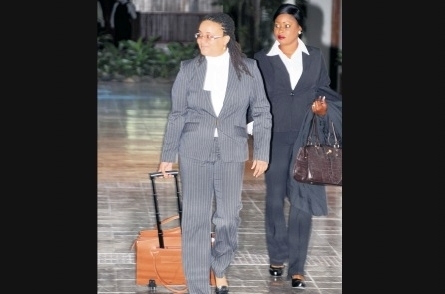
Photo of Myrie (r) from the Jamaica Observer
When one of my favourite Jamaican journalists who was present in court yesteday tweeted the link to her post on the proceedings of the first day I clicked on it rather eagerly but was repelled by her opening sentence:
A beautiful fair skinned pony tailed, black suit, white inside blouse wearing young woman in a medium heeled closed up black shoes, Shanique Myrie is called into conference room 2 at the Jamaica Conference Centre, in a fight for her rights as guaranteed under the Revised Treaty of Chaguaramas which establishes the Caribbean Court of Justice, CCJ.
In the first place, the Grammar Nazi in me was offended by the overladen, clumsy, grammatically dubious lead-in to the report. How on earth could “white inside blouse wearing young woman” be considered acceptable English by anyone but particularly a journalist? Was there a moratorium on fullstops, commas and hyphens? How could a black suit ever be described as beautiful, fair-skinned and pony-tailed?!
Second, why was it important to know what the claimant was wearing? would a male petitioner’s clothing have been described in such tiresome detail? Later in the same post the journalist went on to note:
Wearing a diamond shaped gold looking clip on earring, Miss Myrie recites her full name as Shanique Samantha Myrie who though unemployed now works in food and beverage in better times.
I was dumbfounded and took to Twitter challenging this gendered depiction of events. Why not focus on the substance of what was unfolding in court and leave sartorial detail to be captured by TV cameras ? The journalist responded saying “I believe it is important to paint a full pic for all.” She appeared puzzled by my objections.
I was even more puzzled by the reaction of another tweep, @diva_simmo, who argued that “in the court room image is everything. Even Vybz Kartel choose jacket and tie over – straight jeans and fitted.” Her next tweet said “as a listener I found the information very useful especially the ‘medium heel shoe’. Image matters.”
Curiouser and curiouser. Pray how did it help to know that the claimant wore a medium heel shoe I tweeted back.
Because “if she wore 6″red wedge with mini green dress and blue wig it would indicate the direction her legal team is taking” responded @diva_simmo, “…her attire in court says legal team is portraying self respecting, mature professional.”
The penny dropped.
This landmark case is not only about nationality, it’s also about ‘class’, the ungainly elephant in the room no one wants to explicitly mention. It is important to portray Myrie as ‘decent’ ‘respectable’ and ‘sober’ because the image of Jamaicans in the region is overwhelmingly influenced by the higglers, DJs and hustlers who often represent the face of Jamaica, visiting, even migrating to other countries, where they are not always welcome.
Why? because these enterprising but capitally-challenged individuals (ie owning little capital, whether financial or social) often violate all the dearly held norms of ‘decency’ ‘respectability’ and ‘good taste’ with their choice of garments, raw speech and boisterous behaviour. They regularly transgress the zealously guarded borders of civility and decorum as much as the borders of nation states which under the new Chaguaramas Treaty they now have a right to breach.
Perhaps this was why Myrie was given the finger when she arrived in prim and proper Barbados, regionally glossed as ‘Little England’. Not just because she was Jamaican but because she was perceived to be a particular kind of Jamaican. So @Emilynationwide was right to emphasize the outfit and demeanour of Ms Myrie. It may be extremely germane in the instant case.
PS: The overall point I’m making in this post is not to dis the journalist concerned or claim that there was no substance to her post. Far from it. When i said let’s focus on substance rather than style or appearance it hadn’t yet occurred to me that in this case style IS the substance or a substantial part of what’s at stake. I realized belatedly based on something @diva_simmo said that the reason for the focus on Myrie’s dress was because class prejudice is a real danger here and Myrie’s appearance is material evidence that may well influence the jurists involved, so much so that her legal counsel went to great pains to counter this by dressing her ‘classily’. So Emily was right to focus on how this was achieved. Being somewhat resistant if not immune to the strictures of fashion this wasn’t obvious or self-evident to me. My point is simply that if class is an issue let’s explicitly state it and discuss it because that’s the substance of what we’re getting at by extensively describing Myrie’s carefully assembled clothing. Profound apologies for any distress I caused Emily Crooks.
Javed Jaghai’s brilliant video intervention asking for respect for Jamaican homosexuals is part of a sustained and unprecedented campaign by Jamaican gays asking for recognition as Jamaican citizens.
Jamaica’s LGBT community has come up with the most imaginative and moving campaign called We Are Jamaicans to deal with the widespread local hostility towards homosexuals. It is a series of videos in which young Jamaican gays come out on camera, in an effort to directly put their case to the nation as it were; some like Javed in the video above reveal their faces, others simply use index cards. These YouTube videos have been circulating widely on social media but as many have pointed out in all the fuss traditional media made about the New Kingston street gays and the problem they were causing in the most expensive part of the city, the Golden Triangle–none of them even took note of this unprecedented campaign by the local gay community and JFLAG.
Javed Jaghai’s video above is a must see. It is a brilliant and provocative plea. And a very brave one for in it he squarely faces the camera and identifies himself–and his posture is not that of a supplicant, an outcast begging to be let in–there is a more than a hint in it of that very Jamaican quality–defiance. Watch it and see what you think…
Homeless gay youth live on the streets of Kingston and terrorize passers by…what is the solution? Could this problem be a “creation of our collective homophobia?”
Police personnel assigned to the St Andrew Central Division are admitting they are at their wits’ end in their bid to apprehend members of an ever-increasing group of self-proclaimed homosexuals who are allegedly wreaking havoc in the Golden Triangle and New Kingston communities of South East St Andrew.
Jamaicans have only themselves to blame for this problem of homeless gay street youth. This isn’t the first time we’re hearing about this. Several times last year we heard about the problems police were having with aggressive homeless homosexuals in New Kingston (see above video). JFLAG (the local gay rights lobby group) attempted to mediate but finally threw up their arms in frustration as it seemed there was little they could do to help. The young gay street youth wouldn’t listen to them. People calling up the radio stations are demanding swift punitive action but the Police have nowhere to put the young men if they arrest them and therefore are ‘at their wits’ end’ as the article startlingly says.
Well this is clearly a case of the chickens coming home to roost. In December I read a blogpost that asked a very pertinent, self-evident question: “Could this monster, which has come back to haunt us, be the creation of our collective homophobia?”
The writer goes on to point out that if Jamaican attitudes to homosexuality force families to evict members who are gay and if society in general then denies the young men decent jobs and the social wherewithal to make lives for themselves the outcasts will then do what outcasts everywhere do for survival: beg, borrow, steal, harrass, attack and generally ‘get on bad’.
It’s a predictable outcome. Why are we so surprised? Here is a homegrown case for a drastic revision of the counter-productive but widespread local bias against gays. This pressure isn’t coming from the international gay community, there is no foreign hand we can point to accusingly, this is a case of putting our house in order by ensuring that we don’t stigmatize those who are different from us, casting them out of society till they have no choice but to prey on the rest of us. There is not much the police can do about this problem. The solution to this one lies fairly and squarely in the hands of all Jamaicans. Let’s deal with it post-haste by dismantling the atmosphere of hysteria and denial surrounding homosexuality.
There’s been a bit of an uproar in Jamaica ever since the Chicago Tribune published an editorial on Jan 8, 2013, comparing Jamaica’s parlous financial state to that of Greece, considered the biggest loser of 2012. Provocatively titled Jamaica’s Debt Hurricane the editorial drew attention to Jamaica as another Greek tragedy waiting to happen:
Americans concerned about the impact of public debt on the global recovery have focused — with good reason — on Greece. Closer to home, however, the tourism mecca of Jamaica illustrates the catastrophic effects of borrowing way too much, and the painful choices that follow. This saga, less familiar than Greece’s, is a lesson for lawmakers in the U.S. and elsewhere.
The Caribbean nation actually is in worse financial shape than Greece: Jamaica has more debt in relation to the size of its economy than any other country. It pays more in interest than any other country. It has tried to restructure its loans to stretch them out over more years, at lower interest rates, with no success. Such a move would be risky for its already nervous lenders. So Jamaica is trying to wangle a bailout from a skeptical International Monetary Fund. Another deadline for a potential deal just came and went last week, though negotiations continue.
Jamaica is caught in a debt trap. More than half of its government spending goes to service its loans. The country can spend barely 20 percent of its budget for desperately needed health and education programs. Its infrastructure is faltering. It lacks resources to fight crime. It has little margin to recover from natural disasters such as Hurricane Sandy.
To set itself straight, Jamaica needs a restructuring, and a bailout with significant debt relief. No way can a small economy that has limped along with growth at less than half the global average for two decades pay back the fortune that it owes. But as with Greece, as with America, as with the state of Illinois, government leaders have balked at imposing the inevitable hardships. Saying no to favored constituents is no easier in Kingston than in Springfield.
This bald statement of Jamaica’s stark reality has deeply shaken this nation whose citizens have never had a liking for plain talk. Being a former sugar plantation, the product is abundantly available, and sugar-coating the truth is routine. In the excited chatter that followed, this response by a young friend on Facebook stood out. His name is Samuel Morgan:
Ok – so Jamaica has a serious and critical debt problem. This is therefore the challenge of our time, for our generation to fix and I believe wholeheartedly that we can – why are we educated if not to find solutions? if we don’t, then our children will have to fix it, and if they don’t then theirs will. Could I find just 20 humble and willing people who aren’t motivated by greed and personal welfare, who aren’t caught up with always going to party at maiden cay and getting drunk on Friday nights – who are not so egotistic as to think that they are better than their ordinary countrymen , who are patient and ingenious , who are prepared to sacrifice for the good of those who will come after, whose names will be deserving of marking the halls dedicated to them and their work, and whose names children of the future prosperous Jamaican nation will proudly bear? Could I just find 20 people who understand that things will never get better unless I can find these 20 people? And could those 20 people inbox me with the subject – Revolution!
Its the young who will have to find ways to cauterize our debt wound. If there are enough like Samuel Morgan around there is hope.
An aside on corporal punishment in Jamaican schools with a quote from Professor Orlando Patterson on the terrors of Jamaican childhood as he experienced it.
I find myself bemused by the latest subject of public discussion in Jamaica–whether corporal punishment is a suitable form of discipline for children or not. Alas it seems that if a poll were taken there would be overwhelming affirmation for this cruel practice despite there being instances of severe abuse, including a young boy who lost his eyesight after being struck with a teacher’s belt.
The subject hit the airwaves after a parent objected to her nine year old daughter being hit for not performing well enough at a popular Jamaican school. The following report in the Sunday Observer tells it all:
THE administration of Kensington Primary School in St Catherine is coming under fire from the parents of a nine-year-old girl who are taking issue with the school’s use of corporal punishment in its administration of discipline.
However, the leadership of the school, which is arguably the best-performing primary institution in Jamaica, is hitting back, insisting that it has done nothing wrong, as the flogging of students plays a key rule in ensuring that they focus and display the behaviours that are conducive to learning.
What I find disturbing is the number of people i know, talk show hosts, Facebook friends and others, who defend the use of corporal punishment. One friend asked:
Shouldn’t we define corporal punishment I believe there is a qualitative difference between a slap/hit in your palm as opposed to caning on the backside. When my children consistently do something that is wrong, I slap them with a short belt, not to hurt them, but to remind them that that particular behaviour is not what is expected of them. Over the years it seems to have worked. What is the alternative to correcting bad behaviour away from this physical reminder?
I think what I’m dumbfounded by is the fact that normal, responsible, well-educated adults genuinely don’t seem to know that there are other ways to discipline or teach children right from wrong. Another argument that keeps being repeated is: WE were all brought up on the strap, the switch and the whip and look how well we’ve turned out.
No bredren, you haven’t turned out well, you’ve grown up into someone who thinks that its absolutely fine to beat a child into submission! You’ve taught that child the lesson that violence is the solution to ignorant behaviour not explanation or reasoning or education but application of pain. No wonder Jamaica is such a violent place. Colin Channer even wrote a story once called How to Beat Your Child the Right and Proper Way.
In fact the whole sorry state of affairs reminded me of an email I recieved from Orlando Patterson some years ago. He was responding to an interview I had done with Rex Nettleford in Caribbean Beat in which Rex had rhapsodized over his idyllic rural childhood in Western Jamaica. Orlando’s memories of growing up in the Jamaican countryside were altogether darker. I hope he won’t mind if I quote the relevant paragraphs here…
It was interesting to read a bit about Rex’s childhood although it is heavily filtered by him. I grew up in rural Jamaica too– May Pen mainly, (then a small village) and Lionel Town (a couple of horrible years; I can still recall the stench of the hospital which suffocated the entire town) and spent holidays in St. Elizabeth. Rural life at that time had its brutal side: hunger, beatings from parents and grandparents who firmly believed in not sparing the rod and spoiling the child; sexual abuse of young girls (and, possibly young boys, although I was spared that), overcrowding and just mindless boredom. Rex and myself were among the very, very lucky ones who escaped through education. What I recall are the farm kids who never turned up to school on Fridays, then never on Thursdays and Fridays, then by age 10 or 11 never at all. The teachers were nearly all pretty sadistic, all of them armed with heavy leather straps, some with forked ends. I just don’t see how one can romanticize most of that. It was serious alright, seriously oppressive. Sure there were the good moments– the moist light of the early mornings; the evenings before sleep when the older kids told stories; the rainy days when the teachers briefly rediscovered their humanity and treated us like the children we were; the occasional country fair ( in my case, the early days of the Denbigh Agricultural Show). But they were few and far between, and even the public rituals and fairs had a scary element for a young kid: the Jan Cunu and Horsehead mummeries were genuinely terrifying; the Hussay festival which the Indians in Vere enacted annually scared me near to death as I gasped at grown men flagellating themselves and seeming as if they were about to chop each other to pieces; the crop-over market dances which always had at least one fight or worse. For nearly all but the fortunate few, life for a kid growing up in rural Jamaica (it was a lot better in Kingston, then) during the thirties, forties and fifties, was raw, unhealthy, painful, often hellish, and for far too many, brief.
Sorry if this depresses you. I am still reeling from the shock of New Orleans and the horrible ineptitude of the federal and local governments here. In a better mood I might perhaps remember rural Jamaica in terms more like Rex’s, but I doubt it.
One good thing is that beatings are no longer administered in most schools in Jamaica after determined efforts by the Ministry of Education to discourage it. The outcry in the media concerning Kensington Primary’s use and defence of corporal punishment is also encouraging. Hopefully the number of children living in terror of physical violence will continue to decrease.
In which i resurrect my 2006 Herald column written on the occasion of the near lynching of a suspected gay man by a mob of 2000 UWI students…
In this post I reproduce my column in the Sunday Herald, April 2006, Keeping Men Safe at UWI, written following an unprecedented attack on a man said to have made a pass at a male student on the University of the West Indies (UWI) campus. In that incident a mob of 2000 students descended on the unfortunate man and the security guards concerned actually protected him till the police arrived. But first here is an excerpt from the Gleaner’s editorial on the subject Barbarous bloodlust at UWI, published on April 6, 2006.
What happened was not a reasoned protest against what they consider deviant homosexual behaviour, but rather so violent an overreaction that the police in riot gear had difficulty controlling the mob. Shots had to be fired in the air while some students reportedly hurled missiles at the police. It seems clear that if there had not been strong and timely intervention by the police, the alleged homosexual would probably have been beaten to death.
And below is the column i wrote in response to the attempted lynching.
Keeping Men Safe at UWI
So now UWI has joined the exclusive club of tertiary-level institutions in Jamaica turning out bigots and murderers. Depressing, but somehow predictable, isn’t it? First there was NorthernCaribbeanUniversity where a few years ago five students suspected of being homosexual were severely beaten up after which to add insult to injury the university’s rescue vehicles refused to take the students to hospital. Then a year or two ago UTECH students cornered an alleged car thief on campus and killed him in the most barbaric manner suggesting that the expensive education spent on them had left little or no mark.
Now comes the crowning touch, the finale. Students at the crème de la crème of universities in Jamaica, the University of the West Indies, practically murdered a man who wandered onto campus and allegedly made an ‘advance’ towards a male student in one of the bathrooms on campus. It’s entirely possible that the alleged homosexual wasn’t quite right in the head judging by the fact that he had been escorted off campus earlier in the day for loitering on the premises. He came back and peeped at someone using one of the male bathrooms. Instead of politely declining the man’s advances and notifying security the student raised an alarm that summoned forth a mob described as being 2000-strong that proceeded to chase, beat and stab the man who narrowly escaped with his life after the police, with great difficulty, intervened.
What is perhaps even more alarming is the fact that senior lecturers at UWI seem bent on making spurious arguments which sound dangerously as if they are justifying the action of the students. “Imagine that the alleged pervert had entered the female bathroom and it was your daughter, sister, girlfriend or wife” equivocated one pun-derous (stet) academic who writes a column in the Sunday Gleaner.
Needless to say if every man on campus, student or otherwise, who made advances towards a woman, were similarly lynched men would soon become an endangered species. Perhaps male students should take lessons from us females in how to fend off unwanted advances without panicking that their manly virtue is about to be ravished. Isn’t it interesting, said a female colleague, that the slightest homosexual advance on a man is interpreted as a grievous assault almost amounting to rape? Suppose women were encouraged to do the same every time a lecherous male leered at them?
“I’ve always been told that if you’re robbed in downtown Kingston, its better to shout ‘B-man, B-man!’ rather than ‘Thief! Thief!’ quipped a Trini friend when he heard the news. According to him it’s a well-known fact that Jamaicans will barely take notice if they come across a thief or a murderer but confront them with a gay man and they react as if faced with a weapon of mass destruction or the devil himself.
It’s excellent that the University has come out and condemned the near-lynching in no uncertain terms. It must go further however by undertaking educational campaigns to rectify the prevalent mindset among both students and academics. What is absolutely astonishing is that in spite of such outrageous behaviour senior academics are still claiming that Jamaicans are ‘homo-antipathetic’ rather than homophobic. One shudders to think of the kind of research such scholars are producing given that their grasp of reality is so questionable.
It also does the university no good when it issues stern warnings to its students indicating zero tolerance of such violations of human rights when its own senior academics are to be found in the leading newspaper making weak puns about ‘homocide’ and ‘backlash’ in an attempt to underplay the seriousness of the situation. Noteworthy also is the tendency of such academics to be critical of ‘mob behaviour’ rather than the rabid homophobia which fuels such a mentality. Likewise it raises questions about the Gleaner’s own position on the matter that it carries such columns while at the same time thundering against the behaviour of the students in its editorials. All of this is sending mixed signals to young people who it could be argued seem to know no better though they’ve had the benefit of university education. But can they really be blamed when those who teach them prefer to purvey prejudice rather than knowledge?
This is why I thought the campaign by prominent gay rights organizations in the UK and the US against Jamaican DJs and their homophobic lyrics was fundamentally misguided. Most DJs, almost 99% of them have not had the benefit of the kind of education UWI students have had. How and why should anyone expect them to see the light when highly educated students and lecturers do not? Homophobia must be attacked in the places it really spouts from, the numerous fundamentalist churches that spew hatred and ignorance and in institutions of learning, higher or otherwise.
If at all anything was gained by the campaign to educate DJs against expressing homophobic sentiments it has surely been undone by the example of UWI students who not only engaged in flagrant gay-bashing but also vociferously defended their criminal behaviour on national television afterwards. Shame, shame, shame.
There is no agenda for change in relation to attitudes towards homosexuals in Jamaica, in effect this resulted in the beating of allegedly gay student on the University of Technology campus.
Clovis, The Jamaica Observer
Personally i think the right punishment for the University of Technology (UTECH) students so eager to lynch an allegedly gay student should be a year’s community service at JFLAG…that’s the Jamaica Forum for Lesbians, Allsexuals and Gays. I also think that all of Jamaica’s major institutions, its leaders and its citizens are responsible for the beating the unfortunate UTECH student received. I’ll explain in a minute but first for anyone who doesn’t have the requisite background on this latest episode of homophobic violence in Jamaica please read Petchary’s Blog and the post titled Sticks and Stones for details.
Here’s why i say almost everyone is to blame for the violence that exploded on the UTECH campus this Thursday. The Education Minister Ronald Thwaites was on air yesterday righteously denouncing the episode and calling for the mob of students to be expelled. Yet only a few days before that he was in the media talking about a ‘gay agenda’ which had apparently had a sinister hand in the reform of the health and family life education curriculum for high schools in Jamaica.
Las May, The Gleaner, March 4, 2011
To quote the Gleaner article which reported on this at the time:
The Sexuality and Sexual Health: Personal Risk and Assessment Checklist segment of the third edition of the curriculum geared at grades seven to nine was what caused the uproar.
Contentious Questions
Among the questions posed to students were: Have you ever had sexual intercourse? Have you ever had anal sex without a condom? What caused you to be a heterosexual? When and how did you first discover you were heterosexual? If you have never slept with a member of your own sex, is it possible you might be gay if you tried it? Why do heterosexuals seduce others into their lifestyle?
The book also instructed students to perform a number of exercises to better understand their sexuality.
Yesterday, Minister of Education Ronald Thwaites ordered the curriculum pulled, saying some of the material was “inappropriate”.
“I have been made aware of widespread public concern about certain sections of the health and family life education programme curriculum used in Jamaican schools. There is strong objection to some of the questions on sexual behaviour and the commentary on heterosexuality/homosexuality,” the minister said.
“I consider sections of the material inappropriate for any age and certainly for the grade seven and eight students for which it is designed.”
He added, “I have instructed that the material be withdrawn from all schools and rewritten then redistributed so as to prevent disruption of the health and family life education instruction.”
Meanwhile the Jamaica Observer devoted an editorial, Not Enough Mr. Thwaites, to denouncing the sinister plot to sensitize Jamaican children to alternative sexualities. Here is part of what it said:
WHILE the practice of homosexuality is accepted and considered a basic human right in many other countries, Jamaican law and cultural norms disapprove.
The situation as it relates to Jamaica will perhaps change in time to come; but not yet, and not, we believe, for some time yet.
We should recall that this newspaper is on record — as is the current Prime Minister Mrs Portia Simpson Miller — as saying that the country needs to revisit the archaic, centuries-old buggery law.
However, in the meantime, Jamaican law and culturally accepted behaviour should be respected.
In that respect, we are unsurprised by the suggestion from Minister of Education Rev Ronald Thwaites that at least two persons involved in the drafting of the Health and Family Life Education Programme (HFLEP) curriculum, recently pulled from local high schools because of what can perhaps best be described as ‘gay friendly’ sexual content, “had a particular agenda and were able to embed it in the curriculum”.
For, in our view, loaded questions for teenagers, which were reportedly included in the rejected curriculum, such as “have you ever had anal sex?” and “if you have never slept with a member of your own sex, is it possible that you might be gay if you tried it?” suggest an agenda of sorts. We say this particularly in light of the Jamaican context.
Also, this was clearly not a stand-alone case. The minister tells us that “it does appear that there were previous instances, and there were warnings, and it was a clear intention of some who have very clear predispositions regarding sexual conduct… who got away on this one”.
A look back to 2007 will reveal that the then Minister of Education Mr Andrew Holness felt compelled to tell the country that a book on home economics was not endorsed by his ministry. This followed revelation of a section which claimed that “when two women or two men live together in a relationship as lesbians or gays, they may be considered a family”.
The problems with the withdrawal of the revised curriculum are succinctly stated by Maurice Tomlinson, a former UTECH lecturer, who had to flee Jamaica when he recently married his partner in Canada. In a post titled Countdown to Tolerance Tomlinson points the finger at the brands of Christianity practised in the country for this interference in school curricula.
The situation in Jamaica concerning the status and well-being of its homosexual citizens continues to evolve in a one step forward-two steps backward manner. The video above, featuring former Miss Jamaica World (1998) and Miss Jamaica Universe (2004) Christine Straw with her gay brother, Matthew, was launched by the advocacy group Jamaica Forum for Lesbians, All-Sexuals, and Gays (J-FLAG) at the beginning of this month.
The video was designed as a PSA (Public Service Announcement) and was intended for airplay on Jamaica’s main TV stations, CVM and TVJ. Apparently in yet another display of media gutlessness both stations have declined to air the PSA in fear of public reaction.
So the point I’m making is: how is the change so desperately needed to prevent further episodes of violence towards homosexuals in Jamaica going to occur if those responsible for change through education–the Ministry, the media and the Church (in all its multi-denominational glory)–refuse to undertake the dissemination of material designed to change hearts and minds? What are our tertiary institutions going to do about this? In a separate post i will detail the history of similar incidents at the University of the West Indies and Northern Caribbean University to show that although UTECH is now in the spotlight such an episode could well have occurred (and have occurred in the past) at any of Jamaica’s tertiary institutions.
Finally Owen Black Ellis has just detailed on Facebook an instance that actually happened in Jamaica which highlights the lethal absurdity of local hostility towards gays:
The whole Utech saga has me remembering something that happened couple years ago to a couple I know and their friends. This is a true story. It was valentines day and two couples were having a meal in an uptown fast food joint. The girls were sitting down at the table and the guys were in the bathroom writing up the valentines day cards they bought earlier to give to the two girls who were waiting outside. They were laughing and reading and comparing each other’s cards when a man walked in and assumed they were giving the cards to each other, so he raised an alarm “yow people, two battybwoy inna di bathroom a exchange Valentines day card’. People, in no time a crowd converged, and no amount of explaining from the guys and begging for mercy by the girls could save them. And as they crowd grew and people asked about what happened, some added ‘dem mussi did in deh a have sex’ etc.. etc…so the details got more sensational and the condemnation got more intense, and the beating was wicked…
A note on Hurricane Sandy as she menaces the East Coast of the United States.
The Hope River (Kingston, Jamaica) in spate – Varun Baker photo.
UPDATE! Seven people came to this blog today searching for “hurricane sandy in jamaican patwa”. Can’t tell you how happy that makes me.
SANDY. A hurricane event with a windspan so broad (1000 miles wide) she’s menacing the United States from New York and the East Coast all the way to Chicago. And this after ravaging us in the Caribbean from Jamaica to the Bahamas, through Cuba and Haiti. People don’t understand how a Category 1 hurricane can do so much damage. Satellite shots make it look as humdrum as buttermilk seething in a giant churn but Sandy is dangerous because she’s slow moving and large–as i said her windspan is unusually wide, and she’s adept at the slow creep. So though not packing as much power as a Cat 4 or 5 storm usually does over a much narrower radius Sandy’s still deadly because of the water she brings with her. She dumps so much rain on affected areas as she creeps along in slowmo that the earth gets sodden and trees and poles are no longer securely anchored toppling over once the wind starts plucking at them. Its the flooding Sandy produces that will be the real threat, especially to people in what are called “low-lying areas” (like the homes in the photos by Varun). Meanwhile the relative height of one’s locality is just coming home to people. As the writer Hari Kunzru (@harikunzru) said on Twitter:
Beginning to appreciate the ‘hill’ part of Clinton Hill. #sandy
Varun Baker photo. http://varunbaker.com/A view of the coast at Palmyra Rosehall, St James – Hoween Griffiths Photo. Email: h.griffiths@rosehall.com
At any rate that was our experience with Sandy here in Jamaica. A lot of trees went down or were brutally pruned. She seemed to have something against banana plants…people think they’re trees but they’re not, they’re large plants…so yes, we’ll have no bananas for the next 6 months because both Portland and St. Mary, the banana parishes, have been devastated.
So good luck to all the folks in the US of A who aren’t used to tropical weather events such as hurricanes…its like a wet tornado i guess. And hopefully by the time Sandy has swept through the East Coast you won’t be emerging into a political cyclone as the Republicans and the Democrats go head to head and Mittens and Big O face off for the big one on November 6. We hope that whichever candidate wins he will take the threat of global warming seriouly. Again i turn to Twitter for some instant wisdom on the matter:
RT @TonyKaron: Sandy’s disruption of electioneering is nature’s poetic rebuke to both candidates for their silence on climate change #fb
PS: Breaking News! As of 8 pm EST it was declared that Sandy is now a post-tropical storm. She has morphed into a cold weather event.
and i eavesdropped on this twitterati convo:
Salman Rushdie @SalmanRushdie
Lights flickered off/on. Wind crazy.Watching the big old tree out back. It’s a tough New York tree. It can take it. Right, tree? Am I right?
Deepa Mehta @IamDeepaMehta
@SalmanRushdieYou absolutely are , right that is. Hang tight tree. Hang tight Salman XX
and look at this photo posted by @nycarecs
Official Twitter feed of the New York City Amateur Radio Emergency Communications Service (NYC-ARECS)
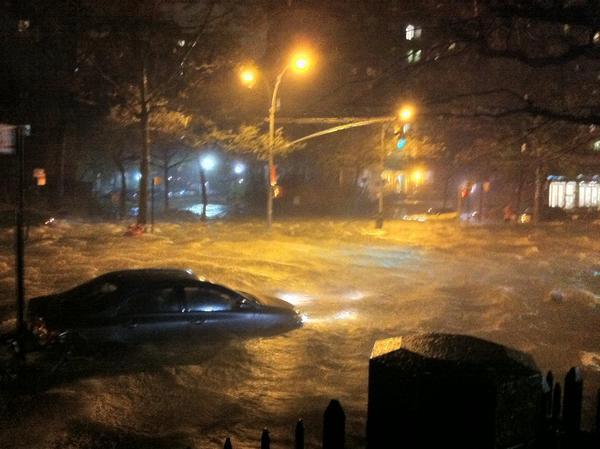
AN OCEAN ON NY’S LOWER EAST SIDE. Never happened ever like this. #sandy #nyc via @nycarecs
Hang tight everyone!
Got this from NYTimes.com. “Sea water flooded the Ground Zero construction site.” Photo: John Minchillo/Associated Press
oh my various gods! will the US Presidential elections have to be postponed…? at this rate? things are deteriorating rapidly in NYC, don’t think they can recover by Nov 6…
An exhibit featuring a selection of the 2012 First International Reggae Poster Contest’s winning posters opens at the National Gallery of Jamaica on Sept 30, 2012 unveiling an ambitious agenda to build a Frank Gehry-designed building on the Kingston Waterfront to showcase Jamaica’s globally renowned music.
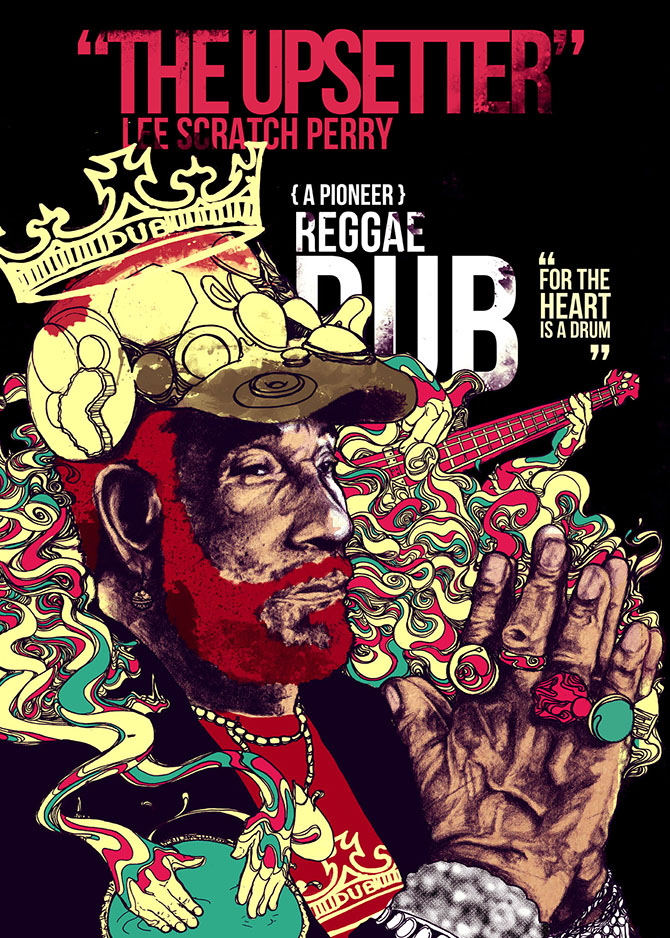
5 | Taj Francis | Jamaica
Taj Francis, a Jamaican designer, came fifth in the the 2012 First International Reggae Poster Contest with the poster directly above, depicting Lee Scratch Perry.
In my last post i decried the shambolic music museum that has been created in Jamaica to honour its world historical musical tradition. I also mentioned the National Gallery of Jamaica, an almost first world facility created to showcase the visual arts tradition of Jamaica. I could never understand why I rarely got a sense from the art displayed at the Gallery that there was any cross-fertilization between the powerful music scene here and the visual art scene. I also thought it strange that there was no reference to the fact that the Gallery was situated on Orange Street which in the 60s and 70s was known informally as Beat Street because it was the throbbing centre of musical activity in Jamaica. The passage quoted below will give you an idea of what I mean:
Like Bourbon Street in New Orleans, Beale Street in Memphis, 42nd Street in New York or Music Row in Nashville, Orange Street in Kingston, Jamaica is the prototypical ‘Music Street’. As indicated by its unofficial name, Beat Street, the area around Orange Street in central Kingston had been a centre for sound system activity since the 1950s. By the 1960s Orange Street itself was the subject of numerous songs – the great Prince Buster’s “Shaking Up Orange Street” being merely the most famous [and versioned]. Many producers rented shops in and around Orange Street, including Bunny Lee at number 101, Sir JJ Johnson at number 133, and perhaps most celebrated, Prince Buster’s legendary Record Shack at number 127. Sonia Pottinger’s pressing plant was also in Orange Street, at the bottom; just around the corner was Randy’s Studio, above the shop on North Parade. The area continued as a centre for music into the seventies and beyond, although on a much smaller scale. Prince Buster still operates his shop there, as does Augustus Pablo. Producer Trevor ‘Leggo’ Douglas was one who came to Music Street in the late seventies, opening Cash & Carry Records at 125 Orange Street, just down the street from Prince Buster; like Buster, he’s still there today, running his own studio. Right next door to the Prince was the address that gives title to this compilation; Dudley ‘Manzie’ Swaby and his then-partner in music the late Leroy ‘Bunny’ Hollett moved into premises on the music street late in 1975, having previously operated from Manzie’s family home in Love Lane nearby. From the House of Music at 129 Beat Street they issued a series of recordings – both in roots style and love songs – that have easily stood the test of time. Most of this music has never been issued outside of Jamaica; this compilation is hopefully the first of several to chronicle Manzie Swaby’s underground roots legacy.
By the end of the eighties when i first came to Jamaica you could see little sign of the former life of this historic street and today very few are aware of its rich musical connection. It’s fitting that finally the National Gallery is putting on a show which directly references the globally renowned music of the counry–Reggae. Tomorrow, an exhibition featuring some of the winning designs in the 2012 International Reggae Poster Competition–World-a-Reggae–will open at the Gallery. The brainchild of Michael Thompson, graphic designer extraordinaire who was trained at the Edna Manley College and exposed to the great graphic tradition in Cuba, the Reggae Poster contest was truly global in scope. To quote the contest website:
The 2012 First International Reggae Poster Contest (RPC) began in December 27, 2011 with the goal of discovering fresh Reggae Poster designs from around the world. Interest in the contest grew significantly over the 4-month run with a total of 1,142 submissions from 80 countries. The contest winners were chosen from 370 finalists by a distinguished panel of judges known for their creativity and commitment to design.
Thoroughly impressed with the outcome of the competition, the RPC organizers are excited to announce that the international jury committee has selected the three finalist and the 100 best posters.
The winners are:
1st Place: Alon Braier, of Israel, for his “Roots Of Dub” poster
2nd Place: Zafer Lehimler, of Turkey, for his “Reggae Star” poster3rd Place: Rosario Nocera, of Italy, for his “Riddim is Freedom” design
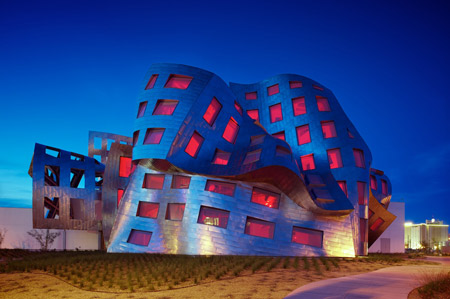
Please note that the top 3 winners are all from outside the Caribbean, a sign that local designers faced stiff competition from abroad. The contest also highlights the extraordinary reach of Jamaican music and popular culture, so inadequately honoured at home. Well Michael Thompson aims to change all that (for an interview with him on Jamaican TV go here). Along with Carolyn Cooper and others he’s all set to lobby for a world-class museum facility to be built on the Kingston Waterfront designed by none other than Frank Gehry, the architect who built the Bilbao Museum and so many other world-renowned art facilities. If he can find enough investors with the vision to see how this would add value to Jamaica’s rather limited tourism product–which does little more than capitalize on the country’s sun, sand and sea–the project could get on its feet. Some may think this is an absurdly grand project but to do justice to Jamaica’s music you do have to reach for the stars. I mean can you imagine how fabulous something like the building below would look squatting on the Kingston Waterfront? It could spearhead the long overdue revival of downtown Kingston. So what’re we waiting for? Let’s do it!
A Frank Gehry-designed building
World-a-Reggae, the exhibit of the 100 best entries opens tomorrow at the National Gallery of Jamaica at 11 am. The winning designer, Alon Braier, from Israel, will be there. Carolyn Cooper will be the guest speaker and the best part: The Alpha Boys Band will be performing all afternoon till 4 pm. So come on down! See you there!
Jamaicans trying to come to grips with atheism on a TV show, Religious HardTalk
The irrepressible Ian Boyne, host of Religious Hardtalk
Religious Hardtalk
One of the stalwarts of the Jamaican public sphere is Ian Boyne, columnist, speech writer, pastor and host of TV programmes Profile and Religious Hardtalk. Last week he produced an exceptionally good episode of the latter looking at the subjects of Atheism and Secularism in religion-obsessed Jamaica (9/18/2012). It must be said that Boyne himself is a superb example of Christian practice at its best. He’s not afraid, as you can see from watching the video (linked below), to engage openly with views that depart drastically from his own. In the process he allowed time and space for a dissenting view rarely heard in Jamaica.
The two young people he had on were very articulate and gave a spirited critique of the kind of Christianity espoused in Jamaica and its insidious seepage into all areas of national life. One of them, @Chatimout or Javed Jaghai, has even gone so far as to start a group called Jamaicans for Secular Humanism for those like himself who want a space to articulate their doubts about the dangers of the all-enveloping, unquestioning forms of religiousity adopted by many Jamaicans. In fact its quite heretical in Jamaica to express the view that God might not exist or that there is something problematic about the de facto embrace of Christianity as a state religion.
I know a young man who as a child at St. Peters and Paul, a prominent Jamaican prep school, innocently announced in class that he didn’t believe in ‘god’. He was then subjected to disbelieving, disapproving scrutiny all day by other teachers who would pop into the classroom to have the ‘godless’ boy, who was all of 8 years old, pointed out to them. I was reminded of this story when I noticed with amusement the caption under Javed Jaghai’s image stating baldly “DOES NOT BELIEVE IN GOD.” In fact so narrow and hidebound are Jamaicans in their practice of Christianity that this episode of Religious Hardtalk was not repeated at the normally scheduled time because the powers-that-be were afraid that schoolchildren might be exposed to such apostasy!
Fortunately the TV station has made it available online. I highly recommend it, in fact its a must see for anyone trying to understand Jamaican culture:









 Active Voice