In which I meet Doc Cornish, shadow Minister of Justice of the Accompong Maroons, literally, by accident in the parking lot of Devon House.
Devon House by Varun Baker
Something surreal happened last night. Rather than go into any lengthy explanations I’ll let the following series of tweets, messages and status updates fill you in on the circumstances:
off to have dinner with Belinda Edmondson author of Caribbean Middlebrow…still haven’t decided on restaurant
On my way to pick Belinda up, i glanced at my phone during a red light break and saw:
Ok if diana paton and gad heumann tag along? They asked where i was eating?
Shortly I was tweeting from The Terrace at Devon House, formerly known as Norma’s on the Terrace. Norma no longer being on the scene (the famous chef died rather suddenly in 2010) the restaurant has been renamed by dropping Norma’s name (a new take on name-dropping?).
At The Terrace, Devon House w Belinda Edmondson, Faith Smith, Gad Heumann, Diana Paton. Magnificently lit tree
‘In courtyard’ I would have added if I had any character(s) left. And Shani Roper. By now you must know about Twitter’s infamous 140 characters, including spaces?
The tweet included a photo–not the best one–of said tree (see below).
Devon House Christmas Tree
The courtyard at Devon House is a splendid sight. The enormous tree in the centre is all decked out in lights for the season, done by someone with a light, magical touch. When you step into that space you feel transported–to happier, more cheerful times, to the festive, to thoughts of celebration and contentment–
There was only one jarring note; a mass produced nativity scene, reminding us that we live in a world largely made in China, out of cheap plastic, in garish colours.
Conversation was lively at our table as it was bound to be with several top ranking scholarly authors around it who happened to be in town for an editorial meeting. The book is to be about Victorian Jamaica, edited by Wayne Modeste, formerly of the Institute of Jamaica, and Tim Barringer, one of the Yale art historians who curated the massive Isaac Mendes Belisario show a few years back. That show produced one of the most sumptuous catalogues of its art the region has yet seen.
Belinda, who’s recovering from an illness, suddenly started to feel ill, and decided to leave before the food even arrived. I left with her to take her back to the Terra Nova where the authors were all staying, and return. In the parking lot people were coming and going, we got into my car and started pulling out when two ladies in a large forerunner type vehicle to our left started hissing and carrying on saying “Stop! Stop!”
What the hell–? I saw no reason to be detained by them so tried to start off again. This time one of them actually came and pounded on poor Belinda’s window shouting, “You can’t go!”
“But I’m feeling sick!” protested Belinda weakly while i leaned over to give the woman a piece of my mind.
“Jesus Christ, these women don’t understand?!” the younger woman shouted throwing her arms up in the air. “Look how long we been waiting for you to come out and now you don’t even want to listen! Lady, we bounced your car by accident, see the damage here!” she said dramatically pointing at the bonnet of the car which i now noticed was slightly bent out of shape.
Meanwhile the older woman came up and said “We’re really sorry, see my card here, just call me.”
This was all very confusing. Red wine had been imbibed after all. I was being pulled down to earth very suddenly and wasn’t sure how to respond. Surely i should be enraged and express some hostility towards these ladies but i couldn’t muster any. They were just so contrite and had been waiting for nearly an hour for me to come out. I shuddered to think what would have happened had Belinda not taken sick because i would only have emerged another couple of hours later.
“Jesus, mi feel faint. Mi was was scared so till…mi seh the driver going to so vex, he will beat mi up.” gasped the younger woman leaning against the bonnet of her vehicle for support. In retrospect i realize she must have been the driver though at the time i didn’t even have the sense to ask who was driving, much less take any photos which i decided some time ago I must do in the event of an accident.
I did have the sense to take down the young woman’s name, number and the license plate number of the vehicle, though i can’t for the life of me tell you what brand of car it was. I looked at the card the other woman had given me. ACCOMPONG it said. Maroon Traditional Medicine. VIH. Doc Cornish. Nature Pathic Practitioner. It gave a Stony Hill Address.
“You’re a Maroon?” I asked stupidly, feeling vaguely honoured at having been bounced by someone with such a legendary heritage. “Yes,” she answered proudly, “I’m the shadow Minister of Justice of the Accompong Maroons.”
Again I have no memory of the name she gave me. Vivian Cornish? I also forgot to ask for her documents or to get details of her insurance company but I just called the driver who assured me that the security guards last night had got all the details from them after examining the requisite documents. I’ll drive by there later today and talk to them.
As i said, somewhat surreal. This morning I wondered if I had dreamt it, but my car bonnet is still a little bent out of shape so i guess not. Somehow I can’t help thinking there’s something fateful about this collision. Its not often that people are honest enough to stay and face up to the consequences of their action. The lady must be a formidable Minister of Justice. Will keep you posted.
The President of the Pharmaceutical Society of Jamaica, Valerie Germaine, is seemingly muzzled after voicing criticism of the government.
One of my closest friends is a pharmacist so i usually prick up my ears when matters pharmaceutical are in the news. My friend who taught at UTech in the 90s used to tell her students that they HAD to pay attention in her class because unlike Literature or Sociology students any mistake they made was likely to kill somebody.
Well pay attention to this. The President of the Pharmaceutical Society of Jamaica, Valerie Germaine, has been sent on half pay leave (from her government job) by the Public Services Commission. Coincidentally this happened days after Germaine appeared on a local TV programme called Morning Time in which she spoke frankly of the acute shortage of qualified pharmacists in the system. In fact, said she, the government was filling the vacancies with technicians who are not properly qualified to be issuing prescriptions to the public which they are at present doing.
Interviewed on Nationwide by Emily Crooks and Naomi Francis this morning Mrs. Germaine said that after her TV appearance she was called into a meeting with health ministry officials, including the Minister of Health, and given a ‘serious scolding’. The half pay leave followed soon after. A health ministry official who was also interviewed on Nationwide denied that any punitive action had been taken against Mrs Germaine for fulfilling her role as President of the Pharmaceutical Association. The Association however says the government is trying to muzzle them. The matter is being investigated said the Health Ministry official who was unable to respond to Crooks and Francis when they asked about the specific offence being investigated. What are the charges, they persistedin asking, without recieving any satisfactory answer.
What emerged from the radio interviews i heard was a contrast being made between private sector pharmacies which adhered to international best practices and the public sector which was in violation of them. The Jamaica Pharmacists’ Association was originally established with fifteen members and in 1944 the name was changed to the Pharmaceutical Society of Jamaica (PSJ) according to the association’s website. Interestingly the website is hosted by the Private Sector Association of Jamaica.
We await further developments with bated breath. Hopefully people’s lives are not at risk in the meantime.
How i got to Bangalore in spite of Hurricane Irene…
Puma store at Forum Mall, Bangalore
Greetings from Bangalore! Can’t believe I’ve let so many weeks go by without posting something here. But then again its been an eventful few weeks. Left Jamaica on Aug 27 heading for New York and then Bangalore. Instead Irene re-arranged my trip and i found myself twiddling my toes in Miami for two whole days. Fortunately was rescued by my good friend Pat Saunders of Miami University. When I left Jamaica American Airlines couldn’t tell me when they could get me to New York because no one had a clue when the airports would reopen there. Fortunately I had plenty of leeway as I had planned to spend several days in Long Island with my favourite aunt before boarding my Emirates flight to Bangalore.
'Fairness' creams on sale at Dubai airport, en route to Bangalore
Still when i got to Miami I decided I wasn’t leaving the airport till I had been given a seat–some seat, any seat–on a flight to New York, so i joined a very long line at the AA counter and ignored employees who assured me that I could leave and re-organize my booking by phone instead of waiting in the long line now. Let me tell you that was a wise move on my part because an hour or so later I was given a standby seat on one of the first flights to NY two days later. Also a cursory check with AA’s twitter feed informed me that people were holding on the phone for hours to talk to agents and rebook flights. i mean 3-4 hours, no joke!
It didn’t hurt that I had a first class ticket. No, I’m not rich but i was using my miles, AA has a generous system that allows you to accumulate ‘miles’ or points that can then be exchanged for actual tickets, incl first class ones and every now and then I use that option. Well this was a very good time to have done so because when i returned to the airport for the standby flight two days later i got on without a problem, being No. 5 in a list of 60 on standby! and i still got to travel first class!
Interestingly, befuddled from lack of sleep and general anxiety (why does that wretched Miami Shuttle have to pick you up a whole hour before its necessary to get you to the airport by a particular time? especially when i was the only passenger!) i had first joined a 3-400 strong crowd waiting for the general check-in counter to open at 4 am. As the time approached the crowd swelled and tempers frayed but the AA staff remained courteous, sympathetic and helpful. And this was before i woke up and realized i was in the wrong line…I was truly impressed by their civility and decency.
So i finally arrived in a wet and bedraggled New York, only to find that my aunt and uncle whose home is normally a beacon of all mod cons, had no power for the next two days, which meant no phone or internet as well. On top of that they were busy scooping water out of their basement–the whole thing seemed slightly surreal. This was New York?!
Anyway, a couple of days of making my ritual contribution to various business establishments followed (also known as shopping) after which i boarded my Emirates flight for Bangalore on the 1st. And let me tell you Emirates treats its economy class passengers like business class. EVERYone gets a hot towel, EVERYone gets a cute little bag with a toothbrush, socks and a mask and menus with three meal options. The Dubai to Bangalore leg served the most delectable fish biryani I’ve ever eaten.
Emirates little flightpack
So I arrived in Bangalore in time to take in dear Usain’s latest exploits, and although he missed the 100m a new star was born, Yohan Blake, and how magnificently Bolt ran the 200m and the 4×100! So what if the two of them weren’t standing rigidly at attention during the national anthem. Lighten up folks! Truly large nations don’t get their knickers in a knot about things like this! In fact its a sign of the opposite. In the meantime check out this Puma ad featuring Jamaica and India.
The relevance of Swiss German, a European Creole to debates about Caribbean Creoles is highlighted.
In the comments in reaction to The Power of Creole, the Boston Globe article I quoted from in my last post a HughMann makes the following points:
In the German part of Switzerland (72%), people speak Swiss German dialect in everyday speech, although literary German is the official language and is the language of the newspapers and formal life. The children enter first grade speaking the dialect and make the transition to German by the end of the year. All instruction from then on is in German, and, if a student has difficulty in understanding, the teacher may switch to dialect momentarily to clarify it. This has not impeded the children’s education. Why is it different in Haiti and Jamaica? Just as we in the U.S. maintain that everyone should speak English to succeed in commerce and business, literary French and English are needed in Haiti and Jamaica for the same reason. By all means, Creole should not be denigrated, but neither should French. Mais, oui!
Why is it different in Haiti and Jamaica indeed? While one appreciates the overall point being made Mann ends up cautioning against the denigration of French as if valorizing Creole automatically means a turning away from European language! To point out the power of Creole is not to diss English, French or German Herr Mann! In fact it is a Jamaican who uses the example of Swiss German to better effect in the blogpost by Flagitious Offscourings quoted below:
Swiss German is spoken in all but a few contexts – the classroom (though not the playground – not only do the schoolkids use Swiss German on the playground, but so do the teachers); in multi-lingual parliamentary sessions; on the main news broadcast; and in the presence of German-speaking foreigners. There are many formal contexts in which Swiss German is the norm, such as business meetings, and court testimony.
He didn’t say this (it would have been un-Swiss to say it out loud) but it seemed clear to me that the use of Swiss German was a matter of pride, and perhaps an important differentiator for the Swiss people.
Somehow it didn’t seem important that his native language was not a written language. Nor that, as he admitted, Swiss German speakers are usually far less fluent in High German. Nor that their language was not intelligible to German-speaking foreigners.
It hasn’t crippled their economy to have a native language that is unknown outside their borders. There is no social stigma associated with the use of Swiss German.
It has its place, and High German has its place, and that’s all there is to it.
Reflections on Emperor Haile Selassie’s 1966 visit to Jamaica, Coral Gardens, Kerala, India with some amazing film footage of the Jamaican visit.
Yesterday was the 45th anniversary of a historic moment in Jamaica. On April 21, 1966 His Imperial Majesty, Emperor Haile Selassie of Ethiopia visited Jamaica to a tumultuous welcome, thrillingly captured in the film footage above. The Emperor might not have fully grasped what he meant to the Rastafarian community in Jamaica who regard his birth as the Second Coming itself. The passages below from the Wikipedia entry on him convey a sense of the excitement caused by the diminutive Emperor’s arrival in Jamaica:
Ricky Culture Mural of the Emperor and Empress at Ital Restaurant at Three Miles RoundaboutAnother Ricky Culture mural depicting Emperor Selassie on horseback trampling the Pope
Haile Selassie visited Jamaica on April 21, 1966, and approximately one hundred thousand Rastafari from all over Jamaica descended on Palisadoes Airport in Kingston,[127] having heard that the man whom they considered to be their Messiah was coming to visit them. Spliffs[130] and chalices[131] were openly[132] smoked, causing “a haze of ganja smoke” to drift through the air.[133][134][135] Haile Selassie arrived at the airport but was unable to come down the mobile steps of the airplane, as the crowd rushed the tarmac. He then returned into the plane, disappearing for several more minutes. Finally, Jamaican authorities were obliged to request Ras Mortimer Planno, a well-known Rasta leader, to climb the steps, enter the plane, and negotiate the Emperor’s descent.[136] Planno re-emerged and announced to the crowd: “The Emperor has instructed me to tell you to be calm. Step back and let the Emperor land”.[137] This day is widely held by scholars to be a major turning point for the movement,[138][139][140] and it is still commemorated by Rastafarians as Grounation Day, the anniversary of which is celebrated as the second holiest holiday after 2 November, the Emperor’s Coronation Day.
From then on, as a result of Planno’s actions, the Jamaican authorities were asked to ensure that Rastafarian representatives were present at all state functions attended by His Majesty,[141][142] and Rastafarian elders also ensured that they obtained a private audience with the Emperor,[143] where he reportedly told them that they should not emigrate to Ethiopia until they had first liberated the people of Jamaica. This dictum came to be known as “liberation before repatriation”.
Haile Selassie defied expectations of the Jamaican authorities,[144] and never rebuked the Rastafari for their belief in him as the returned Jesus. Instead, he presented the movement’s faithful elders with gold medallions – the only recipients of such an honor on this visit.[145][146] During PNP leader (later Jamaican Prime Minister) Michael Manley’s visit to Ethiopia in October 1969, the Emperor allegedly still recalled his 1966 reception with amazement, and stated that he felt that he had to be respectful of their beliefs.[147] This was the visit when Manley received the Rod of Correction or Rod of Joshua as a present from the Emperor, which is thought to have helped him to win the 1972 election in Jamaica.
You can see from the numerous images of the Emperor on walls in Kingston, how much he is revered in the poorest of neighbourhoods
I find the film footage of Selassie’s arrival in Jamaica and his tour of the Jamaican parliament, the University of the West Indies, Montego Bay and other places in Jamaica tremendously moving. Scholars like Louis Lindsay have claimed that Jamaicans would never recieve African royalty as enthusiastically as they recieved the Queen of England. But the footage above gives the lie to that. It wasn’t only at his arrival by plane that throngs descended to get a view of him, everywhere he went in Jamaica vast numbers of excited people turned out to get a sight of his Imperial Majesty.
Curiously Emperor Haile Selassie also visited the land of my birth, Kerala, India, several times, the first time the year i was born, in 1956. No, he didn’t come to anoint me but came to see for himself the Orthodox Christians of Kerala, the Syrian Christians as they are known, the community that i happen to have been born into. Abraham Varghese, the author of bestseller God’s Own Country described the circumstances of the visit in an Observer article:
Whenever I hear the phrase “geography is destiny” I think of my parents, George and Mariam, schoolteachers from India, arriving in the misty mountain empire of Ethiopia in 1951 within two weeks of each other and not knowing a soul. They were there because another traveller, Emperor Haile Selassie of Ethiopia, happened to be on a state visit to India shortly after his country was freed from Mussolini’s occupation. Haile Selassie, head of an ancient Christian nation surrounded on all sides by Muslim nations, knew of the legend of Saint Thomas’s arrival in south India, on Kerala’s shores (which took place 1,600 years before the Portuguese brought Catholicism to Goa). Saint Thomas made converts of the Brahmins he encountered. Their descendants, the Syrian Christians (so called because they owed their allegiance to the Church in Antioch) are the community to which my parents belong. The Emperor wanted to see those first churches, and his motorcade happened to drive through Kerala at the hour when the roads were thronged with legions of schoolkids in uniform.
It was that sight, so my parents say, that so impressed Haile Selassie that he hired all 400 of his first batch of teachers for the new schools he was building across the empire from this one state in India. To this day, almost every Ethiopian you meet abroad who is over 40 years of age will tell you that they had an Indian teacher in their school, someone with an Old Testament name such as Thomas, or Jacob, or Zachariah, or Verghese (the latter derived from Giorgis, or George). A change in their geography allowed Mariam Abraham and George Verghese to meet a few weeks after they arrived in Ethiopia and they eventually married. But it all began with what the emperor saw on a morning drive. The world turns on the smallest of things.
Teachers from Kerala are still imported into Ethiopia (one of my cousins taught there for many years) though i don’t know if they’re greeted with the gift of a gold sovereign anymore, as they used to be when Selassie ruled. Interestingly another Syrian Christian, Paul Verghese, who went on to become a Bishop (the Archbishop of Delhi of the Malankara Orthodox Church of India), was the Emperor’s personal aide for several years. In a long article chronicling the career of the Bishop there is an account of the relationship between the Emperor and the young man from Kerala who became his aide. In it I came across the passage below which i’m assuming refers to Jamaica and the Rastafarian community although some of the details seem hard to believe. Was there such a rebellion? Could it be a reference to the Coral Gardens Rebellion of 1963? Who was the Chief who chopped off the head of an orange and supposedly threatened the future Bishop? Will we ever know? At any rate its interesting to see how histories get garbled if not lost in translation:
But the average Ethiopian loved him, adored him, and one sect of people even believed that Hailie Sellassie was their prophet. Hailie Sellassie repeatedly told them that he was only an ordinary human being, but they wouldn’t accept it. They insisted that the prophecy specifically said that the prophet would deny that he was the prophet. Everything about Hailie Sellassis’s life fit the story of their Prophet. A group of such ‘believers’ rebelled against their government in an island state. They said that the Governor of that state had no authority over them; only Hailie Sellassie was their god-king. The Emperor sent Paul Verghese to this island state to tell them that Hailie Sellassie wanted them to know that the Emperor was not a prophet, as they had believed. After they heard the emissary, their Chief held an orange and a knife in his hands, chopped off the top of the orange, and threatened the messenger that his head could be chopped off just like that for bringing this ‘heresy!’ No, the Truth never appeals to blind fanatics! However, Paul Verghese wasn’t intimidated. He persisted and negotiated an end to the rebellion against the governor.
The Coral Gardens Rebellion (which happened on Good Friday, 1963), also referred to as the Coral Gardens Massacre because of the Jamaican State’s mass detention and torture of Rastafarians in its wake, was the subject of a public lecture yesterday by QC Hugh Small, just emerging from a starring role in the infamous Manatt Commission. It’s also the subject of a film called Bad Friday by Deborah Thomas, Junior Wedderburn and John Jackson. Listen to my interview with Deborah Thomas this Sunday at 10 am on The Silo, Newstalk 93 to learn more about Coral Gardens and what took place there nearly 50 years ago. There is also a book by a former policeman, Retired Detective Selbourne Reid, who gives an eyewitness account of the Rebellion.
A satirical conversation on the Manatt Commission of Inquiry, excerpted from Facebook…
Las May, Jamaica Gleaner, January 19th, 2011
As the world turns Jamaicans, are glued to the live broadcast of what i call the KD Knight Show, aka the Manatt Commission of Inquiry. A semi-judicial reality show of no mean order Jamaica’s legal heavyweights have finally attained their share of the videolight and boy are they revelling in it. The Inquiry is investigating the circumstances leading to the extradition of former Don Christopher ‘Dudus’ Coke in June last year.
Manatt/Dudus Enquiry Is Like A Circus Or Talent Show? Clovis, Jamaica Observer, February 15th, 2011
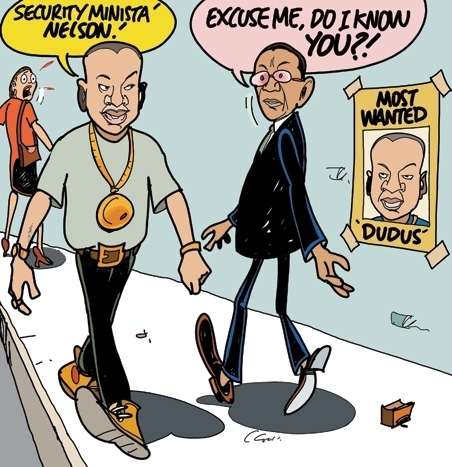
Meanwhile most witnesses called to the stand are tight-lipped and suffering from memory lapses (most notably the Minister of Security, Dwight Nelson). Pity you can’t just plug in extra memory modules to boost their recall. If nothing else the Inquiry has generated some hilarious political satire such as this Facebook conversation below. All names have been changed to protect the identity of the participants.
SW
March 7, 2011
Hear Ye, Hear Ye…we have some Limited Edition Manatt Enquiry stuff for sale….’silent auction’ cos we caan afford wi wake up d ‘Asst Page Turners’…Link me een mi inbox for samples….(ef oono c Dennis Brooks a advertise nuttn no buy e…a teefn goods)…anyways….sen oono credit card come quick cos dem soon done.
LGY We have tings like “I don’t recall” T shirts in Green! “I don’t remember”T-shirts.., IN GREEN! We also have green t-shirts with Dudus face pon di front and a big X through it,and round the back the words “I do not know him”! ALL Green shirts are special edition!
Jamaica Observer, February 20th, 2011 During witness testimony at the Manatt/Dudus enquiry, Minister of National Security, Dwight Nelson, claimed that he did not personally know alleged Tivoli Gardens strongman, Christopher ‘Dudus’ Coke. Clovis.
OD lol…mi want a “It was not clearly in writing” shirt please·
SW We also have T-Shirts dat say “Subjunctive”…an nuff odder tings…we also ave ones dat say “you seem frustrated” (dese will ave Samuda pic on dem)…remember all dese are VERY LIMITED so oono urry up an sen on d money! (u wont regret the purchase)
LGW And we have some orange t-shirt whe sey “I saw the secret MOU”!
SW Yes Yols,,,,in dat dere package we will also have little dolls of the ‘Asst Page Turners’…u can put batteries in dem and dey will speak…albeit slowly but speak they shall…dey will even turn d pages for you & d controls will allow you to adjust d volume so dem can ‘whisper’…now dat oono affi order fast cos dem EXTREMELY LIMITED!!!!
LGY Yes people ah ongle two of dose dolly exist! Order dat now!·
CE Jr I just need the one dat say “Can’t recall”
CW I hear there are hats with”Cant Recall” on them
LGY yes Clyde we have those too! How much you want?
CW nuff as mi acting as agent (duly authorised) for a certain Central Committee
LGY ahright cool!
LGY soon set up your ting!
CW cool, cuz dem seh mi muss mek sure dat people tink seh is a certain Executive Council
LGY ok nuh fret man… it all look like dem, bad spelling and all! ·
CW a now mi wish dis was happening in a merca as di stand comedy circuit would be buzzing daily
CW lol lol lol mi side a at mi
SW Yols…..ef Clydey buy a good amount we can give him two ‘free’ shirt fi good measure…Clyde…u no waan d two dolly dem man?? cho!
LGY eeeh? Buy di dolly dem nuh? How yuh ah move tight suh? Ah mussi yuh name Harold Brady!
CW Whaaphen yuh nuh hab nuh puppets
CW a puppet mi whaan
CW mi whaan mek a gift to some heavy weights
LGY ah dolly we have, dem battery operated and do tings! Not much, but dem do tings!
CW k cuz u know what I know but yuh a gwaan like yuh waan oddas know
SW Clyde…anything u waan wi ave it…we will ‘custom bill’ e for u ongle….puppets we do ave….jus tell wi ow much u waan an mek sure u tek off d 2 dolly dem off wi Hands…u can go sell dem bak pon EBAY an mek NUFF NUFF money cos e price a go skyrocket by year end…wos wen election close!
LGY Yes I know that U know that I know what u know … I’m not daft!
CW dwrl unno have nutten weh mi can gi mis daisy shi seh she whaan gift it to r parson
SW oh…’DOLLY DISCLAIMER’…’Should this toy not meet your specifications or expectations…the manufactures CANNOT be held responsible….please address all concerns in that vein to Jamaica House’ (we do hope you get a response…ef not…hire a good lawyer or commission a COE)
AP or just hire us. Manatt, Phelps & Phillips, LLP. We are known for our extraordinary commitment to clients, for integrated, relationship-based services, and for a range of specialized capabilities typically found only in boutique firms. We are progressive and entrepreneurial compared to other major firms; and we are deeply committed to diversity, to public service, to involvement in the communities we serve and to excellence in all we do, including how to get around extradition requests…
A look at the protest march held in Haiti on February 18 against Jamaican treatment of their Under-17 football team and responses in Jamaica to the Haitian outrage.
The photos below are from the protest march held in Haiti on February 18 against Jamaican treatment of their Under-17 football team.
Poor John Maxwell must be turning in his grave. Jamaican officials, showing uncommon concern for the nation’s health saw it fit to send back the Haitian Under-17 football team which had come here to participate in the CONCACAF tournament.
According to an Observer source, fears about a potential cholera outbreak escalated after several of the Haitian players, who arrived in Jamaica earlier this month to compete in the tournament, fell ill. Others had symptoms including fever and headaches. Eight of the players were tested and three were found to have malaria. They were slated to be admitted at the Cornwall Regional Hospital, but there were no beds there, the source said.
As a precautionary measure, the team was to be quarantined. But after a day of waiting inside the hospital’s emergency ward, the Haitian coach got angry, left the hospital, and returned to the hotel at which the team was staying, the Observer was told. He was later allegedly handcuffed and forcefully removed from the hotel by representatives from the Ministry of Health, who had quarantined the sick players at the Falmouth hospital between Tuesday night and Wednesday morning last week.
The situation wasn’t helped by language problems and the different responses to malaria in each country. It’s a fact that in Jamaica anyone with malaria is immediately quarantined and in general the health authorities are quite punctilious about keeping the nation free from contagion of various sorts. I remember being astonished once years ago when i had just returned from India to receive a visit from a health official who came to my home to ensure that i wasn’t suffering from any illness i might have brought back with me. I did feel slightly insulted but then decided to look on it as a good thing–one small corner of the governance structure that actually works.
Even so i feel that the Jamaican reaction erred on the side of insensitivity. I was alerted to this situation three days ago when an irate friend in Haiti contacted me. At the time there was hardly anything in the media about it and I myself wasn’t fully pripsed on the situation. I asked him if the events were recieving a lot of attention in Haiti. “Attention? We are very pissed off,” came the annoyed reply.
So i went on Facebook and Twitter to find out what others felt about this and was quite horrified at the overwhelming tendency to simply dismiss the whole affair with a smug “Better safe than sorry” response. According to one tweeter “if it were anywhere else. Like China they would b sent home too. This is not a precedence. Been done b4. Remember swine flu!”
Except that malaria, unlike swine flu, isn’t a contagious disease and China does a lot of things that a democratic country like Jamaica might want to think twice before doing. And of course when Jamaicans are ejected from Cayman, Barbados or the UK for fear of their culture ‘infecting’ local youth, i don’t want to hear any weeping and wailing and gnashing of teeth. Those countries are also thinking “Better safe than sorry!”
Other tweets from the diaspora were more critical of Jamaica:
@public_archive I seriously doubt the Jamaican government would quarantine the Canadians with STDs running around Negril. Yeah, I said it. #haiti
Skin-bleaching and anti-Haitianism go hand in hand. #Haiti #Jamaica
@djaspora: #Jamaica should know/do better. Quarantine Haitian kids cause of suspected malaria? Is it malaria or blackness that is contagious? #Haiti
Incidentally the Haitian team coach is Brazilian. I heard him on RJR a little while ago describing the extremely long waits at the hospital and a clinic, we’re talking about hours, five or six hours, without treatment or explanation.He himself was one of the three sick members of the team and returned to Haiti with a very high fever and profoundly upset.
I would have thought that even if Jamaicans feel that they’re in the right they’d have shown more interest in trying to find out what had caused the Haitians so much offence instead of simply shrugging and saying “Better safe than sorry.” The Haitians are clearly hurt and humiliated. They may be overreacting too, just as the health officials seem to have done. I was surprised at how little attention the Jamaican media paid to this situation over the weekend. It wasn’t until the Haitians really made a big issue out of it that the media, today, started focusing on it.
It’s an extremely vexed situation. Jamaica has the upper hand. Does it cost so much to apologize and try to mend fences?
On the eve of the verdict in the Buju Banton trial in Tampa, FL, Jamaicans wait with bated breath for their beloved singer to be released.
Tears from my eyes could not hold anymore
Cry like a child who has lost his way home
longing to go to that place where I’m from
I’m in bondage, so much bondage…
The above lines are from ‘Bondage’ from Before the Dawn, the album that won Buju the Reggae Grammy last week.
Jamaican reggae artiste Buju Banton, flanked by his lawyer David Oscar Markus (right), waves to journalists as he leaves the Sam M Gibbons Federal Court in Tampa, Florida yesterday afternoon after the adjournment of day 2 of his retrial on drug and gun charges. Banton is pushing a stroller occupied by the baby of his manager, Traci McGregor (2nd right). See court report on Page 4. (Photo: Paul Henry) Read more: http://www.jamaicaobserver.com/news/I-m-fighting--says-Buju-after-tough-2nd-day_8378295#ixzz1EW2y2cUn
Once again the Jamaican nation is on Buju watch. Buju Banton, also sometimes referred to as the Voice of Jamaica has been on trial in the United States on purported charges of intent to distribute drugs there. After an abortive first trial Banton who was put in prison in Tampa, FL in December 2009 was tried again last week. The jury is expected to come to a verdict on Tue, Feb 22nd. Jamaicans are taking this very personally, it is as if the nation itself is on trial. To get a sense of the import of this moment read Marcia Forbes’s post on this blog about the lengths Jamaicans went to to tune in to Buju’s concert some weeks ago, the first since his incarceration. Andrea Shaw who was actually at the event produced an excellent write up:
Buju, the beleaguered reggae star, was arrested in Florida on drug charges in the fall of 2009. After being denied bail he endured prolonged delays in his trial while languishing in a Florida jail for a year before finally being released on bail after a mistrial. His high-profile case has dominated the reggae world since his arrest and has elicited an extraordinary outpouring of support and sympathy from fans all over the world, particularly from the Jamaican Diaspora.
The extent of this support has been extraordinary. I’ve even surprised myself by the intensity of my heartfelt concern and fervent prayers for the star whose music I’ve always loved. But even among Buju non-believers, folks like my mother who have not been seduced by his throaty voice and who can’t name even one of his songs, the wish for his safe and speedy release has been widespread. And here’s the kicker: so many of us are not concerned with whether he is guilty or not. We just want him home.
Sunday’s concert struck me as a performance of Buju’s personal prayers for his release as well as the demonstration of a collective desire for his safety and protection while he prepares for the resumption of his trial and to face newly added gun charges. “Before the Dawn” was a performance of faith and hope, both on stage and amongst the audience, and in many ways it was also a ritualized anointing— a communal laying on of hands on Buju’s besieged shoulders by the screaming, 10,000-plus live audience as well as the thousands more who tuned in via live streams and Facebook updates.
This time round Jamaicans are optimistic that Buju will finally walk free. Television images of him–tall, strapping, healthy and handsome, inexplicably pushing a baby’s pram on his way to court with his lawyer have boosted the nation’s morale. As one tweet, which memorably captures the national mood said: RT @ProdigalJa: Push di pram Buju! Push di pram to victory!
Active Voice is happy to host Sarah Manley who has appeared on this blog before, writing on the subject of Buju Banton, as she shoots off an impassioned message to ‘America’ in which she cogently pleads his case:
Buju Banton is not one of the world’s dangerous drug lords. I say that without hesitation, I state it as a fact, that cannot be disputed. It is not true. It is a fallacy and a falsehood to present him as such. You know, I do not like lawyers. I find them dishonest. They seem to think that because a thing cannot be proven or disproven, it is not true. They have an elastic definition of truth. But! There are things that are true regardless of what loopholes you can conjure up to prove or disprove them. Like Buju is not a drug lord. This is just true.
Inventing new charges against him in some maniacal witch hunt isn’t gonna make him any more guilty.
We are not stupid out here in the world. We know that cocaine is made in Columbia from the leaves of the cocoa tree, grown there, harvested there, processed there, and exported from there up through the poor and tired caribbean to be consumed on a massive and devastating scale in North America and around the world. We know that there are many many hands complicit in its travels throughout the world. We know that on any given day, in almost any city on earth, you can find a coke dealer who will sell you, for usually an exorbitant price, a tiny package of white powder, or some tiny rocks. I have been offered cocaine from total strangers in New York, in London, in Paris, in night clubs, in bars, on the streets. Buju had nothing to do with any of this. Shipping magnates, customs workers, random pilots and corrupt politicians, and drug lords, from the don on top, to the starving little runner, these are the people involved in the drug trade. It’s a multli billion dollar industry that the entire world is complicit in allowing to continue.
To single out Buju Banton, who is Reggae Royalty in his country, to decide to frame him, not even catch him red handed, but frame him with some two bit, low life informant, and then, to add insult to injury having not secured a conviction, to throw more charges at him, well… that’s just pathetic and only something stupid America would come up with. It’s not ok. I object! I protest!
You wanna bring down the coke trade America? Go focus your God forsaken missiles and war mongering army on Columbia. Go blow up the cocoa farms, the drug lord mansions. Putting Buju Banton in prison is not going to even put a tiny dent in the coke trade. It will not affect it one iota. All you will succeed in doing is enraging a people already so pissed off with poverty and injustice we are ready to explode.
And don’t you dare, don’t you dare bring up homosexuality as a justification for this victimization and persecution. I do not agree with Buju’s stance on homosexuality, but i defend his right to have that stance. And to voice it if he feels he must. So if IF this framing of Buju has its roots in some gay rights agenda, well that would be the most pathetic of all. So because a man has openly criticized the gay lifestyle, you have him imprisoned on some trumped up charges of drug dealing. That’s just too crazy to be allowed.
America, why don’t you go fight some real enemies on earth? Starvation? Disease? Poverty? What level of idleness leads you to single out and attack, of all the people on earth, Jamaica’s Buju Banton? Our Poet? Our Artist? Are you jealous because we likkle but we talawah? Because we can out run, out dance, out sing, out vibe, out swagga you on any given stage on any given day in any given arena?
Well I bun dat! Babylon System IS the vampire. We refuse to be what you wanted us to be! We are what we are and that’s the way it’s going to be! Oonu vote One Love as the song of the last millenium, Oonu tink seh One Love is all Bob was talking about? You missed the point. Bob said Get up and stand up for your rights… Reggae music is protest music… Protest… not some pot smoking love in like your Woodstock. And Buju is one of a string of Jamaicans who have voiced that protest in song… protest against poverty, injustice, victimization, imperialism, racism… and this is the final irony of this trial of Buju Banton.
You hear mi sah… I could go on and on… the full has never been told!
Most wanted fugitive from justice in Jamaica, gang leader Dog Paw, and his family were the inspiration for Diana McCaulay’s 2010 novel Dog-Heart.
The cliche that truth is stranger than fiction is true. It turns out that one of the main characters in Diana McCaulay’s 2010 novel Dog-Heart was inspired by none other than Christopher ‘Dog Paw’ Linton, who was taken into custody by the security forces on January 24th after topping the most wanted list of the police for several months. Day before yesterday Jamaica Defence helicopters hovered in the air for hours during the operation that netted Linton. After the first hour their incessant buzzing receded to the background like a dull but persistent headache. The University of the West Indies, where i’m based is right next door to Elletson Flats where Dog Paw was eventually found and arrested. We are squarely in the middle of the Dog Paw Gang’s turf which covered Kintyre, Papine, August Town and its environs.
I knew that the novel which i got to read in manuscript form way back in 2006 had been inspired by several street youth that McCaulay, an environmental activist, had tried to rehabilitate in the 1990s. She had written about that experience in her Gleaner columns, detailing her despair when the young boys she had tried to send to school eventually reverted to the streets. There are several co-incidences: the names Dog-Heart and Dog Paw for instance; also one of the illegal operations Dog Paw has been accused of is sand-mining. In the novel sand-mining is what sustains the young boys.
AP: How were you able to get into the head of an impoverished street youth? I know you had tried in the nineties, when you wrote a Gleaner column, to help one or two such youth? Is this novel inspired by those attempts? And did you have any success with the boys you tried to rescue from the street?
DM: In a sense, Dog-heart was inspired by my relationship with a family of boys and their mother in the 1990s, my attempts to help, but the events and people in Dog-heart are entirely fictional – nothing in Dog-heart really happened and the people are quite different from that family. But during that period I did observe many aspects of their lives and realized how difficult their circumstances were. It was humbling – people of my class tend to dismiss people like Dexter and his mother, Arleen, as, I don’t know, wasters, wut’less, stupid. But what I saw was something different – I saw people, children, trying their best to survive situations that I was sure would have defeated me. So I started thinking about it, imagining what it would really be like. Dog-Heart also had its genesis in a writer’s workshop at Good Hope, back in 2003 – we were asked to write a short piece from the point of view of someone of a different age, class, race, background and sex – and I wrote what became chapter two of Dog-Heart. I sent it as a short story called Car Park Boy to Caribbean Writer, they published it, and I decided the seeds of a novel were in there. So I kept working on it.
As for the boys I did try to help, that’s a fairly sad story, one I am not sure I am ready to talk about, because it is their story to tell too. I often wonder about what THEY thought at the time. I lost track of the family when I went to study in Seattle in 2000 – but when I came back to Jamaica in 2002, I learned from one of the boys’ teachers that the eldest boy had been killed by the police in a prison riot. And funnily enough, recently a friend encountered the youngest boy – who is now a man – and we are to get together – hasn’t happened yet.
Yesterday, I learnt that the elusive Dog Paw was one of the boys Diana had tried to rescue. I assumed that he was the model for Dexter, the protagonist of Dog-Heart, but i was wrong. His older brother Jeffrey, since brutally murdered, was the inspiration for Dexter. It is Marlon, Dexter’s younger brother in the novel who was modeled off Christopher Linton. Marlon is a lovely young boy, brimming with hope and wonder and trust, not unlike the child who became Dog Paw and who was eight years old when Diana entered his family’s life. Please read on for my interview with Diana today about the Dog Paw she knew and Dog-Heart, her novel.
DM: Hi Annie, I will try and answer your questions, but I want to tell you a few things before I start. First, obviously I have known Christopher Linton was one of Jamaica’s most wanted men since just after Dog-Heart came out in March 2010. I have never talked publicly about it, though, for various reasons — mostly respect for his privacy and that of his family, and not wanting to use a tragic story for opportunistic book publicity. So when people have asked me about this– Jamaica is a small place, after all — I have answered truthfully, I really didn’t want to lie about it, but have also asked them not to discuss it in public. I’ve decided to talk about it now because I have seen such horrible comments about Christopher on websites, Facebook, and heard them in conversation – things like, the police shoulda kill him, him is worse than a dawg and the like. I’ve decided to speak because I knew this young man, Christopher Linton –- Damien was his pet name -– from he was about eight until he was nearly fifteen or so and he was a sweet, very intelligent little boy with great potential and he was failed in every way by our society.
We need to stop pretending that such men are merely irredeemably evil and are simply to be exterminated. We need to understand what made the boy Christopher Linton become the man he is. I want to state clearly that I am appalled by the crimes he is accused of, and if he is guilty and convicted, he should be incarcerated. I want to say that like most Jamaicans, I am deeply concerned about the levels of crime in our society, I am as afraid as the next person especially as I get older, and I do not want to face a young man with a gun who is prepared to take my life without thought, but also, I want to challenge us as a people to examine the reasons for, the genesis of a young man like Christopher, one of our own sons, now effectively facing the fact that his life is over at 24, even as he and others must deal with his probable or certain role in ending the lives of some of his fellow Jamaicans. It is all an unspeakable tragedy.
AP: You’ve said that the protagonist in your first novel Dog-Heart was loosely modelled on Christopher ‘Dog Paw ‘Linton whom you had tried to rescue from the streets in the 90s when he was an adolescent. When did you find out that the young boy you knew had become a wanted gang leader and was none other than the Dog Paw the police have been searching for since last May?
DM: No, Dexter – the protagonist in Dog-Heart – was not modelled on Christopher Linton. What I have said is that I was involved in the education of four boys from the August Town area, beginning in the early 1990s and ending in roughly 2002. One of them – the second oldest – was Christopher Linton. His elder brother, Jeffrey Jones, was beaten to death while in prison during a prison riot in roughly 2002 or 3. None of the characters in Dog-Heart are the real people – I guess the best way I can put it is that the actual experience of becoming involved with these four boys started me thinking about the whole situation I was witnessing, experiencing, living through and I sat down to write a novel inspired by these real events. But the people in Dog-Heart, the events that occur in the book, I sat at my computer and made them up. As soon as Christopher’s name was mentioned in the newspapers, I knew who he was – I can’t remember how long ago that was, but probably more than a year.
AP: You’ve emphasized that “the events and people in Dog-heart are entirely fictional – nothing in Dog-heart really happened and the people are quite different from that family” but are there any similarities between them? For instance Dexter, the central character in your novel who grows into the gangster Matrix is portrayed as someone who is loving, sensitive and bright but who ultimately cannot overcome the internecine circumstances of the life he was born into. People have commented on the fact that Dog Paw comes across as well-educated and well-spoken. Did he actually graduate from school? What school did you send him to?
DM: When I say that the entire system failed Christopher, one example of that is the education system. When I met him when he was about eight, he was completely illiterate – and he was in school – but he could not recognize or spell simple three letter words. After just under four years in a good prep school – St. Hugh’s – he passed his G-SAT for Jamaica College. So yes, he graduated from St. Hugh’s. As I said before, he was a very bright boy, I am sure he is an intelligent man. He floundered at Jamaica College – he was in a very small remedial class at St. Hugh’s and at JC, he was suddenly in a class of 40-plus. Within a year or so, he was asked to leave as he had not met the minimum academic standard. The school also reported he wasn’t attending regularly, wasn’t doing his assignments. We got him into another secondary school, but within less than a year, his grades were so bad that the sponsors I had found were unwilling to continue to fund his education. I should say that initially myself and my then boyfriend funded the education of the four boys, but when I left my private sector job to work at an environmental NGO, I had to find other help and for many years, the education of the boys was paid for by overseas Jamaicans and local business people. So think about it, at just over fourteen or maybe fifteen, Christopher was out of school, with no prospects, no programme to learn a trade or anything – and then, his brother was killed – beaten to death – while in police custody. I imagine the rage and pain he must have been in – his entire family must have been in – and I am sure this event had something to do with the path his life then took.
AP: Linton has claimed in an Observer interview that he knows nothing of the charges the police want to lay against him. Do you think he’s being framed? He is very young—only 24—to be such a dangerous gang leader. Have you talked to him at all since your novel came out? Do you know if he’s read it? Have you been in touch with the rest of his family?
DM: I have no idea if he’s being framed or if he committed the crimes he is accused of. He IS very young. I haven’t talked to him, no. When I went to Seattle in 2000 I lost track of him and his family. When I came back, I learned of Jeffrey’s death, contacted Jamaicans for Justice, who had spoken to his mother, saw one of the teachers at St. Hugh’s who had been very involved with all four boys, and she told me that Christopher was no longer living at home and was in a gang. It was then that I started to think about the whole experience, question my own opinions, my own prescriptions that education is the answer, and eventually those thoughts became Dog-Heart.
AP: Linton has made an impression in interviews of someone who is very intelligent, articulate and educated. Did you see hints of this in him when you first met and is that what made you want to try and help him out of the ghetto?
DM: I didn’t meet Christopher first. It was really his brother, Jeffrey, who impressed me, and it was he we set out to help. To this day, I couldn’t tell you why he touched me in the way he did, compared to the many other children I have encountered in similar circumstances. I met Christopher and his brothers subsequently – and we then realized that we could not single out one child in the family for help, but had to make sure they all got the same assistance. I can only say again that Christopher was a sweet little boy with great potential who I remember and think about with fondness and I find the situation now unbearably sad, both for him and if he is guilty, for those he hurt or killed.
AP: I hope that finally Dog-Heart will get the attention it deserves. It is in effect the first document that seriously explores the conditions that influence the formation of characters such as Dog Paw; actually another novel that also does this is For Nothing at All by Garfield Ellis but of course it does so differently. You have tried so hard to change the environment that we all inhabit, in more ways than one, not merely as an environmental activist but by drawing attention to the systemic handicaps children such as Dexter suffer, are you at all frustrated by the lack of real change? What do you think it will take to produce an environment in which children are not exposed to such callousness and cruelty?
DM: Well, I’m not talking about this because of Dog-Heart. I’m talking about this, because I want to say, look, I knew this man when he was a child, this man who is easy to hate, easy to demonize, but he did not come out of the womb like that, that he was a child who never had enough, ever, not one day of his life. Yes, I’m very frustrated by the lack of real change in Jamaica, by the weakness and lack of integrity in our leadership, by the lack of thought we Jamaicans ourselves bring to these problems, by the level of national discourse, by the way as Mutty has always said, we trivialize our politics, it’s all a big party to us. I don’t know what it will take to bring about real change – where this particular issue is concerned, I have no expertise, I’m just a witness, a storyteller.
AP: The title of your novel doesn’t necessarily refer to the protagonist Dexter, or does it? I got the impression it more fit his friend ‘Lasco’ who seemed irredeemably ‘bad’. So were you referring to a metaphorical ‘Dog-heart’, a system that turns young children into dog-hearted killers? as an aside i wonder why or how the term ‘dog-heart’ came into being, are dogs really like that?
DM: Dog-Heart doesn’t refer to any particular person in the novel. It’s a reference to dog-heartedness, that quality that we Jamaicans talk about, recognize and react to with such revulsion. So yes, the title is more of a metaphorical frame for the subject of the novel. I don’t actually believe in dog-heartedness. I have no idea how the term came about – a linguist would have to investigate – and I think the heart of a dog is generally a big warm kind heart – unless, just like people, the dog is mistreated.
Calabash International Literary Festival Comes to an End
Wole Soyinka being interviewed by Paul Holdengräber at Calabash International Literary Festival
Well, the news of the moment is that Jamaica’s beloved Calabash International Literary Festival is no more. At a press conference this evening Calabash Programme Director, Kwame Dawes, announced the demise of the festival saying that Calabash, in its ‘present incarnation’ had come to an end and would not be held this year.
The plan is to regroup and return in a new avatar in 2012, Dawes said. 2012 is also the fiftieth anniversary of Jamaica’s independence and the new event will focus on celebrating fifty years of literary production in Jamaica.
Colin Channer, the leonine writer who has been the motive force behind the festival, is also no longer part of the core group. No reasons were given for his departure, with Dawes merely remarking that Channer’s decision was ‘mysterious’. Channer had been the artistic director of Calabash since its inception.
A valued Twitter source sent a message offering Channer’s perspective: Just talk to Channer, Man seh 10 year as the head is enough& anything longer would be a sign that something is wrong that it can’t grow beyond him
Colin Channer (l) posing with the Commonwealth Writers’ Prize (First Book) finalists in 2007. Photo: Georgia Popplewell
The constant challenge of raising funding each year and drawing on personal resources has also taken its toll of the three principals behind the festival.
This is a brief post to give you the breaking news…a more detailed post will follow in the next few days. See my posts on earlier Calabashes below:















 Active Voice