Cake Soap and Creole: The Bleaching of the Nation…

The problem of skin bleaching in Jamaica is discussed and linked to the problem of language, and the privileging of English over Creole.

Khani LTD Edition # 1_21inx21in_ mixed mediaonpaper_2008 by Ebony G. Patterson

All of a sudden the problem of skin bleaching is in the spotlight and we have top DJ Vybz Kartel to thank for it. As I mentioned in an earlier post my favourite Christmas present was a pack of his infamous ‘cake soap’ I received, complete with personal autograph. VK as we’ll call him for short, has recently attracted attention with his complexion suddenly appearing several shades lighter than it used to be, the better he says, to show off his numerous tattoos. The melanin reduction is attributed to the said cake soap which is normally used to whiten clothes in the wash.

It just goes to show you how influential popular music is; young Ebony Patterson has been highlighting the skin bleaching problem here for years with her series of innovative artworks but hardly anyone outside the artworld paid much attention. Then along comes VK, the Darth Vader of Jamaican music (except that he doesn’t want to be dark any longer), with his cake soap and no one can talk of anything else.

Jamaica’s voluble moral majority has rushed to condemn VK claiming that he is encouraging impressionable youngsters to imitate him. What has upset many is that the DJ is unrepentant and even playful about lightening his skin colour, refusing to take the matter seriously and countering that it’s no different from white people wanting to tan themselves. Numerous musicians have rushed forth with anti-bleaching, love-my black-skin-songs but in a way all these knee-jerk responses are just as superficial as the act of bleaching itself, which only changes what is visible without attacking the underlying structural problems that make people bleach in the first place. Historian Elsa Goveia put her finger on it several decades ago when she said the structuring principle of Caribbean societies is “the belief that the blacker you are the more inferior you are and the whiter you are the more superior you are.”

Until this reality changes people are going to think that the best way to advance in such societies is to lighten your skin colour. People can fulminate all they want and express litres of outrage, it will make no difference.

To me bleaching your skin is fundamentally no different from deciding that Creole /Patwa , if that is your mother tongue, is so lowly and contemptible linguistically that it is not worthy of being spoken or allowed in schools.  Edouard Glissant described how in Martinique it was common to see “In beautiful rounded white letters on a clean blackboard at the reopening of school: it is forbidden to speak Creole in class or on the playground.” And Jamaica is no different.

The logic is the same: English/French/Spanish is the language of universal currency so our children must only learn English and must actively be discouraged from speaking Jamaican or Patwa, the versatile, volatile language of the streets here that for many is their native tongue. Similarly skin bleachers reason that since white/light skin is almost universally valued higher than darker skin tones, they must use any means necessary to acquire it.

I find this kind of logic depressing. It’s as if to say that if your mother happens to be a poor, barely literate ghetto-dweller you must abandon her and cleave to the English missionary with her glowing white skin and impeccable English. Surely it’s not an either/ or game. Most people would agree that this was outrageous yet many of the same people would find nothing wrong with denigrating Patwa and banning it from official spaces as if it’s impossible to know and love Jamaican and also become fluent in English! The worst part is that for many children for whom Patwa is the only language available literacy becomes inaccessible because you have to know English to study any subject at school.  In fact the way some people react to the idea that Patwa ought to be recognized as a language and used as a medium of instruction in schools you’d think that to promote or accept Creole is to diss English!

And if you think that’s bad read Carolyn Cooper’s blogpost where she describes the absurd system of ‘justice’ in Jamaica which is dispensed in impeccable English to Patwa-speakers regardless of whether they understand the language or not!

One morning, as I waited for my case to be heard, I listened in amazement as the judge explained in quite sophisticated English how she was proposing to handle a dispute about unpaid rent.

The defendant was told that the case was going to be sent to a mediator who would discuss exactly how much rent the defendant would have to pay.  The distressed defendant kept on insisting in Jamaican that she didn’t owe as much rent as the landlord claimed.  The judge continued speaking in English, simply repeating her proposal.  This back-and-forth went on for a good few minutes.

At the risk of being deemed in contempt of court, I jumped up and asked the judge if she would allow me to translate her comments for the defendant.  She agreed.  As soon as the woman understood the proposal, she accepted it.  What angered me was the smug question the judge then asked: “Is that what I should have said?”  To which I disdainfully replied, “Yes, Your Honour.”

To come back to skin bleaching I had to laugh when I heard someone curling their lip in disdain at Kartel because this person happens to be someone with straightened hair and a very white affect, who never speaks Patwa or genuflects to the African origins proclaimed by her skin colour. What else is that but bleaching? And not just bleaching the superficial skin you were born with but the very culture that is also part of your heritage.

It’s pointless to get our knickers in a knot over Kartel’s latest antics. As a tweeter I know said “People are going to have to be mature enough to think for themselves. If the likes of Kartel can lead them astray then they already lost.”

I think Vybz Kartel is the very embodiment of the contradictions that bedevil Jamaican society and we should be grateful to him for foregrounding this disfiguring practice. But we need to go beyond that and deal with the fundamental problem that causes people to bleach their skins to begin with: the social value placed on lighter skin colour. Until that is addressed the bleaching agent industry will continue to flourish here and everywhere else that puts a premium on ‘fair’ skin (In the country of my birth pale skin is so prized that someone of my complexion could never play a starring role in Bollywood) .

It’s not a moment too soon for The International Conference on Language Rights and Policy in the Creole-Speaking Caribbean taking place in Kingston tomorrow and day after. Below is a disturbing video on a family of skin bleachers in downtown Kingston.

Gaza mi seh!

Aung Suu Kyi’s release, the Gaza situation, and Jamaican dancehall

Free at last! As i write this the world is celebrating the release of Aung San Suu Kyi, held captive for 15 years by the ruthless military government of Myanmar/Burma. What a moment! There aren’t too many women–or men– like Suu Kyi, willing to sacrifice their freedom of movement in the name of moral principle, something completely lacking in politics today. Suu Kyi is an alumnus of my Alma Mater in Delhi, the venerable Lady Sri Ram College, whose initials, LSR, were said to be synonymous with Love, Sex and Romance for male students at Delhi University. Clearly besides being a source of girlfriend material, LSR has also produced stellar leaders with the moral fibre of the redoubtable Aung San Suu Kyi. I think of her as the Orchid of Steel.

Closer to home and the mundane, my daily trod was enlivened yesterday by a Skype interview with an Israeli journalist, Nirit Ben-Ari, who contacted me last week with the following request:

I will be honored and thankful if you interview with me for the article I am writing for Haaretz newspaper on dancehall culture in Jamaica.  I am mainly interested in your interpretation of the term “Gaza” and its possible implication of awareness of global politics. Do you think that the choice of the name “Gaza” represents a political awareness and identification with the underdog?  I am also interested in your view on the global “gaze” on dancehall culture and the dangers of misinterpreting and misunderstanding dancehall culture outside of Jamaica.  What do you think about the dissemination of dancehall images globally?

In response i sent her the paper i had given at the Reggae Studies Conference earlier this year: Eyeless in Gaza (and Gully): ‘Mi deh pon di borderline’;  essentially i was trying to document and comment on the effects of the feud between two of Jamaica’s top DJs, Vybz Kartel (Gaza) and Mavado (Gully) that resulted in the words ‘Gaza’ and ‘Gully’ being spraypainted or otherwise inscribed on surfaces all over Kingston, but also in places like Trinidad, Barbados as well as Brooklyn, London and the generalized Jamaican diaspora. I excerpt a relevant bit from my paper below:

Etymology of ‘Gaza’ in the Jamaican context

It is commonplace in Jamaica for impoverished urban areas to be informally named after locations known globally as war zones. Thus there are locales named ‘Angola’, ‘Tel Aviv’, ‘Vietnam’ and of course ‘Gaza’. In a widely publicized interview between Cliff Hughes, a prominent local journalist, and Vybz Kartel on TV Jamaica’s Impact which aired on November 12, 2009, Hughes asked Kartel why he had chosen the name Gaza for his area, and what the frequently uttered phrase ‘Gaza mi seh’ meant. Kartel who often refers to himself in the third person responded:

“’Gaza mi seh’ means ‘Fight for what you believe in against all odds, against all adversity.’ When I left the Alliance Vybz Kartel came under so much pressure, I said to Black Rhino and others we need to form a group. But we need a perfect name. The first war was just happening in Gaza, Israel was bombarding them but the people were fighting back regardless, and Vybz Kartel said to Laing (Isaiah Laing, prominent promoter associated with the annual Sting show), we’re going to use that name coz it means to me–dem people deh serious and dem nah back down.”

Indeed. Just like Aung San Suu Kyi. She nah back down needa. Interestingly, Kartel steered clear of the reason he felt obliged to look for a suitable name for the Portmore community associated with him, in the first place.  The backstory is an interesting one umbilically connected to the complicated discourse around masculinity and sexuality in Jamaica. Yet the details of why the community of Borderline in Portmore came to be rechristened ‘Gaza’ is one the media had never considered noteworthy enough to mention let alone dwell on.

Those who wish to know more can read my blogpost on the subject where Gaza’s bizarre link to homosexuality in Jamaica is recorded.

But back to yesterday, I can’t tell you how cool it was to be sitting in my living room in Kingston talking directly to Nirit in Tel Aviv, complete with images of ourselves and the rooms we were in. Viva Skype!

Nirit explained that she had wanted to read Carolyn Cooper and Donna Hope’s books on dancehall culture but they weren’t available in Tel Aviv and she had ordered them on Amazon but hadn’t recieved them yet. In the meantime someone referred her to my blog which is why she asked me to help her with the background on the use of the word ‘Gaza’ in dancehall culture. Interestingly Nirit works for an NGO named Gisha “an Israeli not-for-profit organization, founded in 2005, whose goal is to protect the freedom of movement of Palestinians, especially Gaza residents.”


How do you get from Gaza to Ramallah? Play "Safe Passage"

Like Aung San Suu Kyi the Palestinians have had their freedom of movement severely curtailed by the state of Israel. As the Gisha website explains:

Since the 1967 occupation of the West Bank and Gaza Strip, Israel’s military has developed a complex system of rules and sanctions to control the movement of the 3.4 million Palestinians who live there. The restrictions violate the fundamental right of Palestinians to freedom of movement. As a result, additional basic rights are violated, including the right to life, the right to access medical care, the right to education, the right to livelihood, the right to family unity and the right to freedom of religion.

Gisha, whose name means both “access” and “approach,” uses legal assistance and public advocacy to protect the rights of Palestinian residents. Because freedom of movement is a precondition for exercising other basic rights, Gisha’s work has a multiplier effect in helping residents of the occupied territories access education, jobs, family members and medical care.

Funnily Nirit told me that a Palestinian friend of hers got a chance to spend two months in Jamaica and was exulting at the thought of getting away from it all to a tropical island far from the rigours of life in Gaza, only to arrive in Kingston and find the word ‘Gaza’ graffiti-ed all over the city. You can read the first person account of Lisa Hanania’s visit to Kingston here.

Vybz Kartel was certainly aware of and sympathetic to the Palestinian cause but sympathetic is actually too weak a word to describe the admiration he expressed for the people of Gaza in that interview with Cliff Hughes: “…dem people deh serious and dem nah back down” and “’Gaza mi seh’ means ‘Fight for what you believe in against all odds, against all adversity.’” On the other hand i’m not sure how widespread Kartel’s view of the Palestinians is. Could one say that most of Dancehall’s ‘core constituents’ (to use Ragashanti’s apt term) are sympathetic to those ‘trapped in Gaza’? I don’t know.

What i do know is that Jamaican dancehall’s focus on Gaza has had an interesting ripple effect. When i tweeted a few days ago about being contacted by an Israeli journalist about the name Gaza in the Jamaican context one of my tweeple, Sweden-based @johannakey said “I’ve done a story on the same subject. There’s a Swedish song about it here.” The song Real Gaza mi seh! is so addictive i can’t get it out of my head. It’s a beautiful song, in which connections are made between Gaza, the curtailment of Palestinian civil liberties and universal oppression, using the vehicle of dancehall and the refrain “If you kill one of us, you kill all of us…the whole world is Gaza mi seh”. Listen to it below:

Eyes of the world pon the Gaza mi seh

Well dem say Gully, dem say Gaza
dem say Congo and Kinshasa
Everywhere i turn i see pure passa passa
I remember Kid Frost used to talk about La Raza
It’s all tribal war people can’t take it no longer

Hopefully one day the residents of Gaza will–like Aung San Suu Kyi–regain their freedom. Till then Gaza mi seh!

Diana McCaulay and the Palisadoes Highway

I find myself torn between Diana McCaulay, who heads the Jamaica Environmental Trust (JET) and Greg Christie, Contractor-General of Jamaica as candidates for my Man of the Year award.

After the devastating rains we’ve had recently and yesterday’s minor earthquake (could this be the minor before the major as @Marxshields asked on Twitter) we should be even more conscious of the environment we live in and how fragile it really is. Yet how many of us are willing to be activists in ensuring that Jamaica’s delicate ecosystem isn’t eviscerated by ambitious ‘development’ plans with little consideration for preserving the country’s coastal integrity?

Diana McCaulay has almost singlehandedly been taking the fight to the authorities on the matter of the proposed transformation of the Palisadoes spit leading to the airport into a mega highway. We all know the kind of disruption and destruction of the environment this invariably entails. And in case we don’t McCaulay explains it eloquently in her post The Destruction of the Palisadoes Spit:

An environmental victory is in some ways an absence – a road not built, a mine averted, a hotel relocated, a golf course avoided. We are used to the presence of a natural resource – while it persists, it’s unremarkable. An environmental victory is always temporary – no matter how solid the case, how overwhelming the public support – at some point in the future, an attempt will be made to reverse it. The plans for the mine will be dusted off, there will be a new investor for the hotel that wasn’t built and a case will be made for the golf course.

Environmental defeats, though, are glaring – forests razed, rivers “trained,” sand dunes destroyed, beaches scraped clean, wetlands laid waste. And despite the promise of the relatively new science of restoration ecology, such defeats are mostly permanent.

On the doorstep to the city of Kingston in September 2010, you can see an environmental defeat. The Palisadoes spit, that jointed arm that holds Kingston Harbour in loose embrace, has been bulldozed by the National Works Agency (NWA), via their Chinese contractors and/or Jamaican sub contractors, led by the Minister of Transport and Works, with the willing and enthusiastic support of the National and Environment and Planning Agency (NEPA). At this point, it appears that the entire spit will be denuded of all vegetation, its beaches compacted, sand dunes destroyed, the few struggling strands of mangroves obliterated in order to construct or expand (it’s not entirely clear which) an utterly unnecessary road.


Palisadoes removal of vegetation 14 Sep 10-1


It seems that NEPA whose role is to safeguard the interests of the country in matters involving large scale developments which impact on the environment is often toothless when it comes to laying down the law. At a public meeting called on Oct 4 with one day’s notice to stakeholders such as JET, McCaulay delivered a small coffin with the assets of Palisadoes inside it and an RIP sign to Peter Knight, head of NEPA. It was an expression of her frustration with what now seems to be a done deal–the razing of the Palisadoes strip to accommodate a major highway to the airport.

There are plans to also create a boardwalk along the new roadway, which would really be a lovely thing. I visited Barbados in 2009 and enjoyed the beautiful wooden boardwalk the government there had put up along one of the most popular coastal strips there. Why couldn’t we have one like that i remember thinking, so i’m not at all averse to the idea. It’s just that the concerns being raised by the environmentalists here seem not to be gaining any traction and if the price tag is too high, in ecological terms, might we not be exposing ourselves to more violent storm surges and coastal erosion in the future?

It takes balls for a single woman to go up against the state in the way Diana McCaulay has which is why she’s my candidate for Man of the Year.  Below is a video she created to document the proposed changes to the spit, a link to a JET statement about the proposed highway and below that is a link of a University of the West Indies study of the Palisadoes spit done in 1994.

STATEMENT FROM THE JAMAICA ENVIRONMENT TRUST 4 Oct 2010

Click to access PALISADOES.pdf

Inclement Times: Tropical Storm Nicole

Tropical Storm Nicole ravages Jamaica

Well, the trials and tribulations of Buju Banton have abruptly been ejected from the Jamaican imagination by a raging storm which brazenly breezed its way across the island when no one was looking. While we were all on Buju watch Tropical Storm Nicole crept up on us in the guise of a tropical depression, dumping gallons of rain accompanied by some of the scariest thunder and lightning i’ve ever heard. As @MsTrendsettas exclaimed: Bruce’s lying has spread! The met office is now lying to us. This is a hurricane, dem cant trick me!

Up to 14 lives are believed to have been lost, which should give you some idea of the magnitude of the disaster. Hurricane Gilbert, back in 1988, the worst hurricane to hit us in recent times, only claimed 18 victims in total. So many roads and bridges have collapsed all over the country leaving large numbers of people stranded, it makes the vicissitudes of India’s much maligned Commonwealth Village look like a joke. These roads were clearly never built to last though millions of dollars were allegedly spent constructing them.

Damaged Harbour View Bridge, Jamaica

My heart goes out to the family in Liguanea whose house was washed into the gully while they slept. A gully which swiftly bore them away; only one body has been found. Rescue crews didn’t dare search for them because of the electricity poles that had also fallen into the gully with live wires gushing lethal voltage into the raging water. Two adults and five children, missing, presumed dead.

Meanwhile newscasters on radio and TV alike abused the term ‘inclement’ as if there was no other phrase available to describe the weather. Every single school and place of business whose closure was announced blamed the ‘inclement weather’ for doing so. The pompous phrase was bandied about 30 or 40 times leading @HarleeQuinn to tweet: Newscasters; here are some synonyms for “inclement”: foul, harsh, intemperate, rigorous, rough, severe, stormy, tempestuous, violent.

Not to mention the simple ‘bad’ or the stark ‘hostile’, either of which would have been adequate. But no, the weather is ‘inclement’. Such a pompous relic of Victorian English, i bet its rarely used in contemporary Britain, but like a fly in amber remains trapped for eternity in its supposedly anticolonial former colonies.

Patty Bandits in Paradise…#ironymuch

Robbery at Juici Patties in Kingston, Jamaica, hostage situation defused, how it was discussed on Twitter

Juici sent patties to Haiti after the earthquake

What an irony that the very day after Playboy magazine asked me to expand on my statement “In Jamaica farce, intrigue and tragedy remain inextricably intertwined” (Don’t worry–re Playboy–ALL will be revealed in due course) another farcical scenario played itself out in downtown Kingston when armed men took over the Juici Patty outlet on West Street.

@pd_rickards was tickled. lol who would rob a patty shop? <Pattybandits he tweeted. When I was a kid they used to call me Patty Bandit..and seet deh now it come to pass. 8:48 PM Sep 4th. they would bring box of patty home and bam..3 gone..ppl seh..’Is peter dean dweet uno..him is the patty bandit. 9:03 PM Sep 4th.

Meanwhile @JustSherman joined in the commentary: Hostage situation at A Patty Shop, Sounds like something written by @PD_Rickards but sadly true, Lord deliver us.

Details are still sketchy; it was only last night that what rapidly became known as “the hostage situation” developed like a hurriedly-formed hurricane which huffed and puffed but ultimately kept from blowing the house down. I was up in Stony Hill listening to Kate Bush sing Wuthering Heights over and over when i saw the first tweet about hostages being released in downtown Kingston.

I blinked. Had i fallen asleep and woken up in a Bollywood film? Or was this a nightmare in which life was trying to invade the reality show we’ve become? In response to my query as to whether this might be a b-grade Bollywood flick @ drewonline said: that would involve a dance routine on king street ma’am so no it’s not a Bollywood movie it’s a Jamaican farce–:-(

Turn on the TV, turn on the TV, everyone yelled when i announced that my Twitter feed was indicating that people were being held hostage at Juici Patty on West Street. Of course once again real life was quick to intrude. We were in Kingston, Jamaica, not some place with real television stations that report what’s occurring AS it’s occurring around us. Both major local stations were replaying American TV series and there was no live coverage of the potentially deadly drama. As @ArnoldKer said in disbelief: #nowwatching Gossip Girl on TVJ while hostages are being held downtown. How awesome is this!

The inevitable reference to the erstwhile reign of Dudus was made: Likkle bwoy cyan manage bigman work. Now dem know how Presi work did hard and Dem waan do Don work and cyan manage it. They should have tried to co-op the System into regular governance and then use an diffuse it. The latter makes eminent sense for as the same tweeter pointed out: Tivoli was the only “ghetto” with Moneygram, Claro, Digicel, Lime and numerous small and large businesses that were profitable and safe.

Hopefully the international media won’t get hold of this, someone said. I thought events in Barbados where six people were killed in the process of a robbery in Bridgetown were likely to distract attention away from Kingston, where nobody has been killed after all. The farce continued to unfurl; after a tense standoff police orchestrated an invasion of the building only to find the armed men long gone by the time they broke in. Said @DLee876: Welcome to #Jamaica, where police surround a building and yet ALL the criminals inside escape. hahahahah #sadbutfunny.

So the gunmen freed themselves under the guise of being hostages? asked @cucumberjuice.

That was when @drewonline memorably declared: Sometimes i believe we are all hostages inna patty shop (that has a beach, a soundtrack and people who run really fast) #ironymuch

Interestingly it was only a few days ago that there was a situation at another patty shop, Sugar & Spice, in Liguanea. I don’t think it even made the local news because i never did hear the details of it tho’ my twitter feed showed photos of police cars blocking one of the Liguanea plazas and there were rumours of bullets being fired. It is said that a woman who had gone to the bank next door before deciding on a patty for lunch was robbed of J$800,000. But honestly who knows for sure? In the information age crucial information is frequently withheld in Jamaica; its like wading through a perpetual smog.

The hashtag in front of words means that the tweet in question will be filed under those terms in the global twitter feed. For example #nowwatching is usually appended to tweets announcing what movie, TV show or video the person is watching at the time. #sadbutfunny had one quite poignant tweet: hard enough being the slow kid but needing a reminder for drivers not to run you over is just #sadbutfunny http://twitpic.com/2lf035. Another example, this one from Sept 1 @rpugh Discovery Channel gunman James Jay Lee called 4 TV shows promoting war be removed. Holding hostages at gunpoint. #ironymuch

Alas it’s true, we’re all hostages in a patty shop. There’s no escaping it. Jamaica 2010. #ironymuch

Reggae Sumfest 2010: The Finale

Reggae Sumfest 2010 is a resounding success despite being dubbed the mudfest. Usher, Chris Brown, Beenie Man, Mavado, Elephant Man, Tarrus Riley the highlights of the final night.

Usher listening as the crowd sang along to every lyric!!! Photo: @Carae_Doll

By all accounts what is now being termed Reggae Mudfest was a huge success. Let me second @corvedacosta: WOW thanks to @marciaforbes’ tweets its like I am at Sumfest. All I need is mud on my floor. And according to @SeanABennett: Usher doing ‘There goes my baby’ expecting that the grounds will be even more soaked from the liquid flowin down some ladies legs.

Usher and Wata Photo: @goddessrockstar

The relentless rain continued for a third night but didn’t succeed in dampening the spirits of those who attended Reggae Sumfest 2010. Approximately 12,000 people are reported to have been there. The highlight of International Night 2 seems to have been Usher saying Gully and Chris Brown claiming Gaza while Mavado joined them on stage for one of the adrenalin-pumping performances of the night. “2 top foreign lock into 2 top local acts” as @marciaforbes observed.

Usher and Mavado Photo: @goddessrockstar
Usher, Chris Brown n Ele--3 the Hard Way!! Photo: @marciaforbes
Usher and @chrisbrown Photo: @goddessrockstar

A moment before that it was a different combination as Usher, Brown and Elephant Man took the stage and @SugaTwitts tweeted Usher, @chrisbrown and Elephant Man gully creepinnnn on stage!!

Around 4 am @ayeshaalexis who had previously tweeted You know you really tired when you drink a redbull and you’re falling asleep standing up announced …and all the women in the audience officially belong to usher. Di man tekkkkk sumfest! Excellent performance!!!!

Usher and co. were a hard act to follow but Tarrus Riley did the needful even though according to @goddessrockstar: tarrus should be at airport 5am straight to european tour, running late, hope they hold plane…

Dappa Dacta Dancehall King Beenieman...@marciaforbes

At minutes to 6 am @marciaforbes heralded Beenie Man’s arrival: Beenie Man, King of the Dancehall, arrives on stage in black sparkling suit with blue shirt accessosized with huge cross n black Fedora. A moment later another soundbyte: ‘Dem Lock me up fe tump LA Lewis but ah stayin alive, stayin alive’ Beenie aah trow wud!!

Crowd of 12000 Photo: @francoisonfame

Not all had the stamina to endure to the end. @endzoftheearth proclaimed her exhaustion to the world before retiring prematurely: Beenie man u know is u alone mi love but it late and mi muddy and tiyad and…

Well that’s a wrap: Mud or no mud I’m booking a hotel for Reggae Sumfest next year.

PS: The plagiarism problem i had reported earlier has been happily resolved. The website in question has attributed this blog as the source as they should have done in the first place. All’s well that ends well.

Scoop! State of Urgency–Reggae Sumfest 2010 rocked!

First account of Dancehall Night Reggae Sumfest 2010. Vybz Kartel appears in prison suit and handcuffs. Bounty Killer calls for State of Urgency from government, as opposed to State of Emergency and vuvuzelas abounded…

DESERT CLARKS, EVRY CREP A GET FLING WEH!! Photo: @SugaTwitts

Right about now people are waking up and wondering how Sumfest 2010 went last night. Were there any brawls? Did Vybz destroy it? Was Bounty Killer cross, angry and miserable enough? Well folks i wasn’t there but i can give you the scoop on all this and more…

Actually i was supposed to be there. I even got as far as Falmouth with my par Hubert but the relentless rain got on our nerves and we decided to beat it back to Kingston. Luckily various attempts to buy tickets in advance had failed so it wasn’t an expensive decision (what’s with York Pharmacy insisting on cash only and then not having VIP tickets?? And why use Acropolis as a ticket outlet when it doesn’t open before lunchtime?)

Badd Girl Cecile at Sumfest. Photo: Marcia Forbes

Anyway i hit my comfortable bed in Kingston around 11 pm last night after seeing a tweet or two about Cecile’s performance. @marciaforbes reported that there was also a “Sumfest Lighter Tribute to O’Neil of Voicemail. About a dozen young men in white sing for O’Neil–Very touching!!” Woke up this morning and tuned in to find out that Miss Fluffy Kitty and Spice had had a “fluffy versus slim gal wining contest” with some help from Pamputtae. According to @marciaforbes “Spice [was] led on stage by Tivoli Demonstration ‘caz ppl are deading’ ‘Bruce me just want to ask u if Tivoli duppy dem don’t haunt u’.

Remaining two members of Voicemail, Craig Jackson, Kevin Blaire Photo: @itscraigyo
Craig Jackson @itscraigyo!!: @SugaTwitts

One of the highlights of the show was Kartel’s appearance dressed as a prisoner complete with handcuffs which had to be unlocked before he could perform, a literal reference to his arrest and two-week detention by security forces who claimed he was a ‘person of interest’ during the State of Emergency that ended at midnight last night. All i want to say on the SOE is that it’s remarkable that it’s always a DJ or some hapless individual from downtown that’s arrested as a person of interest, apparently the Jamaican middle classes and elites are composed exclusively of saints and angels.

Kartel Vybz Kartel in bright orange 'prison clothes' complete with handcuff. Photo: Marcia Forbes

According to @marciaforbes “Pure Police n Soldiers surround[ed] the entire backstage during Kartel’s performance ” and pandemonium and vuvuzelas greeted Kartel as he entered the Sumfest stage. She went on to tweet that the backstage security during Kartel’s performance was unprecedented. You have to wonder what exactly they were worried might happen!

Morning light, @iamthekartel closing the show. Oh! Ahoe! #sumfest Photo: @SugaTwitts

Bounty Killer (whose night it undoubtedly was) put it well when he said that the government needed ‘a state of urgency’ rather than a State of Emergency. Reggae Sumfest 2010 is mourning the untimely passing of pioneer Sugar Minott and Oniel Edwards of Voice Mail; Dancehall Night also celebrated the career of the redoubtable Bounty Killer, the paradigmatic Warlord of dancehall, the voice of the soil of Jamaica as he is sometimes called, a veteran who has not only towered over the landscape of dancehall for two decades but also launched the careers of a platoon of younger DJs including Vybz Kartel and Mavado.

Warlord a talk di tings tonight!!! #sumfest tunnnn upppp!!! Photo: @SugaTwitts
GULLY GAADDDD!! #mavado #sumfest Photo: @SugaTwitts
Mavado and Wayne Marshall doing You're Messing with my Heart Photo: @SugaTwitts
Movado shellin down di place! Photo: KueSound
Reggae Sumfest (Vybz Kartel and Russian) Photo: NotniceRecords

All in all it looks like it was a stellar Dancehall Night. I missed it but i lived it vicariously via Twitter. Special thanks to @SugaTwitts for the best photos, @marciaforbes and @DougiePlatinum for providing me with fodder for this post. @marciaforbes was womanning the Phase3 production centre below.

Phase 3 console

My Favourite tweet:

anthonyhaley Just put @ladymycherie to bed. She & our son-to-be did Dancehall night all the way through Adi Teacha. Teach them young they say! #sumfest

Picks of the week

Just sharing a potpourri of articles from the web i found compelling/interesting over the last week…

Twitter’s #dearpublisher hashtag takes off

Readers and publishers engage in new medium for debate

A Twitter page

A Twitter page. Photograph: Mario Anzuoni/Reuters

Twitter is not to everyone’s taste – it’s no secret that many readers
of this blog suspect that the Guardian gives the microblogging service
far more attention than it deserves and might agree with Oyl
Miller’s stream of consciousness piece in McSweeney’s
this week that
begins: “I saw the best minds of my generation destroyed by brevity,
over-connectedness, emotionally starving for attention.”


Haiti at 6 months|Managing expectations by not naming them?

Posted on July 16, 2010 by Carla Murphy
A tree is a rare sight at a camp and here, in Tabarre, residents use the shade for community meetings.

When I nearly fainted in the second camp we visited in Tabarre this Monday, some of the women leaders who live there brought me a Tampico juice right quick.  It was sweating, ice cold. How do they get ice? And where do they keep it? Then I thought, Great. They’re running to bring me juice while the 250 families that live here get by on 500 gallons of water a day. That’s the same amount of water in a luxe hotel’s fish tank.

Op-Ed Columnist, New York Times
Can We Talk?
THOMAS L. FRIEDMAN
Published: July 16, 2010
On July 7, CNN fired its senior editor of Middle East affairs, Octavia Nasr, after she published a Twitter message saying, “Sad to hear of the passing of Sayyed Mohammed Hussein Fadlallah,” one of the most prominent Lebanese Shiite spiritual leaders who was involved in the founding of the Hezbollah militia. Nasr described him as “one of Hezbollah’s giants I respect a lot.”


The unpublished journal of a successful entrepreneur

by neo

One year ago, I spent an entire night dreaming that I was a giant fly. When I awoke, I was startled to discover that I was myself. I decided that this was a vision, and asked my Guruji (from Better Living through Conscious Snoring) what I should do with it.

Guruji told me to stop depending on other people to tell me what to do, become an entrepreneur, and document my journey and daily achievements in a journal.

This is the journal:


And finally:

Ataklan flavours up The Mix

Gillian Moore

Published: 10 Jul 2010

Audience members dance and wave during Ataklan’s performance. Photos: Gillian Moore

The crowd went crazy for Ataklan on July 3, at the T&T launch of The Mix at Casa de Ibiza on Tragarete Road in Woodbrook.

Ataklan has been coming to Jamaica frequently over the last year to record songs for his next album here. Identified as the “Trinidadian friend” in the photo below when it appeared in a Jamaican blogpost, Klan even penned a Dudus song called Kingston Town (“Man, so many of dead bodies, so few recovered guns…Tell me what a gwaan roun here, is there no love for life roun here…“) while here in June. I’m indebted to Corve Dacosta who took the photo for his blogpost on the Jamaica Pegasus tweetup.

L-R (@hubertnealjr @anniepaul and a Trinidadian friend

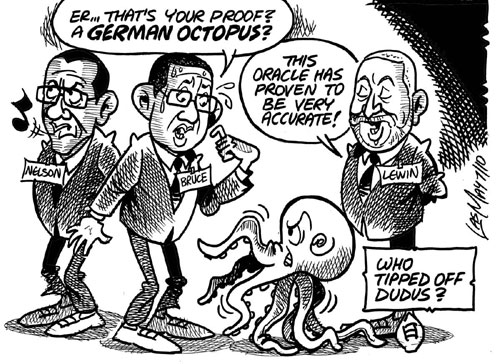
Who Tipped off Dudus?

Paul the Octopus calls it in Jamaica’s Dudus saga…

Las May, Gleaner

Did anyone else watch the Diamond League showdown between Asafa Powell and Usain Bolt today? What a race! The top three spots were taken by Jamaican runners, Usain first with 9.84, Asafa next with 9.91 and Yohan Blake in third place. It’s called a Trifecta apparently…

Speaking of world beaters, Jamaica has two of the world’s best cartoonists as well. Las May of the Gleaner Co. and Clovis of the Jamaica Observer. The cartoon above of OctoPaul confronting the Jamaican Prime Minister Bruce Golding with an accusing tentacle had me in stitches for days. Great way to tie in the World Cup in which Paul the Octopus played a starring role with local politics and the sensational Admiral Lewin revelations.

My Name is Khan…Roger Khan

What kind of sentence is Christopher ‘Dudus’ Coke likely to get from a US court? Will he tell all? Who will he implicate? An examination of what happened in the case of Guyanese drug baron Roger Khan might provide some clues…


Driving Miss Dudus by Hubert Neal Jr.

Now that Dudus is safely in the hands of the US justice system what can we expect the outcome to be? That is the question in almost everyone’s mind with Observer columnist Lloyd B. Smith even wondering “Should Dudus sing?” in his latest column. What kind of sentence is Dudus likely to get? Will he ‘sing’ and get a reduced sentence? Who will he take down with him? Is anyone in government going to be implicated?

Even if we’re unlikely to know the answers to these questions anytime soon, we might get some clues from looking at other extraditions similar to that of Christopher ‘Dudus’ Coke. In 2006 Samuel “Ninety” Knowles, a Bahamian drug ‘kingpin’ with ties to Jamaica was extradited to the US on charges of “conspiracy to import cocaine and conspiracy to possess cocaine with intent to distribute it.” In 2008 a US court sentenced him to 35 years in prison.

Like the Jamaican government the Bahamian government had also dragged its feet before allowing Knowles’ extradition on the grounds that he might not receive a fair trial in the United States. The Jamaican government’s argument in stalling Dudus’s extradition was that the evidence provided by the US to prove that Coke was a trafficker was obtained by wiretapping, allegedly illegal under Jamaican law. Interestingly in his book Police and Crime Control in Jamaica: Problems of Reforming Ex-Colonial Constabularies Anthony Harriott noted that Jamaica citizens may be convicted on illegally obtained evidence with the exception of coerced confessions. (p. 40)

The most notorious drug kingpin of all was Colombian Pablo Escobar of the infamous Medellin Cartel who thumbed his nose at the US for years. Escobar formed a lobby group called Los Extraditables (their slogan: Better a grave in Colombia than a jail in the United States) that bullied the Colombian government “through murder, intimidation and skilful public relations” into repealing the laws allowing extradition of criminals. Escobar then designed a cushy prison for himself in a compound called La Catedral. As Guillermoprieto tells it: “”Despite enormous controversy, the government had finally agreed to Escobar’s terms: he got to choose the prison site, in the hills above his suburban fiefdom of Envigado, and he supervised its security measures. Neither Army troops nor police officers were allowed on the prison grounds, and Escobar personally approved the hiring of half of some fifty guards–the other half to be recruited by the Mayor of Envigado–who were to stand watch over him and his associates.”

In 1992 thinking that the government, which wanted to move him to safer quarters, was going to kill him, Escobar ‘escaped’ from his prison possibly walking out through the back door in women’s clothes. He remained at large until December 1993 when he was shot and killed by Colombian security forces. Alma Guillermoprieto’s book The Heart that Bleeds, from which I got this information, has more details on all this.

Perhaps the most sensational ‘extraditable’ close to home however was Guyanese drug baron Roger Khan who was arrested in Paramaribo, Suriname on June 15, 2006. Wanted in the US for importation of cocaine into that country Khan evaded capture in Guyana by escaping to neighbouring Suriname. In Guyana his close ties to the ruling party, the PPP, had allowed him to escape arrest but in Suriname, a country with a more serious attitude towards law enforcement he was caught by the police and forcibly deported to Guyana via Trinidad and Tobago. He never reached Guyana: The Surinamese Police had evidently tipped off the USDEA who were waiting for Khan at Piarco airport in Trinidad. From there he was flown directly to the US and imprisoned.

Roger Khan was the kind of criminal who makes Dudus look like a pussycat. He allegedly had at his disposal a paramilitary troop known as The Phantom Squad who ruthlessly terrorized and eliminated witnesses and others who stood in his way. Between 2002 and 2006 approximately 200 people are said to have been murdered by the Phantom Squad.


Roger Khan at Brooklyn Federal Court

There were several unique things about the Roger Khan case. Far from admitting to being a criminal Khan took out full page advertisements in Guyanese newspapers claiming that he was actually a crimefighter who had helped both the Guyanese and the US governments during an earlier crime wave. In a further twist during the course of his trial at an East New York district court his high profile lawyer Robert Simels was himself indicted for tampering with witnesses during his defence of Khan.

According to a March 17, 2009 Stabroek News article:

“Since being imprisoned, Khan and the prosecution have made some explosive statements about the inner workings of his criminal enterprise and other matters in Guyana. Khan’s former lawyer, Robert Simels, who, along with his assistant, Arianne Irving, is now his co-defendant in the witness-tampering charge, had stated that US government investigators had learnt that Khan received permission from the Guyana government to purchase surveillance equipment capable of intercepting and tracing telephone calls made from landline or cellular phones. The software is reportedly only sold to governments.”


Roger Khan after arrest in Suriname

The surveillance equipment in question was manufactured by UK firm Smith Myers; its co-director testified in the New York court that “the cellular intercept equipment used by drug kingpin Roger Khan had been sold to the Government of Guyana (GoG), a contention that officials here have repeatedly denied.” This despite the fact that testimony was produced in court showing links between Khan and Minister of Health Dr Leslie Ramsammy. Evidence disclosed to the court showed “that the equipment was purchased for and received on behalf of the GOG by Health Minister, Dr. Leslie Ramsammy. Myers also confirmed that independent contractor, Carl Chapman, traveled to Guyana to train Khan and others in the use of the equipment.”

Among the persons killed for statements intercepted with the surveillance equipment were a popular talk show host Ronald Waddell and a young activist and boxing coach, Donald Allison. According to a Working People’s Alliance press release on July 28, 2009, Selwyn Vaughn, a former member of the notorious Roger Khan phantom squad and now informant for the US government, testified under oath about the involvement of Roger Khan and a high official in the Guyana Government, Minister Leslie Ramsammy, in the execution of PNCR member and political commentator Ronald Waddell and Agricola youth organiser Donald Allison.

For the record Ramsammy has vehemently denied that he has ever had any contact with Khan and said he has no knowledge about the surveillance equipment. As for the execution of talk show host Waddell, according to the New York-based Caribbean Guyana Institute for Democracy (CGID):

President Bharrat Jagdeo, when asked at a press conference on July 28, to respond to Vaughn’s testimony that Ramsammy had been complicit in the assassination of Waddell, said “Maybe if at the end of the day, all the criminals were to deal with each other we may have a better society but I am not going to sanction that. This is not government policy… but I wouldn’t lose any sleep, frankly speaking, about criminals when they kill each other.” Jagdeo also further said that “If you believe all that this informant is saying you have to also believe that he (Waddell) was a member of the Buxton gang and that he was basically in a criminal enterprise. Waddell was a criminal involved in a criminal enterprise.”

As usual the line between being a criminal and outlaw and being a legitimate businessman who was also a popular self-appointed leader is rather blurred. Khan was said to have “founded and operated a number of successful businesses, including, but not limited to, a housing development and a construction company, a carpet cleaning service, a nightclub, and a timber mill.”

Though repeatedly lobbied and besieged by public interest groups to have the entire sordid state of affairs thoroughly investigated the Guyanese government has resisted. The part that sounds mind-numbingly familiar is the following quote from another article carried in the Stabroek News:

The government so far has resisted all calls for such an inquiry; it can afford to do so because it knows that significant elements of its own constituency regard Roger Khan as a ‘saviour’ of sorts. Our reporter earlier last week sought out comments from the Guyanese diaspora, and of those who agreed to say something in the Liberty Avenue, Queens area (NY), the sentiment was that Khan had “saved” Guyana. One man told her that had it not been for Khan the country would have “gone down the drain”; that the US should not have “kidnapped” him and instead he should have been left to continue the “good things he started.”

Shades of Christopher ‘Dudus’ Coke and the ‘Don’ or ‘community leader’ phenomenon we know so well in Jamaica. But in Guyana there is an added complication that, mercifully, is absent from Jamaican politics: the vexed issue of race. As a 2009 Village Voice article alleged:

“Khan’s reputation seems to diverge along racial lines in Guyana, where about half the population is of African descent and half of East Indian descent, like him. To many Indo-Guyanese, he is a folk hero, responsible for cleaning up the streets when the country’s police force which is predominantly Afro-Guyanese couldn’t or wouldn’t, giving East Indians, who dominate the business community, a layer of protection where none previously existed. Khan has claimed, without copping to the existence of the Phantoms, to have helped the government put down a crime spree stemming from a 2002 prison break, and to have collaborated with the U.S. government in the region, most notably in the case of the safe retrieval of an American diplomat who was kidnapped off a Guyana golf course in 2003. Afro-Guyanese are more likely to associate Khan first and foremost as a leader of the Phantom Squad, a drug runner and thug, to blame for just about every suspicious death in Guyana. (Guyana, like Suriname, is a transhipping point for South American cocaine destined for North America, Europe, West Africa, and the Caribbean, according to the DEA.)”

Because of his links to the the ruling PPP, Guyanese President Bharat Jagdeo stood accused of being a friend of Khan’s. Whether this is true or not, a story circulating about Khan, who like Dudus also bore the nickname ‘Shortman’, suggests otherwise. According to the tale Khan was in a particular club with friends when Jagdeo suddenly appeared causing him to ejaculate “Oh skunt boy, here cum the Anti-man!” before getting up to greet the President. As my source put it: Explanation: Jagdeo is believed to be gay — ‘skunt’ is a popular swear word in Guyana and ‘Anti-man’ is homophobic abuse for gay men used as an alternative to ‘battyman.

Homophobia: Another trait that Khan shares with the Jamaican badman (despite their willingness to don female clothing when the situation calls for it). There are plenty of parallels in the Roger Khan and Dudus coke sagas. Both Khan and Ninety, the Bahamian drug don also had ties to Jamaica. Those who are hoping that Dudus will sing long and loud in New York, revealing the dirt on organized crime in Jamaica, should bear the following observation by a Stabroek News editorial in mind:

Those who were optimistic that Khan himself might one day supply information about his operations here as well as his connections, must have been disappointed to learn that the likelihood is he will be deported at the end of his sentence. If he knows he has to return to his homeland eventually, it is hardly likely to put him in confessional mode. It is always possible, of course, that further information may trickle out from future trials which will throw some light on the events of a painful period.