A selection of tweets, including from reps of the accused, immediately before, during and after the tension-filled moments leading up to the jury’s verdict of guilty against Kartel and three of his four co-accused. Includes video of Lizard Williams dancing.
Dec 13, 2013 newscast on Kartel trial detailing video and bbm evidence presented by prosecution
Well, i was wrong. I fully believed that Kartel and co. would walk; because of the weakness of Jamaica’s justice system, the strength of the defence team, and because the powerful are rarely tried, let alone found guilty in this society. But no! In a dramatic, rapidly unfolding denouement yesterday afternoon the nearly 3-month old Kartel trial came to an emotion-filled climax. Amidst rumours that one of the jurors, ‘No. 3’ to be precise, had tried to offer the jury’s headwoman a J$500,000 bribe, the jury decided 10 to 1 that Kartel, and three of his four co-accused were guilty of the murder of Clive ‘Lizard’ Williams, a young dancer whose body has yet to be found.
Lizard’s sister, Stephanie Breakenridge, sat in the courtroom sobbing every now and then as the final moments arrived. In all of the circus around this celebrity court case her brother, seen in the video above dancing and bigging up the Gaza Empire, had been virtually forgotten in the media coverage of the trial, except perhaps as its subject, in cold, clinical terms. His terror-filled texts had been read to the courtroom earlier in the trial but otherwise very little was known of the young man who thought his moment in the sun had arrived the day he was adopted by Kartel and his group.
Word on the verandahs is that the DPP Paula Llewellyn, Judge Campbell, Prosecutor Jeremy Taylor and his team were determined to use this case to showcase the ability of the Jamaican court system to deliver justice, surely if not swiftly. I congratulate them on their determination to demonstrate that justice is not as elusive in Jamaica as many of us have been led to believe…let’s hope the Kartel trial sets the bar for all trials in Jamaica from now on.
As Dah’Mion Blakey said on Facebook: The same rigor with which this case was pursued should be extended to ALL; uptown, downtown, popular, unpopular and indifferent!! #JudicialReform#SocialJusticeForAll
Finally, many of us thought that Kartel would have got off because the jury would have felt too intimidated to find him guilty. Clearly they didn’t. This too was something the DPP must have been keen on establishing, to signal to potential jurors and a timorous public that the all-abiding fear that curtails the carriage of justice too often is perhaps overstated and unnecessary. Of course we have to wait and see and hope that none of the jurors face repercussions for their decision.
Below is a curated collection of tweets that will convey the atmosphere yesterday in Kingston, especially downtown where the Supreme Court is located. There are tweets by @Iamthekartel, a Twitter account supposedly speaking for Kartel, along with many others which capture the climax of this sensational court case.
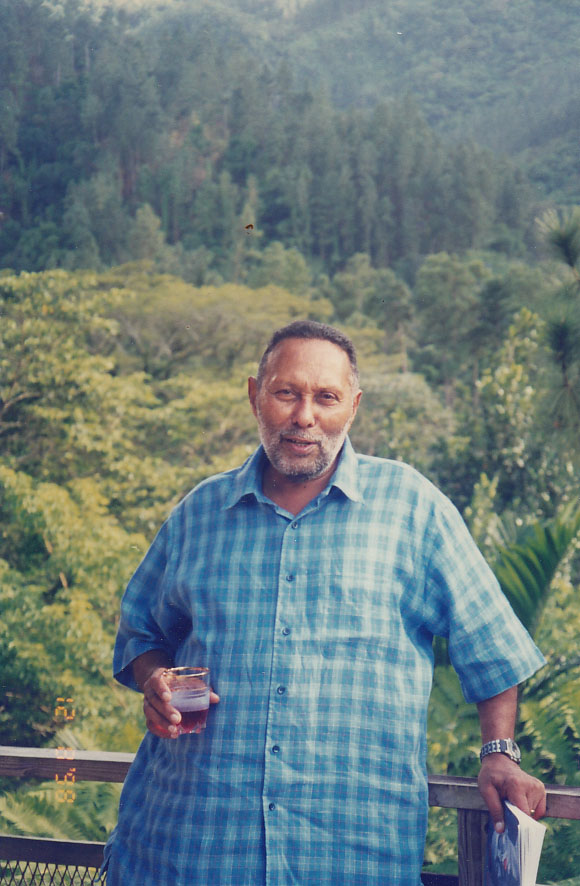
Stuart Hall at Good Hope Estate, Trelawny, Jamaica, 2004
Thought precedes action, and Jamaica in its obliviousness to who Stuart Hall was, to his extraordinary work and life, to his globally mourned death, demonstrates the perils of a society in which the most complex levels of thinking are considered expendable, an unnecessary luxury, something that need not detain the nation. It’s a symptom of the weakness of its intellectual elite that they have shunned serious engagement with the ideas of a thinker who influenced thought all over the world, moreover one who was born and brought up in Jamaica, who left at the age of 19 to embark on a lifetime that would change the world. That it hasn’t changed Jamaica, that there is no room in the oft-cited “Brand Jamaica” for the great thinkers this country has produced (many of whom toil in foreign vineyards), is an indictment of the state of intellectual life here for young Jamaicans deserve to know that their countrymen excel not only in sprinting and music but also in the much less visible arena of intellectual production.
The indifference to the passing of this intellectual colossus (the New York Times referred to him as UK’s Du Bois) in the country of his birth was noted by its leading newspaper, the Gleaner, which went to the lengths of editorializing on it: “…our ignorance of Stuart Hall, at all levels of society, perhaps says more of national inattention to ideas and the people who generate them – especially the big ones. For as a thinker, Professor Hall would, in our view, be the equivalent to the likes of Usain Bolt.”
Members of the University of the West Indies were quick to point out that the University had not been ignorant of Stuart Hall, bestowing an honorary doctorate on him in 1998 and holding a conference in his honour in 2004. The conference which was the most successful of several such colloquia mounted by the now inactive Centre for Caribbean Thought also demonstrated through the overflowing, standing room only auditorium in which Hall gave his public lecture, that there WAS appreciation on the part of the public for the man and his ideas. Nevertheless a mere 10 years later when Hall died, it took the media a couple of days to react and it was the next day before the University of the West Indies managed to get out a tribute, one that would be revised and updated several times over the next couple of days as the starchy institution tried to come to grips with its own lacunae regarding the work of this great thinker.
An early version of the University’s tribute described Stuart Hall as a ‘communications specialist’, which is rather like describing a race horse as a ‘galloping machine’. What this reflects is the restrictive mindset within which tertiary education has been trapped in Jamaica. Ours but to produce ‘experts‘ and ‘specialists’, not thinkers or theorists.
But maybe that’s in the past. I was heartened to receive this tribute written by three of the younger members of the Faculty of Social Sciences, Doreen Gordon, Orville Beckford and Moji Anderson, which they tried to get published in the Gleaner. Alas the old lady of North Street wasn’t interested. I offer it here as a guest blog post because it simply and succinctly sums up who Stuart Hall was and why he was globally valued in the way he was even if not in the country of his birth. We ought to use the moment of his passing and the local apathy to it as an opportunity to do some serious soul-searching about the stifling levels of anti-intellectualism in this country, and for that matter, the world.
Stuart Hall at Aggrey Brown’s home, Golden Spring, Jamaica, 1998
“I want to disturb my neighbour”: Stuart Hall and the role of the public intellectual
by Doreen Gordon, Orville Beckford and Moji Anderson
There have been many tributes to the Jamaican born thinker, Stuart Hall – a testimony to his influence across political, academic, artistic and media spheres. Hall was remarkable for his ability to move between the worlds of the academy, politics and popular media with both elegance and authority, be it in his political writings, television and radio appearances, or guest lecturers. In reflecting on Stuart Hall’s life, one cannot help but think about the role of the intellectual in society. An intellectual often stands outside of society and its institutions, actively disturbing the status quo. However, at the same time, an intellectual is a part of society and should strive to address his/her concerns to as wide a public as possible. Stuart Hall may be described as a “public intellectual”: actively involved in the politics and issues of his day, critiquing the society around him, and disseminating new insights through various media to a wider public. He was also deeply concerned with making education more widely accessible.
Arriving in post-war Britain as a young Rhodes Scholar, Hall did not return to Jamaica to live. Colonial society and the Euro-centric middle class environment in which he grew up seemed too constricting. His socialisation, early colonial education and the culture shock of migrating to race-strained Britain in 1951 no doubt shaped his particular concerns. He once said in a debate with a conservative political figure in London, “You cannot have at the back of your head what I have in mine. You once owned me on a plantation.” He remained on the side of the oppressed, the marginalized and the exploited – a perspective shaped by his Caribbean roots. This was clearly his role as a public intellectual: to make room for the voice of the powerless.
Hall’s broader recognition in Britain came when, along with a handful of intellectuals, he helped to form the Centre for Contemporary Cultural Studies in 1964 at the University of Birmingham, eventually becoming its Director. Emerging as one of the country’s leading cultural theorists, he helped to define some of the major changes and cultural shifts occurring in twentieth century Britain. It was a relatively new idea at the time to take the study of popular culture seriously and in particular, to analyse its relationship to politics and power. The new academic discipline of cultural studies spread from Britain to the United States, to Latin America and the Caribbean, and even to Australia and East and Southeast Asia. Although some might argue that cultural studies is on the decline, the discipline has generated a wealth of significant work and set the stage for an entire line of theory, critique and political action which is still very influential, especially in the anti-globalization movement.
Hall’s writings linking racial prejudice and the media became key works, making him an inspirational figure for young black artists and film makers from Britain. His studies on post-colonialism asked the question of how a modern, multicultural British society could be created that respected cultural differences among people – thus he is often referred to as “the godfather of multiculturalism.” He observed that increased diversity within nations and the need to accommodate different sets of demands by various cultural groups posed challenging questions about the meaning of equality.
When Hall later moved to the Open University as Professor of Sociology, he continued his engagement with major issues of the day relating to British politics, culture and race. Indeed, he is often credited with the phrase “Thatcherism”: a term used to describe the politics, policies and political style of Margaret Thatcher, Conservative Party Leader from 1975 to 1990. Yet his views were never extreme. He urged his comrades not to dismiss Thatcherism: that they should try to understand it and its popular appeal. For Hall, Thatcherism was a new phenomenon, an authoritarian populism that needed to be understood before it could be contested.
Hall was a political actor: he was involved in protests, the campaign for nuclear disarmament, and political writing. He insisted on linking intellectual and cultural work to political struggles rather than pretending that the former is an end in itself. He maintained strong ties to Marxist thinking and to radicalism in general, but he also critiqued Marxism, especially its Stalinist versions. While he insisted on the connection between theory and political practice, he wanted it to be a flexible one that provided space for intellectual, cultural and political creativity. This search for ideological flexibility and freedom within Marxism is the well-spring of his work and impact.
Key to Stuart Hall’s thinking was his refusal to reject completely the impact of economics in peoples’ daily lives, something lacking in many contemporary cultural theories. Yet, he was not an economic determinist – in other words, our consciousness, ideas, and cultural creations have a degree of independence and agency outside of economic realities. However, some critics have suggested that the confinement of the economic factor in Hall’s writings to “the first instance,” meant that serious economic analysis was sometimes missing from his writings. For example, Hall did not consider the material basis of Margaret Thatcher’s political power, nor was he able to articulate convincing alternatives to the present global capitalist order. However, he rightly understood that we could not grasp contemporary realities without studying the workings of capitalism.
Hall’s contribution to issues of race, ethnicity and identity are well respected and far-reaching. Given the genealogy of Stuart Hall – his parents’ ancestors were English, African and Indian – his take on race and race relations was influenced by this cosmopolitan, consanguineal mix. His view was that race, ethnicity and identity are social constructions. If they can be constructed by human beings, they can also be challenged and torn down. Hall argued that race had more in common with language than with biology. In other words, ‘race’ is a moving, shifting conundrum defined by the environment, social structure and the people involved in the social relations of production and speech. Thus the concept of race for Hall was never a fixed but a moving target, with different dialectics attached to each representation and perception. Hall was not afraid to express his dialogic about race in his writings. He acknowledged the power of race and ethnicity to shape social interaction and the ways in which particular objects are viewed – for example, how works of art are read. His deep and independent post-colonial thoughts will surely be missed. However, may they carry on, in the words of Bob Marley, to “disturb my neighbour.”
Are we all becoming pawns of a Pentecostalist anti-LGBT crusade being conducted worldwide?
Binyavanga Wainana. Photo: Ben Curtis, AP
I finally got around to watching Kenyan writer Binyavanga Wainana’s Hard Talk interview with Stephen Sackur of the BBC just a few days ago. The interview was instigated by Binyavanga’s hugely hyped ‘coming out’ a few weeks earlier. In response to the recent wave of homophobic legislation in Nigeria and Uganda Wainana released a short story titled I Am a Homosexual, Mum. In the BBC interview Binyavanga was on form as usual and made a lot of sense but Sackur took me by surprise when he seemed to reject out of hand the Kenyan writer’s assertion that the Pentecostal movement with its fire and brimstone preachers were very much to blame for the recent escalation in homophobia on the African continent.
This sounded perfectly plausible to me, especially since I’ve heard local gay activists say the same thing in the context of Jamaica, that American Pentecostalist preachers come to the Caribbean and rave and rant against homosexuals with an incendiary intensity that simply wouldn’t be allowed in the United States with its hate speech laws. All of a sudden something I’ve been puzzled by for a long time–the mystery of why homophobia manifests itself so virulently both in the Caribbean (with Jamaica taking the cake for over the top intolerance) and on the African continent–seemed to have a simple explanation. The same set of American Pentecostalists have mounted concerted campaigns against what they call ‘the homosexual agenda’ in both locations, and I don’t know about African countries but you will have noticed if you’re from here that the use of the term ‘homosexual agenda’ has seen an exponential rise in the last 5 years. Just to test my hypothesis I decided to look at another recent site of anti-gay rhetoric and action–Russia. It was instructive. An American evangelist named Scott Lively had been at work there just as he had in Uganda, which he first visited in 2002. According to a Washington Post article:
Scott Lively is an obsessively anti-gay American evangelical minister. He is, according to National Journal, “perhaps the most extreme” of a network of U.S. evangelicals who, having failed in their crusade against all things gay at home, travel abroad to connect with anti-gay activists and arm them with arguments that, for example, homosexuals will seduce their children, corrupt all of society, and eventually take over the country. You don’t need to take my word for it; read Lively’s manifesto here. It’s a 2007 missive to Russians suggesting they “criminalize the public advocacy of homosexuality,” i.e., use state power to force gay people into the closet. This is something Russia actually did last year (rather indirectly, but quite effectively).
In early March 2009, he went to Uganda to deliver what would become known as his infamous talk at the Triangle Hotel in Kampala at an anti-LGBT conference organized by Family Life Network leader Stephen Langa. The conference, titled “Exposing the Truth behind Homosexuality and the Homosexual Agenda,” also included Don Schmierer, a board member of the ex-gay therapy group Exodus International, and Caleb Brundidge Jr., a self-professed ex-gay man with ties to the ex-gay therapy group Healing Touch. Thousands of Ugandans attended the conference, including law enforcement, religious leaders, and government officials. They were treated to a litany of anti-LGBT propaganda, including the false claims that being molested as a child causes homosexuality, that LGBT people are sexual predators trying to turn children gay by molesting them, and that gay rights activists want to replace marriage with a culture of sexual promiscuity. Lively met with Ugandan lawmakers during the conference, and in a blog post later he likened his campaign against LGBT people to a “nuclear bomb” against the “gay agenda” that had gone off in Uganda. A month later, the Ugandan parliament was considering legislation that included the death penalty for LGBT people in some instances and life imprisonment for others. According to Rev. Kapya Kaoma, an Episcopal priest from Zambia (now in Boston) who went to the conference under cover, Lively’s talking points were included in the bill’s preamble
While Lively lashes out at Republicans in the U.S. for helping “hand over the military to the Sodomites,” he praises anti-gay measures in India, Russia and Jamaica, and argues that the reason Ukraine’s president pulled out of an agreement with the European Union was “the Ukrainian disdain for the sexual perversion agenda of the EU.”
In Lively’s own words:
Those of us who still hold a Biblical worldview have been heartened by recent global events affirming normalcy. The Australian high court struck down “gay marriage” as unconstitutional, the Indian high court re-criminalized sodomy, and Russian President Putin declared his nation to be the new moral compass of the world for championing family values. Although Ukraine’s highly controversial decision to postpone (or cancel) a step into the fold of the European Union has been framed in economic terms, there is little doubt that the Ukrainian disdain for the sexual perversion agenda of the EU has played a major role. And in tiny Jamaica, a push to decriminalize sodomy (driven in large part by the U.S. State Department), has run into so much opposition that the pro-family Jamaicans just might win that battle.
To see Lively in action watch this UK Guardian video released today, How US evangelical missionaries wage war on gay people in Uganda. Although Lively himself doesn’t seem to have made a personal appearance in Jamaica as yet we have been treated to diatribes against the LGBT-community by one of his disciples, Peter LaBarbera, whose group Americans for Truth About Homosexuality (AFTAH) threw a banquet in honour of Lively in 2011. LaBarbera was in Jamaica as recently as December 2013 urging Jamaicans to resist changing the laws against buggery.
LeRoy Clarke. Photo: Stefan Falke
Of course we can’t blame the Pentecostal purveyors of hate entirely for the intolerance towards the LGBT community. Their maniacal fervour and rhetoric falls on very fertile ground. Anti-gay sentiment is alive and well from the least literate to the most highly educated and accomplished of Caribbean citizens. Look for example at the startling outburst the other day by Trinidadian artist Leroi Clarke, that has stirred up quite a controversy in Port of Spain. A report in the Trinidad Guardian quoted the eminent painter:
In a phone interview yesterday, Clarke related homosexuality to the increase in crime, saying young men are usually indoctrinated into gangs with homosexuality and because of the violation of their manhood use the gun as a symbol of their masculinity. He added: “It is brought about by power bases that manipulate the principles that hold our heritage for their own advantage. “Something is happening with the gender paradigm today. We had guidelines where we looked at certain types of conduct as abominations. We took it from the scriptures.” The Bible, he added, was one of those and verses clearly refer to homosexuality, men with men and women with women, as “unnatural” and an abomination. “Today, the word abomination does not have the same tone. People indulge abominations, accede to them,” Clarke lamented. “At 73, I can say the world is no longer mine,” he said. Asked exactly what he meant by saying homosexuality was threatening the arts, Clarke said with the exception of the sailor and maybe the midnight robber, there were no longer any definitely male costumes in Carnival, not even in portrayals of the devil. “An effeminating power has taken over the costumes and even the rhythm of the music. Carnival is no longer male and female. “This is a very serious matter. We are dealing with a problem that is threatening our heritage.
LeRoy Clarke at work. Photo: Annie Paul
Rumour has it that what may have set Clarke off was the recent state gift to Carnival Masman Peter Minshall of the State property he has been occupying in Federation Park, Port of Spain. Minshall, a white Trinidadian is openly gay.
To return to Stephen Sackur’s interview with Binyavanga Wainana which must be watched to be believed, I admit to feeling as if the scales have dropped from my eyes. On the one hand you have Sackur browbeating Wainana for bringing up the very pertinent matter of the anti-gay campaign by Pentecostalist missionaries in African countries such as Uganda, claiming that the Kenyan writer was trying to blame African homophobia on ‘external influences’ such as this (He wasn’t); and on the other hand you have Sackur insisting later on in the interview that the West must be allowed to interfere in the internal matters of African societies in the name of championing ‘universal values’! Sackur needs to be administered a good dose of Stuart Hall 101 on the inherent problems of overlooking cultural factors in the name of a tenuous universalism which only seems to work unidirectionally–from the West to the rest of us.
If indeedyou speak in the name of the West Mr. Sackur deliver up former UK PM Blair to the Hague for trial for the universally understood category of war crimes (as Wainana gently suggested). I’d love to see an interview along those lines. And at the very least leash the rabid hatemongers within your midst and curb the export of hatred and homophobia from the West before we all become puppets of the Pentecostalists. After that you may or may not be allowed to preach ‘universal values’. External forces ought not to lead the way to change in societies from outside, they can provide assistance discreetly, at the behest of, and in line with, not in advance of those militating for change from within and only after they put their own house in order. Nuff said.
Excerpted from my new blog on EPW’s website…this inaugural post shares memories of Stuart Hall along with some photos.
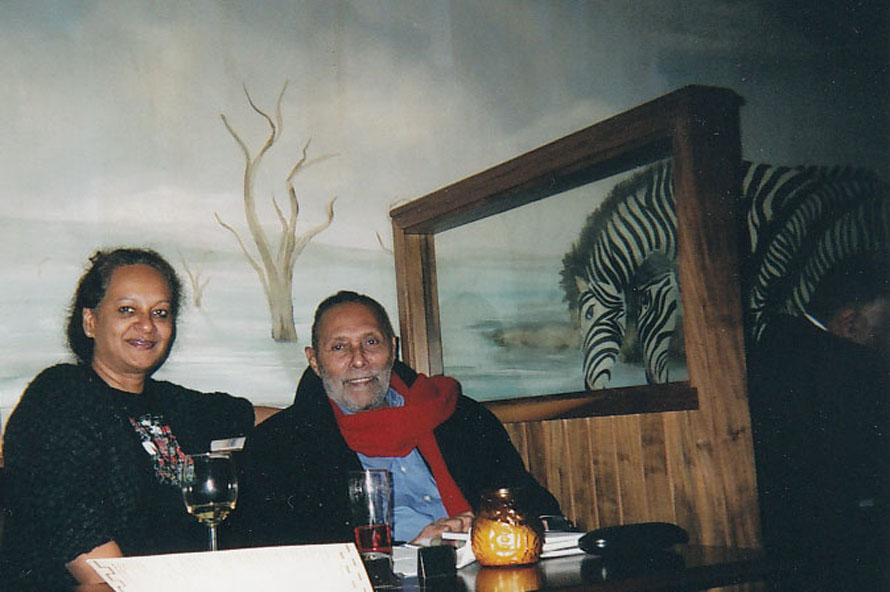
Stuart Hall at INiva (Institute of International Visual Art) with Annie Paul and artist Steve Ouditt from Trinidad and Tobago, 2000
This post was written for the Indian magazine EPW (Economic and Political Weekly), it’s website to be specific, where I’ve been invited to blog. They asked if I would share some of my personal memories and photographs of Stuart Hall in the wake of his passing on Feb 10. The post follows.
RIP Stuart Hall, doyen of cultural theory (1932-2014). “The cultural dimension is not a secondary, but a constitutive dimension of society.”
I found Ranjit Hoskote’s tweet quoted above, worth retailing, because it encapsulates Hall’s vastly influential work most admirably and serves as a suitable introduction to the Jamaican-born thinker the world has been mourning since Feb. 10, 2014.
I first heard about Stuart Hall from Tejaswini Niranjana, an Indian scholar who visited Jamaica for three months in 1994. She was a Homi Bhabha Fellow (named after the Physicist not the theorist of hybridity) and had come to the University of the West Indies to familiarize herself with Caribbean culture. Teju was interested in and fascinated by the Indian diaspora in the Caribbean but equally by Jamaican popular culture which is predominantly Afro-Caribbean.
I credit Teju with awakening my now abiding interest in Caribbean, and in particular Jamaican, popular culture by introducing me to the relatively new field then, of Cultural Studies. Having studied English Honours at Lady Shri Ram College and Sociology at Jawaharlal Nehru University in the 70s followed by Journalism at the University of Kansas, and even a foray into visual art, I had found myself rudderless. Neither English Literature nor Sociology really enthused me; it wasn’t until that fortuitous encounter with Cultural Studies that I began to feel an interest in matters intellectual again.
Having wandered through several different ‘disciplines’ as I had, I was excited to find new ways of thinking and writing that synthesized my different areas of knowledge. Of course this was something that JNU’s multi-disciplinary approach to scholarship had also prepared me for. In 1995 I started writing a weekly column in a Jamaican newspaper while working at the University of the West Indies in scholarly publishing.
I named my column ‘Hyphen’ to signal my lifelong feeling of ‘in-betweenity’, of being formed between cultures in an India that was rapidly modernizing, producing tectonic cultural shifts not always easy to navigate. Born and brought up a Syrian Christian, albeit by liberal parents, I always felt envious of my Hindu friends, especially the numerous rituals and festivals they could lay claim to. There was also a sense of feeling illegitimate, especially since I grew up in Ahmedabad, not Kerala, where I wouldn’t have been as out of place.
There is something profoundly destabilizing about watching your mother carefully crow-proof fishbones and other scraps of our non-vegetarian meals in secure little packets before consigning them to the garbage can in case rapacious birds outed us in front of our finicky vegetarian Gujarati neighbours, forcing us to leave the community in disgrace. There is also a deep discomfort in feeling disconnected from the vernacular culture around you because your father thought English was the only language you needed to know. Not being allowed to go to Hindi movies like all my friends did produced yet more alienation; by the time I reached my teens I felt like a classic misfit, like someone looking at the world through an impervious bubble.
It wasn’t till I came to Jamaica in 1988, after sojourns in the United States and Brazil that I started to feel at home, leading me to settle down here. Here was a vibrant, vernacular culture I could be part of. Jamaica is also the most welcoming society I’ve ever come across.
Excerpts from my 2007 article for Riddim magazine on Cindy Breakspeare…
Photo: Source unknown
Ever since Cindy Breakspeare gave the annual Bob Marley lecture last week interest in her story has heightened. I had interviewed her in 2007 for Riddim magazine. The article appeared in German in Riddim and it just occurred to me that I could publish segments of the English original here on Active Voice. Enjoy!
When asked in a radio interview about her origins Cindy Breakspeare once said “I’m as Jamaican as ackee and saltfish”. The comparison to the national dish was particularly apt as the codfish used in it is often imported from Newfoundland, Canada. Ackee of course is a strange fruit considered inedible in many places because of the potent alkaloid toxins it contains. Jamaicans however eat it with gusto. Apt too because Cindy is the product of a Canadian mother and a Jamaican father; coupled with her white skin her bi-cultural heritage is what often subjects her to questions about her eligibility to be considered Jamaican.
I started thinking about this article after listening to numerous radio interviews with Cindy Breakspeare over the last five or six years. Who was this extraordinary woman? I was struck by her voice and the down-to-earth sincerity it radiated, her healthy sense of humour, her refusal at a certain level to wield the celebrity that is her entitlement or even to take it too seriously. This was in stark contrast to the social columns of Jamaica’s newspapers–filled with the affected poses of individuals whose lives are completely banal and vapid, their only claim to fame being their disproportionate control of the resources of this small postcolonial nation.
Cindy on the other hand had not only been the favoured consort of the first (and to date the only) global musical superstar from the third world—Bob Marley—shortly after meeting him she had become a celebrity in her own right by winning the Miss World competition in 1976. In those days this was an even rarer achievement for an unknown from a small developing country than it is today. As for Cindy’s Marley connection, many of us would have given our eyeteeth just to have heard Bob Marley in concert live, let alone to have enjoyed an intimate relationship with this extraordinary musician whose fame and influence have grown exponentially since his untimely death almost thirty years ago.
Cindy actually bore Marley a son, Damian, or Junior Gong as his father called him, who has turned out to be an outstanding singer and songwriter in his own right. Damian, more than any of his half brothers and sisters, has seemed the reincarnation of his father–the champion of poor people’s rights, the shamanic performer chanting down Babylon. Some Jamaicans, however, criticize Damian Marley as an example of an “uptown browning,” suggesting that he lacks street cred, something essential to good Reggae.
The success of Damian’s 2005 hit ‘Welcome to Jamrock’ silenced most critics. In any case this sort of criticism rarely originated in the streets where people appreciated the younger Marley shining a spotlight on their plight. The question is where did he get this social conscience from? From where did he get his unflinching penchant for reality and plain speaking?
Without a doubt this was partly a legacy of his legendary father who had died when Damian was only 2 years old. But having the same legendary father had not led the other Marley siblings to produce music of this caliber. What if some of Damian Marley’s outspoken lyricism actually came from his famous mother, the beautiful Cindy Breakspeare?
Judging by the interviews I had heard with Cindy I began to suspect that far from being a pampered member of any VIP club the young Marley had actually benefited from a double dose of radicalism: Not only was he his father’s son he also had a mother who had flouted the values of Jamaican society, turning her back on the wealth and privilege that could have been hers and embracing a countercultural lifestyle that was far from glamorous then no matter its currency today.
Who was Cindy Breakspeare exactly? Born in the fifties to a Canadian mother and Jamaican father Cindy was brought up in Jamaica and went to school at Immaculate Conception, a local convent school, as a boarder. Having to be a boarder at such an early age while difficult and challenging taught Cindy independence and self-sufficiency.
I went to Immaculate at the age of 7. I think when you’re separated from your family at that age you have to make a lot of decisions for yourself at a very early age–so you learn to trust your instincts, your own instincts, at a very early age; you develop your own value system, your own sense of what’s right and wrong for you. You tend to move away from being a sheep and doing what every one else wants because you don’t have that safe cocoon; you have to follow your own feelings a lot more. Yes, this feels right for me and no that doesn’t and yes I like this and no, I don’t like that and maybe because there is no family constantly directing and supervising and saying no, you can’t do this and no you can’t do that you just tend to wend your own path and after a while you just kinda don’t know any other way to be–you just dance to the beat of your own drum.
While going to a convent school gave her the foundation of a good middle class upbringing her own family life was fractured and unstable so that when she finished school she was on her own, fending for herself and looking for any opportunity that might come her way. At 19 Cindy had been out of school for a while and done many different jobs. There was no money for further studies; her parents were separated, her father now in Canada and she had to get out there and hustle for a living. “I worked at a furniture store for a while, I worked at a jewellery store, I ran a nightclub, I worked at the front desk of what was then the Sheraton, now the Hilton, so I did many different things and eventually found myself at this restaurant …Café D’Attic.”
Café d’Attic was Jamaica’s first health food restaurant specializing in “fruit platters and salad plates and very healthy sandwiches…It was very health-oriented and attracted those who were looking for something other than your greasy spoon, your fast food”. It was during this period that Cindy met Bob whose own preoccupation with healthy food and ital living brought him to the restaurant. This was also what brought Mickey Haughton-James, the owner of a fitness club called Spartan there, a momentous connection that ultimately led to Cindy becoming Miss World in 1976. “So Mickey came and began talking to me about leaving there and coming to be involved in Spartan. He had not opened it yet but he was looking for someone he felt embodied health and beauty. “I was looking for opportunity, always, always looking for opportunity. Whatever looked like the next good step to take, take, let’s roll with it. So I went to Spartan.”
A few photos of Stuart Hall along with a 2004 interview done in Jamaica
Stuart Hall, North Coast, Jamaica
When I saw Stuart at his home in London on December 14, 2013, I knew he wouldn’t last much longer. He had been ill for years and his health had deteriorated considerably since the previous year when we celebrated his 80th birthday at Rivington Place, the art centre born of his inspiration and hard work. All the same his departure comes as a blow. It’s too early for me to come to terms with this loss, for Stuart has been a close friend and mentor since 1996 when he came to the University of the West Indies to speak at the Rex Nettleford Conference.
For what it’s worth I publish a few photos taken over the years along with a substantive interview I did with Stuart in 2004. Stuart Hall was such an extraordinary thinker that his work ranged over a broad field of interests including visual art which was the one thing we truly bonded over. It was a preoccupation that didn’t get much coverage in other interviews which tend to focus more on his activism, his Marxism, and his political interventions. Here’s a link also to the post I wrote on the John Akomfrah film about him, a must see, which I hope will be shown on Jamaican TV soon.
Stuart when I first met him in 1996.David Scott (editor, Small Axe) and Stuart Hall, 1996Stuart Hall outside Rivington Place, under construction.1998
Stuart Hall at Aggrey Brown’s home, Golden Spring, Jamaica, 1998Stuart Hall at Good Hope Estate, Trelawny, Jamaica, 2004Stuart Hall (R) and Catherine Hall reading a copy of The Caribbean Review of Books at Hellshire Beach, Jamaica; June 2004with Stuart Hall at a bar on Edgeware Road, London, 2008. Photo by Dilia Montes-RichardsonPhoto by Dilia Montes-Richardson
and one of my treasures–a letter Stuart wrote to the Librarian at Birmingham U so that I could gain access to their inner sanctum:
Following the Vybz Kartel murder trial live and on Twitter.
So I finally made it to the Vybz Kartel Murder Trial this week. Jamaican DJ Kartel and his four co-accused are charged with the murder of Clive Williams aka Lizard, an associate who apparently borrowed two guns from the DJ and was subsequently unable to return them. It is alleged that in retaliation he was murdered by the DJ and his accomplices. In an unprecedented move Kartel and company have been held without bail for two and a half years, while rumours have swirled that the Police had incontrovertible evidence of Lizard’s murder at the hands of Kartel and his friends (despite the fact that to this day Lizard’s body has not been found). The evidence was said to be in the form of text messages, voice messages and videos found on cell phones belonging to the DJ that were taken into custody by the Police when he was arrested on 29 September 2011. There was also a series of text messages sent by Lizard Williams to his girlfriend saying that he feared for his life and begging her to inform the police.
Although some people, like my friend Peter Dean Rickards, remain skeptical of such evidence (“If someone preppin’ to murder me the last thing I’m going to be doing is sending txt messages…maybe I’m different,” he tweeted and “1) we’re talking about Jamaica here 2) no matter where it is, if you are looking at someone getting ready to kill you…do you send txt messages or do something a little more urgent?”) quite a few people have made up their minds that the entertainer is guilty of the crimes he’s accused of. So much for the accused being considered innocent until proven guilty.
Even though a couple of journalists, Emily Crooks for example, have been expertly tweeting the proceedings each day I wanted to observe the trial live and direct for myself. I particularly wanted to see Kartel’s defence lawyer Tom Tavares-Finson in action but as luck would have it I picked a day when he had just finished cross examining a key witness and wasn’t scheduled to be on. Not only that, it turned out to be the very day when the proceedings were so dull and plodding that Kartel himself fell asleep after lunch (see Emily’s tweets below).
Nevertheless I thoroughly enjoyed being in court on Wednesday to witness Pierre Rodgers (co-accused Sean Storm’s attorney) systematically pick apart Detective Sergeant Patrick Linton’s testimony. Linton is the former head of the Cybercrimes Unit who downloaded and presented the evidence collected from Kartel’s phones. While waiting for a legal friend to arrive to take me into Courtroom 2 where the Kartel trial was scheduled, I bucked up Supreme Court Judge Bryan Sykes who assured me that I needed no such escort, having a right as a member of the public to attend the trial. That may be true in theory, but in reality entry wasn’t easy.
Had I not been escorted by a legal heavyweight the four heavy set plainclothes policemen outside the courtroom who interrogated us while barring entry would have intimidated me enough to make me leave. Having finally breached the hallowed theatre of justice I was surprised at how small the courtroom was, and intimate; i found myself seated about six feet away from Kartel and within spitting distance of the jury. The DJ wore a shocking pink shirt and orange tie and held a matching orange handkerchief that he occasionally squeezed or twisted in his hands.
I don’t know if there were any other members of the public there, the seats were mostly taken up by plain clothes policeman nattily dressed in suits with different coloured ties and lawyers in their John Crow like robes. Not all the lawyers present were involved with the case, many of them were attending court cases of their own and slipped in and out when time permitted. Legatus Maximus, whose live tweets from the trial i had followed the day before turned out to be one such lawyer.
For those interested in getting a taste of this case and the courtroom action I’ve assembled below a series of tweets from the account of the person tweeting on behalf of Vybz Kartel under the twitter handle @Iamthekartel, followed by some of @Emilynationwide and Legatus Maximus’s tweets capturing some of the action. The main strategy of the Defence this week has been to shake the credibility of Det Sergeant Linton by suggesting that the evidence under his custody was tampered with and unreliable. For a verbatim transcript of the chilling voice notes presented as evidence by the police and much more see Emily Crooks’s blog thecrooksofthematter.
Why the gap between Jamaican media and latest technologies?
Can’t afford the rights to this cartoon, but am carrying it with a link to the original site as free advertising…
Recently I heard Naomi Francis and Emily Crooks on Nationwide Radio exclaiming how Twitter has changed the way they consume content, especially television and other live streaming content, and how much they enjoyed watching The Voice while commenting simultaneously along with so many others on Twitter. A heartfelt Hallelujah. Our media has finally got it. Not a moment too soon for this is the end of 2013 and one day scholars and analysts will want to know why Jamaican media were such late adopters of new media in general; the first big-name journalist to start blogging here was Dionne Jackson-Miller in 2012.
There were several younger, lesser known journalists who started Twitter accounts in the early days and used social media tools (Laura Redpath was one of them), but there seems not to have been any recognition on the part of their media houses that what they were doing was valuable activity, that should have been taken up at the highest levels.
For those plebs like myself who started blogging in 2008, and tweeting in 2009, it remained a mystery why the media here seemed to be spurning the most revolutionary news and opinion-gathering tools to come along in decades. For us the Tessane Chin moment Ems and Nems were describing on Nationwide had happened in 2008 when we watched Obama’s historic win, while talking to each other on Twitter, not only regionally but globally.
I’d really love to know why it took Jamaica’s top media fraternity another five years to get clued in on the powers and pleasures of Twitter. I suggest it behooves them to take a good, long look at their own foot-dragging in this context and ask what it means. What does this hostility to change imply for Jamaica’s future? The world as we know it is irrevocably moving from analog to digital modes of communication. Abandon hope all ye who insist on ignoring this fact or who convinced themselves that social media was just a fad that would go away. If it might help let me quote from a post I wrote in January 2010, “Jamaica’s Twitter-shy Media: When will the would-be watchdogs of Jamaican democracy wake up?“:
I wonder if 2010 will prove to be the year when Jamaican journalists finally discover Twitter. Their silence on/in this increasingly crucial new medium is deafening. Where are @Boyne, @MartinHenry, @Wignall, @Hughes and @emilycrooks? Don’t you know that Twitter is how news is telegraphed nowadays and audiences created?
Ah well, i continue to scratch my head in perplexity at the lagging behind of those who claim to be our watchdogs. Their caginess and timidity would be amusing if it wasn’t so tragic. While the formal, English-speaking posse bury their heads in the sand the Patwa-speakers are off and running with the new technologies. I was able to get a blow-by-blow account of the rather uneventful Sting finale this year because the dancehall massive and crew were tweeting comments and photos, alternately transmitting their disgust at the lack of clashing and fear when shots were fired amongst a range of reactions which i wouldn’t have missed for the world.
May i recommend that our celebrated journalists…take a crash course in Twitter? The lagging behind in use of new technologies from the most literate segments of Jamaican society contradicts the ‘English is better than Patwa’ message that the English-speaking elites are constantly advancing, claiming that English is necessary to ‘move ahead’, converse with the rest of the world, keep up with new knowledge and so on. It would seem from the example that they’re setting that English is actually holding back the learned, speaky-spoky elites.
Even the latest Shebada play Serious Business, pivots on the plot-bending detail of ‘Facebook and Twidder’ for he plays a Revival preacher from New York, with 5000 Facebook friends and 3000 Twitter followers. Those are his qualifications for being hired to replace the crufty, corrupt old Preacher who is busy ripping off the Church at every opportunity he gets. It’s an amazing development when the less literate massive and crew get the new technologies before those who benefited from the highest education this country can offer. What can it portend for the future?
I’ve also tried, unsuccessfully so far, to interest my colleagues at the University of the West Indies in logging on to things digital, for Twitter and Facebook are prime hunting grounds for researching social opinion, commentary and discourse in general. With a few exceptions (Damien King, Sonjah Stanley-Niaah, Donna Hope, Julian Cresser, Marcia Forbes) most UWI academics have spurned these new modes of communication and research. While it may once have been possible to claim to be world-class without having to prove it, be warned that the lack of a significant digital footprint today in any enterprise that claims to be cutting edge, immediately betrays the falsity of such truth claims.
Meanwhile according to a Daily Beast article listing the 10 most popular journalists on Twitter: “MuckRack…reported that the New York Times has the most journalists on Twitter, with 502 tweeting reporters, editors, and photographers. Reuters was just shy of the lead with 496.”
I arrived back in Jamaica from my two week visit to Amsterdam and London on the night of December 16 jetlagged and drained. I was in the air during the most important penultimate airing of the American reality show The Voice that evening and had missed the excitement of following the fortunes of Jamaican singer Tessanne Chin as she navigated a steady path to victory. As soon as we landed I tuned in to Twitter to see what i could glean about the evening’s performances. This collection of tweets is largely from that evening when instead of falling into bed after the ravages of intercontinental travel I stayed up till 1 am hooked to Twitter and the live commentary available there on Tessanne’s relentless ascent up the iTunes charts. Thanks to top journo Emily Crooks for her live tweeting and sometimes hilarious commentary (calling for a sign language interpreter from South Africa to interpret Cristina Aguilera’s body language after another stunning performance by Jamaica’s songbird eg).
Read the rest of this post on Storify–linked below:
A meditation on Afro-futurism and Jamaica’s contribution to it…
The first time I heard of Afrofuturism it was from Camille Turner (@Afrofuturist) who was helping Honor Ford-Smith with her Rest in Peace murals project. She introduced me to her short film, The Final Frontier, according to her “an ongoing performance that chronicles the voyage of African Astronauts, descendants of the Dogon people of West Africa who have returned to earth after 10,000 years to save the planet.” Check it out.
There’s quite a tradition of Afrofuturism in Jamaica. The inimitable Lee ‘Scratch’ Perry is possibly the coolest alien the world ever hatched and he’s from here. check out his video below. It’s unclear if this is a spontaneous ad for Guiness but among other things the goblin of dub raises a toast or two to Dublin.
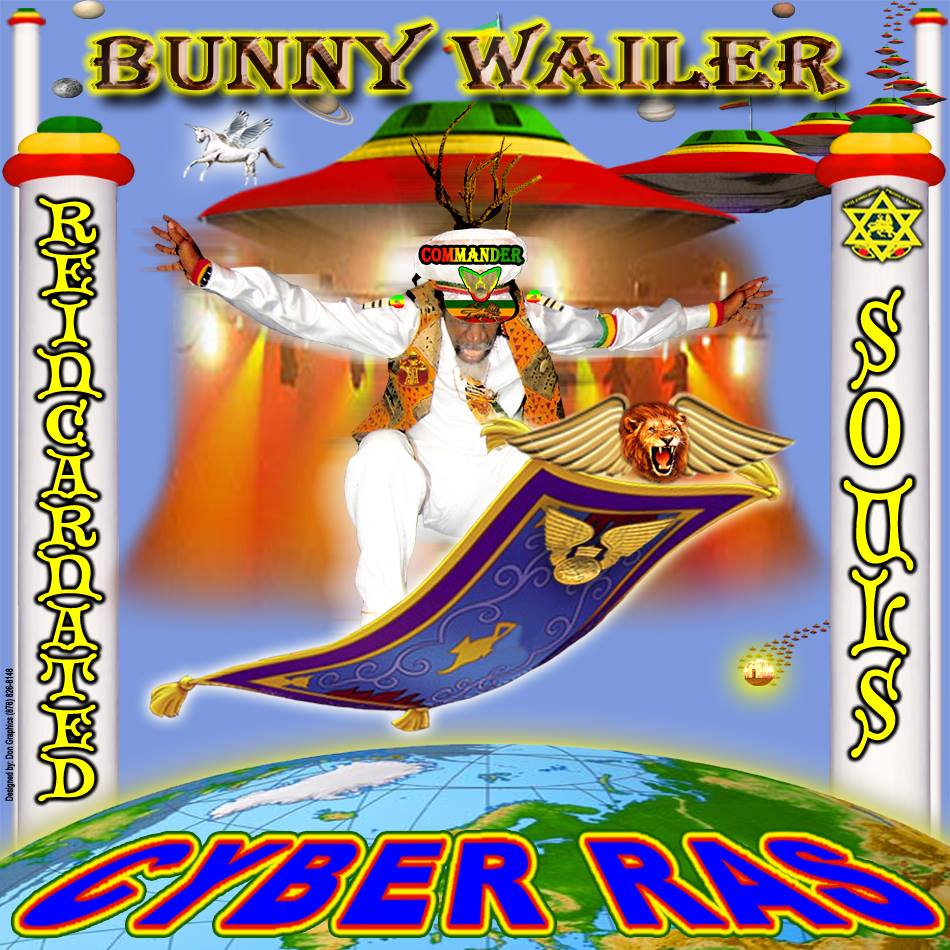
And then, improbably enough, there’s Bunny Wailer. He who hated flying in airplanes, navigates cyberspace on his flying carpet in grand style.
Bunny Wailer as Cyber Ras flying through space
I should mention that the occasion for all this reflection on Afrofuturism is the current exhibition at the Studio Museum in Harlem: The Shadows Took Shape which i sincerely hope I’ll get a chance to see.
The Shadows Took Shape is a dynamic interdisciplinary exhibition exploring contemporary art through the lens of Afrofuturist aesthetics. Coined in 1994 by writer Mark Dery in his essay “Black to the Future,” the term “Afrofuturism” refers to a creative and intellectual genre that emerged as a strategy to explore science fiction, fantasy, magical realism and pan-Africanism. With roots in the avant-garde musical stylings of sonic innovator Sun Ra (born Herman Poole Blount, 1914–1993), Afrofuturism has been used by artists, writers and theorists as a way to prophesize the future, redefine the present and reconceptualize the past. The Shadows Took Shape will be one of the few major museum exhibitions to explore the ways in which this form of creative expression has been adopted internationally and highlight the range of work made over the past twenty-five years.
The exhibition draws its title from an obscure Sun Ra poem and a posthumously released series of recordings. Providing an apt metaphor for the long shadow cast by Sun Ra and others, the exhibition will feature more than sixty works of art, including ten new commissions, charting the evolution of Afrofuturist tendencies by an international selection of established and emerging practitioners. These works span not only personal themes of identity and self-determination in the African-American community, but also persistent concerns of techno-culture, geographies, utopias and dystopias, as well as universal preoccupations with time and space.
Last night there was a Shadows Took Shape Panel Discussion with Naima J. Keith, Zoe Whitley, Alondra Nelson and Paul D. Miller (aka DJ Spooky, That Subliminal Kid) that was live tweeted making it possible for me to follow the proceedings from here. Check out the tweets below to get a sense of the event.
Studio Museum Harlem @studiomuseum live tweeted most of the following:
“How would you define Afrofuturism? Conversations about race and technology.” -Alondra Nelson
“Afrofuturism wasn’t originally about an academic lockdown. It was a collage of hip hop, sound, and tapestry.” -DJ Spooky
“People were bored. In the 90s the art world barely knew how to use a computer.” – @djspooky
“Whether you’re a dada-ist or a futurist you’re interested in new portals.” – @djspooky
“I loved Octavia Butler’s book, Kindred, so much that I wanted anyone I dated to read it first…” @alondra jokes.
“I took my name from “Nova Express” by William S. Burroughs.“ – @djspooky
.@djspooky highlights the influence of dancehall music in the Carribean on the course of electronic music.
“I loved anything that had an alien!” – @alondra
“People have a selective memory when it comes to slavery. There was no future.” – @djspooky
“Well, what isn’t futuristic about being black in America?” -Greg Tate
“The idea that the robots will uprise and take over goes back to slavery.” @djspooky
Thanks to @DukeU we can all access some of @alondra’s #Afrofuturist texts through Dec 21st. Visit: bit.ly/afrofuturism
“What’s wrong if it’s only afro? It isn’t about excluding other people. It was about carving out a space.” –
Panelist @djspooky offers a healthy critique on the exhibition recommending that there be more music.
Alondra Nelson @alondra
In the green room @studiomuseum with @djspooky @naimajoy and Zoe Whitley #afrofuturism… instagram.com/p/hAAdIQSZS2/
DJ Spooky performance and talk at Roktowa in Kingston, Jamaica, December 2012.
For those who may not know, DJ Spooky’s mother is Jamaican. He did a residency in Kingston at Roktowa earlier this year where he talked at length about his mom, his work, his music. Can’t reproduce that now but here’s an excerpt from an interview where he makes the Jamaican connection more than once:
DJ SPOOKY: Everything I do is all about the mix; social, political, economic, it’s a deconstruction of all the crap the 20th century has left behind. I really think that mix culture is that deep. It reflects so much of what is best in humanity, what makes people relate to their fellow human being. I guess you could say I’m a musical idealist.
RIOTSOUND.COM: When you were young your mother owned an international fabric business and you were able to travel a lot; how did that affect your outlook on music and Hip-Hop in particular?
DJ SPOOKY: My mom’s store was called Toast and Strawberries; I used to spend afternoons there after school. I’d play soccer with my high school’s team and then ride a bike to my mom’s store and do chores and whatnot. Then I would take a break and listen to records. I never really got into TV that much; I just liked to listen to records a lot. That made the transition into DJing [easy]. I started producing tracks when I got to college as a way of passing the time.
My dad passed away when I was 2 years old and I checked out his records as a way of getting to know him. My mom wanted us to travel a lot so we wouldn’t get caught up in this whole American trip of race; black, white, whatever. We had German exchange students and Nigerian exchange students [and others] stay at our house, so I was always open to people from different cultures. That’s what Hip-Hop is about to me.
RIOTSOUND.COM: You got a new double mix CD out that features a variety of tracks from the legendary Jamaican label Trojan Records. How did you go about picking out the music for “In Fine Style: 50,000 Volts of Trojan Records”?
DJ SPOOKY: As far as I’m concerned, Jamaica has been part of Hip-Hop from jump. Everything from MC battles to DJ battles to sound systems, Kingston had it all. America was caught up in disco fever when Kool Herc showed up and switched the soundtrack. I pay respect to Herc and I pay respect to how dancehall helped shape what we know as Hip-Hop.
On the compilation I went through a lot of my records and found different versions of classic tracks; stuff like Desmond Dekker’s “007 Shanty Town” that Special Ed sampled or Lee Scratch Perry’s “Disco Devil” out take from Max Romeo’s “Iron Shirt” which Kanye West sampled. 50,000 Volts of Trojan Records looks at the intersection of Hip-Hop, sampling, and different production techniques. I just want people to connect the dots.
RIOTSOUND.COM: In your view, what are some of the most important values of Jamaican sound system culture that contributed to Hip-Hop and to the growth and evolution of music in general?
DJ SPOOKY Let’s put it this way, the sound system situation is a kind of musical democracy. Some people get to vote with their styles and others get to vote with how they respond or don’t respond to the different performers. There’s so many ways that I think this kind of way of presenting shows flipped all the usual performance issues of the day. At the height of the Beatles era people were just going to shows to see the band. The Jamaicans flipped that and made people go to shows to hear records. What could be weirder? I think you have to realize that today, most of the groups you hear, you hear because you checked out their record first, and then went to see them. That’s another gift from Jamaica.
Yet another gift from Jamaica is Small Axe editor David Scott’s interview with Orlando Patterson. This small excerpt, discussing Patterson’s “Toward a Future That Has No Past,” is directly connected to the subject of Afrofuturism though the term is never once used. Check it out:
DS:
How interesting! But I don’t want to let you off the hook so easily with that, because I remember reading An Absence of Ruins as a student at university in the late 1970s and feeling that I could identify with Alexander Blackman—with the sense that even as he is playing himself (as the Trinidadians might say), he is watching cynically a society play at being a “society.” And that perception, I think, is incredibly acute, and as relevant today as it was in 1967.
OP:
It was partly that, but I think Alexander Blackman was an archetype not just of Caribbean blacks but also of blacks generally. I was thinking of the black experience; I was thinking of blacks within the context of Western civilization. How is it possible to survive, to build a meaningful tradition, within the context of a very dominant Western culture? I was thinking of the whole question of what had been achieved, and whether it was possible or not to accept the nationalist answer “Back-to-Africa”; I began to see the dilemma of where you go from this very catastrophic past—especially if you’re not into Negritude, or Eddie Brathwaite’s interpretation. So that novel was more of a broader novel about the black condition than just the West Indian one.
DS:
It’s interesting that you put it that way, because in that very brief passage that I just read—”A being deprived of essence, a willing slave of every chance event”—one notices its deliberately paradoxical character. The passage notes the power structure, that he’s not merely devoid of essence but deprived of essence. He’s both a willing being and an enslaved being. He’s caught in a web of paradoxes.
OP:
And that, of course, is a very powerful philosophical trope, which is behind that Sartrean dictum that “existence precedes essence.” You may be deprived of essence but you still have an existence. It’s like a pure existential state, which I was trying to argue and which may well be the basis of a viable way of survival. I have an essay, which I wrote not long after I came here, “Toward a Future That Has No Past,” published in an odd sort of journal, Public Interest, in 1972 (it was the most radical thing that Public Interest ever published).56 The argument there was that precisely not having a past may be a liberating condition. We’re the people of the future. That was the theme. I linked up the West Indian experience with the black experience all over. So I was thinking in broader terms, even though I was using Jamaica, obviously as the site for the novel. “Blackman,” as the name [End Page 169] indicates, is about black people and the black condition. So I found working through existentialism very valuable then, in that you didn’t need an essence, you didn’t need a tradition, you didn’t need the bourgeois sort of anchorage—that, indeed, in the world in which we live, it may well be that you have the possibility of starting from scratch and creating a world for yourself.
DS:
So Alexander Blackman is an attempt, then, to create that kind of figure.
OP:
Yes. And by the way, I saw jazz as very much a part of that, as the most successful model. I seem to recall having an argument with Brathwaite about that. Because where he was seeing it in terms of continuities I was seeing that the spontaneity of jazz was only made possible because you weren’t trapped in tradition.
DS:
But it’s interesting because the challenge, I suppose, is to create a fictional figure that is both essenceless and simultaneously creative. And Alexander Blackman turns out himself not to be a creative character. He wanders around London lost and adrift at the end.
OP:
Right, that is the end, but it’s also the beginning. And it’s sort of simply saying, let’s forget about the past; forget about any essence; just start in this moment to create. And there may be advantages to that. That last paragraph of the novel was deliberately written in a more poetic way to almost suggest a sort of spontaneous kind of [John] Coltrane expression. So it was not creating something out of nothing but creating something out of chaos.
DS:
It’s not as if there was no past. All of your work is preoccupied with slave past. There is a past, but there is no continuity.
OP:
Right, but there’s the knowledge and weight of the past. There is, in fact, a kind of continuity, the continuity of problems and chaos—a continuity of discontinuity.
David Scott. “The Paradox of Freedom: An Interview with Orlando Patterson.”Small Axe 17.1 (2013): 96-242. Project MUSE. Web. 22 Nov. 2013. <http://muse.jhu.edu/>.
And finally check out Gemsigns, a novel by Stephanie Saulter (yes one of film director Storm’s sisters):
Humanity stands on the brink. Again. Surviving the Syndrome meant genetically modifying almost every person on the planet. But norms and gems are different. Gems may have the superpowers that once made them valuable commodities, but they also have more than their fair share of the disabled, the violent and the psychotic. After a century of servitude, freedom has come at last for the gems, and not everyone’s happy about it. The gemtechs want to turn them back into property. The godgangs want them dead. The norm majority is scared and suspicious, and doesn’t know what it wants.
I’m sure I’ve only scraped the surface of this fascinating subject. If you have anything to add please do so…I respond to all my commenters…Over the next few days i’ll probably add to and refine this post, so do check back!
PS: December 22, 2013. Paul Gilroy recently tweeted the link to this “1992 documentary titled simply Black Sci-Fi, which was directed by a Terrence Francis, for the BBC in the UK.
and of course you must have heard of the new Kenyan sci fi series Usoni, set in 2062, about European refugees fleeing to Africa?
“Included in the film, which focuses on black science fiction in literature, film and television, are interviews with black sci-fi notables like authors Octavia Butler, Samuel R. Delaney, and Steven Barnes, as well as actress Nichelle Nichols, and others.”










 Active Voice