Tweets curated on the historic Indian Election of 2014 which saw a seismic shift in power from the Congress Party to the Opposition Bharatiya Janata Party, the BJP.
Well, after 5 weeks of polling in India the results are in and Narendra Modi and the BJP have swept to victory. Here is a collection of tweets curated from the lead-up to the final day of polling, May 16, that gives a good sense of various reactions to the election results.
For some the victory of the BJP is worrying, almost as if the Boko Haram had taken elections in Nigeria with an overwhelming majority. Certainly the actions of extremists in the new ruling party have earned it the bad reputation it enjoys and the inaction of the new Prime Minister Narendra Modi, in the face of such excesses, is why people treat him as if he has horns. Let’s hope the BJP and Modi prove their critics wrong. Ultimately what my Nigerian friend, Olu Oguibe, said on Facebook remains true:
There’s a great deal of weeping and wailing among some today as Narendra Modi and the BJP sweep the stakes in India’s national elections. Yet, who is to blame for their success but the people? Like the ANC, India’s ruling Congress Party takes power for granted and corruption and incompetence as tradition. Worse, still, it saddles itself with a doddering dynasty. And so, the majority of the Indian people have knowingly and willfully cast their lot with Modi and his right wing, religious fundamentalist party. They’ll live with the consequences.
Curated tweets and articles about the kidnapping of 234 Nigerian girls by Boko Haram
On April 14 234 teenaged Chibok girls were abducted from their boarding school by Boko Haram, a terrorist group in Northern Nigeria. Nigerians themselves seemed slow to take notice and the rest of the world even slower. But when CNN and co finally did so it was like overkill. Below is a collection of tweets, mainly from Nigerian writers chronicling and reacting to the mainstream media coverage of the abduction and the hashtag campaign that started in Nigeria and its diaspora.
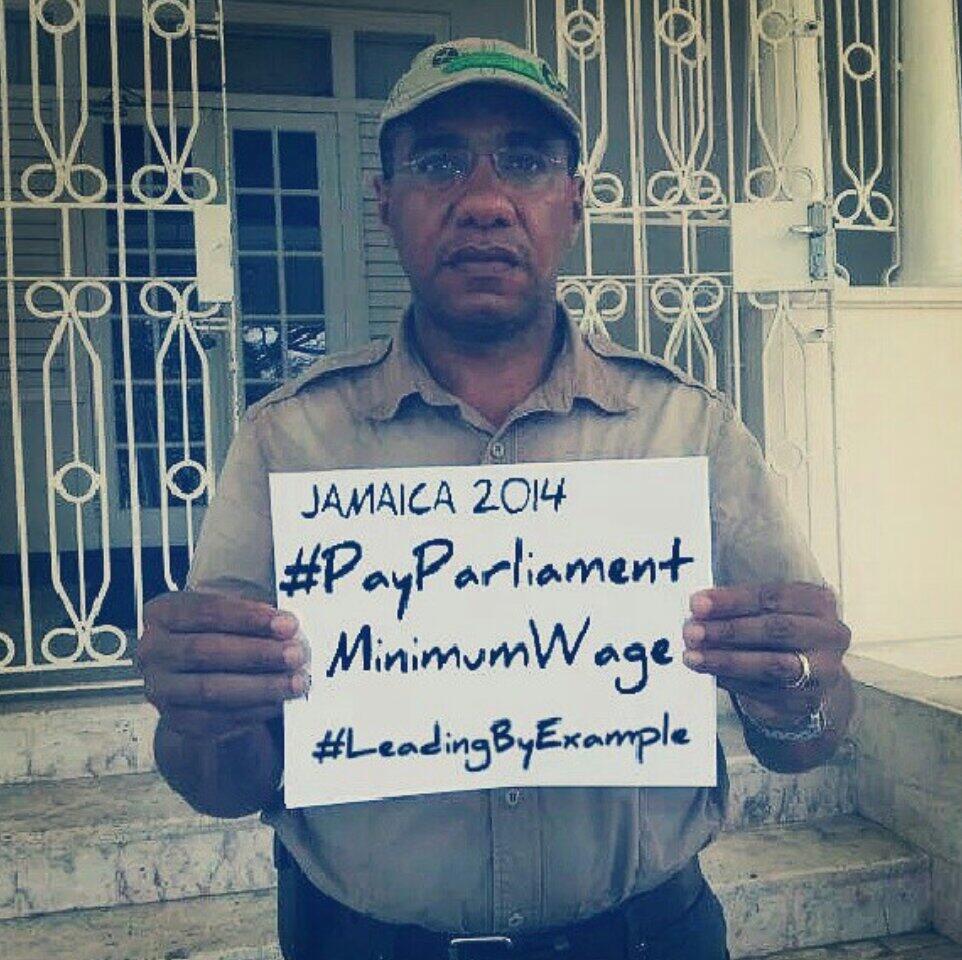
As the #BringBackOurGirls campaign in Nigeria and its diaspora intensified mainstream media suddenly came on board with high profile personalities like Michelle Obama and others posing with placards that shouted #BringBackOurGirls. Predictably it wasn’t long before some bright spark started hijacking the hashtagged statement as evident in the two images below, of Michelle O and Andrew Holness, Jamaica’s Opposition Leader.
The mass abduction of several hundred schoolgirls sparked outrage. But it was the rambling, hourlong Hausa-language video by the terrorist group’s leader that triggered a global uproar. In it, Boko Haram chief Abubakar Shekau threatened to sell the teenage girls “into the marketplace” as slaves, or force them to marry by age 12.
Simple question. Are you Nigerian? Do you have constitutional rights accorded to Nigerians to participate in their democratic process? If not, I have news you. You can’t do anything about the girls missing in Nigeria. You can’t. Your insistence on urging American power, specifically American military power, to address this issue will ultimately hurt the …
BY Zeynep Tufekci | Friday, May 9 2014 Diversity, in the newsroom, in the developer cave, on the conference circuit, or in the writers retreat, is often interpreted as a “feel good” act, or, at most, an act of justice to compensate for structural inequalities that pervade our world.
People always assume because I’m from India that my interest in the Caribbean must lie exclusively in the Indian components of the Caribbean. Nothing could be farther from the truth. I’ve been so little interested in matters pertaining to the Indian diaspora that it wasn’t until last month (after 25 years of being here), when I had to write a review essay of Gaiutra Bahadur’s superb Coolie Woman: An Odyssey of Indenture that I really started delving into the history of Indian indentured labour in the Caribbean.
And having done so I’m finding it difficult to avert my gaze. Like myself not many Indians seem familiar with this classic example of subaltern history that is slowly coming to light once again with books like Bahadur’s. Scholars have studied and written on the subject for many years but it takes a book like Coolie Woman to bring the troublesome subject of indenture to the forefront of what I think of as the popular sphere.
Between 1838 and 1917 around half a million Indians were brought to the Caribbean to serve as indentured laborers on three to five year contracts, replacing the loss of free labor after plantation slavery was abolished in the 19th century. Around 238,000 of these laborers were brought to British Guiana to perform the back-breaking work of cultivating sugarcane. For a description of the kind of people who made the journey let’s turn to Rahul Bhattacharya, the writer I mentioned in my last post, from his novel The Sly Company of People Who Care:
MEANWHILE ship upon ship of coolies from India kept coming – and kept coming steadily for almost another eighty years, by which time they outnumbered the Africans in Guyana. It is a forgotten journey; few, even in India, are now aware of it. The history was too minor compared to slavery and the Middle Passage, its damage not so epic. The ships sailed from Calcutta, and a few from Madras. The immigrants were drawn mainly from the peasant population in the Gangetic plains of the United Provinces–modern-day Uttar Pradesh and Bihar–and a minority from the presidencies of Bengal and Madras. They were mostly young and middle-aged, mostly male (which led to the sensation of ‘wife murders’ arising from jealousy), mostly Hindu, and mostly taken from the agricultural castes, lower castes and outcastes. The largest caste groups were the chamars, the lowly leather workers, and the ahirs, the cowherds. What was common to them was the fate they were escaping: the famines and revolts, the poverty and destitution of British India. Making their way, that is, from the mess of one end of empire to another.
Lured by local recruiting agents and their tales about the land of gold, they set out to cross the seas. Crossing the sea: kalapani: this was the great Hindu taboo. It came with a loss of caste, of one’s place in the social order – but also, for the wretched, a liberation. When victuals among the castes spilled and mixed on the stormy waters, when each person was treated by the white man with equal indignity, the curse of being judged by birth was lifted. From here on they could be anything.
In her book Mobilizing India Tejaswini Niranjana (citing Hugh Tinker) points out that the anti-indenture movement in the early part of the 20th century was Mahatma Gandhi’s first major political intervention in India during which he gave anti-indenture speeches all over the country. Anita Desai records how, ‘It was a shock to Gandhi to find that in South Africa he was considered a “coolie”—in India the word is reserved for a manual laborer, specifically one who carries loads on his head or back. In South Africa the majority of Indians was composed of Tamil, Telugu, and Bihari laborers who had come to Natal on an agreement to serve for five years on the railways, plantations, and coal mines. They were known collectively as “coolies,” and Gandhi was known as a “coolie barrister.”’ It was also the first such campaign fought entirely in India rather than metropolitan Britain. By 1915 it had become a central issue in Indian politics. As Bahadur notes:
The policy made indenture a cause for the nationalists, who saw it as an insult to their dignity and self-respect, an attempt to make Indians permanent coolies in the eyes of the world..indenture offended the pride of Indians by “brand[ing] their whole race in the eyes of the British colonial empire with the stigma of helotry. But this shame over reputations as slaves paled in comparison to their anger over the sullied reputations of their women.
In the review essay I mentioned at the top of this post I dive in-depth into the politics of the struggle over the status and conduct of indentured Indian women, about how Indian nationalists were incensed by the “harlots of empire” even more than the danger of being branded the helots of empire. I had to look up what helot meant actually–an interesting word meaning serfs or slaves–with a history dating back to Spartan times and referring to a subjugated population group from Laconia and Messenia who became state-owned serfs whose job it was to cultivate land to feed and clothe the Spartans. Their status was in-between that of freed people and slaves.
For purposes of this post I want to stick to the other problem that worried Indian nationalists–that of being regarded as “permanent coolies” in the eyes of the world. It was one I found rearing its ugly head unexpectedly and perhaps by mistake when I first posted the link to Bahadur’s Coolie Woman on Facebook. “‘Indian woman’ not ‘Coolie woman’” a well-meaning African-Jamaican friend responded, a bald declaration that crept under my skin and niggled at it. After an inconclusive back and forth during which she firmly maintained that the word “Coolie” was too disrespectful a term to use while I rankled at her presumption in blithely determining the vocabulary a young descendant of indenture was permitted to employ, I snapped something to the effect that the word ‘coolie’ is a living word in India today and is by no means a synonym for its 2 billion strong population.
I’m convinced my Facebook friend didn’t mean to conflate the terms ‘Indian’ and ‘coolie’–and surely if we don’t want to be branded by the word we should demolish the conditions that continue to give it currency in the 21st century, not abroad now but at home–but I realise that the C-word as Bahadur calls it in her book, has a Caribbean history reflected in the discomfort my friend showed when she tried to erase it. In places like Jamaica there were arguments in the local press about what ‘Coolie’ meant and to whom it could be applied which you can see reflected in the letters to the editor of the Jamaica Gleaner appended above and below.
Laxmi and Ajai Mansingh, colleagues from India who worked at the University of the West Indies, produced a book on the 150th anniversary of the arrival of indentured Indians in Jamaica in which they note:
In Jamaica, the term ‘coolie’ was legally banned in the 1950s because it was used in a derogatory sense for an ethnic minority. This process began when the founder-President of the East India Progressive Society (EJPS), Dr. J. L. Varma, was popularly (but not abusively) referred to as ‘coolie doctor’. The EJPS then moved the government to ban the use of the term.
Now my Facebook friend’s squeamishness at the use of the term ‘Coolie’ becomes clearer. But although laudable I wonder whether banning words or proscribing them ever achieves the desired outcome. Should we be trying to sanitize history or recording it in all its ugliness for the benefit of future generations? Can we ever liberate the word ‘Coolie’ from the unbearable weight of its history if its contemporary namesakes continue to work under the backbreaking conditions they do? These are hard questions for hard times.
This article was first posted on my EPW blog (Economic and Political Weekly, India)
A pretty thorough account of the salient points of the Vybz Kartel trial along with background information.
Often in the course of his prolonged trial I found myself wondering if the rollercoaster life of Adidja Palmer aka Vybz Kartel was scripted by someone channeling Breaking Bad, the wildly popular American TV series about the rise and fall of a chemistry teacher turned meth dealer. By the time the trial ended I knew it was nothing of the sort, just another wickedly original Jamaican libretto. Described by some as the country’s pre-eminent lyricist, for more than a decade Kartel ruled the roost in Jamaica as its reigning dancehall deejay (”a genre that is to the roots reggae of Bob Marley as hip-hop is to R&B”), his street cred extending far beyond Kingston, into the nooks and crannies of ghettoes all over the Caribbean, into urban America and as far away as Africa where his Gaza Empire has spawned copycats.
By late 2013 Vybz Kartel, 38, was being portrayed by the police and the justice system as Public Enemy No. 1. His fame and fortune notwithstanding, on April 3, 2014, Adidja Palmer was sentenced to life in prison with no parole possible before 35 years, after the court gave itself an extra week to determine whether the embattled DJ should be allowed to make music while incarcerated. He had been found guilty almost 3 weeks earlier, along with three others, of the murder of one Clive ‘Lizard’ Williams, a dancer and foot soldier in the small army of roughly 30 men that constituted Vybz Kartel’s entourage. These men ensured that Kartel’’s interests were looked after and his bidding done at all times.
Courtroom runnings
It was a dramatic trial with twists and turns that kept the nation in suspense till the very end. As the Prosecution laid it out, Lizard ran afoul of the popular deejay because he and Chow, another member of the entourage, were given two of Kartel’s (illegal) guns, then failed to produce them when asked for their return. After several futile attempts to get the guns back, Lizard and Chow were summoned to Kartel’s house where there was a confrontation between them and Kartel’s cronies. Chow managed to get away, later becoming the Prosecution’s star witness, but Lizard was bludgeoned to death.
Although the hapless dancer’s body has yet to be found Vybz Kartel and six members of his entourage were taken into police custody in September 2011. Kartel’s defence team made repeated attempts to secure bail for him but were systematically rebuffed on the grounds that the Police had good reason to believe he would try and leave the country if granted bail. Rumours were rife that the reason for this unprecedented incarceration was that the police had incontrovertible evidence, including video footage taken from the deejay’s phone, that incriminated Adidja Palmer and his co-accused.
The swirling rumours proved to be true. The trial was prosecuted largely on circumstantial evidence— involving sensational Blackberry messages, video footage and voice notes downloaded from the deejay’s cellphone in which Kartel’s voice could be heard making threats about what he would do if the guns, coded as ‘shoes’ weren’t returned. ‘If dem want dem fren fi live dem fi return mi shoes’ he is heard to say on Voice Note 2. In other messages he asks for information on countries he might travel to, the Bahamas for instance, lending credence to the Police’s concern that he might skip bail if granted it.
The Defence team did not dispute that the voice heard in the notes was Kartel’s. Instead their strategy was to prove that the cellphones in question had not been properly secured by the police, who were careless about maintaining the chain of custody, making it possible for the notes to have been tampered with or manipulated. They also proved that other key items of evidence such as a backup disc provided by the phone company and a notebook belonging to a policeman witness had gone missing. They were able to show also that Kartel’s phone had been used three hours after being taken into police custody.
The long and tension-filled trial lasted nearly four months, ending suddenly on March 13, on the sixth day of the Judge’s summation, after a juror was accused of attempting to bribe the foreman of the jury and fellow jurors. Despite this dramatic development, which might have derailed the case had the Judge called for a mistrial, the trial was hastily concluded with the jury delivering a ten to one guilty verdict.
Judge Lennox Campbell’s instructions to the jury explained the legal doctrine to be used in deciding Vybz Kartel’s guilt—that of common design. After all there was no direct evidence to prove that the deejay himself had participated in the murder. As Judge Campbell explained “…The scope was to kill Clive Lloyd Williams for the loss of a firearm. The law of Common Design is – as long as you participate knowing that was the ultimate end it doesn’t matter that you didn’t pull the trigger; it doesn’t matter that you didn’t wield the knife; it doesn’t matter that you didn’t administer the poison. Common Design can encompass a person at a gate as look out man for the police. As long as he’s there to look out, he can be charged for murder.”
The kind of security put in place by the Jamaican Police on the day of the verdict and again on the day of the sentencing, suggested that this was the trial of someone far more important than a mere music personality. The Police blocked major roads leading to the Supreme Court in downtown Kingston, placed Police personnel in riot gear at strategic points and patrolled the area around the court with mounted Police. The diminutive Judge, known informally as Little Lenny, appeared in court flanked by four bodyguards.
During the final days of the trial American rapper Busta Rhymes attended court in a show of support for Vybz Kartel. Notably absent was anyone from the local music fraternity among whose ranks there did not appear to be much sympathy for the beleaguered DJ or sorrow over his fate. Although a large crowd had appeared outside the courtroom shouting ‘No Teacha, No school’ on the day of the verdict (a reference to Kartel ‘s nickname–‘The Teacher’) and the days leading up to it, on sentencing day there was only a modest crowd in attendance outside. The elaborate preparations made by the Police seemed like overkill.
Vybz Kartel still represents his old high school Calabar, as seen in this photo taken today after his sentencing. Photo: @Dre1allianceEnt
Vybz Kartel: DJ or Don? or both?
So what was the secret of Vybz Kartel’s success I asked Anthony Miller, producer of Television Jamaica’s weekly Entertainment Report, the definitive news source on Jamaica’s volatile music industry. His answer was:
The smartness, the nimbleness of mind; Kartel could string words together. In terms of that hip hop flow, spitting lyrics, he was the quickest and the nimblest and easily the most brilliant. He was the lyrical genius of his generation who flooded the Jamaican market with music. He delivered the social commentary but he also gave the public fun and games with his song about Clarks shoes (which caused a spike in sales for the company) and Ramping Shop which was banned from Jamaican airwaves for its raunchy lyrics. He outraged every sensibility in Jamaica and then he started to bleach. He always had an avalanche of new material. But there was also a sinister element, a darker element. He overreached by flying in the face of the establishment in Jamaica, by continually goading them. He always flew in the face of authority.
Opinions about Vybz Kartel vary depending on the demographic of the person you’re speaking to. Nicknamed World Boss and Addi the Teacher or ‘Teacha’ by his adoring fans his phenomenal popularity made him the envy of politicians though he didn’t kowtow to their demands. On the other hand Kartel was known to hobnob with top dons or gang leaders like Tesha Miller of the Klansman gang and Christopher ‘Dudus’ Coke whose sensational arrest and extradition to the United States occupied international news for weeks in 2010.
“A lot of DJs see themselves as dons; the don is the model, so they behave like dons. Dons have the power, they have the girls and DJs are in the best position to become dons because they have the constituencies, “ says Anthony Miller.
According to ethnomusicologist Dennis Howard the nexus between political dons and musicians in Jamaica goes back to the very roots of Reggae and Dancehall. It was a symbiotic relationship, the musician needed the support of the don who often demanded a ‘big up’ while the don fed off the popularity of the singer. The globally celebrated singer Bob Marley himself was friends with a number of dons/gang leaders across the political divide so Kartel’s association with gang leaders and the underworld was by no means unprecedented. The problem was that with Kartel there no longer appeared to be a distinction between the two.
In 2009 when Vybz Kartel fans (Gaza) clashed violently with rival deejay Mavado’s fans (Gully), the two were summoned to a meeting with then Prime Minister Bruce Golding but the only person who could rein them in was Prezi–short for President– Tivoli Gardens enforcer Dudus who forced the two deejays to publicly end their hostilities at his annual stage show ‘West Kingston Jamboree’.
While Mavado seemed to heed the pleas of the government and the Police to reform himself Kartel continued along the path he had chosen, thumbing his nose at the police and Jamaican society while continuing to parlay his carefully cultivated notoriety into profits. He now diversified into other products such as a line of clothing, bleaching soap and his own rum. Perhaps the last straw for the police was the much hyped launch of Kartel’s own show, Teacha’s Pet, “a reality TV dating show surrounding the love life and career of the Artiste Vybz Kartel.” Within a few weeks of the airing of the show Kartel was arrested and the show discontinued.
Public Enemy No. 1
Why were the Jamaican police so single-minded in their determination to put Vybz Kartel behind bars? Why was he considered such a menace to society? Again stories abound. The Minister of Justice, Peter Bunting, had been touring Montego Bay, center of the vicious Lotto Scam conglomerate, which preys on elderly American citizens, scamming them out of thousands of dollars of their savings each year. In fact the Minister was under pressure from the Americans to smash the criminal enterprise. As he visited area after area he was told by residents in each community that he should go easy on the scammers because what they were doing was, after all, merely a form of reparation–collecting monies due the citizens of Jamaica for the years of free labour provided during the era of plantation slavery.
When the astonished Minister enquired further into the source of such unorthodox views he was referred to a song by Kartel called ‘Reparation’ with the catchy refrain ‘Dem call it scam, Mi call it reparation’.
Foreign exchange is good fi di country
Franklyn, USA, Sterling England
Every Ghetto yute fi a live like di big man
Mansion bigger than Hilton
The catchy tune was even quoted by American TV host Dan Rather in a 60 Minutes expose of Jamaica’s Lotto Scam, adding to the pressure on the Jamaican government to rein in the criminal elements who were preying on America’s elderly. Although Kartel’s lyrics were never explicitly used against him in the trial, they would have been on virtually constant rotation in the minds of the Judge, Jury and Prosecution. In addition to the song about Reparations there were any number of gangster lyrics issuing from the prolific hit machine known as Vybz Kartel.
Perhaps the thing that most cemented Kartel’s image as a demonic creature who had to be contained for the safety of the public was his unconventional appearance, aided by the increasingly visible tattoos embellishing his bleached skin. This more than anything literally marked Kartel as a devil-worshipper in the eyes of fundamentalist Christian Jamaica. As if he realized this, Kartel addressed the issue as soon as he was given a chance to speak for himself in court.
My Lord, I bleach my skin, I am heavily tattooed also but that is merely superficial. That is a part of the persona of Vybz Kartel not Adidja Palmer. I am a normal person like anyone else.
In interviews Kartel would often refer to himself in the third person, drawing a distinction between himself, Adidja Palmer, the responsible father and citizen and his more reckless deejay persona, Vybz Kartel. There was a market demand for a character such as Vybz Kartel, he explained, and Palmer was going to exploit the lucrative niche—after all he had children to feed. His 2012 book, The Voice of the Jamaican Ghetto, begins by saying, “I start this book in the same way that I start each day of my life, with a Thank you Jah for giving me, Adidja Palmer, the inspiration to be Vybz Kartel. “
Gaza
Inspired by Jay-Z’s 2010 autobiographical narrative, Decoded, Kartel’s book, co-written with Michael Dawson, is a combination of lyrics, their interpretations, anecdotes, philosophical reflections, and autobiographical information. Written very much in the mode of a teacher analyzing and explaining the world, it was also a resounding call–Gaza mi seh!–for ghetto people everywhere to get together and stand up for their rights. “Its not a moral war, it’s a financial war, dem nuh waan ghetto yute fi have house n car,” goes the catchy line from one of his songs. “Incarcerated but not silenced” and “I pray this book helps to change Jamaica forever,” say blurbs on the cover with an image portraying Kartel as a Malcolm X type figure.
Some think the book was published because Palmer knew he had to lay the groundwork to shift public perception of himself as a common criminal. That may be so but in the process he managed to harness a cynicism about the system—coded as Babylon in Jamaican parlance—that has great currency. Though his music is viewed as having no explicit political message his concept of ‘Gaza’ has the resonance that rival DJ Mavado’s ‘Gully’ never had though both are metaphors for the underclass that spawned both musicians.
Vybz Kartel flashes the ‘Gaza’ sign as he exits the Supreme Court in downtown Kingston yesterday. The entertainer was given life imprisonment with the possibility of parole after 35 years for his role in the August 2011 murder of Clive ‘Lizard’ Williams. (JAMAICA OBSERVER PHOTO: BRYAN CUMMINGS)
Gaza is the name Kartel gave the locality he comes from in Waterford, part of the bedroom community of Portmore, on the outskirts of Kingston. Inspired by the fierceness of the inhabitants of the original Gaza Strip in Palestine, Kartel adopted the name of this embattled settlement in the Middle East, and the shibboleth of his supporters around the world became Gaza mi seh! Usain Bolt has been one of Kartel’s most avid fans not allowing other deejay’s music to be played at his parties and giving the Gaza sign whenever he was in the limelight. Many of Jamaica’s top athletes are Gaza fans though they may be slowly backing away now.
Perhaps the best way to understand Gaza is to see it as a new identity–underpinned by a Ghetto pride ideology–a defiant “Yes, we’re from the ghetto and we’re proud of it” stance. Although Kartel intended Gaza as a response to the lopsided landscape of opportunity in Jamaica that renders the poor socially invisible, the concept rapidly grew legs and migrated all over the world, an indication both of his talent and the globalization of inequality that disproportionately affects ghetto-dwellers worldwide.
The ‘Shit-stem’
While the Jamaican judiciary jubilantly celebrated Vybz Kartel’s guilty verdict and sentencing as a resounding victory for itself it is worth noting that alleged crime boss and head of the Shower Posse Christopher ‘Dudus’ Coke, now serving a 23 year sentence in the US, was never charged or prosecuted for breaching the law in Jamaica where he lived. Similarly David Smith, who defrauded investors across Florida and the Caribbean out of more than US$220 million was sentenced to 30 years in federal prison in the US. Although he operated out of Jamaica, Smith like Coke, was never charged or prosecuted for any crime or misdemeanor in Jamaica.
And then less than a week after the guilty verdict was announced in the Kartel case, Kern Spencer, a young politician belonging to the ruling party, was found not guilty of significant fraud and money-laundering charges in relation to the distribution of energy-saving light bulbs, a gift from the Cuban Government. The Director of Public Prosecutions herself expressed shock at the verdict saying that the evidence against him had been overwhelming. But for most people the Kern Spencer verdict was par for the course. You can count on the fingers of one hand the number of politicians, police and big businessmen who have ever been convicted of any crime in Jamaica.
Jamaican Police and the country’s legal system now have to prove to cynical Jamaicans that they not only have the will and drive to successfully bring rogue DJs to book but also the numerous rogue policemen, politicians and businessmen still at large. If not, as Kartel’s song ’Sup’m a go happen’ warns Jamaica could be on the brink, like Egypt, like Tunisia before it, of ‘something happening’.
Kartel’s defence team will now prepare to appeal the verdict and the sentence. For them what was unique about this trial was the unprecedented use of digital evidence by the Prosecution. The irony of course is that had Kartel simply used a code to lock his phone the Police could never have got into it to find the incriminating evidence they did. The deejay’s lead attorney Tom Tavares-Finson told me days before the sentencing that he expected Kartel to be sentenced to 35 years. They were already focused on the appeal. Tavares-Finson is hopeful that since he has been requesting and receiving transcripts of the court’s proceedings on a daily basis, he has about 80% of what will be needed to mount the appeal in hand already. He thinks Adidja Palmer stands a good chance of having the guilty verdict overturned by the higher court and his client is of the same mind. As the twitter account known as Adidja A. Palmer @iamthekartel tweeted:
GazaArmy. we nuh deh pon nuh mourning ting .Addi said “Justice how ever long it takes will prevail,a so Haile Selassie sey.”so we a move fwd
POSTSCRIPT: Since the sentencing of Adidja ‘Vybz Kartel’ Palmer and his co-accused on April 3 there have been some interesting developments. The very same day the Police High Command issued a statement detailing among other things the security challenges they had faced in the course of the trial and the numerous “attempts to pervert the course of justice” they had been confronted with. It now is much clearer why they were so determined to put Adidja Palmer behind bars.
Another interesting piece of information came from Shawn Storm’s attorney Miguel Lorne, who revealed that his client had been offered a plea bargain that would have resulted in a much reduced sentence for him. His client turned down the offer, sticking by Vybz Kartel and in the process, also receiving a life sentence.
And yes it’s true. Kartel’s lawyer, Christian Tavares-Finson IS the half-brother of Junior Gong or Damian, Bob Marley’s youngest son. Lead attorney Thomas Tavares-Finson who headed the defence team was once married to Cindy Breakspeare, whose son with Bob Marley he helped raise. Tom and Cindy have two children of their own, Christian and Leah. Incidentally Tavares-Finson Sr. is a highly sought after criminal lawyer with a star-studded list of former clients such as Grace Jones, Gregory Isaacs, Big Youth, Bounty Killer, Mavado, Sean Paul and Shabba Ranks, who retained him to defend them against charges ranging from cocaine possession to ‘using profanity’, a uniquely Jamaican offence. In more recent times Tavares-Finson, also an Opposition Senator, was most wanted Christopher ‘Dudus’ Coke’s lawyer until forced to step aside due to his political obligations.
Selected tweets from the day of Vybz Kartel’s sentencing, April 3, 2014
I will be putting up a more substantial post soon about the sentencing of Vybz Kartel. In the meantime here’s a selection of tweets from earlier today that will give you a feel of what the mood was like today at the Supreme Court and outside it.
Update on Vybz Kartel sentencing along with tweets since the guilty verdict was passed.
Kartel holding kerchief to face as he enters courtroom for sentencing on March 27, 2014. Jermaine Barnaby/Photographer
Vybz Kartel’s sentencing was supposed to take place yesterday but has been postponed to April 3. The Dept of Correctional Services is to decide whether Kartel will be allowed to record music in prison, and if allowed, whether proceeds should go to the family of the victim Clive ‘Lizard’ Williams.
Justice Campbell postponed the sentencing after defence lawyers informed him that they had not received a letter he instructed the Supreme Court to draft and send to the prosecution and the defence.
Director of Public Prosecutions Paula Llewellyn admitted receiving the correspondence.
Justice Campbell told the court that he wanted the assistance of both sides on sentencing guidelines.
He said the degree of participation of each convicted man in the murder would be important in his decision on how long they would be locked away in a penal facility.
“Sentences are not just clutched out of the air,” Justice Campbell said.
The judge said Llewellyn had made her recommendations and had pointed to sentences handed down in similar circumstances.
He referred to the case of singer Jah Cure (real name Sycatore Alcock), who recorded three albums while incarcerated at the Tower Street Adult Correctional Centre, and wondered if, in the event that Vybz Kartel recorded music while he served his sentence, any proceeds made from those songs should go to Williams’ estate.
“In a previous matter, when a person was convicted who had some artistic talent certain things were done. It needs to be found out whether in fact it was open to the court for any of those proceeds gained could go to repairing any of the damage to the relatives of the deceased,” Justice Campbell said.
The Tower Street prison, popularly known as GP, is fitted with a fully operational recording studio and a low frequency radio station FREE FM, which broadcasts in the precincts of the prison.
In the case of Jah Cure, the proceeds of his songs were used to bolster the rehabilitation programme and he earned no money.
The prison authorities would have to ultimately make the decision for the victim’s family to be compensated from any recording released by the artiste while imprisoned.
Meanwhile below is a selection of tweets curated since Adidja Palmer/Vybz Kartel and his co-accused were found guilty.
In the wake of the Vybz Kartel murder trial other cases shed light on the quality of justice dispensed by Jamaican courts.
Comparing and contrasting is always a useful exercise. This morning when I read the abbreviated article shown above i thought, really? Two men, Claytoday Dunkley and Garfield Litchmore, falsely accused of killing lawmen, lose 6 years of their life due to police bungling or worse, and the most the Gleaner can do is run a brief two-column report on page 2 with skeletal details of a case that seems to be a flagrant violation of human rights. Not only that, you would only have read this article if you subscribed to the hard copy or the ePaper of the Gleaner, it wasn’t available on its website. Why not? Is it because the two concerned are labourers from Trench Town and not from Upper St. Andrew? What recourse if any do they have? Will any members of the Police be held accountable for this travesty of justice?
Buju Banton might have smiled and called this low-budget justice for low-budget people…aside from this the admission that the police apparently falsely charged the two men raises doubts about the reliability of evidence they presented against Vybz Kartel and co which as we all know ended in the conviction of the superstar DJ and three of his co-accused last week.
Juxtapose this for argument’s sake with the 2007 trial of former UWI student Rodney Beckles, accused of stabbing one Khalil Campbell to death over a chillum pipe. On that occasion the story occupied the Gleaner’s front page, seen below, no doubt because the protagonists were both sons of ‘high-society officials’ as the headline pointed out. Rodney is the son of Sir Hilary Beckles, Principal of the University of the West Indies, Cave Hill campus. The young man he killed was none other than the son of Justice Lennox Campbell, yes you read it right, the very Supreme Court Judge Lennox Campbell who presided over the Kartel trial. The murder took place in January 2007 and by the end of November the same year young Beckles had been acquitted, much to the relief of his parents.
AN ARGUMENT over ganja has left the son of Supreme Court judge Lennox Campbell dead and the son of principal of the University of the West Indies, Cave Hill campus, facing a charge of murder.
Rodney Beckles, 21, whose father, Professor Hilary Beckles, was en route to Jamaica from Barbados yesterday, is now in police custody after stabbing to death Khalil Campbell, 28, of Daisy Avenue, St. Andrew.
The accused Beckles, a student at the University of the West Indies, Mona campus, allegedly stabbed Campbell 21 times after an argument over the illegal substance.
Police sources say Beckles is alleged to have denied Campbell the opportunity to smoke his chillum pipe, claiming Campbell was not mentally capable of ‘handling the weed’. An altercation developed during which Beckles allegedly stabbed Campbell several times despite attempts by two other persons to restrain him.
Despite the fact that the 18 injuries were all found on the body of the victim, none on the body of the killer Beckles, a jury which deliberated for two hours (shades of the Kartel trial!) decided that the victim had been the aggressor and Beckles was acting in self-defence when he stabbed Campbell through the heart. The Star’s account of the trial described the scenario:
The jury found that Beckles was not guilty of murder or manslaughter.
Beckles who was represented by defence lawyers Patrick Atkinson, Deborah Martin and Robert Fletcher gave sworn testimony in his defence and was thoroughly cross-examined by prosecutors Caroline Hay and Ann Marie Feurtado -Richards.
Beckles said he acted in self defence after Campbell who was known to be mentally ill, rushed at him like a raging bull and held onto his foot. He said he began hitting him and when his foot was released, he saw blood on his clothes and blood on the deceased’s chest.
He said he and a friend were smoking ganja from a chalice and it was after they denied Campbell’s request for a smoke from the chalice that the incident took place.
The prosecution led evidence that there were 16 superficial injuries to the body and two stab wounds. The fatal injury was a stab wound to the chest which penetrated the heart. The pathologist said he saw defensive injuries to the body and it was his definition that the deceased was the victim and the attacker was the aggressor.
The defence brought medical evidence to show that the deceased was diagnosed with paranoid schizophrenia and cannabis abuse and was aggressive when he did not get his medication.
So what do you think? Is the second a case of high-budget justice for high-budget people in contrast to the case of the Trenchtown labourers, Claytoday Dunkley and Garfield Litchmore? Again what does this indicate about the quality of justice meted out by Jamaican courts?
Finally was Kartel found to be guilty or was he to be found guilty by a police force and judiciary determined to make an example of him?
A selection of tweets, including from reps of the accused, immediately before, during and after the tension-filled moments leading up to the jury’s verdict of guilty against Kartel and three of his four co-accused. Includes video of Lizard Williams dancing.
Dec 13, 2013 newscast on Kartel trial detailing video and bbm evidence presented by prosecution
Well, i was wrong. I fully believed that Kartel and co. would walk; because of the weakness of Jamaica’s justice system, the strength of the defence team, and because the powerful are rarely tried, let alone found guilty in this society. But no! In a dramatic, rapidly unfolding denouement yesterday afternoon the nearly 3-month old Kartel trial came to an emotion-filled climax. Amidst rumours that one of the jurors, ‘No. 3’ to be precise, had tried to offer the jury’s headwoman a J$500,000 bribe, the jury decided 10 to 1 that Kartel, and three of his four co-accused were guilty of the murder of Clive ‘Lizard’ Williams, a young dancer whose body has yet to be found.
Lizard’s sister, Stephanie Breakenridge, sat in the courtroom sobbing every now and then as the final moments arrived. In all of the circus around this celebrity court case her brother, seen in the video above dancing and bigging up the Gaza Empire, had been virtually forgotten in the media coverage of the trial, except perhaps as its subject, in cold, clinical terms. His terror-filled texts had been read to the courtroom earlier in the trial but otherwise very little was known of the young man who thought his moment in the sun had arrived the day he was adopted by Kartel and his group.
Word on the verandahs is that the DPP Paula Llewellyn, Judge Campbell, Prosecutor Jeremy Taylor and his team were determined to use this case to showcase the ability of the Jamaican court system to deliver justice, surely if not swiftly. I congratulate them on their determination to demonstrate that justice is not as elusive in Jamaica as many of us have been led to believe…let’s hope the Kartel trial sets the bar for all trials in Jamaica from now on.
As Dah’Mion Blakey said on Facebook: The same rigor with which this case was pursued should be extended to ALL; uptown, downtown, popular, unpopular and indifferent!! #JudicialReform#SocialJusticeForAll
Finally, many of us thought that Kartel would have got off because the jury would have felt too intimidated to find him guilty. Clearly they didn’t. This too was something the DPP must have been keen on establishing, to signal to potential jurors and a timorous public that the all-abiding fear that curtails the carriage of justice too often is perhaps overstated and unnecessary. Of course we have to wait and see and hope that none of the jurors face repercussions for their decision.
Below is a curated collection of tweets that will convey the atmosphere yesterday in Kingston, especially downtown where the Supreme Court is located. There are tweets by @Iamthekartel, a Twitter account supposedly speaking for Kartel, along with many others which capture the climax of this sensational court case.
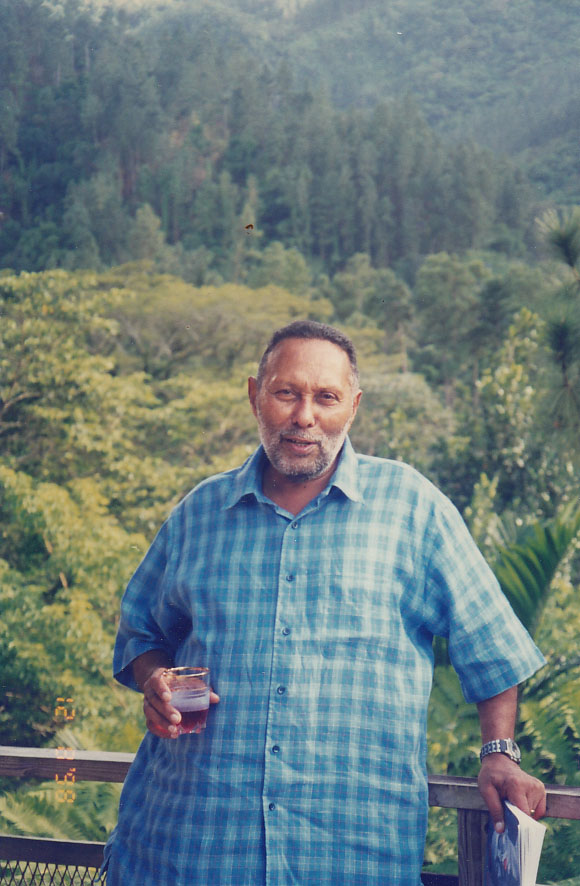
Stuart Hall at Good Hope Estate, Trelawny, Jamaica, 2004
Thought precedes action, and Jamaica in its obliviousness to who Stuart Hall was, to his extraordinary work and life, to his globally mourned death, demonstrates the perils of a society in which the most complex levels of thinking are considered expendable, an unnecessary luxury, something that need not detain the nation. It’s a symptom of the weakness of its intellectual elite that they have shunned serious engagement with the ideas of a thinker who influenced thought all over the world, moreover one who was born and brought up in Jamaica, who left at the age of 19 to embark on a lifetime that would change the world. That it hasn’t changed Jamaica, that there is no room in the oft-cited “Brand Jamaica” for the great thinkers this country has produced (many of whom toil in foreign vineyards), is an indictment of the state of intellectual life here for young Jamaicans deserve to know that their countrymen excel not only in sprinting and music but also in the much less visible arena of intellectual production.
The indifference to the passing of this intellectual colossus (the New York Times referred to him as UK’s Du Bois) in the country of his birth was noted by its leading newspaper, the Gleaner, which went to the lengths of editorializing on it: “…our ignorance of Stuart Hall, at all levels of society, perhaps says more of national inattention to ideas and the people who generate them – especially the big ones. For as a thinker, Professor Hall would, in our view, be the equivalent to the likes of Usain Bolt.”
Members of the University of the West Indies were quick to point out that the University had not been ignorant of Stuart Hall, bestowing an honorary doctorate on him in 1998 and holding a conference in his honour in 2004. The conference which was the most successful of several such colloquia mounted by the now inactive Centre for Caribbean Thought also demonstrated through the overflowing, standing room only auditorium in which Hall gave his public lecture, that there WAS appreciation on the part of the public for the man and his ideas. Nevertheless a mere 10 years later when Hall died, it took the media a couple of days to react and it was the next day before the University of the West Indies managed to get out a tribute, one that would be revised and updated several times over the next couple of days as the starchy institution tried to come to grips with its own lacunae regarding the work of this great thinker.
An early version of the University’s tribute described Stuart Hall as a ‘communications specialist’, which is rather like describing a race horse as a ‘galloping machine’. What this reflects is the restrictive mindset within which tertiary education has been trapped in Jamaica. Ours but to produce ‘experts‘ and ‘specialists’, not thinkers or theorists.
But maybe that’s in the past. I was heartened to receive this tribute written by three of the younger members of the Faculty of Social Sciences, Doreen Gordon, Orville Beckford and Moji Anderson, which they tried to get published in the Gleaner. Alas the old lady of North Street wasn’t interested. I offer it here as a guest blog post because it simply and succinctly sums up who Stuart Hall was and why he was globally valued in the way he was even if not in the country of his birth. We ought to use the moment of his passing and the local apathy to it as an opportunity to do some serious soul-searching about the stifling levels of anti-intellectualism in this country, and for that matter, the world.
Stuart Hall at Aggrey Brown’s home, Golden Spring, Jamaica, 1998
“I want to disturb my neighbour”: Stuart Hall and the role of the public intellectual
by Doreen Gordon, Orville Beckford and Moji Anderson
There have been many tributes to the Jamaican born thinker, Stuart Hall – a testimony to his influence across political, academic, artistic and media spheres. Hall was remarkable for his ability to move between the worlds of the academy, politics and popular media with both elegance and authority, be it in his political writings, television and radio appearances, or guest lecturers. In reflecting on Stuart Hall’s life, one cannot help but think about the role of the intellectual in society. An intellectual often stands outside of society and its institutions, actively disturbing the status quo. However, at the same time, an intellectual is a part of society and should strive to address his/her concerns to as wide a public as possible. Stuart Hall may be described as a “public intellectual”: actively involved in the politics and issues of his day, critiquing the society around him, and disseminating new insights through various media to a wider public. He was also deeply concerned with making education more widely accessible.
Arriving in post-war Britain as a young Rhodes Scholar, Hall did not return to Jamaica to live. Colonial society and the Euro-centric middle class environment in which he grew up seemed too constricting. His socialisation, early colonial education and the culture shock of migrating to race-strained Britain in 1951 no doubt shaped his particular concerns. He once said in a debate with a conservative political figure in London, “You cannot have at the back of your head what I have in mine. You once owned me on a plantation.” He remained on the side of the oppressed, the marginalized and the exploited – a perspective shaped by his Caribbean roots. This was clearly his role as a public intellectual: to make room for the voice of the powerless.
Hall’s broader recognition in Britain came when, along with a handful of intellectuals, he helped to form the Centre for Contemporary Cultural Studies in 1964 at the University of Birmingham, eventually becoming its Director. Emerging as one of the country’s leading cultural theorists, he helped to define some of the major changes and cultural shifts occurring in twentieth century Britain. It was a relatively new idea at the time to take the study of popular culture seriously and in particular, to analyse its relationship to politics and power. The new academic discipline of cultural studies spread from Britain to the United States, to Latin America and the Caribbean, and even to Australia and East and Southeast Asia. Although some might argue that cultural studies is on the decline, the discipline has generated a wealth of significant work and set the stage for an entire line of theory, critique and political action which is still very influential, especially in the anti-globalization movement.
Hall’s writings linking racial prejudice and the media became key works, making him an inspirational figure for young black artists and film makers from Britain. His studies on post-colonialism asked the question of how a modern, multicultural British society could be created that respected cultural differences among people – thus he is often referred to as “the godfather of multiculturalism.” He observed that increased diversity within nations and the need to accommodate different sets of demands by various cultural groups posed challenging questions about the meaning of equality.
When Hall later moved to the Open University as Professor of Sociology, he continued his engagement with major issues of the day relating to British politics, culture and race. Indeed, he is often credited with the phrase “Thatcherism”: a term used to describe the politics, policies and political style of Margaret Thatcher, Conservative Party Leader from 1975 to 1990. Yet his views were never extreme. He urged his comrades not to dismiss Thatcherism: that they should try to understand it and its popular appeal. For Hall, Thatcherism was a new phenomenon, an authoritarian populism that needed to be understood before it could be contested.
Hall was a political actor: he was involved in protests, the campaign for nuclear disarmament, and political writing. He insisted on linking intellectual and cultural work to political struggles rather than pretending that the former is an end in itself. He maintained strong ties to Marxist thinking and to radicalism in general, but he also critiqued Marxism, especially its Stalinist versions. While he insisted on the connection between theory and political practice, he wanted it to be a flexible one that provided space for intellectual, cultural and political creativity. This search for ideological flexibility and freedom within Marxism is the well-spring of his work and impact.
Key to Stuart Hall’s thinking was his refusal to reject completely the impact of economics in peoples’ daily lives, something lacking in many contemporary cultural theories. Yet, he was not an economic determinist – in other words, our consciousness, ideas, and cultural creations have a degree of independence and agency outside of economic realities. However, some critics have suggested that the confinement of the economic factor in Hall’s writings to “the first instance,” meant that serious economic analysis was sometimes missing from his writings. For example, Hall did not consider the material basis of Margaret Thatcher’s political power, nor was he able to articulate convincing alternatives to the present global capitalist order. However, he rightly understood that we could not grasp contemporary realities without studying the workings of capitalism.
Hall’s contribution to issues of race, ethnicity and identity are well respected and far-reaching. Given the genealogy of Stuart Hall – his parents’ ancestors were English, African and Indian – his take on race and race relations was influenced by this cosmopolitan, consanguineal mix. His view was that race, ethnicity and identity are social constructions. If they can be constructed by human beings, they can also be challenged and torn down. Hall argued that race had more in common with language than with biology. In other words, ‘race’ is a moving, shifting conundrum defined by the environment, social structure and the people involved in the social relations of production and speech. Thus the concept of race for Hall was never a fixed but a moving target, with different dialectics attached to each representation and perception. Hall was not afraid to express his dialogic about race in his writings. He acknowledged the power of race and ethnicity to shape social interaction and the ways in which particular objects are viewed – for example, how works of art are read. His deep and independent post-colonial thoughts will surely be missed. However, may they carry on, in the words of Bob Marley, to “disturb my neighbour.”












 Active Voice