A peep into the history of Jamaica and its Constabulary
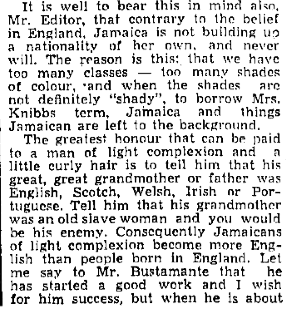
While searching for something else I came across this interesting 1938 letter to the editor of the Gleaner taking Alexander Bustamante on about something he had said regarding the officer corps of the Jamaica Constabulary. Apparently he didn’t approve of black or coloured Jamaicans being appointed as Police Inspectors for fear they would abuse their subordinates. Since both Mr. Bustamante and the JC are in the news right now I thought others might find this peep into history interesting as well.
Are we all becoming pawns of a Pentecostalist anti-LGBT crusade being conducted worldwide?
Binyavanga Wainana. Photo: Ben Curtis, AP
I finally got around to watching Kenyan writer Binyavanga Wainana’s Hard Talk interview with Stephen Sackur of the BBC just a few days ago. The interview was instigated by Binyavanga’s hugely hyped ‘coming out’ a few weeks earlier. In response to the recent wave of homophobic legislation in Nigeria and Uganda Wainana released a short story titled I Am a Homosexual, Mum. In the BBC interview Binyavanga was on form as usual and made a lot of sense but Sackur took me by surprise when he seemed to reject out of hand the Kenyan writer’s assertion that the Pentecostal movement with its fire and brimstone preachers were very much to blame for the recent escalation in homophobia on the African continent.
This sounded perfectly plausible to me, especially since I’ve heard local gay activists say the same thing in the context of Jamaica, that American Pentecostalist preachers come to the Caribbean and rave and rant against homosexuals with an incendiary intensity that simply wouldn’t be allowed in the United States with its hate speech laws. All of a sudden something I’ve been puzzled by for a long time–the mystery of why homophobia manifests itself so virulently both in the Caribbean (with Jamaica taking the cake for over the top intolerance) and on the African continent–seemed to have a simple explanation. The same set of American Pentecostalists have mounted concerted campaigns against what they call ‘the homosexual agenda’ in both locations, and I don’t know about African countries but you will have noticed if you’re from here that the use of the term ‘homosexual agenda’ has seen an exponential rise in the last 5 years. Just to test my hypothesis I decided to look at another recent site of anti-gay rhetoric and action–Russia. It was instructive. An American evangelist named Scott Lively had been at work there just as he had in Uganda, which he first visited in 2002. According to a Washington Post article:
Scott Lively is an obsessively anti-gay American evangelical minister. He is, according to National Journal, “perhaps the most extreme” of a network of U.S. evangelicals who, having failed in their crusade against all things gay at home, travel abroad to connect with anti-gay activists and arm them with arguments that, for example, homosexuals will seduce their children, corrupt all of society, and eventually take over the country. You don’t need to take my word for it; read Lively’s manifesto here. It’s a 2007 missive to Russians suggesting they “criminalize the public advocacy of homosexuality,” i.e., use state power to force gay people into the closet. This is something Russia actually did last year (rather indirectly, but quite effectively).
In early March 2009, he went to Uganda to deliver what would become known as his infamous talk at the Triangle Hotel in Kampala at an anti-LGBT conference organized by Family Life Network leader Stephen Langa. The conference, titled “Exposing the Truth behind Homosexuality and the Homosexual Agenda,” also included Don Schmierer, a board member of the ex-gay therapy group Exodus International, and Caleb Brundidge Jr., a self-professed ex-gay man with ties to the ex-gay therapy group Healing Touch. Thousands of Ugandans attended the conference, including law enforcement, religious leaders, and government officials. They were treated to a litany of anti-LGBT propaganda, including the false claims that being molested as a child causes homosexuality, that LGBT people are sexual predators trying to turn children gay by molesting them, and that gay rights activists want to replace marriage with a culture of sexual promiscuity. Lively met with Ugandan lawmakers during the conference, and in a blog post later he likened his campaign against LGBT people to a “nuclear bomb” against the “gay agenda” that had gone off in Uganda. A month later, the Ugandan parliament was considering legislation that included the death penalty for LGBT people in some instances and life imprisonment for others. According to Rev. Kapya Kaoma, an Episcopal priest from Zambia (now in Boston) who went to the conference under cover, Lively’s talking points were included in the bill’s preamble
While Lively lashes out at Republicans in the U.S. for helping “hand over the military to the Sodomites,” he praises anti-gay measures in India, Russia and Jamaica, and argues that the reason Ukraine’s president pulled out of an agreement with the European Union was “the Ukrainian disdain for the sexual perversion agenda of the EU.”
In Lively’s own words:
Those of us who still hold a Biblical worldview have been heartened by recent global events affirming normalcy. The Australian high court struck down “gay marriage” as unconstitutional, the Indian high court re-criminalized sodomy, and Russian President Putin declared his nation to be the new moral compass of the world for championing family values. Although Ukraine’s highly controversial decision to postpone (or cancel) a step into the fold of the European Union has been framed in economic terms, there is little doubt that the Ukrainian disdain for the sexual perversion agenda of the EU has played a major role. And in tiny Jamaica, a push to decriminalize sodomy (driven in large part by the U.S. State Department), has run into so much opposition that the pro-family Jamaicans just might win that battle.
To see Lively in action watch this UK Guardian video released today, How US evangelical missionaries wage war on gay people in Uganda. Although Lively himself doesn’t seem to have made a personal appearance in Jamaica as yet we have been treated to diatribes against the LGBT-community by one of his disciples, Peter LaBarbera, whose group Americans for Truth About Homosexuality (AFTAH) threw a banquet in honour of Lively in 2011. LaBarbera was in Jamaica as recently as December 2013 urging Jamaicans to resist changing the laws against buggery.
LeRoy Clarke. Photo: Stefan Falke
Of course we can’t blame the Pentecostal purveyors of hate entirely for the intolerance towards the LGBT community. Their maniacal fervour and rhetoric falls on very fertile ground. Anti-gay sentiment is alive and well from the least literate to the most highly educated and accomplished of Caribbean citizens. Look for example at the startling outburst the other day by Trinidadian artist Leroi Clarke, that has stirred up quite a controversy in Port of Spain. A report in the Trinidad Guardian quoted the eminent painter:
In a phone interview yesterday, Clarke related homosexuality to the increase in crime, saying young men are usually indoctrinated into gangs with homosexuality and because of the violation of their manhood use the gun as a symbol of their masculinity. He added: “It is brought about by power bases that manipulate the principles that hold our heritage for their own advantage. “Something is happening with the gender paradigm today. We had guidelines where we looked at certain types of conduct as abominations. We took it from the scriptures.” The Bible, he added, was one of those and verses clearly refer to homosexuality, men with men and women with women, as “unnatural” and an abomination. “Today, the word abomination does not have the same tone. People indulge abominations, accede to them,” Clarke lamented. “At 73, I can say the world is no longer mine,” he said. Asked exactly what he meant by saying homosexuality was threatening the arts, Clarke said with the exception of the sailor and maybe the midnight robber, there were no longer any definitely male costumes in Carnival, not even in portrayals of the devil. “An effeminating power has taken over the costumes and even the rhythm of the music. Carnival is no longer male and female. “This is a very serious matter. We are dealing with a problem that is threatening our heritage.
LeRoy Clarke at work. Photo: Annie Paul
Rumour has it that what may have set Clarke off was the recent state gift to Carnival Masman Peter Minshall of the State property he has been occupying in Federation Park, Port of Spain. Minshall, a white Trinidadian is openly gay.
To return to Stephen Sackur’s interview with Binyavanga Wainana which must be watched to be believed, I admit to feeling as if the scales have dropped from my eyes. On the one hand you have Sackur browbeating Wainana for bringing up the very pertinent matter of the anti-gay campaign by Pentecostalist missionaries in African countries such as Uganda, claiming that the Kenyan writer was trying to blame African homophobia on ‘external influences’ such as this (He wasn’t); and on the other hand you have Sackur insisting later on in the interview that the West must be allowed to interfere in the internal matters of African societies in the name of championing ‘universal values’! Sackur needs to be administered a good dose of Stuart Hall 101 on the inherent problems of overlooking cultural factors in the name of a tenuous universalism which only seems to work unidirectionally–from the West to the rest of us.
If indeedyou speak in the name of the West Mr. Sackur deliver up former UK PM Blair to the Hague for trial for the universally understood category of war crimes (as Wainana gently suggested). I’d love to see an interview along those lines. And at the very least leash the rabid hatemongers within your midst and curb the export of hatred and homophobia from the West before we all become puppets of the Pentecostalists. After that you may or may not be allowed to preach ‘universal values’. External forces ought not to lead the way to change in societies from outside, they can provide assistance discreetly, at the behest of, and in line with, not in advance of those militating for change from within and only after they put their own house in order. Nuff said.
Excerpted from my new blog on EPW’s website…this inaugural post shares memories of Stuart Hall along with some photos.
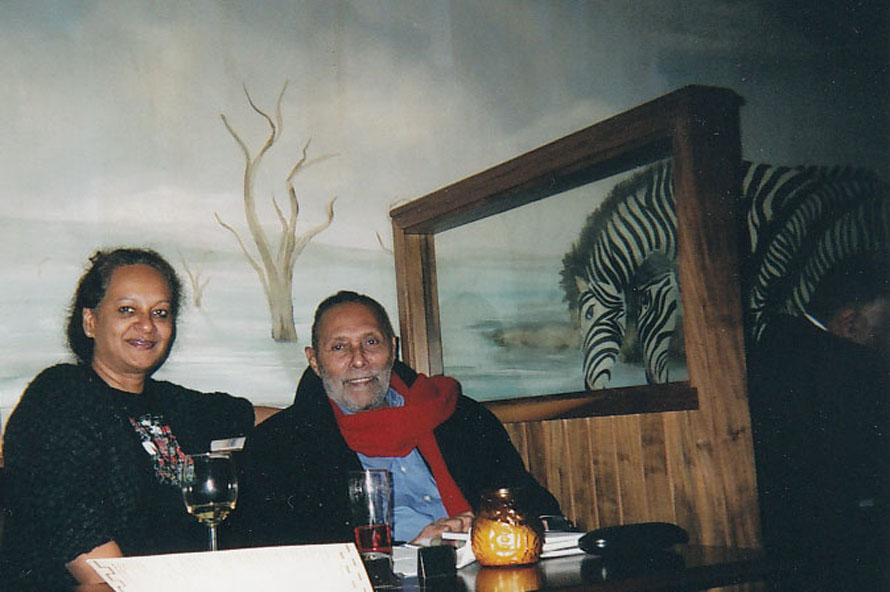
Stuart Hall at INiva (Institute of International Visual Art) with Annie Paul and artist Steve Ouditt from Trinidad and Tobago, 2000
This post was written for the Indian magazine EPW (Economic and Political Weekly), it’s website to be specific, where I’ve been invited to blog. They asked if I would share some of my personal memories and photographs of Stuart Hall in the wake of his passing on Feb 10. The post follows.
RIP Stuart Hall, doyen of cultural theory (1932-2014). “The cultural dimension is not a secondary, but a constitutive dimension of society.”
I found Ranjit Hoskote’s tweet quoted above, worth retailing, because it encapsulates Hall’s vastly influential work most admirably and serves as a suitable introduction to the Jamaican-born thinker the world has been mourning since Feb. 10, 2014.
I first heard about Stuart Hall from Tejaswini Niranjana, an Indian scholar who visited Jamaica for three months in 1994. She was a Homi Bhabha Fellow (named after the Physicist not the theorist of hybridity) and had come to the University of the West Indies to familiarize herself with Caribbean culture. Teju was interested in and fascinated by the Indian diaspora in the Caribbean but equally by Jamaican popular culture which is predominantly Afro-Caribbean.
I credit Teju with awakening my now abiding interest in Caribbean, and in particular Jamaican, popular culture by introducing me to the relatively new field then, of Cultural Studies. Having studied English Honours at Lady Shri Ram College and Sociology at Jawaharlal Nehru University in the 70s followed by Journalism at the University of Kansas, and even a foray into visual art, I had found myself rudderless. Neither English Literature nor Sociology really enthused me; it wasn’t until that fortuitous encounter with Cultural Studies that I began to feel an interest in matters intellectual again.
Having wandered through several different ‘disciplines’ as I had, I was excited to find new ways of thinking and writing that synthesized my different areas of knowledge. Of course this was something that JNU’s multi-disciplinary approach to scholarship had also prepared me for. In 1995 I started writing a weekly column in a Jamaican newspaper while working at the University of the West Indies in scholarly publishing.
I named my column ‘Hyphen’ to signal my lifelong feeling of ‘in-betweenity’, of being formed between cultures in an India that was rapidly modernizing, producing tectonic cultural shifts not always easy to navigate. Born and brought up a Syrian Christian, albeit by liberal parents, I always felt envious of my Hindu friends, especially the numerous rituals and festivals they could lay claim to. There was also a sense of feeling illegitimate, especially since I grew up in Ahmedabad, not Kerala, where I wouldn’t have been as out of place.
There is something profoundly destabilizing about watching your mother carefully crow-proof fishbones and other scraps of our non-vegetarian meals in secure little packets before consigning them to the garbage can in case rapacious birds outed us in front of our finicky vegetarian Gujarati neighbours, forcing us to leave the community in disgrace. There is also a deep discomfort in feeling disconnected from the vernacular culture around you because your father thought English was the only language you needed to know. Not being allowed to go to Hindi movies like all my friends did produced yet more alienation; by the time I reached my teens I felt like a classic misfit, like someone looking at the world through an impervious bubble.
It wasn’t till I came to Jamaica in 1988, after sojourns in the United States and Brazil that I started to feel at home, leading me to settle down here. Here was a vibrant, vernacular culture I could be part of. Jamaica is also the most welcoming society I’ve ever come across.
Part 2 of my 2007 article on Cindy Breakspeare written for Riddim magazine…
Beauty pageants and contests have always been of enormous importance in Jamaica, a vexed and competitive arena that was biased in favour of light-skinned or white girls who defined the ideal of beauty in Black Jamaica. With her green eyes and fair skin Cindy was the embodiment of the “hallowed sororities” of light/white beauty queens produced by the Anglophone Caribbean and thus the ideal candidate to represent Jamaica at Miss World. Unfortunately for her the Manley government in an acknowledgment of the black power movement sweeping through the Caribbean had banned beauty pageants and the Miss Jamaica contest in particular as politically incorrect.
Cindy’s obstacle-filled path to the Miss World competition is a tale in itself. Suffice it to say that after winning the coveted title Cindy spent a hectic year fulfilling her Miss World duties with gusto and returned to Jamaica a celebrity in her own right. About the contest she says that, “It ended up being my ticket and my passport to seeing the world, I always refer to it as my Dale Carnegie course. It really was a job for a year. To me there was nothing else…its not as though I was studying medicine or law or anything else like that and left it to take time out to do this pageant. For me it was an opportunity so I made up my mind to capitalize on it as much as I could.”
Nevertheless she was glad at the end of the year to be able to resume her blossoming relationship with Bob Marley which had continued during her reign; in fact the London press had made a mini-scandal of their affair billing it as a romance between Beauty and the Beast. It may be hard to imagine today but in those days it was not difficult to demonize Marley with his locks and Rasta livity. In fact Marley was similarly typecast by the middle and upper classes in Jamaica to whom Rastafari was anathema.
Nevertheless Cindy was committed to her relationship with Bob. Now that she had experienced the dizzying heights of being judged the most beautiful woman in the world she was keen to settle down and create a life for herself. Realizing during her coronation year that she was pregnant with Bob’s child Breakspeare decided that it was time to start the family she herself had never had. Marley and she had a surprising amount in common, “We definitely were both passionate about the idea of being healthy and keeping fit”. Cindy’s vegetarianism– the only flesh she would eat was fish–had attracted a lot of attention during the contest. In those days such fussiness about diet was not as common as it is today.
The decision to return to Jamaica wasn’t difficult although Cindy turned down several international modeling opportunities to do so. “I think by then I had had my fill and I wasn’t maybe so hungry for travel, I wasn’t so hungry for the idea of stardom coz it was really intense. Within 24 hours you go from being a small island girl that no one has ever heard of anywhere to being on the front of every newspaper that you pick up in London and they’re in your personal life and of course my relationship with Bob was much talked about because it was considered very outrageous and that put me through a lot of anxiety…”
She had always loved to draw and paint and back in Jamaica Cindy was approached by Donna Coore, the wife of Third World musician Cat Coore, to start a business called Ital Craft making jewellery from shells and other natural objects. Ital Craft went on to become immensely successful; at its height the hand-made jewellery found its way into stores like Bloomingdales, onto the runways of Paris and in sixteen locations in the Caribbean.
Cindy disputes the claim that Marley had funded the start up with huge sums of money.
“It’s like Ital Craft –- that the start up money for that was some hundreds and thousands of dollars. Rubbish! We started Ital Craft with J$2500, Donna Coore and I. That was the shell capital that we started the company with, it seemed like a lot of money at the time but certainly nowhere near what has been written I think it was in the Don Taylor book.”
About Bob’s involvement in the business Cindy said:
“Not so much that I would ask but that he would think it was a wonderful idea because he was very supportive of any creative endeavour, any initiative and he just thought it was wonderful and he would come up there late at night when he was finished with studio work and whatever and pull up a stool and say ‘I’m a tradesman you know, what you need me to do for you now?’ and in fact one of our big driftwood tables – I had dug up a tree root from out of the sand out at Hellshire Beach — he leveled it and we put a glass on it. He loved to be involved in any little thing like that. And himself and another little youth from Hope Road leveled the top of that table for us and we put the glass on it. But he just loved the creative energy because he was so steeped in the creative process himself, he loved to see it in other people and since he was in a position to encourage it he would go to London and he gave a girflfriend of mine 500 pounds and said Now go and buy anything you can make jewellery with—beads, cords, bindings anything—I didn’t ask him, he just came back and presented me with this enormous duffel bag full of things and said ‘see a few little things here to make some things?’ Well girl, it was like xmas had come two hundred times over. Wonderful. He was very inspirational that way and when he went to Australia he bought a lot of shells for us and had them shipped. And he bought us like our first drill press to make tiny holes for the jewellery because we were using a dentist’s drill up until then.
“So he was very very encouraging and very inspirational. He always wanted to buy me a fancy car and I kept saying I need a van, I really need a van to transport stuff around, get out to the beach and take up things like these big pieces of driftwood. I always was the kind of person who went for practicality and functionability over just what we call profile nowadays—yeah, a two-seater sports car is great, it can go really fast but can it do anything else? you know that’s always been my way of looking at things. So every now and then I’d keep saying I need a van so finally one day he just drove up the hill in this big blue Ford Transit van, walked inside and said ok see the key here? I said what?! And he said well didn’t you say you need a van, well there’s the van. I had no idea and it didn’t have to be a birthday present or a xmas present if it was just something that you expressed you needed in order to make another part of your life function that much better well ok well I can get you a van. And that’s how he was.”
Excerpts from my 2007 article for Riddim magazine on Cindy Breakspeare…
Photo: Source unknown
Ever since Cindy Breakspeare gave the annual Bob Marley lecture last week interest in her story has heightened. I had interviewed her in 2007 for Riddim magazine. The article appeared in German in Riddim and it just occurred to me that I could publish segments of the English original here on Active Voice. Enjoy!
When asked in a radio interview about her origins Cindy Breakspeare once said “I’m as Jamaican as ackee and saltfish”. The comparison to the national dish was particularly apt as the codfish used in it is often imported from Newfoundland, Canada. Ackee of course is a strange fruit considered inedible in many places because of the potent alkaloid toxins it contains. Jamaicans however eat it with gusto. Apt too because Cindy is the product of a Canadian mother and a Jamaican father; coupled with her white skin her bi-cultural heritage is what often subjects her to questions about her eligibility to be considered Jamaican.
I started thinking about this article after listening to numerous radio interviews with Cindy Breakspeare over the last five or six years. Who was this extraordinary woman? I was struck by her voice and the down-to-earth sincerity it radiated, her healthy sense of humour, her refusal at a certain level to wield the celebrity that is her entitlement or even to take it too seriously. This was in stark contrast to the social columns of Jamaica’s newspapers–filled with the affected poses of individuals whose lives are completely banal and vapid, their only claim to fame being their disproportionate control of the resources of this small postcolonial nation.
Cindy on the other hand had not only been the favoured consort of the first (and to date the only) global musical superstar from the third world—Bob Marley—shortly after meeting him she had become a celebrity in her own right by winning the Miss World competition in 1976. In those days this was an even rarer achievement for an unknown from a small developing country than it is today. As for Cindy’s Marley connection, many of us would have given our eyeteeth just to have heard Bob Marley in concert live, let alone to have enjoyed an intimate relationship with this extraordinary musician whose fame and influence have grown exponentially since his untimely death almost thirty years ago.
Cindy actually bore Marley a son, Damian, or Junior Gong as his father called him, who has turned out to be an outstanding singer and songwriter in his own right. Damian, more than any of his half brothers and sisters, has seemed the reincarnation of his father–the champion of poor people’s rights, the shamanic performer chanting down Babylon. Some Jamaicans, however, criticize Damian Marley as an example of an “uptown browning,” suggesting that he lacks street cred, something essential to good Reggae.
The success of Damian’s 2005 hit ‘Welcome to Jamrock’ silenced most critics. In any case this sort of criticism rarely originated in the streets where people appreciated the younger Marley shining a spotlight on their plight. The question is where did he get this social conscience from? From where did he get his unflinching penchant for reality and plain speaking?
Without a doubt this was partly a legacy of his legendary father who had died when Damian was only 2 years old. But having the same legendary father had not led the other Marley siblings to produce music of this caliber. What if some of Damian Marley’s outspoken lyricism actually came from his famous mother, the beautiful Cindy Breakspeare?
Judging by the interviews I had heard with Cindy I began to suspect that far from being a pampered member of any VIP club the young Marley had actually benefited from a double dose of radicalism: Not only was he his father’s son he also had a mother who had flouted the values of Jamaican society, turning her back on the wealth and privilege that could have been hers and embracing a countercultural lifestyle that was far from glamorous then no matter its currency today.
Who was Cindy Breakspeare exactly? Born in the fifties to a Canadian mother and Jamaican father Cindy was brought up in Jamaica and went to school at Immaculate Conception, a local convent school, as a boarder. Having to be a boarder at such an early age while difficult and challenging taught Cindy independence and self-sufficiency.
I went to Immaculate at the age of 7. I think when you’re separated from your family at that age you have to make a lot of decisions for yourself at a very early age–so you learn to trust your instincts, your own instincts, at a very early age; you develop your own value system, your own sense of what’s right and wrong for you. You tend to move away from being a sheep and doing what every one else wants because you don’t have that safe cocoon; you have to follow your own feelings a lot more. Yes, this feels right for me and no that doesn’t and yes I like this and no, I don’t like that and maybe because there is no family constantly directing and supervising and saying no, you can’t do this and no you can’t do that you just tend to wend your own path and after a while you just kinda don’t know any other way to be–you just dance to the beat of your own drum.
While going to a convent school gave her the foundation of a good middle class upbringing her own family life was fractured and unstable so that when she finished school she was on her own, fending for herself and looking for any opportunity that might come her way. At 19 Cindy had been out of school for a while and done many different jobs. There was no money for further studies; her parents were separated, her father now in Canada and she had to get out there and hustle for a living. “I worked at a furniture store for a while, I worked at a jewellery store, I ran a nightclub, I worked at the front desk of what was then the Sheraton, now the Hilton, so I did many different things and eventually found myself at this restaurant …Café D’Attic.”
Café d’Attic was Jamaica’s first health food restaurant specializing in “fruit platters and salad plates and very healthy sandwiches…It was very health-oriented and attracted those who were looking for something other than your greasy spoon, your fast food”. It was during this period that Cindy met Bob whose own preoccupation with healthy food and ital living brought him to the restaurant. This was also what brought Mickey Haughton-James, the owner of a fitness club called Spartan there, a momentous connection that ultimately led to Cindy becoming Miss World in 1976. “So Mickey came and began talking to me about leaving there and coming to be involved in Spartan. He had not opened it yet but he was looking for someone he felt embodied health and beauty. “I was looking for opportunity, always, always looking for opportunity. Whatever looked like the next good step to take, take, let’s roll with it. So I went to Spartan.”
A few photos of Stuart Hall along with a 2004 interview done in Jamaica
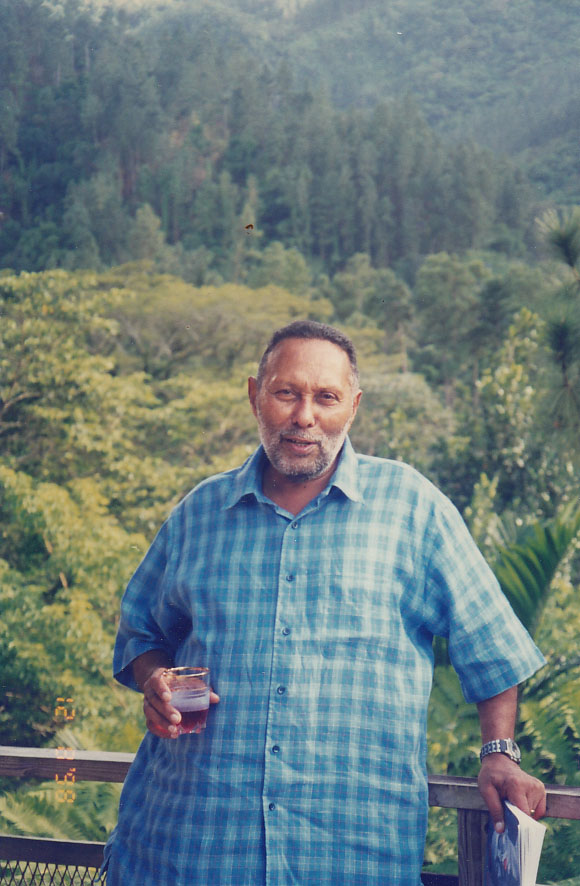
Stuart Hall, North Coast, Jamaica
When I saw Stuart at his home in London on December 14, 2013, I knew he wouldn’t last much longer. He had been ill for years and his health had deteriorated considerably since the previous year when we celebrated his 80th birthday at Rivington Place, the art centre born of his inspiration and hard work. All the same his departure comes as a blow. It’s too early for me to come to terms with this loss, for Stuart has been a close friend and mentor since 1996 when he came to the University of the West Indies to speak at the Rex Nettleford Conference.
For what it’s worth I publish a few photos taken over the years along with a substantive interview I did with Stuart in 2004. Stuart Hall was such an extraordinary thinker that his work ranged over a broad field of interests including visual art which was the one thing we truly bonded over. It was a preoccupation that didn’t get much coverage in other interviews which tend to focus more on his activism, his Marxism, and his political interventions. Here’s a link also to the post I wrote on the John Akomfrah film about him, a must see, which I hope will be shown on Jamaican TV soon.
Stuart when I first met him in 1996.David Scott (editor, Small Axe) and Stuart Hall, 1996Stuart Hall outside Rivington Place, under construction.1998
Stuart Hall at Aggrey Brown’s home, Golden Spring, Jamaica, 1998Stuart Hall at Good Hope Estate, Trelawny, Jamaica, 2004Stuart Hall (R) and Catherine Hall reading a copy of The Caribbean Review of Books at Hellshire Beach, Jamaica; June 2004with Stuart Hall at a bar on Edgeware Road, London, 2008. Photo by Dilia Montes-RichardsonPhoto by Dilia Montes-Richardson
and one of my treasures–a letter Stuart wrote to the Librarian at Birmingham U so that I could gain access to their inner sanctum:
Following the Vybz Kartel murder trial live and on Twitter.
So I finally made it to the Vybz Kartel Murder Trial this week. Jamaican DJ Kartel and his four co-accused are charged with the murder of Clive Williams aka Lizard, an associate who apparently borrowed two guns from the DJ and was subsequently unable to return them. It is alleged that in retaliation he was murdered by the DJ and his accomplices. In an unprecedented move Kartel and company have been held without bail for two and a half years, while rumours have swirled that the Police had incontrovertible evidence of Lizard’s murder at the hands of Kartel and his friends (despite the fact that to this day Lizard’s body has not been found). The evidence was said to be in the form of text messages, voice messages and videos found on cell phones belonging to the DJ that were taken into custody by the Police when he was arrested on 29 September 2011. There was also a series of text messages sent by Lizard Williams to his girlfriend saying that he feared for his life and begging her to inform the police.
Although some people, like my friend Peter Dean Rickards, remain skeptical of such evidence (“If someone preppin’ to murder me the last thing I’m going to be doing is sending txt messages…maybe I’m different,” he tweeted and “1) we’re talking about Jamaica here 2) no matter where it is, if you are looking at someone getting ready to kill you…do you send txt messages or do something a little more urgent?”) quite a few people have made up their minds that the entertainer is guilty of the crimes he’s accused of. So much for the accused being considered innocent until proven guilty.
Even though a couple of journalists, Emily Crooks for example, have been expertly tweeting the proceedings each day I wanted to observe the trial live and direct for myself. I particularly wanted to see Kartel’s defence lawyer Tom Tavares-Finson in action but as luck would have it I picked a day when he had just finished cross examining a key witness and wasn’t scheduled to be on. Not only that, it turned out to be the very day when the proceedings were so dull and plodding that Kartel himself fell asleep after lunch (see Emily’s tweets below).
Nevertheless I thoroughly enjoyed being in court on Wednesday to witness Pierre Rodgers (co-accused Sean Storm’s attorney) systematically pick apart Detective Sergeant Patrick Linton’s testimony. Linton is the former head of the Cybercrimes Unit who downloaded and presented the evidence collected from Kartel’s phones. While waiting for a legal friend to arrive to take me into Courtroom 2 where the Kartel trial was scheduled, I bucked up Supreme Court Judge Bryan Sykes who assured me that I needed no such escort, having a right as a member of the public to attend the trial. That may be true in theory, but in reality entry wasn’t easy.
Had I not been escorted by a legal heavyweight the four heavy set plainclothes policemen outside the courtroom who interrogated us while barring entry would have intimidated me enough to make me leave. Having finally breached the hallowed theatre of justice I was surprised at how small the courtroom was, and intimate; i found myself seated about six feet away from Kartel and within spitting distance of the jury. The DJ wore a shocking pink shirt and orange tie and held a matching orange handkerchief that he occasionally squeezed or twisted in his hands.
I don’t know if there were any other members of the public there, the seats were mostly taken up by plain clothes policeman nattily dressed in suits with different coloured ties and lawyers in their John Crow like robes. Not all the lawyers present were involved with the case, many of them were attending court cases of their own and slipped in and out when time permitted. Legatus Maximus, whose live tweets from the trial i had followed the day before turned out to be one such lawyer.
For those interested in getting a taste of this case and the courtroom action I’ve assembled below a series of tweets from the account of the person tweeting on behalf of Vybz Kartel under the twitter handle @Iamthekartel, followed by some of @Emilynationwide and Legatus Maximus’s tweets capturing some of the action. The main strategy of the Defence this week has been to shake the credibility of Det Sergeant Linton by suggesting that the evidence under his custody was tampered with and unreliable. For a verbatim transcript of the chilling voice notes presented as evidence by the police and much more see Emily Crooks’s blog thecrooksofthematter.
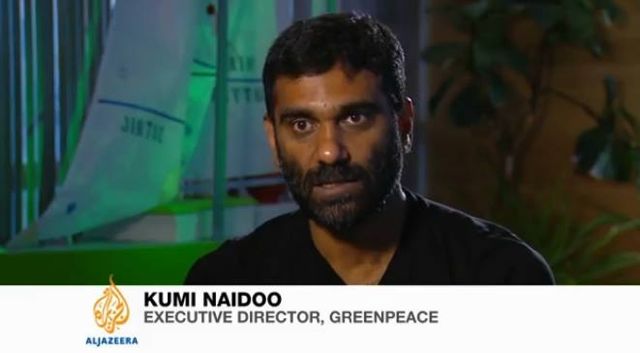
Part 2 of my interview with Executive Director of Greenpeace International Kumi Naidoo.
On December 5, the day Nelson Mandela finally died, after a heavily mediated, prolonged deathwatch, I was in Amsterdam with Kumi Naidoo, a close South African friend of many years standing. In between hundreds of requests for his comments from global media I managed to sneak in an interview myself. I had originally planned to interview Kumi about his role as Executive Director of Greenpeace International, about the predicament of the Arctic 30 who were still in captivity in Russia then and other environmental issues but the occasion demanded that we discuss the passing of Mandela and all that it symbolized and meant. This became Part 1 of the interview published on this blog two weeks ago, Nelson Mandela, Servant Leadership and ‘Born-heres’ : An Interview with Kumi Naidoo, Part 1. Here now is Part 2 in which the environment and activism in general are foregrounded. Make sure to watch the video embedded below for a rich elucidation of some of the points raised in passing in this interview.
AP: Let’s now talk about the fact that you are Executive Director of Greenpeace International which is interesting in itself because you would be the first… I don’t want to say, non-white person to be in that kind of position, but person from the South, let’s say, representing completely new populations globally. Has this been a challenge? The fact that Greenpeace was previously a very kind of white European, or European-origin dominated organization, or is that a wrong perception?
KN: No, historically, that’s the reality. It started in Canada and moved to the US and Europe and Australia and so on, but Greenpeace actually has been operating in the global south for a long time with strong leaders emerging from those parts of the world who are into global leadership roles as well, but still that is not the majority of the experience. It’s still an area we are committed to making more progress in. And one of the things that I’ve been working on is strengthening our presence in the poorer parts of the world, parts of the world where if we don’t get it right, such as India, China, Brazil, Nigeria, South Africa and so on, with big population sizes, then you know we can get every country in Europe to go to clean green energy, but that’s not going to cut it, because the population sizes in the developing world are mushrooming… Just from a very basic doing the math, it makes sense to invest more there and to strengthen our ability to encourage those countries not to follow the same dirty energy path that today’s rich countries built their economies on.
This is not easy to do, because, justifiably, developing countries who have significant access to the remaining fossil fuels are saying, well, why should we not burn it and build our economies in the same way that the others did. But we are saying, the problem is that then you build your economies, and the economies and the infrastructure are going to collapse, because by just continuing to burn fossil fuels, the impacts of climate change are going to become more and more real. And its not a question of us saying that, oh, some time in the future we are going to see climate impacts, we are seeing climate impacts in many parts of the world. Today, in many parts of Africa, and in many small island states, for example, people don’t need climate scientists to come and tell them that climate change is happening and its real. People’s daily lived experiences; rains coming at the times that they didn’t; records that are being broken in terms of hottest temperatures and coldest temperatures. We are seeing storm strength and ferocity, height and velocity increasing to extents that we barely have another recorded moment for. Changes are happening. We can see in the Arctic where the minimum sea ice level last year broke its lowest level.
AP: Sea ice level?
KN: Where there was the lowest level of sea ice. Sea ice serves as the refrigerator or air conditioner of the planet, it plays a key role in climate regulation, and so in that sense, the stakes are very high. At Greenpeace, the reality on the ground has helped to show why we need to win in places like the Philippines and so on, and so resources are shifting but its slower than I would’ve hoped, and the changes could be even bigger than I would’ve hoped. But change is the art of the possible. We don’t have the luxury of saying, okay folks, we’re going to engage in an internal change process now, so let’s think about how to make the most fundamental transformative changes to be as effective as we can, and bring all energies to bear on that.
We are just running out of time, on climate especially, we have to be able to act internally and make the internal changes that we need to make, and the cultural changes that we need to make to be as fit for purpose as we can, and to be as global as the challenge that we are seeking to address. On the other hand we’ve got to continue to fight on the outside at the same time and continue to win as many big and substantial victories to try to reverse the trajectory we’re on. If we continue the way we are, we’re talking about a four degree world, meaning a four degree rise from pre-industrial levels, and right now, its been agreed that we should keep it below two degrees.
AP: The rise of?
KN: Global temperatures. Average global temperatures. And at this rate, this year we passed the 400 parts per million concentration of carbon in the atmosphere, and the safe level of carbon concentration is 350 parts per million of carbon in the atmosphere. Already, we’ve hit 400. We’re in a very precarious state. Our political and business leaders are suffering from cognitive dissonance, where all the facts are there but they’re not prepared to act on it.
AP: You were describing how urgent all these issues are, the environmental issues, and I’m wondering why this isn’t obvious to more people than it seems. For instance, in countries like Jamaica, the environment is almost considered a luxury, and people who protest on its behalf are resented, and often portrayed as being anti-development, Luddites etc, etc. Interestingly its often true that they ARE well off, better off than others in the societies they share.
KN: To take my part here, I was involved in the anti-poverty movement for the better part of my life. I was the founding chair of the Global Call to Action Against Poverty, and I’m still involved in it. What I was seeing, looking at it from a short, medium, and a long-term perspective is that the poor were paying the biggest price for environmental destruction. And when you see an environmental crisis, such as hurricane Katrina in a rich country like the United States, what you see is that those folks who are better off are at least able to jump into their four-by-fours and other vehicles and drive away to safety, when the majority of the poor are left stranded, and the numbers of people that died were devastating to see in New Orleans. But then you take that and you can multiply that story hundreds of times over when we look at different environmental impacts. When I look at the issue of water, for more than ten years now, some of us have been saying that the future wars will not be fought over oil but will be fought about over water, and already you can see that happening. Water is the centre of many conflicts, including, by the way, the Palestinian-Israeli conflict.
So the point I’m making is that if you look at it objectively, the traditional Western environmental movement, which includes Greenpeace, didn’t make the connection early enough between sustainability and equity, and sustainability and poverty. But to Greenpeace’s credit, by the time I arrived there in 2009, they had embraced the idea of sustainable equity or equitable sustainability, which was essentially bringing the agendas of how do we share the resources on this planet in a more equitable way, that everybody should have certain basic things like access to water, sanitation, basic education, health care, and a certain level of energy. There are 1.6 billion people on this planet who live with complete energy poverty today; they don’t have access to a single light bulb. That’s not a small amount of people.
AP: 1.1 Billion, you said?
KN: 1.6 Billion. That’s a substantial amount of people on this planet. So, for me, the struggle to avert catastrophic climate change, which will wipe out all the developments whether in rich or poor countries, is the critical success factor for consolidating any development initiatives that we do, and so, if you look at Bangladesh, some investments that were done, good development work on the coastal parts of Bangladesh, are already being turned back because of sea level rise and salt water contaminating the soil and making it hard for people to grow food that they were able to grow before.
So essentially, the poor, and poor countries–even though poor countries in the main have not been responsible for that huge amount of carbon emissions–if you look at the history of burning oil, coal and gas, and when it started, the irony is that people in poor countries are paying the first and most brutal impacts of climate change. And its only going to get worse. So in that sense, for me, fighting climate change is fundamentally about fighting poverty, and I don’t see a disconnect there.
AP: But you know what I find interesting, when you thing about environmental groups, action groups globally, Greenpeace comes to mind immediately, but one is hard pressed to think of any others. Why do you think that is? I mean, there are other environmental NGOs, aren’t there, who are doing important work?
KN: Yes, there are many… WWF, the World Wildlife Fund…
AP: But I mean one has to think a bit to recall the others…
KN: Well, I suppose its because Greenpeace does take part in, does have as part of our work, peaceful civil disobedience, and that does get us into trouble with the authorities from time to time and gives us more media visibility.
AP: As you are getting now, with the Arctic 30. What does Russia’s reaction of jailing the Arctic 30 imply for activism broadly speaking, for non violent protests, and the like? It’s set a bad precedent, hasn’t it?
KN: I think that there’s two ways you can look at it. One is, just the fact that it happened people will be so shocked by it and will speak out about it, not just in Russia but across the world, and in fact the opposite result might be achieved, which is that people say we really need to make sure that governments do not use such disproportionate force when there are peaceful protests, or such disproportionate use of the formal prosecuting authority. Of course, the other reaction is that people will get intimidated and so they won’t undertake protests. Both will probably be true, as realities. To be fair to Russia, by the way, it is not the only country where there has been a shrinking of civic space, specifically, and democratic space more generally.
AP: Which are the others? China?
KN: Oh no, even in the United States, if you look at their response to September 11: the Patriot Act, legitimizing and defending torture, engaging in extraordinary rendition, racial and religious profiling, NSA, invasion of privacy; I mean all of these things have a chilling effect on citizen participation generally, and civic activism more specifically. In Canada, we have these lawsuits, which are called SLAPP suits, Strategic Litigation Against Public Participation (SLAPP) which are suits brought by companies to intimidate NGOs and campaign groups. A state like Quebec now actually has anti-SLAPP legislation to prevent companies from doing it–that’s how big a problem it is. For example, in Canada now, a company headquartered in Quebec brings a case in Toronto, because they couldn’t have brought it in Quebec because of the anti-SLAPP Legislation. And they are charging us with a seven million dollar defamation claim.
AP: Who? Greenpeace. What is that in relation to?
KN: To the fact that we made statements condemning the activities in the Boreal Forest.
AP: So its not just Russia.
KN: I think it will not be known for some time exactly what the impact will be, but I also think its going to open up some questions about what level of risk is acceptable for activism to take, given what we face in terms of…
AP: Repercussions.
KN: Yes and I don’t know where exactly that will end. As regards Greenpeace, while I’m not saying we will do exactly the same action at the same place in the same way again, neither am I saying that we won’t. But we will obviously learn from this. This has been a big development for us, we will learn from it, and we recognize, as Greenpeace, that we live in a world where people are being killed and tortured and arrested and brutalized for standing up for the environment and social justice everywhere in the world, and we hope that we would be able to help contribute to the push for saying that governments need civil society, society needs active participation and so on, and that hopefully governments will embrace the perspectives of their citizens and allow peaceful protests, including those that have an element of civil disobedience.
AP: Great, thanks so much for this Kumi!
KN: And if you want to connect the two parts of it… Our people in Russia, first were called pirates and now are called hooligans. Nelson Mandela, Mahatma Gandhi, Martin Luther King, Rosa Parks, and many other people who stood up for freedom and justice, were also, when they were doing so, called all sorts of labels, including labels worse than being called hooligans. Terrorists and so on. But today we revere them as the greatest peoples to have walked on our planet. I have no doubt that the Arctic 30 will be seen as people who did the right thing for the world, and acted out of compassion not out of self-interest. But I hope the world will come to that realization sooner rather than later, because we are running out of time.
An interview with Kumi Naidoo on the occasion of Nelson Mandela’s death in which he talks about the great leader, leadership, activism and identity.
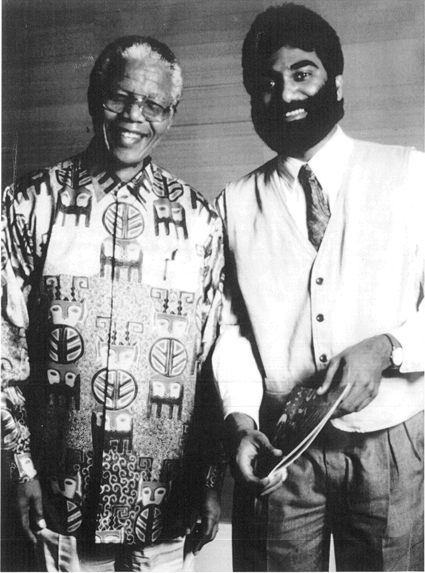
Kumi Naidoo, left
On December 5, the day Nelson Mandela finally died, after a heavily mediated, prolonged deathwatch, I was in Amsterdam with Kumi Naidoo, a close South African friend of many years standing. In between hundreds of requests for his comments from global media I managed to sneak in an interview myself. I had originally planned to interview Kumi about his role as Executive Director of Greenpeace International, about the predicament of the Arctic 30 who were still in captivity in Russia then and other environmental issues. After Mandela’s death I decided to include Kumi’s views on this historic passing in the interview, as an ANC activist of many years standing, as someone who knew and worked with Mandela personally, who better than Kumi Naidoo from whom to get a perspective on Nelson Mandela and political leadership in general. This constitutes Part 1 of the interview. In the second part which i’ll post in a couple of days i ask him about Greenpeace, environmentalism and the Arctic 30 among other things. First an excerpt from Kumi’s Greenpeace blog:
I was 15 years old when I first heard the name Mandela, or Madiba, as he is fondly known in Africa. In apartheid South Africa he was public enemy number one. Shrouded in secrecy, myth and rumour, the media called him ‘The Black Pimpernel’. He was able to avoid the police, using several disguises – a favorite of which was that of a chauffeur – until the CIA colluded with the apartheid regime to ensure his capture. In Durban, where I was born and grew up, and all over Africa, he was a hero! Now he is a hero to the world.
AP: Kumi, you knew Nelson Mandela personally, you’ve had experiences with him, you are from South Africa, and I heard you in the BBC interview a moment ago saying something about how you thought the world could best do justice to him, or the best tribute they could pay to him. Could you develop that point for me?
KN: Mandela was very keen not to be understood as an exceptional person. I’ll give you a story. In 2004, I was in Mobutu, Mozambique, to help moderate a discussion with young people and with some senior African leaders which included Graça Machel and Joaquim Chissano, who was President of Mozambique at that time, and these were kids from eastern and southern African countries who had developed a vision of what they wanted Africa to be in 2050, and were presenting the vision. So, when I was moderating the discussion, one of the young people asked the question: “What is your definition of leadership?” And Mandela’s mind flipped back to the forties and he answered it as he would have answered it at that point: “We in the ANC youth league believe in the idea of collective leadership.” So essentially his notion of leadership was a very servant leadership, that you are there to serve not to take. And the reality is today most of our political leaders want to be treated as gods and semi-gods, from the security details to the fuss around them and so on.
AP: They’re more interested in the aura of leadership?
KN: And I think even though he was feted and praised as he was, he always was at pains to say, I’m a human being. And whenever anybody called him a saint, he would say: “If by saint you mean a sinner who is trying to be better, then I’m a saint.” His own sense of himself was a very humble reading, [different] from how the world read him. And, quite often, you had the sense that he was not comfortable with all the accolades that would be, you know…
AP: Hurled at him.
KN: Yeah, in fact, there’s a beautiful one on women. Nelson Mandela once said “I can’t help it if the ladies take note of me; I’m not going to protest.” He also spoke about how, as a human being, he’s made mistakes. In 1995 when I was heading the Adult Literacy Campaign in South Africa I took kids and adult learners to the Parliament to meet Madiba on International Literacy Day. They were excited to have their picture taken with him – the image was to become a poster for our campaign to promote adult basic education – but everyone was anxious; they were asking me what they should say and how they should approach meeting the President! The main line that people had prepared, the kids, and even the adults that were there, was something like, “Thank you, Mr. President,” or, “Thank you, Madiba, for taking time. We know how busy you are.” But when Madiba emerged from his Cabinet meeting he turned the tables. He walked in and thanked everyone for taking the time to see him. “I know how busy you all are and I thank you for taking time to meet me,” he said. In that moment he closed the gap. He was just a human being, a person like them, and everyone relaxed. Within a minute, that sort of thing about the leader and the lead, the gap was closed, and that’s a rare thing.
One of the things that I noticed with my own eyes was his ability to engage with kings and queens and heads of state on the one hand, and his ability to engage with ordinary people, equally comfortably. For example, I first met him when I was in my late 20s, in 1993. I was helping facilitate an African National Congress (ANC) workshop to plan its media strategy. I went down to meet him for the first time and you know me I got stupid… I just choked. I said, “Hello Madiba, it’s a real honour to meet you,” and I couldn’t get another word out. Just that one sentence. So during the workshop, he quietly, didn’t make a big fuss of it, quietly asked, “Can I go and say thank you to the people who prepared the food, and the workers of the hotel?” And I followed and I watched what he did and he basically shook everybody’s hands in the kitchen and said thank you to everybody.
I’ve come across a lot of people in my life who talk about poverty and talk about the poor, but you rarely have a sense that it matters to them to the point at which they will be willing to sacrifice something. Yes, they feel a sense of solidarity, but when you speak about the poor, that you actually celebrate the eloquence of the poor, the tenacity of the poor, the perseverance, courage… I mean, to survive poverty is… You know, many people theorize poverty, but so many elements of poverty, individually, for most people who theorize about poverty would be really difficult to even comprehend the individual things. Just take homelessness. If you are homeless, what does it mean not to have a post box where people can contact you; what does it mean not knowing where you’re going to sleep at the end of the day; what does it mean not having a place where you can store what little you might possess. So dealing with homelessness in itself is a huge thing for most people who are commentators [on] or benefactors to poverty. Then you take an issue like living with HIV/AIDS… I mean, you know, where health care is difficult… where people have to struggle for access to antiretrovirals and some still don’t have access to them and all of that, and just confronting that alone, for most people, would be a major challenge. And then you got things like educational deprivation as a result of a conscious apartheid strategy, where the founder of apartheid, Verwoerd, once said, and I quote, “Blacks should never be shown the greener pastures of education, they should know that their station in life is to be hewers of wood and drawers of water.”
AP: Who said that?
KN: Verwoerd. V-E-R-W-O-E-R-D. He was the architect of apartheid. Those legacies still live on. And Mandela’s very strong commitment to education more than anything else, and very strong commitment to children more than anything else, comes very much from a deep inter-generational understanding as well. Like when I was the head of the adult literacy movement in South Africa it was always easy to get him to send messages of support and so on. But, because you can say, well, okay, the new government… There’s a term for it in South Africa now, like you know how they talk about the Millennials? There’s a term… ‘Born frees’! The born frees are those that were born after ’94. So now they’re ten years old. They got no… In fact, even if I take talking to the wonderful kids that are a part of my life, and who know the stories because they’ve heard it from me a thousand times, or they’ve been in the presence of friends, who when we get together we always tend to reminisce But still, often they think we’re exaggerating about how bad it was. They don’t really believe, because thankfully they are in more normal situations now, they attend schools with kids of different races, and its no big deal like it was for us. That was such a big thing. So the one thing about Mandela’s leadership is that he was not only a strong leader showing the importance of understanding the appropriate role of individual leadership. But he was always collective-minded, understanding that the wisdom comes from a range of people. For example, his relationship with the other senior leadership of the ANC was critically important to him, like Walter Sisulu was his confidant right until he passed away, Govan Mbeki, Ahmed Kathrada.
AP: I wanted to ask you about Ahmed Kathrada.
KN: So Kathrada was the youngest of the Rivonia trialists…
AP: Of the what?
KN: The Rivonia trialists. Rivonia was a farm where they were captured from and the trial was known as the Rivonia trial.
AP: Mandela was part of that?
KN: Yes, that was the trial where he got life imprisonment.
AP: What were they trying to do?
KN: They had some explosives…Probably, in military terms, it was not even security training 101.
AN: Kindergarten.
KN: Actually, maybe I should take that back, because at that time maybe it was as sophisticated as you could get. But the other thing about Mandela which is really important was his passion for peace, because when he came out of prison he was unequivocal about the need to eliminate violence from the politics of South Africa. I remember this one speech, he went into Durban where there was a huge conflict between the ANC and Chief Buthelezi’s Inkatha Freedom Party, and it was Mandela’s force of character, his strength with humility, and so on. I mean quite often I think leaders are put into positions of unilateralism where they’re not prepared to deal honestly with their people about the ambiguity of leadership, because sometimes there are situations where you need a leader to be more assertive and maybe even less consultative, and in other situations, normally, I would say that’s a better style of leadership.
AP: Being consultative?
KN: Because then the responsibilities are shared more broadly and those who have responsibility for decisions have a greater investment in them… And as President, in the five years Mandela was there he was a very hands-off President, I would say, Thabo Mbeki did a lot of the day to day management of Cabinet Ministers and so on. And de Klerk was the other Deputy President, there were two Deputy Presidents in the first Cabinet. So I think that the kind of leadership that we need to revisit now as we reflect on one of the greatest leaders that walked this planet is, given where the world is, for example, should leaders take as given that the level of material privilege they assume, that comes with the role of leadership, should it be so vastly different from the day to day realities of often the majority of the people in their countries? So, for example, we have had some signs of positive actions such as the current President of Malawi, first woman to head up Malawi, and she, for example, sold off the Presidential jet. We just assume that the norm of leadership is living the life. So therefore you can see that there are times when leaders have to honestly say to their people, this is a time of austerity and we need to…
AP: Tighten our belts.
KN: …tighten our belts, people are thinking, well its easy for you to say. Its going to mean nothing to you because it will have no material effect on you, given that you have so much of excess income anyway, from what it takes to meet your basic needs. And so I think there needs to be a conversation. If there’s something that should come out of Mandela’s death right now, I would think there has to be a conversation about equality, and its importance, because every problem we have here is a world out of balance. I mean to have less than 200 of the wealthiest people in the U.S. be equivalent of, own more than, 65% of the American people, there’s something wrong with that system, where people have so much that they don’t need and they start being silly, and engage in exuberant consumption which is completely self-serving, and so on. And in that sense Mandela did not… and it was also the issue of his age and all when he came out, because, and don’t forget, he was cut off from the world for 27 years. Its amazing how he just appeared to fit smoothly into that world. But there’s a lot that he had missed in absolute terms. And so I don’t judge him too harshly on this, but the fact is, you know, he didn’t really fundamentally challenge the structural injustices in our economic life, and in that sense, I think that if you assume that he had spent, if you take the time that he was in prison, for example, and how much of that was lost. Because you know people don’t sufficiently acknowledge that he was not only about charisma and wisdom and all of that, he was also a person of intellect. He had a very very amazing intellectual gift, and I think his real gift was that ability to be able to walk one day with kings, queens and heads of state, and another day be as comfortable, and in fact, quite frankly, more comfortable, walking with regular people.
AP: That’s really good, you’ve given me a few private glimpses which aren’t out there which is great. I wanted to go back to the fact that you’re an Indian South African, and people don’t realize that many Indian South Africans participated in the ANC and in those struggles against apartheid. For instance I was quite surprised to see that this cellmate of Nelson Mandela was another Indian South African. What’s his name again?
KN: Ahmed Kathrada
AP: Right, so its not as exceptional as it seems?
KN: No, no, in fact, several South Africans of Indian origin were in Robben Island with Nelson Mandela. There was Mac Maharaj, Billy Nair, who spent twenty years there, and Zed, Uncle Zed we used to call him.
AP: Zed?
KN: Yes, Z-E-D, he spent fourteen years. Yeah, many, and disproportional to the size of the population in terms of this thing, but it was because of the legacy of Gandhi. During all of that there was quite a strong spirit of resistance in the community. Mandela was fond of Gandhi in terms of his life and work and writings, but the apartheid state, like all colonial regimes, maintained control by divide and rule, and in South Africa, the main form of divide and rule was on the basis of race, and not just that but also on the basis of language, so it wasn’t that it was just white, Indian, African, coloured, as they would’ve called it, but the African community was, the black African community were then broken up into Zulu, Xhosa, Tswana and the other African languages… your language and culture.
AP: Interesting, I have never heard that side.
KN: Yes, so there were people like myself who came through the liberation struggle, who were first influenced by Steve Biko, and were resisting the divisions of apartheid which were also historical and cultural divisions. Distinctions, let’s say, because obviously the people who came as indentured servants from India have a different history versus those who came to be defined as Coloured, whose numbers are in excess of three million; and their community was rich in culture…
AP: And the Coloureds are the hybrid people born out of contact between the Europeans and Africans?
KN: Yes, but the people who were so defined have forged themselves also into a rich community in their own standing. I think one of the richest cultures in South Africa in terms of music, dance, even rich art forms and so on, because there is also Malay influence, because there were slaves brought from Indonesia and Malaysia.
AP: Really, I didn’t know that.
KN: So, given all of these different influences, our response, those that came through the struggle like myself, when the state used to say white and non-white, we said we didn’t want to be non anything. So black then became the unifying identity. And Steve Biko’s big contribution was in the way that he defined black consciousness. He defined it as everybody who wasn’t benefiting from the privileges of white citizenship, and the ANC drew on and embraced that as well, and so for me my identity is very much first and foremost…
AP: A black identity, as a black person?
KN: Today, given the journey I’ve traveled, my first identity, it might sound silly but, is as a human being who is not bound by any man-made boundaries, but my second biggest identity is as an African whose identity is fundamentally linked to the African continent as a whole, and third it is South African, and then fourth, I would say, as a South African of Indian origin, and I don’t see any of those in contradiction. I think that they enrich each other in different ways.
Why the gap between Jamaican media and latest technologies?
Can’t afford the rights to this cartoon, but am carrying it with a link to the original site as free advertising…
Recently I heard Naomi Francis and Emily Crooks on Nationwide Radio exclaiming how Twitter has changed the way they consume content, especially television and other live streaming content, and how much they enjoyed watching The Voice while commenting simultaneously along with so many others on Twitter. A heartfelt Hallelujah. Our media has finally got it. Not a moment too soon for this is the end of 2013 and one day scholars and analysts will want to know why Jamaican media were such late adopters of new media in general; the first big-name journalist to start blogging here was Dionne Jackson-Miller in 2012.
There were several younger, lesser known journalists who started Twitter accounts in the early days and used social media tools (Laura Redpath was one of them), but there seems not to have been any recognition on the part of their media houses that what they were doing was valuable activity, that should have been taken up at the highest levels.
For those plebs like myself who started blogging in 2008, and tweeting in 2009, it remained a mystery why the media here seemed to be spurning the most revolutionary news and opinion-gathering tools to come along in decades. For us the Tessane Chin moment Ems and Nems were describing on Nationwide had happened in 2008 when we watched Obama’s historic win, while talking to each other on Twitter, not only regionally but globally.
I’d really love to know why it took Jamaica’s top media fraternity another five years to get clued in on the powers and pleasures of Twitter. I suggest it behooves them to take a good, long look at their own foot-dragging in this context and ask what it means. What does this hostility to change imply for Jamaica’s future? The world as we know it is irrevocably moving from analog to digital modes of communication. Abandon hope all ye who insist on ignoring this fact or who convinced themselves that social media was just a fad that would go away. If it might help let me quote from a post I wrote in January 2010, “Jamaica’s Twitter-shy Media: When will the would-be watchdogs of Jamaican democracy wake up?“:
I wonder if 2010 will prove to be the year when Jamaican journalists finally discover Twitter. Their silence on/in this increasingly crucial new medium is deafening. Where are @Boyne, @MartinHenry, @Wignall, @Hughes and @emilycrooks? Don’t you know that Twitter is how news is telegraphed nowadays and audiences created?
Ah well, i continue to scratch my head in perplexity at the lagging behind of those who claim to be our watchdogs. Their caginess and timidity would be amusing if it wasn’t so tragic. While the formal, English-speaking posse bury their heads in the sand the Patwa-speakers are off and running with the new technologies. I was able to get a blow-by-blow account of the rather uneventful Sting finale this year because the dancehall massive and crew were tweeting comments and photos, alternately transmitting their disgust at the lack of clashing and fear when shots were fired amongst a range of reactions which i wouldn’t have missed for the world.
May i recommend that our celebrated journalists…take a crash course in Twitter? The lagging behind in use of new technologies from the most literate segments of Jamaican society contradicts the ‘English is better than Patwa’ message that the English-speaking elites are constantly advancing, claiming that English is necessary to ‘move ahead’, converse with the rest of the world, keep up with new knowledge and so on. It would seem from the example that they’re setting that English is actually holding back the learned, speaky-spoky elites.
Even the latest Shebada play Serious Business, pivots on the plot-bending detail of ‘Facebook and Twidder’ for he plays a Revival preacher from New York, with 5000 Facebook friends and 3000 Twitter followers. Those are his qualifications for being hired to replace the crufty, corrupt old Preacher who is busy ripping off the Church at every opportunity he gets. It’s an amazing development when the less literate massive and crew get the new technologies before those who benefited from the highest education this country can offer. What can it portend for the future?
I’ve also tried, unsuccessfully so far, to interest my colleagues at the University of the West Indies in logging on to things digital, for Twitter and Facebook are prime hunting grounds for researching social opinion, commentary and discourse in general. With a few exceptions (Damien King, Sonjah Stanley-Niaah, Donna Hope, Julian Cresser, Marcia Forbes) most UWI academics have spurned these new modes of communication and research. While it may once have been possible to claim to be world-class without having to prove it, be warned that the lack of a significant digital footprint today in any enterprise that claims to be cutting edge, immediately betrays the falsity of such truth claims.
Meanwhile according to a Daily Beast article listing the 10 most popular journalists on Twitter: “MuckRack…reported that the New York Times has the most journalists on Twitter, with 502 tweeting reporters, editors, and photographers. Reuters was just shy of the lead with 496.”












 Active Voice