A Hate Story: Reflections on the Death of Dwayne Jones

Jamaican society’s contradictory responses towards its own Trayvon Martins.

gullyqueen2

The Trayvon Martin case has been keenly followed in Jamaica with people vociferously expressing outrage over the not guilty verdict that allowed Zimmerman to walk free. How could there be no legal penalty for unnecessarily taking a human life? How could the law protect Zimmerman’s right to stand his ground but not Trayvon’s? This was madness. Many Jamaicans keenly identified with Trayvon and his family, imagining that this was something that could easily happen to them or their loved ones in racist North America.

All over the Caribbean those with a human rights perspective were eager to point out that similar outrage was rarely forthcoming in numerous local instances of flagrant injustice, often involving victims of police and vigilante killings where the perpetrators are almost never held responsible for their crimes. Why were such folk, unmoved by the wanton killing of fellow citizens in their own backyard, so willing to take such an interest in a case so distant from their immediate lives and localities?

Clearly we must attribute some or most of that interest to the intense coverage of the case by mainstream media in the United States. Channels such as CNN, MSNBC, ABC and others are available via cable and voraciously consumed in Jamaica and many other parts of the world. It’s not difficult to get sucked in by the wall-to-wall coverage of a murder trial for weeks on end, particularly when its racial component resonates locally. This was the case with the murder of Trayvon Martin.

Let’s also give credit where credit is due. American media excel at focusing attention on the human interest in a story; at laying open the lives and personalities of those concerned, at making the viewer identify with the principals of a high profile news item. This is why the world cares more about 500 victims of a natural disaster in the US as opposed to 150,000 deaths caused by a Bangladeshi cyclone or an earthquake in Turkey.  American media puts faces on the victims, details their losses, personalizes them. The 150,000 victims of a distant cyclone remain just that—faceless, lifeless, abstract ciphers.

Not many countries have the sheer heft of media muscle that the USA can lay claim to. Our media in small places like Jamaica lack the infrastructure, the traction and the reach of American media. We also have far more deaths, murders and killings per capita than the media can possibly keep up with even if they had the will and the ability to do so.

Even in the United States there were complaints that cases just as heinous as Trayvon Martin’s or worse had received little or no visibility and thus generated little or no outrage. What makes a particular story a media sensation depends on the number of people who feel affected by it. Can they can identify with it?   But this is also a function of how much airtime and column inches the story receives.

In Jamaica the media almost never gives you enough information or gives it to you after the fact as in the case of the Brissett Brothers accused of the vicious rape of 4 women and an 8-year old girl. Now that DNA evidence has proven that they couldn’t have been the perpetrators the media has interviewed them at length, along with their family members who had given them a cast iron alibi, and basically got the story out. Had there been no DNA evidence the brothers would have been wrongfully convicted raising uncomfortable questions about how many such innocent people there are in prison.

The ongoing saga of Vybz Kartel raises similar questions. One murder charge has completely crumbled and the other may do the same, yet Kartel has been held without bail for more than a year now.

Alexis Goffe,  a spokesperson for the human rights group Jamaicans for Justice, recently observed that another reason there is little or no outrage about the legion of local Trayvons is that in these situations most educated Jamaicans identify with Zimmerman rather than Trayvon. Jamaicans are not Trayvon Martin, Jamaicans are George Zimmerman said Goffe.  After all Trayvon’s profile fits that of the ‘idle youth’ most gated and residential communities in Jamaica remain wary of and police zealously. They want the Jamaican equivalents of Trayvon Martin to be kept in their place, on pain of severe punishment and even death. Since the start of the year Jamaican Police have killed 114 citizens, yet it’s business as usual in this tourist paradise.

For most Jamaicans such deaths when they happen are non-stories–like the slaying of young Dwayne Jones aka Gully Queen a few days ago near Montego Bay. 17-year old Jones was at a party on the night of July 22 dressed as a female and dancing when he was outed by a woman who knew he was cross-dressing. Details are sketchy but early reports said that Jones was killed by a mob that stabbed and shot him to death, flinging his body into nearby bushes.

In most countries a lynching such as this would be front-page news but not in Jamaica, known far and wide for its hostility towards homosexuals. The police have said that they can’t prove that there is a link between Dwayne’s cross-dressing and his murder and the media has barely taken note of the gruesome slaying. Judging by comments made on social media most Jamaicans think Dwayne Jones brought his death on himself for wearing a dress and dancing in a society that has made it abundantly clear that homosexuals are neither to be seen nor heard.

Attempts to portray the mob killing as a hate crime have also been futile. “Dwayne Jones chose to tempt fate” seems to be the popular feeling, “and he got what was coming to him.” Which is like saying Trayvon Martin tempted fate by lingering in the wrong neighbourhood; he got what was coming to him. Dwayne Jones decided to wear a dress and dance and for that he was put to death by a motley crowd. Most Jamaicans seem to think there is nothing at all wrong with this judging by the lack of outrage, scant media attention and silence from the political directorate.

The Senseless Death of Dwayne Jones aka Gully Queen

Laments the killing of Gully Queen, a young transgendered male, by a mob at a party near Montego Bay.

gullyqueen1

gullyqueen2

gullyqueen3 gullyqueen4

I’ve been very disturbed by the wanton slaying of the young wo/man in these photographs, Dwayne Jones. S/he was killed on Monday night in St. James, not far from Montego Bay, the tourism capital of Jamaica. As the excerpt quoted below says, Dwayne was killed after a woman recognized him and irresponsibly outed him at a party he attended cross-dressed in female clothes.

I think this woman should be identified and made an example of, don’t you? She must be sanctioned for needlessly endangering the life of a Jamaican citizen. And the media should treat this as the front page story it really is. Had Dwayne Jones come from Cherry Gardens or Norbrook, there wouldn’t have been another news item in Jamaica since Monday. But poor Dwayne was just a Gully person, worse he was an effeminate trans gendered Gully person…no space for him, no place, no grace, only jungle justice.

As a friend observed on Facebook:

Ignorant Hateful Jamaicans carry out their god’s commands.

The following excerpt is from the Minority-Insights blog:

On July 22, 2013 Dwayne Jones a Trans-gender otherwise known as “GULLY QUEEN” and “Dwayne Gagastar Trensetta” was shot and stabbed to death in the Irwin community, St James.
According to Iriefm news report, “the 17-year-old was dressed as a female and was dancing with a male, when a woman at the party recognized him and told other patrons that he was not a woman, but a male. One of the men at the party accosted the teen and conducted a search where he discovered that the teen was not a female. A mob then descended on the teen and chopped and stabbed him to death, before dumping his body in bushes along the Orange main road.”

Furthermore, the Jamaica-Gleaner reported that, “a number of explosions were heard and the police were summoned. They discovered Jones’ body on the roadway, with multiple stab wounds and a gunshot wound.” No arrest has been made.

For more click here.

Of Adichie, Coco Yams, the Caine Prize and Literary Tiffs…

Chimamanda-Adichie-670x665

Nigerian writers had their feathers ruffled by what the acclaimed author Chimamanda Ngozi Adichie said in a July 14 interview with Aaron Bady whose twitter handle is @zunguzungu. The literary kas kas has produced a series of archly comical tweets, blogposts and ripostes that inspire awe in latent Nigerian literary talent. Here’s the offending snippet from the IV.

AB: I would love to ask you about the Caine Prize. I find it interesting that so many Nigerians are on the short list this year—that it’s four Nigerians out of five . . .

CA: Umm, why is that a problem? Watch it.

AB: Well, none of them are you!

CA: Elnathan was one of my boys in my workshop. But what’s all this over-privileging of the Caine Prize, anyway? I don’t want to talk about the Caine Prize, really. I suppose it’s a good thing, but for me it’s not the arbiter of the best fiction in Africa. It’s never been. I know that Chinelo is on the short list, too. But I haven’t even read the stories—I’m just not very interested. I don’t go the Caine Prize to look for the best in African fiction.

AB: Where do you go?

CA: I go to my mailbox, where my workshop people send me their stories. I could give you a list of ten—mostly in Nigeria—writers who I think are very good. They’re not on the Caine Prize short list.

And in case you don’t know, Aaron Bady is a very influential blogger, tweeter and scholar of African literature. Here’s a bit about him from an Atlantic Monthly article some time back:

“When historians look back at WikiLeaks and how the world’s pundits tried to make sense of what was happening, they’ll see a familiar list of sources: Foreign Policy’s Evgeny Morozov, The Guardian’s John Noughton, The New York Times’ David Carr, several people from the Berkman Center for the Internet and Society, and various long-time digital leaders like Geert Lovink and Larry Sanger.

“But among that list you’d also find Aaron Bady and his blog zunguzungu.wordpress.com. His probing analysis of Julian Assange’s personal philosophy and possible motivations became an oft-cited piece of the global conversation about what WikiLeaks might mean. Before Bady’s November 29 post, Julian Assange and the Computer Conspiracy; “To destroy this invisible government”, only a few hundred people a day found their way Bady’s blog. In the days afterward, tens of thousands of people swarmed to the site — and Bady ended up linked by some of the most influential media outlets on the planet.”

The first response came from Elnathan John, shortlisted for the Caine Prize, and referred to by Adichie as “…one of my boys…” In a tongue-in-cheek yet hard-hitting blogpost called THE CONSEQUENCES OF LOVING NGOZI he gently takes her on.

It is the Americans you blame as you struggle to craft a response to Ngozi that sounds neither bitter nor desperate; ‘something funny’ your friend said, so people would be left with no doubt about your maturity and sense of humour. You blame the Americans for organizing that workshop and putting you on the guest list where you first met Ngozi. This is what the Americans have often been guilty of: causing wars through third parties and standing back, claiming ignorance of roots and beginnings. They made you meet Ngozi. They made you love Ngozi.

His blog bio gives a more elaborate sense of the budding writer:

You wan know who I be?

My Photo

Abuja, Federal Capital Territory, Abuja, Nigeria
Elnathan is a writer who trained as a lawyer. Although he is routinely called a journalist, he rejects this title, preferring instead to be called a writer. His works have appeared in ZAM Magazine International, Otis Nebula, Per Contra, and Evergreen Review in addition to numerous Nigerian publications and newspapers. He writes a column for Sunday Trust. He has not won anything. The South African government recently truncated his plans to attend the prestigious Caine Prize Writing workshop to which he was invited. He holds no grudges. In 2008 he hastily self-published an embarrassing collection of short stories which has since gone out of print. He hopes to never repeat that mistake. He has just completed work on a new collection of short stories and is working on a novel. Nobody seems to want to publish his new collection of short stories. This puzzles him. He really loves those stories. Elnathan is touchy about his skin and man boobs and isn’t bold enough to grow hair. One of his new goals is getting to a weight below his current 100kg that will not warrant totally changing his wardrobe. He hopes to start a family comprising a partner, no kids and two hairy pets

For more go to my Storify

Trinidad Journalism in crisis?

What the hell has happened to press freedom in Trinidad and Tobago?

The news broke yesterday. Trinidad Guardian Editor-in-Chief Judy Raymond had reportedly walked off the job, followed by Sheila Rampersad and several other conscientious journalists in an atmosphere rife with allegations of political interference. Then today both the governemnt and the Guardian refuted the charge of political interference. As Patricia Worrell@bytesdog succinctly put it “This Guardian story have more twists and turns than Lady Chancellor or the road from Maracas.”

Raymond’s laconic Twitter account @HeyJudeTT doesn’t yield much at first glance. Her last three tweets are suitably cryptic but the Orwell quote is telling:

heyjudeTT
Judy Raymond@heyjudeTT
A luta continua
7 hours ago

heyjudeTT
Judy Raymond@heyjudeTT
“Journalism is printing what someone else doesn’t want printed. Everything else is public relations” – George Orwell
a day ago

heyjudeTT
Judy Raymond@heyjudeTT
fun times in the newsroom
3 days ago

Here’s another blog’s take on the situation:

Trinidad Guardian editor-in-chief Judy Raymond did not even realise she was holding a political seat!

Raymond was hired last year to help the Guardian bottom-line: Increase sales. However, Mr Live Wire understands she ran afoul of the company’s motto: Stay close to the Government.

Photo: Ansa McAll chairman Anthony Norman Sabga. Editorial policy is whatever he writes down on a sheet of paper.

Photo: Ansa McAll chairman Anthony Norman Sabga.
Editorial policy is whatever he writes down on a sheet of paper.

In a politically aware country, although not necessarily a politically intelligent one, Raymond’s Guardian won nationwide acclaim for a string of exclusives including the stunning Section 34 scandal.

It turns out that Government officials felt Raymond and her nosey crew should spend more time on hard-hitting stories like the intrusion of Keith Rowley’s back door at Balisier House or MP Donna Cox’s alleged slap across the face of a PNM rival, presumably during recess.

For more click here.

How will this situation be resolved? The region watches and waits with bated breath.

Roland Watson-Grant and his debut novel, Sketcher

An interview with Jamaican writer, Roland Watson-Grant, about his debut as a novelist.

582304_309184419202450_938270534_n

Before April this year I didn’t know who Roland Watson-Grant was. But we were on a panel together during the Kingston Book Festival and that’s when I found out that he was only Jamaica’s latest novelist, whose book, Sketcher, was about to be launched in England. Subsequently he sent me an advance copy which I was foolish enough to leave in Grenada with a friend, so I haven’t had a chance to read it yet, except for the excellent first chapter which the publisher, Alma Books, has made available online (see excerpt below).

Roland Watson-Grant

I was intrigued by Roland’s unusual trajectory (where had he suddenly appeared from? and how did he snag a UK publisher with his first book?). Yes, yes, I know Peepal Tree is also a UK publisher but Alma Books is a different kettle of fish altogether. Unlike Peepal Tree Alma isn’t dedicated to publishing Caribbean authors, on the contrary, according to their website:

Alma Books publishes from fifteen to twenty titles a year, mostly contemporary literary fiction, taking around sixty per cent of its titles from English-language originals, while the rest are translations from other languages such as French, Spanish, Italian, German and Japanese. Alma Books also publishes two or three non-fiction titles each year.

They’ve also just won the Independent Publisher of the Year award in the UK. So dive into the excerpt from Sketcher immediately below and then my interview with Roland Watson-Grant.

Simple answers. I was only eight, but when my turn came to ask, she had to make it complicated. She said: “Skid, I’m so tired a y’all asking me where he is. Why don’t you all get on that CB radio and holler out your dad’s name and tell him to get himself home.”

So we did. Now, we had a CB radio, and in the Eighties that was a big deal. You had to have a CB nickname and all that fancy stuff. And we called our dad “T-Rex” on the radio. And my pops, he was one of the biggest godfathers of Citizen Band radio technology in the South. People knew him, cos he fixed CB radios and boosted their frequencies, and he invented all these sky-scrapin’ antennae things that could prob’ly pick up as far as China. So when we all got on the radio and switched to Channel 19 and started pressing the hell out of the key on the microphone and jumpin’ up and chantin’ “Breaker, Breaker, T-Rex, you copy? Come on home, T-Rex”, all the truckers and all the cops and the hunters and the shrimp fishermen and people as far as frickin’ California and prob’ly Mexico could hear us. And man, they all started in on the joke, whether they knew T-Rex or not, cos that’s one of the things that CB radio people do.

Well, within fifteen minutes we could hear the Ford Transit engine revvin’ into the swamp and the tires grindin’ and the door slammin’, and the great big ol’ T-Rex came crashin’ into the house with his claws all out and his teeth sharp. He looked across the room and growled at me, cos he said my voice was the loudest on Channel 19. Me? And he made me get back on the CB radio and announce that “T-Rex made it home tonight”, and then I had to speak like I was an AM radio announcer, with a big, dumb radio voice and everything. I had to tell ’em what time it was, and do the weather report and tell ’em to “stay tuned for more news”.

To read more click here.

Photo of Roland Watson-Grant, by his brother, Salfrico

The Interview:

Roland where did a writer like you pop out from, fully formed like Athena from the forehead of Zeus? Have you deliberately secreted yourself away from the literary world of Jamaica, small as it is? You know with most other recent writers there’s a loose arc they tend to follow; first publication in Wayne Brown’s writing supplement in the Observer, then appearances at various festivals, participation in Calabash-sponsored events, by the time their first book is published they’re practically household names. You escaped this arc. Tell us about your coming into being as a writer.

It’s the stuff of dreams really. You could say I’ve been “writing in the wings” as an advertising creative director/copywriter since I was 21 years old. Literature was my first love though. When I got into advertising through a voicetape I recorded in a bathroom, I went to UWI the following year. My mother wanted me to become a Professor of English but I didn’t stay that course and decided to stick with Advertising instead (a classmate has called me a sell-out ever since.) My overseas advertising training came from being hired by McCann-Erickson in 2002, which led to more creative discipline and an interest in writing for wider appeal. In 2011 I entered a UK short story competition. When one of my stories won an international prize, I was invited to read at the prize giving ceremony in England that same Fall. A London-based publisher was in the audience and the reading led to a book deal.

Stuff of dreams. As for Greek gods, I feel more like Prometheus, dedicated to progress but bound to be burned by the same fire I want to share. But that’s another story.

I remember a conversation with you in which we were discussing the place you grew up in, in Jamaica, and how it was the inspiration for the Louisiana swampland where Sketcher is set. Did I imagine this? If not, how did it go again?

I grew up in New Haven, Kingston, Jamaica in the 1980s. You won’t see the name appear on Google Earth. It was a swamp when we got there. Wilderness: fish swimming by the side of the ‘roads’, mosquitoes and crocs in the Duhaney River. Reading helped us escape. Olive Senior, William Golding, Salinger, Claude McKay, Hardy Boys. When I read Twain’s “Life on the Mississippi” I started enjoying living in a swamp. We raised chickens, others raised goats and dug wells. We had a “Home Sweet Home” lamp– a real rural existence in the city. A whole different life was happening among the zinc roofs you still see when you fly over from Ferry. Somehow that whole life, fused with what I’d read in books and became the atmosphere of Sketcher.

the-house-that-haunts-the-pages-of-sketcher

The house that haunts the pages of Sketcher is the house Watson-Grant grew up in. “I grew up in New Haven, Kingston Jamaica in the 1980s. It was a swamp when we got there. Somehow that whole life, fused with what I’d read in books and became the atmosphere of Sketcher.”

Did you do a course in creative writing somewhere or are you that rare being–a natural writer–who’s able to produce the most lyrically poignant first novel without painful contractions or cramps? Did this novel go through many iterations? Did you work with an editor?

Apart from writing everyday in advertising, I kept journals for a number of years in New Haven, just to practice atmospherics and observe emotions. My mother encouraged it and that was very beneficial. Then I got incredible insights from my tutors, teachers and Professors from Kingston College to University. I always wanted to but never attempted a novel until my publisher/editor Alessandro Gallenzi of Alma Books said I should consider expanding the story. He’s a genius, really. Erudite. Working with him was a great opportunity. We got through the novel in a year. His feedback was and continues to be priceless.

Tell us about your experience with Alma Books. Were you represented by an agent? Did you try to be published in Jamaica or did you always know you wanted a publisher outside the region, a semi-mainstream publisher as it were?

Simon Kerr from the University of Hull in England was responsible for putting all the winning entries into an anthology. He invited industry people to the ceremony hear us read. As I mentioned, Alma Books was in the audience and I got handed a business card and a task to do a draft in a month and submit it for review. Published in Jamaica? I used to write letters to the Gleaner editor in fourth form. So I guess I was ‘published’ in a sense. (I was proud of those letters!) But literary-fiction wise, I entered the Commonwealth Prizes. I went with similar themes about growing up in New Haven, but it wasn’t my time yet, I guess. I wasn’t deterred because I really wanted to see my work (which has the Caribbean at its core) judged in a wide context, win or lose. I’ve always been the David vs. Goliath type of guy. 

I’ve gotten incredible support locally though since appearing “out of nowhere”. I wait for the opportunity to name all those people.

I’d like you to expand on Prometheus and your dedication to progress but fear of being burned?

Well, fear is a strong word. But I accept that Sketcher is not your everyday Caribbean novel. It’s about a second generation Caribbean kid growing up in a Louisiana swamp slowly finding out about his heritage by observing seemingly magical occurrences. This is a new approach to talking about cultural identity. And I accept with every new endeavour that takes a different route, there will be controversy. Jamaicans can be very insular. People all over the world imitate our culture but we ourselves are not comfortable behaving like citizens of a wider world. We ignore the fact that Jamaican culture is also made of many others apart from West African: Chinese, Indian, Middle-Eastern, Jewish, English et cetera. In turn, many in positions of influence expect artistes to create art and literature with a kind of Jamaica tourist-brochure agenda. This is the message we send to our literary and visual artistes and also to our children. The ironic result is that out of boredom future generations will ignore Maas Joe, bankra baskets, shet pans, burlap bags, brown paper and bandana (which we should know we got from India). We should declare these things as PART of the amalgam that is our heritage, but who dares suggest to the next generation that sentimental, nostalgic, or even our contemporary local culture is ALL the Jamaican culture is or ever will be? Every culture is in flux. When you don’t allow different expressions of it you end up with cookie cutter artistes who follow a formula like slaves, wondering why they can’t be the next Bob Marley. Screw the formula. Let’s do something new. That’s what Bob did. Big up Bob.

Are you a social media fiend?

Not really. I spend hours on the internet though. Alma Books got me into social media and rightly so. I recognize the communication power of social media and I try to use it as a tool. I respect it as I would fire. A novel like Sketcher with multi-cultural layers might not have been possible without that power or the overall abilities of the internet.

Boy I think you have single-handedly upped the profile of advertising agencies as creative incubators. Am I correct you not only ‘did voices’ or voiced ads for businesses but you also became a copywriter and got into advertising because you sent a voice recording to an ad agency?

Yes. While I was a teacher at my alma Mater, Kingston College, I made a voice tape after my students dared me to do so. I hated the recording. But the Creative Director at Dunlop Corbin at the time saw the writing potential in the scripts I sent in with the tape and they hired me almost immediately. So she opened up the opportunity for a 21 year old to write commercials for big clients even before I did a single voiceover.

How did this preoccupation with ‘doing voices’ come about? Did you listen to ads as a child and think ‘Oh, I can do that better?’

Haha. We used to listen to the news and imitate Charles Lewin and Dennis Hall and recite commercials. My family listened to a radio series on RJR called Mortimer Simmonds and soon we made up and recorded our own stories. We didn’t have a TV. Years later when my brother Seymour, and friends Kevin Day and Horatio Grant wrote and created the Mother’s Patty TV commercial with singing and dancing patties, we could trace it back to those days. It was the natural trajectory.

You also referred to joining McCann-Erickson and getting the chance to go abroad into a more creative atmosphere, this released your creative juices you said. What is the problem with the local advertising industry? What was the crucial difference that enabled you to write fiction abroad?

Well, I don’t want to pontificate and make prescriptions for local advertising, but I will say what I learnt at McCann. 1.Deadlines are crucial. 2. You’re a creative being and a salesman. And most importantly: The IDEA is key. Get your IDEA straight and you can execute it in a thousand ways. But the IDEA must always be singular and original. We have lovely graphics and software and agendas, but what’s your IDEA? Any society that encourages NEW IDEAS will prosper. I recently did an interview where I suggested we call for a Ministry of Imagination in Jamaica. I remember a Creative Director in New York once told us to stand in Times Square and try to recall all the ads we saw on the screens. We couldn’t keep up. He said: “Good, now go do something that people will remember”.  You can’t do anything ordinary after that.

SWAMP CHARACTERS (circa 1974): Watson-Grant’s three elder brothers and the blueprints for a trio of personalities from the novel. The tiniest one in the jumpsuit is the template for the Sketcher himself.

How autobiographical is Sketcher? Do you come from a family of several siblings? Did CB Radio play a key role in your life? Can you also draw? And although your Mom is disappointed that you decided not to be a literary professor she must be pleased at your debut as a fiction writer?

My mother is thrilled. My biggest fan. She can recite the short story version by now I’m sure. I would say the feelings, the atmosphere and some familial occurrences are autobiographical. But Skid Beaumont the main character is a completely different animal from me. Bookseller Magazine says he’s “part Scout Finch, part Bart Simpson”. I couldn’t top that when I was nine going on sixteen. 

My father was a CB expert in real life. That was the internet those days. He would make antennas and study the weather so he could use atmospheric conditions to talk to people in the Southern United States who couldn’t believe he was in Jamaica.

Did you locate your novel in Louisiana from the get go or was that a suggestion that came from Alessandro Gallenzi, your publisher and editor? In the short story that won the competition what was the location of the story?

Yes, from the short story version Sketcher was always in Louisiana. But in my mind the characters had a Caribbean background and sensibility. This would heighten the plight of them trying to fit into another society. In Sketcher the novel they are still trying. Alessandro never got involved in things like that. He would pull me back and tell me to rewrite chapters only if I started influencing the characters too much with my own politics and thoughts. And he once told me to literally draw a map so I wouldn’t get lost in the swamps when I was writing. I’ve always loved the “bizarre” beauty of New Orleans and how much the magic feels like our own folk belief systems of obeah and the like. There are conversations happening between cultures that we fail to eavesdrop on. For example, hoodoo and folk beliefs in Jamaica are family. So is New Orleans food and Caribbean dishes. In a documentary Cyril Neville, a New Orleans musician calls New Orleans, “the northernmost city in the Caribbean”. He plays lots of reggae and soca. My point is: people borrow from us yet we remain largely insular and frankly, a bit ignorant of how the constantly evolving Jamaican culture really fits into the wider world.

Finally have you read Erna Brodber’s novel Louisiana which is also about these connections? What about Garfield Ellis? Ellis was also inspired as a writer by Mark Twain. Have you read his novel For Nothing At All?

Wow. I have great respect for Erma Brodber but I must admit I haven’t read that. I have shared the stage with Ellis but I haven’t read his either and didn’t know he was inspired by Twain. Olive Senior and William Golding are my biggest influences though. I will look for Brodber’s book right now. That’s refreshing to know. Here’s what Chris Blackwell said in Louisiana one time at Loyola University Chris Blackwell on the Connection between New Orleans Music and Reggae – YouTube

“The scourge of poverty” by Jeremy Dear or What ails Jamaican journalism?

A UK magazine features the Jamaican Press as a pitiful thing, hobbled by poverty and corruption.

scourge


A few days ago the June/July 2013 issue of The Journalist, a magazine of the national union of journalists in the UK, carried a sensational article titled “The scourge of poverty” by noted British journalist, Jeremy Dear. In the article Dear, who was the main speaker at the annual National Journalism Week Forum put on by the PAJ and the National Integrity Action last year, outlines the parlous state of the Jamaican media with journalists so poorly paid that they die in poverty and while alive, are susceptible to bribes, threats, and gags of all sorts. In effect the impression is given that the Press corps in Jamaica has been castrated, and is ineffectually limping along, while going through the motions of aping a free and dynamic press.


If what is claimed in the UK article is true then this is an extremely serious situation. Yet top journos like Ian Boyne have scarcely mentioned it or warned the public about this  in their columns; Dancehall, it would seem by the inordinately high number of column inches he and other esteemed columnists regularly devote to the subject, is a far more pernicious threat to Jamaican society not the virtual bankruptcy of the media!


In fact instead of trying to rescue this crucial democratic institution Jamaican leaders are busy trying to find better ways to censor dancehall lyrics. You really have to scratch your head wondering about such blatantly misplaced priorities.  But maybe there’s some method to the madness after all. For if the media has effectively been gelded (look at the number of posts I’ve written pointing out its inadequacies) into submission by corrupt interests then the next step is to suppress the voice of the people, nah true? And that would be dancehall.


But read the article below for yourselves and see what you think. I had to  reproduce it in full as it’s not easily available to post and circulate otherwise. Thanks to Debbie Ransome for originally bringing it to my attention.


It is a universal truth that there can be no press freedom

if journalists live under conditions of corruption,

poverty or fear.


Little wonder then that Jamaica’s journalists are

increasingly concerned that their cherished media

freedoms are under serious threat as low pay and precarious

employment stalk the media.


Five of the last seven editors of Jamaica’s biggest newspaper

have died in poverty, unable to afford the care they need after

a lifetime serving an ungrateful media. Journalists called

out to cover a job are sometimes unable to respond because

they do not have even enough money for petrol for their

car. Others out covering hurricanes have had to leave their

children alone at home in the raging storm because they

cannot afford proper childcare.


And these journalists, fearful about losing their jobs, have

suffered in silence. In Jamaica such issues have only been

whispered about.

 
Corruption is rife in Jamaican society. In December,

Jamaica was ranked 83 out of 174 countries by Transparency

International. Journalists are the targets of vested interests

– from corporations to politicians to criminal gangs and

even media owners promoting their own business interests.

Widespread poverty among the country’s media workers

opens up the possibility that such vested interests can exert

an undue influence on journalists.

 
But today, the Press Association of Jamaica, which is

bombarded every week with requests for loans and financial

support from journalists who have fallen on hard times, is

finding its voice. Alongside campaigns to create a joint press

council with media companies and for an end to punitive

criminal libel laws which restrict journalists’ ability to do

their job, it is to launch a nationwide campaign to fight

against the poverty of journalists as a way of working to

improve quality and tackle the possibility of individual

journalists being susceptible to corruption.

 
The PAJ Executive has declared 2013 the year it “takes the

message to all stakeholders that the under-compensation of

journalists is a threat to the freedom of the media which we

all so treasure”.

 
Its says: “Any journalist worried about their next meal is

cannon fodder to the corrupt who want to ensure that their

deeds do not make it into the pages of the newspaper or on

the radio and television newscasts. This is an issue which

everyone who wants to ensure a free, fair and independent

media in Jamaica should rally around and one which the PAJ

will champion”.

 
I heard first-hand stories of journalists who had accepted

money for petrol or loans or financial and other gifts or

discounts from politicians, corporations or other vested

interests while researching this article. Payola is seen by

many businesses as a legitimate way to get things done – and

by some journalists as a way to supplement meagre salaries.

 
Sometimes the request to handle a story a particular way is

explicit, sometimes implied. But in every case the journalists

know the intention is to attempt to corrupt media coverage.

The International Federation of Journalists recognises that

the poverty and precarious employment of journalists

means journalism is too open to corruption, too reliant on

corrupt practices so its independence can be challenged.

 
The link between journalists’ working conditions and

their ethical stance is not absolute — but conditions play a

significant part. If journalists feel insecure they are much

less likely to challenge dubious editorial decisions. If they are

very low paid, and journalism is for the most part very low

paid, then they find it harder to develop the independence of

mind on which ethical journalism depends.

 
That’s why the PAJ’s President Jenni Campbell is so

committed to tackling the financial well-being of her

members. Ms Campbell said: “At the heart of what journalists

do is asking questions on behalf of those who would not

otherwise have access and provide information that allows

people to make critical personal choices.

 
“But in our quest to be objective at all times, we often

fail to stand up for our own causes. Our failure is in not

recognising that press freedom is as much a matter of

providing access to the public to express themselves freely

and maintaining firewalls to guard against boardroom and

special interests’ abuse, as it is also the ability of journalists

to do their jobs without the deliberate and sometimes

systematic pressures of eking out an existence way beneath

the poverty line.

 
“We must stand firmly against working in a climate where

payola and other forms of corruption become almost a

necessary consideration as we are called upon to do more,

simply because new and emerging technology demand it,

without any thought of how these new realities impact on

our own already meagre personal resources.

 
“As role models, we put on a positive face of prosperity

even as we struggle to feed young families and grapple with

too-long working hours.

 
“We fight for changes to libel laws, we speak out firmly for

the right of freedom of expression, the right to know, then we

go home and suffer in silence….we must be prepared to speak

up for ourselves. It is only then that we can speak up for

others with confidence and without fear or favour”.

The PAJ is already winning widespread backing for its

campaign. Professor Trevor Munroe, executive director

of National Integrity Action, has backed the association’s

demands for more ethical training and support for

journalists so they can increasingly challenge government

officials and others.

 
And Sandrea Falconer, Jamaican Government Information

Minister and a former journalist, says her government has

listened to the PAJ’s case and will reform the country’s libel

regime – which currently opens the door to media being

sued for criminal libel and facing unlimited fines – before the

endof the current Parliamentary year. But she also challenged

media to provide journalists with practical support to help

them tackle corruption wherever it may appear – including

in the media itself.

 
“Private power has increased enormously over the years in

our society and private actors have the means to influence

media content and output. Media practitioners themselves

have to exercise considerable moral courage to resist unjust

enrichment. They need support to do that”.

What the Police Can’t Do…

Jamaican Police’s power to stop and search is challenged by a Supreme Court judge.

Poster by Michael Thompson, Freestylee

In Jamaica its so normal for the police to stop your car and search it if they want that the ruling of a judge saying there is no legal basis for such police action comes as a thunderclap. According to Barbara Gayle, writing in the Gleaner:

A Supreme Court judge has ruled that the police have no power, under the Road Traffic Act, to arbitrarily stop and search motor vehicles, opening the door for a flood of lawsuits.

The police have repeatedly argued that the law gives them the power to stop and search vehicles, and that this has resulted in the apprehension of criminals, the recovery of stolen vehicles and stolen farm produce.

But Justice David Batts says the police are abusing this power.

Batts made the ruling when he ordered the Government to pay $2.8 million in damages to a motorist who was assaulted by the police when he was stopped in St Catherine in May 2007.

The judge’s statement has been refuted by the Police Commissioner who insists that the Police do have the power to stop and search members of the public. On the Jamaica Constabulary Force’s Facebook Page the laws as the Police understand them are set out:

Police Powers to Stop and Search
by Jamaica Constabulary Force (Notes) on Monday, 1 July 2013 at 20:07

The Police High Command takes note of public reaction to comments attributed to High Court Judge, Mr. Justice David Batts on the powers of the Police to conduct stop and search operations, which were published in the Sunday Gleaner on June 30, 2013. The Judge’s remarks will be examined by the High Command, to determine whether they have implications for how personnel operate on the front line.

In the meantime, the High Command wishes to remind the public and members of the Force of powers given to the Police to conduct stop and search operations as part of their effort to control criminal activities, especially in instances where public thoroughfares are used.

Powers to Stop and Search Vehicles and Occupants (Broad Powers)

Section 19 of the Constabulary Force Act empowers the Police to stop and search, without warrant, vehicles and the occupants thereof, known or suspected to be carrying stolen or prohibited goods, as well as any dangerous or prohibited drugs and gambling materials.

Powers to Stop and Search for Firearms

Section 42 (1) and 42 (2) of the Firearms Act empowers the Police to, without warrant stop and search any vehicle and its occupants on reasonable suspicion that firearms and/or ammunition is being unlawfully conveyed therein.

Four more instances are laid out under which the Police have the power to stop citizens and search them: to verify agricultural produce was legally reaped; under the Customs Act; for goods unlawfully possessed; and under the Offensive Weapons (Prohibition) Act.

By a startling coincidence, the very day after this was made clear to the public the Police stopped a van on the North Coast of Jamaica and found that it was stuffed with lethal weapons, allegedly imported from Haiti. This reinforces the rationale for giving police such extra-judicial powers, a move supported by many citizens on the grounds of security. The problem is that there seem to be no checks and balances for the many occasions on which the police abuse these powers.

Meanwhile let’s go back to Justice Batts for a moment. Interestingly he had once wanted to join the police force but decided against it, becoming a lawyer instead (see quote below). His ruling which in effect is a move to police the police, has not gone unnoticed and unappreciated by those of us who demand that the wanton killing and maiming of innocent citizens by the Police be stopped forthwith.

Law was not my first choice at all,” Batts said.

“For a long time, and up to the time I entered Sixth Form, my desire was to serve my country as a police officer or in the military. But I never joined the cadets because they required a clean haircut and in high school I sported an afro,” Batts said.

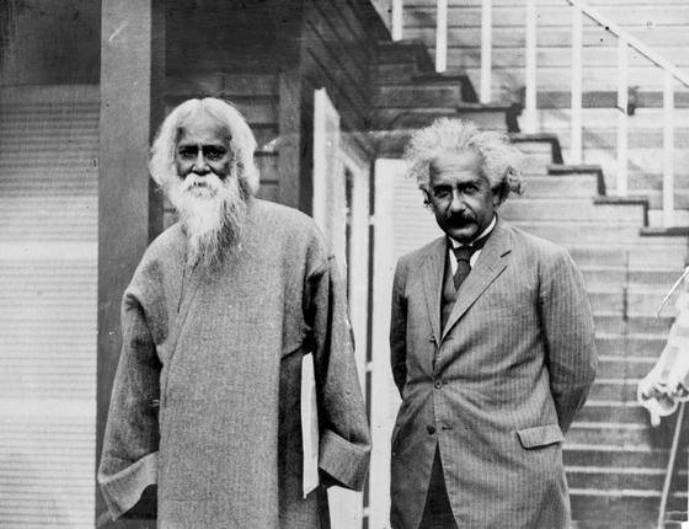
Please note that clean haircuts are highly over-rated and don’t necessarily  go hand in hand with ethical behaviour. See photo below of two eminent Nobel prize winners, Rabindranath Tagore and Albert Einstein, who clearly didn’t bow to the cult of  ‘clean haircuts’.

The Life Cycle of Blogs…

Noting the gradual slowing down of my blogging I post two articles really worth reading.

It’s more than a month since I updated Active Voice; I realize with mixed feelings that I’ve reached that point when you hit a plateau and blogging has lost the overwhelming fascination it once held. This seems to occur approximately five or six years after you begin (I started Active Voice in January 2008). At the time the blogs that inspired me were mostly Indian; I had come across them during the violent occupation of Bombay’s Taj Hotel in 2007. They had all been in existence for four or five years and some I noticed were beginning to taper off with a few like Sepia Mutiny eventually shutting down completely (A group blog, SM was my school for blogging, my role model that I looked up to and fervently wished to emulate). Sonia Faleiro moved from Mumbai to San Francisco and didn’t blog as often anymore (in fact her blog no longer exists) and the inimitable Sidin was updating his Domain Maximus  much less frequently as well.

So I’m just saying…there comes a time when blogs succumb to the natural rise and fall dynamic and I doubt that Active Voice will remain  immune to this curve.

But in the meantime we’re still here and just to show that there is still life in the old beast I post a couple of things that caught my eye.

The first is an awe-inspiring story about one of Jamaica’s celebrated athletes, Novlene Williams-Mills. After reading it I wondered why it had taken a British paper to break this news (or did I miss our local media’s coverage of it?). Especially in the wake of Angelina Jolie’s decision to have a double mastectomy, this story is relevant, inspirational AND its local. But alas, our media in general continues to fail at mining the gems in our own soil. Read on for the story of this indomitable runner and visit the UK Daily Mail for the full version:

On June 25 2012, Novlene Williams-Mills was diagnosed with breast cancer.

She told no-one apart from her husband of five years, Jameel, family and friends and then won the 400 metres at the Jamaican Senior National Championships that weekend in 50.60 seconds, booking her place in the Olympic team.

Williams-Mills finished fifth in the 400m at London 2012 and won a bronze medal in the 4 x 400m relay.

Courage: Novlene Williams-Mills won a bronze medal at the Olympics after being told she had breast cancerCourage: Novlene Williams-Mills won a bronze medal at the Olympics after being told she had breast cancer

 
Three days after the Games surgeons removed a small lump in her breast. She then had a double mastectomy, a further operation to cut out the remaining cancerous cells and reconstructive surgery. Her final operation was on January 18.

Last week Williams-Mills lay on the track as the Jamaican 400m champion after qualifying for the World Championships in Moscow this August by running 50.01secs.

‘I’m back,’ she thought. ‘I’ve still got it.’

What an incredible story. I hope Novlene beats her cancer and prevails in Moscow and at the next Olympics.


The other article i want to highlight is a blogpost about the late Jamaican writer C. Everald Palmer whose books are still used in local schools. Here’s the opening of @Cucumberjuice’s post about him:
The first book that I read by Cyril Everard Palmer (popularly known as C. Everard Palmer) was A Cow Called Boy.  It was fascinating to me, from the front cover until the last page.  What’s not to like: Josh’s farm pet follows him to school, disrupts school, is sold, and then Josh and his friends organize to get the bull-calf (read the book to find out why the title refers to it as a cow) returned to Josh.  We read it in grade four I think, sometimes taking turns to read aloud in class and always stopping to discuss what was happening and to learn new words.  Then came The Cloud with the Silver Lining and on my own I sought out his other children’s books.  Most of Mr. Palmer’s books were set in rural Jamaica, an environment with which he was familiar being born and raised in Kendal, Hanover.  His parents – Cyril and Vida – were “subsistence” farmers.  I’m a city girl, born and raised in Kingston and St. Andrew, so Mr. Palmer’s books exposed to me a side of Jamaica I knew very little about.  Then, before talking the Common Entrance Examination and in between the Nancy Drews, Enid Blytons, and Hardy Boys, it was just fun to read about what other children my age in my country could be doing; to learn about how my Grandparents grew up — things they didn’t talk about and that I simply didn’t ask.  I learned a good deal about what is probably now ancient traditional Jamaican life and living…people, things, and events about my country came alive on those pages to satisfy my growing appetite for reading.  Later on I discovered The Broken Vessel (1960), a slim riveting novel about making life in hot, vibrant, dangerous Kingston (informed by his work as a Daily Gleaner journalist covering crime in Kingston?).
For more click here.
Mr. Palmer’s story is a cautionary tale. By all accounts he was flourishing in the 60s, highly regarded nationally and in Canada where he made a life for himself. Yet a mere 50 years later the Jamaican newspapers hardly take not of his passing, according to this blogpost. The high profilers among us with much less to their credit than Mr. Palmer, please take note. Within a few years you will be forgotten.


In the meantime I’m keen to read The Broken Vessel. Wonder where I can find a copy of it.

Ja Blog Day 2013: Police & Security Force Abuse–“wi a pay unno fi murder wi!”

Poster by Michael Thompson, Freestylee

policeabuse

Mark Shields @marxshields
So NYPD, Boston PD and London Met Police, plus 1,000s more police depts ALL use Twitter. Come on #JCF – keep up. No cost, just results.

Mark Shields @marxshields
#JCF seethis “@NYPDnews: Male wanted for armed robbery, demanded cash, W 26 St & 9 Ave 5/19 1:20pm #10Pct #800577TIPS ”

RMA#872-13 ROBBERY 10PCT 5-19-13 (1).jpg


Mark Shields @marxshields
#JCF and this: Officers investigating disorder during FA Cup Semi-Final at Wembley Stadium have released 16images flickr.com/photos/metropo…”

Michael Mitchell @MichaelAssured
@marxshields @MizDurie As long as they focus on crime-fighting instead of crime-solving, #JCF will NOT see [or] appreciate benefits of Twitter.

I open this post by quoting Mark Shields, the colourful English policeman who was loaned to the Jamaican police force some years ago, along with several of his colleagues, in a vain effort to combat the Jamaica Constabulary Force’s chronic problems with corruption, rogue cops and inefficacy to the point of stultification. Let’s get a sense of the depth of the problem by looking at this quote from the British policeman:

“When I first got here, there was a very inward-looking, nepotistic culture. They were hated by most of the public in Jamaica, because fatal shootings were running at a ridiculously high rate, corruption was out of control, from top to bottom. Anything from allowing drugs to be brought on to the island, and turning a blind eye for a cut, to police officers contracted to kill other criminals, anything you can think of, they did.”

Even the officers trying their best were struggling in a system that would have looked old-fashioned a century ago. “It was appalling. An exhibit such as a bullet fragment would be put into a paper brown envelope, and then they would get a red wax seal and stamp it on the back like something out of the Napoleonic war. I’m serious. So you would have this old envelope with a Napoleonic seal on the back, and that’s your exhibit.” Fingerprints were stored on cards, with no digital database; crimes were laboriously recorded by hand in big old dusty ledgers. “They would just say, that’s how we do it…”

As you can imagine there was a lot of resistance to the British imports into the JCF. Most of them have served their time and moved on but Shields, known as @marxshields on Twitter, is still here working privately as a security consultant. Ever one for upgrading to new technologies, in recent times he has been urging the JCF to start using DNA testing and Twitter, the detective’s tool par excellence, one i myself have been recommending to both my academic colleagues and the journalistic community in Jamaica for years. The reason? It’s the latest, most innovative means of news and information-gathering, like tapping into a vast reservoir, a virtual motherlode of data waiting to be mined; at the same time it offers conduits to reach multiple networks, to crowdsource whatever it is you need or just to transmit your message far and wide.

Has anyone seen this ‘Male wanted for armed robbery’? Here’s the picture we have of him. or Does anyone know where this place is? with a photo attached to it will bring in valuable responses that may very well help solve your research problem if you’re an academic or the crime if you happen to be a member of the Police Force. If you wanted to know for instance how many police forces around the world are already using Twitter you would post a tweet like this: Are the #police in YOUR country using Twitter yet? Please use #smartpolicing when replying. The hashtag ‘smartpolicing’ would collect answers from all around the world which could then be separately verified for accuracy.

But as @MichaelAssured pointed out the JCF will only realize the value of Twitter if they accept that their mandate is crime-‘solving’ rather than crime-‘fighting’.

With crime as rampant as it is in Jamaica and the Jamaican police specializing in crime-fighting you would think that they’d be experts at it now, neatly taking out criminals as they encounter them but no! Unfortunate citizens who happen to be in the vicinity of suspects will be taken out too; when questions are raised ‘collateral damage’ will be mentioned as in Tivoli Gardens three years ago to the day, when local security forces (army and police with benign technical assistance from the US) breached the barricaded community in search of the most wanted Don in the history of Jamaica–Christopher “Dudus” Coke.

In the days that followed 73 plus civilians were killed, no Don was found and despite claims by the armed forces that they were fighting heavily armed gangs loyal to Dudus only 6 guns were recovered. But let’s not rehash history. We are using the unfortunate events of May 23rd to catapult this first Ja Blog Day and to focus collectively on the problem of policing here and the wanton slaughter of Jamaican citizens.

The extra-judicial killings are too numerous to itemize here. I will pick just one to focus on because it illustrates the problem really well. It’s the case of Matthew John Lee, a generous young middle class boy, who gave two less fortunate friends a ride one day. The police descended on them as they drove through an affluent community many of us traverse daily and after the usual controversial ‘encounter’ all three were shot dead in broad daylight. I won’t repeat the details here because they were very well captured in this video footage of a show called Impact in which journalist Cliff Hughes explored the case with family members and the President of Jamaicans for Justice, Carolyn Gomes.

I deliberately cite the case of Matthew Lee because he was not a ghetto youth, the perennial victims of encounters with the police. He was a young middle class youth, a former junior hockey champion, a citizen in good standing, yet the police didn’t bat an eyelid in killing him. This suggests that a new frontier has been reached and those of us who think our elite status will give us immunity from the violence that stalks the land please take note. They came for Keith Clarke in the wee hours of the morning, they came for Matthew Lee in broad daylight and they will come for you and me whenever they please. Welcome to a reality the poor in Jamaica have always known–the Police/Armed forces are not in control–they are completely OUT of control. “Wi a pay uuno fi murder wi,” as one such hapless citizen remarked.

I close with an extended quote from a former policeman who has penned a tell-all book, soon to be published, which tells it like it is from the inside. I won’t disclose his name right now but do read the excerpt below. The incident described happened in the 90s. I warn you that it contains material that may not be suitable for children or the squeamish. It’s a measure of the problem we now face.

Most cops see the ghetto man as wicked, murderous, and criminal. And so he greets him with that mindset. He doesn’t see conditions; he sees an obstruction to peace and quiet. He sees the ghetto man as an animal that should be slaughtered as soon as possible. I was one of those cops. I was especially resentful of ghetto dwellers when I had had a few drinks. I abused them, kicked them, punched them and made them crawl in the gutters. I was indoctrinated not just by other police officers but by society at large. I did not like these youths who dressed outrageously and smoked weed and bleached and twisted their hair and wore earrings and nose rings. I was programmed to see them as nonentities, but the intelligence and wit of the ghetto man, his will to survive, his courage to face the bullets, baton and jailhouse was enough to open my eyes.

Sometimes it takes the death of another to open your eyes. I witnessed the killing of a ghetto man by one of my patrol member and it changed my perception of people from ghettos forever. That martyr’s death was the beginning of the end for me as a police officer. It wasn’t going to be the last of such incidents I would see but it remains the most senseless act of wanton cruelty I have ever experienced. The incident keeps replaying in my mind year after year and up to this day I feel motivated to speak out against it, to bring closure to this tragedy, to have that murderer in uniform face the Courts, to have the family of that young man compensated and consoled for what I consider a calculated, pre- meditated, cold blooded murder.

It was about midday when I received a call on my portable radio to assist another patrol in my vicinity. Along with my three army personnel, we covered ground quickly. On reaching we saw a young man with a broken machete in his waist trying to elude the grasp of some angry soldiers. It was in the Coronation Market area and the higglers were shouting to the cops and soldiers that the man was mentally challenged. The man seemed to be in his early twenties and was dressed in a pair of dirty short pants. The only weapon he had was the machete in his pants waist.

The soldiers from the other patrol tried surrounding him, but every time one grabbed at him he would step into the running sewage by the side of the road. Suddenly I saw a soldier take aim at him with his SLR rifle and open fire. The man fell into the sewage with half his face blown away. I saw one of the soldiers in my team holding his neck. The bullet had gone on to graze him. I watched the sewage turned red. As the bloody liquid passed me I saw the front teeth of the dead youth along with gum and top lip drifting along. I watched in shock as the young man’s body quivered and he clawed the ground trying desperately to hold onto a life that had long left him. Some people were shouting, “murder” and others were just screaming. Market stalls were overturned as people ran in all directions, some running towards the scene and others running away from it. I remembered just standing there staring, immobilized by this display of wanton cruelty. I looked at the soldier who had fired and I could see the fear in his eyes. He was swinging the rifle from left to right as if he expected the crowd to storm him. I crouched and walked away, but looked again at the body of the young man in his half pants, the machete still in his waist.

His killing did something to me; it tore me apart, for I was a part of this unwarranted and brutal abuse. I represented the group the soldier came from and I felt shame, anger and confusion all in one. The victim was mentally challenged, he was ill, he was helpless and he was murdered for it. I felt sick to the pit of my stomach. The soldier with the grazed neck was beside me and he was still touching the spot where the bullet had grazed him. He too was muttering his disapproval of the killing.

When I returned to our base in downtown Kingston I saw the soldier who had pulled the trigger. I walked straight up to him, looked him in the eye and asked him why. He never answered. I don’t even know if he heard me. But the real shocker came when I discovered that I was perhaps the only one there who didn’t think he was a hero. Everyone else was congratulating and cheering him on. I was told later that this was not his first killing or murder, as one officer audaciously put it. By now rioting had started and we were summoned to the streets again, this time to quell the rioting.

I looked at the killer once more but he didn’t look at me. He pretended to be distracted by the noise outside. He was sweating, and there was fright in his eyes. This was the first time I was looking in the eyes of a murderer, and he didn’t have twisted hair or earrings, he wasn’t dressed outrageously, or have bleached skin. He was a soldier, not the usual demonic ghetto inhabitant.

It was painful to use physical force to disperse the mob that had gathered outside our command post but I had to do it. It was painful because I understood their hurt, their anger. They cursed me too, they called me ‘dutty murdering police bwoy’; some accused us of having strength only for ‘mad’ people and I will never forget the female voice that shouted above the rest “wi a pay unno fi murder wi,” That was the statement of the day, for it was true, it was shamefully true.

I left the scene that evening with my team, found a bar and drank for the rest of the afternoon. Later that night there was a news report that a man of ‘unsound mind’ was killed when he attacked members of the security forces with a machete. That was the moment it dawned on me that something was very wrong with the approach and conduct of the security forces. It was the beginning of the end for me.

What the police can do…Ja Blog Day!

A short one to urge bloggers to unite on May 23rd to protest the brutal tactics of the Jamaican police and armed forces.

Gleaaner: Soldiers stand guard at an entrance into Tivoli Gardens during the May 2010 incursion into the volatile community - file photo. Town - File.
Gleaaner: Soldiers stand guard at an entrance into Tivoli Gardens during the May 2010 incursion into the volatile community – file photo. Town – File.

Well, we’re counting down now to May 23rd, the third anniversary of the siege of Tivoli, a military operation in which more than 73 lives were lost, most of them civilian. The Jamaican security forces unleashed a blitzkrieg in Tivoli Gardens, a highly politicized residential community in Western Kingston, using shock and awe tactics, firing mortars, violently entering homes and massacring young male residents by all accounts. Their excuse? That most wanted Don, Christopher Lloyd Coke or the infamous ‘Dudus’, was holed up in the community with an army of gunmen protecting him. Well, they didn’t net the Don, who escaped and was captured almost a month later. Were the men slaughtered by the armed forces actually gunmen and criminals? Could they have been taken alive and arrested using more conventional methods? We’ll probably never know.

To mark the tragic anniversary of the Tivoli incursion and the lives that were lost there, Jamaican bloggers are uniting to draw attention to the scourge of extra-judicial killings in Jamaica and a police force seemingly out of control and beyond restraint, legal or otherwise. We invite all bloggers to join us by publishing thoughtful, well-researched, hard-hitting commentaries on police brutality in Jamaica on May 23rd, which also happens to be Labour Day here.

From Bob Marley’s famous line about waking up in a curfew, surrounded by police all “dressed in uniforms of brutality” to Lovindeer’s comical Babylon Boops (see video below), the police (often referred to as ‘Babylon’ in Jamaica) have been a popular subject for commentary and satire in Jamaica. Please add your voice to ours to make this first Ja Blog Day a meaningful and productive one! Please see further information on Ja Blog Day and how to participate immediately below the Lovindeer video.

Bloggers are not given any directives about how they should post or present on the issue of police and security force abuses. The topic was chosen around the time of marches in Jamaica to remember the 1963 Good Friday Coral Gardens Incident, also known as Bad Friday. Unfortunately incidents similar to Coral Gardens persist in Jamaica, the most recent occasion being the allegations about security force abuses in 2010 during the Tivoli Gardens Incursion to find and capture Christopher Coke. Abuses by both entities happen en masse during events at Coral Gardens, Tivoli, Braeton, and Crawle but also during what should be routine interactions between the Jamaican public and the entities meant to keep the peace, the army and police force. The names that many remember are as a litany – Vanessa Kirkland, Kentucky Kid, Nicketa Cameron, Kayann Lamont, Ian Lloyd. The public often charge that the innocent are killed and that the police or army acted improperly. The army and police often claim a “shoot out,” mistake, or nothing at all. But amidst the back and forth and wondering there is too often no resolution for a community or victim’s family. Too often there is no feeling of justice if indeed there was illegality. Too often there is no search for truth, however uncomfortable or unwelcome that may be.

“Many people may be resistant to speaking up and out about this issue because they’re afraid but the plain fact is that in Jamaica there are far too many and frequent questionable incidents involving the security forces and civilians,”. It is not intended that the posts produced on this first Ja Blog Day will immediately end instances of police and security force abuses. However, for Jamaica’s strong and growing community of Jamaican bloggers to speak up about this issue is important. Ja Blog Day is an opportunity for Jamaican bloggers to strengthen their presence on the Internet and within Jamaican society as important writers and contributors to the public sphere.

WHAT: First Annual Jamaica (Ja) Blog Day on Police and Security Force Abuses
WHEN: May 23, 2013, all day
BLOG REGISTRATION: https://docs.google.com/forms/d/1EkbDJcjQPaUmXcjBFlqdUcLOtqhCEGhVh2HpwKlvXR8/viewform
WEBSITE: jablogday.tumblr.com
TWITTER:@JABLOGDAY
EMAIL: JaBlogDay@gmail.com

Jamaica (Ja) Blog Day will be an annual event for Jamaican bloggers. Each year’s topic will be different but the charge will be the same: a day of action in service to Jamaica, speaking on an important issue in Jamaica. Visit http://www.jablogday.tumblr.com and http://www.twitter.com/jablogday for more information and continuing updates.