

One Laptop per Child reaches Jamaica

What the One Laptop per Child project is doing in Jamaica…


Recently I had a conversation with Sameer Verma of San Francisco State University about an innovative venture he’s involved with — the One Laptop per Child project. Verma, an open source software (OSS) activist, was invited by Professor Evan Duggan, Executive Director of the Mona School of Business and new Dean of the Faculty of Social Sciences at the University of the West Indies, Mona, whom he went to school with, to spearhead the OLPC project in Jamaica. According to the OLPC Jamaica website:

OLPC Jamaica is a general interest group for the One Laptop per Child initiatives in Jamaica. The group started at the University of the West Indies (UWI), Mona Campus, Jamaica on 5th September, 2008. Compelled by the belief that the OLPC has considerable potential for enhancing the efficient delivery, and improved Pedagogy in early childhood education in Jamaica, OLPC Jamaica intends to foster interest, generate ideas and learn from experiences about OLPC both on the UWI campus and in its neighboring communities.
The Group is currently embarked on deployment pilots of the OLPC concept in two local schools:
– The August Town Primary School, located in the heart of the August Town community in the University’s Township neighborhood
– Providence Methodist Basic school, located on the premises of the Providence Methodist Church in Liguanea

Now in its fourth year Verma pointed out some of the recent findings from the pilot project in August Town where Grade 4,5 and 6 students are involved. Each laptop, equipped with wireless connectivity, multimedia software, an edition of Wikipedia, games and recording equipment is provided to the youngest child in each family, there not being enough laptops to be given to every child at school. The computer belongs to them for the year, and they are allowed to take it home. One outcome of this is that children are teaching their parents or caregivers various things using the laptops.

Children at August Town Primary showing off their Xo laptops. Photo: Varun Baker

One of the interesting findings in August Town Primary has been that the most popular software on it has been a math game called TuxMath. It is the most frequently used item on the laptop and technicians who occasionally upgrade the software said that children who had somehow lost the game during upgrades would bother them endlessly to have it put back on. Lest you dismiss this as a mere game (as the blurb says’ TuxMath lets kids hone their arithmetic skills while they defend penguins from incoming comets, or offers them a chance to explore the asteroid belt with only their factoring abilities to bring them through safely!’)  the principal of the school said that normally when Grade 4 students are tested their numeracy scores sit in the mid 40s; for the batch who had played the TuxMath game the numeracy score rose to 61%. At a time when educators are discussing the lack of qualified math teachers in the school system the experience of the children in August Town Primary is particularly instructive.

TuxMath

Verma has met with Ministry of Education personnel to discuss the next step which is the production of textbooks as e-books. While enthusiastic about this, Ministry officials also seem locked into a Kindle mentality, that is, thinking that the adoption of e-books necessitates e-book-readers such as Kindles or Nooks to read the electronic textbooks, whereas Verma is trying to persuade them that this is unnecessary and even counterproductive to the kind of learning the OLPC project is promoting. In fact e-book reading software can easily be downloaded and added to the Xo laptops allowing children to read their school texts on the same machine they use for multimedia activity daily.

According to Verma this speaks to a deeper issue. “Learning is not just about consumption, it also has to be about production because creativity means I learn, I absorb and then I produce something. Book readers are a one-way process.” Interactivity is a core feature of the software provided on Xo laptops. Verma explains: For example there’s a game that will show you a river crossing and a train waiting to cross the river but there’s no bridge. The child’s task is to use drawing tools to build a bridge and connect it and make it strong enough for the train to go across. Then you hit go and the train starts crossing but if the bridge structure isn’t strong enough it crashes to the ground and you have to go back and build another bridge. Laws of physics and measurement come into play and over a process of building and rebuilding until you manage to get the train across a child learns many scientific and creative principles.


The Jamaican experiment with OLPC is funded/supported by several partners: Pace Canada, UWI’s Township Project, LIME and the Early Childhood Learning Commission. OLPC is being used in 47 countries.  In Peru the Ministry of Education funds it and there are 1.1 million laptops. Uruguay however, has the highest density with 100% saturation in primary school, every primary schoolchild getting a laptop when they start school. According to Verma the focus in Peru is different. In addition to integrating it into schoolwork they have a full programme during summer vacation where the laptops are used for summer vacation activities which count towards something at school. For older children in higher grades they’ve also attached robots to the laptops enabling children to explore all sorts of other capabilities. Different countries use the project for different ends and in different ways.  In Afghanistan where girls have been forbidden from going to school by the Taliban, the laptops come in particularly useful allowing female students to stay at home and learn. In Nepal everything has been translated into Nepali and is completely content-driven.

In Jamaica UWI has provided student interns to work in the field. What is needed now is for one major funder to come on board or failing that the Ministry of Education. Having a number of small partners creates a problem with ‘ownership’, if no one feels total ownership, its difficult to move the project forward as is needed. For more information view the video below and link to the OLPC Jamaica website. Also check here for beautiful photos of the children in the August Town project.

A visit to Rev Claudius Henry’s church, Sandy Bay, Jamaica

In which i visit a small church steeped in Jamaican history, which once attempted to mount the only modern-day guerilla activity in independent Jamaica

2012-08-18 13.25.412012-08-18 10.24.122012-08-18 10.27.492012-08-18 10.28.002012-08-18 10.28.212012-08-18 10.45.04
2012-08-18 10.45.362012-08-18 10.45.392012-08-18 10.45.482012-08-18 10.46.542012-08-18 10.47.092012-08-18 10.47.41
2012-08-18 10.47.462012-08-18 10.47.542012-08-18 10.52.002012-08-18 10.52.262012-08-18 10.53.012012-08-18 10.53.07
2012-08-18 10.53.132012-08-18 10.54.042012-08-18 11.58.162012-08-18 11.58.292012-08-18 12.32.272012-08-18 12.32.52

On Saturday I accompanied my friend Deborah Thomas, author of Exceptional Violence: Embodied Citizenship in Transnational Jamaica and Modern Blackness: Nationalism, Globalization, and the Politics of Culture in Jamaica, to a church service in Sandy Bay, Clarendon. Deb is now researching the International Peacemakers’ Association of the African Reform Church which once ran one of the island’s black-owned bakeries, making their communities self-sufficient until political interference forced their closure. Although they don’t wear the customary locks and other outward symbols of Rastafari the roots of this Church are firmly entwined with the history of Rasta.

The leader of the church was one Reverend Claudius Henry, who also led the so-called Henry Rebellion in 1959, the only full-fledged guerilla movement to be found in independent Jamaica. Today a handful of his aged supporters keep the faith alive. According to one narrative:

“This religious group was linked with the First Africa Corps, a militant group from New York that got its weapons from bank robberies that were masterminded by a black policeman. The First Africa Corps and the ARC-militants joined forces in a guerrilla training camp in the Red Hills of Jamaica. Overcoming a preemptive police raid in which Claudius was arrested (based on intelligence from New York handed over to British authorities), Claudius’s son took over the movement. His armed group had one violent confrontation with the police, in which two British soldiers were killed.”

In his book about Walter Rodney’s intellectual and political thought Professor Rupert Lewis writes of accompanying Rodney on a visit to Henry’s church in 1968. By then according to Lewis Henry had  shifted his ‘Back to Africa’ position to one that emphasized ‘building Africa in Jamaica’. In this context the black nationalist evangelist leader (who had been released from prison in 1966) had turned his church into a religious and entrepreneurial centre with a blockmaking factory, a farm and a bakery. Lewis writes:

“Henry’s lieutenants gave Rodney a tour of the premises. The church was packed and the drumming was powerfu. Henry was not a moving speaker but he was held in respect and the fact that he had been to prison and been a target of political harassment gave him standing as a prophet among his followers. At that time Henry claimed some 4000 followers, of whom, 1000 were active members in his organisation.”

In a letter written after Rodney was exiled from Jamaica, he wrote:

“At Kemp’s Hill…Rev. Henry has gathered together a number of black brothers and sisters, and they have turned themselves into an independent black community. In less than a year they built themselves an attractive church and several dwelling houses, all of concrete for they make the concrete building blocks. They have proper plumbing and electricity and in case the local supplies are inadequate they have their own water tanks and electrical generator. They operated a fish shop from the outset and later they set up a bakery. In spite of massive persecution by the government, the police and the army, the Henry community has extended to several other parts of the island…”

Other scholars who’ve written about Claudius Henry are Brian Meeks in his book Narratives of Resistance and Anthony Bogues in Black Heretics, Black Prophets. The question is who will keep his memory alive once the small band of followers left in Sandy Bay are no more?

Caribbean Swagger!

A wonderful song by Trinidadian singer Ataklan exemplifies how the region feels after the London Olympics.

This great song by Ataklan, one of the best kept secrets of Trinidad and Tobago, truly captures the outcome of Olympics 2012 for the region. Especially sweet for me is the fact that I’ve known this song as its developed through its various stages. Enjoy it!

Is it time for a Caribbean Sports Academy asks Ronald Sanders in this op-ed article on Huntingtonnews.com:

The people of the English-speaking Caribbean have every reason to be proud of their athletes and of the impact they are making on the world, but this pride will not be sustained unless governments and the private sectors invest in the facilities these gifted athletes need. To ensure future champions, how about a single sports academy manned by outstanding coaches, located in Jamaica and funded by all the governments and private sectors of the Caribbean Community, for the region’s elite athletes?

Here also is my new Newsweek article on Usain Bolt and how he embodies Jamaica’s national character and spirit.

Most postcolonial countries have found it hard to overcome the handicaps they inherited at independence, and Jamaicans are rightly proud of their superb tradition in athletics and the country’s incomparable music, both of which have catapulted them onto the world stage on more than one occasion. For a nation this tiny, Jamaica has an ego and cultural wallop grander than most superpowers, punching way above its weight, as some here like to say.

For more click here.

I should add that this time my piece wasn’t touched by the editors at all, except for punctuation. I do wish they’d left the word ‘sly’ out of their title or used a different title altogether. The only consolation is that it might lure anti-Usain folk into reading it thinking its a critique 🙂

Ready! Get set! Smile! Jamaican Olympic Humour

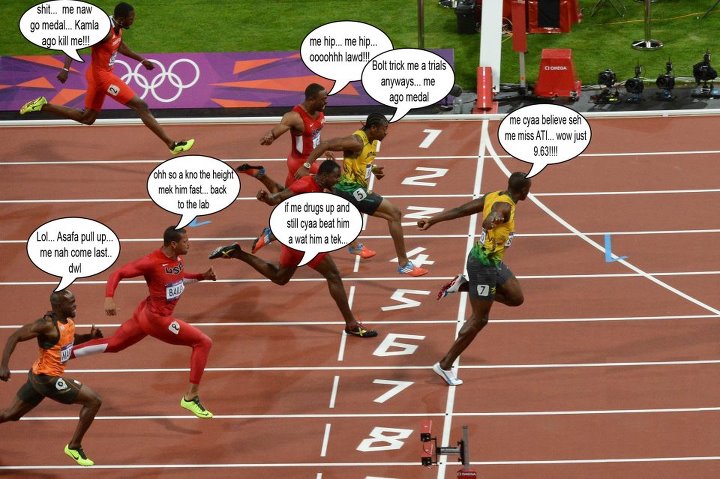
Picks from the jokes and funny photos circulating on the web related to Jamaica’s Olympic Track and Field team

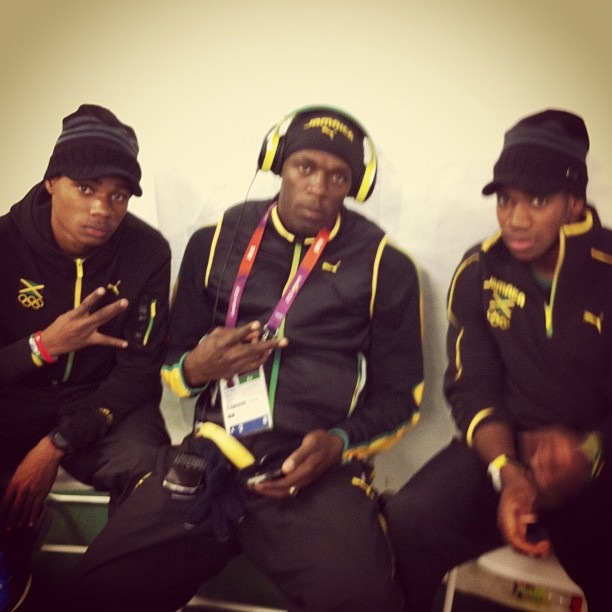
Yohan Blake posted this photo of himself by Usain Bolt yesterday after the 200m with the following caption: “Now I know I have made it when I can hire a living legend to photograph me 😀 But seriously nuff respect to Usain- this is his time to shine”
Source unknown
Natural stamina cause wi nuh fraid…
A dis a fi wi performance enhancement drug #TeamJamaica Source: Jamaica Olympics Facebook page. Rohan Preston reposted the photo with a translation into English. “Jamaica’s performance enhancement drugs yams, plantains, coconut, ginger, more yams, lol.”
Source unknown
Hilarious reference to Prince Harry’s jubilee visit to Jamaica some months ago and the staged race he ran with Bolt. Source unknown
Another stellar image by Ricardo Makyn of the Gleaner
More poses: Source unknown
Awww they’re just a bunch of irrepressible, overgrown BOYS who can run faster than anyone in the world…

From the Book of Legends?

Clovis cartoon, Jamaica Observer, August 10, 2012

Got this from my friend Heather by email…the author is unkown but if anyone knows who wrote it tell me and i’ll credit her/him…

Reading from The Book of Legends – Bolt 2 Vs 19-32

19: And when they were all gathered in a certain place in
the land of Lon, these
swift men of many nations, Usain, he being the swiftest of
the lot, did turn and say
to his fellow brethren from the land of Jahm.

20: Verily I shall go before thee to prepare a place on the
mountain for all of us
and one shall stand on my right hand and the other on my
left.

21: For know thee this, there are precious metals on offer
and it is written that we
are the chosen ones and that we alone shall partake of the
gold, silver and bronze
which they have prepared for us on Olympia.

22: There shall be none before us.
23: There shall be none with us on the mount of victory

24: Verily shall the naysayers be silenced and they shall
behold the people of Jahm

25: And they shall say amongst themselves “What sign is
this? How can a land so
small produce such giants?”

26: And they will be struck dumb.

27: We shall cover ourselves with the Black, the Green and
the Gold and show them
the back of our spiked feet.

28: They shall try to overtake us on the curved path. They
will fail.

29: They will try to ambush us in the straits. But they will
again fail, for we will
have already passed that way.

30: The tribe of Lewis shall make burnt offerings and pray
that duppy will tek us but
they will fail and be blinded, dumbfounded and confounded.

31: You Yohan of the Beastly Tribe, and you young Warrior of
the Tribe of Weir are
the chosen ones to be with me in victory.

32: Therefore I say unto thee brethren of Racers, come
swiftly and tarry not in this
starting place and I will meet thee both at the end of this
chevroned path [anon]

Unfortunately I don’t know who wrote this… but I do know
more precious metals will be earned by our relay teams today
and tomorrow!

Like a Bolt from the blue…Jamaica Jamaica Jamaica…

What makes Usain Bolt tick? How does Jamaican culture produce such an abundance of athletic superheroes? A selection of images, videos and texts about the unbeatable Bolt and his compatriots…including the up and coming Warren Weir.

Photo by Jamaican photographer Ricardo Makyn, after Bolt aces the 100m
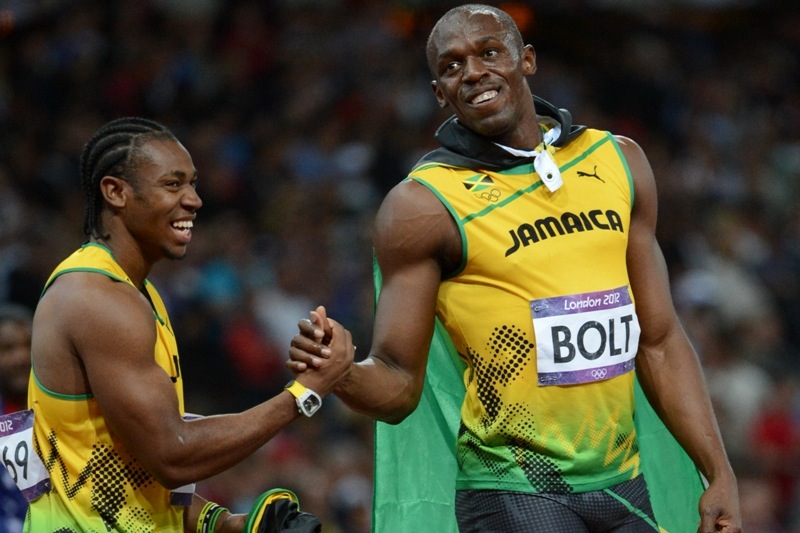
Yohan Blake and Usain Bolt, after taking gold and silver in the 100m. Photo source unknown
Not sure when or where this was but Blake and Bolt are bussing a Jamaican dance move. Photo source unknown
Brilliant photoshopped cartoon by Keon Scarlett…
Usain Bolt with the undeclared winner of the 100m, Coach Glen Mills, who is also Yohan Blake’s coach. Photo source: Usain Bolt’s Instagram.

Just thought I’d post some of the interesting photos, articles and videos that I’ve collected off Twitter and Facebook about Usain Bolt and a few other Jamaican athletes. They give a better insight into Jamaica’s extraordinary athletes than you get from mass media. I think my favourite photo is the one of him with his coach, Glen Mills. You can clearly see the affection between them from the way Usain and Mills are talking to one another. Mills truly is a star in his own right; after all he’s responsible for training the two fastest men in the world today, Bolt and Yohan Blake, who won gold and silver in the Olympic 100m a couple of days ago. Would love to interview him but he dislikes media I understand.

Before that fateful race there were enough skeptics including Tim Layden who went on to write one of the best post-100m articles on Usain in Sports Illustrated. The quote below from a Slate article chronicles the widespread uncertainty about Bolt’s ability to prevail:

A couple of hours before today’s men’s 100-meter final, Sports Illustrated’s Tim Layden made a bold prediction on Twitter: “OK. Go big or go home. My 100m pick: 1) Gatlin 2) Bolt 3) Blake.” Layden wasn’t the only one who was betting against Usain Bolt. The Jamaican sprinter hadn’t run against a 100-meter field this stacked since 2009, when he set the world record of 9.58 seconds in Berlin. In 2011, a false start knocked him out of the world championships. At the Jamaican Olympic Trials earlier this year, he lost to Yohan Blake in both the 100 and 200 meters.

Bolt and Blake clowning around during training. Photo source unknown.

After the race Layden sang a different tune:

LONDON — In many ways, this one was better. Four years ago in China, Usain Bolt transformed the 100 meters into performance art, and the Olympics into a soliloquy, winning with such playful arrogance that it seemed less like a competition than a palette on which an emerging and transcendent talent could splash his greatness in great, broad strokes. The other sprinters were like extras in the Bolt Show, useful in the same way that painted planks of background scenery are deployed in a Broadway production. Bolt was bigger than all of them and so much faster. It wasn’t a race, it was an exhibition (and one that Bolt would repeat four days later in the 200 meters and again in the 4×100-meter relay; three gold medals and an unprecedented three world records. He did likewise a year later at the 2009 world championships in Berlin).

The world gathered again to witness Bolt on Sunday night in London’s Olympic Stadium. Many had surely not seen him since Beijing, as track and field lives on the distant margins of mainstream sport and Bolt is its only true star. In a superficial sense, he did not leave them wanting, winning the 100-meter gold medal in 9.63 seconds, an Olympic record and the second-fastest time in history (behind only his world record of 9.58 from Berlin) and .06 faster than he ran in Beijing. But this was not a virtuoso encore, this was a race, and it had begun more than two years earlier.

To read more go here:

Bolt celebrating with Swedish handball players. He’s got them making the Gaza sign–in tribute to his favourite DJ Vybz Kartel. The sign is also used by US West Coast hip hop musicians.
Warren Weir and Usain doing the Gaza sign, while Yohan Blake looks on. Photo source: Warren Weir’s Instagram

Meanwhile on Foxsport.com Greg Couch lamented USA Track and Field’s lack of get up and go while ruefully noting Bolt’s casual, cool but deadly sporting style:

Usain Bolt posed again with Bolt Arms pointing to the sky, then put his hands behind his ears to get the crowd to yell for him more, as if they could. And then he sprinted his 200-meter heat Tuesday to an easy victory.

Well, actually, he sprinted about 125 of it, then jogged the other 75 to advance to Wednesday’s semifinals.

“I was taking it as easy as possible,’’ he said. “It’s my first (200) run. I’m looking forward to tomorrow.’’

This was basically a day off for Bolt, with a quick Olympic run mixed in. But there’s no day off in the Bolt buzz.

Let’s see: He tweeted back and forth with a Manchester United player, saying he wants to try out for the team. He snuck past one of the picky Olympic rules he complained about the other night, hiding a jump rope in the bottom of his bag. After saying he wasn’t going to celebrate winning the 100 because he needed sleep, he emerged in a picture with three female Swedish handball players, supposedly partying with him in his room at 3 a.m.

This isn’t to be critical of Bolt for any of that, by the way. As an American, I’m asking this:

Why can’t we have one of those? By “those’’ I mean Bolt. I wonder if the US is ever going to get Bolt, understand him, build from him. Meanwhile, it was just a few months ago that U.S. hurdler Lashinda Demus referred to track as “a dying sport.’’ It was just Sunday night that two million people wanting tickets to Bolt’s 100-meter race were turned away.

A debonair Bolt models a suit. Photo source unknown.

Well Greg, as i said in an earlier post, to ‘get’ Bolt, you have to get Jamaica. Getting Bolt to tour the USA is one way to approach it but understanding something about the ‘never say die’ nature of Jamaican culture would help too. The videos below might help illuminate this a bit. First a beautifully produced Gleaner video of Jamaicans watching, then celebrating Jamaican victory in the men’s 100m in one of Kingston’s busiest streets:

Then a longer video movie of Usain Bolt, his life and style:


And finally there’s the third Jamaican…

Come tomorrow the world might want to know a little more about Warren Weir, the third Jamaican in the 200m at Olympics 2012. Incredibly Weir too is coached by Glenn Mills. As I write all three have cruised into the 200 m finals. The following video is a good introduction not only to Weir but also virtually the entire Jamaican team, Usain and all, getting ready for the Opening Ceremony…didn’t spot Yohan Blake…but a great peek behind the scenes at the Jamaican camp at Olympic Village. Check it out and #TeamUSA, take notes…

PS: If the copyright holders of any of the photos above identify themselves I will immediately credit them where necessary.

‘Do you remember the days of slav’ry?’

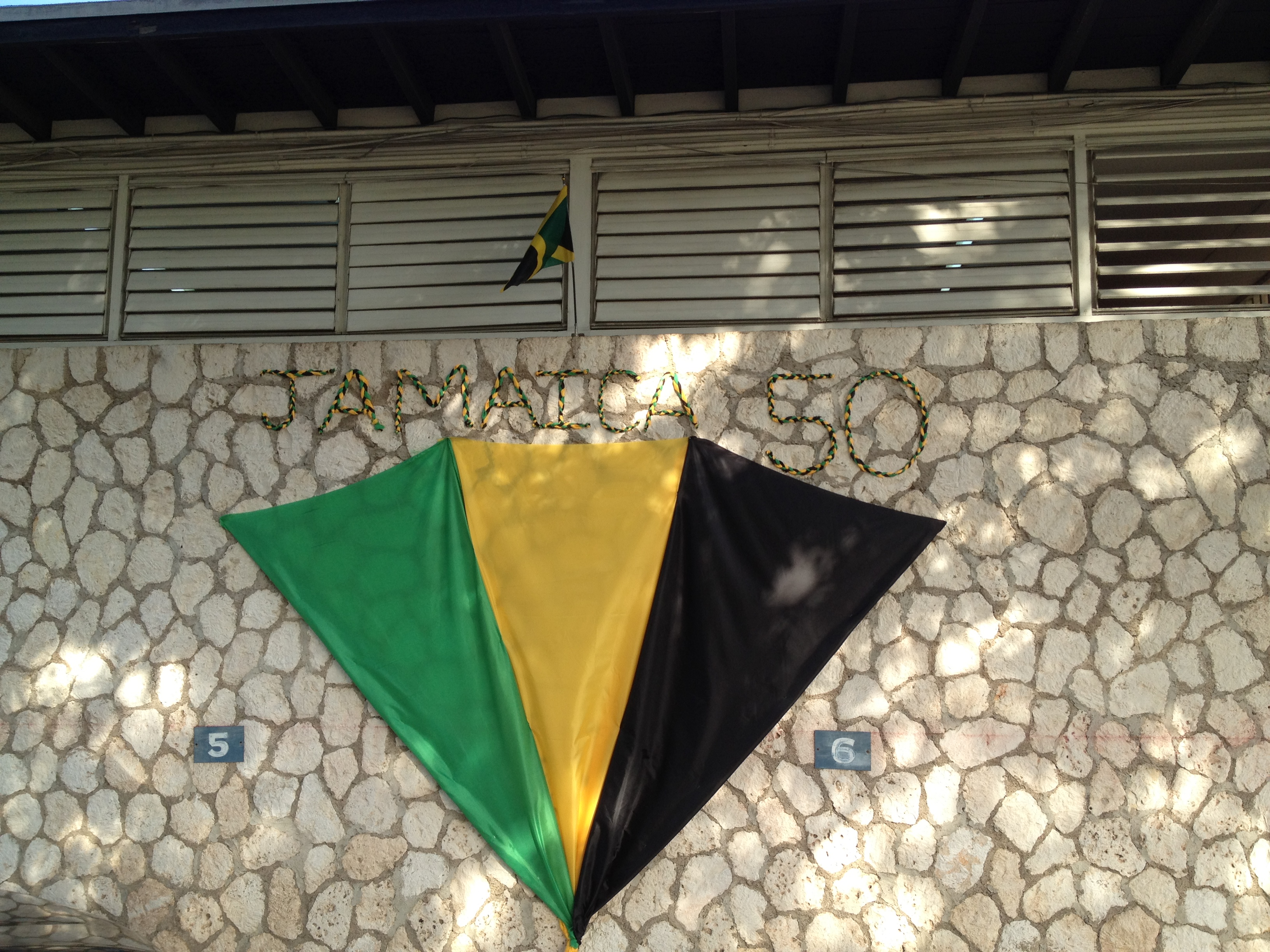
Independence day decorations opposite the US Embassy in Liguanea, Kingston on Emancipation Day, Aug 1, 2012

Although Kingstonians were running around like chickens with their heads cut off yesterday preparing for the Emancipation Day holiday today a number of supermarkets and small stores were actually open for part of the day. The Indian stores for instance at the Marketplace and Northside Plaza. I was happy because I hadn’t been able to do a proper shopping last week but it did set me remembering an article I published three years ago in the British journal Slavery and Abolition called ‘Do You Remember the Days of Slav’ry?’ Connecting the Present with the Past in Contemporary Jamaica.

Supermarkets in Jamaica are mainly owned by Chinese families. The Indians and Chinese came here as indentured labourers, and emancipation from slavery clearly doesn’t have the same resonance for them as for the rest of the population. In my article i discuss at length the historical ambivalence to this holiday in Jamaica, the celebration of which was officially banned in 1962 when Jamaica became independent and only reinstated in August 2002 on the fortieth anniversary of independence by then prime minister, P.J. Patterson.

Wish i knew who took this amazing image of Jamaica’s Emancipation Monument, they deserve credit. Found this on Facebook today. Sculpted by Laura Facey, Redemption Song was created to stand at the entrance to Emancipation Park in Kingston.

Why not make a pdf of the article available today I thought, considering that its Emancipation Day today and Jamaica is on the verge of celebrating its fiftieth anniversary of independence. The following abstract will explain why it may be of interest:

In early 2006, the parish councilors of St Elizabeth, Jamaica, decided not to support plans
for celebration of the abolition of the slave trade citing the position taken by National Hero Sir
Alexander Bustamante, founding father of the Jamaica Labour Party, that ‘we should celebrate
our achievements (but) we should not look back at our shame’. This article looks at
this instance and others like it of ambivalence towards the memory of slavery and how it
ought to be treated today. Main sources for the article are discussions in the public sphere,
radio, newspaper and television debates on the subject, and interviews with key principals
such as the chairwoman of the Committee for the Commemoration of the Abolition of
the Slave Trade as well as dissenting voices such as the St Elizabeth councilors during the
period 2006–2007 in the run-up to commemorative activities.

So here’s a link to it: https://anniepaul.net/do-you-remember-the-days-of-slavry/

In the published abstract we didn’t catch two errors…’abolition of the slave trade’ instead of  ‘abolition of slavery’, which I’ve taken the opportunity to correct in the abstract above. Hope my article is of interest. Happy Emancipation Day!

The security guard at the Sir Arthur Lewis Institute of Social and Economic Studies (SALISES), singlehandedly created this festive decoration on the front of the SALISES building

P.S. The entire island has erupted into effusions of black. gold and green, the colours of the Jamaican flag. As @DamienWKing, head of the Economics Department at the University of the West Indies rightlynoted on Twitter: Proliferation of black, green & gold around the country is NOT frivolous. Builds social capital & sense of unity. Important for development.

There is hope.

Profiling Usain Bolt…

A further look at my Newsweek profile of Usain Bolt and some of the discussion around what I said in it.

A friend based in Indonesia sent a photo of this double-spread from the AsiaPacific edition of Newsweek where my profile of Bolt occupied 6 pages incl photos….

i was overjoyed when I got the invitation to write a profile of Usain Bolt for Newsweek International. It came in mid-June and I had till July 9th to deliver 2000 words. I sighed with relief for it was a deadline i could work with. Then came the hard part–realizing that i couldn’t get access to Usain because as his publicist, Carole Beckford said, he was in training and absolutely no interviews were allowed at this stage. It slowly began to dawn on me that while Newsweek might need Bolt, Bolt definitely didn’t need Newsweek. That they wanted to put him on the cover made not one iota of difference.

The Japanese edition of Newsweek with my article in it did have UB on the cover…

Dispirited I almost gave up on the story. It seemed unfair. Here was my big break at last and I couldn’t deliver because of lack of access to the subject. Lord knows Carole Beckford must be absolutely sick of me because i wouldn’t take no for an answer though my persistence wasn’t getting me anywhere. While waiting to get through with live access I had started working on a rough draft; at some point it suddenly occurred to me that I already had a fully developed piece written just by talking to people who knew him and immersing myself in all the audio, video and texual material available about Usain Bolt, including his fascinating autobiography 9.58. Written with help from professional writers, the book is a must-read and I warn Ian Randle Publishers that they should be ready to do a huge new print run by mid-August for if UB comes good, millions of people are going to want a copy.
As background, I wanted to foreground Jamaican culture and the place of sports, athletics in particular, in all of this. As I see it Jamaica’s aspirations as a former plantation society to erase the scars of slavery by exemplary, world-beating performance are embodied by Bolt and enacted in its extraordinary track and field history. Remember this is Newsweek, not Sociology Today, warned Editor Tunku Varadarajan, half jokingly, adding that lots of personal colour was what was needed.

There is a certain array of  ‘facts’ about Usain that are in wide circulation already and I didn’t intend to reproduce them. To my mind what would make my article different was providing salient features of the context he comes from. The language wars in Jamaica are something I’ve focused on quite a bit, even featuring Usain Bolt himself in an August 23, 2008 post-Beijing post called To the World from Jamaica! Patwa Power Bolts the Stables…from which i quote below:

The Ministry of Transport hastened to announce that it was going to upgrade the roadways in all the communities whose athletes had produced Olympic gold. Why? Not so much to elevate these depressed communities as to give them an instant facelift so that when the international media arrived their impoverishment would be less apparent and less of a blight on the brand name of Jamaica! The politics of sports in Jamaica! Or just the politics of politics…

On a more amusing note page two of the Observer, the social page, suddenly underwent a population transfusion, the beige and white socialites who normally monopolize it abruptly displaced by the almost uniformly dark-skinned athletes. Sigh! If only Jamaica’s business and social elite were one hundredth as nimble and competitive as the country’s athletes! If only they too were worldbeaters!

Personally I think that the phenomenal performance of Jamaican athletes is also due to the cultural self-confidence they feel; a confidence expressed by Usain Bolt in Beijing’s Bird’s Nest stadium when he spontaneously broke into the Nuh Linga and the Gully Creeper, the latest dance moves innovative Jamaican dancehall music has produced (actually Usain’s trademark gesture of pulling back an imaginary bow and arrow like Orion is now the latest dancehall move here).

This is not a confidence manufactured by the abjectly self-conscious, respectability-seeking, hymn-singing English-speaking middle classes but one bred out of the flamboyant, boisterous, in-your-face Patwa-speaking population. In the forty years since Jamaica’s independence it is the latter who have proved both through their athletic and musical prowess that they are ready to take on the world. The Beijing Olympics have shown that the world is more than ready for them (minus the prissy IOC head Jacques Rogge who sounds for all the world as if he had been formed in the bowels of Upper St. Andrew). To the World Ja!

In providing a lightning sketch of Usain Bolt I had to carefully select the facts I thought would bring him to life and animate him for an international audience. Language would be one of them for Bolt had spoken eloquently about it himself.

In 9.58 Bolt writes:

When I moved to Kingston and started running professionally I had to take special English lessons so that in interviews people would know what I was saying…I can adapt now, according to who I’m speaking to, but with friends and family we always use patois. Some native Jamaicans cannot speak proper English at all, they talk patois all the time–and its raw patois. When I’m talking to my mom a normal English-speaking person could probably pick up some words, but raw patois is impossible–you would have no chance (pp 183-4).

Here was something that none of the previous interviews with Bolt I read or heard had focused on, something my own interest in Jamaica’s language politics had primed me for. Accordingly this is what i wrote in the text I sent to Newsweek:

Another interesting thing about Usain Bolt is that he only learnt ‘proper English’ after he began winning gold medals and was groomed to interface with international audiences. Till then like many Jamaicans his first language was Jamaican patois, a fast-paced amalgam of several different tongues including African languages, English and Spanish, virtually incomprehensible to English-speakers. While the world thinks of Jamaica as an Anglophone country not many realize that a sizeable proportion of the population is fluent only in its versatile oral vernacular. Today, Bolt’s rival and partner, Yohan Blake, finds himself in the same predicament, his English halting and hard to understand. No doubt the nation’s elocution teachers are rushing to rectify the situation weeks before the London Olympics where Blake stands a good chance of becoming the new sprint sensation.

Cartoon titled ‘Edited for Clarity’ by Mike Luckovich of the Atlanta Journal-Constitution. I’m grateful to Melody Winnig for bringing this to my attention.

Translated into Newsweek speak that became:

Bolt is still growing into his role as an international star. He didn’t even know standard English until he began winning gold medals. Until then he spoke only the Jamaican patois, a dizzying amalgam of English, Spanish, and African languages. Blake currently finds himself in the same predicament, his English halting and hard for outsiders to understand. Jamaica’s elocution teachers will need to work as fast as they can to prepare him for the spotlights in London.

Clearly some of what I said was lost in translation. I could have exercised more control over the editorial process but time didn’t permit. In particular I wish I’d changed back the last line in the paragraph above to my original. But c’est la vie, you live and you learn. There was so much else i thought important and would have loved to include–such as the role of dancehall music in motivating Usain Bolt, Yohan Blake and so many of the Jamaican athletes to higher heights–but there was no space for such detail. I remain grateful to Newsweek, to my readers and my critics for all the lessons learnt in the process of producing this profile. Glad I had the opportunity to write about such a legendary athlete for a forum like Newsweek/The Daily Beast. Oh and in Japan mine was the cover story, see above for a shot of it…glad to get a copy courtesy Fuji TV…thanks Kumiko!

PS: September 25, 2013. I just came across an article by Matthew Teller about his experience of writing for CNN and the gross editorial changes made to his text which eventually caused him to ask them to remove his byline from the piece. It’s very relevant to many of the issues I’ve raised in this post and well worth a read:

CNN, Anthony Bourdain and me

Usain Bolt: A Latter-day Hermes? Part 2

In which i respond to criticism of my Usain Bolt article which appeared in Newsweek, July 16. Part of the problem may have been caused by the inevitable editing process which condenses and removes context in some cases, throwing statements into starker relief than was intended.

Street artist James Cochran, also known as Jimmy C, works on his spray painted picture of Jamaican sprinter Usain Bolt in Sclater Street car park in east LondonPicture: REUTERS/Paul Hackett
Olympic security. Soldiers doing a Usain Bolt impression waiting to enter the Olympic Park on Sunday 15/07/2012 Pic by Frances Leader

On the rare occasion when i’ve had to teach a writing class, usually to students at the Sir Arthur Lewis Institute of Social and Economic Studies at the University of the West Indies, there are  three publications i use as exemplars of the best writing available in English today. They are Time, Newsweek and the Economist. These three global newsmagazines, employ some of the best writers in the world today evident in the tightly constructed, yet fluid articles they feature, some no more than half a page in length, or a few hundred words, but words so expertly chosen and so economically strung together that (like the ant which carries loads several times its size on its tiny back) the quantity of information they convey belies their slender word counts.

Or so i thought. When i relayed this opinion at a dinner party once, someone, and I wish i could remember who this was, suggested that I was wrong. It’s not good writers these newsmagazines have, she or he said, it’s excellent editors. Hmmmm i thought to myself at the time, not entirely convinced. Now in the wake of writing an article on Usain Bolt for the current issue of Newsweek I know exactly what they meant; they were right.

When i got back the first edit of my article from Sam Seibert, an editor at Newsweek, i was mortified but also somewhat pleased. It was a drastic edit, with some rewriting and additions to my text in places (was my writing as poor as that?), but on the whole i couldn’t deny that it had improved my submission considerably. In fact there were some lessons about writing that Sam’s expert editing and rewriting reminded me of and i can’t thank him enough for this. The transition from one paragraph to another for instance; how to link thoughts and words so that the narrative flows along at a clip bearing the reader along.

Of course some of the changes inevitably shift the emphasis, sometimes even altering the meaning that was originally intended. I was given the opportunity to correct his rewrite more than once but the turnaround time was short and in retrospect i see a few things now which i should have rephrased. They’ve come to my attention because of the number of negative reactions, even objections to some of the things i say in the article. For example Dionne Jackson-Miller, one of the top journalists here whose shows I regularly tune into on radio and tv,  posted on Facebook saying: Several comments gave me pause Annie Paul like this one…” In a land where hardly anything else works, an exemplary tradition of track-and-field instruction and competition has flourished for almost 100 years. ” Gonna have to think about that – are we really as underdeveloped as that suggests?

I could see her point, it was a harsh statement. Had i really said that? i went back to the text I had sent Newsweek and found something slightly different: “In a country where hardly anything works as it should an exemplary tradition of track and field instruction and administration has existed for almost 100 years.

In fact it’s worth quoting the entire section this line was taken from, in which in an attempt to explain the Bolt phenomenon i try to sketch out the roots of the athletic culture that has developed in Jamaica.

Biological and dietary considerations aside the truth is that to ‘get’ Usain you have to get Jamaica, a country and culture riven by contradictions and inconsistency. To call Jamaica a ‘sprint factory’ is misleading; far from churning out cookie-cutter champions Jamaica is a crucible in which unique, world-class runners are formed, bursting onto the world stage at regular intervals and conquering it against all odds. They’ve been doing this since the 1948 Olympics when Jamaican runners, Arthur Wint and Herbert McKenley, won gold and silver in the 400m. In a country where hardly anything works as it should an exemplary tradition of track and field instruction and administration has existed for almost 100 years.

A nation of fervent Christians and bible thumpers, Jamaica has a deeply entrenched network of churches which may have been very receptive to nineteenth century British ideas about ‘muscular Christianity’. This may explain why running became so popular; anyone, anywhere could do it you didn’t neeed deep pockets or an expensive infrastructure to become a runner. By the middle of the twentieth century the sport was flourishing in Jamaica. According to Patrick Robinson, author of Jamaican Athletics: “There is no entity or area of endeavour in Jamaica, whether in the public or private sector, that is as well organized and, applying international standards, has been as consistently successful as track and field athletics.”  

Whereas earlier generations of promising athletes with Olympic ambitions had to go abroad to be trained on track scholarships, Jamaica now has its own world-class coaches, trainers and managers. Stephen Francis of MVP Track Club and Glen Mills of Racers Track Club are two whose homegrown battalion of runners in the last two Olympics stupefied the world. Glen Mills is not only Usain Bolt’s coach, he is also the man behind young Yohan Blake, Bolt’s most dangerous opponent in the upcoming Olympic 100 and 200m races.

Blessed with exceptional natural talent in running Usain Bolt benefited from the systems already in place to identify potential athletes and train them. His passion as a child was cricket and he played on his school team from an early age. Fortunately his father and others noticed the speed with which he ran down the pitch and sent him to the William Knibb Memorial High School, a school with a strong track and field programme that gave sports scholarships and has produced a number of the country’s top athletes including the multiple-gold medal winning Veronica Campbell Brown.

Much of this landed on the cutting floor during Newsweek’s editorial process and what was left was this:

Running is a sport that seems practically ideal for a country like Jamaica. You don’t need deep pockets or fancy equipment to become a great runner. In a land where hardly anything else works, an exemplary tradition of track-and-field instruction and competition has flourished for almost 100 years. The island first seized the world’s attention back in 1948 when Jamaican runners Arthur Wint and Herbert McKenley won the gold and silver in the 400m in London.

Nevertheless, the sport that first captured the boy’s heart was not running, but cricket. He played on his school team from an early age, and it was on the pitch that his extraordinary speed first caught the attention of the town’s grown-ups. He became a prize recruit for William Knibb Memorial High School, which featured both a strong track-and-field program and sports scholarships. Knibb has produced many of Jamaica’s top athletes.

Sam Seibert’s editing of my article was so drastic that i actually asked if he’d be sharing the byline with me, but that’s not the convention in most major print media. It was interesting to come across an article called How the Byline Beast was Born, the very day after i got back the first edit of my article. I realized that there was no need for me to be crestfallen, that the process i had just undergone was pretty standard. In Byline Beast Jack Shafer was writing about the recent fuss about Journatic a content farm that provides local news stories to news media all over the United States. It’s a fascinating article i highly recommend, the following is only a small quote of immediate relevance to the editorial process i describe above:

In even the most professional of newsrooms, editors frequently do sufficient work on a piece – reporting and re-reporting sections, composing long passages without the assistance of the bylined writer, redefining the story’s parameters – that they deserve a byline or at least a co-byline. Yet magazine, newspaper and wire editors rarely receive this credit for their extraordinary interventions.

Although I highlight the radical edit of my article in this post I don’t blame it entirely for people’s reactions to what I’ve said in this article. When I call Jamaica a country where hardly anything functions as it should I’m referring to the major structures of governance that  serve the needs of most citizens here so poorly that they’ve created their own informal structures and processes. While middle-class Jamaicans may well find things to be proud of–the system does work on their behalf after all–large numbers of poorer Jamaicans may disagree, for there is a sharp divergence in the way they are treated by the Police, the Justice system, the education system and government processes in general. Even the media in Jamaica treats you differently based on whether you come from uptown or downtown.

Incidentally the text i sent Newsweek was titled Usain Bolt: A Latter-day Hermes? but news media here and elsewhere rarely use headlines provided by writers, they have special people on board just to write headlines.

There were other things i said in my article which upset readers here and in the diaspora. I’ll discuss those in subsequent posts. In the meantime enjoy this Dorian Scott video of Usain Bolt, Yohan Blake and others building a vibe on the racetrack in Birmingham while they prepare for the Olympics. Scott is representing Jamaica in shotput at the upcoming Olympics. You may need a Facebook account to view the video but it’s well worth it.

PS: The photos at the top of this post are from the UK Telegraph.

And Justice for Tivoli Gardens? Memento mori…

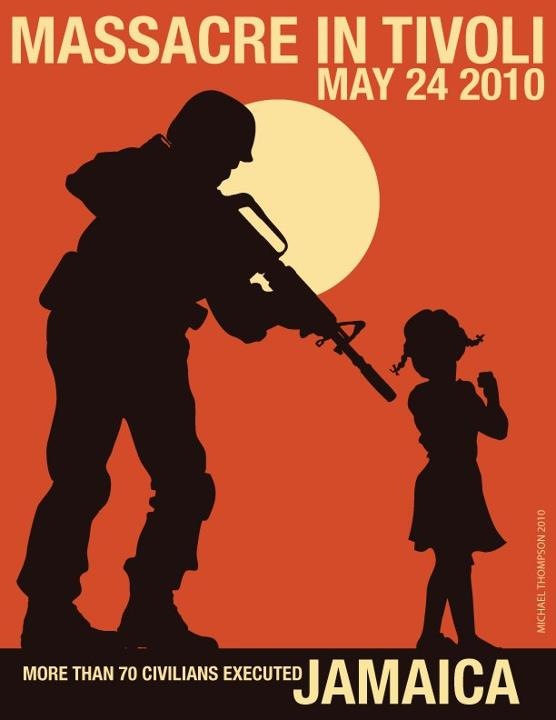
Keeping Tivoli Gardens in the picture…memento mori by Michael Thomspon

Tivoli. What of Tivoli. What of the Tivoli 73. Let’s not forget…

All posters above are by graphic designer Michael Thompson. He’s produced a stream of unforgettable images to sear the unspeakable nature of this act of war into our memories. I will let him speak for himself. The folliowing is a quote from him that accompanied the series above on Facebook:

Immediately after the information began to leak out of the Tivoli Gardens community of the executions by the Jamaican Security forces during the military operations there on May, 24, 2010 I began making posters to express my feelings about the brutality and massacre that the citizens spoke about. Two years after the incident there is still no official report published or any one held responsible for the massacre. The Government and the security forces are silent on the matter. The local media has since forgotten about the incident. Last December an article in the The New Yorker magazine written by Mattathais Schwartz uncovered the tragic stories of killings. A MUST READ for anyone who missed the story. The story is not going away and more people who believe in Justice need to speak out and demand Justice for the people of Tivoli.

For background on Tivoli 73 read my previous post and also Hung out to Dry…Who were the Tivoli 73? and 73 Civilians killed in Jamaica. Big deal! So what?