A link to my article in a South African magazine, Chimurenga…
I’ve just published an article in Chimurenga’s PMS Reader…see below for details and link…oh PMS stands for PowerMoneySex…
Shebada…
Over the Borderline
Homosexuality and the Caribbean: you think you know all there is to know about this don’t you? Think again. Meet Shebada, a cross-dressing stage sensation who has won his way into the hearts of the Jamaican working class. Then meet the murderous gay gangsters who have worried their way into the minds of the middle-class. In this panoramic snapshot, Annie Paul welcomes you to the sublimely surprising world of Jamaican masculinity.
The first time I saw a drag queen pageant was in Trinidad and Tobago some ten years ago. Our venue was a nightclub in the centre of Port of Spain, and the audience mainly consisted of straight couples. When I tried to use the ladies’ room that evening, I had a problem. The ladies’ room was blocked by a crowd of six-feet-plus macaw-like glamazons in high heels vying with each other for one full-length mirror. I remember thinking that this would be unimaginable in Jamaica – even though there was a muscular, six-foot-two Miss Jamaica competing for the crown that evening right in front of my eyes.
In which i visit a small church steeped in Jamaican history, which once attempted to mount the only modern-day guerilla activity in independent Jamaica
On Saturday I accompanied my friend Deborah Thomas, author of Exceptional Violence: Embodied Citizenship in Transnational Jamaica and Modern Blackness: Nationalism, Globalization, and the Politics of Culture in Jamaica, to a church service in Sandy Bay, Clarendon. Deb is now researching the International Peacemakers’ Association of the African Reform Church which once ran one of the island’s black-owned bakeries, making their communities self-sufficient until political interference forced their closure. Although they don’t wear the customary locks and other outward symbols of Rastafari the roots of this Church are firmly entwined with the history of Rasta.
The leader of the church was one Reverend Claudius Henry, who also led the so-called Henry Rebellion in 1959, the only full-fledged guerilla movement to be found in independent Jamaica. Today a handful of his aged supporters keep the faith alive. According to one narrative:
“This religious group was linked with the First Africa Corps, a militant group from New York that got its weapons from bank robberies that were masterminded by a black policeman. The First Africa Corps and the ARC-militants joined forces in a guerrilla training camp in the Red Hills of Jamaica. Overcoming a preemptive police raid in which Claudius was arrested (based on intelligence from New York handed over to British authorities), Claudius’s son took over the movement. His armed group had one violent confrontation with the police, in which two British soldiers were killed.”
In his book about Walter Rodney’s intellectual and political thought Professor Rupert Lewis writes of accompanying Rodney on a visit to Henry’s church in 1968. By then according to Lewis Henry had shifted his ‘Back to Africa’ position to one that emphasized ‘building Africa in Jamaica’. In this context the black nationalist evangelist leader (who had been released from prison in 1966) had turned his church into a religious and entrepreneurial centre with a blockmaking factory, a farm and a bakery. Lewis writes:
“Henry’s lieutenants gave Rodney a tour of the premises. The church was packed and the drumming was powerfu. Henry was not a moving speaker but he was held in respect and the fact that he had been to prison and been a target of political harassment gave him standing as a prophet among his followers. At that time Henry claimed some 4000 followers, of whom, 1000 were active members in his organisation.”
In a letter written after Rodney was exiled from Jamaica, he wrote:
“At Kemp’s Hill…Rev. Henry has gathered together a number of black brothers and sisters, and they have turned themselves into an independent black community. In less than a year they built themselves an attractive church and several dwelling houses, all of concrete for they make the concrete building blocks. They have proper plumbing and electricity and in case the local supplies are inadequate they have their own water tanks and electrical generator. They operated a fish shop from the outset and later they set up a bakery. In spite of massive persecution by the government, the police and the army, the Henry community has extended to several other parts of the island…”
Other scholars who’ve written about Claudius Henry are Brian Meeks in his book Narratives of Resistance and Anthony Bogues in Black Heretics, Black Prophets. The question is who will keep his memory alive once the small band of followers left in Sandy Bay are no more?
What makes Usain Bolt tick? How does Jamaican culture produce such an abundance of athletic superheroes? A selection of images, videos and texts about the unbeatable Bolt and his compatriots…including the up and coming Warren Weir.
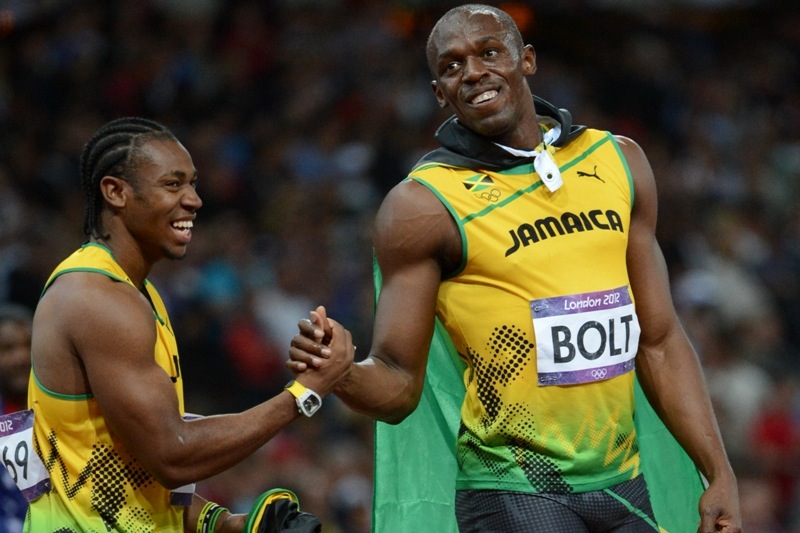
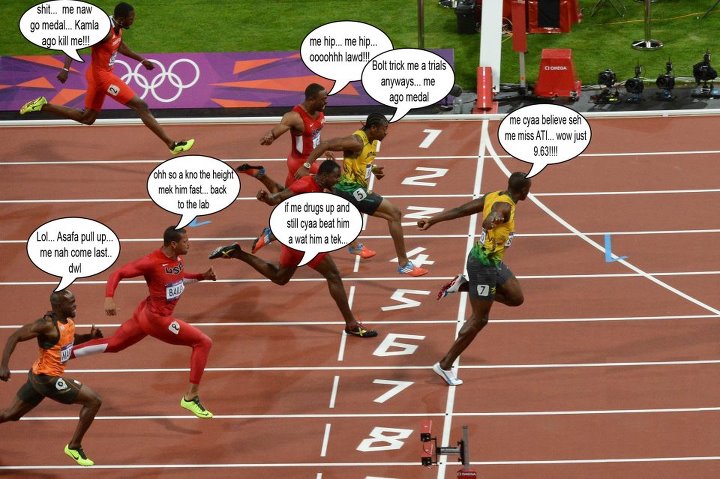
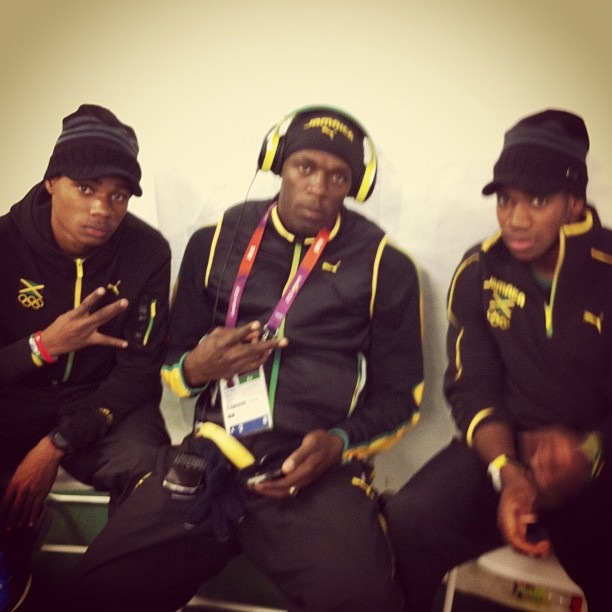
Photo by Jamaican photographer Ricardo Makyn, after Bolt aces the 100mYohan Blake and Usain Bolt, after taking gold and silver in the 100m. Photo source unknownNot sure when or where this was but Blake and Bolt are bussing a Jamaican dance move. Photo source unknownBrilliant photoshopped cartoon by Keon Scarlett…Usain Bolt with the undeclared winner of the 100m, Coach Glen Mills, who is also Yohan Blake’s coach. Photo source: Usain Bolt’s Instagram.
Just thought I’d post some of the interesting photos, articles and videos that I’ve collected off Twitter and Facebook about Usain Bolt and a few other Jamaican athletes. They give a better insight into Jamaica’s extraordinary athletes than you get from mass media. I think my favourite photo is the one of him with his coach, Glen Mills. You can clearly see the affection between them from the way Usain and Mills are talking to one another. Mills truly is a star in his own right; after all he’s responsible for training the two fastest men in the world today, Bolt and Yohan Blake, who won gold and silver in the Olympic 100m a couple of days ago. Would love to interview him but he dislikes media I understand.
Before that fateful race there were enough skeptics including Tim Layden who went on to write one of the best post-100m articles on Usain in Sports Illustrated. The quote below from a Slate article chronicles the widespread uncertainty about Bolt’s ability to prevail:
A couple of hours before today’s men’s 100-meter final, Sports Illustrated’s Tim Layden made a bold prediction on Twitter: “OK. Go big or go home. My 100m pick: 1) Gatlin 2) Bolt 3) Blake.” Layden wasn’t the only one who was betting against Usain Bolt. The Jamaican sprinter hadn’t run against a 100-meter field this stacked since 2009, when he set the world record of 9.58 seconds in Berlin. In 2011, a false start knocked him out of the world championships. At the Jamaican Olympic Trials earlier this year, he lost to Yohan Blake in both the 100 and 200 meters.
Bolt and Blake clowning around during training. Photo source unknown.
After the race Layden sang a different tune:
LONDON — In many ways, this one was better. Four years ago in China, Usain Bolt transformed the 100 meters into performance art, and the Olympics into a soliloquy, winning with such playful arrogance that it seemed less like a competition than a palette on which an emerging and transcendent talent could splash his greatness in great, broad strokes. The other sprinters were like extras in the Bolt Show, useful in the same way that painted planks of background scenery are deployed in a Broadway production. Bolt was bigger than all of them and so much faster. It wasn’t a race, it was an exhibition (and one that Bolt would repeat four days later in the 200 meters and again in the 4×100-meter relay; three gold medals and an unprecedented three world records. He did likewise a year later at the 2009 world championships in Berlin).
The world gathered again to witness Bolt on Sunday night in London’s Olympic Stadium. Many had surely not seen him since Beijing, as track and field lives on the distant margins of mainstream sport and Bolt is its only true star. In a superficial sense, he did not leave them wanting, winning the 100-meter gold medal in 9.63 seconds, an Olympic record and the second-fastest time in history (behind only his world record of 9.58 from Berlin) and .06 faster than he ran in Beijing. But this was not a virtuoso encore, this was a race, and it had begun more than two years earlier.
Bolt celebrating with Swedish handball players. He’s got them making the Gaza sign–in tribute to his favourite DJ Vybz Kartel. The sign is also used by US West Coast hip hop musicians.Warren Weir and Usain doing the Gaza sign, while Yohan Blake looks on. Photo source: Warren Weir’s Instagram
Meanwhile on Foxsport.com Greg Couch lamented USA Track and Field’s lack of get up and go while ruefully noting Bolt’s casual, cool but deadly sporting style:
Usain Bolt posed again with Bolt Arms pointing to the sky, then put his hands behind his ears to get the crowd to yell for him more, as if they could. And then he sprinted his 200-meter heat Tuesday to an easy victory.
Well, actually, he sprinted about 125 of it, then jogged the other 75 to advance to Wednesday’s semifinals.
“I was taking it as easy as possible,’’ he said. “It’s my first (200) run. I’m looking forward to tomorrow.’’
This was basically a day off for Bolt, with a quick Olympic run mixed in. But there’s no day off in the Bolt buzz.
Let’s see: He tweeted back and forth with a Manchester United player, saying he wants to try out for the team. He snuck past one of the picky Olympic rules he complained about the other night, hiding a jump rope in the bottom of his bag. After saying he wasn’t going to celebrate winning the 100 because he needed sleep, he emerged in a picture with three female Swedish handball players, supposedly partying with him in his room at 3 a.m.
This isn’t to be critical of Bolt for any of that, by the way. As an American, I’m asking this:
Why can’t we have one of those? By “those’’ I mean Bolt. I wonder if the US is ever going to get Bolt, understand him, build from him. Meanwhile, it was just a few months ago that U.S. hurdler Lashinda Demus referred to track as “a dying sport.’’ It was just Sunday night that two million people wanting tickets to Bolt’s 100-meter race were turned away.
A debonair Bolt models a suit. Photo source unknown.
Well Greg, as i said in an earlier post, to ‘get’ Bolt, you have to get Jamaica. Getting Bolt to tour the USA is one way to approach it but understanding something about the ‘never say die’ nature of Jamaican culture would help too. The videos below might help illuminate this a bit. First a beautifully produced Gleaner video of Jamaicans watching, then celebrating Jamaican victory in the men’s 100m in one of Kingston’s busiest streets:
Then a longer video movie of Usain Bolt, his life and style:
And finally there’s the third Jamaican…
Come tomorrow the world might want to know a little more about Warren Weir, the third Jamaican in the 200m at Olympics 2012. Incredibly Weir too is coached by Glenn Mills. As I write all three have cruised into the 200 m finals. The following video is a good introduction not only to Weir but also virtually the entire Jamaican team, Usain and all, getting ready for the Opening Ceremony…didn’t spot Yohan Blake…but a great peek behind the scenes at the Jamaican camp at Olympic Village. Check it out and #TeamUSA, take notes…
PS: If the copyright holders of any of the photos above identify themselves I will immediately credit them where necessary.
In which i respond to criticism of my Usain Bolt article which appeared in Newsweek, July 16. Part of the problem may have been caused by the inevitable editing process which condenses and removes context in some cases, throwing statements into starker relief than was intended.
Street artist James Cochran, also known as Jimmy C, works on his spray painted picture of Jamaican sprinter Usain Bolt in Sclater Street car park in east LondonPicture: REUTERS/Paul HackettOlympic security. Soldiers doing a Usain Bolt impression waiting to enter the Olympic Park on Sunday 15/07/2012 Pic by Frances Leader
On the rare occasion when i’ve had to teach a writing class, usually to students at the Sir Arthur Lewis Institute of Social and Economic Studies at the University of the West Indies, there are three publications i use as exemplars of the best writing available in English today. They are Time, Newsweek and the Economist. These three global newsmagazines, employ some of the best writers in the world today evident in the tightly constructed, yet fluid articles they feature, some no more than half a page in length, or a few hundred words, but words so expertly chosen and so economically strung together that (like the ant which carries loads several times its size on its tiny back) the quantity of information they convey belies their slender word counts.
Or so i thought. When i relayed this opinion at a dinner party once, someone, and I wish i could remember who this was, suggested that I was wrong. It’s not good writers these newsmagazines have, she or he said, it’s excellent editors. Hmmmm i thought to myself at the time, not entirely convinced. Now in the wake of writing an article on Usain Bolt for the current issue of Newsweek I know exactly what they meant; they were right.
When i got back the first edit of my article from Sam Seibert, an editor at Newsweek, i was mortified but also somewhat pleased. It was a drastic edit, with some rewriting and additions to my text in places (was my writing as poor as that?), but on the whole i couldn’t deny that it had improved my submission considerably. In fact there were some lessons about writing that Sam’s expert editing and rewriting reminded me of and i can’t thank him enough for this. The transition from one paragraph to another for instance; how to link thoughts and words so that the narrative flows along at a clip bearing the reader along.
Of course some of the changes inevitably shift the emphasis, sometimes even altering the meaning that was originally intended. I was given the opportunity to correct his rewrite more than once but the turnaround time was short and in retrospect i see a few things now which i should have rephrased. They’ve come to my attention because of the number of negative reactions, even objections to some of the things i say in the article. For example Dionne Jackson-Miller, one of the top journalists here whose shows I regularly tune into on radio and tv, posted on Facebook saying: Several comments gave me pause Annie Paullike this one…” In a land where hardly anything else works, an exemplary tradition of track-and-field instruction and competition has flourished for almost 100 years. ” Gonna have to think about that – are we really as underdeveloped as that suggests?
I could see her point, it was a harsh statement. Had i really said that? i went back to the text I had sent Newsweek and found something slightly different: “In a country where hardly anything works as it should an exemplary tradition of track and field instruction and administration has existed for almost 100 years.”
In fact it’s worth quoting the entire section this line was taken from, in which in an attempt to explain the Bolt phenomenon i try to sketch out the roots of the athletic culture that has developed in Jamaica.
Biological and dietary considerations aside the truth is that to ‘get’ Usain you have to get Jamaica, a country and culture riven by contradictions and inconsistency. To call Jamaica a ‘sprint factory’ is misleading; far from churning out cookie-cutter champions Jamaica is a crucible in which unique, world-class runners are formed, bursting onto the world stage at regular intervals and conquering it against all odds. They’ve been doing this since the 1948 Olympics when Jamaican runners, Arthur Wint and Herbert McKenley, won gold and silver in the 400m. In a country where hardly anything works as it should an exemplary tradition of track and field instruction and administration has existed for almost 100 years.
A nation of fervent Christians and bible thumpers, Jamaica has a deeply entrenched network of churches which may have been very receptive to nineteenth century British ideas about ‘muscular Christianity’. This may explain why running became so popular; anyone, anywhere could do it you didn’t neeed deep pockets or an expensive infrastructure to become a runner. By the middle of the twentieth century the sport was flourishing in Jamaica. According to Patrick Robinson, author of Jamaican Athletics: “There is no entity or area of endeavour in Jamaica, whether in the public or private sector, that is as well organized and, applying international standards, has been as consistently successful as track and field athletics.”
Whereas earlier generations of promising athletes with Olympic ambitions had to go abroad to be trained on track scholarships, Jamaica now has its own world-class coaches, trainers and managers. Stephen Francis of MVP Track Club and Glen Mills of Racers Track Club are two whose homegrown battalion of runners in the last two Olympics stupefied the world. Glen Mills is not only Usain Bolt’s coach, he is also the man behind young Yohan Blake, Bolt’s most dangerous opponent in the upcoming Olympic 100 and 200m races.
Blessed with exceptional natural talent in running Usain Bolt benefited from the systems already in place to identify potential athletes and train them. His passion as a child was cricket and he played on his school team from an early age. Fortunately his father and others noticed the speed with which he ran down the pitch and sent him to the William Knibb Memorial High School, a school with a strong track and field programme that gave sports scholarships and has produced a number of the country’s top athletes including the multiple-gold medal winning Veronica Campbell Brown.
Much of this landed on the cutting floor during Newsweek’s editorial process and what was left was this:
Running is a sport that seems practically ideal for a country like Jamaica. You don’t need deep pockets or fancy equipment to become a great runner. In a land where hardly anything else works, an exemplary tradition of track-and-field instruction and competition has flourished for almost 100 years. The island first seized the world’s attention back in 1948 when Jamaican runners Arthur Wint and Herbert McKenley won the gold and silver in the 400m in London.
Nevertheless, the sport that first captured the boy’s heart was not running, but cricket. He played on his school team from an early age, and it was on the pitch that his extraordinary speed first caught the attention of the town’s grown-ups. He became a prize recruit for William Knibb Memorial High School, which featured both a strong track-and-field program and sports scholarships. Knibb has produced many of Jamaica’s top athletes.
Sam Seibert’s editing of my article was so drastic that i actually asked if he’d be sharing the byline with me, but that’s not the convention in most major print media. It was interesting to come across an article called How the Byline Beast was Born, the very day after i got back the first edit of my article. I realized that there was no need for me to be crestfallen, that the process i had just undergone was pretty standard. In Byline Beast Jack Shafer was writing about the recent fuss about Journatic a content farm that provides local news stories to news media all over the United States. It’s a fascinating article i highly recommend, the following is only a small quote of immediate relevance to the editorial process i describe above:
In even the most professional of newsrooms, editors frequently do sufficient work on a piece – reporting and re-reporting sections, composing long passages without the assistance of the bylined writer, redefining the story’s parameters – that they deserve a byline or at least a co-byline. Yet magazine, newspaper and wire editors rarely receive this credit for their extraordinary interventions.
Although I highlight the radical edit of my article in this post I don’t blame it entirely for people’s reactions to what I’ve said in this article. When I call Jamaica a country where hardly anything functions as it should I’m referring to the major structures of governance that serve the needs of most citizens here so poorly that they’ve created their own informal structures and processes. While middle-class Jamaicans may well find things to be proud of–the system does work on their behalf after all–large numbers of poorer Jamaicans may disagree, for there is a sharp divergence in the way they are treated by the Police, the Justice system, the education system and government processes in general. Even the media in Jamaica treats you differently based on whether you come from uptown or downtown.
Incidentally the text i sent Newsweek was titled Usain Bolt: A Latter-day Hermes? but news media here and elsewhere rarely use headlines provided by writers, they have special people on board just to write headlines.
There were other things i said in my article which upset readers here and in the diaspora. I’ll discuss those in subsequent posts. In the meantime enjoy this Dorian Scott video of Usain Bolt, Yohan Blake and others building a vibe on the racetrack in Birmingham while they prepare for the Olympics. Scott is representing Jamaica in shotput at the upcoming Olympics. You may need a Facebook account to view the video but it’s well worth it.
PS: The photos at the top of this post are from the UK Telegraph.
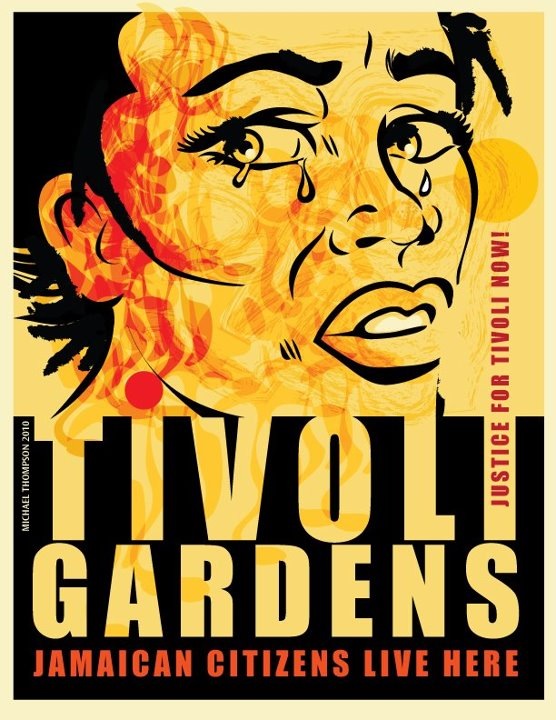
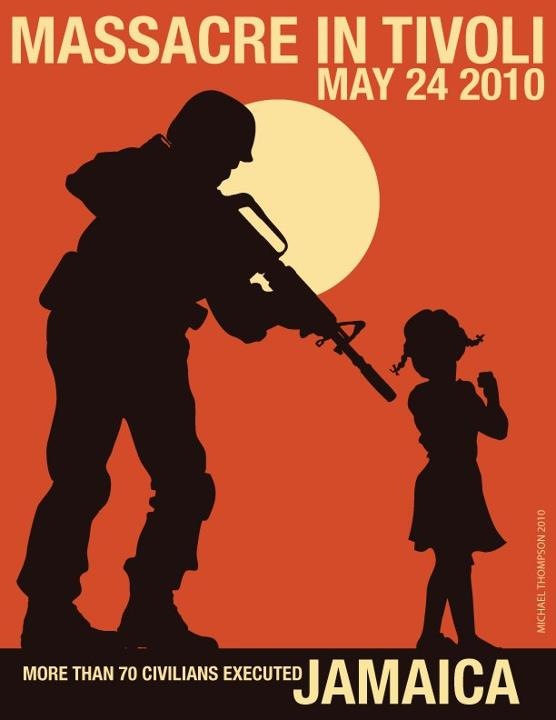
Keeping Tivoli Gardens in the picture…memento mori by Michael Thomspon
Tivoli. What of Tivoli. What of the Tivoli 73. Let’s not forget…
All posters above are by graphic designer Michael Thompson. He’s produced a stream of unforgettable images to sear the unspeakable nature of this act of war into our memories. I will let him speak for himself. The folliowing is a quote from him that accompanied the series above on Facebook:
Immediately after the information began to leak out of the Tivoli Gardens community of the executions by the Jamaican Security forces during the military operations there on May, 24, 2010 I began making posters to express my feelings about the brutality and massacre that the citizens spoke about. Two years after the incident there is still no official report published or any one held responsible for the massacre. The Government and the security forces are silent on the matter. The local media has since forgotten about the incident. Last December an article in the The New Yorker magazine written by Mattathais Schwartz uncovered the tragic stories of killings. A MUST READ for anyone who missed the story. The story is not going away and more people who believe in Justice need to speak out and demand Justice for the people of Tivoli.
A link to my article on Usain Bolt in Newsweek International this week…
Presenting my article on Usain Bolt which appears in Newsweek International this week…
Jamaica’s Usain Bolt: Is He Still the World’s Fastest Runner?
Jul 16, 2012 1:00 AM EDT
Will lightning strike again in London? Or have the years of fast living finally caught up with the speediest man alive? A close look at the Jamaican record breaker.
The Twitter messages seemed calculated to drive Jamaica frantic. “Driving the black speed today,” Usain Bolt informed his followers as he posted an Instagram image of his chosen vehicle for the day, a 2009 Nissan GT-R. “Nothing but speed for the fastest,” he added. Still, the world-record sprinter could scarcely ignore the fact that the last thing they want is for him to risk yet another smashup in the final days before the 2012 London Games. “I will take it easy lol,” he promised.
An innovative video on class, race and other matters in Jamaica as well as a really acute quote from songwriter/singer Tanya Stephens…
When i got back to the rock from Trinidad last week the big news was a protest that had erupted on the University of the West Indies (UWI) campus. Students who owed fees were not allowed to sit final exams and a bangarang ensued. Public opinion was divided on the matter but the most creative, trenchant critique i came across was the video retort (above) to statements by a UWI student who had been interviewed on the matter. It brings to the fore many tensions simmering just a skin away from the surface regarding class, race, privilege and education. It’s well worth a watch.
And not at all related but equally provocative and nakedly intelligent was this Facebook post by singer Tanya Stephens…yes, she who wrote These streets don’t love you like i do…. Talk about Satanic verse…
I feel compelled to apologize to Satan on behalf of all humans this evening. For generations you who dont even exist have been criminalized, blamed for every thing we humans do and feel stupid about because we know it’s not in our best collective interest. I want to apologize especially on behalf of the clergy who earn so much off your name yet haven’t enough gratitude to say thanks. Let me also take this opportunity to thank you for taking the blame for the stupid shit i’ve done, and let you know it wasn’t in vain for I have learned from them and wont be needing your services anymore. I simply MUST apologize for you bearing the blame for wars and hunger, poverty. Ironically, the collective wealth of organized religion could solve these problems if redistributed with the love they profess, yet they who are righteous say you’re the bad guy… My humblest apologies!
Now if that doesn’t tell you why Tanya is one of the most innovative songwriters in Jamaica today i can’t imagine what will…she cuts to the heart of darkness at the centre of most religious belief and human endeavour…would love to know what you think….
An illustrated look at Prince Harry’s unveiling of the plaque at the University of the West Indies with views on Jamaica becoming a republic from bystanders
Belatedly receiving a request for a short piece on the Prince’s visit from the Guardian in London, I set off for the Law Faculty with my trusty iPhone 4S.
A crowd of mainly students, staff members and journalists had gathered under cloudy skies to watch Prince Harry unveil a plaque at the University of the West Indies’ new Faculty of Law in honour of his grandmother’s Diamond Jubilee. As the University’s website informs you “The Queen holds the title “Visitor” of the university. The position of Visitor is considered to be the most senior official of the UWI.”
Usain Bolt graciously allows the Prince to win...which he does in grand style...
The young Prince arrived at the Law Faculty after a playful race with Jamaican star runner Usain Bolt at the University’s Mona Bowl. Crowds of young females, both from the university and from local high schools, cooed loudly in excitement as the Prince’s motorcade drew up to the Faculty.
Switching Jamaica’s constitutional status to that of a republic is by no means a done deal. The government has promised to hold a referendum before any decision is made and retaining the Monarchy might well turn out to be the more popular choice when all the votes are counted.
A quartet of girls from the St. Andrew High School for girls in Kingston, including the Head Girl and 3 prefects, said that Prince Harry’s visit was an ‘Oh my God moment’. On the subject of Jamaica becoming a republic they said they were on the fence, feeling unsure that Jamaica had adequate resources to make it on its own. They said there were clear advantages and disadvantages involved and it was a matter of weighing them carefully.
Lanesa Downs, who wore a sash that said ‘Miss Law’ and was part of the official welcome party at the law faculty, said she was really excited to meet Prince Harry. “Not all the time you’re able to meet royalty and I even got to shake his hand.” She had mixed feelings she said about the possibility of her country becoming a republic, worrying that this was not the right time for Jamaica to consider such a step; she was concerned that it might not be able to sustain itself alone and should wait a few years before becoming a republic.
In contrast Business student Andre Poyser who also hosts Newstalk 93’s Issues on Fire programme said he was in full support of Jamaica becoming a republic even though it might not change much. “We’ll just be swopping the Queen for another titular head but what I think it will provide is the opportunity for the government to go out and do broad-based consultations on the drafting of the new constitution. People can become more involved in governance. I think it will add more value to the strength of our democracy.”
Grace Kennedy, one of the foundational business companies in Jamaica turned 90 today. For some reason i remember a campaign they did some years ago advertising ‘the new face of Grace’ to a lot of pomp and fanfare. Alas the new face turned out to be that of an uber-browning, a pretty, pony-tailed woman who was shown sweeping up and down supermarket aisles with a cart, doing her shopping. Unfortunately the public at large gave her a frosty reception so she was duly dispensed with.
When my son was growing up he would watch the Grace Kitchen series on TV and want me to reproduce the meals they showed you how to cook. The video below is sort of a spoof of that series but its a gem in its own right. Comedian Fancy Cat showing us how to cook Jamaican Steamed Fish with Crackers…come on…try it!
The US Embassy in Kingston, Jamaica names its Information Resource Center (IRC) after Paul Robeson, someone who had previously been vilified and ostracized by and in his own country.
I first heard about Paul Robeson in the mid 1980s when I acquired a copy of his autobiographical book Here I Stand. Reading this first person account from a veritable giant of a man filled me with awe; I was living in the United States then, actually on the campus of Rutgers University, the very university that he had won a scholarship to attend in 1915. Rutgers had only had two black students before Robeson.
At Rutgers Robeson became a national football superstar, and later, with his powerful baritone, an internationally renowned concert singer and actor perhaps best known for the song Old Man River. He was also an indomitable champion of equal rights for African-Americans as well as the oppressed anywhere, everywhere. Regularly invited to sing in different countries Robeson was the original citizen of the world, spending a lot of time in Europe, particularly in London and the former Soviet Union, a country he admired because it was a place “where coloured people waked secure and free as equals.”
Robeson would pay dearly for this during the McCarthy Era of the fifties when he was dragged before a congressional committee that grilled him about his ‘communist sympathies’. When the committee demanded to know why he had spent so much time in the Soviet Union Robeson retorted that it was because, “in Russia I felt for the first time like a full human being—no colour prejudice like in Mississippi, no colour prejudice like in Washington.“ Then why hadn’t he remained in Russia, why had he returned to the United States demanded a committee member.
Robeson’s answer was swift and impassioned.
Because my father was a slave, and my people died to build this country, and I am going to stay right here and have a part of it, just like you. And no fascist minded people will drive me from it. Is that clear?
Robeson’s defiance and refusal to bow earned him the revocation of his passport in 1950. Hard to believe that a mere 60 years ago such undemocratic behaviour was possible in the very United States that today champions human rights left, right and centre exporting so-called democracy worldwide at the tip of heat-seeking missiles if need be. Not only were Robeson’s wings clipped, the powers that be also subjected him to slander campaigns and vicious disinformation so that his power to earn from concerts diminished and he became virtually invisible.
Lloyd L. Brown who wrote the preface to Here I Stand, ended by making the following observation:
…In Robeson’s case there can be no doubt that the ‘fascist-minded people’ whom he challenged did all they could to obscure the man and his message.
It can be expected, however, that the inquiring minds of the new generation will break through to the truth about him. Inevitably, like a mountain peak that becomes visible as the mist is blown away, the towering figure of Paul Robeson will emerge as the thick white fog of lies and slanders is dispelled. Then he will be recognized and honoured here in his homeland, as he is throughout the world, as Robeson, the Great Forerunner.
Remarkably that time seems to have come. As a recent press release from the US Embassy in Kingston, Jamaica detailed:
In early 2011, the Public Affairs Section of the U.S. Embassy in Kingston launched an essay competition among high school students to name the embassy’s Information Resource Center (IRC), in observance of Black History Month. The aim of this competition was to have the IRC named after the historical figure selected in the winning essay. The legendary Paul Robeson was the character highlighted in the winning essay which was entitled “The Soul of a Continent.” The writer was Kathy Smith, then a Grade 13 student at Manchester High School in Mandeville, Manchester. Ms. Smith is presently a first-year law student at the University of the West Indies.
On the morning of January 23, Ambassador Pamela Bridgewater, along with State Minister of Tourism and Entertainment Damion Crawford, Kathy Smith and Susan Robeson, unveiled at the entrance to the IRC, a plaque that bears the name “Paul Robeson Information Resource Center. This was followed by a ceremony in the embassy atrium to officially name the IRC in honor of Paul Robeson. The date for this event was set for January 23 because it coincided with the 36th anniversary of his death. The occasion was also used as one of the many cultural activities to celebrate Jamaica’s 50th anniversary of independence.
The guest speaker was the award-winning U.S. documentary filmmaker and Chair of the Paul Robeson Foundation, Susan Robeson. Ms. Robeson is granddaughter of the African American singer, actor, athlete and civil rights activist Paul Robeson.
Interestingly Paul Robeson actually gave a concert in Kingston on 19 November 1948. Unfortunately the sound system failed and the concert turned out to be a disaster with the stage collapsing from the crush of people who turned out to hear him and a few children getting killed in the melee. The occasion was documented by Edna Manley in her diaries:
Last night we went to hear Robson sing at the racecourse—the largest crowd we had ever seen. The sound system was hopelessly bad, and one could hear the words but the tone was hopelessly distorted—thousands of people heard nothing at all. The crowd was around seventy thousand. We were wading through the crowd to a spot where we could hear better, and the crowd around us, quite a small part of it, began to snowball behind us—so Norman stood still. It was terribly disappointing not to hear, and to feel the disappointment.
…went to the airbase to see Robeson go—he was in a terrible mood—savage over the failure of the ‘sound system’ and deeply hurt over the death of the child and injuries to the others. So typical of the Gleaner to headline the accident and give the type of presentation that almost made Robeson responsible for the tragedy.
Edna went on to note that Robeson subsequently phoned from New York asking Norman to contact the parents of the children who were killed and injured so that he could cover their hospital and funeral expenses.
Centre: Tayo Aluko with Barbara Gloudon, after performance of Call Mr. Robeson, Feb 4, 2012, Kingston
In celebration of Black History Month the US Embassy in Kingston put on two performances of “Call Mr. Robeson: A Life With Songs,” a one-man show written and performed by U.S. actor and singer Tayo Aluko.” I was privileged to attend the Saturday performance, last weekend, which was an intense and riveting enactment of one of the most extraordinary lives of the twentieth century. Aluko will be performing at Carnegie Hall on February 12th, 2012.
The Paul Robeson Information Resource Centre has the most comprehensive collection of materials on Robeson in the Caribbean, along with many other valuable documentary resources, and is freely available to the public.


















 Active Voice