The other day Richard Drayton asked a number of us on Facebook a provocative question: “…why do you commit the energy and time you do to Twitter?”…
I proffered a number of reasons but chief among them is what i think of as ‘locality’; how Twitter gives you the ability to tune in to any locality you wish as long as there are people from there on Twitter. This means that I’m now in touch with events, opinions and news from Pakistan, that shoulder that was chopped off the torso of India in 1947 leaving the citizens of both countries strangers to each other. Some of my favourite tweeple are the tweeters from Pakistan i follow, chief among them @BhopalHouse. This morning she tweeted the link to the post below which offers a perspective on the rage sweeping through the so-called Middle East that I’m happy to have come across. It offers a neat counter to international media narratives of overheated Muslims succumbing to irrational rage threatening to take us all back to the so-called Middle Ages…
“The world has clearly gone crazy. That a lame movie trailer (does the actual movie even exist?) made in the US by some kind of Coptic Christian can induce people to attack branches of KFC or the German embassy in Khartoum is simply too bizarre for comprehension.
So can I just point out the fine example of Pakistan for a moment. This country, usually portrayed as a steaming cesspit of crazy, beard-wearing nutcases intent on destroying the West, managed to broadly treat the “Innocence of Muslims” movie trailer with the contempt it deserved, for the most part ignoring the amateurish provocation for what it was.”
PS: This blogpost was clearly premature. Within a few days there were violent protests all over Pakistan. Read an account of the US consulate being stormed here.
An unflattering depiction of Zimbabwean President Robert Mugabe by Jamaican painter Michael ‘Flyn’ Elliott
The Trillionaire by Michael ‘Flyn’ Elliott (click to enlarge)
Zimbabwe’s Robert Mugabe has annoyed Jamaicans by airing his views on Jamaican culture and Jamaican men in a rather cavalier manner. He was speaking at a research exposition in Harare according to the UK Telegraph which quoted from his 3-hour speech:
“In Jamaica, they have freedom to smoke cannabis, the men are always high and universities are full of women”…
“The men want to sing and do not go to colleges, some of them twist their hair. Let us not go there.”
In his 2010 painting The Trillionaire Jamaican painter Flyn depicted Mugabe in even more unflattering terms; as a delusional despot stubbornly clinging to his throne in the midst of rotting debris, a heap of skulls and a ruined shell of a building symbolizing the state of the state he has presided over for far too long.
I had to wonder if Mugabe’s outburst wasn’t a case of delayed post-Olympic penis envy…I mean Bolt, Blake, Weir, Hansle Parchment and the rest of the Olympic men’s team represent Jamaican masculinity at its world-beating best. Had they escaped Muggy’s notice? Is his memory failing?
Featuring rising dancehall star Tommy Lee’s latest music video shot in Port Royal, Jamaica.
Newest Dancehall star Tommy Lee shooting music video for We Want Paper in Port Royal…
Here’s Tommy Lee, the new star from the Gaza firmament, shooting his latest music video, We Want Paper, in Port Royal. According to his publicity machine:
The song is a special one for the performer who is also the song’s writer. It was penned to inspire youngsters to focus on working hard to achieve financial success. “Youths them a the future, we nuh want no fourteen shooter, fe mess up we dream like Freddy Krueger”, words of encouragement from Tommy Lee. Neighborhood children chorused with the artiste word for word on the set.
By setting the video against the backdrop of Port Royal, once known as the wickedest city in the West, Lee hopes to tune into its history, that of a once wealthy capital of criminality reduced to rubble by an earthquake. The message? The guilty will be punished, crime doesn’t pay.
Interestingly the song is an anti-gun tune and aims to promote education, heterosexuality and materialism if i read the lyrics and images correctly. We want paper, big up all moneymaker… I like it, the production values are great, editing is by fellow musician Wayne Marshall. Incidentally i love the name of his company and its logo, see screenshot below to see what i mean. And immediately below that watch a YouTube video of We Want Paper:
A link to my article in a South African magazine, Chimurenga…
I’ve just published an article in Chimurenga’s PMS Reader…see below for details and link…oh PMS stands for PowerMoneySex…
Shebada…
Over the Borderline
Homosexuality and the Caribbean: you think you know all there is to know about this don’t you? Think again. Meet Shebada, a cross-dressing stage sensation who has won his way into the hearts of the Jamaican working class. Then meet the murderous gay gangsters who have worried their way into the minds of the middle-class. In this panoramic snapshot, Annie Paul welcomes you to the sublimely surprising world of Jamaican masculinity.
The first time I saw a drag queen pageant was in Trinidad and Tobago some ten years ago. Our venue was a nightclub in the centre of Port of Spain, and the audience mainly consisted of straight couples. When I tried to use the ladies’ room that evening, I had a problem. The ladies’ room was blocked by a crowd of six-feet-plus macaw-like glamazons in high heels vying with each other for one full-length mirror. I remember thinking that this would be unimaginable in Jamaica – even though there was a muscular, six-foot-two Miss Jamaica competing for the crown that evening right in front of my eyes.
What the One Laptop per Child project is doing in Jamaica…
Recently I had a conversation with Sameer Verma of San Francisco State University about an innovative venture he’s involved with — the One Laptop per Child project. Verma, an open source software (OSS) activist, was invited by Professor Evan Duggan, Executive Director of the Mona School of Business and new Dean of the Faculty of Social Sciences at the University of the West Indies, Mona, whom he went to school with, to spearhead the OLPC project in Jamaica. According to the OLPC Jamaica website:
OLPC Jamaica is a general interest group for the One Laptop per Child initiatives in Jamaica. The group started at the University of the West Indies (UWI), Mona Campus, Jamaica on 5th September, 2008. Compelled by the belief that the OLPC has considerable potential for enhancing the efficient delivery, and improved Pedagogy in early childhood education in Jamaica, OLPC Jamaica intends to foster interest, generate ideas and learn from experiences about OLPC both on the UWI campus and in its neighboring communities.
The Group is currently embarked on deployment pilots of the OLPC concept in two local schools:
– The August Town Primary School, located in the heart of the August Town community in the University’s Township neighborhood
– Providence Methodist Basic school, located on the premises of the Providence Methodist Church in Liguanea
Now in its fourth year Verma pointed out some of the recent findings from the pilot project in August Town where Grade 4,5 and 6 students are involved. Each laptop, equipped with wireless connectivity, multimedia software, an edition of Wikipedia, games and recording equipment is provided to the youngest child in each family, there not being enough laptops to be given to every child at school. The computer belongs to them for the year, and they are allowed to take it home. One outcome of this is that children are teaching their parents or caregivers various things using the laptops.
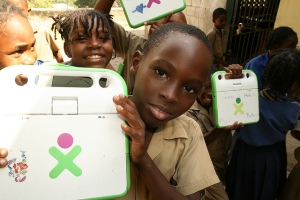
Children at August Town Primary showing off their Xo laptops. Photo: Varun Baker
One of the interesting findings in August Town Primary has been that the most popular software on it has been a math game called TuxMath. It is the most frequently used item on the laptop and technicians who occasionally upgrade the software said that children who had somehow lost the game during upgrades would bother them endlessly to have it put back on. Lest you dismiss this as a mere game (as the blurb says’ TuxMath lets kids hone their arithmetic skills while they defend penguins from incoming comets, or offers them a chance to explore the asteroid belt with only their factoring abilities to bring them through safely!’) the principal of the school said that normally when Grade 4 students are tested their numeracy scores sit in the mid 40s; for the batch who had played the TuxMath game the numeracy score rose to 61%. At a time when educators are discussing the lack of qualified math teachers in the school system the experience of the children in August Town Primary is particularly instructive.
TuxMath
Verma has met with Ministry of Education personnel to discuss the next step which is the production of textbooks as e-books. While enthusiastic about this, Ministry officials also seem locked into a Kindle mentality, that is, thinking that the adoption of e-books necessitates e-book-readers such as Kindles or Nooks to read the electronic textbooks, whereas Verma is trying to persuade them that this is unnecessary and even counterproductive to the kind of learning the OLPC project is promoting. In fact e-book reading software can easily be downloaded and added to the Xo laptops allowing children to read their school texts on the same machine they use for multimedia activity daily.
According to Verma this speaks to a deeper issue. “Learning is not just about consumption, it also has to be about production because creativity means I learn, I absorb and then I produce something. Book readers are a one-way process.” Interactivity is a core feature of the software provided on Xo laptops. Verma explains: For example there’s a game that will show you a river crossing and a train waiting to cross the river but there’s no bridge. The child’s task is to use drawing tools to build a bridge and connect it and make it strong enough for the train to go across. Then you hit go and the train starts crossing but if the bridge structure isn’t strong enough it crashes to the ground and you have to go back and build another bridge. Laws of physics and measurement come into play and over a process of building and rebuilding until you manage to get the train across a child learns many scientific and creative principles.
The Jamaican experiment with OLPC is funded/supported by several partners: Pace Canada, UWI’s Township Project, LIME and the Early Childhood Learning Commission. OLPC is being used in 47 countries. In Peru the Ministry of Education funds it and there are 1.1 million laptops. Uruguay however, has the highest density with 100% saturation in primary school, every primary schoolchild getting a laptop when they start school. According to Verma the focus in Peru is different. In addition to integrating it into schoolwork they have a full programme during summer vacation where the laptops are used for summer vacation activities which count towards something at school. For older children in higher grades they’ve also attached robots to the laptops enabling children to explore all sorts of other capabilities. Different countries use the project for different ends and in different ways. In Afghanistan where girls have been forbidden from going to school by the Taliban, the laptops come in particularly useful allowing female students to stay at home and learn. In Nepal everything has been translated into Nepali and is completely content-driven.
In Jamaica UWI has provided student interns to work in the field. What is needed now is for one major funder to come on board or failing that the Ministry of Education. Having a number of small partners creates a problem with ‘ownership’, if no one feels total ownership, its difficult to move the project forward as is needed. For more information view the video below and link to the OLPC Jamaica website. Also check here for beautiful photos of the children in the August Town project.
In which i visit a small church steeped in Jamaican history, which once attempted to mount the only modern-day guerilla activity in independent Jamaica
On Saturday I accompanied my friend Deborah Thomas, author of Exceptional Violence: Embodied Citizenship in Transnational Jamaica and Modern Blackness: Nationalism, Globalization, and the Politics of Culture in Jamaica, to a church service in Sandy Bay, Clarendon. Deb is now researching the International Peacemakers’ Association of the African Reform Church which once ran one of the island’s black-owned bakeries, making their communities self-sufficient until political interference forced their closure. Although they don’t wear the customary locks and other outward symbols of Rastafari the roots of this Church are firmly entwined with the history of Rasta.
The leader of the church was one Reverend Claudius Henry, who also led the so-called Henry Rebellion in 1959, the only full-fledged guerilla movement to be found in independent Jamaica. Today a handful of his aged supporters keep the faith alive. According to one narrative:
“This religious group was linked with the First Africa Corps, a militant group from New York that got its weapons from bank robberies that were masterminded by a black policeman. The First Africa Corps and the ARC-militants joined forces in a guerrilla training camp in the Red Hills of Jamaica. Overcoming a preemptive police raid in which Claudius was arrested (based on intelligence from New York handed over to British authorities), Claudius’s son took over the movement. His armed group had one violent confrontation with the police, in which two British soldiers were killed.”
In his book about Walter Rodney’s intellectual and political thought Professor Rupert Lewis writes of accompanying Rodney on a visit to Henry’s church in 1968. By then according to Lewis Henry had shifted his ‘Back to Africa’ position to one that emphasized ‘building Africa in Jamaica’. In this context the black nationalist evangelist leader (who had been released from prison in 1966) had turned his church into a religious and entrepreneurial centre with a blockmaking factory, a farm and a bakery. Lewis writes:
“Henry’s lieutenants gave Rodney a tour of the premises. The church was packed and the drumming was powerfu. Henry was not a moving speaker but he was held in respect and the fact that he had been to prison and been a target of political harassment gave him standing as a prophet among his followers. At that time Henry claimed some 4000 followers, of whom, 1000 were active members in his organisation.”
In a letter written after Rodney was exiled from Jamaica, he wrote:
“At Kemp’s Hill…Rev. Henry has gathered together a number of black brothers and sisters, and they have turned themselves into an independent black community. In less than a year they built themselves an attractive church and several dwelling houses, all of concrete for they make the concrete building blocks. They have proper plumbing and electricity and in case the local supplies are inadequate they have their own water tanks and electrical generator. They operated a fish shop from the outset and later they set up a bakery. In spite of massive persecution by the government, the police and the army, the Henry community has extended to several other parts of the island…”
Other scholars who’ve written about Claudius Henry are Brian Meeks in his book Narratives of Resistance and Anthony Bogues in Black Heretics, Black Prophets. The question is who will keep his memory alive once the small band of followers left in Sandy Bay are no more?
A wonderful song by Trinidadian singer Ataklan exemplifies how the region feels after the London Olympics.
This great song by Ataklan, one of the best kept secrets of Trinidad and Tobago, truly captures the outcome of Olympics 2012 for the region. Especially sweet for me is the fact that I’ve known this song as its developed through its various stages. Enjoy it!
Is it time for a Caribbean Sports Academy asks Ronald Sanders in this op-ed article on Huntingtonnews.com:
The people of the English-speaking Caribbean have every reason to be proud of their athletes and of the impact they are making on the world, but this pride will not be sustained unless governments and the private sectors invest in the facilities these gifted athletes need. To ensure future champions, how about a single sports academy manned by outstanding coaches, located in Jamaica and funded by all the governments and private sectors of the Caribbean Community, for the region’s elite athletes?
Here also is my new Newsweek article on Usain Bolt and how he embodies Jamaica’s national character and spirit.
Most postcolonial countries have found it hard to overcome the handicaps they inherited at independence, and Jamaicans are rightly proud of their superb tradition in athletics and the country’s incomparable music, both of which have catapulted them onto the world stage on more than one occasion. For a nation this tiny, Jamaica has an ego and cultural wallop grander than most superpowers, punching way above its weight, as some here like to say.
I should add that this time my piece wasn’t touched by the editors at all, except for punctuation. I do wish they’d left the word ‘sly’ out of their title or used a different title altogether. The only consolation is that it might lure anti-Usain folk into reading it thinking its a critique 🙂
Picks from the jokes and funny photos circulating on the web related to Jamaica’s Olympic Track and Field team
Yohan Blake posted this photo of himself by Usain Bolt yesterday after the 200m with the following caption: “Now I know I have made it when I can hire a living legend to photograph me 😀 But seriously nuff respect to Usain- this is his time to shine”
Source unknown
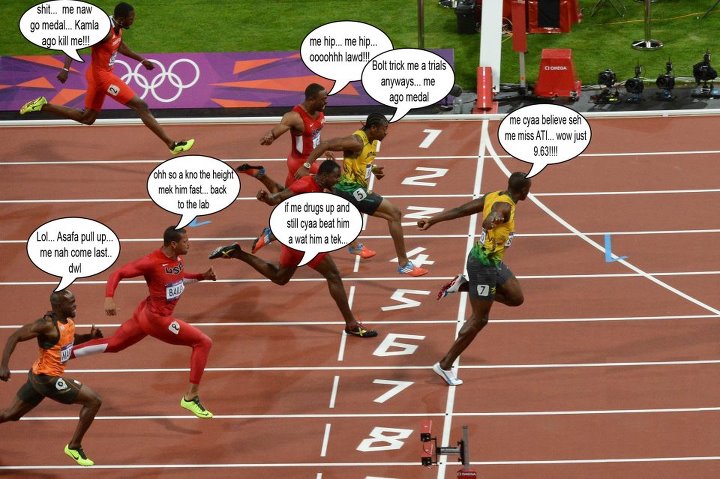
Natural stamina cause wi nuh fraid… A dis a fi wi performance enhancement drug #TeamJamaica Source: Jamaica Olympics Facebook page. Rohan Preston reposted the photo with a translation into English. “Jamaica’s performance enhancement drugs yams, plantains, coconut, ginger, more yams, lol.”Source unknownHilarious reference to Prince Harry’s jubilee visit to Jamaica some months ago and the staged race he ran with Bolt. Source unknownAnother stellar image by Ricardo Makyn of the GleanerMore poses: Source unknownAwww they’re just a bunch of irrepressible, overgrown BOYS who can run faster than anyone in the world…
Got this from my friend Heather by email…the author is unkown but if anyone knows who wrote it tell me and i’ll credit her/him…
Reading from The Book of Legends – Bolt 2 Vs 19-32
19: And when they were all gathered in a certain place in
the land of Lon, these
swift men of many nations, Usain, he being the swiftest of
the lot, did turn and say
to his fellow brethren from the land of Jahm.
20: Verily I shall go before thee to prepare a place on the
mountain for all of us
and one shall stand on my right hand and the other on my
left.
21: For know thee this, there are precious metals on offer
and it is written that we
are the chosen ones and that we alone shall partake of the
gold, silver and bronze
which they have prepared for us on Olympia.
22: There shall be none before us.
23: There shall be none with us on the mount of victory
24: Verily shall the naysayers be silenced and they shall
behold the people of Jahm
25: And they shall say amongst themselves “What sign is
this? How can a land so
small produce such giants?”
26: And they will be struck dumb.
27: We shall cover ourselves with the Black, the Green and
the Gold and show them
the back of our spiked feet.
28: They shall try to overtake us on the curved path. They
will fail.
29: They will try to ambush us in the straits. But they will
again fail, for we will
have already passed that way.
30: The tribe of Lewis shall make burnt offerings and pray
that duppy will tek us but
they will fail and be blinded, dumbfounded and confounded.
31: You Yohan of the Beastly Tribe, and you young Warrior of
the Tribe of Weir are
the chosen ones to be with me in victory.
32: Therefore I say unto thee brethren of Racers, come
swiftly and tarry not in this
starting place and I will meet thee both at the end of this
chevroned path [anon]
Unfortunately I don’t know who wrote this… but I do know
more precious metals will be earned by our relay teams today
and tomorrow!
What makes Usain Bolt tick? How does Jamaican culture produce such an abundance of athletic superheroes? A selection of images, videos and texts about the unbeatable Bolt and his compatriots…including the up and coming Warren Weir.
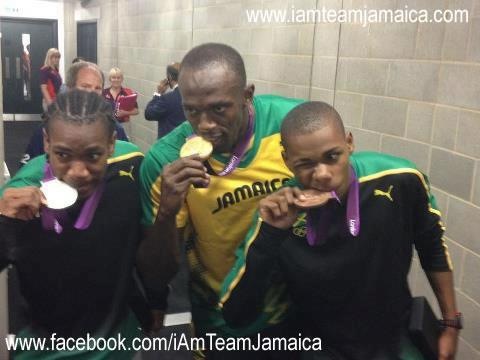
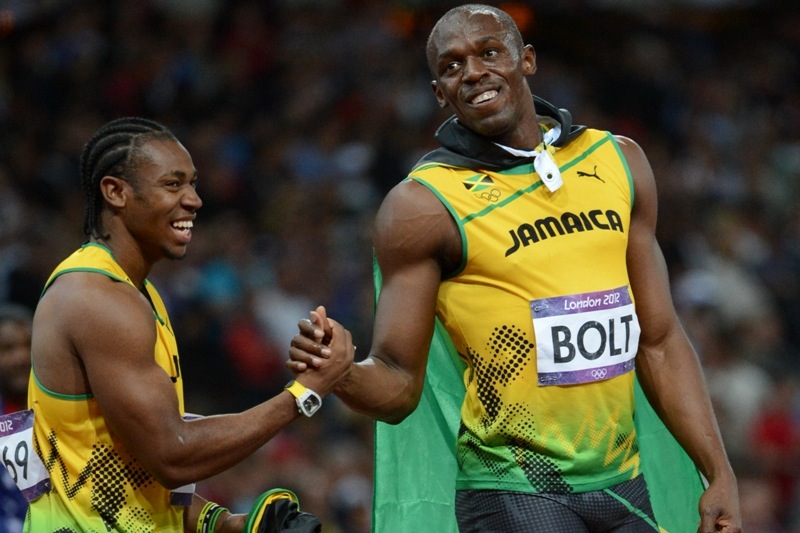
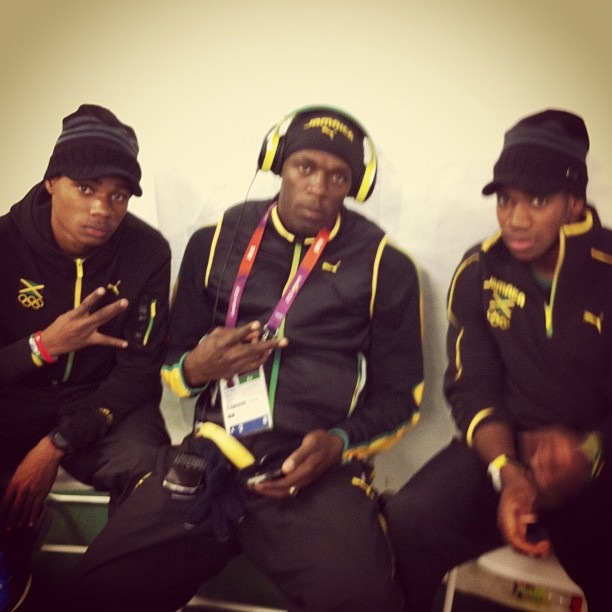
Photo by Jamaican photographer Ricardo Makyn, after Bolt aces the 100mYohan Blake and Usain Bolt, after taking gold and silver in the 100m. Photo source unknownNot sure when or where this was but Blake and Bolt are bussing a Jamaican dance move. Photo source unknownBrilliant photoshopped cartoon by Keon Scarlett…Usain Bolt with the undeclared winner of the 100m, Coach Glen Mills, who is also Yohan Blake’s coach. Photo source: Usain Bolt’s Instagram.
Just thought I’d post some of the interesting photos, articles and videos that I’ve collected off Twitter and Facebook about Usain Bolt and a few other Jamaican athletes. They give a better insight into Jamaica’s extraordinary athletes than you get from mass media. I think my favourite photo is the one of him with his coach, Glen Mills. You can clearly see the affection between them from the way Usain and Mills are talking to one another. Mills truly is a star in his own right; after all he’s responsible for training the two fastest men in the world today, Bolt and Yohan Blake, who won gold and silver in the Olympic 100m a couple of days ago. Would love to interview him but he dislikes media I understand.
Before that fateful race there were enough skeptics including Tim Layden who went on to write one of the best post-100m articles on Usain in Sports Illustrated. The quote below from a Slate article chronicles the widespread uncertainty about Bolt’s ability to prevail:
A couple of hours before today’s men’s 100-meter final, Sports Illustrated’s Tim Layden made a bold prediction on Twitter: “OK. Go big or go home. My 100m pick: 1) Gatlin 2) Bolt 3) Blake.” Layden wasn’t the only one who was betting against Usain Bolt. The Jamaican sprinter hadn’t run against a 100-meter field this stacked since 2009, when he set the world record of 9.58 seconds in Berlin. In 2011, a false start knocked him out of the world championships. At the Jamaican Olympic Trials earlier this year, he lost to Yohan Blake in both the 100 and 200 meters.
Bolt and Blake clowning around during training. Photo source unknown.
After the race Layden sang a different tune:
LONDON — In many ways, this one was better. Four years ago in China, Usain Bolt transformed the 100 meters into performance art, and the Olympics into a soliloquy, winning with such playful arrogance that it seemed less like a competition than a palette on which an emerging and transcendent talent could splash his greatness in great, broad strokes. The other sprinters were like extras in the Bolt Show, useful in the same way that painted planks of background scenery are deployed in a Broadway production. Bolt was bigger than all of them and so much faster. It wasn’t a race, it was an exhibition (and one that Bolt would repeat four days later in the 200 meters and again in the 4×100-meter relay; three gold medals and an unprecedented three world records. He did likewise a year later at the 2009 world championships in Berlin).
The world gathered again to witness Bolt on Sunday night in London’s Olympic Stadium. Many had surely not seen him since Beijing, as track and field lives on the distant margins of mainstream sport and Bolt is its only true star. In a superficial sense, he did not leave them wanting, winning the 100-meter gold medal in 9.63 seconds, an Olympic record and the second-fastest time in history (behind only his world record of 9.58 from Berlin) and .06 faster than he ran in Beijing. But this was not a virtuoso encore, this was a race, and it had begun more than two years earlier.
Bolt celebrating with Swedish handball players. He’s got them making the Gaza sign–in tribute to his favourite DJ Vybz Kartel. The sign is also used by US West Coast hip hop musicians.Warren Weir and Usain doing the Gaza sign, while Yohan Blake looks on. Photo source: Warren Weir’s Instagram
Meanwhile on Foxsport.com Greg Couch lamented USA Track and Field’s lack of get up and go while ruefully noting Bolt’s casual, cool but deadly sporting style:
Usain Bolt posed again with Bolt Arms pointing to the sky, then put his hands behind his ears to get the crowd to yell for him more, as if they could. And then he sprinted his 200-meter heat Tuesday to an easy victory.
Well, actually, he sprinted about 125 of it, then jogged the other 75 to advance to Wednesday’s semifinals.
“I was taking it as easy as possible,’’ he said. “It’s my first (200) run. I’m looking forward to tomorrow.’’
This was basically a day off for Bolt, with a quick Olympic run mixed in. But there’s no day off in the Bolt buzz.
Let’s see: He tweeted back and forth with a Manchester United player, saying he wants to try out for the team. He snuck past one of the picky Olympic rules he complained about the other night, hiding a jump rope in the bottom of his bag. After saying he wasn’t going to celebrate winning the 100 because he needed sleep, he emerged in a picture with three female Swedish handball players, supposedly partying with him in his room at 3 a.m.
This isn’t to be critical of Bolt for any of that, by the way. As an American, I’m asking this:
Why can’t we have one of those? By “those’’ I mean Bolt. I wonder if the US is ever going to get Bolt, understand him, build from him. Meanwhile, it was just a few months ago that U.S. hurdler Lashinda Demus referred to track as “a dying sport.’’ It was just Sunday night that two million people wanting tickets to Bolt’s 100-meter race were turned away.
A debonair Bolt models a suit. Photo source unknown.
Well Greg, as i said in an earlier post, to ‘get’ Bolt, you have to get Jamaica. Getting Bolt to tour the USA is one way to approach it but understanding something about the ‘never say die’ nature of Jamaican culture would help too. The videos below might help illuminate this a bit. First a beautifully produced Gleaner video of Jamaicans watching, then celebrating Jamaican victory in the men’s 100m in one of Kingston’s busiest streets:
Then a longer video movie of Usain Bolt, his life and style:
And finally there’s the third Jamaican…
Come tomorrow the world might want to know a little more about Warren Weir, the third Jamaican in the 200m at Olympics 2012. Incredibly Weir too is coached by Glenn Mills. As I write all three have cruised into the 200 m finals. The following video is a good introduction not only to Weir but also virtually the entire Jamaican team, Usain and all, getting ready for the Opening Ceremony…didn’t spot Yohan Blake…but a great peek behind the scenes at the Jamaican camp at Olympic Village. Check it out and #TeamUSA, take notes…
PS: If the copyright holders of any of the photos above identify themselves I will immediately credit them where necessary.



























 Active Voice