Soldiers and Police in The Hunt for Dudus


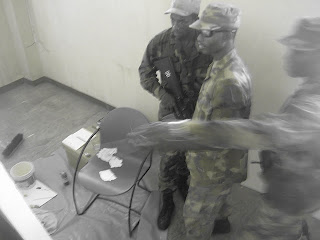
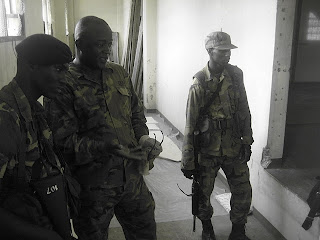
Photos above by Hubert Neal Jr.
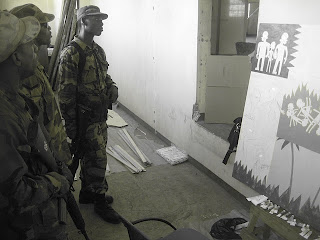
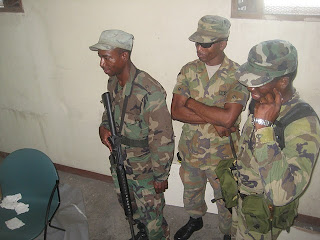
A frequently heard comment in the wake of the May 23rd assault by Jamaican security forces on Tivoli Gardens is that Jamaica Defence Force soldiers are far more civil and easy to trust than the police. The latter stand accused of shooting to kill without any consideration for whether the target is actually a suspected criminal or not. The soldiers on the other hand have been accused at the most of paying too much attention to the young women of Tivoli, an area that has remained under curfew ever since the barricades of Tivoli were demolished.

Of course the soldiers too are alleged to have participated in some questionable activities such as the hasty and unauthorized burial of bodies in makeshift coffins during the siege of Tivoli. But their reputation has fared far better than that of the much reviled and feared Police Force accused of wantonly killing young men in the affected areas. According to a Trini friend who generally knows about such things, a state of emergency is an opportunity for rogue police to go around eliminating those who are their partners in crime in times of peace–those who abet them in drug dealing, illegal taxi operations, extortion among other things. If true, this could explain the outrageously high number of casualties in the operation to capture Dudus–who of course, remains free and alive.

The Hunt for Dudus has inspired Belizean artist Hubert Neal Jr., who arrived in the island on May 20, just before the ‘Operation Take Dudus Alive’ unfurled. Neal, an artist in residence at Roktowa on Pechon Street around the corner from Coronation Market and Tivoli Gardens found himself the recipient of an unlikely studio visit a few days ago when three groups of soldiers decided to patrol the old Red Stripe Brewery where he works along with the Haitian artists who are part of the ‘Trembling Heart’ project.

The soldiers allowed themselves to be detained by Neal’s painting in progress, titled–what else–The Hunt for Dudus. They questioned him closely about his representation of the storming of Tivoli, disapproving of the low number of soldiers depicted (see photos above and below). On the whole however they were quite animated by the work they saw and their unorthodox art critique thrilled Hubert who documented The Studio Visit on his blog The Visual Poets Society.

Photos below by Annie Paul
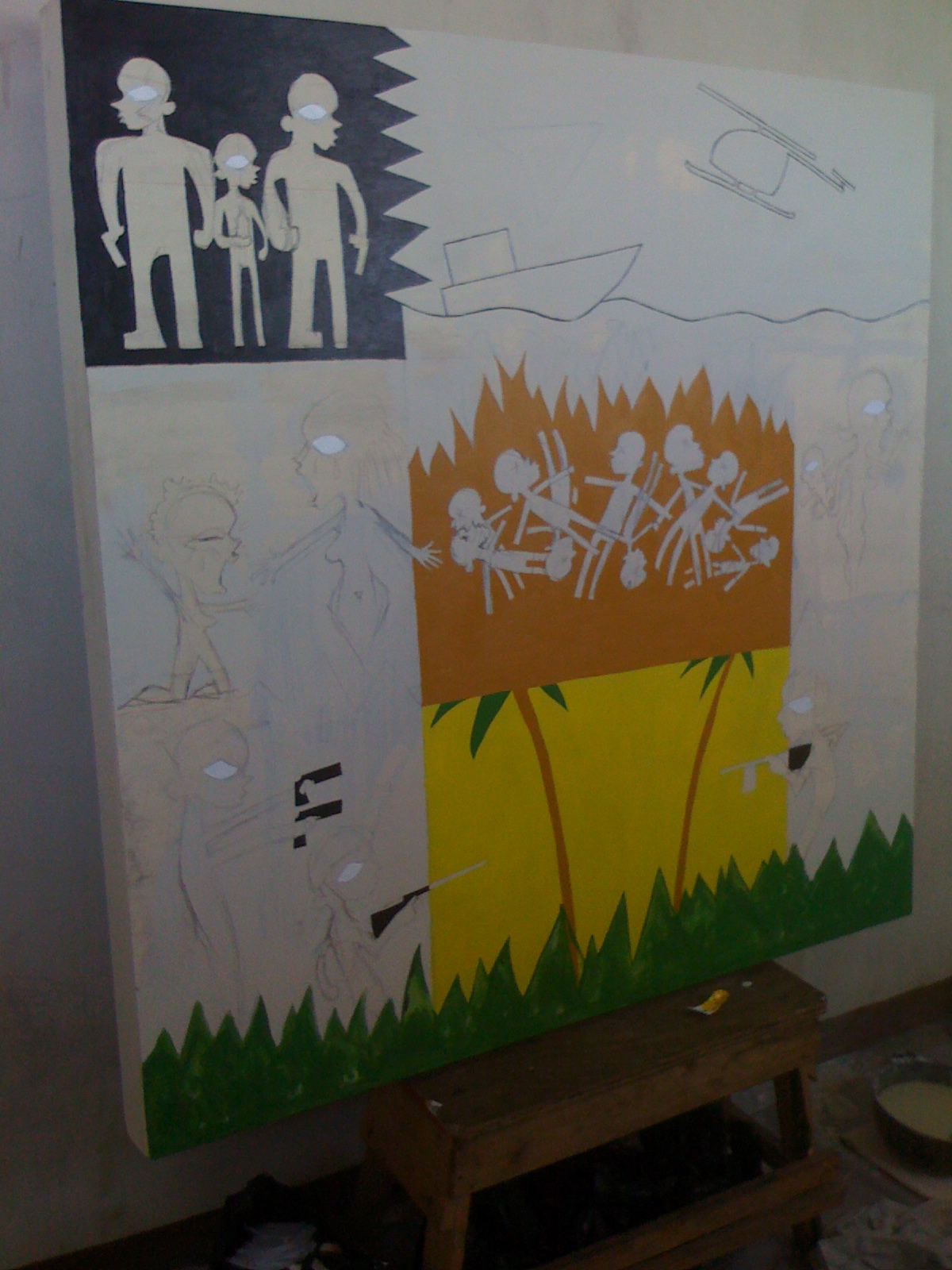
The Hunt for Dudus by Hubert Neal Jr. (work in progress)
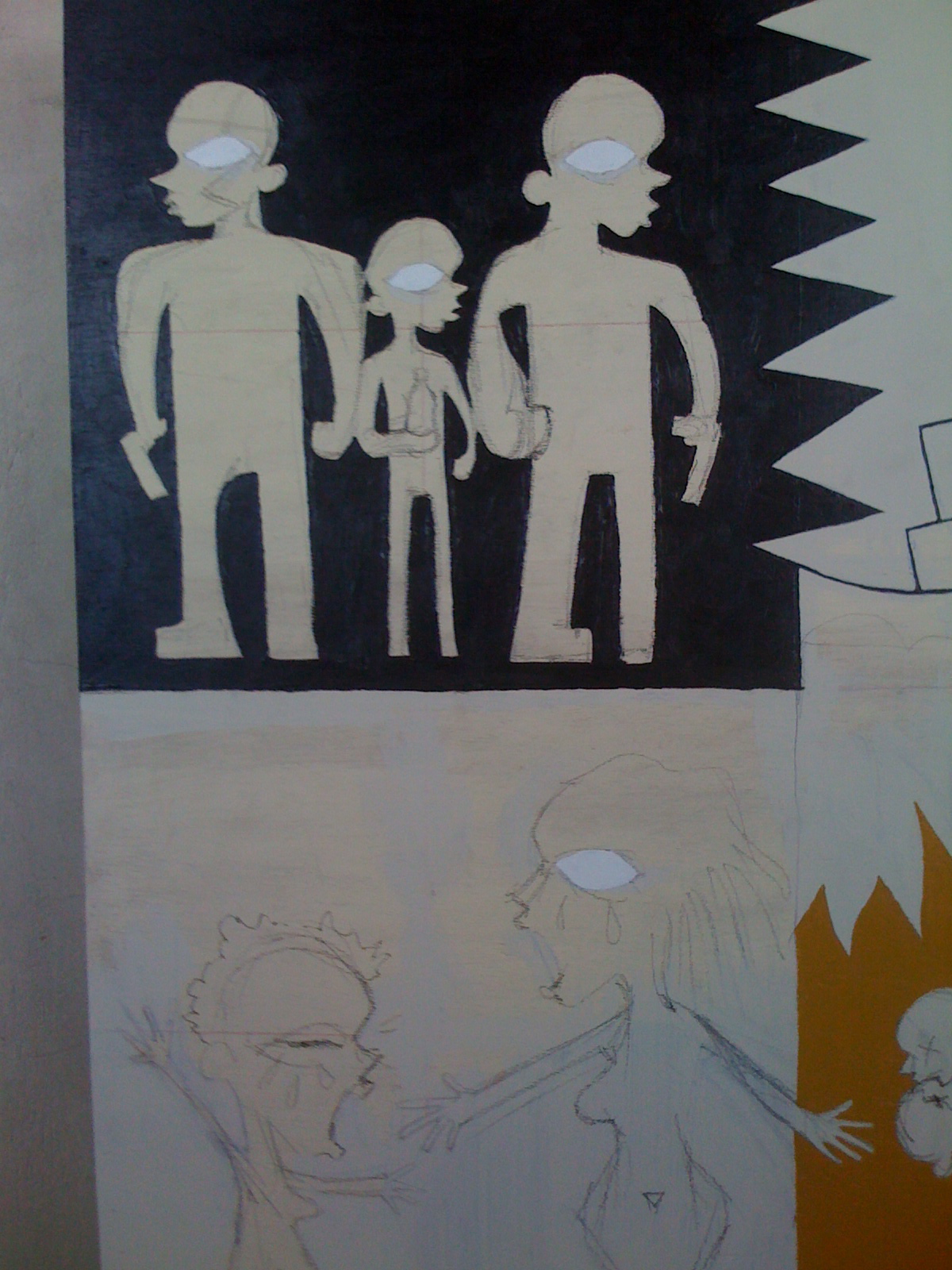

Dudus in between his bodyguards above and terrified woman and child below


A beaming Neal…

The most potent paintings i think are the two below, Hubert’s depictions of the torture chamber the media described finding in Tivoli. I’m particularly moved by his interpretation of the grave found with a skeleton buried upright in it (below right).

Last Saturday we were part of a visit to award-winning writer/sociologist Erna Brodber‘s home at Woodside, St. Mary. As part of her Blackspace project she has documented various sites and relics dating from the days of slavery. One of the things she mentioned was the existence of what she referred to as a ‘punishment hole’ somewhere in the vicinity. What’s that, I asked.

Well, sometimes slaves were punished by being buried upright up to their necks for days on end, said Erna. Wow, i thought, the Tivoli Punishment Hole was no doubt a variant of this time-honoured method of torture.


Erna Brodber at the entrance to the Woodside Community Centre

If you come to Roktowa next Sunday for the opening of Laura Facey’s show Propel you can see Hubert’s painting and work by the Haitian artists as well. In addition to Laura’s marvelous drawings, prints, carving and sculpture there will also be Nine Night singing. The show is curated by Melinda Brown. Click on invite below for address and map to Roktowa.

Desperately Seeking Dudus 2: The Person behind the Persona


Las May, The Gleaner

On May 8 I had occasion to talk to Tom Tavares-Finson, Chris Dudus Coke’s erstwhile lawyer (who stepped down as part of his defence team on May 18, citing conflict of interest) at a mutual friend’s birthday party. Can you talk about Dudus I asked, unable to resist my reporter’s instincts.

“You mean that figment of the collective imagination?” Tom responded playing his legal role to the hilt; according to him, Dudus was an ordinary man on whom every abnormal event–the revoking of visas, crimes of various kinds, resignations–was being pinned with abandon. I was more than willing to engage in a spirited discussion on this unlikely portrayal of the nation’s Public Enemy No. 1 but, alas, was deterred by frantic hand signals from my host who was afraid that the ensuing argument might derail his party.

I don’t think anyone there could have guessed that within two weeks Tom’s beloved Tivoli would be torn to pieces by Jamaican armed forces searching for Dudus who was barricaded in there. And apart from the one or two nondescript photographs circulating in the media there was hardly any information on this man now hunted on grounds of being a dangerous criminal mastermind by the United States.

This was the same man whose power enabled him some months ago to defuse the simmering rivalry between the Gaza and Gully factions by mounting the West Kingston Jamboree in Tivoli where the rival Dancehall DJs at the head of the two factions, Vybz Kartel and Mavado, performed on stage together (see video above). Dudus is also reputed to do a mean Gully Creeper but unlike our business and social elite he shuns the limelight remaining a shadowy, mysterious figure who by all reports craves ‘ordinariness’ and ‘normalcy’.

Finally this morning, Jamaica’s Sunday Gleaner has shed some more light on this retiring character in an excellent article by Tyrone Reid called “FROM MATH WHIZ TO WANTED.” For once we’re able to read a story like this in the local media and not in the New York Times, on BBC or CNN. The Gleaner reporter tracked down people who knew Coke at Ardenne High School, and uncovered information suggesting that the young Coke was anything but a ganglord in the making. In fact he was one of that rare, endangered species in Jamaica, a natural mathematical talent.

“The math teacher remembered Coke as one of his elite batch, picked at the end of the ninth grade.

Having breezed through CXC math Coke tackled the dreaded additional mathematics (add math) in Grade 11 and scored a Grade B – the second-highest mark.

“Math is the only universal language, and he spoke it very fluently,” the teacher reminisced. “I taught him for five years straight. Basically, he was the model student; very quiet, and there were no problems in terms of discipline,” said the educator.

Reid’s story goes toe to toe against The Sunday Observer‘s rambling reminiscence by journalist Tino Geddes of Tivoli and its various Dons, most of whom he seems to have known closely.

Dudus is not a run of the mill ordinary Joe, looking to make some money and in search of power. He has never been and he will never be regarded by those who have known him, in that light.

I have personally known all the previous ‘dons’ of Tivoli Gardens. I had a special affection for Massop; I was closely involved with Bya; I watched Jah T go through high school at Wolmer’s; I was particularly close to Jim Brown, and although not as close to Dudus as I was to his father, the younger Coke has commanded my respect.

Dudus has undeniably captured the nation’s imagination. At the recently staged Calabash Literary Festival the open mic segment was dominated by references to both Dudus and Tivoli. As news broke that his brother Livity and sister Sandra had both turned themselves in to the Police stories started swirling.

Was it true, enquiring minds on Facebook wanted to know, that Livity Coke was on Twitter and when rumours of his demise were reported he immediately tweeted saying “See mi yah”? The urban legends surrounding the Coke family continue to grow yet there have been no images in the media here of either Sandra or Livity or any further information about them.

The Jamaican media is puzzling in its tendency to conceal rather than reveal the news. Tightlipped and taciturn at the best of times, it took the New York Times to carry an article on the extrajudicial killings by the security forces in Tivoli. With the exception of Lloyd D’Aguilar, my former co-host on Newstalk 93, who took it upon himself to visit Tivoli in the wake of the assault on it, and report on what he found there, no other major news media here has followed up in a serious way on the ‘collateral damage’ caused by the breaching of Tivoli.

In the aftermath of the events of May 24th the BBC had footage of masked gunmen in Tivoli fortifying themselves and the community (see below). A reliable source informs me that this footage was actually shot by a TV Jamaica cameraman who had access to the individuals in question yet TVJ declined to air the exclusive video allowing the BBC an unnecessary scoop. The local television channel’s reticence in airing the footage shot by its own cameraman remains a mystery.

What amazed me about this BBC footage that i watched over and over again in my hotel room in Barbados was that much of the early scenery shown, with police dodging around corners of buildings was right outside the National Gallery of Jamaica. The Gallery’s walls are slightly pockmarked with bullet holes now and the fighting outside was so intense that a security guard was trapped inside the Gallery for 5 days.

“How did he survive? What did he eat?” I gasped when told this by the Executive Director of the Gallery, Veerle Poupeye.

“Well, he had access to the coffee shop. Thank God we stock three different flavours of muffins there,” she replied laughing.

Desperately Seeking Dudus…Letters from the Dead

“They seek him here,
they seek him there,
those Frenchies seek him everywhere.
Is he in heaven or is he in hell?
That damned elusive Pimpernel.”

Dudus is far from being the Scarlet Pimpernel but the Jamaican armed forces are certainly busy seeking the mild-mannered Christopher Coke in every nook and cranny of the country. Even the Mayor of Kingston’s house wasn’t spared in the security forces’ hunt for Jamaica’s Pimpernel.

It now appears the armed forces executed a well-planned and stealthy assault on Dudus’s citadel, Tivoli Gardens, on May 23rd. The scenario didn’t play out quite as feared back in March when Police expressed concern that the country’s 268 gangs might act in concert to create incidents throughout the country to distract lawmen in the event of an offensive on Tivoli.

National Security Minister Dwight Nelson went on record then saying that “Government was focusing on preparing strong anti-gang legislation that would target, infiltrate and dismantle criminal gangs.

“The legislation, Nelson said, would also identify and arrest members of criminal gangs; ensure long sentences for gang members; conduct a thorough historical and proactive investigation into the activities of gang members; and develop intelligence as to each member’s association with and participation in gangs.”

With the speed at which Dons and gang members have been turning themselves in, one fervently hopes that the said legislation is in place to put them away for a long time. Meanwhile the security forces must be congratulated for keeping deaths down to under a hundred although the various charges of wrongful detention, wounding and killings by the armed forces must also be fully investigated with those responsible for the wanton taking of life duly punished. The New York Times had an article today about extrajudicial killings by Jamaican police, something that’s a problem even when there’s no state of emergency.

Life has more or less returned to normal on the rock except for those who lost family members in the clash and for those who remain on the run. The tragedy is that the parts of the city where gangsters unleashed violence are the same areas which have long been the killing fields of Kingston.

At the Caribbean Studies’ Association’s 35th annual conference in Barbados, May 24-28, eerily titled “The Everyday Occurrence of Violence in the Cultural Life of the Caribbean,” many of us recalled the previous CSA conference in Kingston last June which included a commemorative walk for victims of violence organized by Sistren and the Peace Management Initiative. The walk started outside the Hannah Town Police Station (the first building to be burnt down by the gunmen protesting Dudus’s arrest last week) and proceeded along Hannah Street, Slipe Pen Road, past the Kingston Public Hospital culminating in a ceremony at the Monument to Children killed in Violence outside the KSAC offices on Church Street.


As the pictures above from the Letters from the Dead walk show, it was mainly women who marched, each one holding an image of a slain family member. An article in Guyana’s Stabroek News documented the process preceding the performance as recorded by Honor Ford-Smith and Alissa Trotz:

Weeks before the march took place, workshops with women from different communities explored the ways in which people remember and forget urban violence. Women discussed the different circumstances that result in the shooting and death of diverse victims and the enormous pain and waste that it has caused. For several, forgetting was an attempt to cope with the pain of loss, but it was also to avoid the desire for revenge that was triggered by remembering, raising the important question of how to link memory with reconciliation as one constructive response to violence. Participants found it difficult to share their stories publicly and in a collective setting. One woman who had lost all of her children to violence spoke of her complete isolation, of shutting herself in her house, of leaving her yard and being completely disoriented on a street that she had inhabited for years. Her story is deeply symbolic of how the violence both produces and continues to be produced by alienation from neighbourhood and community, spaces that we so often associate with nurturing and bonds of solidarity.

The performance on June 3 vividly dramatized elements of the workshops. Women, men and children gathered in the yard outside a church in Hannah Town. Dressed primarily in black, heads tied with red cloth, each person bore witness to the devastating effects of violence on families and communities. During the workshops, participants had selected images of those they had lost. As we took to the streets that afternoon, we were surrounded by faces of the dead mounted on placards, pinned to shirts, hung on a cord around the neck. On a poster held up by one elderly woman, an infant lost to gun violence stared out solemnly at those gathered in the churchyard.

As the procession began its trek through downtown Kingston, participants formed a long line, bearing 35 yards of red cloth that rippled like water, symbolizing the blood of the thousands killed in community wars over the last decades. Two young women dressed in white – cultural workers from Toronto – performed the part of ghosts or spirits, urging the marchers on to the final destination. Women led the marchers in church hymns punctuated by clapping. Some bore a coffin that had been made locally – it is tragic how many funeral parlours one can find in inner city Kingston – and that linked urban wars in Canada to those in Kingston through the use of repeating images of the black youth murdered in Toronto. Onlookers – asking questions or greeting familiar faces – were urged to join the march. Scholars who are members of the Caribbean Studies Association from around the world and who were holding their annual conference in Kingston, also joined the walk which was part of the performance programme of the conference.

The ‘walk’ culminated outside the office of the Kingston and St Andrew Corporation, at the site of the Secret Garden and Monument to the Children, dedicated in late 2008 to remember those killed under violent and tragic circumstances since 2000. The bronze sculpture depicts the face of a weeping child, with names of the dead inscribed around its perimeter; almost three sides of the monument had been filled with hundreds of names, children ranging in age from a few months to 17 years. As a young woman sang a tribute to the dead children, the red cloth was laid down on the pavement and placards and mementos laid along its length. Before a large gathering that had collected on the street, Sistren member Afolashade explained the purpose of the moving commemoration, and invited workshop participants to the microphones to share the letters they had written to their dead and to ‘post’ them in a specially designed letterbox. Audience members were also asked to read a few letters aloud. Others read fictional responses from victims of violence; in one particularly telling letter, a young man imagined his dead friend urging him not to link memory to retribution because that would only continue the cycle of violence. Music by reggae musicians including Ibo Cooper – from Third World – and others accompanied the readings. After the last letter was read, witnesses were invited to walk around the cloth. People pointed out faces they knew. A woman exclaimed in shock when she realized that a male friend of hers was among the dead. There was silence as people circled the monument to read the names of children. One woman who had been leading us in song along the march collapsed on the sidewalk in grief, surrounded by other women trying to comfort her.

The question is what sort of ritual will we need to hold now for the inhabitants of Tivoli Gardens and others who were victims of Operation Desperately Seeking Dudus?

Post-Calabash Glow: Vintage 10


Jack Sprat’s at Jake’s, last evening after the Bash ended

Calabash 2010 was magical. For those of us who came from Kingston it was like a huge lung purifying the putrid air of the preceding week. Attendance was surprisingly good, probably because most people wanted to escape the pressure cooker the city had become.


Lion in Winter, Wole Soyinka…

Bereft of my usual techie Calabashmates who all decided to take a break this year, and staying at less than Lyric-al lodgings, I was apprehensive about how this tenth staging of Calabash would treat me. I needn’t have worried, it turned out to be the best one i can remember attending in a long time. The programme was tight and well-put together and the quality of the writers more even than in previous years.

The organizers seemed determined not to mention the turbulent times the country had just been through but of course individual authors felt no such compunction and on Friday evening Diana Macaulay read out a ‘non-poem’ called Open Mouths she had produced in response to the blood-letting in Tivoli.

on the other side of the barricades
well thinking Jamaicans listen to radios
as they do when the open mouth of a hurricane threatens
waiting for bulletins
will the storm turn away this time?

the city is tense
the city is in lock down
the travel advisories are issued
the airport road is open for now
the open mouths on the verandahs are silenced by seclusion


Diana Macaulay

Banton, one of my Calabash companions this year, had actually been shot at downtown by the armed forces who saw him peeping out from the Red Stripe Brewery where Roktowa is located. He had never been to Treasure Beach he said, could he come along? He proved to be invaluable, regaling us with stories about the different, wondrously named snappers (fish) to be found at Greenwich Farm. The God Bless Snapper, so called because ‘you see which part Jesus finger print one side a him’ and the Dogfeet Snapper which you steam ‘coz im gummy, you don’t fry dat fish deh.’ He also told us about a band of ‘robber police’ called Four the Hard Way who used to terrorize the residents of various downtown communities.


Liming at Jack Sprat’s w Kim-Marie and Banton


My Calabash 2010 crewHubert Neal Jr and Banton. All the photos
in this post, save the very first one which i took, are by Hubert Neal.

Back to Calabash proper, Wole Soyinka was asked by Paul Holdengräber why he had once compared Kingston to Lagos. Had he noticed the mini-insurrection in Kingston organized to welcome him? Soyinka talked about his association with Sheila Graham’s Area Youth Foundation among other things and the arbitrary mapping of Africa by Europeans saying sardonically “What white people have put together let no black man put asunder.”

He recited several poems including “Your logic frightens me, Mandela” a few excerpts from which i present below.

“…Not for you the olive branch that sprouts
Gun muzzles, barbed-wire garlands, tangled thorns
To wreathe the brows of black, unwilling Christs.

“Your patience grows inhuman, Mandela.
Do you grow food? Do you make friends
Of mice and lizards? Measure the growth of grass
For time’s unhurried pace?
Are you now the crossword puzzle expert?
Chess? Ah, no! Subversion lurks among
Chess pieces. Structured clash of black and white,
Equal ranged and paced? An equal board? No!
Not on Robben Island. Checkers? Bad to worse.
That game has no respect for class or king-serf
Ordered universe. So, scrabble?

“Tell me Mandela,
That guard, is he your prisoner?”

Soyinka also talked about the ‘Ogun element’ saying he didn’t believe in ‘good’ and ‘evil’ beings; everyone has a bit of the Ogun element in them; Ogun is a protagonist who uses violence when necessary. Soyinka was a closet glutton for peace he said, but not a pacifist.

Lean and elegant, with his white mane and sonorous voice, Wole Soyinka was probably the highlight of Calabash 2010.

Another highlight was the reading from The Last Enchantment by Neville Dawes, father of Kwame Dawes the Programme Director of Calabash. Winston “Bello” Black launched the reading by gesturing towards the recent warfare in the country when he said, “We are in a new Jamaica where there are no born JLPs or born PNPs, we are all born Jamaicans.” Leonie Forbes followed with a sparkling reading, her acting abilities allowing her to inhabit the various voices with aplomb. Minister of Agriculture Christopher Tufton started his segment by saying that on behalf of himself and “Peter Bunting, the only other parliamentarian brave enough to be here today: We promise to do better.” Bunting is the General Secretary of the Opposition Party. Surprisingly Tufton was also very good at animating the voice of Anansi and the entire reading was quite memorable.

Regrettably I missed many of the poets; poet Sudeep Sen, who was flown in from Delhi, was nervous about following in the wake of the hugely popular Billy Collins but held his own, with his “brand of simplicity and unfussy, musical words” to quote William Abbott.


Sudeep Sen and moi

Alas, I also missed the live performance by Freddie McGregor and Etanna the first night, as well as Russell Banks and
Sharon Olds’ readings which i heard were excellent. I did however manage to catch the huge non-clash between Colin Channer and Mutabaruka on Saturday night, a musical healing that truly rubbed the pain of the previous week away. It was astonishing how many of the songs both Muta and Colin played really ‘spoke’ to the bloodletting in Kingston of the week before.

The closing performance/reinterpretion by the Calabash Musical Ensemble (Wayne Armond, Seretse Small, Stevie Golding and others) of Marley’s album Uprising released thirty years ago was also exceptional, with the words to songs like ‘We no know how we and dem ago work it out’ this out or ‘WE…CAN MAKE IT WORK’ seeming eerily of the moment.

Calabash 2010 rocked, it really did. This literary festival provides a neat model for similar ventures that could showcase the best that Jamaica has to offer. Congratulations are due to Colin Channer, Justine Henzell and Kwame Dawes. May a thousand Calabashes bloom.


The Don of a New Era Part 2: The Gideon continues


Sign in Barbados

Well, the Gideon (local slang for Armageddon) continues. Last night it seemed as if things in Kingston had simmered down but this morning i checked into Twitter to hear that the armed forces were lobbing grenades and perhaps bombs at a house in E. Kirkland Heights, a very upscale neighbourhood in Red Hills, Kingston. “The template of violence in jamaica has changed ova d las week. Its now an insurgency with all the relevant weaponry” tweeted one of the people i follow. “I wanna see the police deny this one. Grenades an bombs are the new weapon of choice for the state now.”

No idea whether the Police suspect that Dudus is holed up in there or some other Don. Things unravelled very quickly. On May 17th Prime Minister Bruce Golding addressed the nation saying apologetically that he was finally giving the go-ahead for the signing of the papers to extradite Dudus to the US, something he had resisted for 9 months. To many of us it was clear that the US had made him an offer he couldn’t refuse; pressure from the local media, business and other interest groups had also mounted in the weeks leading up to this astonishing about-face.

As i said before Dudus’ lawyer Tom Tavares-Finson was furious. He would take the matter to court the next day he said but the following day we heard that he had removed himself from the team representing Dudus due to conflict of interest issues; issues however that had always existed. All I can say is, do not use this as an excuse to slaughter innocents in Tivoli, an angry Finson was heard saying in interview after interview on radio and tv. His words would prove prophetic.

The day after Golding’s speech it was announced that a warrant had been issued for Dudus’s arrest. That would have been on May 18th. The rest of the week was tense with everyone expecting the Police and Army to invade Tivoli at any minute but the armed forces seemed unusually tolerant, waiting patiently for Dudus to turn himself in. Actually they were waiting till the weekend of the 21st, a long weekend with the 24th being a holiday in Jamaica–Labour Day–to make their move.

On the 23rd a number of colleagues and i were at the airport waiting to catch a flight to Barbados to attend the Caribbean Studies’ Association’s 35th annual conference presciently titled “The Everyday Occurrence of Violence in the Cultural Life of the Caribbean” when i saw a tweet saying that shots were being fired in the vicinity of Tivoli. It’s going down i said to one of my colleagues, a leading Jamaican criminologist, the war is beginning.

I wouldn’t say so he said calmly, assuring us that his information was that Dudus was willing to turn himself in to the US authorities and was expected to do so any minute now. Well, that turned out to be misinformation of the highest quality. By the time we reached Barbados we heard that a state of emergency had been imposed and I’ve literally been glued to Twitter and online media ever since.

In fact I’m happy to report that my tweets were actually picked up by the New York Times blog The Lede in an article called Following Jamaica’s State of Emergency Online. Channel 4 in London contacted me to see if i could write a piece for them on Dudus which i did. My comments appeared in their story Jamaica death toll rises as unrest continues.

Here is an excerpt from it:

Dudus has been an extraordinary provider for the inhabitants of Tivoli.

What makes him exceptional is that he has also managed to forge coalitions between gangs across party lines and across the country when needed because of the respect he commands. His reach extends beyond his immediate community across all kinds of borders and is a testament to his abilities as an astute leader.

Had he been legit and able to run for election he would have probably created a modern, efficient Jamaica the likes of which have yet to be seen, but of course one where personal freedoms may have been more circumscribed than they are today.

The problem is his links to the underworld do not permit the state to continue the tacit alliance with him and others like him that have persisted to this day.

The question is how do you take the milk out of the coffee once the two have been mixed. That is the predicament Jamaica finds itself in.

Meanwhile the Gideon continues and while many of us would like to comfort ourselves by thinking that this is a necessary bloodletting, a purge of the criminal elements in society, the truth is otherwise. Discriminating between criminals and law-abiding citizens is not as easy as we think particularly for the Police force, members of which are known to wield their ‘license to kill’ with wanton disregard. i received a heartbreaking message from a friend about the execution of a young man she personally knew, by the police, a story which was reported in the media under the headline “Cops kill three men in Back Bush.”

One of the men was well-known to my friend and no criminal. Here is part of the heartbreaking message i received from her this morning:

“Picked up one of my neighbours on the road only to hear that Ian Gordon, a sweet young dread who ran a little “venue” in Irish Town square was killed by the police. Hard to believe he would be involved in anything – he would always ask me if I had dominos, or other games, that I could give him because he liked to have lots of games for people coming to his place. On Sundays I would sometimes take him down to town and he always said he was going to visit his 2 daughters. He had a lovely girlfriend, also a dread, and it was a joke in Irish Town how they were always together. Anyway I’m sure this Observer story of how he died is accurate, and this is probably happening to young men all over Kingston. Very depressing. “

It turns out also that the early morning raid on Red Hills i mentioned earlier was in pursuit of Dudus who was believed to be holed up in a house there. In the process of flushing him out the armed forces have killed another innocent man, Keith Clarke, the brother of former minister Claude Clarke, who lived nearby, by mistake.

Mr. Seaga, former Prime Minister is also concerned about the safety of the residents of Tivoli Gardens, his former constituents and has broken his silence. I conducted an interview with him in January this year in which i asked him about his relationship with Dudus and the fact that he had once placed him at the top of a list of wanted men that he provided the Police with in 1994. I’ll post relevant portions of the interview later.

Time doesn’t permit for me to write much more right now. I’m still at the conference in Barbados but will end with two lighthearted takes on what is a truly dread situation back home, (to use Jamaican parlance).

The photo posted at the top of this blog is actually a piece of graffiti seen in Barbados on the day the armed forces went into Tivoli Gardens in pursuit of Christopher Lloyd Coke–Dudus. The blog that carried it said “This sign was seen today (Monday May 24 Bank Holiday) on the left-hand side of Collymore Rock Road going towards Wildey from Bridgetown.” Dudus’s reach clearly extends beyond Jamaican shores.

And of course Jamaicans being Jamaican still have a mordant sense of humour. The following dance poster was making the rounds on email and facebook.

Bradygate continued…

Update: Today was the most unsettling exciting day in the last decade or so. Around 3 pm started to hear rumours that ‘war’ was going to break out because the Prime Minister was going to announce that the extradition proceedings agaist ‘Dudus’ Coke were going forward. A feeling of panic began to spread and there was a stampede to get out of downtown where the rumours started circulating around 11 in the morning. By mid-afternoon everyone was on the road trying to reach a safe place. Top 10 ways to get home quickly proclaimed a blog…

The most interesting thing was that the US Embassy sent out an announcement saying a talk it had planned to hold at the Institute of Jamaica tomorrow was being postponed. I found the title of the talk interesting. It was called “Congress and the President: An Invitation to Conflict” and should have been delivered by one Don Baker. hmmmmmmmm. Doesn’t Bruce own a bakery?

At the appointed hour Bruce Golding addressed the nation looking suitably contrite and apologizing profusely. Then he announced that the Attorney General was going to sign the relevant papers so that the extradition could proceed. Dudus’ lawyer, Tom Tavares-Finson was reputed to be livid with anger; he would defend his client in court he said.

More on the runnings tomorrow. Time for bed now…

Bradygate…The Don of a New Era, Part 1

Mr Golding has now admitted to parliament that he authorised the hiring of a law firm to lobby senior US State Department officials on Mr Coke’s behalf Photo: AFP/GETTY (Daily Telegraph UK)


Las May, Daily Gleaner, 15 May 2010 (our cartoonists are world class)

I feel it for Bruce Golding
. Who could have predicted the woes that would befall his first two years as Crime Minister, er, oh, LOL, i mean Prime Minister. I know what his wife Lorna means when she says we must read between the lines because he isn’t free to disclose everything. My first reaction when i heard that he had admitted sanctioning the Manatt, Phelps ‘initiative’ from the get-go was that someone or something had forced his hand. Only something far worse staring him in the face could have made owning up to having played fast and loose with the truth seem like the better alternative.

And i feel it for him because this turn of events has nothing to do with him personally, or the Jamaica Labour Party for that matter. It’s just the way the cookie crumbles in countries that are well on their way to being narco-democracies. I’m amazed at the amount of moral indignation being directed at the PM by members of the media. C’mon! It’s not a matter of morality is it? It’s a matter of how to decriminalize a country. Not easily done. The Colombians might have a tip or two and the Haitians. Forget about decriminalizing ganja or gay-ness, this is an entire country that has been hijacked by criminality. How is a government to cope?

Granted the PM could have handled the entire matter differently from the beginning. But he was playing by the old rules like all politicians have done so far. And he’s been jerked to reality by the powers-that-be. This is a power struggle. That’s what we have to realize. And to win this power struggle we need the new, the young, the strong and the able…because only they know how to negotiate the new rules that are now in effect. Alas, our criminals too are world-class and internationally competitive.

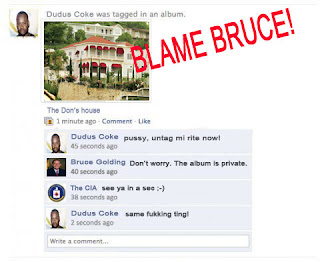
In the meantime a spurious facebook page purporting to be that of Dudus Coke is making the rounds in cyberspace. It’s a no holds barred version so if you’re under 15 or an Ayatollah or a member of Jamaica’s Moral Majority you might want to make a hasty switch to a less profane website.

Finally, take a look at National Dish by Michael ‘Flyn’ Elliott below. As a painted image it pretty much captures our predicament as a society. And for a variety of innovative takes or interpretations of the state we’re in you must visit the National Gallery’s Young Talent V which opened today. It is an exciting show that signals the resurgence of the visual art scene here. Here is a link to my photos from the opening.


National Dish by Michael ‘Flyn’ Elliott

My Dad, IIMA and CK Prahalad

The parents trying to beat their rivals, the rat bats,

to the fruit of this chikoo or naseberry tree.


The parents were just here on a visit. This was probably their ninth or tenth time here and they spent two and a half weeks during which my Dad celebrated his 80th birthday. It’s quite amazing having your parents depend on you for a change, however briefly. Well, of course, assuming that you aren’t normally one of their main sources of support. One of my friends, all of 25 years old, is putting his Mom through university. Seriously. Not for nothing is he known as Biggy.

My parents, on the contrary, like most Indian parents, want to look after us from the cradle to the grave, if possible. Try telling them that you CAN cross a road alone by now or that you figured out how to use the toilet without their help some decades ago. They just won’t buy it, they’re still in instructional mode. Do this, don’t do that, if you do this remember that etc…What is your cholesterol level, they demand and your bank balance. I mean one can’t complain especially if they’re given to enhancing the latter from time to time.

At the age of 80 my father is moving like a 60-yr old. Resident in Bangalore he was in Turkey the week before leaving for Jamaica and in Manila the month before–on work, no less. In fact the parents arrived bearing Turkish Baklava among other things, a delightful way to gain weight, if you must.

Unfortunately for them it wasn’t just my son and me who were delighted to receive the parents; a flotilla of mosquitoes also arrived to meet and greet them, extending their visit to the duration of their stay. Even the heat waved at my parents though on my father’s birthday, April 11, the drought finally broke. Everything is now satisfactorily green and the water shortage has briefly abated.


One of the things i had asked my parents to bring me from their home in Bangalore was a beautiful rosewood plaque my Dad was given by the Indian Institute of Management, Ahmedabad (IIMA) (see above), when he retired from there in 1984. The plaque is a replica in silver and rosewood of the stunning Siddi Saiyad Jaali, one of the screen windows at the Siddi Saiyad mosque in the centre of the old city. The arched, semicircular window portrays a beautiful Peepal tree with curving, sinuous, intertwined branches, intricately carved out of yellow stone to give the effect of filigree. There is also a palm tree in the centre. It is a stunning example of sixteenth-century stone tracery decorating a mosque built in 1573 by a Siddi General. The Siddis are Africans who have been living in India for centuries. More on them in a future post.


When IIMA was set up in collaboration with the Harvard Business School in the early 60s its logo incorporated a simplified version of the Sidi Saiyad Jaali. I wish i knew who the designer was. Whoever it was I’m grateful to them for presenting me as a child with this fine exemplar of graphic design, this ingenious conversion of a centuries old emblem of vernacular visual culture into a twentieth century symbol or trademark. It signalled the best possible use of India’s iconic ancient heritage, yoking it with modern typography to produce a memorable brandmark for one of India’s most avant garde institutions. To this day the IIMA logo remains a most elegant and sophisticated trademark, an ingenious marriage of the Oriental, the Islamic and the modern.


Sidi Saiyeed Mosque in Ahmedabad, India, Nichalp, 28-Jan-2006
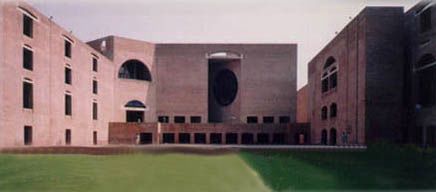
Louis Kahn designed the IIMA campus see above; note the arched windows echoing the numerous arches to be found in traditional Ahmedabad architecture.

I had the good fortune to grow up in Ahmedabad, specifically on the campus of the Louis Kahn-designed IIMA where my father worked from 1963 to 1984. “According to the Economist‘s survey of global business schools in 2009, IIMA is considered to be the “toughest in the world to get into” as over 600 people compete for every seat.” One of its earliest graduates, Batch of ’66, was CK Prahalad whose untimely demise last week shocked management circles all over the world. Dr. Prahalad was the author of the New York Times bestseller, “The Fortune at the Bottom of the Pyramid: Eradicating Poverty through Profits”.

Source: http://www.the-south-asian.com/Feb%202003/Davos%202003-South%20Asian%20voice.htm

Professor CK Prahalad

As the Hindu put it:

Coimbatore Krishnarao Prahalad, 68, Distinguished Professor in the Ross School of Business at the University of Michigan, and a world authority on management thought, passed away on Friday in San Diego after a brief illness. He was known for his work specialising in corporate strategy focussing on top management in large, diversified, multinational corporations.

Professor Prahalad’s seminal work, alongside Gary Hamel in the 1990s, on the concept of “core competence” of companies won the McKinsey Prize and sold the maximum number of reprints in the entire 80-odd years of history of its publisher, the prestigious Harvard Business Review.

In his paper with Hamel, he urged corporate leaders to think of diversified company as a tree: “The trunk and major limbs as core products, smaller branches as business units, leaves and fruit as end products. Nourishing and stabilising everything is the root system: core competencies.”

He was also known widely for his interest in the “Fortune at the Bottom of the Pyramid” and his book on the subject is considered an authoritative exposition of the potential for large corporations to improve the conditions of the poor in countries such as India. They could do so, he argued, by “mobilising investment capacity [along with] the commitment of NGOs and the communities that need help.” The poor must become active, informed and involved consumers, he urged.

Yet Professor Prahalad’s illustrious career was not restricted to academe: he equally established his reputation as a corporate consultant par excellence, working with a wide cross-section of companies from the CEOs of the top 30 Fortune 200 firms to Hindustan Lever Limited and Microsoft Corporation, India.

Very few people know that CK was my Dad’s student and protege in those early years at IIMA. By the time he graduated CK had impressed his professors enough for them to arrange for him to proceed to Harvard to get a Ph. D in Business Administration. IIMA underwrote the expenses on condition that CK return to teach there for a minimum of five years when he obtained his doctorate.

As agreed CK came back to teach at IIMA in the mid-seventies; by then my father was director of the Institute. Soon after returning CK received an offer from University of Michigan to teach there, one he apparently couldn’t refuse. He left IIMA before serving the full five years of his bond, a fact the Ahmedabad newspapers made a lot of at the time, with headlines such as “IIM Professor leaves country like a thief in the night.”

For years after that when i heard news of CK’s successes in the US I would relay it to my Dad but he would make a wry face and turn away. He had been sorely disappointed by CK’s premature departure from IIMA and never quite forgave him. But when i told him on the morning of April 17th after checking my twitter feed that CK had passed away in San Diego the day before he was visibly shocked and sorrowful.

Although he didn’t complete his tenure at IIMA CK Prahalad did repay the money that had been spent on his Harvard education. And with his stellar career, his championing of the poor and India and the mark he left on the world CK more than repaid his debt both to IIMA and the country i think.

It was an eventful two weeks while my parents were here. The day after news of CK’s death broke came news of Shashi Tharoor’s resignation from the Indian cabinet. Again i caught it on Twitter as it happened. Tharoor may have left national politics but he will be back, trust me. ST was at St. Stephens’ College when i was at Lady Sri Ram College at Delhi University from 73-76 and he was already a personality then. He topped his batch at DU and became President of St Stephens’, then a ‘men only’ college. His class notes were greatly in demand and being the consummate politician he seems to be, he never turned down a request for his famous notebooks, generously turning them over to those who requested them. It was discovered much later that he had two sets of notes; one set especially prepared as a loaner for circulation and his own private notes, never circulated, with which he aced his exams. A man like that doesn’t quit in the first round, even if he suffers periodically from irrational exuberance. He will be back, whether in politics or some other arena.


Finally, Twitter was abuzz last week with Arundhati Roy’s recent entry into the tweeting classes (this was later discovered to be a fake account but with a beguiling twist. read my post on it here). Calling herself @Arundhati_Roy the author of The God of Small Things surefootedly negotiated Twitter, charming journalists such as @KanchanGupta who had been cursing her only the week before. @KanchanGupta purred @Arundhati_Roy. We must. You look like a dark liquor on the rocks kind of man…


People seemed to doubt that it was really her but i didn’t need persuading, I recognized her voice immediately. Flags are bits of coloured cloth that governments use to first, shrink wrap people’s brains and then as ceremonial shrouds to bury the dead.”Little events, ordinary things, smashed and reconstituted. Imbued with new meaning. Suddenly they become the bleached bones of a story. And something i profoundly agree with her on: “Democracy is the biggest scam in the world.” Last week Thursday Roy only had 75 or so followers, today its 905. Let’s see how many more she attracts by the time she really gets going.


With the exception of Prahlad, all the principals in this blogpost are from Kerala, India’s most unique state, a state that you must look out for, the first state in the world to freely elect a communist government, a state that is maddening and inspiring all at once and where i happen to have been born and where my roots lie. It is a state like Jamaica that exports its people far and wide, while welcoming people from around the world to the self-titled splendours of God’s Own Country.


The LGBT Community and Rhetorical Rastas/DJs

Its the last day of a long weekend which began on Thursday evening with a really special experience for me. I was invited to be part of a forum in San Francisco. For details see the poster below where i’m listed as ‘Prof’ Annie Paul (chuckle).
No Title
The comments below the poster were borrowed from Yardedge.net, a great site for news on the entertainment and cultural scene in Jamaica.

Here’s an interesting forum happening next week on the dancehall music/culture scene- a simulcast between gay and straight folks in the San Francisco area and Kingston.

The forum will be addressing relevant issues including a proposal to initiate a BUYCOTT of artists, instead of BOYCOTT of artists. The “bUycott” is being put forward as a socio-politically conscious economic initiative in which LGBT-allied consumers (lesbian, gay, bisexual, transgender people) offer their business to Jamaican recording artistes, small exporters, international brands, tourist destinations, etc, with demonstrated progressive human rights attitudes and practices. The forum will explore some ideas and strategies for organizing and undertaking the LGBT-allied Jamaica bUycott. The idea is to basically to reward artists who are promoting non-violent, positive vibes.

The forum will take place at the Hall Of Culture, African-American Art & Cultural Complex in SF. Contact ajawowheel@gmail.com for the Kingston location information.

The forum hopes to encourage progressive dialogue and partnership between Jamaicans and people abroad as well as to raise U.S. awareness about dancehall music’s current role in Jamaican culture and society and to present the music in a broader context for the San Francisco audience.

So it was really cool linking with the folks in San Francisco from my living room in Kingston. I was on for the full two hours and a thorough discussion was had along the lines described by Yardedge above. One of the other participants was Andrea Shorter, the woman with locks in the top centre of the infamous photograph above. She was a bit of a tough customer but Nic Ming, a Jamaican self-styled LGBT, moderated us out of troubled waters with engaging calm and wisdom.

I made several points that evening. One that if the homophobic rhetoric in Jamaican music was really taken seriously by the people who consume it there wouldn’t be a single gay person left alive in the island. On the contrary a number of very high profile individuals who occupy the highest positions in this society are homosexual, although they cannot publicly admit this. And therein lies the rub. Jamaicans really don’t have a problem with homosexuals as long as they remain in the closet. And older generations of gay men and women have generally obliged.

Today however there are younger gay men and women who are not willing to live closeted lives. They want to be out–dressing effeminately if they choose, or not, but letting everyone know who and what they are. I made the point that a few years ago there was a local hit called Out and Bad by Elephant Man (first heard Agostinho Pinnock refer to the song in this context) which though not explicitly referencing being gay–it was a celebration of the dance scene and the latest dance at the time–the Willie Bounce–could nevertheless be read to be a defiant assertion by the very gay-appearing dancers who populate Kingston’s street dances. Dance will never die/Out and bad so badly bad/It a get intensify/…

The other thing i pointed out and i’m by no means the first to do so, is that the pressures of globalization, that is, the huge cultural changes that have taken place here and all over the world in response to the forces of economic globalization, are somehow mapped onto the body of the homosexual. He/she embodies, even personifies, the negative influences seen as penetrating society from the outside, from ‘foreign’. “Keep us free from evil powers” goes a line in the Jamaican national anthem and i would argue that gays/homosexuals are seens as the emissaries of unnamed ‘evil powers’.

This in turn has to do with the power relations undergirding the battle for space and legitimacy by the LGBT community. LGBTs often claim that their struggle for recognition and equal rights is no different from similar struggles by other once disenfranchised groups–Black people’s continuing fight against racism, women’s struggles against gender discrimination, the war by the colonized against the colonial yoke, the fight for freedom from slavery and so on. But as i pointed out there is one major difference between all these groups and the LGBT lobby and that is this: the LGBT lobby has power, it has economic power, and is able not only to flex its muscles but to cause severe damage as it has shown in recent years with the ongoing targeting of so-called murder music by Jamaican DJs. The marginalized groups previously mentioned were all waging wars from below; the campaign waged by Tatchell and others is, like the US embargo against Cuba, one that is fought from a position of power. And like the Cuban embargo, i maintain, it will have limited success and the people who suffer the consequences will be the very people on whose behalf you’re mobilizing.

By exclusively targeting Jamaican DJs, whose constituencies are the poor and marginalized, the ‘wretched of the earth’, LGBTs are re-inforcing the underlying power imbalance. They are now seen as representing not merely ‘evil powers’ but rich and powerful evil powers. And this is the message not only from Dancehall music but from the pulpit and parliament. As Tara Atluri pointed out in a groundbreaking paper titled “When the Closet is a region: Homophobia, Heterosexism and Nationalism in the Commonwealth Caribbean” some years ago, this is not a Jamaican problem only:

…From popular culture to constitutional inequity, homosexuality is dismissed, loathed and ignored by mainstream Caribbean culture. I feel that this fear of homosexuality keeps gender roles sharply intact, thereby normalizing sexism. Furthermore I feel that homophobia and heterosexism are reinforced by Caribbean nation states, based on a discriminatory nationalism that uses both religious conformity and conformity to capitalist patriarchy as a basis for inclusion.


Atluri remarked on the difficulty of finding material, research or willing interlocutors on the subject of homophobia. On the subject of dancehall music and offensive lyrics she made an interesting observation:

Silence and shame guard Caribbean homosexuality. Therefore, i have found few avenues upon which to form an analysis of heterosexism and homophobia in the region. Popular culture, in the form of dancehall and reggae seems to be some of the only and concrete cultural discourses in which attitudes towards homosexuality are expressed outright. While dancehall and reggae lyrics have come under fire for their crude portrayal of sexual politics, they offer an opening. They are explicit. And while they may be explicitly prejudiced, they do what respectable silences do not. They start the conversation.

I couldn’t have put it more eloquently. I’m glad that I was invited to to put in my two paisa worth in that forum in San Francisco. I’m glad that discussions such as this are taking place. And I don’t mean to close this conversation on an unpleasant note but the video below is extremely pertinent to the subject we’ve been examining in this post. It may make us want to tear our hair out but in this South African interview Sizzla clearly articulates a widespread set of attitudes in Jamaica. To combat such views nothing less than the most informed and sophisticated strategy of engagement is required.

Rhetorical Rasta

“Controversial reggae musician Sizzla Kalonji speaks to the Mail & Guardian about homosexuality, his music and Zimbabwe president Robert Mugabe whom he recently met while performing at his birthday celebrations in Bulawayo during his African tour.”

(Unfortunately there was no means to embed this video in my blog so you will have to click on the link to get it.)