From Nation to Abattoir?

Chubby


My column of September 6, 2017. The funeral for Leonard Collins “(Chubby”) is this Saturday at Church of Christ, Mona. I still shed tears at the wantonness of his killing.

I didn’t know his given name. On campus he was known as Chubby, a dread with a bicycle and a green thumb, who worked in the Maintenance Department for many years. Involved in a job-related accident some years ago, Chubby was waiting to collect some long overdue compensation monies.

On Friday, the 25th of last month, the money finally arrived in his credit union account and Chubby went and collected it. The first thing he wanted to do was buy a cake for his two-year old son. He sat down outside his August Town home with some friends idly discussing where to buy the cake. Some said Megamart, others said he should get a Cherry Berry cake from Sugar and Spice in Liguanea.

I remember when the ‘yout’, as Chubby called him, was born. The proud father came to my office to see if I could help in any way, as there were complications. I gave him some money. What Chubby really wanted was for me to visit his son in hospital because he said ‘they’ would treat him and his family better if someone like me visited. It haunts me to this day that I allowed my fear and dislike of hospitals to dissuade me from going.

Two years later Chubby did not get to buy his son a cake. The same night he got the money, someone pushed their way into his house and robbed him, viciously shooting and killing him in the process. I don’t think his death made the news. Sometimes I wonder if murders in August Town are under-reported to protect the much vaunted but fragile ‘peace treaty’. I know that not all murders are reported to the media by the Police in time for them to carry the news.

It’s heartbreaking when from he that hath not, even that which he hath not is taken. A good, hard-working man has been struck down, separated from the one thing he could call his own—his life. What lies ahead for Chubby’s son now, joining the legion of fatherless children?

There was a series of gruesome murders in Clarendon during the same period but  it’s human nature to mourn those closest to us, especially if they lived in physical proximity and you knew them. Someone from one’s own family, country, class or caste takes precedence over nameless strangers halfway across the world. The media too spends more column space or airtime on individuals who were prominent because of talent, brains, money or beauty. Thus the murder of designer Dexter Pottinger last week has dominated social media, where shell-shocked Jamaicans have been expressing sorrow, outrage, anger and bewilderment at his killing by a person or persons unknown.

The usual arguments are making the rounds. As Pottinger was openly gay there are those who suspect he was killed directly or indirectly because of his social orientation. Others counter this by saying he was likely killed by a lover in a crime of passion, so this can’t be classified as a homophobic murder. I find the latter a strange claim the fallacy of which is illustrated by looking at women who are murdered by their partners, ex husbands or boyfriends. Does the fact that this might be a crime of passion negate the fact that beneath the casual slaughter of women lies a deep-seated patriarchal belief that they are inferior and therefore expendable? Does it negate the widespread misogyny that permeates such societies and drives violence against women?

“Please don’t make it about the fact that he was gay” implored someone on my Facebook timeline. And I get that people don’t want Jamaica to get bad press again, especially if this was a straight robbery and murder, so to speak. But the fact is if a black man is killed in a racist country, the first thing you’re going to wonder is whether the color of his skin was a contributing factor. If racists view black people as an alien species endangering the public, in much the same way as homosexuals are viewed as dangerous threats to society here, it makes them more vulnerable to violence by those who feel justified in ridding society of the ‘menace’ by killing them.

Thus some men feel justified in killing men who make advances towards them instead of politely brushing them off in the way women do 365 days of the year when men make unwanted passes at them. Imagine what the world would look like if women killed every man who made a pass at them! I’ve never understood the “I killed him because he made an indecent proposal” defence that seems to find such currency here.

We might never know the reason Dexter was killed but in the meantime how about building a nation where people are as concerned to eliminate unwarranted prejudice as they are to protect their country’s reputation?

Feeding the Troll…

laughing Troll

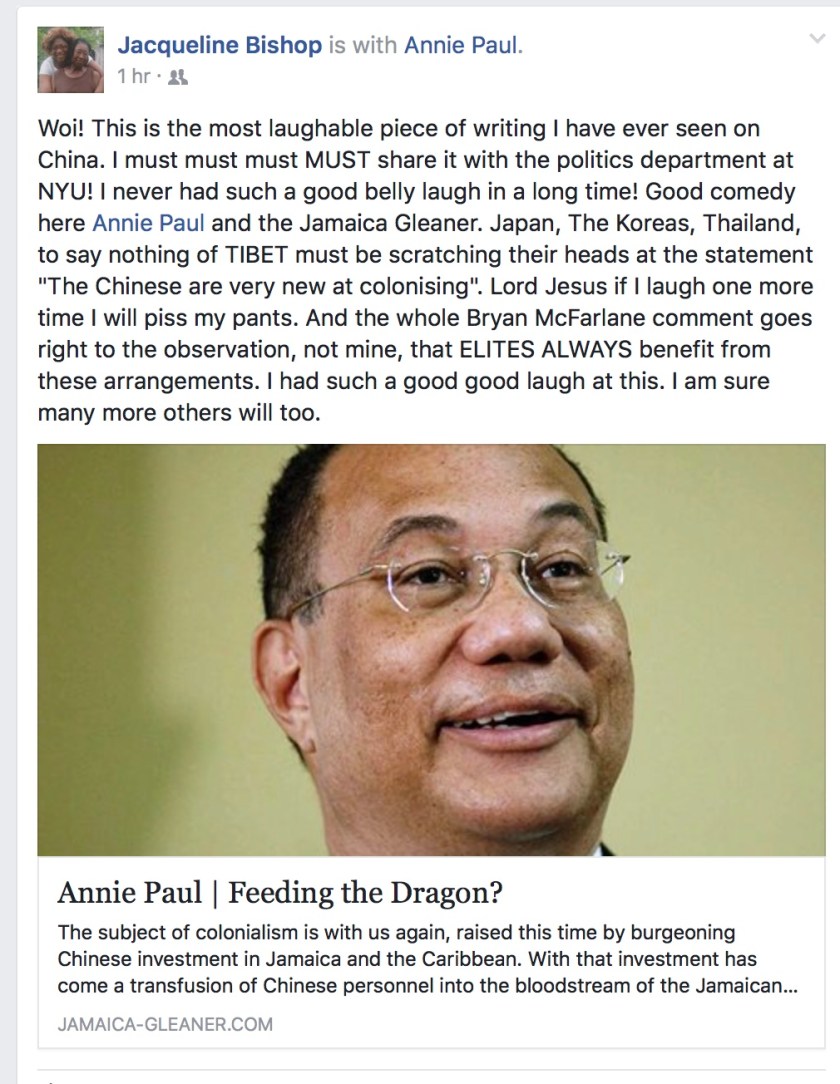
The day after my column Feeding the Dragon (see previous post) was published in the Daily Gleaner the indefatigable Jacqueline Bishop tried once again to draw me into a Facebook spat by tagging me in her snarky response to my piece (see above). On a previous occasion when Bishop did this (that time it was an article by Seph Rodney in the online art forum, Hyperallergic) I politely declined to engage saying that although she was clearly spoiling for a fight, she wouldn’t get any satisfaction from me. I had responded to the article in question on Hyperallergic’s website and saw no reason, I said, to explain myself to Bishop on Facebook. Bishop then proceeded to troll Seph Rodney, the author of the article, and myself, both on Facebook and in the comments section of the Hyperallergic article. Her seemingly proprietary interest in the matter has never been made clear.

This time around I decided to do what they advise you not to do, which is feed the trolls. Feeding them only emboldens trolls and gives them an opportunity to amplify their attacks. But since I was curious about the nature of these attacks by Bishop and how low she would stoop this time, I decided to respond, albeit tongue in cheek.

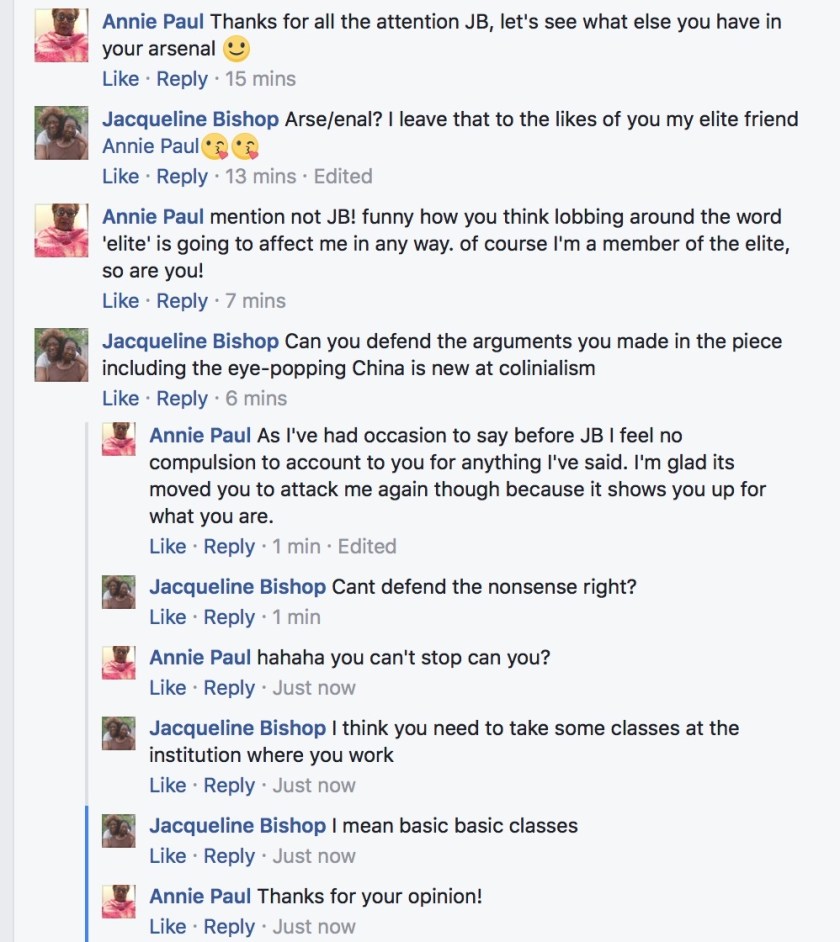
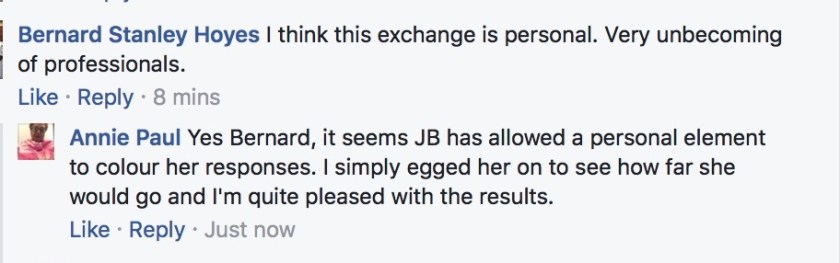
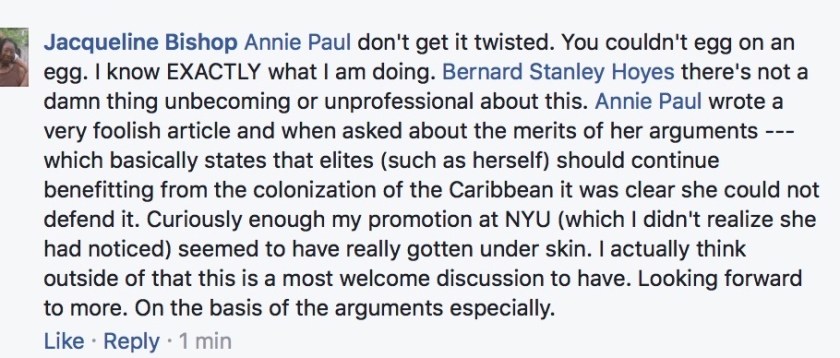
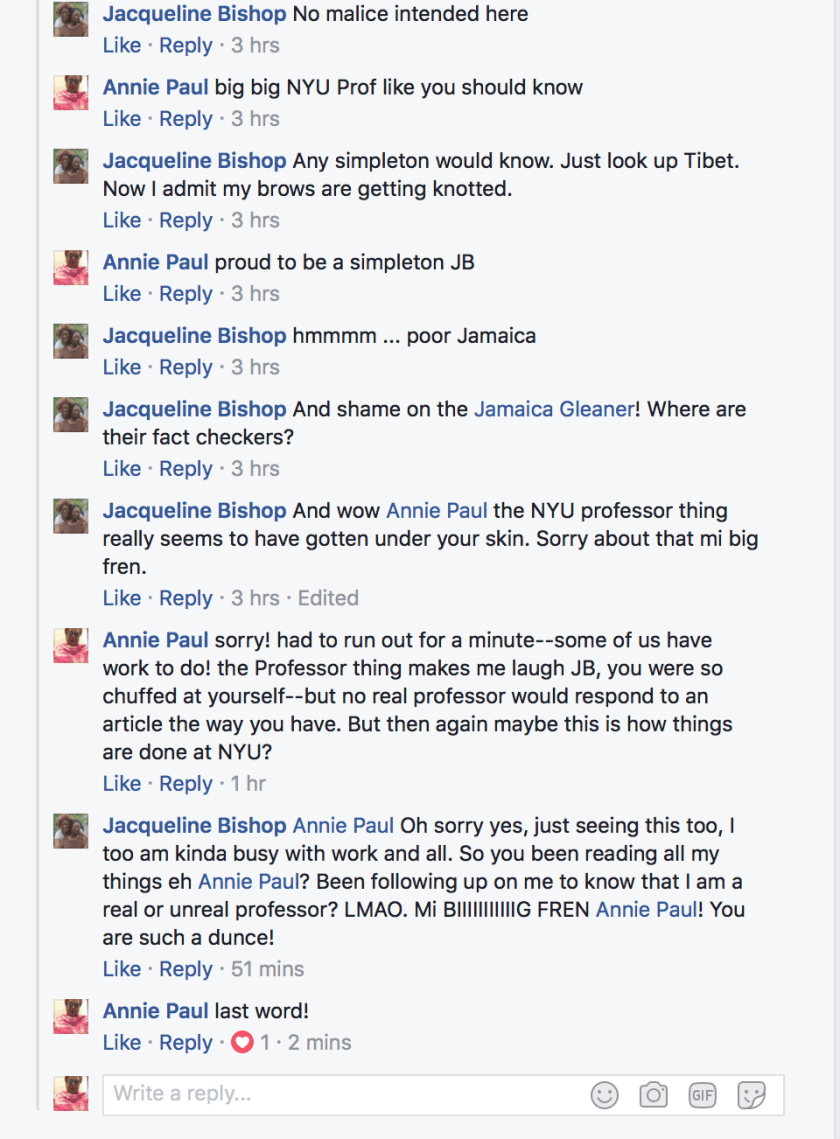
In the sorry exchange that follows (excerpts from which can be found at the end of this post) Bishop calls me a dunce and a simpleton who needs to take basic lessons at “the institution where I work” (the University of the West Indies), as well as an ‘elite’ benefitting from the colonization of the Caribbean. The vehemence and the venom with which she excoriates me might lead one to think that I had advocated something similar to Bruce Gilley’s infamous Third World Quarterly article called “The Case for Colonialism” which is exciting much comment and vituperation right now on social media and elsewhere.

Yet all I had done was mildly suggest, based on interviews with scholars such as Richard Bernal (Pro Vice-Chancellor, Global Affairs, University of the West Indies) and artist Bryan McFarlane who has had a studio in Beijing for a decade now, that perhaps the accusation of ‘colonialism’ to describe the relationship between China and the Caribbean might be overstated.

Bishop takes exception to my quoting McFarlane saying that the Chinese are new at ‘colonizing’ in the classical sense of the word, having had little or no history of European-style colonizing of the planet. This leaves Bishop incredulous and she lists Japan, Thailand, Korea and Tibet as counter-examples. But, as an eminent writer said, after  reading her comments, she seems not to know the difference between ‘colonization’ and ‘invasion’, a rather crucial distinction in this instance.

My article is a far cry from Gilley’s which asserts that colonialism is a force for good in the world, anti-colonial sentiment is ‘preposterous’ and a new  program of colonization is needed, “with Western powers taking over the governing functions of less developed countries.” As outrageous as his article is, Gilley hasn’t attracted the kind of ad hominem attacks I have from Bishop. Whereas it has been widely ridiculed, the standard of put-down has been considerably superior to the abuse that was lobbed at me, with the following example being a stand-out in my opinion:

Crispin Bates: Next week’s special issue could be about why we need to bring back castrati in order to restore the quality of Italian opera. This author and Shashi Tharoor seem almost perfect mirrors of one another. Are they related by any chance?

Dilip Menon: There would be high-pitched objections to that surely.

But at the end of the day, the wittiest take-down isn’t enough to discredit an article appearing in a respected academic journal even if many consider it self-evidently absurd. Hooting and cackling on Facebook isn’t going to do it, you actually have to engage with it, demolishing it by systematically countering its arguments with historical facts and evidence. This is what Nathan Robinson does in the latest issue of Current Affairs saying  that it’s worth responding to the case Gilley makes because he appears to be sincere and the article appeared in a mainstream journal, and the sentiments it expresses are somewhat common:

I go into this level of detail because I think it’s crucial to show that Gilley’s article is not a serious work of scholarship. I think the gut reaction of many people will be that Gilley’s arguments are “self-evidently” absurd. But apparently this is not the case, because the Third World Quarterly chose to publish them.

Unfortunately, neither I nor the Daily Gleaner was afforded this courtesy by Bishop who chose instead to insinuate that the Gleaner’s fact-checkers had fallen asleep. The abusive tone of her responses on Facebook hardly shows either Bishop or New York University where she is a clinical associate professor, in a good light. It’s important to note, especially for those not familiar with the American academy that a clinical professor is not the same as a specialized, tenure-track research professor or what in our system is called a lecturer. You would hardly see such professors/lecturers resorting to the kind of cyber-bullying that Bishop seems to revel in.

Bishop is a highly regarded writer and art impresario who occasionally writes for The Huffington Post and I have given her no cause, personally, to nourish a grudge against me. The raging desire to belittle and discredit me displayed in the screenshots of our Facebook exchange below requires some other explanation. Perhaps she is acting on someone else’s behalf?

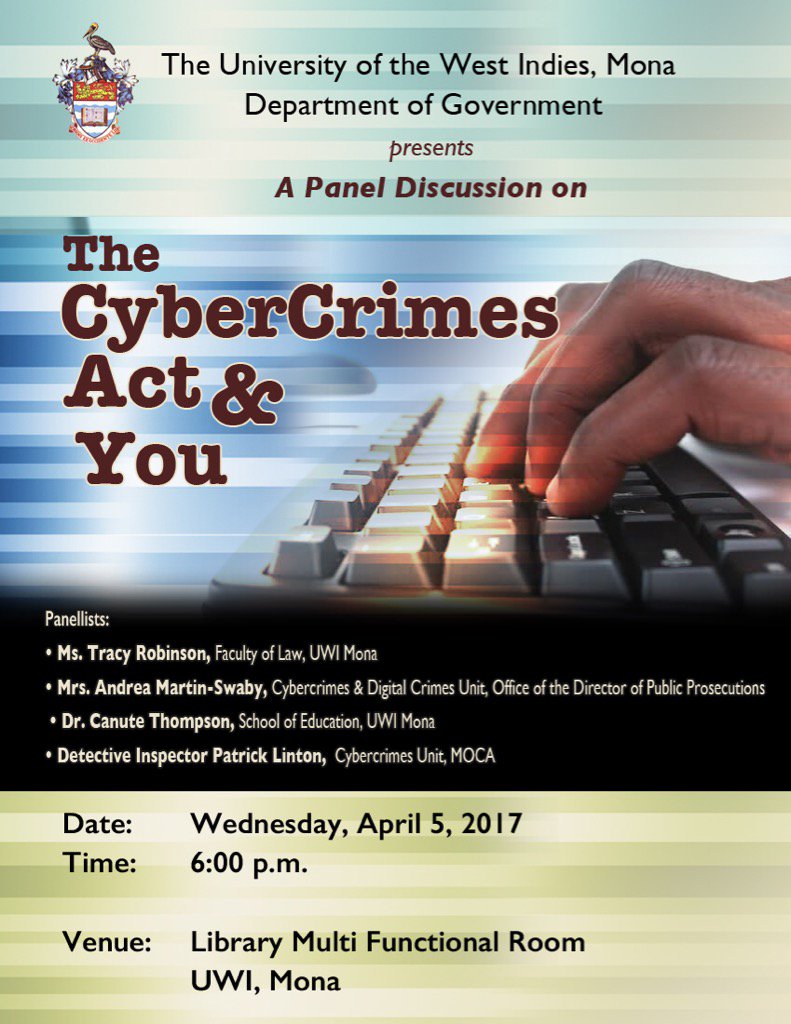
Whatever her motives are I would urge Bishop the next time she decides to publicly berate me, to not tag me in her posts. Despite her repeated claims that “no malice is intended” she might find herself running afoul of the Jamaican Cybercrimes Act. “Use of a computer for malicious communication,” is actually a thing here.

Below are snippets of the Facebook exchange that followed Bishop’s opening salvo, quoted at the top of this post.


arsenal


personal elementegging on etc

Screenshot 2017-08-30 13.33.06

dunceHoyes not productive

What if…?

Screenshot 2017-08-31 08.33.09

Gleaner column of August 2, 2017

Confederates, a new HBO series which will follow its blockbuster Game of Thrones, has excited quite a reaction on social media with its premise: What if the South won the Civil War? What would the United States look like today? It prompted Jamal Richardson,  @HoodAcademic on Twitter, to suggest other alternative histories to make into TV shows instead of “WHAT IF THE CONFEDERATES/NAZIS WON?”

This spurred several intriguing responses on Twitter. For instance, What if Rome had evolved into an early UN and we had fast, world-wide communication in 600 CE? What if the French beat the British for control of North America? What if the African traditional religions priests and priestesses converted the Christian missionaries? What if Afro/Indigenous Cubans revolts succeeded in overthrowing the Spanish before the US showed up, and created an economic/political alliance with Haiti? What if Nkrumah/Lumumba/Sankara survived to create the United States of Africa. TV show depicts them trying to liberate S Africa from the settlers.

In Jamaica, Erin MacLeod, posted her friend Moji Anderson’s ideas for a range of alternative history tv shows based in/on Jamaica. Dr. Anderson who is a lecturer in Anthropology in the Faculty of Social Sciences at the University of the West Indies, Mona, and is not on social media herself, had come up with a formidable list which provides much to reflect on, sandwiched as we are between Emancipation Day and Independence Day.

Moji’s list is a veritable treasure trove for would be film and TV series makers out there and I reproduce it in full here:

What if Marcus Garvey hadn’t left JA?
What if the Maroons hadn’t agreed to capture and kill rebels?
What if Michael Manley had managed to keep out the IMF?
What if he hadn’t allowed rich Jamaicans to leave?
What if Bedward hadn’t been sent to Bellevue?
What if MG had got his Black Star Line together and people went to Africa?
What if the Taino hadn’t been decimated?
What if Howell kept Pinaccle?
What if Haiti’s revolution spread before 1834?
What if JA didn’t allow tourism all those years ago?
What if Taki won?
What if WI Federation had happened?
What if emigration was prohibited? All the way from 1800s
What if slaves on every slave ship had committed mass suicide?
Or mass insurrection and taken over the ships?
What if Dutty Boukman had stayed home?
What if we hadn’t allowed St Domingue slave owners to flee here?
What if we’d timed a rebellion with Haiti’s and we both got indie at the same time?
What if we’d broken the French imposed embargo on new Haiti?
What if more people could have gone to secondary school in the early twentieth century?
What if Walter Rodney hadn’t been banned from JA?
What if Haile Selassie never granted Shashamane to foreigners?
What if we actually gained independence? (Ok that was snarky)
What if Bob didn’t die of cancer and stayed in JA?
What if they didn’t kill Peter Tosh?
What if post Emancipation immigration was banned?
What if the US army had come for Dudus and not the JDF?
What if Revivalism, Kumina, and Rastafari were national religions?
What if Patwa was our official language?
What if Chronixx was PM?
What if after the concert, Manley and Seaga had held a referendum and Bob was nominated as PM?

All I can add to this list is What if Whappie neva kill Phillup? And moving beyond Jamaica what if Trump’s mom never met his dad? On the local front Losing Patience is a new micro webseries produced by director and writer Teeqs and Justine Henzell, Michelle Serieux and others which seems to answer the question “What if we peep at moments in the life of an attractive, dark-skinned young Jamaican office worker?” Starring the singer Sevana, who also seems to have serious acting talent, the humorous series premiered on TVJ in July and promises to change the lacklustre pace of local TV production with buy in from savvy investors. There is a huge market waiting for snappy, smart mini-series like this from countries like Jamaica.

Screenshot 2017-08-31 08.31.53

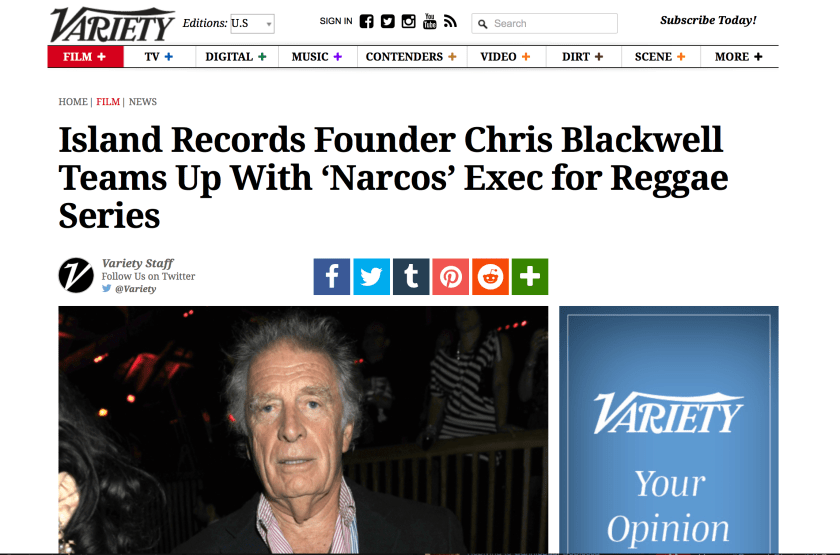
Meanwhile news broke that Island Records’ Chris Blackwell is partnering with the producers of Netflix blockbuster “Narcos” and novelist Marlon James to develop a series exploring “the resounding local and global impact of iconic Jamaican music.” The show will look at “the political discord that followed in the wake of Jamaican independence from Britain in 1962 and the birth of a local music industry that reached, and changed, the world.” This promises to be exciting with characters ranging from Millie Small and Desmond Dekker to Norman Manley and Alexander Bustamante. According to Marlon James it will be about the music but also politics and the last days of colony.

What if there were more savvy business people in Jamaica with the imagination and will  to exploit the rich mother lode of Jamaican culture and history?

Routes and Culture

IMG_4655
Cutting a cake for Marcus Garvey at the launch of Cinema Paradiso

Below is my Gleaner column of August 16.

Last weekend I found myself repeatedly being reminded of something the eminent social and cultural theorist Stuart Hall was fond of saying about identity and culture: “If you think of culture always as a return to roots — R-O-O-T-S — you’re missing the point. I think of culture as routes — R-O-U-T-E-S — the various routes by which people travel, culture travels, culture moves, culture develops, and culture changes, cultures migrate, etc.”

I found myself thinking this as I watched Rasta: A Soul’s Journey, a film starring Donisha Prendergast, that kicked off Cinema Paradise, the Portie film festival put on by Portland-based Great Huts Resort. Produced by Patricia Scarlett whose brainchild it was, Rasta tracked the routes taken by Rastafari as it traveled across the world, reincarnating itself in various locations from Ethiopia to South Africa to Canada to England.

Cultural identity, Hall said, is what you make with what you find. Thus Donisha Prendergast, found herself born in Jamaica into the family of Bob Marley, her maternal grandmother being Rita Marley, whose first child Sharon, Donisha’s mother, was adopted by the famous singer. Though not connected to Bob by blood, Donisha grew up identifying with him as her grandfather and Rastafari as her cultural heritage.

The film followed her travel to eight countries linking with those espousing the tenets of Rastafari far from the Caribbean island where it was born. Thus Prendergast was following the routes taken by the culture of Rastafari as it rooted itself in different parts of the world. The second film in the Portie Film Festival, screened the following night at Great Huts, was Shashamane by Giulia Amati, an in-depth look at Jamaican and Caribbean migrants to Ethiopia, who went there in enactment of the Back to Africa ideology so integral to Rastafari.

Theirs was an attempt to return to their roots, to the legendary promised land, “We’re leaving Babylon, We’re going to our Fatherland” as Bob Marley sang in Exodus. But it was a bittersweet experience for the few who survived and remained in Shashamane, especially after Emperor Haile Selassie who had donated the 500 acres of land in 1948 for descendants of the enslaved to repatriate to, was deposed in 1974. The communist government that followed reclaimed most of the land leaving just a little for the Rastafari who had been living there since the early 60s, to call their own.

As Ras Mweya Masimba, the protagonist of the film said: “After being so long in the Western world, it’s a joy to be back in Africa. But it’s a very great challenge. We are coming back here now as foreigners. People don’t remember who we are, or forget that they sold us into slavery, or how we left here. It is a hard task of re-integration with the people on all levels.”

IMG_4679
Dr. Paul Rhodes introducing the film Shashamane at Africana House

The film Shashamane captures exactly why thinking of culture exclusively in terms of one’s biological and ancestral roots is insufficient. The routes Masimba and his ancestors took or were taken on, from Western Africa to Jamaica to the UK, where he lived before migrating to Shashamane, defined his identity and made him who he is just as much as his ancestral origins. What comes across clearly in the film is how Jamaican/Caribbean and Rastafarian the culture of most of those who migrated from this region to Shashamane, has remained.

“I’ve got to go back home, This couldn’t be my home, It must be somewhere else…”, plaintively sang another Jamaican singer, Bob Andy, in his contribution to the back to Africa discourse. But going back is easier to sing about than to accomplish. In the words of Bro Trika, another resident of Shashamane, “It was a complete challenge to make it here to Ethiopia. And a lot of people couldn’t do it. So whenever you see people come from outside to Africa, you have to respect them. Because there are so many people who don′t have the guts to leave the developed countries to come here.”

IMG_4709
A chair by Gilbert Nicely

There was something poetic about viewing Shashamane at Great Huts in Boston Bay, an Afrocentric resort created by an American medical doctor, Paul Rhodes, who first visited Jamaica in 1973 as a medical student. In Brooklyn where he studied, his landlord, Edward Gentles, was a Jamaican. It was a Caribbean neighborhood and Rhodes, a secular Jew, felt a kinship with Rastafari, because of the common histories of persecution and longing for a promised land to call one’s own. “Many Jews would look upon the Rastafari as their brethren,” explained Dr. Paul, the name by which he’s popularly known.

With its ingenious architecture and design, furniture by master carver Gilbert Nicely, statuary by master potter Sylvester Stephens, artworks by Mazola, Alicia Brown and others, Great Huts occupies the land with a lightness of being that’s bracing. If you’re ever in the area you should check it out, it’s a serious hat tip to African roots/routes and culture right here in Jamaica.

A new cadre of investigative journalists

IMG_4809
Zahra Burton of 18 Degrees North

Have been forgetting to update Active Voice with my Gleaner columns. This one is from August 9.

Jamaica consistently ranks highly in global press freedom rankings, yet seems to exploit that freedom too little. There’s a burning need for hard-hitting, in-depth journalism exposing and stemming the rampant white collar crime and corruption we live with yet it’s something our media houses don’t focus on enough, a state of affairs in itself worthy of serious investigation.

So it gladdened my heart when freelance journalist and writer Kate Chappell recently brought a community journalism training program titled Building a Journalist With Integrity and Impact to my attention. Chappell, along with Zahra Burton of Global Reporters for the Caribbean, has been working with Omar Lewis, Civil Society Coordinator at National Integrity Action (NIA) and Ian McKnight, Chief of Party USAID COMET II, to train about 30 community members in investigative journalism and will be publishing 10 pieces (in print, radio and television outlets such as ROOTS FM, MORE FM, The Gleaner and POWER 106) produced by the novice journalists in the next few weeks. The aim of the program is to cultivate investigative skills as well as to hold authorities accountable by using tools such as the Access to Information Act (ATI).

Zahra Burton as many of us know is the star reporter of 18 Degrees North, a TV news magazine inspired by shows such as CBS’s 60 Minutes and ABC’s Nightline. With Zahra’s rigorous approach to journalism and Chappell’s organizational and empathic skills, and the help of mentors such as Dennis Brooks and Kalilah Reynolds, fourteen women and 13 men with a mix of educational levels, mostly in their 20s and 30s, were trained at the end of April and have spent the last three months researching, interviewing, writing and putting together pieces to air or be published in media outlets.

The project coordinators were interested in training community members to report on what happens in their communities with a particular interest in good stories that hold people to account, instead of the standard media fare of “Everybody a tief and rape and kill each other”. One story involved churches and noise pollution. One day Burton received a call from the veteran dub poet Oku Onoura in Portmore saying “18 degrees North I have a story for you…” The story involved a church near Onoura’s house making intolerable noise that he wanted help in curbing. The group investigated the situation and produced a story with a clever lead in: “Oku Onuora has been attending church every Sunday morning, though not by choice. He goes up to four times a week depending on when his neighbour, Harvest Temple Apostolic, chooses to meet.”

“So we’re trying to do the kinds of stories that maybe people do want to tell, but that maybe another outlet may not be interested in because it’s too small an issue, it’s too big an issue, it’s too rural an issue,” said Burton who also arranged for a screening of the film Spotlight, some months ago in Kingston, which focused on the Boston Globe’s exposure of child sexual abuse in the Catholic Church.

I spoke to two participants from the training program, Sharlene Hendricks and Jamaila Maitland, both of whom had studied at CARIMAC. Sharlene described the investigative journalism training as exceptional, especially learning to use the ATI Act to pry out information from tight-lipped government ministries and agencies. A resident of Rae Town in downtown Kingston, Sharlene focused on the adverse effects of the dredging of Kingston Harbor on fishermen who were being insufficiently compensated for the reduction in their fish catch by Kingston Freeport Terminal Limited (KFTL), the entity doing the dredging.

Sharlene’s team started by finding out the process by which fishermen would be compensated, under what legislation the dredging was being undertaken and the terms of the beach license granted. Some of this was obtained from NEPA but the ATI request to KFTL revealed that the company was private, not government-owned which meant that they had to be persuaded to release information. Charlene and her team were eventually successful in getting the information they wanted.

Another aspect of the Rae Town story was environmental as it seemed KFTL was dumping what it was dredging up, in the community, silting up archaeological sites in the process, but doing so legally with NEPA’s permission. An examination of the weekly reports KFTL was required to make showed that complaints were being registered but NEPA advised KPTL to ignore these and proceed, as the beach license granted them leeway to dump there! While NEPA’s ATI officer was forthcoming, Sharlene was unable to get a comment from someone senior at NEPA in charge of monitoring KFTL, a problem Chappell said many of the trainees had when attempting to get interviews with those in charge.

Jamila Maitland and her team’s TV report stemmed from a budget speech made by PM Holness in 2016 after a number of women were brutally murdered by their partners, in which he promised there would be a domestic violence coordinator in every police station in the country. Calls made to 40 police stations a year later revealed only one domestic violence coordinator in place.

Kudos to all concerned for this much-needed fillip to local journalism.

Reggae inna India

IMG_1391IMG_1392

I’ve been enjoying the month of July off from my column, so much that I’ve even forgotten to post the last few columns from June. This is my Gleaner column from June 9. Taru and Samara have received much publicity recently with a really good Guardian article about them last week. 

With all the angst about two Japanese performers supposedly taking over the Jamaican music scene by entering local competitions and dominating them (Japanese sound system Yard Beat beating Jamaica’s Bass Odyssey in the Boom Sound Clash finals, and Japanese reggae/dancehall artiste Rankin Pumpkin, nearly winning Magnum Kings and Queens) I thought I might highlight a happier story about the export of Jamaican music and culture.

Last month Al Jazeera aired a half hour documentary called India’s Reggae Resistance: Defending Dissent Under Modi. The film featured a musician named Taru Dalmia aka Delhi Sultanate and his partner, singer Samara Chopra aka Begum X. Principals in a band named the Ska Vengers, bringing classic Reggae to the masses of India is their mission.

After current Prime Minister of India Narendra Modi was elected the Ska Vengers produced a confrontational video called A Message to You, Modi, with lyrics that went”Stop your fooling around / Messing up our future / Time to straighten right out / You should have wound up in jail.” Like many other artists, writers and musicians they were worried about what the new regime might mean for freedom of speech. The bold song earned the band a lot of attention attracting filmmaker Vikram Singh, who made the Al Jazeera documentary.

I met Delhi Sultanate and Begum X about three years ago when they visited Jamaica. For them it was a pilgrimage, a much cherished visit to the holy land so to speak. For Taru in particular the trip was like living a dream because of the close emotional and psychic connection he feels with Jamaican music. He first encountered Reggae as a young teenager living in Germany where his mother taught Hindi. The bond was immediate and his love for the music followed him to Berkeley in California where his family moved next.

In California Taru hung out with youngsters whose parents had been members of the Black Panthers and continued to nourish his radical roots with Reggae. Fast forward to today and Delhi where he now lives. The documentary showed Taru and Samara in the process of getting a large sound system built called Bass Foundations Roots – BFR Sound System. Their plan is to tour the country with it, visiting sites of environmental and human rights protests bringing Reggae, which they see as the quintessential protest music, to protesters.

An earlier project called World Sound Power, tried to meld Indian folk resistance music with Jamaican sounds, with lyrics focusing on caste violence, state abuse of power and crony capitalism. With the BFR Sound System their intention is quite simple and revolutionary. As Taru explained in an interview on criticallegalthinking.com:

“We can make people dance. Our sound system is powerful and can create a sense of physical well-being and connectedness in listeners. At present, this is one thing that we can contribute to political spaces and gatherings. There is a time for speeches, for critical discourse for discussion, for slogans, but dancing and singing together is also very important. We will only get through these times if we find joy in each other and build strong relationships of trust and care, with each other as well as with the larger community. It’s the only way I find myself being able to not get depressed and to despair.”

Begum X who has a yoga therapy show on TV also sings over the sound. She’s a small woman with a big voice, when you hear her you look around expecting to see someone like Ella Fitzgerald or Sarah Vaughan only to see a petite pixie like figure dancing Jamaican stylee in between belting out lyrics. She designs all the graphics and organizes the shows.

Both Taru and Samara sing in Patwa which the former fluently raps and DJs in, something people are surprised by. According to him if you sing in American English or perform on a theatre stage in India with a British accent it is considered normal, but “speak in English from another colony and people start raising questions at once. JA to my knowledge is the only colony that has managed to export its form of English globally.”

In the criticallegalthinking.com interview Taru elaborated on his unusual identity formation: “I consider the heritage that made Reggae to be part of my heritage, and my work aims to bring this into the Indian context. For me there are also clear links between the forces that underpin Reggae music and things that are happening in India today. The colours red, gold and green have concrete meaning here, incidentally the first national flag of India or the flag of the revolutionary Gaddar party also featured Red, Gold and Green. Red stands for the blood of the martyrs, green stands for natural abundance, and gold stands for the wealth that is inside the earth.”

So what do you say? Are Delhi Sultanate and Begum X not the most unlikely but inspiring Reggae Ambassadors ever? So what if the Japanese are invading Jamaican culture? The groundwork is being laid for access to the second-largest market in the world. Run wid it producers!

Garvey Lite?

Garvey v. 1
Bust of Marcus Garvey v. 1. After a massive protest by Rastas in Papine Square on June 25, 2017, the University of the West Indies agreed to take down the offending bust and replace it with another that would approximate the demands for a big-head, big nosed Garvey more like the photos that exist of him.

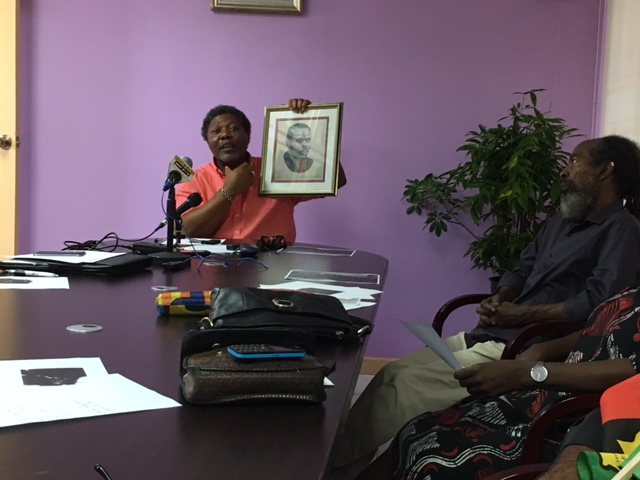
My column of June 2 in the Gleaner. After much public agitation and disapproval the University of the West Indies finally agreed to bow to public pressure and withdraw the offending bust. At a tumultuous press briefing (see video above for a brief taste of the event) the Dean confirmed that a new bust would be produced by August 2017. The sculptor would still be Raymond Watson. At the briefing Watson said that he had tried to create a youthful image of Garvey, to befit the University setting where the bust would be installed.

During his lifetime Garvey was much vilified as those who fight the status quo often are. Born in Jamaica he strode forth boldly into the world and changed it by rallying people of African origin who had been systematically exploited and denigrated by slavery. His influence rebounded all the way from the Americas to Africa, where he promised to take all those who wanted to ‘go back home’ in the immortal words of Jamaican singing star Bob Andy. To the pre-eminent shipping enterprise of the day, White Star Line, he counterpoised his Black Star Line, a fleet of ships that would carry the descendants of slaves back to Africa. The rest is history.

Decades after they’re gone how do we memorialize such individuals? In May 2017 during a short run of Garvey: The Musical at the University of the West Indies in Kingston a bust of the great man was unveiled at the Department of Humanities and Education. Members of the Marcus Garvey Movement on campus had demanded a statue of Garvey after a life-size one of Mahatma Gandhi was installed there a few years ago. How could the University pay tribute to an Indian leader before even nodding in the direction of its own home-grown hero, the first national hero of the country, they asked.

Accordingly the Dean of the Faculty of Humanities and Education (FHE), Professor Waibinte Wariboko, a Nigerian by birth, volunteered to take on the task of arranging for a suitable monument to the great man. A Jamaican sculptor, Raymond Watson, was commissioned to produce a bust, the University’s slender resources not stretching to accommodate the expense of a full-bodied statue in these hard times.

Details of the commission, such as the brief presented to the sculptor, are unknown but on May 19 the bust was duly unveiled in the courtyard of the FHE. The ceremony was timed to coincide with the visit of Professor Rahamon Adisa Bello, vice-chancellor of the University of Lagos in Nigeria, who jointly unveiled it with the Principal of the Mona Campus, Archibald McDonald. When they ritually removed the cover revealing the modest bust underneath a gasp of consternation went up from the audience. Rastafari representatives in the audience started grumbling loudly that this was the statue of an imposter, not Garvey, this slim, unremarkable, downtrodden looking person could never represent the magnificent Marcus. Garvey, they said. Many agreed.

“Garvey seems poorly. His posture conveys passivity. He looks like a weakling,” declared Carolyn Cooper in her column. #NotmyGarvey protested lecturer Isis Semaj-Hall commenting on what she called the “slimmed down interpretation” of the great leader. This is a “UWI interpretation of Garvey” said a Facebook commenter while Xavier Hutchinson accused the sculptor of “fat shaming one of my heroes.”

Suzette Gardner was kinder to Watson: “Maybe he was trying to inspire young people capturing Garvey as a youth. Still, Garvey might have been slimmer but his head was always big. Give us our big headed Garvey so the youth can know him as he was – young or old!”

According to Am’n Ron: “Regardless of the artist’s explanation this presentation should never have been approved. This was a moment for a recognizable rendering that will last through the generations and not a moment for a random artistic interpretation. From what period in Garvey’s life did he take this, and what is the image source he used? This seemingly made a mockery of the whole effort. I fully appreciate the spirit of the mounting of a Garvey bust, and I agree that it was overdue, but I’m in agreement with the woman who calmly said, “tek it dung!”  To those who have the authority, please replace it. It feels disrespectful.”

Another Facebook commenter said: “I’ve been too upset to speak on it but i have  much more to say. I will write and share. The best part of the ceremony for me was catching up with people I have not seen in ages. Unfortunately it was an upsetting occasion for all of us.”

For me the problem wasn’t so much that the bust didn’t look anything like the Garvey we feel we’ve come to know and love. It’s the scale and unambitious scope of the representation that bother me.The only other life-like sculptures on campus are of Mahatma Gandhi (Indian) and Philip Sherlock (white) both full body representations. Then for the champion of black identity you have a modest bust. It’s a problem to say the least.

In the weeks since the unveiling calls have been mounting for the removal of the ‘fake’ statue of Garvey. The Gandhi and Sherlock sculptures were gifts to the university, and it may be that those who feel strongly about this might have to undertake to commission a better representation of Garvey that can be situated at the University of the West Indies or some other location.

IMG_4414
Petrina Dacres, whose Ph.D dissertation, “Modern monuments: Fashioning history and identity in post -colonial Jamaica” documents the furore surrounding almost every public monument in Jamaica, was also at the press briefing.

In future any public commissions of art should be informed by the well-documented history of responses to public monuments in Jamaica. Edna Manley lecturer and first Stuart Hall Fellow Petrina Dacres has written an entire thesis on the subject. There is no excuse to be caught by surprise like this. Contrary to what many seem to think, commissions of public statuary are not occasions for artists to wield artistic license and express themselves as they would with work meant for a gallery or private setting.

Rudies don’t fear…

IMG_1348

My unedited Gleaner column of May 17, 2017

The case of Latoya Nugent, her arrest and trial on three counts of ‘using a computer for malicious communication’ under the Cybercrimes Act came to a head on May 17, 2017. After pleading ‘not guilty’ to the three charges brought against her by the Thompson brothers, the apparently trumped up case against her was finally dismissed.

Essentially Paula Llewellyn, the Director of Public Prosecutions (DPP), who intervened in the case, admitted that Ms Nugent could not be found guilty because her actions had not been criminally liable.  The DPP acknowledged that the postings allegedly made by Nugent were offensive and perhaps intentional but they didn’t come anywhere near meeting the ‘high threshold’ of evidence required by Section 9 of the Cybercrimes Act.

“In other words, it was offensive, but it was not at the level to make it obscene, or threatening, or menacing,” Paula Llewellyn told The Gleaner outside court.

This is interesting in light of the fact that Nugent had not only named alleged sexual predators on social media, she had then responded to their lawyer with an ‘expletive-filled’ letter. Many senior journalists had already pronounced Nugent guilty and seemed to approve of her arrest by the police but surely they must re-assess their understanding of what constitutes cybercrime now? Also what constitutes obscenity?

What Latoya may have been guilty of was offending certain deeply held notions of propriety in Jamaica where cursing is forbidden, no one should be ‘out of order’, especially women, the young should yield to the old, and everyone is referred to as a ‘lady’ or a ‘gentleman’, even crooks and murderers. Advocating on behalf of children and women who have been systematically violated and abused Nugent was in no mood to mince her words or be silenced and for this she was crucified. ‘She had it coming’ thought most of her critics when she was arrested but now they’re confronted with the fact that ‘she had it coming’ doesn’t constitute a criminal charge.

What civil society must ask in the wake of the DPP’s statements about the lack of evidence against Ms. Nugent is what made the Police act in the manner they did? Six heavily armed policemen invaded her home looking for her, then when they couldn’t find her, invaded Mary Seacole Hall, a dormitory on the University of the West Indies campus, where they intimidated her colleague, Student Services Manager, Nadeen Spence. Spence described the terror of those moments and the complete lack of support from civil society going on to say “The media wants to put us in our place and have us speak in proper hushed tones.” Is this the rightful role of the media?

As we all know, Ms Nugent was subsequently arrested and hauled off to a lockup where she was detained overnight. The manner of her arrest, with the Police brandishing high powered weapons suggested they were apprehending a kingfish of organized crime or at the very least a serious menace to the nation. They showed no warrant either when arresting her or seizing her property. Surely this is highly irregular? What does the media have to say about this complete overstepping of bounds by the police? Or is such censure reserved only for women who step out of bounds?

At the same time let’s contrast the extraordinary treatment of Latoya Nugent with the relative lack of resolve of the Police when confronted with actual gangsters and threats to the nation. In such cases Police are impotent, apparently, until some external government flexes its muscles and insists that the Jamaican Police do their job.

Thus the Gleaner recently editorialized about the fact that “since 2006, lottery scammers have operated in St James and other parts of western Jamaica with virtual impunity, and they have been sullying Jamaica’s name internationally.” The scammers have terrorized Western Jamaica unstemmed by police action, as they went about their business of fleecing thousands of elderly Americans. Pointing out that It was the extradition of an alleged mastermind and eight others at the insistence of the US that had finally prompted police action, the Gleaner lambasted “the tepid response of the Jamaican justice system.”

“This newspaper believes it is quite humiliating that our local authorities have been largely impotent in investigating and bringing to justice the people behind scamming, which are said to include police officers… Jamaica… has demonstrated that it is weak in its attempt at reining in criminals, whether they are white-collar offenders who ravage people via Ponzi schemes, or they are heavily armed street gangs.”

Is it too much to ask that some of the zeal displayed by the Police in arresting and charging impolite women be diverted to the apprehension and prosecution of real criminals? Meanwhile as Stella Gibson, Latoya Nugent’s alter ego said on Facebook:

“As long as I breathe abusers will never silence me.
As long as I breathe paedophiles will never silence me.
As long as I breathe sexual predators will never silence me.
As long as I breathe, the state will never silence me.”

Rudies don’t fear (as the song goes), rudies don’t fear.


Kingston: Creative City Not?

IMG_1396

Kingston on the Edge (KOTE), an urban art festival held every June, will not celebrate its tenth anniversary this year due mainly to dwindling support from corporate Jamaica. The email press release from the organizers of the festival said simply:
“The staging of KOTE is a large undertaking and can be difficult given that it is a 10 day studio and performing art festival held at over 26 venues throughout Kingston with hundreds of artists participating.”

“This year KOTE Milestones would have been our 10th anniversary however unfortunately given a combination of factors and unforeseen circumstances including not least of all the financial strain of the festival, we have been forced to cancel KOTE 2017.”

The cancelling of KOTE is a blow to Kingston’s cultural calendar as it was a showcase for artists, writers, musicians, poets, dancers and others involved in the expressive arts. Typically KOTE events catered to aficionados of alternative music (alternative to Reggae and Dancehall that is), modern dance, poetry, theatre, architecture, pottery and visual art, bringing a wide range of patrons, young and old, out of their closets for this rich cultural immersion.

IMG_1397
David Marchand (photo: Chloe Walters-Wallace)

For example at KOTE 2015, David Marchand, the fantastically eccentric and reclusive visual artist found dead in his Runaway Bay home last week, had his first solo exhibition in 23 years featuring 55 of his art works. Titled “Tsunami Scarecrow: A David Marchand Retrospective” the launch of the exhibition featured opening words by Maxine Walters, a dedicated patron of his work, jazz compositions by Seretse Small and a preview of a documentary on Marchand by Chloe Walters Wallace. Marchand liked to think of himself as “a visual Bob Marley”, but I think Lee ‘Scratch’ Perry offers a better comparison.

Another year the highlight of KOTE was a guided bus trip starting at Wolmer’s Boys’ School, the site of the 1891 World Fair and stopping at different locations in Kingston that once were tourist sites. Conducted by architect Evon Williams, the tour extended from the site of the now defunct Myrtle Bank Hotel downtown to Immaculate Conception Convent in uptown Kingston once better known as the Constant Spring Hotel. To visit its beautiful lobby and environs is to take a step back in time, for the nuns have changed the buildings very little and done a good job of maintaining its serene ambiance.

KOTE also pioneered what has become a regular feature of the National Gallery of Jamaica, its Last Sundays programme, when the Gallery is open to the public for free with performative offerings in addition to the art exhibtions. Hard to believe that sponsors were not forthcoming for such a beautifully curated series of events showcasing Kingston as the creative hub it is.

Trinidad and Tobago, on the other hand, even with a depressed economy due to plummeting oil prices was able to find the resources to continue hosting their excellent little literary showcase, the NGC Bocas Lit Fest. Aside from their title sponsor, the Trinidad and Tobago Gas Company, Bocas has 30 or more other sponsors including One Caribbean Media willing to support and celebrate Caribbean talent.

IMG_3772
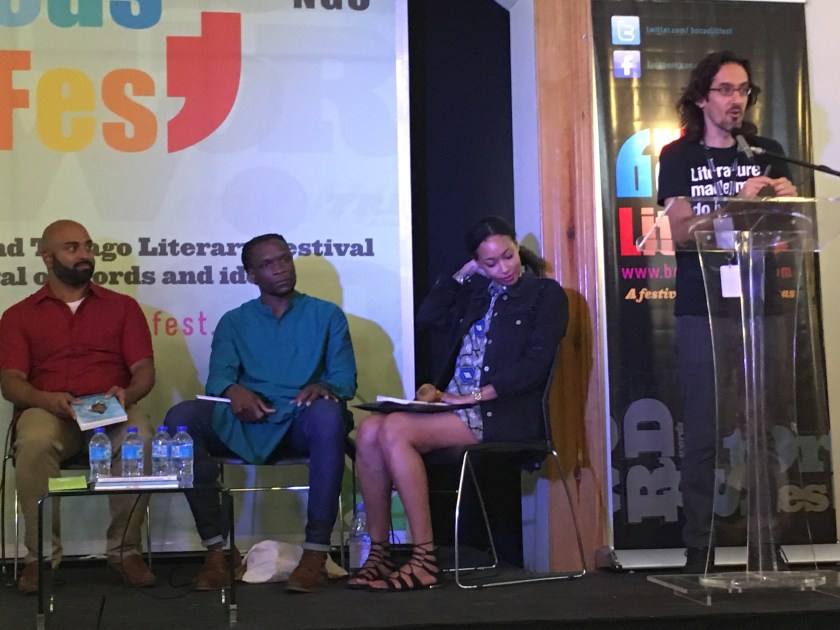
Ishion Hutchinson (2nd from left), Safiya Sinclair at Bocas Lit Fest. At mike Nicholas Laughlin

Jamaica dominated the festival this year, leading people to refer to it as the Jamaican Bocas, which culminated in Kei Miller winning the overall Bocas Award for his consummate novel, Augustown. Also in the running was another Jamaican, Safiya Sinclair, for her book of poetry, Cannibal. Safiya was the Bocas winner for poetry this year and is the latest wunderkid of Jamaican poetry to hit the international circuits, winning several mainstream fellowships and awards.

Another headliner at Bocas Lit Fest this year was Ishion Hutchinson, the Portland prodigy, the shearing of whose locks as a schoolboy inspired Kei Miller’s novel, Augustown. Hutchinson’s many honors include the American National Book Critics Circle Award for Poetry, a Whiting Writers Award and the Larry Levis Prize from the Academy of American Poets; he is also a finalist for the L.A. Times Book Prize in poetry. Like Sinclair, Ishion grew up in a Rasta household, she in Montego Bay and he in Port Antonio.

Festivals such as KOTE and Bocas are also about developing a ground for home-grown talent to thrive in…for how much longer can we expect our best and brightest to live in their heads? Safiya Sinclair pinpoints the sense of ‘unbelonging’ quite eloquently:

“Home was not my island, which never belonged to us Jamaicans, though it’s all we’ve known, and home was not my family’s house, which we’ve always rented, all of us acutely aware of the fact that we were living in borrowed space, that we could never truly be ourselves there. Home was not the body. Never the body—grown too tall and gangly too quickly, grown toward womanhood too late. Like a city built for myself, home was a place I carved out in my head, where the words were always the right words, where I could speak in English or patois, could formulate a song or a self. Home for me has always been poetry.”

What price press freedom?

3801A7C4-9FDA-409F-B1E1-0F8BEA7CC0F1-3295-0000043D3CCB5C60.png

When you were a child and got punished for doing something bad did you ever wish for a world in which wrong was right and right was wrong? Because then, you resentfully imagined, you might not find yourself the target of a beating or scolding so often? Well, I’m beginning to think that I may be living in such a world after all.

There are several reasons for thinking this. The arithmetic of crime and punishment in Jamaica for one. Take the fact that Former Commissioner of Customs Danville Walker was found guilty of breaching the Contractor General Act for which the maximum fine was only J$5,000 (approx US$35) or 14 days in prison.

Let’s add to that the fact that reputed gang leader Tesha Miller was recently fined the maximum penalty of J$100 (under US$1) after pleading guilty to one of two counts of making a false declaration to Jamaican immigration officials. In effect Miller was found guilty of entering Jamaica under a false name. In what I can only assume was sarcasm at the paltry sum involved Parish Judge Sancia Burrell in the Kingston and St Andrew Parish Court imposed the fine accompanied by the following statement:
“I hope you are prepared to satisfy the maximum fine and I hope you are able to call a relative or family member to help you if you can’t manage it”.

In contrast section 9C of The Town and Communities Act specifies that “any person who shall make on any fence, wall or other building, any obscene figure, drawing, painting, or representation, or sing any profane, indecent, or obscene song or ballad, or write or draw any indecent or obscene word, figure, or representation, or use any profane, indecent or obscene language publicly can be subject to a fine not exceeding $1,500 or to imprisonment with or without hard labour, for a period not exceeding thirty days.”

Well, clearly using “indecent or obscene language” publicly is 15 times worse than pretending to be somebody else, in essence trying to mislead immigration officials, in Jamaica. And it’s twice as bad as breaching the Contractor General Act, to calculate by the dividend of the maximum number of days one can be sentenced to prison for. Keep in mind that the Act in question is designed to curb corruption in public office, one of the scourges of the developing world. Clearly this crime is viewed with mild disapproval and no more in Jamaica.

The boom shot however is the new Cybercrimes Act under which human rights activist Latoya Nugent was arrested and charged for allegedly publishing information on social media accusing several persons of being sexual predators. According to a report in one newspaper, “Under Section 9 (1) of the Cybercrimes Act, which speaks to the use of a computer for malicious communication, in the case of a first offence, Nugent faces a maximum fine of J$4 million or imprisonment of up to four years, or both, if convicted.”

Blow wow, well blow me down with a feather. Do the math and tell me what you think the Jamaican justice system is telling us about which crimes it considers serious and which ones to rap us on the knuckles for. Tell me why we’re not to conclude that the Jamaican state feels much more threatened by a freedom of speech violation than nefarious crimes such as sidestepping the laws of the nation or brazenly lying to officials about one’s identity.

Senior Trinidad and Tobago journalist Wesley Gibbings says that freedom of expression and freedom of the press are really hard sells in the Caribbean, that deep down Caribbean societies don’t believe in these freedoms. Apart from “financially induced self-censorship” new cyber legislation is a threat, according to Gibbings, who was speaking at a forum on press freedom at Bocas Lit Fest in Port of Spain, because any statement viewed as having embarrassed someone can be considered libelous and subject to punitive fines. Cyber legislation is being invoked under criminal law so that you can be arrested and jailed for being insulting, ‘unpatriotic’ and other such vague and loosely defined terms.

While May 3 is celebrated as World Press Freedom Day there are different metrics of press freedom, according to Gibbings some of which may not be relevant to the Caribbean. Reporters without Borders compiles an index in which Jamaica ranks 8th out of 180 and Trinidad 34th. Despite this says Gibbons “in the Caribbean journalists are not being killed, but many stories die,” though in most places stories die because journalists are killed. But in the Caribbean, according to Gibbings stories die without journalists being killed, silenced by threats to their jobs and self-censorship so the metrics need to be compiled in a much more nuanced way.

The other problem Gibbings feels is that there is little real interest in investigative journalism. “…whether you look at civil society and their representative organizations, journalists themselves, the corporate sector, the state—none of them really want it because a lot of them really wouldn’t last too long in their positions if you had proper investigative journalism.”

This is a chilling realization borne out by the calculus of crime and punishment detailed at the beginning of this column. What it makes clear is that too many sectors of society have a serious interest in maintaining a corrupt status quo, and will use the legal system to suppress those who would expose the wrongdoing while giving a bligh to the wrongdoers.