Crying out for Peace in Jamaica: The Extradition of Christopher ‘Dudus’ Coke


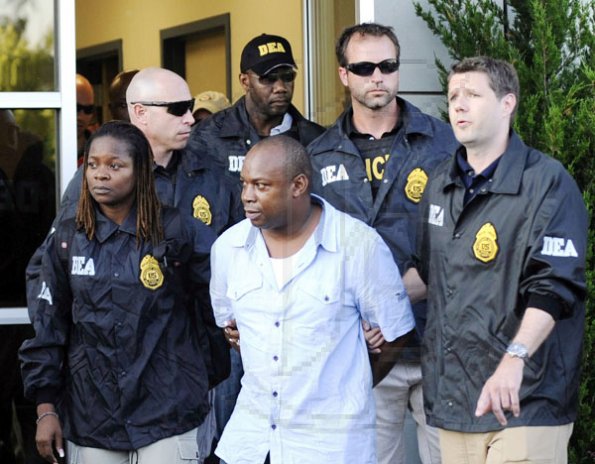
Christopher “Dudus” Coke arrives in New York to face drug trafficking charges on Thursday June 24, 2010. (AP Photo/ Louis Lanzano)

In Jamaica farce, intrigue and tragedy remain inextricably intertwined. The fugitive don, Christopher ‘Dudus’ Coke, on the run since May 24th, is finally in the United States where he arrived earlier this evening (see photo above). Coke was intercepted on the outskirts of Kingston on June 22nd by the Jamaican police while they were supposedly conducting random spot checks on passing motorists. There was a J$5 million dollar bounty for information leading to his arrest.

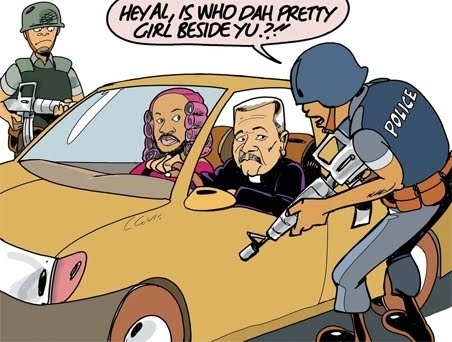
We’re told that he was being escorted by charismatic preacher Reverend Al Miller to the US Embassy in an abortive attempt at surrendering to American authorities who were clamouring for his extradition. We’re also informed that he was sporting a curly black woman’s wig when the police stopped the car and that he thanked them for sparing his life. These are titillating details but who knows if we’ll ever know the whole truth?
Meanwhile jokes abound about the principals in this sordid drama with imaginary headlines such as “Miller to be charged for attempting to export Coke!” being bandied about the public sphere. The irrepressible Reverend has subsequently been charged with harbouring a fugitive but didn’t let that prevent him from going to watch The Karate Kid this evening.

In an irreverend post titled Bad Man Nuh Dress Like Girl Kei Miller ruminated on the reports of cross-dressing by gunmen and dons:

That’s why this sentiment of ‘bad man nuh dress like girl’ is always kind of funny – because in a country where Dudus and the dear departed Natty could wear wigs and frocks whenever their minds took them to do it; and in a country where any tour of dancehall will feature a few male dance crews who always offer, on public display, the most profound and sometimes magical performances of Jamaican queerness; and in a country where bad men run across garrison communities – one hand holding onto their uzi guns, and the other lifting up the hem of their frocks so as not to trip, then we know the real truth – that bad man dress however de rass him want to dress. And that’s exactly what makes them de real bad men.

In a matter of weeks Coke has gone from being the most feared gang leader or strongman in Jamaica to a figure of scorn and ridicule after Police released photos of him wearing a wig and looking like an earnest church-going matron. Many are convinced that the police deliberately placed the wig on his head before photographing him in order to humiliate him and raise doubts about the awesome powers he is supposed to possess.

This morning Coke appeared before a Jamaican Resident Magistrate at a maximum security facility in Kingston. At 2 pm he was flown out of Norman Manley International Airport to New York to face charges of drug and gun running there. The nation which had waited with bated breath to see if Coke would actually leave the island alive heaved a sigh of relief. His ill-fated father, the legendary Jim Brown, was set ablaze in his Kingston cell on the eve of his extradition to the US for similar charges. That was in the nineties.

After the intense military and police activity of the last few weeks, with violent raids being conducted all over Kingston while security forces were desperately seeking Dudus, his final capture and impending extradition seem almost anti-climactic. Only in March this year the Police had worried aloud that the country’s 268 gangs might act in concert to create incidents throughout the country to distract lawmen if there was any attempt to capture Coke. The violent reprisals that accompanied the raid into Coke’s stronghold, Tivoli Gardens, on May 24th have not recurred since his arrest two days ago.

Coke himself seems surprised and grateful at the restraint shown by Jamaican Police when they intercepted the car he was travelling in with Reverend Al Miller on May 22nd. The Police, once famously described by Bob Marley as being “all dressed in uniforms of brutality” seem to have finessed a textbook arrest of the country’s Public Enemy Number One with no shots fired and not a drop of blood shed. This is contrary to the way they normally deal with suspected criminals.

The unexpectedly peaceful capture of the country’s most wanted man, the sustained assault on criminal gangs and their leaders, and the cautious upward movement in the value of the local dollar have given Jamaicans cause for optimism about the future. If there are any successors waiting to pick up the reins after Coke’s departure they have yet to appear. A large number of dons and gang leaders have prudently turned themselves in to police custody since the State of Emergency which has now been extended for another month, was first declared.

Ultimately leaders such as Dudus Coke derive their power from catering to the needs of impoverished communities by providing them with versions of ‘local government’ that the elected government seem disinterested in or unable to supply. If Jamaicans want to prevent their country from slipping back into the clutches of the narco-trade they have to figure out how to deliver democratic governance to all their citizens instead of a chosen few.

Everyone is crying out for peace yes, none is crying out for justice sang Peter Tosh in his famous song Equal Rights. Ultimately its only equal rights and justice, yoked together for all citizens, that will deliver lasting peace in Jamaica.

In the meantime questions linger over why Christopher Coke didn’t turn himself in to Jamaican authorities before May 24th thus saving the 74 lives expended in the military operation to take back Tivoli from the ‘rebels’ who had barricaded it supposedly to defend Coke. It was their alleged attack on four police stations that provoked the intense assault by the Jamaican armed forces in which so many lives were lost in West Kingston.

One version of events has it that this happened just when the Reverend Al Miller was about to accompany Dudus Coke to the US Embassy on or around the 23rd of May. There were reports in the media of meetings between the US authorities and Dudus’s legal team that seemed to have fallen through.

The question is was there a deliberate attempt by interests unknown to sabotage an earlier, potentially peaceful surrender of Coke to the US authorities? By whom and to what purpose? Was there indeed a clash of differing agendas as Tom Tavares-Finson, once again speaking as Dudus’s lawyer today, has suggested? If so, what was the agenda? And whose agenda was it?

Meanwhile Christopher ‘Dudus’ Coke remains an intriguing and tragic figure. Except for the unflattering bewigged photo circulated by the police after his arrest Coke was never shown in the Jamaican media wearing handcuffs or otherwise displaying signs of someone whose freedom has been severely curtailed. In contrast the very first photo of Coke after he landed in the US shows him with his arms handcuffed behind him (see photo above). The message is clear; as far as the United States is concerned Coke is a vicious criminal. In Jamaica however, his status is far more ambiguous.

Before appearing in a Kingston court today to waive his right to an extradition hearing in Jamaica Coke issued a statement to the Jamaican public asking them to pray for him:

I have, today, instructed my Attorneys that I intend to waive my right to an extradition hearing in Jamaica and to proceed directly to the United States under the terms of the Extradition Laws and treaty between Jamaica and the United States of America. I have taken this decision of my own free will and have done so even though I am of the belief that my case would have been successfully argued in the Courts of Jamaica. I take this decision for I now believe it to be in the interest of my family, the community of Western Kingston and in particular the people of Tivoli Gardens and above all Jamaica. Everyone, the whole country, has been adversely affected by the process that has surrounded my extradition and I hope that my action today will go some way towards healing all who have suffered and will be of benefit to the community of Tivoli Gardens. Above all I am deeply upset and saddened by the unnecessary loss of lives which could have been avoided, be it of members of the Security Forces and over eighty (80) residents of Tivoli or any other innocent Jamaicans that has occurred during this time. I leave Jamaica and my family in particular Patsy [Coke’s mother] with a heavy heart but fully confident that in due course I will be vindicated and returned to them. Pray for me and God bless Jamaica.

– Christopher Coke

Sister Dudus Coke: The Good, the Bad and the Ugly….


Clovis, Jamaica Observer, June 23, 2010

“Have you caught that guy yet?” was a question frequently thrown at me in recent weeks by friends and family abroad who remembered hearing about Jamaica’s elusive don, Christopher “Dudus” Coke in the international media coverage that followed the deadly raid on his citadel in Kingston which left 74 Jamaicans dead in late May.

I was getting ready for a party I was hosting to launch a series of artworks called “The Hunt for Dudus” by Belizean artist Hubert Neal Jr when a friend called with the news that Dudus had finally been captured. While the details are still filtering through to an excited public and before i actually write a proper blogpost on the subject i thought i’d share these unforgettable images with you. Soon come with the rest of the post!


Dudus as church sister, in wig…photo released by Police. Allegedly the car also contained a pink wig just in case a more preposterous get-up was required in a hurry.

Above: The indefatigable Reverend Al Miller, who was supposedly escorting the hapless don to the US Embassy when their car was intercepted by the Jamaican police.

The Don of a New Era Part 2: The Gideon continues


Sign in Barbados

Well, the Gideon (local slang for Armageddon) continues. Last night it seemed as if things in Kingston had simmered down but this morning i checked into Twitter to hear that the armed forces were lobbing grenades and perhaps bombs at a house in E. Kirkland Heights, a very upscale neighbourhood in Red Hills, Kingston. “The template of violence in jamaica has changed ova d las week. Its now an insurgency with all the relevant weaponry” tweeted one of the people i follow. “I wanna see the police deny this one. Grenades an bombs are the new weapon of choice for the state now.”

No idea whether the Police suspect that Dudus is holed up in there or some other Don. Things unravelled very quickly. On May 17th Prime Minister Bruce Golding addressed the nation saying apologetically that he was finally giving the go-ahead for the signing of the papers to extradite Dudus to the US, something he had resisted for 9 months. To many of us it was clear that the US had made him an offer he couldn’t refuse; pressure from the local media, business and other interest groups had also mounted in the weeks leading up to this astonishing about-face.

As i said before Dudus’ lawyer Tom Tavares-Finson was furious. He would take the matter to court the next day he said but the following day we heard that he had removed himself from the team representing Dudus due to conflict of interest issues; issues however that had always existed. All I can say is, do not use this as an excuse to slaughter innocents in Tivoli, an angry Finson was heard saying in interview after interview on radio and tv. His words would prove prophetic.

The day after Golding’s speech it was announced that a warrant had been issued for Dudus’s arrest. That would have been on May 18th. The rest of the week was tense with everyone expecting the Police and Army to invade Tivoli at any minute but the armed forces seemed unusually tolerant, waiting patiently for Dudus to turn himself in. Actually they were waiting till the weekend of the 21st, a long weekend with the 24th being a holiday in Jamaica–Labour Day–to make their move.

On the 23rd a number of colleagues and i were at the airport waiting to catch a flight to Barbados to attend the Caribbean Studies’ Association’s 35th annual conference presciently titled “The Everyday Occurrence of Violence in the Cultural Life of the Caribbean” when i saw a tweet saying that shots were being fired in the vicinity of Tivoli. It’s going down i said to one of my colleagues, a leading Jamaican criminologist, the war is beginning.

I wouldn’t say so he said calmly, assuring us that his information was that Dudus was willing to turn himself in to the US authorities and was expected to do so any minute now. Well, that turned out to be misinformation of the highest quality. By the time we reached Barbados we heard that a state of emergency had been imposed and I’ve literally been glued to Twitter and online media ever since.

In fact I’m happy to report that my tweets were actually picked up by the New York Times blog The Lede in an article called Following Jamaica’s State of Emergency Online. Channel 4 in London contacted me to see if i could write a piece for them on Dudus which i did. My comments appeared in their story Jamaica death toll rises as unrest continues.

Here is an excerpt from it:

Dudus has been an extraordinary provider for the inhabitants of Tivoli.

What makes him exceptional is that he has also managed to forge coalitions between gangs across party lines and across the country when needed because of the respect he commands. His reach extends beyond his immediate community across all kinds of borders and is a testament to his abilities as an astute leader.

Had he been legit and able to run for election he would have probably created a modern, efficient Jamaica the likes of which have yet to be seen, but of course one where personal freedoms may have been more circumscribed than they are today.

The problem is his links to the underworld do not permit the state to continue the tacit alliance with him and others like him that have persisted to this day.

The question is how do you take the milk out of the coffee once the two have been mixed. That is the predicament Jamaica finds itself in.

Meanwhile the Gideon continues and while many of us would like to comfort ourselves by thinking that this is a necessary bloodletting, a purge of the criminal elements in society, the truth is otherwise. Discriminating between criminals and law-abiding citizens is not as easy as we think particularly for the Police force, members of which are known to wield their ‘license to kill’ with wanton disregard. i received a heartbreaking message from a friend about the execution of a young man she personally knew, by the police, a story which was reported in the media under the headline “Cops kill three men in Back Bush.”

One of the men was well-known to my friend and no criminal. Here is part of the heartbreaking message i received from her this morning:

“Picked up one of my neighbours on the road only to hear that Ian Gordon, a sweet young dread who ran a little “venue” in Irish Town square was killed by the police. Hard to believe he would be involved in anything – he would always ask me if I had dominos, or other games, that I could give him because he liked to have lots of games for people coming to his place. On Sundays I would sometimes take him down to town and he always said he was going to visit his 2 daughters. He had a lovely girlfriend, also a dread, and it was a joke in Irish Town how they were always together. Anyway I’m sure this Observer story of how he died is accurate, and this is probably happening to young men all over Kingston. Very depressing. “

It turns out also that the early morning raid on Red Hills i mentioned earlier was in pursuit of Dudus who was believed to be holed up in a house there. In the process of flushing him out the armed forces have killed another innocent man, Keith Clarke, the brother of former minister Claude Clarke, who lived nearby, by mistake.

Mr. Seaga, former Prime Minister is also concerned about the safety of the residents of Tivoli Gardens, his former constituents and has broken his silence. I conducted an interview with him in January this year in which i asked him about his relationship with Dudus and the fact that he had once placed him at the top of a list of wanted men that he provided the Police with in 1994. I’ll post relevant portions of the interview later.

Time doesn’t permit for me to write much more right now. I’m still at the conference in Barbados but will end with two lighthearted takes on what is a truly dread situation back home, (to use Jamaican parlance).

The photo posted at the top of this blog is actually a piece of graffiti seen in Barbados on the day the armed forces went into Tivoli Gardens in pursuit of Christopher Lloyd Coke–Dudus. The blog that carried it said “This sign was seen today (Monday May 24 Bank Holiday) on the left-hand side of Collymore Rock Road going towards Wildey from Bridgetown.” Dudus’s reach clearly extends beyond Jamaican shores.

And of course Jamaicans being Jamaican still have a mordant sense of humour. The following dance poster was making the rounds on email and facebook.

Bradygate continued…

Update: Today was the most unsettling exciting day in the last decade or so. Around 3 pm started to hear rumours that ‘war’ was going to break out because the Prime Minister was going to announce that the extradition proceedings agaist ‘Dudus’ Coke were going forward. A feeling of panic began to spread and there was a stampede to get out of downtown where the rumours started circulating around 11 in the morning. By mid-afternoon everyone was on the road trying to reach a safe place. Top 10 ways to get home quickly proclaimed a blog…

The most interesting thing was that the US Embassy sent out an announcement saying a talk it had planned to hold at the Institute of Jamaica tomorrow was being postponed. I found the title of the talk interesting. It was called “Congress and the President: An Invitation to Conflict” and should have been delivered by one Don Baker. hmmmmmmmm. Doesn’t Bruce own a bakery?

At the appointed hour Bruce Golding addressed the nation looking suitably contrite and apologizing profusely. Then he announced that the Attorney General was going to sign the relevant papers so that the extradition could proceed. Dudus’ lawyer, Tom Tavares-Finson was reputed to be livid with anger; he would defend his client in court he said.

More on the runnings tomorrow. Time for bed now…

“All Muscle and Damage”: Dog-Heart by Diana McCaulay

Tomorrow, March 26, 2010, is the launch of Diana McCaulay’s first novel Dog-Heart. I wrote the review below four years ago when i first read the book in manuscript form. Yesterday i did a short interview with Diana about the process of writing this novel; My questions and her responses are presented below the review. The book will be launched at Bookophilia, 92 Hope Road, tomorrow evening at 6.30 pm.

My Review

Kingston, April 23, 2006

Dog-Heart peels back the zinc fence concealing the liminal world of the outcasts of postcolonial development; not just for a hasty peep but for a sustained look at what most of us would prefer to forget exists. Written by an “atypical middle-class Jamaican” attempting to live her life by the Emersonian principle of leaving the world a better place “whether by a garden patch, a happy child or a redeemed social condition” this is a book that could have easily descended into missionary melodrama and bathos.

Instead it is a tightly plotted, muscular narrative recounted mainly through the voice of its young male protagonist–Dex—one of the ubiquitous street kids of Kingston. McCaulay renders his patois-inflected voice vividly, deftly drawing the reader into the brutal shadows of the ghetto; you find yourself literally following Dex and his brother as they negotiate the peril-strewn path of their poverty-stricken existence.

The clumsy though determined intervention of the ‘uptown browning’ into their lives is described through Dex’s eyes. Miss Sahara disapproves of almost everything—“She don’t like it that we t’ief light from public service but she don’t say how we is to pay light bill.” Miss Sahara complains that they watch too much TV and that their mother spends too much money on unnecessary things such as a new dresser from Courts instead of buying books and clothes for the children. Dex despairingly observes that “She don’t understand about respect, how people inna ghetto disrespect you if you don’t have certain t’ings.”

Dexter has little faith in Miss Sahara’s mission to turn them into uptown children. “She think if we learn how to read and count, learn how to behave, get expose to opportunity—she always a talk about opportunity—make uptown friend, then we will be like uptown people.” His cautious teenaged eyes take in everything, processing and assessing with impeccable ghetto logic the hostile environment he faces.

One of the finest touches in this impressive debut novel is the friendship between Dex and Felix, the quadriplegic who is not only wheelchair-bound (“He look like him don’t have muscle”) but whose head needs the perpetual support of a tin can. After his initial revulsion Dex is drawn into a close relationship with the handicapped boy, making a point of protecting and looking out for him, something he himself has lacked all his life. The socially handicapped Dexter and the physically handicapped Felix thus manage to establish a useful though fleeting alliance.

Ever aware of his liminality Dexter inexorably morphs into the thuggish ‘Matrix’ whose overweening ambition is to join one of two warring neighbourhood gangs. Along the way we get to know Dex’s younger brother, the gentle Marlon, his baby sister Lissa and his friend, the dog-hearted Lasco innocuously named after a Jamaican brand of powdered milk. We even get to know and like Arleen, Dexter’s feckless mother, one of the less sympathetic characters in the book, who is forever beating and abusing her children.

Dog-Heart is an uncompromising story imaginatively told; it is a tale of the class imbalance of postcolonial societies, of how vast the gap is between those damned by the (Babylon) system and kept outside and those who reside comfortably inside. The expendability of life in the ghetto and the perpetual injustice meted out to its inhabitants by the state and so-called civil society lie at the heart of this tale of postcolonial darkness.

As Dexter sadly observes:

“This is what everybody inna ghetto know: If anybody want kill you, white man, big man, policeman, area don, gang member, schoolmate, politician, shotta anybody—they will just do it. Nobody can stop them and after, nobody will care. You can t’ink man who do murder will be arrest and put in jail and you, the person who is dead, will be in heaven a look down on them in jail with a whole heap a batty man, but that is not how it will go.”

Not even such limited justice as rejoicing after death in the travails of one’s murderer is available to ghetto people. “Batty man” is colloquial Jamaican for ‘homosexual’; terms such as these require glossing else the foreign reader new to Jamaican culture unnecessarily loses a whole layer of allusion and meaning that serve to add focal depth to the narrative.

Aside from that McCaulay’s sense of irony and humour delicately leavens this tale of what lies on the other side of tourist paradises such as Jamaica inviting the reader into territory you probably would have declined to enter on your own. The novella is expertly constructed, its constituent parts neatly dovetailing into one another.

McCaulay, who wrote a weekly column in the country’s leading newspaper for many years, showcases her formidable writing skills in this ambitious, heart-breaking work to excellent effect. Woven into the story are traumatic events—mob killings, kidnappings–from contemporary Jamaican life that convulsed the nation when they happened, registering as twenty-first century landmarks in the history of its world-renowned violence. For her Jamaican readers these signal additional dimensions of common belonging; the mirror McCaulay relentlessly holds up doesn’t let anyone off the hook, least of all those who read this book without flinching.

The Interview

Kingston, March 24, 2010

How long did it take you to write Dog-Heart Diana? And then after that how long till it was published? Did you ever feel like just giving up?

The first draft took two years to write. The submission process (sending in, rejection, rewrite, sending again) took five years up to the time I had a contract. Then another year and a half to publication. Eight and a half years in all. Yes, I felt like giving up many times. Had no faith in the work at all, at many, many points along the way. But people encouraged me – like Esther Figueroa, you, Kim Robinson, another friend in England, Celia, who has been reading my writing since we were teenagers, so somehow I kept going. I have quantities of never finished manuscripts on my computer, in boxes, in drawers and I was determined to see this one in print..

You had to revise the manuscript several times. What were the kinds of changes publishers asked for?

The eventual publisher, Peepal Tree Press, asked for very few changes – a few language issues, a few places that editor Jeremy Poynting felt did not ring true. He was right in every case. But earlier in the process, various agents and publishers who eventually passed on it had suggested changes…some I adopted, others no. For instance, the first draft of Dog-Heart had four voices – Dexter, Sahara (the two that now survive), but also Sahara’s son Carl, and Dexter’s mother Arleen. An agent who sent me five pages of comments on the early draft suggested these were too many voices, and that I tell the story from only two points of view – Dexter and Sahara. So that’s what I did. I have many chapters of Arleen’s story and Carl’s story in my computer… who knows what I will do with those one day. Some agents didn’t like the Jamaican, felt it was too limiting, but I wasn’t prepared to compromise on that.

How were you able to get into the head of an impoverished street youth? I know you had tried in the nineties, when you wrote a Gleaner column, to help one or two such youth? Is this novel inspired by those attempts? And did you have any success with the boys you tried to rescue from the street?

In a sense, Dog-heart was inspired by my relationship with a family of boys and their mother in the 1990s, my attempts to help, but the events and people in Dog-heart are entirely fictional – nothing in Dog-heart really happened and the people are quite different from that family. But during that period I did observe many aspects of their lives and realized how difficult their circumstances were. It was humbling – people of my class tend to dismiss people like Dexter and his mother, Arleen, as, I don’t know, wasters, wut’less, stupid. But what I saw was something different – I saw people, children, trying their best to survive situations that I was sure would have defeated me. So I started thinking about it, imagining what it would really be like. Dog-Heart also had its genesis in a writer’s workshop at Good Hope, back in 2003 – we were asked to write a short piece from the point of view of someone of a different age, class, race, background and sex – and I wrote what became chapter two of Dog-Heart. I sent it as a short story called Car Park Boy to Caribbean Writer, they published it, and I decided the seeds of a novel were in there. So I kept working on it.

As for the boys I did try to help, that’s a fairly sad story, one I am not sure I am ready to talk about, because it is their story to tell too. I often wonder about what THEY thought at the time. I lost track of the family when I went to study in Seattle in 2000 – but when I came back to Jamaica in 2002, I learned from one of the boys’ teachers that the eldest boy had been killed by the police in a prison riot. And funnily enough, recently a friend encountered the youngest boy – who is now a man – and we are to get together – hasn’t happened yet.

There’s a wonderfully taut scene where Dexter is bouncing a football while being taunted by his new schoolmates. How did you know how to do that? Did you play football yourself? The moment when he raises his eyes to look at the games teacher and the ball finally falls and rolls away was a masterful use of suspense I thought.

I did play football when I was young. My sisters tell me I was unbearably sweaty. But truthfully, I don’t really know where that scene came from, I remember the day I wrote it, and it just appeared in my head, in the very mysterious way such things happen from time to time.

Also how did you come up with the character of Felix the quadriplegic boy stuck in a wheelchair who has to rest his head on a tin-can for support? Felix is a fine foil for Dexter and the growing sympathy between them is very finely developed.

Well, I needed a way to show aspects of Dexter’s character – that he was able to overcome opinions he held (about the “slow” children, for example) and find sympathy and empathy with someone facing greater hurdles, and I thought a boy in a wheelchair might be a good way of doing that…

I particularly like the moments of collision between what I think of as ‘ghetto logic’ and ‘uptown logic’ in the way people’s lives are organized in the novel. So eg. Sarah’s presumptuous and haughty complaints about the way Dexter’s family ‘wastes’ money on a dresser, on TV or other luxuries they can’t ‘afford’ goes to the root of the class divide that governs our lives.

Yes, it was one of the novel’s many challenges – to write about the same events from two different points of view without becoming boring or redundant, and to try and really understand these different ways of looking at the world – Sahara’s point of view was easy for me to imagine, even to feel, of course – but Arleen and Dexter’s much harder. Writing Dog-Heart was really a search for compassion and empathy and understanding in my own heart.

Did you make any earth-shattering discoveries in the process of writing this novel?

Not sure about earth-shattering, Annie! I have many reflections about the process of writing a novel, about developing characters, about the pitfalls of writing a novel with a message – as some early feedback pointed out. I struggled greatly with language – I wanted to write in Jamaican when I was in Dexter’s voice, without making the novel inaccessible to a non Jamaican speaker. I am still not totally satisfied with how that came out. I learned something about what Anthony Winkler calls “trusting the darkness…” often I would go to bed with my characters stuck in some situation, with a feeling of hopelessness about the novel, and I would make sure they were in my mind when I fell asleep, and when I woke up the next morning – answers came to me. I learned to trust that. I learned the value of readers – people who support you – it’s a mistake to let too many people read your early work. Most of all, I learned that writing a novel is a marathon, not a sprint, but with determination, patience and a fair bit of pain, it can be done.

The Haitians are Coming! The Haitians are Coming!


Clovis, Sunday Observer, January 31, 2010


Ever since January 12 when the 7.0 earthquake hit Port-au-Prince Jamaicans have been bracing for an influx of Haitians seeking refuge from their inhospitable island. Finally on January 28, TVJamaica’s 7 pm newscast announced that the first ‘refugees’ had arrived on the North Coast–in Stewart Town, St. Mary, to be precise.


The camera switched to an impoverished looking individual with no front teeth who described how he and some other Stewart Townians had encountered a famished looking stranger riding a bike through their community. His clothes were wet and when questioned by the stalwarts of Stewart Town, he couldn’t provide an answer. In fact he looked at them mutely, dumbstruck as it were.


By this time the residents of Stewart Town were beginning to suspect that what they had in front of them was none other than a real live Haitian who had come to Jamaica looking for help. After days of wall-to-wall coverage of the quake on CNN and the BBC, the dire straits of those who survived the natural disaster was well known and the St. Mary residents were determined to be kind and hospitable to the putative refugee.


In mounting excitement they started gesticulating at the man asking if there had been an earthquake where he came from. According to a newspaper report:


Pearl Cameron, a resident who offered Anderson a bath, food, clothing and money said although he was hungry and weak he appeared to be in good health.


‘He wrote on a piece of paper and told us that it was five of them on the boat and that his family survived the earthquake,’ she told the Observer, adding that she had used sign language to communicate with Anderson.”


The newspaper account continued, saying “The residents, believing Anderson’s story, called the police who took him to the Port Maria Hospital where, with the help of a translator, they tried to question him.”


Meanwhile the nation was shown images of the unfortunate Haitian being tenderly ministered to by the Police; in Portland one Mavis Anderson gasped and jumped to her feet.


“Him a nuh Haitian, him a Jamaican. Mi nuh know weh him a do a Stewart Town. Him usually ride him bicycle to Port Maria, but mi nuh know weh him a do down there.” Mavis Anderson is reported to have told the Observer after retrieving her son from the hospital.


It transpired that the starving Haitian refugee was a famished Jamaican fisherman or as the Observer put it, “a Jamaican mute from Windsor Castle, Portland.”


At this point i find it necessary to issue the disclaimer that any similarity or resemblance to the plot of an Anthony Winkler story is purely incidental. The truth in Jamaica, is truly stranger than fiction…


While we’re on the subject of refugees it might interest you to know that no less than 13 heads of state from Haiti have taken refuge here with four actually passing away on this island. And all of this was between the years of 1843-1871! The first Haitian President to arrive was Jean-Pierre Boyer in 1843. In 1844 his properties in Haiti were confiscated by the new government in Haiti, headed by one Charles Riviere-Herard. And it wasn’t only Haitian Presidents who whiled away their exile in Kingston. As Matthew Smith, UWI historian and author of the book Red and Black in Haiti: Radicalism, Conflict, and Political Change, 1934-1957 noted:


“Boyer…was one among a handful of once powerful ex-Presidents who were lying low in Kingston. Among the others were: the colourful Mexican caudillo, Antonio Lopez de Santa Anna who, after the crushing defeat at Chapultepec in the final decisive battle of the Mexican-American War in 1848, fled to Guatemala and then to Kingston, where he would remain for two years; Jose Antonio Paez, the heroic leader of the llaneros who fought the royalists in 1819 in the South American revolution against Spain, and who was the first President of Venezuela; and General Juan Jorge Flores, former President of Ecuador who had been forced out of office…in 1843. How exciting it must have been walking around Kingston in 1848! To complicate things even further, Boyer’s successor and archrival, Riviere-Herard, the same man who had confiscated Boyer’s property, was overthrown in May 1844 and found himself living in Kingston at the same time…Later Guerrier, Riviere-Herard’s successor would also set sail for Kingston, though we don’t know much of what became of him.”*


*from “Emperors, Exiles and Intrigues: The Case of Nineteenth-century Haitian Heads of State in Jamaica” by Matthew Smith in Regional Footprints: The Travels and Travails of Early Caribbean Migrants


See? In Jamaica the truth rivals fiction anyday.


PS: This post was originally called “The Haitian Fugee” but after reading Gelede’s comment i had to rename it. The Haitians are Coming captures it all…nuff thanks Gelede.


Kidnapped from Facebook…Jamaica’s Great Earthquake

The following was posted by Kei Miller as a Facebook note. I found it compelling enough to repost, with permission of course…

Kei Miller: (Odd..just last week I had been reading this striking account of Jamaica’s Great Earthqake in 1907. The scenes seem like such an echo of today. Here are some excerpts from Caine’s account)

Jamaica’s Earthquake…

by W.Ralph Hall Caine

The strong breeze began to lose force until, at about 3.30, it had faded into nothingness. For two minutes there was not a breath of wind, no doors banged, no blinds moved, curtains fell back to their places, not a sigh lifted a leaf on any bough. Nature had seemingly withdrawn for her afternoon siesta.

And then I live that moment now without murmur or warning, from the Blue Mountains beyond, or the still bluer heavens above, or the ground beneath our feet, there steals down upon us some intangible, impalpable monster, before whom the very earth reels and groans in violent agony and despair.

The heightening roar is of eternal memory; it was as though some vast herd of tigers, with warm blood already on their tongues, had been suddenly robbed of their prey. A giant had seemingly seized upon the foundations of the structure in which I sat, and was shaking the building with brutal pertenacity…

At the first movement of the earth the ceiling began to fall about my ears, covering me with small particles of mortar and dust though not till long afterwards did I notice either. I stood up with a certain dazed sense of danger that is near, but none of fear. Some guardian angel seems to whisper, “It is not now.” Ah, yes; I know!

That moment, amid the clatter of broken glass, collapsing floors directly above my head, tumbling walls of brick, and falling masonry, the instinct Came “Escape.”

I have heard how the universe seemed to revolve like a child’s top for four or five seconds, and then stop with a frightful jerk. But no one has described to me the dancing earth as I experienced it at that moment. The circular movement was there, close under my feet, but the upward move-ment was not less marked. We seemed to rise and fall as though embarked on the surging sea. Heavy walls swayed like an insecure bad stage setting,and at the same moment the earth rose and fell, bringing down masses of debris at every plunge into some hidden gulf, breaking floors like so much match-boarding, and tearing every holding from its socket in wrathful violence.

At 3.32 Kingston was happy and well. At 3.33 the city was seemingly a hopeless wreck, with the very sun itself obscured from our vision. All man’s handiwork of a generation, nay, of a whole century or more, was instantly flouted. A whole community lay in ruins and in tears, in suffering and in death.

Many efforts have been made to measure the disaster by some standard of significance to the understanding: the roll of death, the area of destruction, the small proportion of buildings left standing, the happening in mere duration of time… How vain!

Some have said the earthquake was all the work of twenty seconds. May be so. But who among us can count the passage of time in the moment of a cataclysm, when the mind is living a vast eternity every second, and the tablets of the memory are crowded with so many conflicting impressions, impulses, and memories?

Any languishing sense of bitter resentment towards any one, at any time, anywhere, falls from us like a discarded cloak. I think of such as near and dear to my own heart, and ask, “Where? Whence? Alone? Why am I not seeking? saving? doing?”


Words cannot picture a scene of such desolation and despair as befell Kingston within that brief and awful space of time. The thunder of falling masonry stuns the air. Solid brick walls bulge, and then collapse with a crash ; great structures of iron, wood, brick, and stone sink like a house of cards ; roofs built entirely of wood glide away from their holdings into the street; entire buildings become in a moment a mere mash of debris.

There is a tiny moment of silence, in which people are trying to realise what has happened. And then out of all this ruin, with the very sun itself obscured by blinding dust, there comes the pleading cry of the helpless, the dreadful oaths of the bitterly hopeless, the swooning and only half conscious groans of the dying. The call for help is everywhere, the plea for water here, the agonised appeal for release from broken timbers there. …

Written 6 hours ago · Comment · Like · Report Note
4 people like this.

Annie Paul Unbelievable. This is eerily similar. i’m speechless. Thanks, its awe-inspiring to read it today, in the 21st century. Where did you find it? Would love to post on my blog…
6 hours ago ·

Kei Miller Annie, I found it in a little book I bought at Sangsters called ‘Old Jamaica Memories’. (part of my revival research). The book i’s apparently part of a series that includes ‘Old Jamaica Journeys’, ‘Old Jamaica Conversations’ and three more. Feel free to repost.
6 hours ago · Report

Haiti, We’re Sorry…

from Jamaican designer Ruth Francis, thinking of Haiti from the snowy distance of England

The-National Presidential Palace of Haiti on January 11, 2010

Haiti’s famous National Palace a day later


I don’t have words to convey my emotions at the devastation in Haiti or Ayiti as it is also known. The Haitians are a gallant, hardworking people with an incredible history of overcoming adversity. But now it seems as if they really have the worst kismat in the world. As my Facebook friend Unsociable Bastard exclaimed:

“Why [is] Haiti like the Good Friday Bobolie… always getting licks.”

A Bobolie is the Trini version of the straw man that everyone likes to take aim at and beat the shit out of.

It’s Earthquake Awareness Week in Jamaica and the slogan on the Earthquake Unit’s banner was prophetic: “Learn, plan, prepare. The next big quake could be near.” It was 103 years since the temblor that levelled Kingston on January 14, 1907 and 17 years since the last somewhat big one here on January 13, 1993. I was at my desk yesterday, January 12, at the University of the West Indies, at minutes to 5 pm when the monitor started swaying from side to side and i felt the earth move under my feet–very gently of course–unlike Haiti where it erupted like an enraged beast. From that moment onward i’ve been glued to Twitter with my first tweet simply announcing TREMORRRRRRRRR! That was at approximately five mintues to 5 pm. On my way home 15 minutes later i heard that Port-au-Prince, Haiti, had been hit by a 7.0 earthquake. As a friend said in a Facebook chat this morning:

my first news of any earthquake was ur tweet!

and that was before u knew it was in haiti!

twitter amazin

Twitter certainly IS amazing. As the evening progressed it turned out to be the only reliable source of images and live information from ground zero. Ironic that my last post was ruing the backwardness of the Jamaican media in not adopting this protean new medium. As Global Voices Online pointed out:

The Caribbean blogosphere is busy tonight, discussing very sad news – an earthquake measuring 7.3 on the Richter Scale struck off the coast of Haiti, causing major damage and loss of life in the already besieged island nation.

Twitter emerged as the fastest, most time sensitive vehicle through which to report on the catastrophe; Facebook was also full of wall comments on the disaster, from both French and English-speaking Caribbean netizens. One user in Trinidad and Tobago was already collecting “foodstuff, blankets & clothing for Haiti”, asking donors to “label all bags”. Others, like Jamaica-based Annie Paul, quoted lyrics from calypsonian David Rudder‘s ode to the island: “Haiti, I’m sorry…but one day we’ll turn our heads, restore your glory”, following up with links to video of the earthquake, which she found posted on YouTube:


Regional bloggers soon followed with more detailed posts, the most compelling of course, coming from within the island. The Haitian Blogger did a good job of posting regular updates with critical information:

General Hospital in Port-au-Prince is down, Palace is damaged.

No one knows how many dead or injured. The aftershock is reverberating. People can only see dust,

Obama is sending in military troops.

Phone lines that are working are: Haiti-tel and Voila.

All windows are shattered in houses in la plaine

Houses are falling down everywhere.

All the poor on the mountains, whose houses were build on the mountains, all tumbled down, one on top another…

A terrible situation! Devastating. There’s NEVER been an earthquake of this magnitude in Haiti. Major aftershocks happening…

The quake was quickly followed by two nearby, strong aftershocks of initial magnitude of 5.9 and 5.5, the aftershocks were major earthquakes in and [of] themselves.

This is catastrophic. Changes everything.

For the full article go here; and for Global Voices consolidated coverage of the earthquake see here.

I made the point in my last post that Jamaica’s musicians unlike Jamaican journalists had taken to Twitter like ducks to H2O. And to reinforce that point the earliest information on and from Haiti came from musicians there: @RAMhaiti is the Twitter name of Richard Morse (how ironic! Morse, as in Morse code). “Morse and his band are famous in Haiti for their political songs and performances critical of the Raoul Cédras military junta from 1991 to 1994″ (Wikipedia). The other musician was @Wyclef, the famous Wyclef Jean. Between the two of them and a handful of others the earliest calls for aid and reports from the site were transmitted to the world.

One of the last tweets from Morse said: when my batteries die I will no longer be able to communicate..it’s going to be a long night..our prayers go out to everyone. Update: he has just started tweeting again. This was his most recent tweet: RAMhaiti 12:55PM, 13 Jan 2010..I am hearing the siren of an ambulance for the first time as I right this note..

The reason the quake was felt as far away as Jamaica is because as Dr. Paul Mann of the University of Texas puts it:

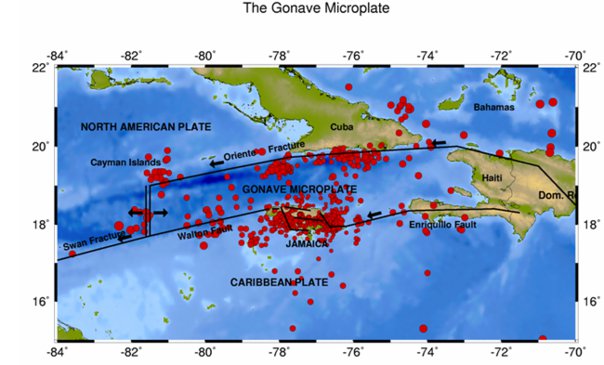
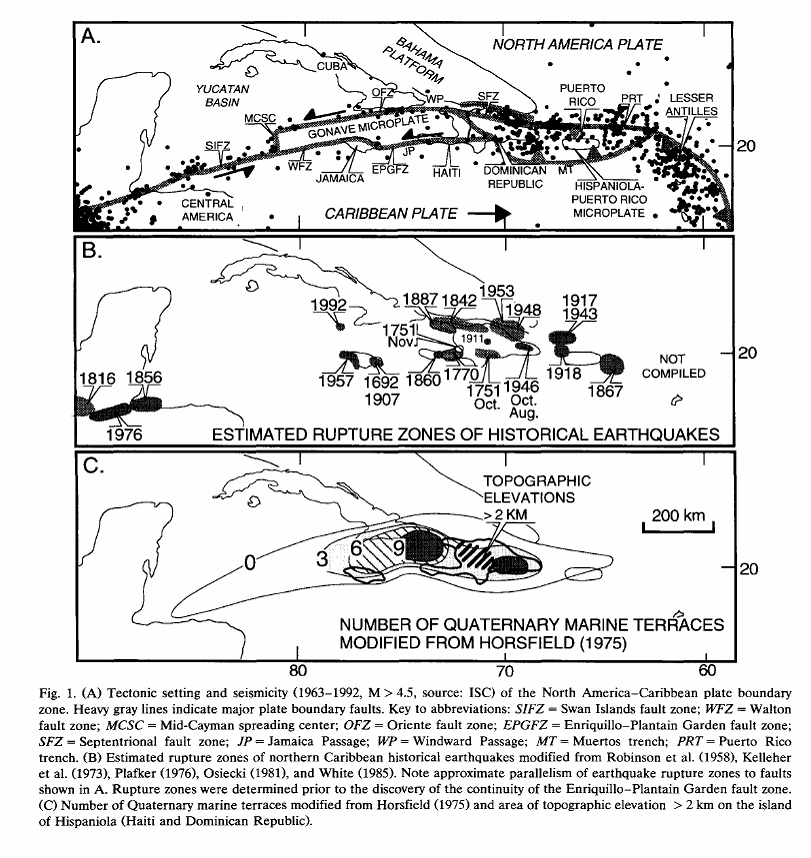
The Enriquillo-Plantain Garden fault extends from the island of Hispaniola to the island of Jamaica and to the west of Jamaica. The fault has been recognized for many years along with its hazard to cities along it.

The Gonave microplate is wedged between the much larger North America plate and the Caribbean plate. This means that there are two parallel zones of strike-slip faults in this part of the Caribbean (cf map below); the northern zone called the Septentrional-Oriente fault extends along the northern coast of Haiti to the southern Cuba and along the Cayman trough to Central America. The Enriquillo is the southern zone extending from Hispaniola to Jamaica. The two zones merge near the Mid-Cayman spreading center.


I’ll be posting more information as i get it.