Say YES to INDECOM if you want to be taken seriously Mr Crawford–

A Jamaican Minister inexplicably asks for a police oversight body to be shut down. what does this mean??

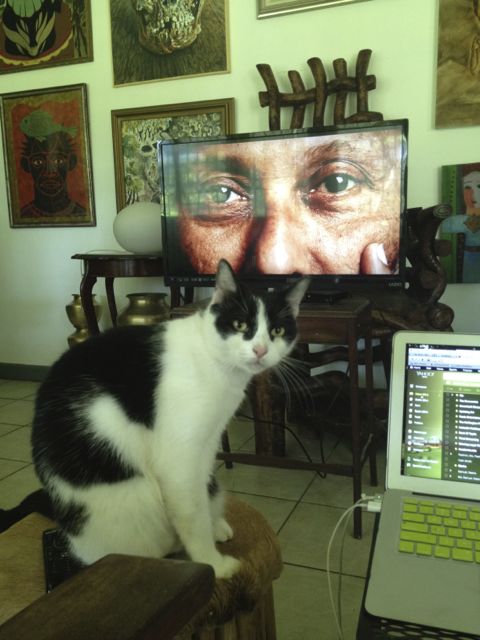
What a disappointment Member of Parliament and Minister of State for Entertainment & Tourism, Damion Crawford, is turning out to be. Check out his tweet, pictured above, about closing down INDECOM, before its had a real chance to show what it can do. Why such  unseemly haste Mr. Crawford? Why aid and abet police men and women who may be abusing their powers, by shutting down the one agency empowered to investigate police killings and other crimes?

Clovis Toon
Clovis. Jamaica Observer. Nov. 12, 2013

Earlier this year, on May 23 to be precise (the third anniversary of the Tivoli Massacre), a group of us decided to make extra-judicial killings by the police and security forces  the subject of Jamaica’s first  Blogging Day. We did this because the police seemed out of control, there is no accountability for such killings, and no police personnel are ever held responsible, emboldening the police to kill more wantonly, more frequently, more brazenly.

The only ray of hope recently has been the creation 3 years ago of a unit called INDECOM, an independent commission to investigate cases of police abuse, and prosecute officers guilty of corruption and murder. Although their success rate has been less than stellar there has been so much pushback recently from within the police, now escalating all the way to the level of a state minister that it makes you wonder if they may not be on the verge of making an example of some bad cops.

In fact I’m beginning to wonder in the wake of MP Crawford’s astonishing tweet whether what my Labourite friend has been telling me for years isn’t true. He claims that police killings go up astronomically once the PNP are in power, because the police feel licensed to terrorize the population under the guise of hard policing. If this is true then its up to us the citizenry to muzzle those who represent us in Parliament, to let them know in no uncertain terms that we will NOT put up with the casual murder of so many citizens by those the state has hired to protect us.

Some months ago Baroness O’Loan, a former police ombudsman of Northern Ireland spoke in Montego Bay during an Independent Commission of Investigations (INDECOM) Open Day held at the Old Hospital Park. Her speech was reported in the Jamaica Observer and is well worth noting:

“There is an unparalleled level of police shootings in Jamaica,” she said, citing figures in a 2002 paper presented by the local human rights group Jamaican for Justice, which showed that “police killings of civilians were running at around 150 a year.”

“In the 10 years since then that number has almost doubled. In 2011 there were about 210 shootings, in 2012, 219 police fatal shootings and between January and June this year there were 147 fatal shootings by police,” lamented Baroness O’Loan.

Baroness O’Loan said she has worked across the world, even in places like Liberia and in Timor Leste when there was an attempt to assassinate the president, yet she has not seen police fatal shootings in the numbers as she has seen them here.

She underscored the need for a thrust by INDECOM, to not only identify the cops involved in shootings, but also their commanders.

“They will need to see the intelligence or information which the police had before and after the shootings. My experience was that once the police concentrated on proper planning of operations; once they risk-assessed each planned operation and send police officers out — briefed to use minimum force to carry out the arrests or searches — the level of police violence dropped dramatically,” Baroness O’Loan argued.

She noted also that proper proactive police management, modern intelligence-led policing, human rights compliant policing — rather than just sending squads of heavily armed police officers out to do a job — can save lives, and make people more trusting of the police.

“When that happens people support the police more and are prepared to come forward as witnesses, and then the police can do their job better,” she said.

Among other measures she recommended was for Government to increase the staff at INDECOM.

“INDECOM needs more resources. They don’t have enough investigators to do this work. They have only 37. I had 91 in a country with fewer fatal police shootings and a smaller geographical territory and I did not have enough,” Baroness O’Loan argued, adding that civilians and members of the JCF should also report police officers involved in wrongdoing.

Also check out Think Jamaica’s blogpost on INDECOM for more statistics on police killings.

Reviewing The Stuart Hall Project…

Revelling in having delivered my review of the Stuart Hall Project I rue the fact that he’s so little known in Jamaica…

stuart1

Deadlines…what would I do without them? They hem my life into productive segments and I feel slightly lost when I’ve just slain a big one. Like now. I was asked to review The Stuart Hall Project, for the Caribbean Review of Books–in case you don’t know that’s the new John Akomfrah film about one of the major intellectuals of the 20th century–the deadline dogged me all through my recent trip to New York and back. I finally delivered it today and now feel light as air, positively giddy at the thought that for the rest of the week, i can read what i want, watch what I want and basically lounge about as much as I want.

stuart2

One of the most influential thinkers of the twentieth century, Stuart Hall, was born and brought up here, made his career in Britain, become an intellectual powerhouse there, and is virtually unknown in the land of his birth.  So true what Jesus said: A prophet is not without honour, save in his own country. Ah well.

stuart3

Here’s a handful of links to articles in case you want to know more about him:

Jazz fan, hipster and a leftwing hero; the remarkable journey of Stuart Hall

From 50s migrant to 80s Thatcher critic, the cultural theorist has long led the debate on race and politics. A new film charts his life and his decades-long influence on the culture of modern Britain (UK Guardian)

Stuart Hall: “We need to talk about Englishness”

Born in Jamaica, Stuart Hall is the éminence grise of the British intellectual left and one of the founders of cultural studies. He coined the word “Thatcherism” and, aged 80, he remains one of our leading thinkers. (New Statesman)

And from Caryl Phillips’ 1997 interview with Hall in Bomb magazine:

Stuart Hall was born in Jamaica in 1932 and came to England to study at Oxford in 1951, as a Rhodes Scholar. His curriculum vitae is an awe-inspiring document. The list of publications, honorary degrees, awards, and teaching positions span 24 pages. A sociologist, writer, film critic and political activist, his achievements are an extension of the work of a man he greatly admired, the Trinidadian intellectual, C.L.R. James.

I remember back in 1979, during my final year as a student at Oxford, contemplating whether to take the low road toward a career as a writer, or stay on the academic high road and attempt to put some more initials after my name. Stuart Hall, at that time Director of the Centre for Cultural Studies at the University of Birmingham, was the only person that I wanted to study with. I applied to his Centre and then, at the last minute, changed my mind and opted for the low road.

Just thought I’d share this so that young people here realize that Jamaicans excel not only in track and field and music but also in the intellectual arena…

India’s Mission to Mars…

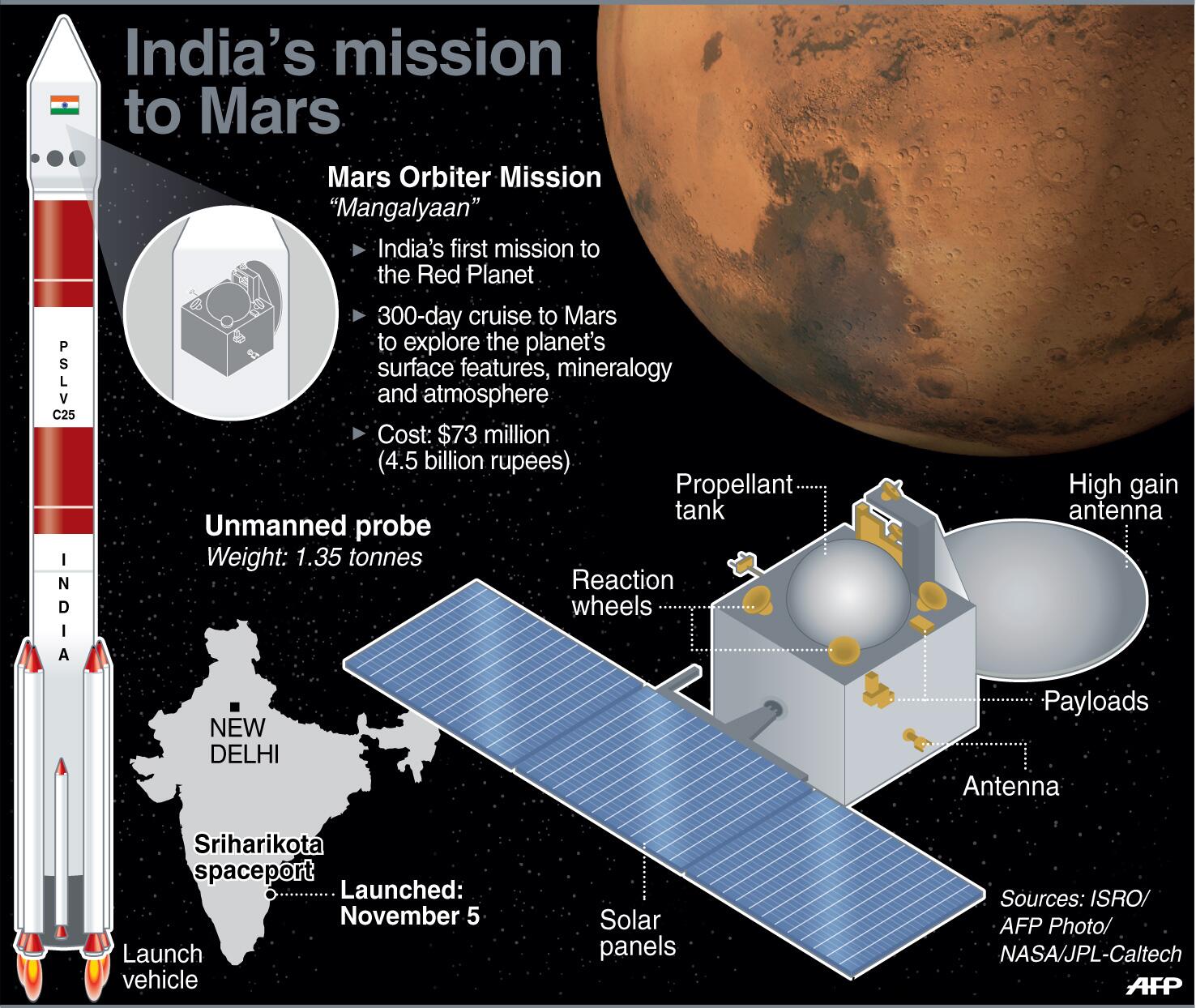
India launches its Mission to Mars amidst excited tweets and the usual criticism.


Agence France-Presse @AFP
India’s Mars Orbiter Mission, which successfully launched today #infographic pic.twitter.com/3eH0He53m8
13h

Waking up this morning at 5-5.30 am, i checked in with Twitter, as i usually do, to see what the folks on my Indian timeline were talking about. It turned out to be something quite spectacular. The Indian Space Research Organization (ISRO) at Thumba in Kerala (the state I happen to come from :)) had just launched India’s Mission to Mars and all or most of my Indian peeps were still tingling from the excitement of having just watched the liftoff live on their smartphones, tablets and TVs. Of course the occasional naysayer could be heard here and there as well, eg:

Anusha Yadav@anushayadav
Sending a mission to Mars to pretend we are all so first world is like making a swimming pool on slum land and calling it a 5 star hotel.

This is such a predictable wet blanket, one i don’t subscribe to at all. In the first decade after independence in India national leaders decided to set up five Indian Institutes of Technology, state of the art institutions delivering cutting edge technological education. At the time there were many opponents to the new ventures who cited similar reasons for not undertaking such expensive investments. India was poor they claimed, too poor to afford elite educational establishments using such high-powered technologies. Fortunately the naysayers were outnumbered and the IITs became institutions to reckon with, directly spawning what would eventually produce the IT revolution that galvanized the Indian economy30-40 years later. So more power to the Indian scientists who made Mangalyaan, the popular name for the Mars bound spaceship, possible.

The following selection of tweets culled from this morning’s stream reflects the tug-of-war between enthusiasts and naysayers. Fascinatingly it also exposes another schism, that between North and South India. As I mentioned earlier the spaceship was launched from the deep South so to speak–my home state of Kerala–also the most literate state. One person even went so far as to ask if this launch would have taken place had the scientists involved been North Indian. Culturally there are deep differences between North and South with North Indians generally looking down on South Indians (and making fun of their accents) who counter this by flaunting their superior intellectual traditions.

Others focused on the relatively low budget India had managed to pull off this great achievement with. Basically for the cost of four blockbuster Bollywood films we had managed to put a spaceship in orbit. Early indicators are that China is green with envy. Enjoy the tweets below and the article after that giving details about India’s exciting new space initiative.

Ashok @krishashok
I just saw India launch a rocket to Mars on my phone over 3G. I know we have problems to fix but we have sure come a long way
Details

Shivam Vij @DilliDurAst
Hmm. “@rupasubramanya: The successful launch to Mars today is a great moment for South Indians. We should be proud.”
15h

Mihir Sharma @mihirssharma
No photographic angle available that includes cow in foreground, rocket launch in background? #GrauniadIsDisappointed
16h

Saugato Datta @sd268
@mihirssharma Ideally, cow chewing garbage next to defecating child in front of ancient monument. #HavingItAll
15h

Manreet S Someshwar @manreetss
For all the naysayers on #Mangalyaan, here’s Wilde for you: We are all in the gutter, but some of us are looking at the stars.
16h

Sidin Studukut @sidin
Good morning. Any major achievements today by non-Malayalis?
16h

Nitin Pai @acorn
Pavan Srinath wrote this post about ISRO a few months ago. http://pragati.nationalinterest.in/2013/07/not-quite-over-the-moon/
16h

Vimal Sapiens @vimalg2
I’m a big fan of creative people doing amazing things with frugal infrastructure. #ISRO  #jugaad #givesYouWings
16h

aby @abytharakan
RT @srini091: An ISRO Scientist transporting a nose cone of a rocket on a cycle. Thumba, Kerala, 1968. pic.twitter.com/VuClBM1KPC
16h

Sonia Faleiro @soniafaleiro
The Chinese seem rather put out by India’s #MarsMission: globaltimes.cn/content/822493… Via @akannampilly
16h

Surekha Pillai @surekhapillai
osum. RT @smitaprakash: Only South Indian accents so far…at Mission Control Room ISRO. 🙂 (yes yes you can send me hate tweets for this)
16h

Surekha Pillai @surekhapillai
i’m a bit of both. worship me. MT @samar11 Q: Would there be a credible Indian Space programme without all those Tamilians and Keralites? 😉
17h

Mahendra Palsule @Palsule
Folks watching launch live on phones/tablets/webcasts, sharing excitement on Twitter…who would’ve thought of this 5-10 yrs back?!
17h

Gautam John @gkjohn
Space fight! RT @sumenrai79: #Mangalyaan will reach Mars in September 2014, around the same time as #NASA’s #MAVEN.
17h

Firstpost @firstpostin
Mars Orbiter Mangalyaan crosses 3,000 km Live updates: bit.ly/1dJRz23
17h

Overrated Outcast @over_rated
At the cost of four and a half Salman Khan movies, ISRO sent a rocket into the orbit of Mars.
17h

Chetan Bhagat @chetan_bhagat
You know how they say in offices when someone doesn’t get it “It’s not rocket science you know.” Wonder what they say in ISRO.
17h

For more details read this NDTV article:

Mangalyaan, which means “Mars craft” in Hindi, is the size of a small car. It is golden in colour and will be carried by a rocket much smaller than American or Russian equivalents.

About 1000 scientists spent Diwali at work and also did not sleep last night, many of them performing last-minute health checks on the rocket that is now fully-fuelled and ready to go.

Lacking the power to fly directly, the 350-tonne launch vehicle will orbit Earth for nearly a month, building up the necessary velocity to break free from our planet’s gravitational pull.

Only then will it begin the second stage of its nine-month journey which will test India’s scientists to the full, five years after they sent a probe called Chandrayaan to the moon.

More than half of all Mars projects have failed, including China’s in 2011 and Japan’s in 2003. Only the United States, Russia and the European Union have successfully reached there.

The total cost of the project is 450 crores, one sixth of the cost of a Mars probe set to be launched by NASA in 13 days. (India’s mission to Mars: 10 facts)

The 1,350-kilogram unmanned orbiter must travel 485 million miles over 300 days to reach the red planet next September.

“This is a technology demonstration project, a mission that will announce to the world India has the capability to reach as far away as Mars,” said K. Radhakrishnan, chairman of the Indian Space and Research Organization.

The Faculty of Social Sciences, UWI, Mona: 60 years of Praxis

A potted history of the University of the West Indies’ Faculty of Social Sciences at Mona, Jamaica

NB: The following article was written in 2008 for a commemorative insert in the Gleaner at the request of the then dean, Mark Figueroa. It is NOT an official document put out by the University of the West Indies. Today I received a request from a lecturer at UWI, St. Augustine, asking me where her students could source this article and i thought the best way to do this was to publish it here. It would also take care of today’s post for #NABLOPOMO which requires participants to post something each day for the month of November 🙂

The study and teaching of social sciences at the University of the West Indies, Mona, is an academic venture that started in 1948 with the establishment of the Institute of Social and Economic Research (ISER) at the then nascent UniversityCollege of the West Indies. The funding for this new institution was provided by a Colonial Development and Welfare grant provided by the British Government.

It would be another twelve years before a Faculty of Social Sciences was instituted at the University. The thinking was that researchers working at ISER on social and economic issues in the Caribbean would create a bank of relevant local research that academics could draw on in the teaching of Caribbean Economics, Political Science and Sociology.

As early as 1953 therefore, a quarterly, inter-disciplinary journal, Social and Economic Studies (SES), was established with a view to publishing and disseminating the fruits of the research conducted at ISER. The climate of intellectual ferment at the Institute was such that despite the lack of an approved budget the Director Dudley Huggins decided to go ahead with production of the journal using small grants from various sources including the Leverhulme Foundation in London and a contribution from the Colonial Secretary. The Institute also embarked on a publishing programme producing books, monographs and working papers. These were to become important texts in the teaching of Caribbean social science.

The Faculty of Social Sciences was formally established in June 1960. The Faculty initially had only two departments: Government and Economics. Later a one-year course in Public Administration was instituted for technical and administrative personnel in the British Caribbean. In October a two-year certificate course in Social Work was introduced and in 1961 the Department of Sociology was established. Early staff members were recruited from Britain and it was only by the mid-sixties that lecturers of West Indian or Caribbean extraction began to teach in the Faculty of Social Sciences.

This early cadre of West Indian lecturers set out with alacrity to analyze, research and teach various aspects of Caribbean reality. By so doing they aspired to contribute to the development of Caribbean society as well as make their mark in their respective fields. They ran headlong however into resistance and hostility from the British researchers who formed the core of the teaching departments who felt that there were no social and economic problems specific to the Caribbean and that the creation of a Caribbean-oriented Economics, Sociology or Political Science would lead to a dangerous parochialism.

The Economics Department was particularly active in the early years with lecturers representing a wide range of differing ideological perspectives. By the late 60s and early 1970s there was already a vibrant critique of the work of the Nobel-prize winning Arthur Lewis’s Theory of Economic Growth and the work of George Cumper, a stalwart of the department since 1949. The latter was a prolific contributor to Social and Economic Studies, the journal started by ISER.

These critiques came from a group of loosely allied thinkers known as the New World Group in the Faculty of Social Sciences. Their aim was to develop an “indigenous view of the region”. It was members of this group that produced the influential ‘PlantationSchool’ model of economic analysis which was rooted in a strong sense of pan-Caribbean nationalism. The group included thinkers such as Lloyd Best, Norman Girvan, George Beckford and Michael Witter. In recent times this paradigm has in turn been challenged by a younger cadre of economists such as Damien King, Dillon Alleyne and others.

Meanwhile the Sociology Department was animated by the work of social structuralists such as Lloyd Brathwaite and R.T. Smith. A younger generation was hot on their heels with M.G. Smith and his theory of plural societies leading the way. The latter was the principal author of The Rastafari movement in Kingston, Jamaica co-authored with Roy Augier and Rex Nettleford and published by ISER in 1960. This was the first academic study undertaken of this unique indigenous religious movement. Smith was in turn challenged in later years by Marxist sociologists such as Don Robotham and Derek Gordon and others who posited a ‘Creole Society’ in opposition to Smith’s Plural Society model. In more recent years sociologists such as Patricia Anderson, Hermione McKenzie and Ian Boxill have continued the tradition. By 2002 the Department was expanded and became the Department of Sociology, Psychology and Social Work.

The Department of Government in turn had its own ideological battles with the likes of Trevor Munroe, head of the Worker’s Party of Jamaica, in its ranks. In the seventies ISER published Munroe’s The Politics of Constitutional Decolonization: Jamaica, 1944–62. In general UWI political scientist concerned themselves with “an investigation of questions concerning power and state legitimacy, community and justice, and authority and civil order in contemporary Jamaica”. Louis Lindsay’s seminal works The Myth of Independence — Middle Class Politics and Non-Mobilization in Jamaica and The Myth of a Civilizing Mission: British Colonialism and the Politics of Symbolic Manipulation were published as working papers by ISER. Meanwhile Rupert Lewis engaged in ground breaking research on Marcus Garvey, producing important texts on the pan-African leader.

The eighties were dominated by the quixotic figure of the late Carl Stone (1940-1993), and his theory of “clientelism”. Stone was a public intellectual with his Gleaner columns and his surveys and polls. The theory of clientelism, it has been said, is to the political sociology of the Jamaican polity what M. G. Smith’s theory of pluralism is to the anthropological analysis of its society and culture. Stone offered “his social-political clientelism in direct criticism of Smith’s cultural pluralism as the theoretical handle able to supply the best understanding of modern life in Jamaica.” In his first book, Class, Race, and Political Behaviour in Urban Jamaica, published in Kingston in 1973, Stone made the case for building up an empirical tradition of political science in the Caribbean.

Younger members of the Department of Government such as Brian Meeks, by contrast, concerned himself with the re-historicization of radical politics (especially revolts, insurrections and revolutions) so as to make visible the “hidden transcripts” of those whose voices and actions have been marginalized or suppressed. Anthony Bogues, sought “to generate an understanding of the “symbolic orders” of a popular political tradition, and of the alternative conceptions of history, freedom and sovereignty that this tradition articulates and embeds in its practices”.

Meanwhile the Faculty continued to grow with the Department of Management Studies being officially established in 1971. In 1978 the Centre for Hotel and Tourism Management was established as a specialist department within the Faculty of Social Sciences, Mona although located in Nassau, the Bahamas.

In 1984 a major landmark of the Faculty came about with the establishment of  ISER’s Mona Documentation and Data Centre for the storage, retrieval and dissemination of documents and data.  This was followed in 1985 by the founding of The Consortium Graduate School in the Social Sciences. The introduction of an experimental multi-disciplinary MSc Social Sciences degree was approved to start from October 1985 for a minimum of two (2) years in the ConsortiumGraduateSchool.

In 1999 the Institute of Social and Economic Research (ISER) and the Consortium Graduate School of Social Sciences (CGS) were merged to create the Sir Arthur Lewis Institute of Social and Economic Studies (SALISES). Sixty years after its creation the Faculty of Social Sciences, UWI, Mona continues to retool and re-invent itself to cope with the demands of a region in constant change.

William Kentridge’s Second-hand Reading

A view of Second-hand Reading, a show of selected works by South African artist William Kentridge.

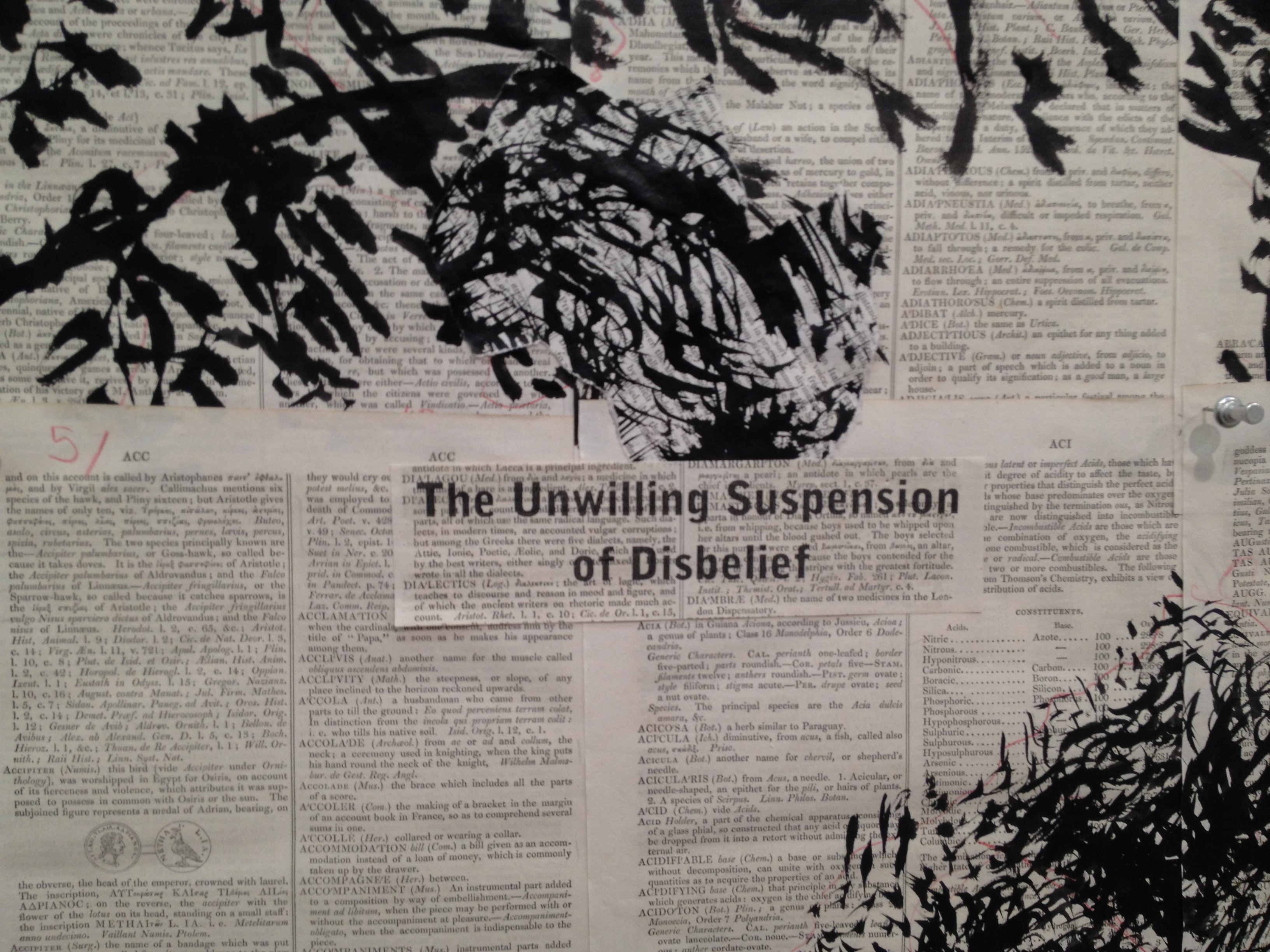
The Metropolitan Opera’s collaboration with South African artist William Kentridge, The Nose, was on in one of Kingston’s cinemas today; a small group of us went to see it. It was hard to suspend our disbelief and get into the story of a runaway nose, no matter how exquisite Kentridge’s animations were. I far preferred this show of his work I saw last week in NYC at the Marian Goodman Gallery. Kentridge‘s work was as lyrically compelling as ever although the gallery setting seemed cold and clinical. The photos below should give an idea of the exhibition and the two video clips at the bottom will give you some sense of the power of his animations.

IMG_8832IMG_8833 IMG_8834 IMG_8835 IMG_8836 IMG_8839 IMG_8840 IMG_8841 IMG_8844 IMG_8845 IMG_8848 IMG_8846 IMG_8829

Fly Jamaica…

plane-staff-sm

I flew Fly Jamaica on my recent trip to New York. I chose it because the return flight from JFK is at noon rather than 6 am like American Airlines or Jet Blue. AA even forces you to negotiate Miami’s vast and boring airport, it has no direct flight from Kingston to New York.

I had no idea what to expect with Fly Jamaica as its fairly new and is a collaborative venture between Jamaican and Guyanese interests. In fact i was taken aback by the number of Indian-looking passengers on board till i remembered that the flight originated in Georgetown, Guyana.

By coincidence the lady sharing my row also looked Indian. We both assumed the other was Guyanese till we started talking; she turned out to be Indo-Jamaican while I’m from the subcontinent itself, though resident in Jamaica for 25 years now.

The plane seemed much larger than the ones that usually ply between the Caribbean and North America. It was a Boeing 757. No wonder Fly Jamaica can afford to allow Economy passengers two check in items instead of the measly one almost all airlines now allow you. What’s the point of travelling if you can’t bring back all kinds of goodies with you?

And perhaps because they’re new and want to make an impression Fly Jamaica also serves a hot meal in-flight. On the way there it was delicious ackee and saltfish and on the return leg I had curry chicken. Good quality too. The film showing wildlife in Guyana looked fascinating but i’d forgotten to get one of the free earphones so couldn’t hear the soundtrack. The images were truly compelling, i couldn’t believe the wide variety of creatures you can find in Guyana. I’ll definitely visit now that there’s a direct flight.

Curry chicken lunch on Fly Jamaica

Out of curiousity I looked up Fly Jamaica’s website to find out more about their background. I had heard that it was a former Air Jamaica pilot and a Guyanese pilot who started the airline. Here’s what the website says:

Fly Jamaica Airways began with a dream to create a truly regional airline, using local talent and with an emphasis on providing a truly local experience to its customers. A full-service, local airline that would bring the Diaspora, and the world, home to the Caribbean.
Fly Jamaica Airways is a partnership between Chief Executive Officer and Guyanese-born Captain Paul Ronald Reece, and Jamaican shareholders, including Chief Operating Officer, Captain Lloyd Tai and Manager of In-Flight Services, Christine Steele. The Company was incorporated in Kingston, Jamaica on September 7, 2011 and started with a Boeing 757 aircraft. We faced a rigorous start-up process, including meeting national and international requirements.
Through the stewardship of our experienced management and dedication of our amazing employees, we proved to aviation regulators that we have what it takes to be a world-class airline.
On August 24, 2012, Fly Jamaica Airways conducted its demonstration flight from Kingston, Jamaica to Georgetown, Guyana, as part of the Jamaica Civil Aviation Authority’s (JCAA) approval process.  On August 31, 2012 the JCAA issued our Air Operators Certificate (AOC). Fly Jamaica Airways has also satisfied rigorous requirements for the US Federal Aviation Administration (FAA), Department of Transportation (DOT), and Transportation and Security Administration (TSA), in order to operate as a commercial US-registered carrier. Now, we look forward to taking to the skies and sharing our passion for safe, reliable and enjoyable aviation with the world!

I generally don’t buy things just because they’re locally produced but if you give me local AND good you have my vote. The service on Fly Jamaica was warm, friendly and efficient. I would fly them again. And again.

The Centrality of Central Park to NYC

First post participating in NaBloPoMo (National Blog Posting Month) in which I feature my first encounter with Central Park in New York City.

Well, it’s November 1 and I’ve decided to take part in NaBloPoMo (National Blog Posting Month). That means I’ll post something on my blog every single day this month. Thousands of people are participating in this event all over the world so the ‘National’ should really be changed to ‘International’ resulting in InBloPoMo. But at the moment it remains the blogging counterpart of NaNoWriMo (National Novel Writing Month) during which hundreds of thousands of would-be novelists churn out 50,000 words during the month of November. Well, i guess they haven’t heard of the demise of the novel…

So I was in New York City last month for about 9 days and found myself staying one short block from Central Park. Before reaching the city I had had ambitions of walking in the Park every single day of the precious 3 days at that particular address. No such thing happened and I found myself hurriedly getting a walk in on the very last day. What surprised me was that even though it was the end of October very few trees had changed to the traditional autumn colours of yellow, orange and red. Was this another sign of the creeping climate change we’ve all been noticing recently?

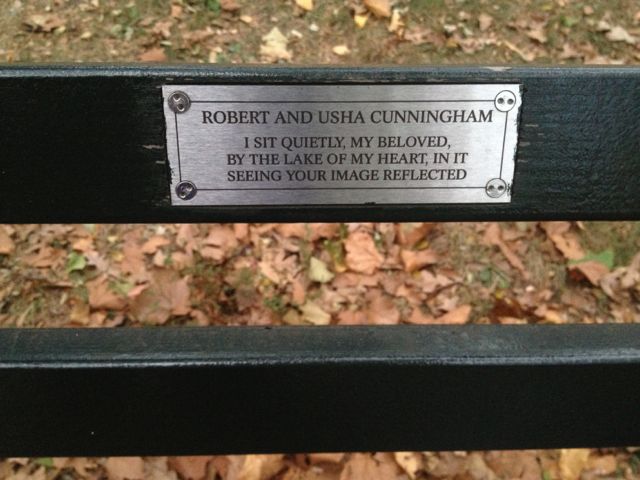
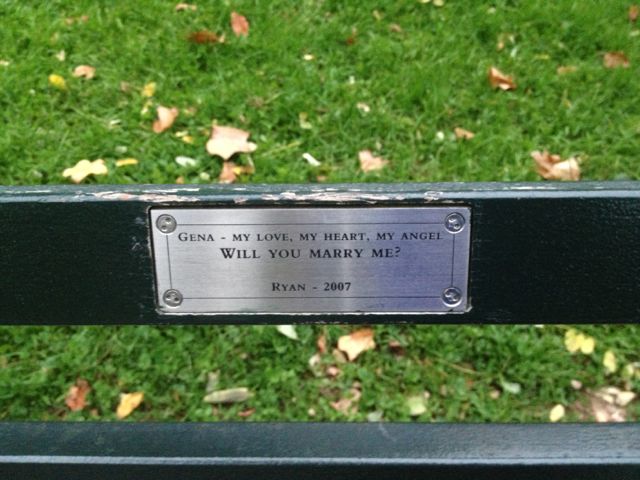
The apartment I was staying in was at 102nd st very close to the 103d st entrance to the Park. There’s a lovely duck pond there with benches sprinkled here and there. What I hadn’t expected were the little plaques on each bench evidently placed there by the individuals or families who had paid for the particular bench. I’ll post some of the photos I took below:

CentralPark01 CentralPark02 CentralPark03 CentralPark04 CentralPark05 CentralPark06 CentralPark07 CentralPark08 CentralPark09 CentralPark10 CentralPark11

And soon after getting back to Kingston I came across the article below which I found alarming considering that Central Park in effect constitutes the lungs of the city…are the proposed skyscrapers akin to invasive cancerous growths that will eventually cause the demise of this treasure?

Luxury Skyscraper Shadows Are Devouring Central Park

http://gothamist.com/2013/10/29/skyscraper_shadows_will_ruin_centra.php

102913shadow.jpg
One57 looms large over Central Park, its shadow resembling an appropriately obscene gesture. (Warren St. John)

The city’s parks are among the few empty spaces protected from New York developers. No parking garages will ever trample Central Park’s Sheep Meadow and no high-rise Walmart’s will ever raze Prospect Park’s Nethermead. But there is one threat to the park’s sanctity that perhaps few people had considered: The Shadows.

It’s not a weird hypothetical sprung from the world of sci-fi. Developers are eying the south side of the park as the new home to seven enormous towers which will serve as second and third homes for as-yet-unborn children of gallingly wealthy oil moguls around the world. The towers, nicknamed Billionaire’s Row, will stand as tall as 1,424 feet, and the shadows they will cast over the park will serve as chilling reminders that their owners are probably on a plane destined for Saint-Tropez anyway, and you’re on the ground shivering under their icy umbra. It’s an allegory for your life.

Looming skyscrapers can make a particular difference in the winter months, Michael Kwartler, the president of the Environmental Simulation Center, told Warren St. John, who penned an op-ed in today’s Times on this very issue. At noon on the winter solstice, Kwartler calculates that the building’s shadows will fall half a mile into the park by noon, and up to a mile as the day wears on. “The cumulative effect of these shadows will be to make the park less usable and less pleasant to be in,” Kwartler said.